Online time
Monday to Friday: 9AM - 8PM
Weekend: 10AM - 5PM

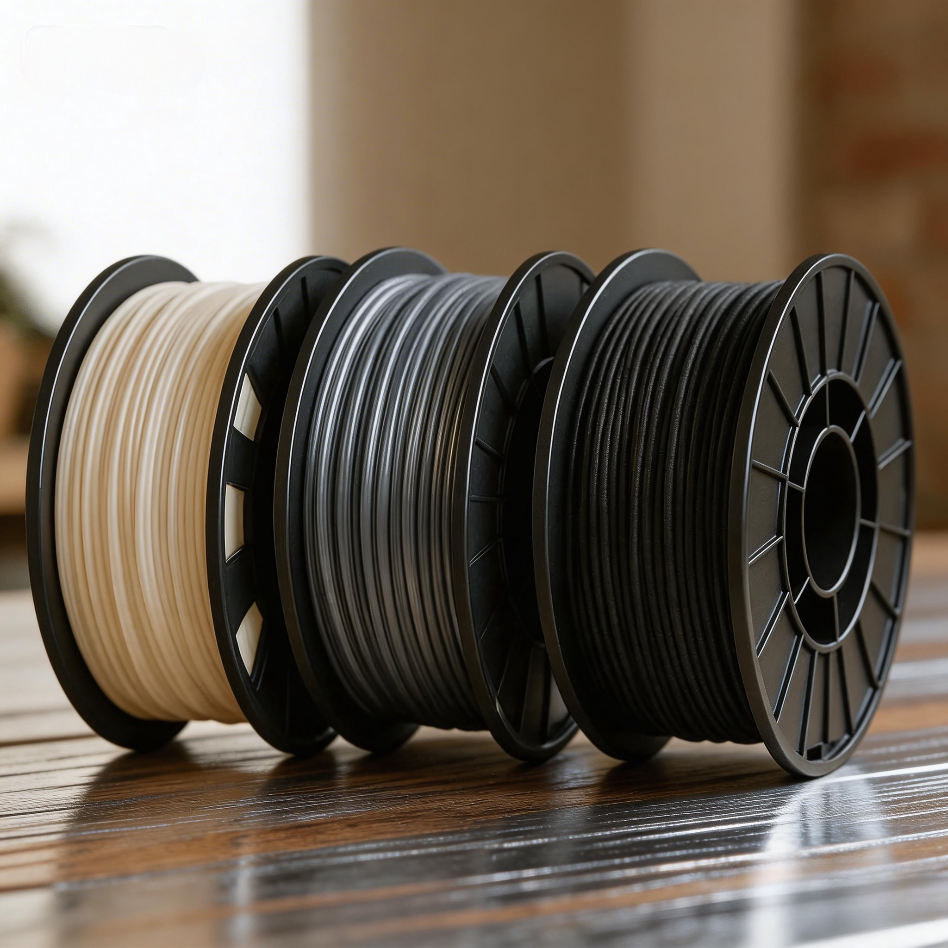
Abstract — If your printed parts need to survive real-world use, PETG filament is usually where the conversation starts. It sits between PLA and ABS in a way that makes practical sense: easier to print than ABS, yet tougher and more durable than PLA in most applications. This guide covers the decisions that matter to buyers and production teams—what PETG filament is, how PLA vs PETG compares for business use, which print settings matter most, and where specialized grades fit in. We also address common troubleshooting issues, transparent PETG use cases, and what B2B buyers should look for when sourcing bulk material in 2026.
Key Takeaways
- PETG filament combines many of the advantages of PLA and ABS—strong durability, chemical resistance, and relatively easy printability—without the fumes often associated with ABS.
- In PLA vs PETG comparisons, PETG typically performs better in impact resistance, UV stability, and heat tolerance. As a result, it is more suitable for functional parts.
- PETG filament printing settings need tighter control than PLA, especially for stringing, first-layer adhesion, and moisture management.
- Food-safe and medical-grade PETG can support applications in packaging, healthcare, and laboratory equipment. However, certifications should always be verified at product level.
- Recycled PETG filament can retain most of the performance of virgin material, making it a practical option for sustainability-focused production.
- European B2B buyers may reduce lead times and landed costs by choosing suppliers with local warehousing and OEM/ODM support.
- High-impact PETG formulations are worth considering for parts exposed to repeated stress, handling, or outdoor use.
Table of Contents
- What Is PETG Filament? The Science Behind This Material
- PETG Filament Properties: A Complete Performance Breakdown
- PLA vs PETG: Choosing the Right Material for Your Business
- Transparent PETG Filament: Optical & Functional Applications
- PETG Filament Printing Settings & Troubleshooting Guide
- Top PETG Filament Brands 2026: A B2B Buyer’s Guide
- Specialized PETG Filament Formulations for Advanced Use
- Frequently Asked Questions
- Conclusion
- References
What Is PETG Filament? The Science Behind This Material
If PLA is starting to feel too brittle for the parts you actually use, PETG filament is often the next material worth testing. It is widely chosen when a print needs better toughness, improved weather resistance, and a longer service life—without the higher difficulty and ventilation requirements of ABS.
PETG stands for Polyethylene Terephthalate Glycol. Essentially, it is a modified form of PET, the plastic commonly used in bottles and packaging. During polymerisation, glycol is added to change how the material behaves both during processing and in the finished part.
Why Glycol Modification Matters for PETG Filament
The glycol modification matters because it reduces crystallinity. In practical terms, this makes PETG filament easier to process in FDM printing and less prone to the brittleness associated with more crystalline plastics.
Standard PET tends to crystallise more readily during cooling, which complicates printing. By contrast, PETG’s modified structure slows that process down. Consequently, the material generally offers better clarity, better impact resistance, and more forgiving print behaviour. For a deeper look at PET chemistry, see the PET overview on Wikipedia.
Another practical advantage is improved resistance to stress cracking. For parts exposed to repeated handling, vibration, or temperature swings, that characteristic can be more important than a headline tensile-strength number.
At SSSray, we focus on consistency in extrusion and diameter control to improve print reliability from spool to spool. For production users, that kind of consistency often matters more than a lab claim on paper, because inconsistent material quickly shows up as failed prints, poor layer bonding, or surface defects.
Overall, this balance of printability, toughness, and environmental resistance is why PETG filament has become a common choice for functional 3D printing across prototyping, tooling, and end-use parts.
PETG Filament Properties: A Complete Performance Breakdown
To understand where PETG filament fits, it helps to compare it with the two materials most buyers already know: PLA and ABS.
One common mistake is to compare materials using only tensile strength. That number matters, of course, but it rarely tells the whole story for FDM parts. In actual use, impact resistance, layer adhesion, heat tolerance, UV stability, and chemical resistance often have a greater influence on whether a part survives in service.
Below is a comparison of core mechanical and environmental properties based on published testing data and commonly cited 2026 industry ranges.
| Property | PLA | PETG | ABS |
|---|---|---|---|
| Tensile Strength (MPa) | 57 – 65 | 50 – 56 | 40 – 50 |
| Impact Resistance (kJ/m²) | ~7 | ~13 | ~11 |
| Heat Deflection Temp. (°C) | 55 | 80 | 95 |
| Moisture Absorption Rate | 0.1 – 0.2 % | 0.3 – 0.5 % | 0.4 – 0.8 % |
| UV Resistance | Poor (yellowing in 2–3 months) | Excellent (3 + years outdoor) | Fair (yellowing in ~1 year) |
| Chemical Resistance | Poor | Excellent | Good |
Mechanical Strength: Why PETG Filament Outperforms PLA
PLA often posts a slightly higher tensile strength on paper, but that can be misleading if the part will be bumped, flexed, or dropped. PLA is relatively stiff and brittle. In contrast, PETG is more ductile, so it tends to deform before failure rather than snapping suddenly.
This difference is one reason PETG filament is frequently preferred for brackets, housings, guards, handles, and other parts that experience repeated real-world handling. Ultimately, a part that survives abuse is usually more valuable than one that only performs well in a controlled tensile test.
Furthermore, a 2024 study published in MDPI Polymers evaluated PETG as an alternative to ABS for drone spare parts and reported strong impact performance under demanding conditions. Findings like these help explain why PETG is increasingly used where shock resistance is critical.
Chemical & UV Resistance for Industrial and Outdoor Use
One of the most commercially important PETG filament properties is its resistance to both chemicals and outdoor exposure.
PETG generally holds up well against dilute acids, bases, alcohols, and many common cleaning agents. Therefore, it is more suitable than PLA for parts that need to be wiped down, disinfected, or used in workshop, lab, or packaging environments.
Its UV stability is another practical advantage. PLA tends to degrade fairly quickly under sunlight, especially outdoors. PETG performs much better here, which is why it is frequently chosen for signage, enclosures, covers, and outdoor accessories.
That said, PETG is not the answer to every harsh environment. If a part will face sustained temperatures well above its heat deflection range, ABS, ASA, nylon, or polycarbonate may still be more appropriate depending on the specific application.
PLA vs PETG: Choosing the Right Material for Your Business
For most buyers, PLA vs PETG is not really a chemistry question. Instead, it is a workflow and cost question: what do you need the part to do, how often will it be replaced, and how much printing difficulty can your team tolerate?
If the goal is fast, low-cost visual prototyping, PLA still deserves its place. On the other hand, if the part will be installed, handled, shipped, exposed to sunlight, or expected to last, PETG filament often becomes the better option.
Below is a practical comparison of common printing parameters.
| Parameter | PLA | PETG |
|---|---|---|
| Nozzle Temperature | 190 – 220 °C | 230 – 250 °C |
| Bed Temperature | 50 – 60 °C | 70 – 85 °C |
| Print Speed | 50 – 80 mm/s | 40 – 60 mm/s |
| Cooling Fan Speed | 100 % | 0 – 30 % |
| Retraction Distance (Bowden) | 4 – 6 mm | 5 – 7 mm |
| Retraction Distance (Direct Drive) | 1 – 2 mm | 2 – 3 mm |
Use Case Comparison: When to Choose PLA or PETG Filament
PLA remains a good choice for:
- Low-cost prototyping and concept verification
- Display models and visual aids
- Short-life indoor parts
- Users who prioritise speed and easy setup
PETG filament is usually the better option for:
- Functional tools and fixtures
- Outdoor parts and signage
- Protective covers and housings
- Parts exposed to impact, handling, or chemical contact
- Components that require better moisture or UV resistance
A common misconception is that every “functional part” should automatically use PETG. That is not always true. If a part is dimensionally simple, used indoors, carries little load, and cost matters more than durability, PLA can still be the more efficient material.
Conversely, many teams keep using PLA longer than they should because it is familiar. Once broken parts, reprints, and replacement labour start adding up, the lower spool price matters less than people expect.
Cost & ROI Analysis: Is PETG Filament Worth the Premium?
PETG filament usually costs more than PLA per kilogram—often in the 10–15 % range at retail. On paper, that makes PLA look more economical. In practice, however, the answer depends on failure rate and service life.
If you are printing fixtures, housings, brackets, or outdoor parts that regularly crack or deform in PLA, the higher cost of PETG can be offset by fewer replacements and less operator time. For B2B users in particular, the material cost difference is only one part of the equation. Labour, machine time, warranty exposure, and field failure typically matter more.
For wholesale buyers, the gap often narrows further. At SSSray, bulk PETG filament orders for European distributors can be priced much closer to PLA than retail buyers expect, thanks to optimised production and EU warehousing.
A better way to evaluate PETG filament is not “Is it cheaper per spool?” but rather “Does it reduce the total cost of getting a reliable part into use?”
Transparent PETG Filament: Optical & Functional Applications
Transparent PETG filament is one of the material’s more distinctive commercial advantages. It can be produced in highly clear grades, which makes it valuable for parts where visibility, light transmission, or a cleaner visual finish matters.
Typical applications include:
- Medical device housings and face shields
- Optical prototypes and light diffusers
- Liquid containers and laboratory equipment
- Decorative and functional lighting components
There is, however, an important distinction many buyers miss: transparent filament does not automatically produce a transparent printed part. Layer lines, trapped moisture, internal gaps, print speed, temperature, and wall thickness all affect clarity. Without optimised settings, a “clear” PETG print often comes out translucent rather than truly transparent.
For clearer PETG prints, the usual approach involves:
- Slightly higher nozzle temperature
- Lower layer height
- Reduced internal voids
- Thorough drying before printing
- Surface finishing or polishing if appearance is critical
At SSSray, our Ultra-Clear PETG is produced with tight diameter control to support more consistent extrusion and cleaner layer bonding. That does not remove the need for tuning, but it can make transparent printing significantly more predictable. Explore our full range of 3D printing materials.
PETG Filament Printing Settings & Troubleshooting Guide
PETG filament is often described as “easy to print,” but that only feels true once the basic settings are dialled in. Compared with PLA, it is more sensitive to temperature, retraction, and moisture. Most problems come from a small number of predictable setup errors.
Below is a troubleshooting summary based on widely used 2026 printing practices. For additional printer-specific guidance, see the official Prusa Research PETG guide and the Raise3D PETG printing tutorial.
| Issue | Root Cause | Proven Solution |
|---|---|---|
| Bed Adhesion Failure | Low bed temp, dirty plate, incorrect Z-offset | Increase bed temp to 75–80 °C; clean PEI plate with IPA; adjust Z-offset |
| Stringing & Oozing | Nozzle too hot, insufficient retraction, slow travel | Lower nozzle temp by 5–10 °C; increase retraction to 6 mm; travel speed 120–150 mm/s |
| Layer Separation | Nozzle too cool, speed too high, excessive fan | Raise nozzle temp to ~240 °C; slow to 50 mm/s; fan to 10–20 % |
| Warping | Insufficient bed heating, cold ambient | Use enclosure; first-layer bed temp 85 °C; add brim for large parts |
| Filament Bubbles | Moisture absorbed by filament | Dry at 65 °C for 4–6 hours before printing |
Optimal Temperature Settings for PETG First Layers
For standard PETG filament, a nozzle temperature of 230 °C to 250 °C is the usual working range. A practical starting point is 235 °C; from there, adjust based on print behaviour:
- If layers are not bonding well, raise the temperature gradually.
- If stringing is excessive, lower it slightly.
- If the surface looks glossy but messy, you may be running too hot.
For the bed, 70 °C to 85 °C works for most setups. The exact number depends on build surface, ambient temperature, and part geometry.
Moreover, one common mistake is using too little first-layer gap. PETG likes to stick, but if the nozzle is pressed too close to the bed, the first layer can become messy and hard to remove. Unlike PLA, “more squish” is not always better.
How to Fix PETG Stringing and Oozing
Stringing is probably the issue most users associate with PETG. In many cases, however, the cause is not just retraction—moist material is another frequent culprit. The Creality stringing guide offers a useful visual reference for diagnosing this issue.
A practical tuning order is:
- Dry the filament first.
- Lower nozzle temperature slightly.
- Tune retraction distance and speed.
- Increase travel speed.
- Reduce unnecessary travel moves in slicer settings.
For Bowden systems, 5–7 mm retraction is a common starting range. For direct drive, 2–3 mm is usually sufficient. Meanwhile, travel speed in the 120–150 mm/s range often helps reduce ooze between islands.
If stringing persists after those changes, check storage conditions before making extreme slicer adjustments. PETG absorbs moisture more readily than PLA, and wet material often produces wisps, bubbles, and inconsistent extrusion. For additional tips, visit our FAQ page.
Dual Extrusion Support Settings
For dual-extrusion workflows, PETG can be paired with PLA or PVA support materials depending on geometry and finishing needs.
PLA supports can work when easy breakaway removal is the priority. PVA, on the other hand, is useful for dissolvable support structures, especially on complex internal features—but it requires strict moisture control.
The main caution here is not material compatibility in theory, but process stability in practice. Mixed-material printing increases the number of variables. Therefore, it makes sense to validate adhesion, support release, and thermal behaviour on smaller parts before committing to production runs.
Top PETG Filament Brands 2026: A B2B Buyer’s Guide
The best PETG filament brand depends less on marketing and more on consistency, availability, and fit for your application. For casual users, one poor spool is merely annoying. For B2B buyers, however, inconsistent batches can disrupt schedules, increase scrap rates, and create avoidable support issues.
Based on market reputation, published specifications, and buyer feedback, these brands are commonly shortlisted in 2026:
- Polymaker — Strong overall consistency; broad appeal for premium consumer and industrial use.
- Siraya Tech — Often chosen for specialty formulations and more demanding technical applications.
- Overture — A common value option for hobby and entry-level production use.
- SSSray — Focused on B2B wholesale, OEM/ODM support, and supply stability for European distributors.
For wholesale buyers, the real evaluation criteria are typically:
- Diameter consistency (target ±0.02 mm)
- Spool-to-spool colour stability
- Moisture control in packaging
- Availability of technical support
- Warehouse location and lead time
- Willingness to handle custom colour or formulation requests
At SSSray, each production batch is checked for diameter consistency using laser measurement systems. We also support local EU warehousing to shorten delivery times for European buyers and simplify procurement planning.
Specialized PETG Filament Formulations for Advanced Use
Standard PETG filament covers a wide range of needs, but it is not the only option within the PETG category. For more demanding applications, specialized formulations can solve problems that generic grades cannot.
High-Impact PETG for Heavy-Duty Parts
High-impact PETG is modified for better toughness under repeated or sudden loads. It is often considered when standard PETG filament is good but not quite sufficient for harsh handling conditions.
Typical use cases include:
- Automotive parts and under-hood components
- Protective equipment and safety housings
- Industrial tool handles
- Drone and robotics components
Notably, a 2024 study reported that high-impact PETG could achieve significantly higher impact strength than standard grades. For users who need more durability without moving to much harder-to-print engineering polymers, this category is worth evaluating.
Medical-Grade PETG for Healthcare Applications
Medical-grade PETG is relevant because certain PETG grades can be biocompatible and suitable for sterilisation workflows. Potential uses include:
- Surgical tools and accessories
- Dental models and aligner-related applications
- Medical device housings
- Face shields and protective components
One important clarification: not every PETG spool is medical-grade simply because PETG as a base polymer is used in healthcare settings. For regulated applications, documentation, compliance, and traceability matter as much as base material selection.
Recycled PETG Filament: Sustainable Manufacturing Without Compromise
Recycled PETG filament (rPETG) is becoming more relevant as sustainability moves from branding language to procurement criteria. Typically, rPETG is produced from reclaimed PET feedstock and processed into new printing material.
Academic research has shown that recycled PETG can retain a high proportion of the mechanical performance of virgin material, even across multiple recycling cycles. As a result, it is a viable option for businesses looking to reduce their carbon footprint without fully redesigning print settings or production workflows.
At SSSray, our Eco rPETG is produced from 100 % post-consumer PET waste and is designed to run on settings similar to our standard PETG grades. Learn more about our sustainable product range.
Frequently Asked Questions
Is PETG filament food safe?
PETG is often described as food-safe as a base material. In practice, however, the answer depends on the specific formulation, colorants, additives, and manufacturing controls. For any food-contact application, use a certified food-safe grade and review the supplier’s compliance documents rather than relying on generic material assumptions.
Can I print PETG without a heated bed?
It is possible in some cases, but not recommended for reliable results. PETG generally benefits from a heated bed to improve first-layer adhesion and reduce warping risk.
Is PETG better than ABS for 3D printing?
For many users, PETG is easier to print and more forgiving than ABS, while also offering strong layer adhesion and good UV resistance. Nevertheless, ABS still has an advantage in higher-temperature applications. The better choice ultimately depends on the specific service conditions.
How do I stop PETG filament from stringing?
Start with the basics: dry the material, reduce nozzle temperature slightly, tune retraction, and increase travel speed. If stringing remains, check slicer travel behaviour and storage conditions before making large profile changes.
Is PETG suitable for outdoor use?
Yes. PETG is generally much better suited to outdoor use than PLA because of its stronger UV resistance and better durability under weather exposure.
Can I place bulk PETG filament orders for my European business?
Absolutely. At SSSray, we support bulk wholesale orders for European businesses with local EU warehousing, flexible MOQs, custom colour matching, and OEM/ODM services.
Is recycled PETG as strong as virgin PETG?
Published studies suggest that recycled PETG can retain over 90 % of the mechanical properties of virgin material under appropriate processing conditions. Actual performance still depends on feedstock quality and manufacturing control.
Conclusion
PETG filament has earned its place as one of the most practical all-round materials in FDM printing. It offers a useful middle ground: easier to process than ABS, yet more durable and application-ready than PLA in many functional scenarios.
That does not mean PETG replaces every other material. PLA is still the easier and cheaper option for fast prototypes and simple indoor parts. Similarly, ABS, ASA, nylon, and PC still make sense where higher heat resistance or more specialised performance is required. However, for many businesses trying to balance printability, durability, appearance, and cost, PETG filament is often the most balanced choice.
If you are sourcing material for distribution, private labelling, or production use, consistency matters as much as raw material type. Diameter control, moisture-resistant packaging, supply stability, and technical support all have a direct impact on print results and operating cost.
If you are evaluating PETG filament for your business, SSSray offers standard, high-clarity, medical-grade, and recycled solutions—along with OEM/ODM support and bulk supply options for B2B customers.
References
- Bultić, M. Z., et al. (2024). PETG as an Alternative Material for the Production of Drone Spare Parts. Polymers, 16(21), 2976.
- Guessasma, S., et al. (2019). Printability and Tensile Performance of 3D Printed Polyethylene Terephthalate Glycol Using Fused Deposition Modelling. Polymers, 11(7), 1220.
- Flores, J. D. S., et al. (2024). Sustainable polymer reclamation: recycling poly(ethylene terephthalate) glycol (PETG) for 3D printing applications. Journal of Materials Science: Materials in Engineering.
- Yan, C., et al. (2022). PETG: Applications in Modern Medicine. Engineered Regeneration.
- Prusa Research. (2026). PETG Printing Guide. Prusa Help Center.
- Raise3D. (2025). PETG 3D Printing Guide: Steps, Settings, Temperature & Tips. Raise3D Blog.
- Creality. (2025). Say Goodbye to PETG Stringing: How to Eliminate PETG Stringing with 6 Easy Ways. Creality Forum.
- Vidakis, N., et al. (2021). Sustainable Additive Manufacturing: Mechanical Response of Polyethylene Terephthalate Glycol over Multiple Recycling Processes. Materials, 14(7), 1723.
