Online time
Monday to Friday: 9AM - 8PM
Weekend: 10AM - 5PM

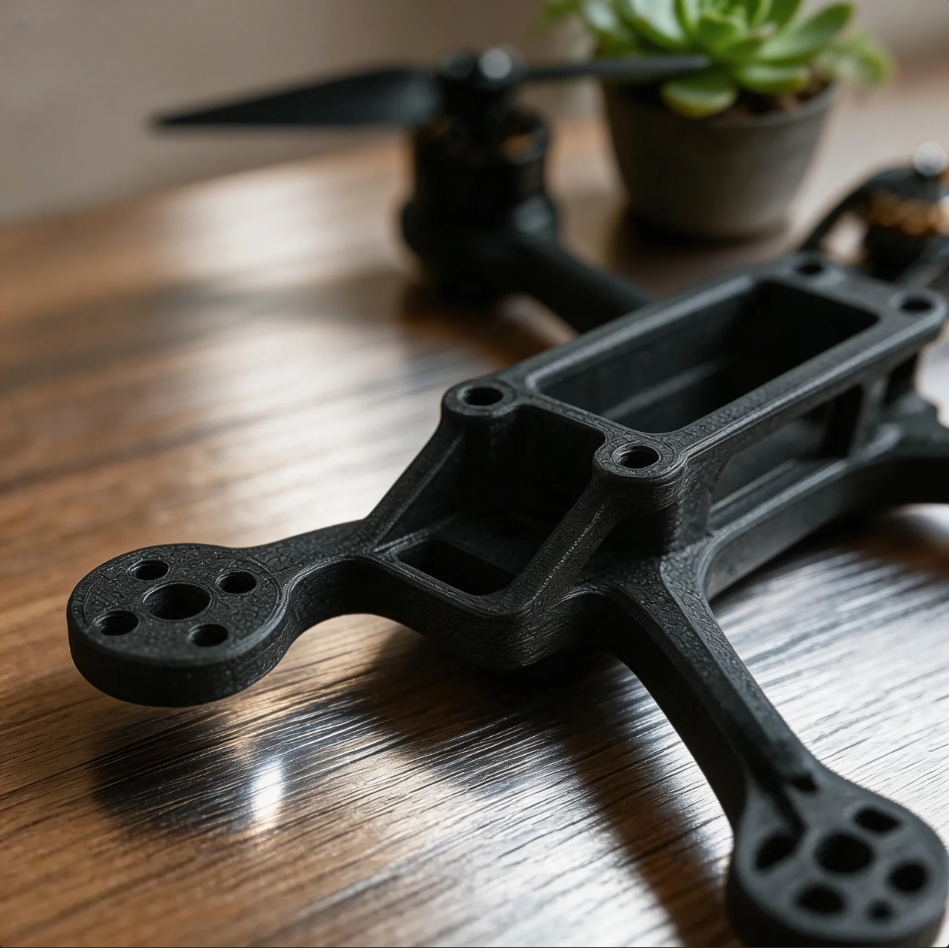
Choosing the right carbon fiber filament for industrial 3D printing comes down to one core decision: PA6-CF or PA12-CF. Both are carbon fiber reinforced nylon. Both print on similar equipment. And both show up on nearly identical-looking datasheets. However, they behave very differently in production — and picking the wrong one costs real time and money.
This guide breaks down the actual mechanical data, drying requirements, equipment needs, and cost trade-offs between these two materials. In addition, we cover when lower-cost alternatives like CF-PETG or CF-PLA might be the smarter pick. If you manage procurement for a print farm, evaluate materials for OEM production, or distribute carbon fiber filament to end users, the goal here is simple: give you the trade-offs, failure modes, and total cost picture that datasheets leave out.
Key Takeaways
- Carbon fiber reinforced nylon delivers 40–102 MPa tensile strength — but real-world performance depends heavily on print orientation and moisture control.
- PA6-CF wins on raw strength and heat resistance (HDT up to 180 °C). In contrast, it demands strict moisture management during storage and printing.
- PA12-CF trades some peak strength for much better dimensional stability and moisture tolerance, making it the safer choice in humid facilities.
- Hardened steel or ruby nozzles are non-negotiable. Standard brass wears out after just 300–500 g of carbon fiber filament.
- Material cost per kilogram is misleading on its own. Instead, calculate cost per functional part — CF parts often use thinner walls, cutting material volume 30–50 %.
- Skipping the drying step (4–6 h at 80–100 °C) is the single most common cause of failed prints and weak parts with CF nylon.
- SSSray’s CF Series holds ±0.02 mm diameter tolerance and ships with application-specific print profiles for major industrial platforms.
Table of Contents
- What Makes Carbon Fiber Filament Different
- Tensile Strength and Mechanical Performance Data
- PA6-CF vs PA12-CF: Which One Should You Buy?
- When CF-PETG or CF-PLA Makes More Sense
- Print Settings for Carbon Fiber Filament
- Equipment You’ll Need: Nozzles, Printers, Environment
- Applications: Aerospace, Automotive, Drones, Tooling
- Cost Analysis and ROI
- Frequently Asked Questions
- Conclusion
1. What Makes Carbon Fiber Filament Different
If you are evaluating industrial-grade carbon fiber reinforced filament for the first time, the sheer volume of specs and marketing claims can be overwhelming. Before comparing products, it helps to understand what is actually inside the filament — and why formulation details matter more than the fiber percentage on the label.
Composition and Reinforcement Mechanism
Carbon fiber reinforced filament is a two-component system. The thermoplastic matrix — typically nylon, PETG, or PLA — melts, flows, and solidifies into shape. Embedded in that matrix are short, discontinuous carbon fibers, usually 100–200 µm long, with individual tensile strengths around 4 137 MPa. Together, the fiber and matrix share loads: the polymer distributes stress, while the fibers carry the bulk of tensile force.
As a result, carbon fiber composites reach tensile moduli above 3 000 MPa, compared with 2 000–2 500 MPa for unreinforced engineering plastics. Yet that load transfer only works well when the fiber-matrix interface is strong — a detail most datasheets skip over entirely.
Why Fiber Percentage Alone Doesn’t Tell the Full Story
Carbon fiber content typically ranges from 10 % to 30 % by weight. Higher loadings do increase stiffness — up to a point. Beyond roughly 20–25 %, the matrix becomes too thin to wet and protect each fiber properly. The result: increased brittleness, more nozzle clogging, and diminishing mechanical returns.
Common Mistake: Buyers often compare filaments by carbon fiber weight percentage alone — “20 % CF must be better than 15 % CF.” In practice, a 15 % formulation with properly treated fibers and strong interfacial bonding can outperform a 30 % loading where fibers are poorly dispersed. Ask suppliers about fiber surface treatment and length distribution, not just weight percentage.
Modern formulations get around the loading limit through surface chemistry. SSSray’s CF Series, for instance, uses a proprietary coupling treatment to improve bonding between fiber and nylon matrix. The practical effect is better interlayer adhesion and higher impact resistance at a given fiber loading — differences that show up in drop testing, even when the datasheet tensile numbers look similar.
When reviewing any technical data sheet, therefore, check the test methodology (ISO 527 vs ASTM D638), the specimen type (printed vs injection-molded), and fiber orientation relative to load. A tensile strength number without this context is almost meaningless. Whenever possible, request samples for in-house testing before committing to volume purchases.
2. Tensile Strength and Mechanical Performance Data
Every carbon fiber filament gets marketed on tensile strength. However, the gap between datasheet numbers and what your printed parts actually achieve can be substantial. Understanding why that gap exists is where informed buyers gain an edge.
Strength Comparison Across Filament Types
PA12-CF typically tests at 60–70 MPa, while PA6-CF reaches 85–102 MPa under optimal conditions. Carbon fiber reinforced PETG falls in the 40–52 MPa range, and CF-PLA sits at 35–45 MPa. These figures are ISO 527 values measured along the print direction where fibers align best.
Here is what the datasheets usually omit: Z-axis (between-layer) strength of the same materials runs 40–60 % lower. Consequently, if your part sees loads perpendicular to the layer lines, the published tensile number significantly overstates real-world performance.
| Filament Type | Tensile Strength (MPa) | Young’s Modulus (GPa) | Elongation at Break (%) | Best Application Fit |
|---|---|---|---|---|
| PA6-CF (20 %) | 85–102 | 7.2–8.5 | 3–5 | Structural / Load-Bearing |
| PA12-CF (20 %) | 60–70 | 5.8–7.0 | 8–15 | Precision / Dimensional Stability |
| CF-PETG (15 %) | 40–52 | 4.5–5.5 | 5–8 | Functional Prototypes |
| CF-PLA (20 %) | 35–45 | 4.0–5.0 | 2–4 | Lightweight / Low-Temp Parts |
| Standard PLA | 45–50 | 2.5–3.5 | 5–10 | General Prototyping |
| ABS | 35–45 | 2.0–2.5 | 10–25 | Industrial Prototyping |
Data compiled from Formlabs 2025 materials testing, CNCKitchen comparative studies, and peer-reviewed publications. Note: CF-PLA tensile strength overlaps with standard PLA — the real advantage is stiffness (Young’s modulus), not ultimate strength.
Flexural Stiffness and Impact: The Trade-Off Most Buyers Miss
Tensile strength gets the headlines, but for most real parts, flexural modulus matters more. A bracket that deflects under load fails its purpose even if it never fractures. Carbon fiber reinforcement dramatically improves flexural stiffness — PA6-CF reaches flexural moduli above 6 000 MPa versus roughly 2 000 MPa for unfilled nylon.
Impact resistance, on the other hand, reveals a genuine trade-off. Carbon fiber makes parts stiffer but also more brittle. PA12-CF handles this better: its more flexible molecular structure yields notched Izod impact values approximately 30 % higher than PA6-CF. In short, PA6-CF is the stronger material; PA12-CF is often the tougher one.
Heat Deflection Temperature
PA6-CF offers HDT values of 150–180 °C (at 0.45 MPa), making it viable for under-hood automotive work and enclosures near heat sources. PA12-CF reaches 120–140 °C — still well above CF-PETG or CF-PLA, but potentially insufficient for continuous high-temperature exposure. For applications involving thermal cycling, this difference alone can settle the material choice.
3. PA6-CF vs PA12-CF: Which Carbon Fiber Nylon Should You Buy?
This is the decision most industrial buyers actually need to make. Both materials are carbon fiber reinforced nylon, both print on similar equipment — yet they behave very differently in production. Choosing wrong costs time and money.
The Moisture Problem That Drives Most Decisions
The biggest operational gap between PA6-CF and PA12-CF is not strength or stiffness. It is how they respond to humidity. PA6 absorbs moisture aggressively, reaching equilibrium at up to 9 % moisture content. At that level, you will see steam bursting through the extruded filament, poor layer adhesion, and mechanical properties that fall well short of specification.
PA12, in contrast, equilibrates at only 1.5–2 % under identical conditions. In practical terms, PA6-CF needs drying before every print session and active drying during runs longer than a few hours. PA12-CF is more forgiving — a spool left out overnight will not turn into scrap the way PA6-CF will.
Worth Calculating: If your facility runs above 60 % relative humidity without climate-controlled storage, PA12-CF’s higher per-kilogram price may actually be cheaper overall. Factor in reduced drying energy, fewer failed prints, and less wasted material. Operations in Southeast Asia and the US Gulf Coast frequently switch to PA12-CF purely on waste-reduction economics.
Processing Windows and Printability
Both materials need heated beds (100–120 °C) and enclosed chambers. PA6-CF prints at 265–285 °C; PA12-CF runs at 250–270 °C. The meaningful difference, however, is the width of the window. PA12-CF tolerates ±10 °C variation without visible quality loss, whereas PA6-CF reacts noticeably to just 5 °C off target.
For multi-printer facilities with varying calibration precision, PA12-CF’s wider window reduces both the learning curve and the failure rate.
Side-by-Side Comparison Table
| Property | PA6-CF | PA12-CF | Advantage |
|---|---|---|---|
| Tensile Strength | 85–102 MPa | 60–70 MPa | PA6-CF |
| Flexural Modulus | 7.2–8.5 GPa | 5.8–7.0 GPa | PA6-CF |
| Impact Resistance | Moderate | High | PA12-CF |
| Heat Deflection (HDT) | 150–180 °C | 120–140 °C | PA6-CF |
| Moisture Sensitivity | High (9 % max) | Low (2 % max) | PA12-CF |
| Dimensional Stability | Good | Excellent | PA12-CF |
| Chemical Resistance | Moderate | Excellent | PA12-CF |
| Z-Axis Layer Adhesion | Good | Very Good | PA12-CF |
| Print Temperature | 265–285 °C | 250–270 °C | PA12-CF (wider window) |
| Cost per kg (Q1 2026) | $55–75 | $70–95 | PA6-CF |
Prices reflect average industrial bulk pricing. Actual costs vary by supplier, quantity, and region.
A Practical Decision Framework
For structural parts that need maximum strength — brackets, fixtures, mechanical linkages — PA6-CF is the right material, provided you have the drying discipline and environmental control to process it correctly. Its higher tensile and flexural properties let you design thinner walls that still meet load requirements.
For precision components that must hit tight tolerances across multiple production runs, PA12-CF is usually the better bet. Its lower moisture sensitivity means parts printed on Monday and parts printed on Friday perform the same, even if humidity changed during the week. Aerospace and medical manufacturers increasingly favor PA12 composites for this reason.
There is also a post-processing angle to consider. PA12-CF accepts vapor smoothing more readily, while PA6-CF’s higher crystallinity makes chemical finishing more difficult. If surface quality matters for your end use, this can tip the decision.
The honest answer for many operations? Stock both. Use PA6-CF where strength and heat resistance are non-negotiable. Use PA12-CF for everything else.
4. When CF-PETG or CF-PLA Makes More Sense
Not every application needs nylon. In fact, for a surprising number of use cases, carbon fiber reinforced PETG or CF-PLA delivers adequate performance at lower cost and with far less processing hassle.
CF-PETG: The Practical Middle Ground
Carbon fiber PETG prints at 230–250 °C — well within the range of most FFF printers without all-metal hotend upgrades. It does not warp like nylon, does not require an enclosed chamber, and does not degrade if you forget to dry it for six hours. Meanwhile, the mechanical gains are real: roughly 40–52 MPa tensile strength and a 50 % stiffness improvement over standard PETG.
Where CF-PETG falls short is at elevated temperatures and under sustained load. It softens earlier than nylon composites and creeps under long-term stress. Still, for functional prototypes, short-run production fixtures, and applications where PETG’s chemical resistance matters, it avoids the infrastructure costs of nylon-based CF printing.
CF-PLA: Lowest Barrier to Entry
Carbon fiber PLA prints on virtually any FFF printer at standard temperatures (195–220 °C). The value proposition is not strength — CF-PLA’s tensile numbers overlap with standard PLA. Instead, the real advantage is stiffness: approximately 40 % higher flexural modulus. Parts feel rigid and resist flex, which matters for drone frames, RC components, and lightweight fixtures.
The limitation is thermal. CF-PLA starts softening around 55–60 °C, ruling out any application involving heat. It is also brittle — drop it and it may shatter rather than deform.
Transition Tip: If your print farm is adopting carbon fiber materials for the first time, start with CF-PETG. Your operators learn fiber-handling basics — nozzle wear, slower speeds, adjusted retraction — without the moisture headaches of nylon. That experience transfers directly when you step up to PA12-CF or PA6-CF later.
Quick Decision Guide
- Tensile requirement below 50 MPa, no heat exposure? CF-PETG saves time and money.
- Printer limited to 250 °C or lacks an enclosure? CF-PETG is the ceiling; CF-PLA works on anything.
- Operating temperature above 100 °C? Skip PETG and PLA — you need nylon-based CF.
- Chemical exposure (fuels, solvents, oils)? PETG handles many chemicals better than nylon; verify compatibility first.
→ Compare our full carbon fiber filament product line
5. Print Settings for Carbon Fiber Filament
Getting carbon fiber filament to print reliably is not difficult — but it is unforgiving. The profiles that work for standard PLA or PETG will produce poor results with CF nylon. Below are the parameters to change and the reasons they matter.
Temperature Optimization
Nozzle temperature directly affects three things: layer adhesion, surface finish, and mechanical integrity. Set it too low and you get incomplete melting, rough layers, and nozzle clogs. Set it too high and the nylon matrix degrades, weakening fiber-matrix bonding. Each material has a sweet spot.
| Parameter | PA6-CF | PA12-CF | CF-PETG | CF-PLA |
|---|---|---|---|---|
| Nozzle Temp | 265–285 °C | 250–270 °C | 230–250 °C | 195–220 °C |
| Bed Temp | 100–120 °C | 80–100 °C | 70–90 °C | 45–60 °C |
| Chamber Temp | 50–60 °C | 40–50 °C | 35–45 °C | Room temp OK |
| Print Speed | 30–50 mm/s | 40–60 mm/s | 50–80 mm/s | 50–80 mm/s |
| Layer Height | 0.1–0.2 mm | 0.1–0.25 mm | 0.12–0.24 mm | 0.12–0.28 mm |
| Drying Time | 6–8 h at 80–100 °C | 4–6 h at 70–80 °C | 4 h at 60 °C | 4 h at 50 °C |
Starting points — not gospel. Layer height, speed, and temperature interact. If you change one, re-tune the others.
Drying: The Non-Negotiable Step
This bears repeating because it is the #1 cause of CF nylon print failures: you must dry the filament. Not “should.” Must.
Moisture in nylon flashes to steam at extrusion temperatures. The symptoms are obvious once you know them: popping sounds, tiny bubbles, a rough matte surface, and visible steam wisps. Less obvious is the structural damage — hydrolysis weakens nylon polymer chains, and steam voids inside the part reduce load-bearing cross section. A PA6-CF part printed from wet filament can lose 30–40 % of its rated tensile strength.
For production work: dry PA6-CF at 80–100 °C for at least 6 hours before printing. During printing, keep the spool in an active dryer at 50–60 °C. Store unused material in airtight containers with fresh desiccant — not the packet that shipped with it six months ago.
First Layer and Bed Adhesion
CF materials are harder to stick to the bed than unfilled nylon because their lower thermal expansion gives less natural “grip” on cooling. The following approach works reliably:
- Surface: PEI sheets or BuildTak — not bare glass.
- Temp: 110–120 °C bed for PA6-CF; 80–100 °C for PA12-CF.
- Adhesion aid: Magigoo PA or PVA glue stick, applied thin.
- Brim: 8–10 mm width for parts with small footprints.
- First layer: Over-extrude slightly (105–110 % flow) at 15–25 mm/s.
- Removal: Let parts cool to 40–50 °C before lifting — forcing hot parts off risks warping.
6. Equipment You’ll Need: Nozzles, Printers, Environment
Carbon fiber filament will wear out standard equipment. Short fibers act as microscopic abrasives, and the high print temperatures demand hotend components that many consumer printers lack. Here is what to budget for — and what you can skip.
Nozzle Selection and Expected Lifespan
Standard brass nozzles show measurable wear after 300–500 g of CF filament. Independent testing documents orifice-diameter increases of 0.3–0.5 mm — enough to ruin dimensional accuracy.
Hardened steel nozzles last 5–10× longer, surviving several kilograms before needing replacement. The trade-off: lower thermal conductivity requires a 10–20 °C temperature bump.
Ruby-tipped nozzles (such as the Olsson Ruby) push service life past 10 kg. The per-unit cost is 3–5× that of hardened steel, yet amortized over their lifespan the cost per kilogram printed is often lower. For daily production environments, the math usually favors ruby.
Minimum Printer Requirements for CF Filament:
- All-metal hotend rated above 300 °C (PTFE-lined hotends degrade past 240 °C)
- Hardened steel or ruby nozzle
- Enclosed build chamber — ideally with active heating for nylon CF
- Direct-drive extruder (Bowden setups struggle with stiff fiber-filled filament)
- Heated bed capable of sustained 120 °C
Printer Selection for Production
Beyond the hotend, inspect the full filament path. PTFE tubes in the throat off-gas above 240 °C — fine for PETG but dangerous at 280 °C nylon temperatures. All-metal heatbreaks are therefore essential.
Direct-drive extruders outperform Bowden configurations with CF materials because the stiff, fiber-filled filament does not compress well in long tubes. If your fleet is Bowden-based, consider dedicated direct-drive machines rather than attempting retrofits.
Most current industrial FFF platforms — Markforged, Raise3D, Bambu Lab X1 series, Intamsys — handle carbon fiber nylon out of the box. For facilities upgrading from consumer equipment, budget $5 000–30 000 for production-capable systems. These machines also handle standard engineering materials, so the investment serves your broader material strategy.
Storage and Environmental Control
For PA6-CF production, aim for ambient humidity below 50 % RH. Above 65 %, filament absorbs moisture even while sitting on the spool with active drying. Facilities in tropical or Gulf Coast climates need room-level dehumidification, not just filament dryers.
PA12-CF is more tolerant. Standard climate-controlled factory environments (40–60 % RH) work fine with proper spool drying. This is another practical reason PA12-CF sees wider adoption in facilities without purpose-built print rooms.
→ Explore our industrial-grade 3D printer filament solutions
7. Applications: Aerospace, Automotive, Drones, and Industrial Tooling
The appeal of carbon fiber filament is straightforward: parts that are strong, stiff, and light, produced on demand without tooling. The industries where that combination has the most economic value are adopting it fastest.
Aerospace and Defense
Aerospace adoption has moved beyond prototyping into production parts — primarily interior brackets, ducting, sensor housings, and non-structural enclosures. Every gram saved from cabin hardware translates to measurable fuel savings over an aircraft’s service life.
Certification remains the gating factor. Flame-retardant CF nylon variants can meet FAR 25.853, and chemical resistance handles typical aerospace fluids. However, aerospace supply chains demand documented quality management, material traceability, and lot-to-lot consistency. Before discussing price with any industrial carbon fiber filament supplier, ask about CoC documentation and batch testing records.
UAV manufacturing represents the highest-growth subsegment. Drone builders report 20–30 % weight savings versus injection-molded alternatives, with design iteration cycles measured in days rather than months.
Automotive and Electric Vehicles
Under-hood applications favor PA6-CF for its heat resistance, with typical uses including cable guides, sensor mounts, and bracket assemblies exposed to 100 °C+ operating temperatures. Meanwhile, the EV transition is accelerating demand: every kilogram removed extends range, and unlike metal weight reduction, additive carbon fiber parts require minimal tooling investment.
Drones and Robotics
Drones highlight carbon fiber’s strength-to-weight ratio most directly. Every gram of frame weight subtracts from payload or flight time. Common applications include motor mounts, landing gear, gimbal plates, and payload brackets. PA12-CF is favored over PA6-CF here — its dimensional stability across humidity changes keeps tolerances consistent, and its higher impact resistance improves crash survivability.
Robotics follows similar logic. Manipulator arms, end-effectors, and structural linkages benefit from the stiffness-to-weight ratio, and printed organic geometries enable weight reductions impossible with CNC machining.
Industrial Tooling: Often the Fastest ROI
This category frequently delivers the quickest payback. Jigs, fixtures, assembly aids, and check gauges need to be stiff, stable, and available tomorrow — and CF nylon checks all three boxes. A $15 aluminum fixture that takes two weeks to machine can often be replaced by a $3 CF nylon fixture printed overnight, with sufficient mechanical properties for most fixturing loads.
8. Cost Analysis and ROI for Carbon Fiber Filament
Carbon fiber filament costs more than standard materials. The relevant question, however, is not whether it is expensive — it is whether the parts it produces are cheaper, better, or faster than the alternatives.
Material and Infrastructure Costs
As of Q1 2026, industrial-grade pricing runs roughly: PA6-CF at $55–75/kg, PA12-CF at $70–95/kg, CF-PETG at $40–55/kg, and CF-PLA at $30–45/kg. Standard PLA sits at $20–25/kg for reference.
Material cost per kilogram, though, is the wrong metric. The right one is cost per functional part. Because CF nylon’s higher specific strength often allows thinner walls and less infill, material consumption drops 30–50 % compared with designs made for unfilled nylon or ABS. In addition, budget for nozzles ($15–150 each depending on type), dedicated filament dryers ($200–800), and potential printer upgrades ($5 000–30 000 if current equipment cannot reach 280 °C).
When Carbon Fiber Filament Delivers ROI
The math works when one or more of these conditions apply:
- The part requires strength or stiffness that standard filaments cannot physically deliver.
- Weight reduction has direct economic value — drones, EVs, handheld tools, aerospace.
- Volumes are too low for injection molding to amortize tooling — typically under 500–1 000 units.
- Parts need complex geometries that cannot be machined economically.
- Lead time matters: overnight CF prints versus 2–6 week machining cycles.
Where it works less well: high-volume commodity parts where injection molding dominates on per-unit cost, purely aesthetic applications where CF mechanical properties go unused, and environments where the drying discipline required for nylon CF cannot be maintained.
For volume pricing and custom TCO analysis, contact our technical team with your part drawings or STL files and current process details. We also offer OEM and ODM carbon fiber filament manufacturing for private-label and custom-formulation requirements.
Frequently Asked Questions
What is the tensile strength of carbon fiber nylon filament?
PA12-CF typically tests at 60–70 MPa, while PA6-CF reaches 85–102 MPa. These are XY-direction values from ISO 527 specimens. Z-axis (between-layer) strength runs 40–60 % lower due to FFF anisotropy. For comparison, standard PLA measures 45–50 MPa. Always ask suppliers to specify test direction and methodology — a tensile number without that context is not useful for engineering decisions.
What is the best nozzle for printing carbon fiber filament?
For most production operations, the Olsson Ruby nozzle offers the best wear-to-cost ratio — its ruby-tipped orifice lasts 5–10× longer than hardened steel. E3D hardened steel nozzles are a solid mid-tier option. Regardless of type, check orifice diameter every 2–3 kg of CF filament. Gradual wear shows up as inconsistent extrusion width before it becomes visible to the naked eye.
How do I achieve proper bed adhesion with carbon fiber nylon?
Five things matter: (1) Use PEI or BuildTak — not bare glass. (2) Set bed temperature correctly — 110–120 °C for PA6-CF, 80–100 °C for PA12-CF. (3) Apply a thin layer of Magigoo PA or PVA glue stick. (4) Add an 8–10 mm brim for small-footprint parts. (5) Over-extrude the first layer slightly (105–110 % flow) at reduced speed. CF materials are less forgiving of first-layer under-extrusion than standard filaments.
What automotive parts work well with carbon fiber 3D printing?
Engine bay components (brackets, cable guides, sensor mounts), structural elements in low-volume vehicles (motor mounts, suspension brackets), interior mechanisms, and manufacturing tooling (assembly jigs, check fixtures). PA6-CF suits under-hood applications above 100 °C. PA12-CF works for interior and lower-temperature uses. Always verify fluid compatibility and perform thermal cycling validation for the specific part.
How should I store and dry carbon fiber reinforced filament?
Store in airtight containers with color-indicating desiccant. Before printing: PA6-CF requires 6–8 hours at 80–100 °C; PA12-CF requires 4–6 hours at 70–80 °C. During printing, use an active filament dryer at 50–60 °C. Symptoms of wet filament include popping or hissing from the nozzle, bubbles in the extrusion, and rough surface finish. If you see any of these, stop and re-dry before continuing.
Is PA6-CF stronger than PA6-GF (glass fiber)?
Carbon fiber delivers higher specific strength, better fatigue resistance, and lower thermal expansion than glass fiber — so PA6-CF wins for lightweight structural parts. Glass fiber, on the other hand, provides better impact resistance and costs 30–40 % less per kilogram. If your part needs maximum stiffness-to-weight, choose CF. If it needs to survive impacts or your budget is tight, GF may be more practical. Many operations stock both and select per application.
Can carbon fiber filament produce functional structural parts?
Yes — structural parts are one of its primary use cases. Three design rules matter: (1) Orient the part so primary loads align with print lines, not perpendicular. (2) Use 80–100 % infill with gyroid or cubic patterns. (3) Apply safety factors of 2–3× compared with isotropic materials to account for the weaker layer-adhesion plane. For critical applications, validate with physical testing rather than relying solely on simulation.
How long do nozzles last when printing carbon fiber?
Brass nozzles: 300–500 g before measurable diameter increase, typically unusable by 800 g. Hardened steel: 2–5 kg. Ruby-tipped: 10+ kg with maintained orifice precision. For production, extrude a test line at known settings every 500 g (brass) or 2 kg (steel). When the line width starts increasing, replace the nozzle. Proactive replacement is always cheaper than scrapping a batch of out-of-spec parts.
Conclusion: Choosing the Right Carbon Fiber Filament for Your Operation
The decision framework is straightforward once you start from the application. Need maximum strength and can maintain moisture discipline? PA6-CF. Need reliable dimensional accuracy across varying conditions? PA12-CF. Need carbon fiber stiffness without rebuilding your print infrastructure? Start with CF-PETG.
The most common mistake we see is not choosing the wrong material — it is underinvesting in the supporting infrastructure. A $70/kg PA6-CF spool printed on a machine with a PTFE hotend, no dryer, and a brass nozzle produces parts worse than $25/kg PLA. The material is only as good as the process around it.
Carbon fiber filament is no longer experimental. With the market projected to grow from $1.77 billion (2025) to $4.20 billion by 2030, these materials are becoming baseline expectations for industrial additive manufacturing. The operations building expertise now — dialing in profiles, training operators, qualifying parts — will carry a meaningful head start into the next phase of adoption.
SSSray’s CF Series filaments are engineered for production consistency: tight diameter tolerances (±0.02 mm), documented lot-to-lot mechanical properties, and print profiles for major industrial platforms. Whether you need 10 spools or 10 pallets, our team works with you from material selection through production optimization.
References
- Burnett, C. et al. (2025). “Tensile performance of carbon fibre-reinforced 3D-printed specimens.” Engineering Failure Analysis. ScienceDirect
- MarketsandMarkets (2025). “3D Printing Filament Market Report 2025-2030.” MarketsandMarkets
- CNC Kitchen (2025). “Carbon Fiber Nylon in 3D Printing: PA6 vs PA12 Tested.” CNCKitchen
- Formlabs (2025). “What Is the Strongest 3D Printing Material?” Formlabs
- E3D Online (2024). “Are Abrasives Killing Your Nozzle?” E3D
- CNC Kitchen (2024). “How Much Abrasive Filaments Damage Your Nozzle!” CNCKitchen
- Polymaker Fiberon (2025). “Material Comparison Guide.” Polymaker
- Coherent Market Insights (2026). “3D Printing Filament Market 2026-2033.” CMI
- MDPI (2025). “Mechanical Tensile Characteristics of Nylon 12 Carbon Fiber Specimens.” Technologies, 13(10), 456. MDPI
- Inslogic3D (2025). “Composite Filament Comparison: PA6-CF vs PA12-CF vs PA6-GF25.” Inslogic3D
About the Author
SSSray Technical Team — Materials scientists, additive manufacturing engineers, and application specialists with decades of combined hands-on experience in industrial 3D printing. We write these guides because we have seen too many buying decisions go sideways over datasheet misinterpretation or incomplete cost analysis.
Ready to Source Carbon Fiber Filament?
Bulk pricing · OEM/ODM capability · Technical support for print profile development
OEM/ODM Manufacturing View FAQ