Online time
Monday to Friday: 9AM - 8PM
Weekend: 10AM - 5PM

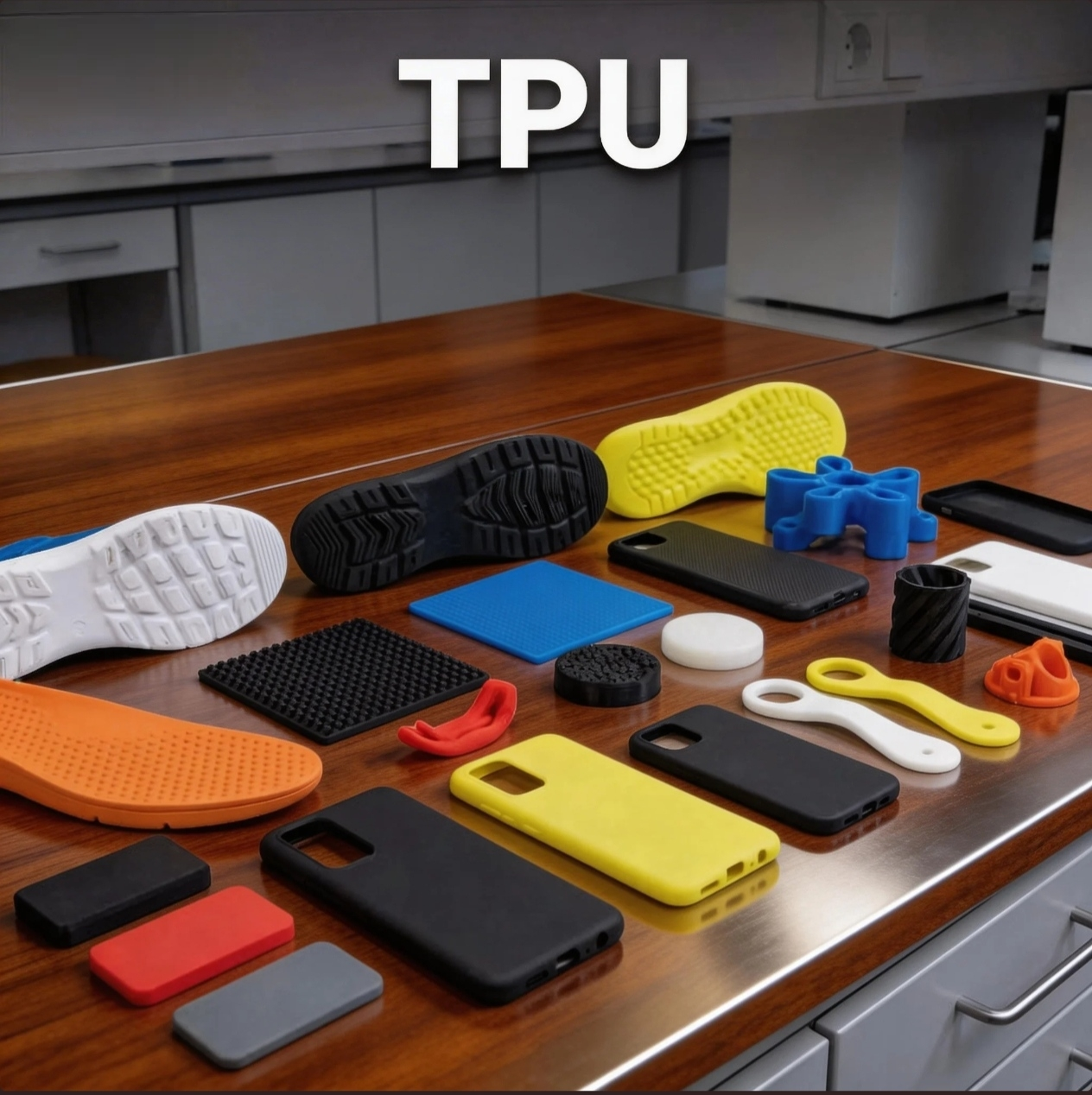
TPU 95A filament purchasing decisions often fail—not from lack of data, but because nobody explains what the numbers actually mean for your production line. The TPU filament market is growing from $567M (2025) to $1.9B by 2033, yet most B2B buyers still use flawed selection criteria. This guide targets procurement managers and technical decision-makers who need clear answers: What separates TPU 95A from 85A or 98A in real manufacturing? When does PEBA justify its premium over TPU? How do you calculate true cost-per-part beyond kg pricing? We’ll cover industrial applications—from automotive seals to medical devices—with actionable intelligence for 2026’s competitive landscape.
Key Takeaways
- ✓ TPU 95A tensile strength reaches 27-47 MPa with 580% elongation—but compression set (25-35%) matters more for sealing applications
- ✓ Direct drive extruders aren’t “recommended”—they’re mandatory unless you want 40%+ failure rates with Bowden systems
- ✓ Print speeds of 20-40 mm/s work reliably; “high-speed TPU” formulations enable 60-80 mm/s but require optimized equipment
- ✓ Moisture sensitivity is underestimated: 60-80°C drying for 4-6 hours isn’t a suggestion—it’s a requirement for quality prints
- ✓ TPU 85A vs 95A: 10 Shore points softer means double the printing difficulty—avoid 85A unless soft-touch is critical
- ✓ Medical-grade formulations now achieve ISO 10993 certification, opening non-implantable device opportunities
- ✓ Evaluate total cost beyond price/kg: cheaper materials with 10% higher waste rates cost 30% more in production
- ✓ SSSray’s value proposition centers on batch consistency (±0.02mm tolerance) rather than lowest unit pricing
1. Understanding TPU: Chemistry and Material Properties
Before purchasing flexible 3D printer filament, most engineers check Shore hardness and tensile strength. However, those numbers won’t explain why identically-rated 95A materials behave completely differently during printing. The answer lies in molecular architecture—and whether your supplier truly understands application requirements.
The Chemistry Behind TPU Flexibility
TPU molecular chains consist of alternating hard segments (diisocyanates) and soft segments (polyols). Hard segments act as structural scaffolding through hydrogen bonding. Soft segments provide elastic recovery. When you stretch TPU 95A filament, soft segments elongate while hard segments maintain the polymer network. Upon release, hard segments pull the material back to original dimensions—this “shape memory” enables TPU seals to withstand thousands of compression cycles without permanent deformation.
This dual-phase structure explains why cheap TPU 95A often prints poorly. Manufacturers increase soft segment ratios to reduce costs. Shore hardness might barely meet specifications, but extrusion consistency suffers—the material compresses unevenly in extruder gears. Consequently, understanding hard/soft segment ratios matters more than headline specifications when evaluating suppliers.
Mechanical Performance Data
Recent research (MDPI 2025) demonstrates optimized TPU 95A formulations achieve 27-60 MPa tensile strength with 450-580% elongation at break. Nevertheless, these laboratory values assume standard conditions. In production environments, performance typically falls in the mid-to-lower range of these specifications.
Data compiled from MDPI research (2025), Ultimaker technical datasheets, and independent testing. Actual performance varies with print orientation and layer height.
Why Shore Hardness Matters for Application Selection
Shore 95A indicates material comparable to rubber sneaker soles—firm enough to maintain shape yet flexible enough to compress effectively. For flexible filament for seals and gaskets, this hardness level proves ideal. Consider a gasket sealing a fluid connection: the material must compress sufficiently to fill microscopic surface irregularities while maintaining enough rigidity to spring back after assembly.
This isn’t theoretical—it’s empirically validated. We’ve observed customers using 85A for hydraulic seals experience leakage after three months due to 40% permanent compression set. Switching to 95A eliminated the issue for over 12 months of operation. The material handles compression cycles typical of sealing applications without the permanent deformation that plagues softer elastomers. Therefore, TPU 95A for automotive sealing parts has become the de facto standard, not through compromise but through field-proven performance.
2. TPU Hardness Grades: Making the Right Selection
The TPU 85A vs 95A comparison represents the most common procurement question. Most suppliers answer with “it depends on your application”—effectively saying nothing. Here’s the actual difference: 10 Shore points softer translates to fundamentally different printing requirements, cost structures, and failure modes.
TPU 85A: Maximum Flexibility with Maximum Challenges
TPU 85A feels like a soft eraser—finger pressure easily creates indentations. This softness excels in consumer products where tactile comfort matters: phone cases, wearable device bands, and orthotic insoles. However, printing difficulty isn’t “slightly higher”—it’s categorically different.
Such soft material buckles within extruder systems, making Bowden configurations essentially unusable. Even direct drive systems require speeds reduced to 15-30 mm/s. Additionally, first-layer adhesion becomes problematic as the material readily peels from build surfaces. From a procurement perspective, 85A materials typically command 15-30% price premiums over standard 95A formulations. For high-volume consumer-facing soft-touch components, this premium may deliver ROI. For functional sealing applications, the added cost rarely provides corresponding performance benefits.
TPU 95A: The Industrial Workhorse
TPU 95A filament strikes a balance that has made it the best-selling flexible material for industrial applications. The firmer formulation extrudes more consistently than softer grades while maintaining flexibility required for sealing, damping, and flexible mechanical components. Importantly, compatibility extends to both direct drive and properly configured Bowden extruders—though direct drive remains preferred.
Market dominance creates beneficial supply dynamics. Volume pricing tends to favor this grade, and broader technical knowledge accelerates troubleshooting compared to specialty grades. When operators encounter issues, the extensive community experience with 95A reduces problem resolution time significantly. Furthermore, if your application involves functional sealing rather than decorative soft-touch components, 95A essentially becomes the default choice. Softer 85A exhibits poor compression recovery; harder 98A doesn’t seal adequately—95A sits precisely in the functional sweet spot.
Harder Grades: TPU 98A and Specialty Formulations
TPU formulations approaching Shore D hardness (98A and above) bridge flexible elastomers and semi-rigid thermoplastics. These materials print more like rigid filaments while retaining meaningful flexibility, making them attractive for applications requiring dimensional stability combined with controlled compliance. Medical device applications frequently specify harder TPU grades where biocompatibility, chemical resistance, and controlled flexibility meet regulatory requirements.
Beginner Recommendation: For teams evaluating flexible materials initially, start with TPU 95A regardless of eventual application requirements. This isn’t because it’s “best”—rather, its forgiving print window builds operator confidence. Skills developed with 95A transfer directly to softer grades, whereas jumping straight to 85A often results in frustrating first-week failure rates exceeding 40%.
3. TPU vs PEBA: Comparing Flexible Filament Technologies
If TPU 95A represents the “ABS of flexible materials,” then PEBA (Polyether Block Amide) is the “carbon fiber”—genuinely high-performance but expensive, difficult to process, and narrowly applicable. Understanding the TPU vs PEBA comparison prevents costly specification mistakes.
Understanding PEBA Technology
PEBA consists of rigid polyamide segments connected by flexible polyether segments—similar architecture to TPU but different chemistry. The most notable distinction is energy return: PEBA demonstrates rebound values exceeding twice those of TPU 95A. This explains why athletic footwear manufacturers adopted PEBA foam technology for midsole applications.
However, this performance advantage comes with significant trade-offs. PEBA exhibits lower tensile strength than comparable TPU formulations (15-25 MPa vs 27-47 MPa), and its processing window is narrower and more temperature-sensitive. The material’s flexibility makes printing challenging, particularly for operators accustomed to TPU’s more forgiving characteristics. Unless your application specifically requires exceptional energy return or extreme low-temperature flexibility (-40°C), PEBA’s premium pricing rarely justifies selection.
Performance Comparison: When Each Material Wins
Selection Guidelines: Choose TPU When…
For the majority of industrial applications, TPU 95A filament delivers optimal performance-cost balance. Select TPU when applications involve:
- Structural loading: Flexible hinges, shock mounts, robotic gripper pads—components that must bear loads or resist tearing benefit from TPU’s superior tensile strength
- Chemical exposure: Automotive engine bay seals contacting oils/coolants; PEBA’s limited chemical resistance makes it unsuitable for such environments
- UV/outdoor exposure: Exterior equipment requiring multi-year service life; PEBA degrades within months under sunlight
- Production scalability: TPU’s broader supplier base creates competitive pricing and reliable supply chains vs PEBA’s limited availability
Selection Guidelines: Choose PEBA When…
Select PEBA only when its distinctive properties directly translate to product competitive advantage:
- Energy return is critical: Sports equipment (footwear midsoles, protective padding), bouncing toys—applications where 75%+ rebound creates measurable performance benefits
- Extreme cold operation: Arctic equipment, cryogenic lab tools operating below -25°C where TPU becomes brittle
Real-World Caution: An outdoor equipment manufacturer specified PEBA for winter gear flexible buckles. During summer production (high humidity), moisture absorption caused severe “popcorn” extrusion defects with 60% scrap rates. Switching to climate-controlled facilities with active drying increased costs 40%. These hidden costs rarely appear in initial material selection but significantly impact profitability.
4. Optimal TPU Printing Settings for Common 3D Printers
Generic parameter tables (“nozzle 220°C, speed 30mm/s”) provide starting points but ignore formulation variability. Even identically-rated TPU 95A from different suppliers may require 10-15°C temperature adjustments. This section teaches rapid parameter optimization for your specific material-equipment combination.
Core Parameters: Temperature, Speed, Retraction, First Layer
Nozzle temperature for TPU 95A typically ranges 210-240°C, but formulation-specific optimization is essential. Start at 220-225°C, then adjust based on extrusion quality. Signs of insufficient temperature include clicking sounds (stepper motor skipping), under-extrusion, and poor layer adhesion. Excessive temperature manifests as stringing, oozing, and surface blemishes. Correct temperature produces smooth extrusion without leakage during travel moves.
Print speed directly impacts feeding stability with flexible filaments. Unlike rigid materials, soft TPU “bunches” between extruder gears and nozzle at excessive speeds. Most TPU 95A formulations perform reliably at 20-40 mm/s. Modern “high-speed TPU” enables 60-80 mm/s, but only with optimized acceleration settings, extruder tension, and nozzle geometry.
Moisture Management: Non-Negotiable Best Practices
TPU moisture sensitivity causes more print failures than incorrect parameters. Absorbed moisture vaporizes during extrusion, creating steam bubbles that produce surface defects, poor layer adhesion, and degraded mechanical properties. Before printing, dry TPU 95A at 60-80°C for 4-6 hours using dedicated filament dryers. For production environments, active-drying systems that maintain temperature during printing ensure consistent quality throughout extended runs.
Storage between sessions demands sealed containers with fresh desiccant. Even brief exposure to humid air (>50% RH) compromises material quality. Visual inspection during extrusion—checking for steam, popping sounds, or surface irregularities—provides immediate feedback on material condition. If any symptoms appear, stop printing and re-dry the filament completely rather than producing defective parts.
Production Tip: For print farms processing multiple TPU jobs, dedicated filament dryers maintaining temperature during printing ($200-600 investment) typically pay for themselves within one month through reduced failure rates and material waste. One customer reduced scrap from 15% to 3% after implementing active drying—ROI achieved in 28 days.
Troubleshooting Common Issues
- Under-extrusion + clicking: Increase temperature 5°C, decrease speed, verify filament diameter consistency, check extruder tension
- Excessive stringing: Reduce temperature, increase retraction distance/speed, enable coasting and wipe settings
- First layer failures: Increase bed temperature, clean build surface thoroughly, adjust Z-offset slightly closer
- Warping/lifting: Reduce part cooling fan first 3 layers, increase bed temperature, add simple enclosure
5. Industrial Applications: Seals, Gaskets, Medical Devices, Wearables
TPU 95A filament isn’t merely “printable flexible material”—it’s actively replacing traditional silicone molded parts and rubber seals in production applications. Not due to cost alone, but because 3D printing’s geometric freedom combined with TPU’s material properties enables designs impossible with conventional manufacturing.
Automotive Sealing and Fluid Handling
Automotive components demand rigorous sealing performance: withstanding 120°C engine bay temperatures, resisting petroleum-based fluids, maintaining seals through vibration for years. TPU 95A for automotive sealing parts now approaches traditional rubber seal performance while eliminating tooling costs for low-to-medium volumes.
Typical applications include engine bay wire harness grommets, coolant line connectors, and intake system flexible joints. Previously these required injection molding with tooling costs reaching $5,000-$50,000. Using TPU 95A, manufacturers produce functional prototypes and small production runs without tooling investment. Design iterations that previously required weeks now complete in days.
However, application boundaries exist: TPU 95A handles short-term high temperature exposure (brief 120°C spikes) but isn’t suitable for continuous high-temperature environments (>80°C sustained use accelerates aging). For turbocharger proximity or exhaust system sealing, silicone or fluoroelastomer materials remain necessary. Additionally, TPU exhibits limited resistance to strong polar solvents (acetone, MEK)—such environments require careful material validation.
Medical and Healthcare Applications
Medical-grade TPU filament development has accelerated significantly, with formulations now achieving ISO 10993 biocompatibility certification for non-implantable patient-contact devices. However, “medical-grade” terminology is frequently misused—not all TPU qualifies for medical device applications.
Genuinely compliant medical applications include custom orthotic devices (scoliosis braces, ankle-foot orthoses), prosthetic socket liners, rehabilitation equipment grips, and wearable medical device enclosures. These applications share common requirements: personalized fitting combined with skin-contact comfort—precisely where 3D-printed TPU excels.
One orthotic manufacturer’s case study proves compelling: traditional custom ankle-foot orthoses required plaster casting, manual pattern adjustment, and vacuum forming—2-3 week turnaround at $200-300 cost. Using 3D scanning plus TPU 95A printing, delivery time dropped to 48 hours with costs reduced to $80. Patient satisfaction increased due to superior conformance.
Regulatory Compliance: Medical device applications require comprehensive material traceability documentation: production lot numbers, test reports, biocompatibility certificates for each material batch. Moreover, your printing process requires validation—proving batch-to-batch consistency, contamination prevention, and effective cleaning/sterilization protocols. Generic TPU cannot provide this documentation. Source from certified suppliers with complete quality system integration support.
Consumer Wearables and Electronics
Consumer electronics applications for TPU 95A leverage two key attributes: soft-touch tactile experience plus protective functionality. Smartwatch bands, phone cases, headphone components, and fitness tracker housings benefit from TPU’s comfortable wearability while meeting impact protection requirements.
TPU’s Shore 95A hardness (shoe-sole firmness) proves advantageous versus silicone cases (typically Shore 60-70A) which attract dust and develop sticky surfaces. Compared to hard plastics (Shore D), TPU provides impact cushioning during drops. Furthermore, TPU resists perspiration and common cosmetics without the yellowing degradation typical of silicone.
Wearable device bands present an interesting case study. Traditional silicone bands offer softness but poor breathability—causing skin irritation during extended wear. Some brands now use TPU 95A to print lattice-structure bands: maintaining silicone-comparable flexibility while dramatically improving ventilation. This design approach is only feasible through additive manufacturing; traditional injection molding cannot achieve such complex internal geometries with reliable demolding.
Industrial Equipment and Robotics
Industrial applications for TPU 95A span protective covers to functional mechanical components. Cable glands, flexible conduit supports, robotic end-effector gripper pads, and vibration-damping mounts demonstrate material versatility in manufacturing environments.
Robotic grippers using TPU finger pads achieve reliable parts handling without surface damage that harder materials cause to delicate workpieces. TPU’s abrasion resistance exceeds many rubber compounds, supporting applications involving repeated sliding contact or dynamic loading. For cable protection, TPU-printed grommets prevent cable abrasion through metal holes while absorbing vibration—outperforming heat-shrink tubing in durability and metal bushings in weight.
6. Cost Analysis and B2B Procurement Considerations
Material cost-per-kilogram represents only one component of total ownership cost. A filament priced 20% lower but generating 10% higher scrap rates actually costs 30% more in production. This section provides frameworks for calculating true cost-per-part and evaluating suppliers beyond unit pricing.
Understanding TPU Pricing Structures
TPU 95A market pricing varies significantly: commodity-grade $20-35/kg, premium industrial-grade $35-50/kg, medical-certified formulations $50-80/kg. However, price differentials reflect substantive quality variations:
- Diameter tolerance: Budget materials typically ±0.05mm; premium formulations achieve ±0.02mm. This 0.03mm difference causes 10-15% extrusion volume variation affecting dimensional accuracy and surface quality
- Batch consistency: Low-cost suppliers frequently change raw material batches, requiring parameter re-optimization with each order—wasting half-day setup time
- Technical documentation: Premium materials include comprehensive TDS, MSDS, and certification packages. Budget materials often lack documentation, preventing quality traceability
Total Cost of Ownership Framework
Accurate cost analysis requires examining total ownership cost (TCO):
- Material cost = Price/kg × (Theoretical volume ÷ (1 – scrap rate) + support material)
- Time cost = Print hours × equipment depreciation + labor monitoring
- Failure cost = Scrap rate × (material + time + rescheduling)
- Supply chain cost = Stockout risk × production downtime loss
Practical example: Material A costs $30/kg with 8% scrap rate, prints at 35mm/s. Material B costs $25/kg with 18% scrap rate, prints at 28mm/s (slower due to clogging tendency). Calculations reveal:
- Material A: Effective material cost $32.6/kg, part print time 100 minutes
- Material B: Effective material cost $30.5/kg, part print time 125 minutes
At $5/hour equipment depreciation, Material A’s total cost runs 15% lower despite higher unit pricing. This excludes Material B’s higher scrap rate creating rework delays and delivery risks.
Procurement Best Practice: When evaluating new suppliers, purchase 2-3kg samples rather than bulk orders. Print 20-30 test parts, meticulously recording scrap rate, actual achievable print speed, and post-processing requirements. Use this empirical data to calculate true cost-per-part instead of relying on kg pricing. We’ve observed customers purchase 50kg of budget material only to discard it after discovering 40% failure rates.
Supplier Evaluation Criteria
Select TPU filament suppliers based on these dimensions beyond pricing:
- Diameter consistency: Request QC data showing multi-point diameter measurements per spool. Quality suppliers test 10+ points with ±0.02mm control
- Batch traceability: Each spool should carry lot number labels enabling traceability to production date, raw material batch, and test reports
- Technical responsiveness: Test supplier support by asking specific technical questions. Do they provide expert guidance or generic parameter copy-paste?
- Inventory capability: Can common colors ship from stock? What’s replenishment lead time? Do they support VMI (Vendor Managed Inventory)?
- Customization capacity: Can they formulate application-specific modifications (enhanced temperature resistance, reduced moisture sensitivity)? Minimum custom quantities?
SSSray’s B2B Value Proposition
SSSray positions as a total-cost-competitive industrial solution provider rather than lowest-price supplier. Our TPU 95A batch consistency, comprehensive technical documentation, and customization responsiveness represent why customers select us after evaluating 3-5 alternative suppliers. Diameter tolerance consistently achieves ±0.02mm with batch-to-batch color and performance variation <3%. While not market-cheapest, our total cost of ownership (TCO) proves competitive—a conclusion our customers reach through thorough cost analysis.
For B2B industrial buyers requiring volume procurement, we offer tiered pricing starting at 10kg with progressive discounts through 100kg+. Beyond material supply, we provide complete technical support packages: print parameter optimization consultation, application case analysis, and custom formulation development for specialized requirements.
Frequently Asked Questions
What are optimal TPU settings for Prusa i3 MK3/S printers?
Start with nozzle temperature 220-235°C, bed 50-60°C, speed 25-40mm/s. However, the critical parameter is retraction: MK3S direct drive’s short filament path means 0.8-1.2mm retraction suffices—excessive retraction causes flexible material to bunch in the nozzle. PrusaSlicer’s generic Flex profile is conservative; you can typically increase speed 20% after initial testing. For small parts, reduce acceleration 20% to minimize vibration-induced layer misalignment.
How much softer is TPU 85A compared to 95A?
10 Shore points softer translates to significantly different tactile feel. 85A resembles soft eraser—finger pressure creates obvious indentation. 95A feels like sneaker sole—firm resistance to compression. Functionally, 85A suits applications requiring maximum softness (baby products, soft-touch phone cases). 95A provides better compression recovery for sealing applications. If uncertain, start with 95A—it offers broader application range and much easier printing.
How long must TPU filament be dried before printing?
Drying time depends on moisture absorption level. Unopened sealed material may only need 2-3 hours at 60-80°C. Material exposed to high humidity (>70% RH) for one week may require 6-8 hours. Test method: After partial drying, manually push a filament segment into 220°C nozzle—listen for hissing or observe bubbles. If present, continue drying. Production environments benefit from overnight drying (start before leaving, use next morning) ensuring thorough moisture removal.
What medical devices can use TPU filament?
TPU achieving ISO 10993 biocompatibility certification suits non-implantable patient-contact devices: flexible surgical instruments, custom orthotic/prosthetic components, wearable monitoring device housings, medical tubing connectors, protective covers. However, material certification alone is insufficient—finished devices require complete biocompatibility evaluation including printing process contamination assessment and post-processing chemical residue testing. Always verify specific certification status with suppliers and confirm suitability for intended applications through proper regulatory channels.
When should I choose PEBA over TPU?
Select PEBA only when its distinctive properties directly create product competitive advantage: ① Exceptional energy return (75-85% vs TPU’s 40-50%) critical for sports equipment like footwear midsoles or impact-absorbing protective gear. ② Extreme cold operation below -25°C where TPU becomes brittle but PEBA maintains flexibility. Beyond these scenarios, PEBA’s 2× cost, higher printing difficulty, poor UV resistance, and limited chemical resistance make TPU the superior choice for 90% of industrial applications.
Can TPU 95A replace rubber O-rings for sealing?
Low-pressure applications (<1 MPa) yes; high-pressure applications require caution. TPU 95A compression set performance approaches nitrile rubber, working well for water/air low-pressure sealing. Limitations: ① Dimensional tolerance—3D printing achieves ±0.1-0.2mm vs traditional O-rings' ±0.05mm, potentially insufficient for precision sealing. ② Anisotropy—printed parts exhibit different strength perpendicular vs parallel to layers; sealing force direction matters. ③ Temperature—TPU 95A continuous use ≤80°C, unsuitable for hot water or steam systems. For prototyping or custom low-volume sealing, TPU printing proves viable. For volume production, cost may not compete with standard O-ring procurement.
Can Bowden-configuration printers successfully print TPU?
Possible but not recommended. Bowden systems’ long tubing (typically 30-50cm) allows flexible filament to buckle and bunch. If Bowden printing is necessary, implement these optimizations: ① Short tube + low-friction liner (Capricorn PTFE with smaller ID, smoother bore). ② Reduce speed to ≤20mm/s. ③ Minimal/zero retraction (0.5mm maximum)—retraction pulls filament back in tube, causing jam on re-advance. ④ Increase extruder tension for firm gear engagement. Even optimized, success rates only reach 60-70%. Investing $50 in direct drive conversion kit proves more cost-effective than fighting Bowden limitations.
Strategic Recommendations for 2026
Three core procurement principles for TPU 95A filament selection:
1. Hardness Selection: 95% of industrial applications perform optimally with TPU 95A. Choose 85A only when soft-touch consumer products justify 30% cost increases and 2× printing difficulty. Specify 98A for dimensional-critical semi-rigid applications. TPU 95A dominates because it matches the most common functional requirements—not through compromise but proven field performance.
2. TPU vs PEBA: Unless producing athletic footwear midsoles or arctic equipment, avoid PEBA. PEBA’s 75-85% rebound outperforms TPU’s 40-50%, but ask critically: does your application truly require that additional 30% energy return? If not, PEBA’s 2× cost, higher scrap rates, poor UV resistance, and limited supply chains represent disadvantages without offsetting benefits.
3. Supplier Evaluation: Calculate total cost, not price/kg. Material priced 15% lower but generating 8% higher scrap and 30% slower printing actually costs more. Evaluate suppliers on: diameter tolerance consistency (±0.02mm target), batch-to-batch performance variation (<5%), comprehensive technical documentation, supply chain reliability, and responsive technical support. Price is an outcome, not a starting point—first define required quality, then negotiate acceptable pricing.
SSSray positions not as “cheapest TPU supplier” but as “TCO-competitive industrial solution provider.” Our batch consistency, documentation completeness, and customization responsiveness represent why customers select us after evaluating multiple alternatives. B2B procurement isn’t about finding cheapest material—it’s about ensuring production line stability and predictable costs.
SS
About SSSray Technical Team
Our technical team comprises materials scientists, additive manufacturing engineers, and industry specialists with decades of combined experience in industrial 3D printing applications. We provide evidence-based guidance for B2B material selection and production optimization.
Ready to Source TPU Filament for Industrial Production?
SSSray provides comprehensive B2B solutions: volume pricing, OEM formulations, and technical integration support.
