Online time
Monday to Friday: 9AM - 8PM
Weekend: 10AM - 5PM

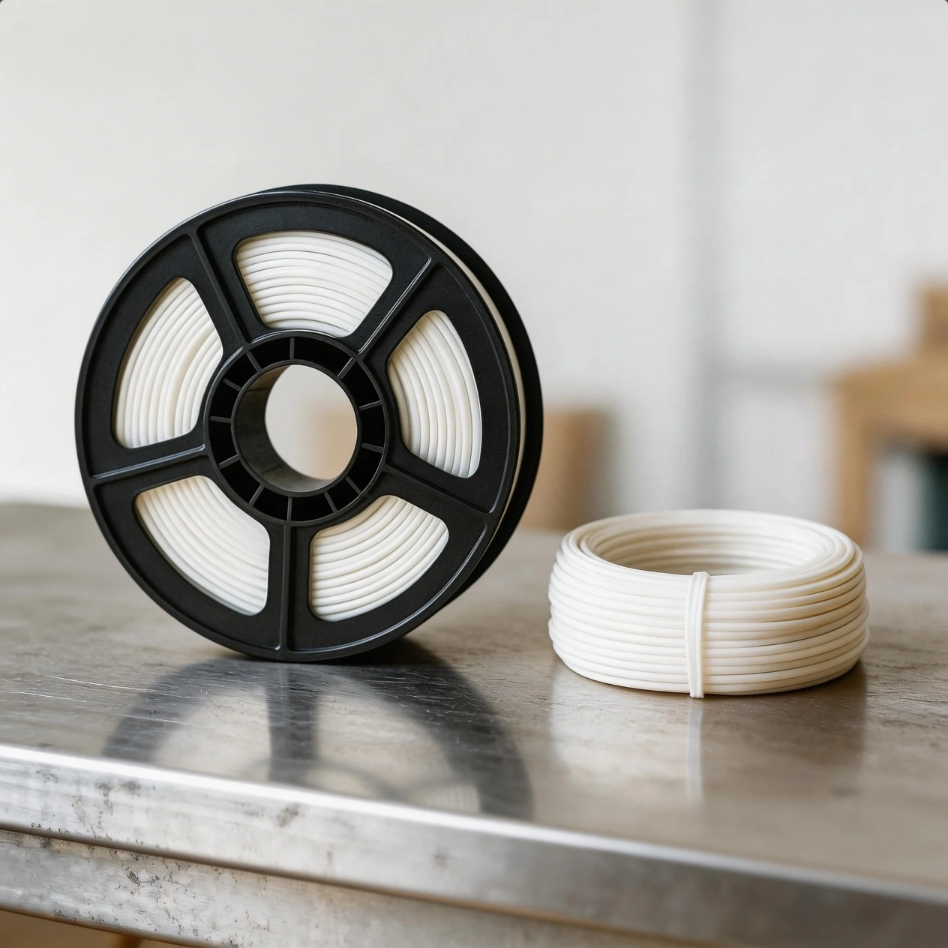
Glass Fiber Filament Guide
What This Guide Covers
Glass fiber filaments (GF Series) are showing up in more production environments—not just prototyping labs. Consequently, this guide addresses the practical questions buyers and engineers face: which PA6-GF or glass fiber polypropylene formulation matches your application, what equipment changes you’ll need (nozzles wear out fast), how to prevent common print failures (moisture is the usual culprit), and whether the investment makes sense for your production volume. Furthermore, we’ve included comparative data against carbon fiber alternatives, real failure modes from industrial use, and total cost analysis that accounts for nozzle replacement and drying equipment.
🔑 Key Takeaways
- ✓ Glass fiber filaments can triple tensile modulus versus standard PLA—but only when properly dried and printed. Moreover, the difference between a strong bracket and a brittle failure often comes down to moisture control
- ✓ PA6-GF needs aggressive drying: 120°C for 8-12 hours before printing. Additionally, moisture content must stay below 0.2% to avoid bubbling and weak layers
- ✓ Budget for hardened steel or ruby nozzles from day one. In fact, brass nozzles degrade within 50-100 hours with GF materials
- ✓ Heat deflection temperature reaches 180-220°C for PA6-GF formulations. However, thermal resistance varies significantly between manufacturers
- ✓ Interlayer adhesion hits 85-92% of bulk material strength when parameters are dialed in. Nevertheless, achieving this requires slower speeds (30-50 mm/s)
- ✓ Glass fiber polypropylene cuts weight by 15-25% versus ABS while maintaining stiffness. Therefore, it’s ideal for weight-sensitive applications
- ✓ GF filaments warp less than carbon fiber alternatives in large prints (60-70% reduction). Thus, they’re more forgiving for parts over 200mm
- ✓ For B2B procurement, supplier technical support matters more than unit price. Indeed, batch consistency prevents more waste than a 10% price difference saves
📋 Table of Contents
- 1 Understanding Glass Fiber Filament: Material Science and Composition
- 2 PA6-GF vs PA6-CF: Performance Comparison
- 3 Optimal Printing Parameters and Settings
- 4 Nozzle Selection: Protecting Your Investment
- 5 Moisture Management Protocol
- 6 Industrial Applications and Case Studies
- 7 Cost Analysis and ROI Considerations
- 8 Frequently Asked Questions
1. Understanding Glass Fiber Filament: Material Science and Composition
If you’ve tried printing structural parts with PLA or ABS and found them too flexible or prone to warping, glass fiber filaments solve different problems. They’re not universally “better” materials—they’re stiffer, more heat-resistant, and far less forgiving of printing mistakes. For B2B buyers evaluating materials for production applications, the chemistry matters less than understanding which failure modes you’re trying to prevent.
How Glass Reinforcement Actually Works
The basic structure: chopped glass fibers (typically E-glass) embedded in a nylon or polypropylene matrix. Specifically, the fibers themselves don’t melt—they sit at around 850°C melting point—so they create a reinforcing skeleton within the plastic. E-glass dominates commercial formulations because it’s cheap and handles general industrial abuse. In contrast, S-glass shows up in aerospace applications where the 40-60% cost premium buys higher tensile strength and better thermal stability.
Load transfer happens at the fiber-matrix interface. When you stress a printed part, the rigid glass fibers carry most of the load while the polymer distributes forces across the fiber network. Interfacial shear strength—typically 15-25 MPa for PA6-glass interfaces—determines how well this works. Poor interfacial bonding means fibers pull out of the matrix under load instead of reinforcing it. Therefore, surface treatments (silane coupling agents) improve this bonding, which is why formulation quality matters more than just fiber percentage.
💡
Fiber Loading Sweet Spot
Most production-grade GF filaments cluster around 20-30% glass by weight. Below 15%, you’re paying a premium for marginal improvement. Above 35%, you’ll fight nozzle clogs and poor layer adhesion. The exception: specialized aerospace formulations at 40% that require dedicated equipment and aggressive drying protocols.
GF Series Product Range
PA6-GF dominates industrial applications—it offers the highest modulus and thermal resistance for structural components. Meanwhile, glass fiber polypropylene targets weight-sensitive applications where you’d otherwise use ABS or standard PP. Additionally, hybrid formulations (glass + carbon fiber) exist but serve niche needs like combining stiffness with electrostatic dissipation.
When evaluating GF filament options from suppliers like SSSray, ask about fiber length distribution, not just fiber content percentage. Longer fibers (300-600 microns) provide better reinforcement but increase extrusion difficulty. Furthermore, surface treatment quality varies between suppliers—request interfacial shear strength data if your application involves sustained loads.
Dimensional Stability: The Practical Advantage
Glass fiber’s biggest practical benefit isn’t raw strength—it’s dimensional stability. The coefficient of thermal expansion (CTE) for PA6-GF measures 15-25 × 10⁻⁶/°C, compared to 70-80 × 10⁻⁶/°C for unfilled PA6. This 70% reduction means GF parts hold their shape when temperatures fluctuate, which matters enormously for precision fixtures, inspection gauges, and anything that interfaces with metal components.
Heat Deflection Temperature (HDT) provides another key spec. PA6-GF formulations hit 180-220°C at 0.45 MPa load, enabling use near heat sources where standard polymers sag. However, HDT varies significantly between formulations even at the same fiber loading. Always request actual test data from your supplier rather than relying on generic material family specifications.
2. PA6-GF vs PA6-CF: Performance Comparison
The PA6-GF versus PA6-CF question doesn’t have a universal answer—it depends on whether your application punishes flexibility, impact, heat, or cost. Both materials get marketed as “industrial grade,” but they fail in different ways.
Mechanical Properties: Where Each Material Wins
What this means in practice: PA6-CF bends half as much under the same load (2-3x higher modulus), but it’s also twice as likely to crack on impact. Therefore, choose CF for precision fixtures that never see shock loads. Conversely, choose GF for anything that might get dropped, knocked around, or needs to absorb vibration without fracturing.
Thermal and Electrical Properties: The Hidden Differentiators
Critical application note: PA6-CF’s thermal conductivity makes it useful for heat sinks and thermal management parts. However, that same conductivity means CF is electrically conductive (10+ orders of magnitude lower resistivity than GF). If your part goes anywhere near electronics or needs electrical isolation, PA6-GF is non-negotiable.
Printability Differences That Affect Production
PA6-GF prints more reliably than PA6-CF for production environments. The glass fibers are softer than carbon fibers, which translates to 30-40% longer nozzle life. Moreover, the higher elongation at break (2-4% versus 1.5-2.5%) improves interlayer adhesion, reducing the delamination risk that plagues thick-section carbon fiber parts.
Surface finish also differs. Glass fibers produce a matte gray-white appearance that accepts paint and coatings readily. In contrast, carbon fiber shows through most surface finishes with a distinctive weave pattern. For parts that need secondary operations like vapor smoothing or painting, PA6-GF provides a better starting surface.
💡
When to Choose GF Over CF
PA6-GF makes sense when you need: electrical insulation (CF is conductive), better impact resistance without catastrophic brittle failure, lower material cost (typically 20-30% less than CF), or easier printing with less equipment wear. Indeed, the stiffness gap matters less than datasheets suggest once you account for real-world design constraints.
3. Optimal Printing Parameters and Settings
Glass fiber filament demands different parameters than standard thermoplastics. In fact, the difference between a successful print and a failed part often comes down to temperature precision and cooling strategy rather than exotic equipment.
Temperature Settings: Finding the Working Window
Temperature settings for GF filaments run hotter than unfilled nylon—but not arbitrarily hot. The fiber loading increases melt viscosity, so you need 260-290°C to get proper flow. However, push past 295°C and you’ll see discoloration and brittleness from thermal degradation. The sweet spot for most PA6-GF formulations: 270-280°C.
Bed temperature requirements split between materials. PA6-GF needs 80-100°C heated beds to prevent warping during those critical first layers. In comparison, glass fiber polypropylene tolerates 60-80°C because PP has lower crystalline shrinkage. Nevertheless, ambient temperature matters as much as bed temperature for large parts. A 30°C enclosure dramatically improves first-layer adhesion compared to open-frame printing at 20°C.
Print Speed: Slower Than You Think
Glass fibers and increased viscosity force slower speeds than marketing materials admit. For structural parts requiring maximum strength, 30-50 mm/s produces superior interlayer bonding and fiber orientation. You can push to 60-80 mm/s for cosmetic prototypes, but expect mechanical properties to drop proportionally—sometimes by 20-30%.
Layer height interacts with fiber content in ways that affect strength. At standard 0.2mm layers, fibers orient predominantly in the XY plane, maximizing in-plane stiffness but potentially weakening Z-direction strength. Conversely, reducing to 0.1-0.15mm layers promotes more randomized fiber distribution and better interlayer entanglement. The tradeoff: print time nearly doubles.
Cooling Strategy: The Warping Prevention Balance
Part cooling for GF filaments requires careful balancing. Too much cooling and the polymer solidifies before achieving proper layer bonding—you’ll see delamination and weak Z-strength. On the other hand, too little cooling and overhangs sag, thin features distort, and dimensional accuracy suffers.
The approach that works: 20-40% part cooling for the first 3-5 layers (building bed adhesion), then increase to 50-70% for remaining layers. For small parts with limited thermal mass, you can run full cooling after layer 10. Meanwhile, for large solid sections, keep cooling minimal (10-20%) throughout to prevent internal thermal gradients that cause warping.
💡
Critical Parameter Warning
Never disable layer cooling entirely for PA6-GF prints exceeding 2 hours. Heat accumulates in large prints to the point where bottom layers can reach glass transition temperature. Consequently, this causes softening, warping, and potential print failure. Use a graduated cooling schedule that increases fan speed as print height increases.
Retraction: Preventing Stringing Without Compromising Extrusion
Retraction parameters need adjustment for the increased viscosity of GF filaments. Standard retraction settings leave strings and blobs because the material doesn’t stop flowing immediately. Nevertheless, excessive retraction compresses the filament, leading to inconsistent extrusion and weak layers.
Start with 20-30% longer retraction distances than your baseline material—typically 6-10mm for direct drive, 10-15mm for Bowden. Furthermore, reduce retraction speed by 20-30% to prevent compression: aim for 20-30 mm/s instead of the 40-50 mm/s common for PLA. Some stringing is acceptable—over-retraction causes worse problems than minor post-processing cleanup.
4. Nozzle Selection: Protecting Your Investment
Nozzle selection matters more for glass fiber filament than any other printing parameter. The wrong nozzle choice doesn’t just affect print quality—it creates a hidden cost drain through frequent replacement and inconsistent dimensional accuracy.
Why Brass Nozzles Fail Fast
Brass works excellently for most 3D printing because of its thermal conductivity. However, glass fibers have a Mohs hardness of 6-7 versus brass at 3-4. This hardness mismatch means abrasive wear happens rapidly—brass nozzles lose dimensional accuracy within 50-100 print hours with 20-30% glass fiber loading.
The wear pattern shows as nozzle bore enlargement and internal surface scratching. You’ll notice inconsistent extrusion before the nozzle visibly fails. Specifically, slight over-extrusion, surface pitting on prints, and degraded layer adhesion all indicate worn brass. By the time you see helical scratches aligned with filament movement, mechanical properties have already degraded by 20-30%.
Nozzle Material Options: Cost Versus Longevity
Cost-benefit reality: Hardened steel nozzles deliver best value for most operations. The 5x lifespan improvement justifies the 2-3x cost premium, reducing per-hour material costs and eliminating frequent replacement downtime. Meanwhile, ruby-tipped nozzles become cost-effective around 1000 annual print hours with GF materials.
Nozzle Geometry Considerations Beyond Material
Material selection matters, but geometry affects performance too. Precision machined throats provide better flow characteristics than standard conical nozzles. Look for:
- Hardened throat inserts: Most wear happens in the heat break zone where filament transitions from solid to melt. Therefore, hardened inserts here prevent dimensional changes over time.
- Ruby or hardened tips: The orifice sees maximum fiber contact and abrasive wear. This is where material hardness matters most.
- 0.4-0.6mm orifice diameter: Smaller diameters increase clog risk with glass fibers. 0.4mm works for most applications; 0.6mm provides margin for fiber-rich formulations.
- Polished internal surfaces: Reduces friction and thermal degradation during extrusion, particularly important for moisture-sensitive PA6-GF.
5. Moisture Management Protocol
Nylon’s hygroscopic nature makes moisture management non-negotiable for PA6-GF. Unlike forgiving materials like PLA or PETG, wet nylon degrades during extrusion through hydrolysis—a chemical reaction that permanently damages polymer chains.
What Actually Happens When Nylon Absorbs Moisture
When nylon absorbs moisture from air, water molecules hydrogen bond to the polymer’s amide groups. At extrusion temperatures above 260°C, these water molecules trigger hydrolysis reactions that cleave polymer chains. Each cleavage reduces molecular weight, directly degrading tensile strength, impact resistance, and layer adhesion.
You’ll know moisture damage by these symptoms: excessive bubbling and steam from the nozzle during extrusion, rough pitted surface finish on printed parts, inconsistent extrusion with pressure fluctuations, and amber or brown discoloration. Once you see these indicators, mechanical properties have typically dropped 30-50%—the damage is permanent.
Drying Protocol: The Non-Negotiable Steps
Effective drying requires sustained elevated temperatures. For PA6-GF, follow this protocol without shortcuts:
- Preheat oven to 120°C (248°F) for PA6-GF or 80°C (176°F) for GF polypropylene. Allow 30-60 minutes for temperature stabilization before adding filament.
- Remove filament from any packaging. Vacuum bags prevent moisture escape during drying. Leave filament on the spool or in a loose coil.
- Position for airflow. Use a shallow, oven-safe container. Don’t stack spools—ensure air circulation around all surfaces.
- Dry for 8-12 hours minimum for PA6-GF (4-6 hours for GF PP). Overnight drying provides margin for error.
- Verify moisture content below 0.2% using a filament moisture analyzer if available. Weighing before and after should show 0.5-2% weight loss.
- Load immediately after removal from oven. If you can’t print within 15-20 minutes, return filament to the dryer.
💡
Common Drying Mistakes
Never exceed 130°C for PA6-GF—higher temperatures accelerate thermal degradation. Don’t use hot air ovens with poor temperature uniformity. Never dry filament while still in the shipping vacuum bag. If filament doesn’t lose 0.5-2% weight after a full drying cycle, it may already be thermally degraded beyond recovery.
Storage: Prevention Beats Remediation
Store all GF nylon filament in airtight containers with fresh desiccant immediately after use. For production environments, vacuum-sealed aluminum bags with multiple desiccant packs provide months of protection. Moreover, exposure to ambient air for 24+ hours in humid conditions often requires complete re-drying before the next print.
6. Industrial Applications and Case Studies
Glass fiber filament has moved beyond R&D prototyping into actual production use across several industries. These applications demonstrate where GF materials deliver measurable advantages over alternatives.
Aerospace: Interior Components and Tooling
Aerospace applications drove early GF filament development because weight reduction directly translates to fuel savings. Interior components, cable routing brackets, and non-structural mounting hardware now see regular production use. Furthermore, the strict traceability requirements and testing protocols of aerospace have established quality benchmarks that benefit other industries.
Automotive: Production Tooling and Low-Volume Parts
Automotive manufacturers and tier-one suppliers use glass fiber filament primarily for tooling, fixtures, and components. The combination of thermal resistance, dimensional stability, and rapid production makes GF materials competitive with machined aluminum for manufacturing aids.
Industrial Machinery: The Broadest Current Use Case
Production machinery applications represent the largest current market for glass fiber filament. Custom brackets, cable management components, sensor mounts, and replacement parts all benefit from GF’s property profile. In addition, the on-demand production capability eliminates inventory carrying costs and long lead times.
💡
Application Development Support
Reputable suppliers like SSSray offer application engineering consultation to help customers select optimal formulations. OEM and ODM services enable custom formulations for specific requirements—modified fiber loadings, enhanced UV resistance, or specialized colorants.
Robotics and Drones: Emerging Applications
Lightweight structures for robotics and UAVs represent rapidly growing application areas. Frame components, protective enclosures, and mounting brackets benefit from GF’s stiffness-to-weight ratio. Drone manufacturers particularly favor glass fiber polypropylene for aerial applications where every gram affects flight time.
7. Cost Analysis and ROI Considerations
B2B procurement decisions require financial justification beyond material performance. Glass fiber filaments carry a price premium, but total cost of ownership analysis frequently favors GF when accounting for the full production picture.
Material Cost: Beyond Per-Kilogram Pricing
PA6-GF pricing currently runs 2.5-4x standard PLA costs per kilogram. However, material cost per part tells a different story than per-kilogram pricing. GF’s enhanced mechanical properties enable thinner walls and lighter designs that reduce material consumption by 20-40%.
Processing Costs: Time and Energy Factors
Print time runs 20-40% longer for GF versus standard materials. Energy consumption increases proportionally with higher extrusion temperatures. Nevertheless, these increases get offset by reduced failure rates from GF’s dimensional stability.
ROI Calculation Framework
Evaluating GF filament ROI for your specific operation requires considering:
- Alternative production method costs: What would equivalent parts cost via machining or injection molding?
- Volume economics: GF printing becomes increasingly advantageous below 500-1000 unit quantities
- Lead time value: Quantify the business value of reducing part lead times from weeks to days
- Inventory optimization: Calculate carrying costs saved by producing parts on-demand
💡
Typical ROI Outcomes
Operations transitioning to GF filaments typically achieve 200-400% ROI within the first year. Primary value drivers: tooling cost reduction (60-80%), lead time improvements (20-30% of project value), and inventory optimization (15-25% reduction in carrying costs).
8. Frequently Asked Questions
Conclusion: Where Glass Fiber Filament Actually Makes Sense
Glass fiber filament has earned its place in industrial 3D printing, but it’s not a universal replacement. It solves specific problems: excessive flexibility in structural parts, warping in high-temperature environments, and dimensional instability in precision fixtures. For these applications, GF materials deliver measurable advantages that justify the learning curve.
The technical challenges—moisture management, nozzle wear, parameter optimization—are well understood and manageable with proper protocols. What separates successful GF implementation from frustrating failures isn’t exotic equipment. It’s attention to the basics: thorough drying, appropriate nozzle selection, and realistic expectations.
For B2B decision-makers, the strategic value extends beyond immediate part performance. Reduced tooling costs, faster design iteration, on-demand production flexibility, and inventory optimization collectively deliver ROI that justifies initial investment. However, these benefits only materialize when you match material capabilities to actual application requirements.
Whether you’re a distributor expanding product offerings, an industrial user evaluating manufacturing alternatives, or a brand owner developing differentiated products, glass fiber filament deserves evaluation for appropriate applications. Request samples, conduct validation testing, and run the total cost numbers for your specific use case.
References
[1] ISO 527:2012 – Plastics — Determination of tensile properties. International Organization for Standardization.
[2] ISO 178:2019 – Plastics — Determination of flexural properties. International Organization for Standardization.
[3] ISO 75-1:2013 – Plastics — Determination of temperature of deflection under load. International Organization for Standardization.
[4] ISO 180:2019 – Plastics — Determination of Izod impact strength. International Organization for Standardization.
[5] Tekerek, M. et al. “Mechanical Properties of Glass Fiber Reinforced Nylon Composites for Additive Manufacturing.” Science Advances, 2025.
