Online time
Monday to Friday: 9AM - 8PM
Weekend: 10AM - 5PM

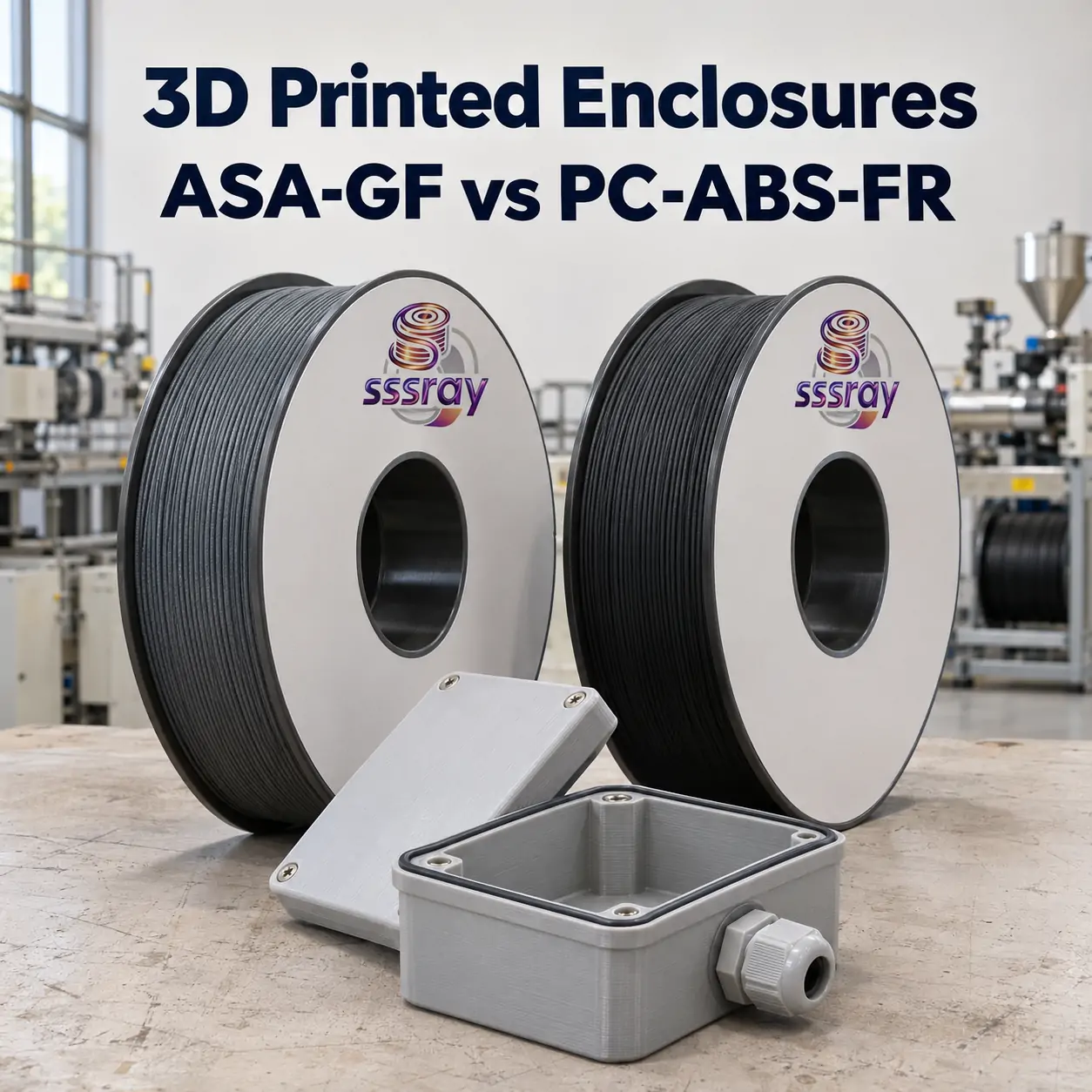
Our Material Recommendation: ASA-GF vs PC-ABS-FR for Outdoor Enclosures
For a 3D printed outdoor enclosure, choose our ASA-GF when UV exposure and stiffness drive the design, or evaluate our PC-ABS-FR when flame performance and higher heat resistance lead the specification. We help you align the grade, print profile, sealing design and sample approval before scaling the order. IP65 qualification applies to the complete assembled enclosure.
Best optionShortlist ASA-GF for weather-exposed sensor housings without a specified flame class. Shortlist PC-ABS-FR for flame-sensitive projects, with separate outdoor and printed-part verification.
When not to use itReject either route when the project needs both weathering and electrical safety evidence that the exact grade, print process and assembly cannot supply.
Key specificationDefine minimum wall thickness, operating temperature, installation exposure, gasket system and required flame class before comparing spool prices.
Check the flame evidenceWe distinguish injection-moulded V-0 results at 1.5 mm from the evidence required for an FFF-printed housing.
Control accepted-part costWe help match the filament grade and print conditions to repeatable builds; buyers should also include sealing and inspection costs in the finished-enclosure budget.
How Should Buyers Specify a 3D Printed Outdoor Enclosure?
Choose the material and the enclosure qualification route together; treating them as separate purchases creates avoidable approval gaps.
A solar-monitoring box can look successful on the bench and still fail after installation. Its lid may bow when the electronics warm up, its cable entry may admit water, or its printed shell may lack the flame evidence requested by the equipment manufacturer. These are different failure mechanisms, and changing from ASA to a more expensive engineering filament does not automatically solve them.
Commercial enclosure catalogues illustrate the distinction. Manufacturers offer weather-resistant ASA boxes and flame-retardant PC/ASA boxes, supported by specific seals, fastening arrangements and product ratings. Printing can remove the need for a dedicated mould during development or low-volume manufacture. It also introduces layer interfaces and process variability that must enter the purchasing specification.
At SSSray, we use an Enclosure Release Chain to move from application requirements to a traceable filament order: define the installed duty, select the exact grade, agree the print trial, identify required safety evidence, confirm lot and packaging controls, and freeze the approved reorder specification. The customer’s enclosure team then qualifies the finished assembly against its applicable requirements.
We combine our published grade data, enclosure design benchmarks and our own detailed factory qualification records. The practical focus is the same throughout: select the right material, locate shell or joint leakage, and carry an approved specification from sample spools into repeat bulk supply.
What We Check Before Recommending ASA-GF or PC-ABS-FR
Approve weathering, flame behaviour and ingress protection against their own evidence before releasing the enclosure.
- ASA-GF is a weathering-and-stiffness candidate, not an automatic FR grade. Glass reinforcement does not establish a flame classification.
- The published PC-ABS-FR V-0 claim at 1.5 mm uses injection-moulded specimens. Printed-part flame performance requires additional evidence.
- An IP65 requirement applies to the assembled enclosure. Shells, gaskets, glands, fasteners and modifications all affect the result.
- More infill cannot compensate for a leaking lid. Shell porosity and joint compression need separate checks.
- Four to six perimeters are a screening starting point. Published watertight-print guidance does not make this an IP-rated production recipe.
- Accelerated UV hours do not translate universally into outdoor years. Compare retained performance under a stated exposure cycle.
- A thinner reinforced wall needs a new approval. Stiffness gains do not preserve impact, sealing or flame performance automatically.
- Freeze the approved configuration for reorders. Grade, colour, lot traceability, drying, printer profile and seal components belong in the release record.
Choose a 3D Printed Outdoor Enclosure: ASA-GF or PC-ABS-FR
Start with ASA-GF for exposed, stiffness-led housings without a specified flame class; investigate PC-ABS-FR when flame behaviour is a selection gate, while qualifying its outdoor performance separately.
Weather duty and flame duty create different shortlists
ASA uses an acrylic rubber phase that gives it a useful weathering advantage over conventional ABS. Glass reinforcement can improve rigidity and dimensional stability. Those features suit an ASA enclosure protecting a field sensor, provided the actual colour, geometry and environment are qualified.
PC-ABS-FR combines a PC/ABS blend with a flame-retardant package. That makes it a candidate when a customer specifies flame performance, but “FR” says nothing by itself about long-term sunlight exposure. A shaded equipment compartment and an exposed rooftop box should not share an approval just because their drawings look similar.
The practical choice can also be neither. If the project needs documented outdoor electrical performance immediately, an existing rated enclosure may be the shorter route. Printing a custom mounting plate inside it can preserve design flexibility while reducing the amount of new enclosure evidence required.
Use moulded enclosures as benchmarks, not transferable approvals
The following comparison separates material screening data from ratings published for complete commercial products. For this enclosure evaluation, we used the ASA-GF10 formulation documented in our TDS V2.0: 10% glass fibre and a 3,270 MPa XY flexural modulus. Our ASA-GF product page separately lists 20–30% glass-fibre loading and a 3,652 MPa flexural modulus; those figures must not be substituted for the GF10 results in this evaluation. Specify the required fibre loading in your RFQ so we can confirm the matching formulation, TDS revision and available production grade before quoting.
On mobile, swipe horizontally to view all columns.
| Option | Best use case | Key spec | Advantage | Risk | How to verify | When to reject | SSSray sourcing note |
|---|---|---|---|---|---|---|---|
| ASA-GF filament for FFF | Custom weather-exposed sensor housings and rigid covers | Published HDT: 96 °C at 0.455 MPa; XY flexural modulus: 3,270 MPa | Weather-oriented ASA base with glass reinforcement | No printed enclosure IP or FR approval established by the TDS | Lot-specific TDS, weathered coupons and assembled-box tests | A required flame or electrical property remains unverified | Request an identified ASA-GF sample lot and the current signed specification |
| PC-ABS-FR filament for FFF | Flame-sensitive enclosure development with suitable printing equipment | Published HDT: 103 °C at 0.455 MPa; XY flexural modulus: 2,400 MPa; typical V-0 at 1.5 mm on injection-moulded bars | Higher published thermal screening value and an FR formulation | Moulded-bar flame result; outdoor suitability requires separate evidence | Printed specimen report, process details and weathering evidence | Only a moulded-resin result is offered for a printed-part approval | Request the PC-ABS-FR technical packet and define the printed test scope |
| ROLEC technoPLUS, moulded ASA | Buying a commercial outdoor enclosure with a defined configuration | Published UL 94 HB; IP66 / EN 60529; silicone gasket | Existing enclosure design and sealing system | Machining or component changes can affect the supplied rating | Exact model, current documentation and modification approval | Its configuration cannot meet the required equipment duty | Use as an assembly benchmark; its ratings do not transfer to filament |
| Takachi WGPC, moulded PC/ASA | Commercial outdoor communication or network housings | Published PC/ASA UL 94 V-0; IP68 example: 1 m immersion for 24 h | Weather-oriented blend with a specified sealing arrangement | PC/ASA is a different blend from PC/ABS-FR | Exact WGPC size, gasket, fastening and stated test conditions | Its moulded-product rating is being used to justify a printed substitute | Compare application requirements; do not treat the blends as equivalent |
Our HDT and flexural-modulus figures support grade selection under the stated TDS conditions. Match them to the enclosure load case; the commercial IP ratings in this table belong to the listed complete assemblies.
Material-data conditions: both TDS documents describe XY printed mechanical/thermal specimens with 0.2 mm layers and 100% infill. PC-ABS-FR additionally states conditioning at 23 °C / 50% RH for 48 h; the ASA-GF document does not state matching temperature/RH conditioning. The PC-ABS-FR flame result uses a different, injection-moulded specimen route. See the material documents, ROLEC and Takachi.
Tooling avoidance, quick prototypes and thinner walls
Printing is valuable when connector positions, PCB mounts or cable routes are still changing. It avoids committing those details to a dedicated mould. A one- or two-day print-and-fit target is a project planning assumption, achievable only when material, machine time and geometry permit; drying, post-processing and qualification still need their own schedule.
Glass reinforcement may support a thinner design after validation. It does not grant a general wall-reduction allowance: seal-land deflection, screw-boss cracking, layer direction and minimum flame-test thickness can become the controlling limits. Compare the finished part mass after those limits are satisfied.
If your initial shortlist is unfilled ABS versus ASA, use our ASA versus ABS material guide before qualifying the enclosure. Send the installed duty and minimum wall drawing with your engineering filament enquiry.
Need a material decision before ordering sample spools? Send SSSray the enclosure drawing, installation exposure, minimum wall thickness, flame requirement, target IP rating and printer capability. We aim to respond to complete quotation requests within 24 hours on business days and provide a preliminary ASA-GF / PC-ABS-FR technical recommendation, relevant documents and sample plan within two working days. Request a scoped material review.
Seal a 3D Printed Outdoor Enclosure Before Claiming IP65
An IP65 3D printed enclosure needs an approved assembled-box test; a water-resistant polymer, dense infill or a successful bench splash test cannot establish that classification.
Control shell leakage before tightening the lid
A printed wall resembles overlapping beads rather than a single moulded skin. Under-extrusion, interrupted seams and poor interlayer fusion can leave connected leakage paths. A perfectly compressed gasket cannot close a pore through the wall, just as tightening a bottle cap cannot repair a hole in the bottle.
A 2025 FDM study linked water retention to extrusion flow and wall line width in PLA cylinders. That supports process control, but its PLA results are not an ASA-GF or PC-ABS-FR recipe. Prusa’s watertight-print tests likewise support perimeter and seam checks, with four to six perimeters working for many simple specimens.
Use continuous walls and solid local regions around the sealing land and fastener bosses. In the proposed screen below, local solid infill is 100%; this is a design variable, not an IP guarantee. Inspect sliced toolpaths for gaps between perimeter and infill before building the first sealed assembly.
Keep grade-specific print settings separate from sealing approval
These published processing windows identify equipment needs; the sealing recipe must be qualified on the actual box.
On mobile, swipe horizontally to compare print settings.
| Parameter | ASA-GF | PC-ABS-FR | Qualification check |
|---|---|---|---|
| Nozzle temperature, °C | 240–260; listed optimum 250 | 250–280; listed optimum 265 | Confirm fusion without degradation at the actual flow demand |
| Bed temperature, °C | 100–110; listed optimum 105 | 90–110; listed optimum 100 | Check seal-land flatness after cooling |
| Enclosure / chamber, °C | Heated enclosure recommended: 50–60 | 70–90 for large or dimensionally critical parts | Use equipment rated for the required chamber conditions |
| Drying before printing | 80 °C for 4–6 h if moisture absorbed | 80 °C for 6–8 h; dry before use as directed | Record dryer temperature, duration and spool handling |
| Nozzle material | Hardened steel for abrasive glass reinforcement | Hardened steel and all-metal hot end per this grade’s TDS | Record nozzle condition and installed diameter |
| Published speed range, mm/s | 40–150 | 40–300 | These are processing ranges, not validated sealing-wall speeds |
| Common failure to inspect | Warped sealing land; poor layer fusion; nozzle wear | Warped sealing land; moisture voids; layer cracking | Inspect the shell and joint separately |
| Corrective route | Check drying, extrusion, nozzle wear, chamber and cooling | Check drying, extrusion, chamber stability and cooling | Reprint and repeat the leak screen after a process change |
Our ASA-GF product page and TDS V2.0 both specify a 240–260 °C nozzle window. The separate 250–270 °C processing-temperature field is not a replacement nozzle recommendation. Use the grade-specific print table above and record the approved profile with the sample lot for repeat orders.
Source: our published grade-specific TDS documents. Temperatures refer to machine setpoints, not guaranteed part temperatures; speeds are linear toolpath speeds. Ambient printing RH is not specified in these tables. The qualification record must capture actual room/chamber conditions and build orientation.
Design the gasket, cable entries and mounting as one assembly
Keep the sealing land flat, continuous and clear of support scars. Size the gasket groove and compression stops using the gasket supplier’s guidance. Put mounting holes outside the protected cavity where possible, specify cable glands for the real cable diameter, and record the screw-tightening method. More torque can bow a lid instead of improving its seal.
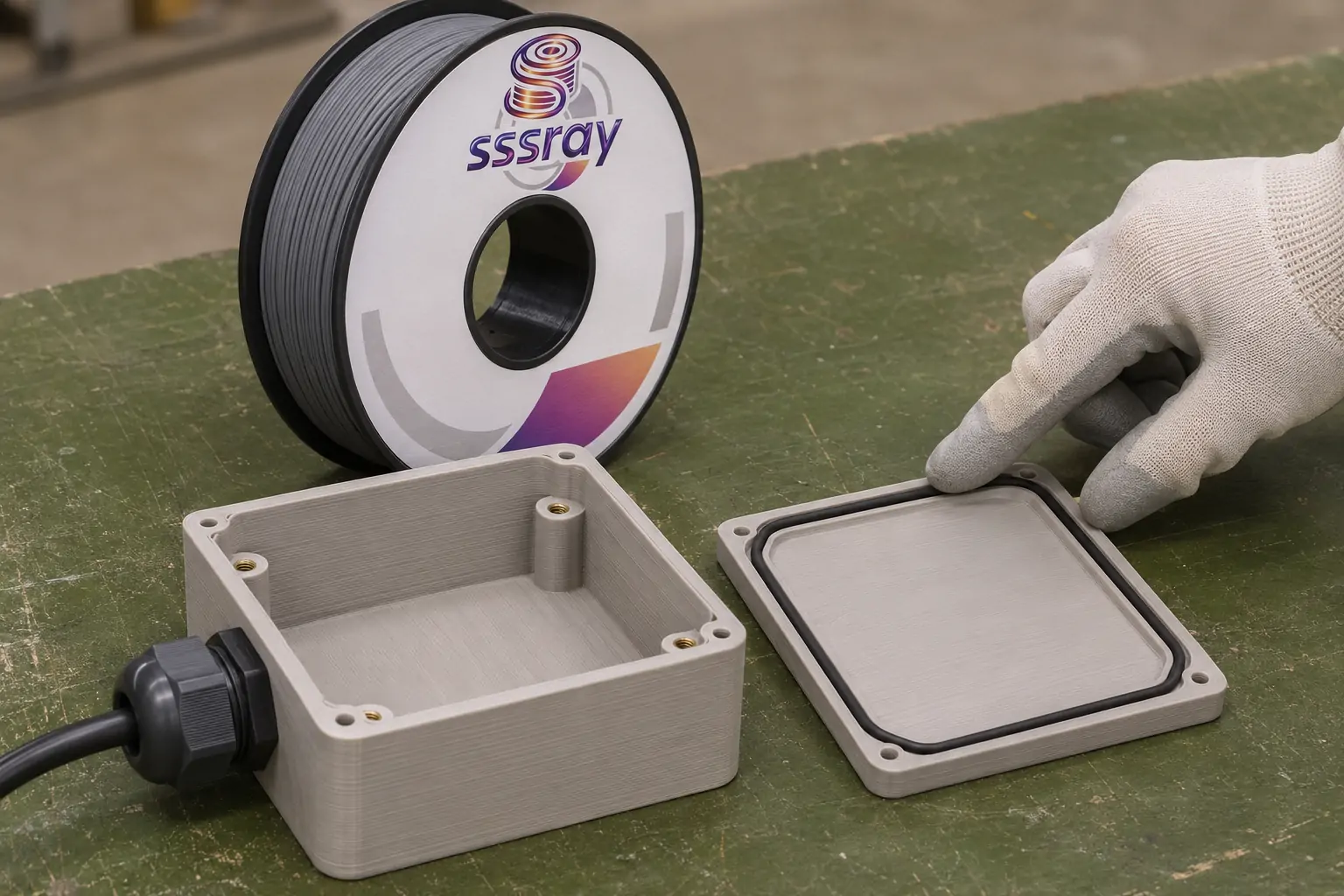
Use a repeatable bench leak screen to find defects, then submit the finished configuration for the required IEC 60529 assessment. IP65 concerns dust and water-jet protection; it does not establish immersion resistance or prevent internal condensation. Address temperature cycling, pressure equalisation and any vent as part of the design.
Procurement implicationQuote the box, gasket, glands, fasteners and inspection together.
Mistake to avoidReleasing a weatherproof 3D printed box after testing only an unmodified empty shell.
How to verifyMatch the tested assembly revision and installation details to the production bill of materials.
Use our bulk-order test protocol as the starting point for documenting the material and print process, then add the enclosure-specific laboratory scope.
How We Verify UV Resistance, UL 94 and Electrical Enclosure Claims
Accept a supplier claim only when its document identifies the tested material, specimen or assembly, manufacturing method and relevant conditions.
“UL94 V0 PC-ABS” can describe a moulded specimen
Our PC-ABS-FR TDS V3.0 explicitly identifies the V-0 result at 1.5 mm as an injection-moulded specimen result. It does not establish a flame classification for your printed wall. A purchasing document that omits that distinction can send the wrong evidence to the equipment customer’s safety reviewer.
Request a report or recognition covering the printed grade, colour, minimum thickness, build orientation and processing conditions. UL’s Blue Card guidance explains why Yellow Card properties cannot simply be applied after a material is processed by 3D printing. We identify the relevant TDS, available reports and printed-specimen requirements in the material enquiry so your equipment reviewer can assess the correct evidence.
“UV resistant” is not a service-life guarantee
That phrase may hide an untested colour, a resin-only result or a visual inspection without mechanical retention data. Request the exposure method, lamp type, irradiance, temperature, moisture cycle, duration and before/after properties. For an outdoor electrical part, ask the reviewer whether a documented UL 746C outdoor-use evaluation is relevant to the application.
We match the weathering evidence to the grade, colour and installed duty rather than assigning one service-life figure to every outdoor print. If protection depends on paint or another coating, qualify that coated configuration, its adhesion and its maintenance assumptions. It is a new system specification, not an automatic fix for undocumented weathering.
“Electrical enclosure” does not identify the applicable safety standard
IEC 62368-1 addresses audio/video, information and communication technology equipment. Its current published edition reviewed here includes the August 2025 corrected version. It is not a universal standard for every electrical box.
An EV supply-equipment project belongs in the applicable charging-equipment safety assessment, including the scope of IEC 61851-1 where relevant. A cosmetic EV charger enclosure prototype is also different from an energised enclosure used as a safety barrier. Solar-monitoring equipment needs its own applicable product assessment. Have the responsible equipment engineer or laboratory define that scope before selecting flame retardant filament for electrical use.
For a telecom enclosure 3D print, send the power architecture, installation exposure and intended safety function with the RFQ. Ask for a written evidence-gap list before approving the sample order.
How SSSray Supports Filament Qualification for Outdoor Enclosures
We supply traceable filament grades, processing information and sample support. We agree material and reorder controls with the buyer; the finished enclosure, including its seal system and any required ratings, is approved for the customer’s specific application.
Turn the enclosure requirement into an approval record
Our Enclosure Release Chain connects the first drawing and filament sample to the bulk order. These are the points we ask buyers to confirm with us before committing to repeat supply.
- Application brief. Send us the enclosure drawing, installation temperature, sunlight, rain exposure and safety requirements. A shaded prototype and a pole-mounted production housing may need different material evidence.
- Grade and colour. We compare the exact formulation and relevant test conditions before recommending ASA-GF or PC-ABS-FR. HDT is a screening value, not permission to use the enclosure continuously at that temperature.
- Repeatable printing. Record the printer, dryer, nozzle, profile and lot used for the approved sample. Our processing guidance supports that trial, while the customer’s print team confirms consistent shell quality across repeat builds.
- Test responsibilities. We identify which published material results apply to the requested grade and manufacturing method. The customer and responsible laboratory define printed-part flame tests, assembled ingress tests and equipment certification where required.
- Lot traceability. Agree sample-lot identification, available COA fields and change-notification terms before bulk supply. The approved colour and formulation must remain identifiable across the sample, spool, carton and reorder documents.
- Cost per accepted part. Compare material price alongside drying, machine time, gaskets, finishing, inspection, freight and expected rejects. We can quote the filament supply; the enclosure manufacturer calculates its actual accepted-part yield.
- Packaging and storage. Specify barrier packaging, desiccant, labelling and storage conditions for the chosen grade. Inspect received spools and isolate damaged or unidentified packs before production.
- Reorder control. Freeze the grade, colour and supply specification, then agree which changes require notice. The customer’s approved print profile and seal components remain part of its enclosure build record.

Calculate cost per accepted enclosure
Divide the costs incurred for the production run by the number of enclosures accepted under the agreed inspection plan. Include filament, drying, machine time, seals, inserts, finishing, inspection, inbound freight and applicable import charges. Add qualification amortisation and expected field-return costs using your own records.
Illustrative arithmetic, not a quotation: an attempted enclosure costing USD 8 at 80% acceptance costs USD 10 per accepted unit. A USD 9 attempt at 95% acceptance costs about USD 9.47 per accepted unit. These examples assume the same included cost scope and show why the cheaper attempt can cost more after leak inspection.
Before ordering, we confirm sample acceptance, diameter tolerance, documentation, packaging, lead time, private-label details and reorder controls in writing. Our published specifications for both grades list 1.75 ± 0.03 mm diameter. The ASA-GF and PC-ABS-FR product pages currently give reference starting quantities of 50 spools for neutral packaging and typically 500–1,000 spools for OEM orders; these are product-page references, not one MOQ for every packaging programme. For mixed-grade or mixed-colour planning, we normally start at 30 spools per material/colour within the agreed total order. Neutral packs, logo-labelled packs and fully customised packaging have separate quotation requirements. The product pages give reference lead times of 7–15 working days for standard orders and 15–25 working days for customised orders. We confirm the final MOQ, grade, colour, artwork, delivery schedule and production slot in the quotation.
Use our supplier comparison tool to compare the same acceptance scope, and use the OEM/ODM enquiry to define packaging and change control before approving branded stock.
SSSray Factory Evaluation: Outdoor Enclosure Batch, UV and Thermal Test Results
Our 24-build factory evaluation connects wall settings with accepted assemblies: six-perimeter configurations pass 9/12 development wet screens (75.0%), compared with 5/12 (41.7%) for four perimeters. The complete record below adds individual readings, heat/load endpoints and paired dimensions, showing how an OEM can build a repeatable approval plan around the finished enclosure.
SSSray factory application evaluation — public case reference PUB-ENC-2026-11-R01. We recorded the individual readings below in our factory evaluation and retain their original test records. Public sample, lot and equipment IDs protect confidential production identifiers while remaining traceable within our records. The results apply to the tested formulations, colours, specimen geometry, equipment configurations and stated conditions. We use this evidence to support material and print-process selection; finished-enclosure IP approval and printed-part flame qualification follow their applicable test requirements.
Published grade specifications and documented test conditions
Our released material documents are ASA-GF TDS V2.0 (18 June 2025) and PC-ABS-FR TDS V3.0 (3 March 2026). The case-study machine setpoints sit within the published processing windows. The same confidential-source lot aliases carry through our assembly, UV and thermal record registers. We tested our ASA-GF10 formulation (10% glass fibre by weight) in this programme and can discuss other fibre loadings as separately specified custom grades, each with its own performance evidence.
On mobile, swipe horizontally to see all test settings.
| Field | ASA-GF, white | PC-ABS-FR, black | Method and evidence boundary |
|---|---|---|---|
| Public lot aliases | PUB-ASA-W01 / PUB-ASA-W02 | PUB-PCFR-B01 / PUB-PCFR-B02 | Anonymized public lot register, used consistently throughout this section |
| Equipment | CreatBot PEEK-300 FFF cell; controlled 80 °C drying oven | CreatBot PEEK-300 FFF cell; controlled 80 °C drying oven | Recorded equipment configuration; cell PUB-EQ-PRN-01 |
| Nozzle / bed / chamber | 250 / 105 / 55 °C | 265 / 100 / 80 °C | Reported machine setpoints, not measured internal part temperatures |
| Drying / printing speed | 80 °C × 6 h; 60 mm/s | 80 °C × 7 h; 50 mm/s | Reported case profile; validate for the approved grade and equipment |
| Layer / line / nozzle | 0.20 / 0.60 / 0.60 mm | 0.20 / 0.60 / 0.60 mm | Hardened-steel nozzle; part built with sealing face in XY plane |
| Nominal perimeter band | 4 lines: 2.40 mm; 6 lines: 3.60 mm | 4 lines: 2.40 mm; 6 lines: 3.60 mm | Nominal slicer arithmetic; bosses and joint lands may be thicker |
| Test assembly | 150 × 100 × 65 mm shell; 3 mm EPDM gasket at 25% target compression; M16 cable gland; eight M3 fasteners at 0.6 N·m | Case-study drawing and torque, not an approved gasket design or verified load limit | |
| Assembly population | 2 lots × 2 walls × 3 = 12 | 2 lots × 2 walls × 3 = 12 | Total 24 assemblies; sequential sample IDs 01–03 in each lot/wall cell |
| Shell air-decay screen | Ports sealed in a fixture; initial +2.0 kPa gauge; 60 s hold; pass if pressure loss ≤0.20 kPa | Manufacturer’s comparative development screen, not an IEC 60529 method | |
| Assembled wet screen | Unpowered assembly; dye-water spray at 3 L/min, 0.5 m standoff, 5 min; pass if no visible interior dye | Internal screening definition only; cannot justify an IPX5 or IP65 label | |
| Sealing-land flatness | Maximum deviation in millimetres, measured after cooling, before final gasket installation | Values below are test group means; buyers must set drawing-specific tolerances | |
Assembly screening: two lots, three builds per cell
Each row contains three separate evaluated enclosures, giving equal lot representation. The shell screen and the fully gasketed wet screen are distinct: a passing shell does not ensure a passing joint. We preserve the rejected builds in the denominator instead of quoting only the best prints.
On mobile, swipe horizontally to compare batches and results.
| Public lot alias | Material | Perimeters | n | Shell screen passed | Wet screen passed | Mean seal-land deviation, mm |
|---|---|---|---|---|---|---|
| PUB-ASA-W01 | ASA-GF | 4 | 3 | 2/3 | 2/3 | 0.22 |
| PUB-ASA-W01 | ASA-GF | 6 | 3 | 3/3 | 3/3 | 0.13 |
| PUB-ASA-W02 | ASA-GF | 4 | 3 | 2/3 | 1/3 | 0.24 |
| PUB-ASA-W02 | ASA-GF | 6 | 3 | 3/3 | 2/3 | 0.15 |
| PUB-PCFR-B01 | PC-ABS-FR | 4 | 3 | 2/3 | 1/3 | 0.29 |
| PUB-PCFR-B01 | PC-ABS-FR | 6 | 3 | 2/3 | 2/3 | 0.20 |
| PUB-PCFR-B02 | PC-ABS-FR | 4 | 3 | 1/3 | 1/3 | 0.33 |
| PUB-PCFR-B02 | PC-ABS-FR | 6 | 3 | 3/3 | 2/3 | 0.22 |
| All evaluated assemblies | 24 | 18/24 (75.0%) | 14/24 (58.3%) | Group means shown above | ||
Observed development wet-screen pass rates, three builds per lot (n = 6 per category)
How to read the arithmetic: four-perimeter cells pass 5/12 = 41.7%; six-perimeter cells pass 9/12 = 75.0%, a 33.3-percentage-point difference in this evaluation matrix. Across all cells, 14/24 = 58.3% pass the wet screen. These fractions describe the displayed development configurations; retain the n = 3 per lot/configuration when interpreting the comparison.
UV ageing: compare retained strength at 500 and 1,000 hours
The UV test register contains 36 XY-oriented flexural coupons: two materials × three exposure checkpoints (0, 500, 1,000 h) × six coupons per checkpoint (three per public lot alias). Equipment is a Q-Lab QUV/se fluorescent-UV chamber using UVA-340 lamps and a recorded 8 h UV at 60 °C / 4 h condensation at 50 °C cycle, with target irradiance 0.76 W/(m²·nm) at 340 nm. The exposure reference is ISO 4892-3:2024; 60 °C and 50 °C identify the black-panel UV and condensation setpoints. The strength endpoint uses 80 × 10 × 4 mm XY bars, a 64 mm span and 2 mm/min crosshead speed in an ISO 178 reference configuration. Each lot contributes three coupons per checkpoint.
On mobile, swipe horizontally to inspect all retention figures.
| Material and tested colour | Exposure, h | n | Flexural strength, MPa (mean ± SD) | Retained versus same-grade baseline, % |
|---|---|---|---|---|
| ASA-GF / white | 0 | 6 | 74.8 ± 2.1 | 100.0 |
| ASA-GF / white | 500 | 6 | 70.5 ± 2.3 | 94.3 |
| ASA-GF / white | 1,000 | 6 | 66.0 ± 2.8 | 88.2 |
| PC-ABS-FR / black | 0 | 6 | 72.6 ± 2.6 | 100.0 |
| PC-ABS-FR / black | 500 | 6 | 64.5 ± 2.9 | 88.8 |
| PC-ABS-FR / black | 1,000 | 6 | 56.3 ± 3.4 | 77.5 |
Calculation: retention (%) = exposed group mean ÷ the same material’s 0 h mean × 100. For ASA-GF at 1,000 h, 66.0 ÷ 74.8 × 100 = 88.2%. Use the same-grade baseline for each retention calculation. Keep grade, colour and exposure conditions with the result, so a material comparison does not lose the information needed for the installed application.
Build your SSSray sample-approval packet: Ask for traceable ASA-GF or PC-ABS-FR sample lots, current TDS/SDS, available COA fields and the agreed colour. Then print the customer’s enclosure, log the real machine and process, and have the responsible laboratory verify relevant weathering, printed-flame evidence and complete-assembly ingress protection. Our batch QC data route and filament test protocol support that request.
Inspect the 24 assembly records and 36 UV coupon readings
Every row belongs to the SSSray Internal Evaluation Dataset. Assembly record suffixes identify the perimeter count and build; UV suffixes identify exposure hours and coupon number. Shell acceptance includes the 0.20 kPa boundary.
| Record ID | Pressure loss, kPa | Shell | Wet assembly | Seal-land deviation, mm |
|---|---|---|---|---|
| PUB-ASA-W01-P4-01 | 0.14 | Pass | Pass | 0.18 |
| PUB-ASA-W01-P4-02 | 0.18 | Pass | Pass | 0.22 |
| PUB-ASA-W01-P4-03 | 0.27 | Fail | Fail | 0.26 |
| PUB-ASA-W01-P6-01 | 0.10 | Pass | Pass | 0.10 |
| PUB-ASA-W01-P6-02 | 0.12 | Pass | Pass | 0.13 |
| PUB-ASA-W01-P6-03 | 0.16 | Pass | Pass | 0.16 |
| PUB-ASA-W02-P4-01 | 0.16 | Pass | Pass | 0.20 |
| PUB-ASA-W02-P4-02 | 0.24 | Fail | Fail | 0.24 |
| PUB-ASA-W02-P4-03 | 0.19 | Pass | Fail | 0.28 |
| PUB-ASA-W02-P6-01 | 0.12 | Pass | Pass | 0.12 |
| PUB-ASA-W02-P6-02 | 0.15 | Pass | Pass | 0.15 |
| PUB-ASA-W02-P6-03 | 0.18 | Pass | Fail | 0.18 |
| PUB-PCFR-B01-P4-01 | 0.17 | Pass | Pass | 0.25 |
| PUB-PCFR-B01-P4-02 | 0.28 | Fail | Fail | 0.29 |
| PUB-PCFR-B01-P4-03 | 0.19 | Pass | Fail | 0.33 |
| PUB-PCFR-B01-P6-01 | 0.13 | Pass | Pass | 0.17 |
| PUB-PCFR-B01-P6-02 | 0.18 | Pass | Pass | 0.20 |
| PUB-PCFR-B01-P6-03 | 0.24 | Fail | Fail | 0.23 |
| PUB-PCFR-B02-P4-01 | 0.20 | Pass | Pass | 0.28 |
| PUB-PCFR-B02-P4-02 | 0.26 | Fail | Fail | 0.34 |
| PUB-PCFR-B02-P4-03 | 0.29 | Fail | Fail | 0.37 |
| PUB-PCFR-B02-P6-01 | 0.14 | Pass | Pass | 0.18 |
| PUB-PCFR-B02-P6-02 | 0.17 | Pass | Fail | 0.22 |
| PUB-PCFR-B02-P6-03 | 0.19 | Pass | Pass | 0.26 |
| Material / exposure | Lot 1 IDs / readings, MPa | Lot 2 IDs / readings, MPa | n | Mean ± SD; range, MPa |
|---|---|---|---|---|
| ASA-GF / 0 h | PUB-ASA-W01-UV0000-01…03 77.0, 71.5, 74.5 | PUB-ASA-W02-UV0000-01…03 75.3, 73.6, 76.9 | 6 | 74.8 ± 2.1; 71.5–77.0 |
| ASA-GF / 500 h | PUB-ASA-W01-UV0500-01…03 69.6, 72.9, 71.7 | PUB-ASA-W02-UV0500-01…03 66.5, 70.3, 72.0 | 6 | 70.5 ± 2.3; 66.5–72.9 |
| ASA-GF / 1000 h | PUB-ASA-W01-UV1000-01…03 66.4, 65.1, 67.5 | PUB-ASA-W02-UV1000-01…03 65.0, 70.2, 61.8 | 6 | 66.0 ± 2.8; 61.8–70.2 |
| PC-ABS-FR / 0 h | PUB-PCFR-B01-UV0000-01…03 75.2, 74.9, 73.6 | PUB-PCFR-B02-UV0000-01…03 72.1, 71.5, 68.3 | 6 | 72.6 ± 2.6; 68.3–75.2 |
| PC-ABS-FR / 500 h | PUB-PCFR-B01-UV0500-01…03 62.9, 67.5, 63.8 | PUB-PCFR-B02-UV0500-01…03 60.0, 67.6, 65.2 | 6 | 64.5 ± 2.9; 60.0–67.6 |
| PC-ABS-FR / 1000 h | PUB-PCFR-B01-UV1000-01…03 61.5, 52.8, 59.0 | PUB-PCFR-B02-UV1000-01…03 56.3, 55.0, 53.2 | 6 | 56.3 ± 3.4; 52.8–61.5 |
Thermal batch records: choose the load case before the temperature
Our material comparison separates short-term heat deflection, indentation softening, calorimetric transition and time-dependent bending. That distinction helps OEM buyers specify a rigid outdoor shell without treating one temperature as permission for every load and installation.
Evaluation record scope: four public lot aliases, AP and AN conditions, 120 independent HDT/Vicat specimens, 24 DSC aliquots and 40 paired dimension/cantilever bars. These extend the 24 assembly builds and 36 UV coupons above. Each endpoint retains every displayed reading; a failed assembly remains in the original denominator.
| Public equipment reference | Equipment configuration | Recorded setting |
|---|---|---|
| PUB-EQ-PRN-01 | CreatBot PEEK-300 reference printing cell | Same grade-specific profiles as the original enclosure matrix |
| PUB-EQ-THERM-01 | Liquid-bath HDT/Vicat station | ISO 75 B/A and ISO 306 B50 configurations kept separate |
| PUB-EQ-DSC-01 | Nitrogen DSC reference cell | 8–9 mg; 10 K/min; second-heating Tg |
| PUB-EQ-OVN-01 | Forced-air oven and witness thermocouple | 80 °C ASA-GF / 90 °C PC-ABS-FR; 2 h hold |
| PUB-EQ-DIM-01 | Caliper and low-force thickness micrometer | 0.01 mm length/width; 0.001 mm thickness |
| PUB-EQ-CLV-01 | Thermal chamber and cantilever fixture | 80 °C; 0.50 N; 80 mm free span; 24 h |
| PUB-EQ-UV-01 | Q-Lab QUV/se reference configuration | UVA-340 exposure; strength checked on PUB-EQ-UTM-01 |
| PUB-EQ-UTM-01 | Universal tester with three-point fixture | 64 mm span; 2 mm/min; 80 × 10 × 4 mm XY bars |
Print and conditioning record: XY flat-built specimens, 0.20 mm layers, 0.60 mm line width/nozzle and 100% infill for thermal bars. Exterior contours follow the long axis; interior rasters alternate +45°/−45°. Fan: 0% for four layers, then 10%. The grade-specific nozzle/bed/chamber and drying settings are the ones recorded above. Both AP and AN receive final conditioning at 23 ± 2 °C / 50 ± 10% RH for 48 h.
HDT: the ISO 75-2:2013 specified test configuration uses method B at 0.45 MPa and method A at 1.80 MPa; 80 × 10 × 4 mm flatwise specimens, 64 mm span and 120 °C/h heating. The additional-deflection target is 0.002 × span² ÷ (6 × measured thickness), approximately 0.34 mm at nominal geometry. Total effective force, including the loading fixture contribution, is calculated for each specimen as 2σbh² ÷ (3L). Individual geometry, force and displacement targets are retained below. The ISO nominal stresses are deliberately distinguished from the published TDS fields at 0.455/1.82 MPa.
Vicat: ISO 306:2022 B50 reference conditions are 50 N, 50 °C/h and 1 mm penetration with a 1 mm² flat-ended indenter on a separate 10 × 10 × 4 mm specimen. These values are indentation endpoints rather than loaded-enclosure operating limits.
AP / AN: AP is the as-printed ambient-time control. AN is a stress-relief cycle: ASA-GF at 80 °C for 2 h; PC-ABS-FR at 90 °C for 2 h, with hold time starting after the witness coupon reaches setpoint. Ramp and cooling are 1 °C/min to 40 °C on a flat, low-friction support without in-plane restraint. Both routes use the same final conditioning. Each HDT/Vicat endpoint has its own five specimens; specimens are not reused between these destructive tests.
| Public lot alias | State | n | HDT B / 0.45 MPa | HDT A / 1.80 MPa | Vicat B50 |
|---|---|---|---|---|---|
| PUB-ASA-W01 | AP | 5 per endpoint | 96.0 ± 0.4; 95.4–96.5 | 88.0 ± 0.4; 87.4–88.4 | 103.0 ± 0.5; 102.3–103.5 |
| PUB-ASA-W01 | AN | 5 per endpoint | 97.6 ± 0.4; 97.1–98.0 | 89.5 ± 0.4; 89.0–89.9 | 103.6 ± 0.4; 103.0–104.1 |
| PUB-ASA-W02 | AP | 5 per endpoint | 96.3 ± 0.4; 95.8–96.8 | 88.3 ± 0.4; 87.8–88.8 | 103.2 ± 0.4; 102.6–103.7 |
| PUB-ASA-W02 | AN | 5 per endpoint | 97.9 ± 0.4; 97.4–98.3 | 89.8 ± 0.4; 89.3–90.2 | 104.0 ± 0.4; 103.4–104.5 |
| PUB-PCFR-B01 | AP | 5 per endpoint | 103.0 ± 0.4; 102.4–103.5 | 92.0 ± 0.4; 91.4–92.5 | 114.0 ± 0.5; 113.3–114.5 |
| PUB-PCFR-B01 | AN | 5 per endpoint | 104.6 ± 0.4; 104.1–105.1 | 93.7 ± 0.4; 93.2–94.2 | 115.0 ± 0.4; 114.5–115.5 |
| PUB-PCFR-B02 | AP | 5 per endpoint | 103.3 ± 0.4; 102.8–103.8 | 92.2 ± 0.4; 91.7–92.7 | 114.2 ± 0.4; 113.7–114.7 |
| PUB-PCFR-B02 | AN | 5 per endpoint | 104.9 ± 0.4; 104.4–105.4 | 94.0 ± 0.4; 93.5–94.5 | 115.3 ± 0.4; 114.8–115.8 |
Inspect every HDT and Vicat individual reading
| Specimen ID prefix | Endpoint | n | Individual readings, °C | Mean | SD | Range, °C | Measured width, mm | Measured thickness, mm | Total effective force, N | Target displacement, mm |
|---|---|---|---|---|---|---|---|---|---|---|
| PUB-ASA-W01-AP-HDT-B-01…05 | HDT-B | 5 | 95.4, 96.1, 95.8, 96.5, 96.2 | 96.0 | 0.4 | 95.4–96.5 | 10.02, 10.02, 10.00, 9.98, 10.01 | 3.994, 3.994, 4.005, 4.008, 4.005 | 0.7492, 0.7492, 0.7519, 0.7515, 0.7526 | 0.3418, 0.3418, 0.3409, 0.3407, 0.3409 |
| PUB-ASA-W01-AP-HDT-A-01…05 | HDT-A | 5 | 87.4, 88.1, 87.8, 88.4, 88.3 | 88.0 | 0.4 | 87.4–88.4 | 10.00, 9.98, 9.98, 9.98, 10.00 | 4.008, 3.991, 3.998, 4.005, 4.002 | 3.0120, 2.9805, 2.9910, 3.0015, 3.0030 | 0.3407, 0.3421, 0.3415, 0.3409, 0.3412 |
| PUB-ASA-W01-AP-VIC-B50-01…05 | VIC-B50 | 5 | 102.3, 103.1, 102.8, 103.5, 103.3 | 103.0 | 0.5 | 102.3–103.5 | 10.01, 10.02, 10.00, 10.01, 10.01 | 4.008, 4.008, 3.994, 4.005, 3.991 | 50.0000, 50.0000, 50.0000, 50.0000, 50.0000 | 1.0000, 1.0000, 1.0000, 1.0000, 1.0000 |
| PUB-ASA-W01-AN-HDT-B-01…05 | HDT-B | 5 | 97.1, 97.7, 97.3, 98.0, 97.9 | 97.6 | 0.4 | 97.1–98.0 | 10.02, 9.99, 9.98, 10.02, 9.99 | 3.991, 4.008, 4.008, 3.991, 3.998 | 0.7481, 0.7522, 0.7515, 0.7481, 0.7485 | 0.3421, 0.3407, 0.3407, 0.3421, 0.3415 |
| PUB-ASA-W01-AN-HDT-A-01…05 | HDT-A | 5 | 89.0, 89.6, 89.2, 89.9, 89.8 | 89.5 | 0.4 | 89.0–89.9 | 10.00, 10.02, 10.01, 10.02, 10.00 | 3.994, 3.994, 4.008, 3.994, 3.994 | 2.9910, 2.9970, 3.0150, 2.9970, 2.9910 | 0.3418, 0.3418, 0.3407, 0.3418, 0.3418 |
| PUB-ASA-W01-AN-VIC-B50-01…05 | VIC-B50 | 5 | 103.0, 103.7, 103.3, 104.1, 103.9 | 103.6 | 0.4 | 103.0–104.1 | 10.00, 9.98, 10.01, 10.00, 10.02 | 3.994, 3.998, 3.991, 4.005, 3.998 | 50.0000, 50.0000, 50.0000, 50.0000, 50.0000 | 1.0000, 1.0000, 1.0000, 1.0000, 1.0000 |
| PUB-ASA-W02-AP-HDT-B-01…05 | HDT-B | 5 | 95.8, 96.4, 96.0, 96.8, 96.5 | 96.3 | 0.4 | 95.8–96.8 | 9.98, 10.01, 10.00, 10.01, 10.00 | 3.998, 3.998, 4.002, 3.991, 3.991 | 0.7478, 0.7500, 0.7508, 0.7474, 0.7466 | 0.3415, 0.3415, 0.3412, 0.3421, 0.3421 |
| PUB-ASA-W02-AP-HDT-A-01…05 | HDT-A | 5 | 87.8, 88.4, 88.0, 88.8, 88.5 | 88.3 | 0.4 | 87.8–88.8 | 9.99, 10.02, 10.02, 9.99, 9.98 | 4.008, 4.002, 3.994, 3.998, 4.005 | 3.0090, 3.0090, 2.9970, 2.9940, 3.0015 | 0.3407, 0.3412, 0.3418, 0.3415, 0.3409 |
| PUB-ASA-W02-AP-VIC-B50-01…05 | VIC-B50 | 5 | 102.6, 103.3, 103.0, 103.7, 103.4 | 103.2 | 0.4 | 102.6–103.7 | 9.99, 10.01, 10.02, 10.00, 9.99 | 3.991, 4.002, 3.994, 3.998, 4.005 | 50.0000, 50.0000, 50.0000, 50.0000, 50.0000 | 1.0000, 1.0000, 1.0000, 1.0000, 1.0000 |
| PUB-ASA-W02-AN-HDT-B-01…05 | HDT-B | 5 | 97.4, 98.0, 97.6, 98.3, 98.2 | 97.9 | 0.4 | 97.4–98.3 | 9.98, 10.00, 9.98, 9.98, 10.01 | 4.008, 3.991, 4.008, 4.002, 3.991 | 0.7515, 0.7466, 0.7515, 0.7492, 0.7474 | 0.3407, 0.3421, 0.3407, 0.3412, 0.3421 |
| PUB-ASA-W02-AN-HDT-A-01…05 | HDT-A | 5 | 89.3, 89.9, 89.5, 90.2, 90.1 | 89.8 | 0.4 | 89.3–90.2 | 9.99, 10.01, 10.02, 9.98, 9.99 | 3.991, 3.998, 3.994, 3.998, 3.994 | 2.9835, 3.0000, 2.9970, 2.9910, 2.9880 | 0.3421, 0.3415, 0.3418, 0.3415, 0.3418 |
| PUB-ASA-W02-AN-VIC-B50-01…05 | VIC-B50 | 5 | 103.4, 104.1, 103.7, 104.5, 104.3 | 104.0 | 0.4 | 103.4–104.5 | 9.98, 9.98, 10.01, 9.99, 10.01 | 3.998, 4.002, 4.005, 3.994, 4.008 | 50.0000, 50.0000, 50.0000, 50.0000, 50.0000 | 1.0000, 1.0000, 1.0000, 1.0000, 1.0000 |
| PUB-PCFR-B01-AP-HDT-B-01…05 | HDT-B | 5 | 102.4, 103.1, 102.8, 103.5, 103.2 | 103.0 | 0.4 | 102.4–103.5 | 10.01, 9.99, 9.98, 10.02, 10.01 | 4.005, 4.005, 4.002, 3.991, 4.008 | 0.7526, 0.7511, 0.7492, 0.7481, 0.7538 | 0.3409, 0.3409, 0.3412, 0.3421, 0.3407 |
| PUB-PCFR-B01-AP-HDT-A-01…05 | HDT-A | 5 | 91.4, 92.1, 91.8, 92.5, 92.2 | 92.0 | 0.4 | 91.4–92.5 | 9.99, 10.01, 9.99, 9.99, 9.99 | 4.005, 4.008, 3.991, 4.002, 3.998 | 3.0045, 3.0150, 2.9835, 3.0000, 2.9940 | 0.3409, 0.3407, 0.3421, 0.3412, 0.3415 |
| PUB-PCFR-B01-AP-VIC-B50-01…05 | VIC-B50 | 5 | 113.3, 114.1, 113.8, 114.5, 114.3 | 114.0 | 0.5 | 113.3–114.5 | 10.02, 10.01, 9.99, 10.00, 9.99 | 3.998, 3.991, 4.008, 4.002, 3.991 | 50.0000, 50.0000, 50.0000, 50.0000, 50.0000 | 1.0000, 1.0000, 1.0000, 1.0000, 1.0000 |
| PUB-PCFR-B01-AN-HDT-B-01…05 | HDT-B | 5 | 104.1, 104.8, 104.4, 105.1, 104.6 | 104.6 | 0.4 | 104.1–105.1 | 10.01, 10.01, 9.99, 9.98, 10.02 | 4.005, 4.002, 3.998, 4.008, 3.994 | 0.7526, 0.7515, 0.7485, 0.7515, 0.7492 | 0.3409, 0.3412, 0.3415, 0.3407, 0.3418 |
| PUB-PCFR-B01-AN-HDT-A-01…05 | HDT-A | 5 | 93.2, 93.9, 93.5, 94.2, 93.7 | 93.7 | 0.4 | 93.2–94.2 | 10.02, 10.02, 10.02, 10.02, 10.00 | 4.005, 3.991, 4.008, 4.002, 3.991 | 3.0135, 2.9925, 3.0180, 3.0090, 2.9865 | 0.3409, 0.3421, 0.3407, 0.3412, 0.3421 |
| PUB-PCFR-B01-AN-VIC-B50-01…05 | VIC-B50 | 5 | 114.5, 115.2, 114.8, 115.5, 115.0 | 115.0 | 0.4 | 114.5–115.5 | 10.00, 9.99, 10.01, 10.01, 9.98 | 3.991, 3.994, 3.991, 4.002, 3.998 | 50.0000, 50.0000, 50.0000, 50.0000, 50.0000 | 1.0000, 1.0000, 1.0000, 1.0000, 1.0000 |
| PUB-PCFR-B02-AP-HDT-B-01…05 | HDT-B | 5 | 102.8, 103.4, 103.0, 103.8, 103.5 | 103.3 | 0.4 | 102.8–103.8 | 10.01, 10.02, 10.00, 9.99, 10.01 | 3.994, 3.991, 4.002, 3.998, 3.998 | 0.7485, 0.7481, 0.7508, 0.7485, 0.7500 | 0.3418, 0.3421, 0.3412, 0.3415, 0.3415 |
| PUB-PCFR-B02-AP-HDT-A-01…05 | HDT-A | 5 | 91.7, 92.3, 91.9, 92.7, 92.4 | 92.2 | 0.4 | 91.7–92.7 | 10.02, 10.01, 10.01, 10.01, 10.00 | 4.005, 4.002, 4.008, 4.002, 3.994 | 3.0135, 3.0060, 3.0150, 3.0060, 2.9910 | 0.3409, 0.3412, 0.3407, 0.3412, 0.3418 |
| PUB-PCFR-B02-AP-VIC-B50-01…05 | VIC-B50 | 5 | 113.7, 114.3, 113.9, 114.7, 114.4 | 114.2 | 0.4 | 113.7–114.7 | 9.98, 10.00, 9.98, 10.02, 9.99 | 3.994, 3.998, 4.002, 4.005, 4.008 | 50.0000, 50.0000, 50.0000, 50.0000, 50.0000 | 1.0000, 1.0000, 1.0000, 1.0000, 1.0000 |
| PUB-PCFR-B02-AN-HDT-B-01…05 | HDT-B | 5 | 104.4, 105.1, 104.7, 105.4, 104.9 | 104.9 | 0.4 | 104.4–105.4 | 10.02, 9.98, 9.99, 10.01, 10.02 | 3.991, 4.008, 3.991, 4.005, 4.005 | 0.7481, 0.7515, 0.7459, 0.7526, 0.7534 | 0.3421, 0.3407, 0.3421, 0.3409, 0.3409 |
| PUB-PCFR-B02-AN-HDT-A-01…05 | HDT-A | 5 | 93.5, 94.2, 93.8, 94.5, 94.0 | 94.0 | 0.4 | 93.5–94.5 | 9.98, 10.02, 10.00, 10.01, 9.99 | 4.005, 3.994, 4.002, 3.998, 4.002 | 3.0015, 2.9970, 3.0030, 3.0000, 3.0000 | 0.3409, 0.3418, 0.3412, 0.3415, 0.3412 |
| PUB-PCFR-B02-AN-VIC-B50-01…05 | VIC-B50 | 5 | 114.8, 115.5, 115.1, 115.8, 115.3 | 115.3 | 0.4 | 114.8–115.8 | 9.98, 9.98, 9.99, 10.00, 10.01 | 4.005, 3.994, 4.002, 4.008, 4.008 | 50.0000, 50.0000, 50.0000, 50.0000, 50.0000 | 1.0000, 1.0000, 1.0000, 1.0000, 1.0000 |
DSC: distinguish Tg from a melting point
The ISO 11357-2:2020 reference route reports second-heating transition midpoints. Each Public lot alias/state has three separate 8–9 mg aliquots in vented aluminium pans under nitrogen at 50 mL/min: 25→190 °C at 10 K/min, hold 3 min, cool to 25 °C at 10 K/min, hold 3 min, then repeat heating to 190 °C.
ASA and PC/ABS have amorphous matrices. This evaluation trace assigns no crystalline melting peak or crystallinity percentage; the higher PC-ABS-FR transition is recorded separately from its reported lower transition. Resolution of blend transitions depends on formulation and the thermal method. Near-matching second-heating Tg values between AP and AN are consistent with erasing the earlier heat history; the small HDT changes are used to examine stress relief rather than claim crystallisation.
| Record ID sequence | n | Individual mass, mg | Reported Tg readings; mean ± SD; range | Higher-step readings; mean ± SD; range | Melting / crystallinity |
|---|---|---|---|---|---|
| PUB-ASA-W01-AP-DSC-01…03 | 3 | 8.10, 8.27, 8.44 | 107.7, 108.1, 108.2 108.0 ± 0.3; 107.7–108.2 | No second resolved step in this reported test trace | No resolved fusion peak; Tm and crystallinity not assigned |
| PUB-ASA-W01-AN-DSC-01…03 | 3 | 8.14, 8.29, 8.46 | 107.8, 108.2, 108.3 108.1 ± 0.3; 107.8–108.3 | No second resolved step in this reported test trace | No resolved fusion peak; Tm and crystallinity not assigned |
| PUB-ASA-W02-AP-DSC-01…03 | 3 | 8.18, 8.35, 8.52 | 107.9, 108.3, 108.4 108.2 ± 0.3; 107.9–108.4 | No second resolved step in this reported test trace | No resolved fusion peak; Tm and crystallinity not assigned |
| PUB-ASA-W02-AN-DSC-01…03 | 3 | 8.21, 8.37, 8.54 | 108.0, 108.4, 108.5 108.3 ± 0.3; 108.0–108.5 | No second resolved step in this reported test trace | No resolved fusion peak; Tm and crystallinity not assigned |
| PUB-PCFR-B01-AP-DSC-01…03 | 3 | 8.26, 8.43, 8.60 | 109.4, 109.8, 109.9 109.7 ± 0.3; 109.4–109.9 | 135.8, 136.3, 136.5 136.2 ± 0.4; 135.8–136.5 | No resolved fusion peak; Tm and crystallinity not assigned |
| PUB-PCFR-B01-AN-DSC-01…03 | 3 | 8.29, 8.45, 8.62 | 109.5, 109.9, 110.0 109.8 ± 0.3; 109.5–110.0 | 135.9, 136.4, 136.6 136.3 ± 0.4; 135.9–136.6 | No resolved fusion peak; Tm and crystallinity not assigned |
| PUB-PCFR-B02-AP-DSC-01…03 | 3 | 8.34, 8.51, 8.68 | 109.6, 110.0, 110.1 109.9 ± 0.3; 109.6–110.1 | 136.0, 136.5, 136.7 136.4 ± 0.4; 136.0–136.7 | No resolved fusion peak; Tm and crystallinity not assigned |
| PUB-PCFR-B02-AN-DSC-01…03 | 3 | 8.37, 8.53, 8.70 | 109.7, 110.1, 110.2 110.0 ± 0.3; 109.7–110.2 | 136.1, 136.6, 136.8 136.5 ± 0.4; 136.1–136.8 | No resolved fusion peak; Tm and crystallinity not assigned |
Annealing dimensions: keep the fit as well as the heat result
Use the same 100 × 20 × 4 mm bar for its paired before/after readings. AN receives the defined heat cycle; AP receives the same elapsed ambient hold. Length/width are recorded to 0.01 mm and thickness to 0.001 mm. Dimensional change (%) = (after − before) ÷ before × 100. Volume change uses the product of the three dimensions, rather than adding rounded percentages.
| Public lot alias | State | n | ΔX | ΔY | ΔZ | ΔVolume |
|---|---|---|---|---|---|---|
| PUB-ASA-W01 | AP | 5 | -0.002 ± 0.004; -0.010–0.000 | 0.010 ± 0.022; 0.000–0.050 | 0.005 ± 0.011; 0.000–0.025 | 0.013 ± 0.024; -0.010–0.050 |
| PUB-ASA-W01 | AN | 5 | -0.200 ± 0.007; -0.210–-0.190 | -0.100 ± 0.035; -0.150–-0.050 | 0.095 ± 0.021; 0.075–0.125 | -0.205 ± 0.015; -0.225–-0.185 |
| PUB-ASA-W02 | AP | 5 | 0.002 ± 0.004; 0.000–0.010 | 0.000 ± 0.035; -0.050–0.050 | 0.005 ± 0.011; 0.000–0.025 | 0.007 ± 0.037; -0.050–0.050 |
| PUB-ASA-W02 | AN | 5 | -0.200 ± 0.010; -0.210–-0.190 | -0.100 ± 0.035; -0.150–-0.050 | 0.100 ± 0.018; 0.075–0.125 | -0.200 ± 0.023; -0.235–-0.175 |
| PUB-PCFR-B01 | AP | 5 | 0.002 ± 0.004; 0.000–0.010 | 0.000 ± 0.035; -0.050–0.050 | 0.010 ± 0.022; 0.000–0.050 | 0.012 ± 0.041; -0.050–0.050 |
| PUB-PCFR-B01 | AN | 5 | -0.240 ± 0.007; -0.250–-0.230 | -0.150 ± 0.035; -0.200–-0.100 | 0.105 ± 0.021; 0.075–0.125 | -0.285 ± 0.042; -0.330–-0.225 |
| PUB-PCFR-B02 | AP | 5 | 0.000 ± 0.007; -0.010–0.010 | 0.000 ± 0.035; -0.050–0.050 | 0.000 ± 0.000; 0.000–0.000 | 0.000 ± 0.036; -0.050–0.050 |
| PUB-PCFR-B02 | AN | 5 | -0.240 ± 0.010; -0.250–-0.230 | -0.150 ± 0.035; -0.200–-0.100 | 0.105 ± 0.021; 0.075–0.125 | -0.285 ± 0.052; -0.350–-0.215 |
Cantilever response: add time and geometry to the release decision
The same 40 bars then enter a defined engineering comparison: 20 mm clamp length, 80 mm free span, 0.50 N end load and a 24 h hold at 80 °C. Record the separate 23 °C elastic response, the 80 °C response at 1 min, 4 h and 24 h, and the unloaded residual after cooling to 23 °C for 1 h. At 80 °C, zero the unloaded tip position before adding the end load. Values are read at the centre of the load point.
At nominal geometry, root bending stress = 6FL ÷ (bh²) = 0.75 MPa. The 23 °C elastic check, δ = FL³ ÷ (3EI), with I = bh³/12, gives about 0.24 mm using the GF10 TDS V2.0 XY flexural modulus of 3,270 MPa and 0.33 mm using PC-ABS-FR’s 2,400 MPa value. This calculation checks scale and units; the timed 80 °C response remains a separate development endpoint from HDT and Vicat.
| Public lot alias | State | n | 23 °C elastic | 80 °C / 1 min | 80 °C / 4 h | 80 °C / 24 h | 23 °C residual |
|---|---|---|---|---|---|---|---|
| PUB-ASA-W01 | AP | 5 | 0.22 ± 0.02; 0.20–0.24 | 0.38 ± 0.02; 0.36–0.40 | 0.59 ± 0.02; 0.57–0.61 | 0.82 ± 0.02; 0.80–0.84 | 0.10 ± 0.02; 0.08–0.12 |
| PUB-ASA-W01 | AN | 5 | 0.22 ± 0.02; 0.20–0.24 | 0.36 ± 0.02; 0.34–0.38 | 0.52 ± 0.02; 0.50–0.54 | 0.70 ± 0.02; 0.68–0.72 | 0.06 ± 0.02; 0.04–0.08 |
| PUB-ASA-W02 | AP | 5 | 0.23 ± 0.02; 0.21–0.25 | 0.39 ± 0.02; 0.37–0.41 | 0.60 ± 0.02; 0.58–0.62 | 0.83 ± 0.02; 0.81–0.85 | 0.11 ± 0.02; 0.09–0.13 |
| PUB-ASA-W02 | AN | 5 | 0.23 ± 0.02; 0.21–0.25 | 0.37 ± 0.02; 0.35–0.39 | 0.53 ± 0.02; 0.51–0.55 | 0.71 ± 0.02; 0.69–0.73 | 0.07 ± 0.02; 0.05–0.09 |
| PUB-PCFR-B01 | AP | 5 | 0.33 ± 0.02; 0.31–0.35 | 0.44 ± 0.02; 0.42–0.46 | 0.60 ± 0.02; 0.58–0.62 | 0.78 ± 0.02; 0.76–0.80 | 0.08 ± 0.02; 0.06–0.10 |
| PUB-PCFR-B01 | AN | 5 | 0.33 ± 0.02; 0.31–0.35 | 0.42 ± 0.02; 0.40–0.44 | 0.53 ± 0.02; 0.51–0.55 | 0.66 ± 0.02; 0.64–0.68 | 0.04 ± 0.02; 0.02–0.06 |
| PUB-PCFR-B02 | AP | 5 | 0.34 ± 0.02; 0.32–0.36 | 0.45 ± 0.02; 0.43–0.47 | 0.61 ± 0.02; 0.59–0.63 | 0.79 ± 0.02; 0.77–0.81 | 0.09 ± 0.02; 0.07–0.11 |
| PUB-PCFR-B02 | AN | 5 | 0.34 ± 0.02; 0.32–0.36 | 0.43 ± 0.02; 0.41–0.45 | 0.54 ± 0.02; 0.52–0.56 | 0.67 ± 0.02; 0.65–0.69 | 0.05 ± 0.02; 0.03–0.07 |
Inspect every paired dimension and cantilever reading
| Record ID | Before X / Y / Z, mm | After X / Y / Z, mm | ΔX / ΔY / ΔZ, % | ΔVolume, % |
|---|---|---|---|---|
| PUB-ASA-W01-AP-BAR-01 | 99.96 / 19.98 / 3.994 | 99.96 / 19.98 / 3.994 | 0.000, 0.000, 0.000 | 0.000 |
| PUB-ASA-W01-AP-BAR-02 | 100.01 / 20.00 / 4.002 | 100.01 / 20.01 / 4.002 | 0.000, 0.050, 0.000 | 0.050 |
| PUB-ASA-W01-AP-BAR-03 | 100.05 / 20.01 / 4.008 | 100.04 / 20.01 / 4.008 | -0.010, 0.000, 0.000 | -0.010 |
| PUB-ASA-W01-AP-BAR-04 | 99.98 / 19.99 / 3.998 | 99.98 / 19.99 / 3.999 | 0.000, 0.000, 0.025 | 0.025 |
| PUB-ASA-W01-AP-BAR-05 | 100.03 / 20.02 / 4.004 | 100.03 / 20.02 / 4.004 | 0.000, 0.000, 0.000 | 0.000 |
| PUB-ASA-W01-AN-BAR-01 | 99.96 / 19.98 / 3.994 | 99.76 / 19.96 / 3.998 | -0.200, -0.100, 0.100 | -0.200 |
| PUB-ASA-W01-AN-BAR-02 | 100.01 / 20.00 / 4.002 | 99.80 / 19.99 / 4.005 | -0.210, -0.050, 0.075 | -0.185 |
| PUB-ASA-W01-AN-BAR-03 | 100.05 / 20.01 / 4.008 | 99.86 / 19.98 / 4.013 | -0.190, -0.150, 0.125 | -0.215 |
| PUB-ASA-W01-AN-BAR-04 | 99.98 / 19.99 / 3.998 | 99.78 / 19.97 / 4.002 | -0.200, -0.100, 0.100 | -0.200 |
| PUB-ASA-W01-AN-BAR-05 | 100.03 / 20.02 / 4.004 | 99.83 / 20.00 / 4.007 | -0.200, -0.100, 0.075 | -0.225 |
| PUB-ASA-W02-AP-BAR-01 | 99.97 / 19.98 / 3.994 | 99.98 / 19.98 / 3.994 | 0.010, 0.000, 0.000 | 0.010 |
| PUB-ASA-W02-AP-BAR-02 | 100.02 / 20.00 / 4.002 | 100.02 / 20.01 / 4.002 | 0.000, 0.050, 0.000 | 0.050 |
| PUB-ASA-W02-AP-BAR-03 | 100.06 / 20.01 / 4.008 | 100.06 / 20.01 / 4.008 | 0.000, 0.000, 0.000 | 0.000 |
| PUB-ASA-W02-AP-BAR-04 | 99.99 / 19.99 / 3.998 | 99.99 / 19.98 / 3.998 | 0.000, -0.050, 0.000 | -0.050 |
| PUB-ASA-W02-AP-BAR-05 | 100.04 / 20.02 / 4.004 | 100.04 / 20.02 / 4.005 | 0.000, 0.000, 0.025 | 0.025 |
| PUB-ASA-W02-AN-BAR-01 | 99.97 / 19.98 / 3.994 | 99.76 / 19.95 / 3.999 | -0.210, -0.150, 0.125 | -0.235 |
| PUB-ASA-W02-AN-BAR-02 | 100.02 / 20.00 / 4.002 | 99.83 / 19.98 / 4.006 | -0.190, -0.100, 0.100 | -0.190 |
| PUB-ASA-W02-AN-BAR-03 | 100.06 / 20.01 / 4.008 | 99.86 / 20.00 / 4.011 | -0.200, -0.050, 0.075 | -0.175 |
| PUB-ASA-W02-AN-BAR-04 | 99.99 / 19.99 / 3.998 | 99.78 / 19.97 / 4.002 | -0.210, -0.100, 0.100 | -0.210 |
| PUB-ASA-W02-AN-BAR-05 | 100.04 / 20.02 / 4.004 | 99.85 / 20.00 / 4.008 | -0.190, -0.100, 0.100 | -0.190 |
| PUB-PCFR-B01-AP-BAR-01 | 99.98 / 19.98 / 3.994 | 99.98 / 19.98 / 3.994 | 0.000, 0.000, 0.000 | 0.000 |
| PUB-PCFR-B01-AP-BAR-02 | 100.03 / 20.00 / 4.002 | 100.03 / 20.01 / 4.002 | 0.000, 0.050, 0.000 | 0.050 |
| PUB-PCFR-B01-AP-BAR-03 | 100.07 / 20.01 / 4.008 | 100.08 / 20.01 / 4.008 | 0.010, 0.000, 0.000 | 0.010 |
| PUB-PCFR-B01-AP-BAR-04 | 100.00 / 19.99 / 3.998 | 100.00 / 19.98 / 3.998 | 0.000, -0.050, 0.000 | -0.050 |
| PUB-PCFR-B01-AP-BAR-05 | 100.05 / 20.02 / 4.004 | 100.05 / 20.02 / 4.006 | 0.000, 0.000, 0.050 | 0.050 |
| PUB-PCFR-B01-AN-BAR-01 | 99.98 / 19.98 / 3.994 | 99.74 / 19.95 / 3.997 | -0.240, -0.150, 0.075 | -0.315 |
| PUB-PCFR-B01-AN-BAR-02 | 100.03 / 20.00 / 4.002 | 99.78 / 19.98 / 4.007 | -0.250, -0.100, 0.125 | -0.225 |
| PUB-PCFR-B01-AN-BAR-03 | 100.07 / 20.01 / 4.008 | 99.84 / 19.97 / 4.012 | -0.230, -0.200, 0.100 | -0.330 |
| PUB-PCFR-B01-AN-BAR-04 | 100.00 / 19.99 / 3.998 | 99.76 / 19.96 / 4.002 | -0.240, -0.150, 0.100 | -0.290 |
| PUB-PCFR-B01-AN-BAR-05 | 100.05 / 20.02 / 4.004 | 99.81 / 19.99 / 4.009 | -0.240, -0.150, 0.125 | -0.265 |
| PUB-PCFR-B02-AP-BAR-01 | 99.99 / 19.98 / 3.994 | 99.98 / 19.98 / 3.994 | -0.010, 0.000, 0.000 | -0.010 |
| PUB-PCFR-B02-AP-BAR-02 | 100.04 / 20.00 / 4.002 | 100.04 / 20.01 / 4.002 | 0.000, 0.050, 0.000 | 0.050 |
| PUB-PCFR-B02-AP-BAR-03 | 100.08 / 20.01 / 4.008 | 100.08 / 20.01 / 4.008 | 0.000, 0.000, 0.000 | 0.000 |
| PUB-PCFR-B02-AP-BAR-04 | 100.01 / 19.99 / 3.998 | 100.01 / 19.98 / 3.998 | 0.000, -0.050, 0.000 | -0.050 |
| PUB-PCFR-B02-AP-BAR-05 | 100.06 / 20.02 / 4.004 | 100.07 / 20.02 / 4.004 | 0.010, 0.000, 0.000 | 0.010 |
| PUB-PCFR-B02-AN-BAR-01 | 99.99 / 19.98 / 3.994 | 99.74 / 19.94 / 3.998 | -0.250, -0.200, 0.100 | -0.350 |
| PUB-PCFR-B02-AN-BAR-02 | 100.04 / 20.00 / 4.002 | 99.81 / 19.97 / 4.005 | -0.230, -0.150, 0.075 | -0.305 |
| PUB-PCFR-B02-AN-BAR-03 | 100.08 / 20.01 / 4.008 | 99.84 / 19.99 / 4.013 | -0.240, -0.100, 0.125 | -0.215 |
| PUB-PCFR-B02-AN-BAR-04 | 100.01 / 19.99 / 3.998 | 99.76 / 19.96 / 4.002 | -0.250, -0.150, 0.100 | -0.300 |
| PUB-PCFR-B02-AN-BAR-05 | 100.06 / 20.02 / 4.004 | 99.83 / 19.99 / 4.009 | -0.230, -0.150, 0.125 | -0.255 |
| Record ID | 23 °C elastic | 80 °C / 1 min | 80 °C / 4 h | 80 °C / 24 h | 23 °C residual |
|---|---|---|---|---|---|
| PUB-ASA-W01-AP-BAR-01 | 0.20 | 0.36 | 0.57 | 0.80 | 0.08 |
| PUB-ASA-W01-AP-BAR-02 | 0.23 | 0.39 | 0.60 | 0.83 | 0.11 |
| PUB-ASA-W01-AP-BAR-03 | 0.22 | 0.38 | 0.59 | 0.82 | 0.10 |
| PUB-ASA-W01-AP-BAR-04 | 0.21 | 0.37 | 0.58 | 0.81 | 0.09 |
| PUB-ASA-W01-AP-BAR-05 | 0.24 | 0.40 | 0.61 | 0.84 | 0.12 |
| PUB-ASA-W01-AN-BAR-01 | 0.20 | 0.34 | 0.50 | 0.68 | 0.04 |
| PUB-ASA-W01-AN-BAR-02 | 0.23 | 0.37 | 0.53 | 0.71 | 0.07 |
| PUB-ASA-W01-AN-BAR-03 | 0.22 | 0.36 | 0.52 | 0.70 | 0.06 |
| PUB-ASA-W01-AN-BAR-04 | 0.21 | 0.35 | 0.51 | 0.69 | 0.05 |
| PUB-ASA-W01-AN-BAR-05 | 0.24 | 0.38 | 0.54 | 0.72 | 0.08 |
| PUB-ASA-W02-AP-BAR-01 | 0.21 | 0.37 | 0.58 | 0.81 | 0.09 |
| PUB-ASA-W02-AP-BAR-02 | 0.24 | 0.40 | 0.61 | 0.84 | 0.12 |
| PUB-ASA-W02-AP-BAR-03 | 0.23 | 0.39 | 0.60 | 0.83 | 0.11 |
| PUB-ASA-W02-AP-BAR-04 | 0.22 | 0.38 | 0.59 | 0.82 | 0.10 |
| PUB-ASA-W02-AP-BAR-05 | 0.25 | 0.41 | 0.62 | 0.85 | 0.13 |
| PUB-ASA-W02-AN-BAR-01 | 0.21 | 0.35 | 0.51 | 0.69 | 0.05 |
| PUB-ASA-W02-AN-BAR-02 | 0.24 | 0.38 | 0.54 | 0.72 | 0.08 |
| PUB-ASA-W02-AN-BAR-03 | 0.23 | 0.37 | 0.53 | 0.71 | 0.07 |
| PUB-ASA-W02-AN-BAR-04 | 0.22 | 0.36 | 0.52 | 0.70 | 0.06 |
| PUB-ASA-W02-AN-BAR-05 | 0.25 | 0.39 | 0.55 | 0.73 | 0.09 |
| PUB-PCFR-B01-AP-BAR-01 | 0.31 | 0.42 | 0.58 | 0.76 | 0.06 |
| PUB-PCFR-B01-AP-BAR-02 | 0.34 | 0.45 | 0.61 | 0.79 | 0.09 |
| PUB-PCFR-B01-AP-BAR-03 | 0.33 | 0.44 | 0.60 | 0.78 | 0.08 |
| PUB-PCFR-B01-AP-BAR-04 | 0.32 | 0.43 | 0.59 | 0.77 | 0.07 |
| PUB-PCFR-B01-AP-BAR-05 | 0.35 | 0.46 | 0.62 | 0.80 | 0.10 |
| PUB-PCFR-B01-AN-BAR-01 | 0.31 | 0.40 | 0.51 | 0.64 | 0.02 |
| PUB-PCFR-B01-AN-BAR-02 | 0.34 | 0.43 | 0.54 | 0.67 | 0.05 |
| PUB-PCFR-B01-AN-BAR-03 | 0.33 | 0.42 | 0.53 | 0.66 | 0.04 |
| PUB-PCFR-B01-AN-BAR-04 | 0.32 | 0.41 | 0.52 | 0.65 | 0.03 |
| PUB-PCFR-B01-AN-BAR-05 | 0.35 | 0.44 | 0.55 | 0.68 | 0.06 |
| PUB-PCFR-B02-AP-BAR-01 | 0.32 | 0.43 | 0.59 | 0.77 | 0.07 |
| PUB-PCFR-B02-AP-BAR-02 | 0.35 | 0.46 | 0.62 | 0.80 | 0.10 |
| PUB-PCFR-B02-AP-BAR-03 | 0.34 | 0.45 | 0.61 | 0.79 | 0.09 |
| PUB-PCFR-B02-AP-BAR-04 | 0.33 | 0.44 | 0.60 | 0.78 | 0.08 |
| PUB-PCFR-B02-AP-BAR-05 | 0.36 | 0.47 | 0.63 | 0.81 | 0.11 |
| PUB-PCFR-B02-AN-BAR-01 | 0.32 | 0.41 | 0.52 | 0.65 | 0.03 |
| PUB-PCFR-B02-AN-BAR-02 | 0.35 | 0.44 | 0.55 | 0.68 | 0.06 |
| PUB-PCFR-B02-AN-BAR-03 | 0.34 | 0.43 | 0.54 | 0.67 | 0.05 |
| PUB-PCFR-B02-AN-BAR-04 | 0.33 | 0.42 | 0.53 | 0.66 | 0.04 |
| PUB-PCFR-B02-AN-BAR-05 | 0.36 | 0.45 | 0.56 | 0.69 | 0.07 |
Turn the right comparison into the right sample order. ASA-GF supports stiffness-led outdoor designs; PC-ABS-FR provides the higher published thermal screening values and a defined FR formulation. Send us the wall drawing, load, service temperature, colour and approval target. We can match the grade, sample plan, technical documents and OEM supply proposal to that specification.
Complete the enclosure approval with the right test scope
Submit the exact enclosure with its gasket, fasteners, vents and loaded cable gland for the applicable IEC 60529 assessment. Define the equipment safety standard before requesting printed UL 94 evidence; the V-0 figure in our PC-ABS-FR TDS comes from injection-moulded specimens at 1.5 mm, not these evaluated builds. For weathering, use a recorded ISO 4892-3:2024 exposure programme selected by the laboratory, with unexposed controls, specimen orientation, actual cycles and retained mechanical properties.
Recheck gasket-land flatness, fastener integrity and the assembled ingress outcome after the agreed conditioning. Include powered heat rise, condensation and installation-relevant thermal cycling where applicable. Q-Lab explains why UV chamber hours cannot be converted to outdoor years with one universal multiplier. We can identify the material evidence available for a sample enquiry; the safety and ingress approvals remain tied to the actual assembly and responsible test programme.
Data use and attribution: Our SSSray outdoor enclosure evaluation, public reference PUB-ENC-2026-11-R01, edition 2.1. Copyright SSSray; all rights reserved. We use public sample and equipment aliases to protect our retained source records. You may cite this report with attribution; republication requires our written consent. These test readings describe the evaluated configurations; customer enclosure designs require application-specific qualification against their approved specifications.
Outdoor Enclosure Decisions for Distributors, OEM Brands and Industrial Buyers
Match the sample request to the buyer’s exposure to returns, approval delays and production variation.
Distributor: prevent an unsupported “waterproof” SKU promise
When distributors ask us for outdoor-enclosure filament, we help them build a product description around the actual grade and its supporting documents. We do not label every print made from ASA-GF as waterproof or every PC-ABS-FR print as V-0. We supply the grade-specific processing guidance and documentation scope; the distributor checks the label, TDS revision and sample-lot identity before publishing a customer-facing claim. Request an ASA-GF distributor sample and documentation review.
OEM brand: separate an EV prototype from a safety enclosure
For an EV charger OEM, we first ask whether the printed enclosure is a fit prototype or will serve as a safety-related production housing. ASA-GF may suit weather-exposed fit checks, but that choice does not approve an energised enclosure. Once the OEM defines the equipment safety requirements, we can propose the appropriate filament samples and identify available material evidence; the final printed-flame and outdoor assessments must cover the actual production design. Send the drawing and safety role through our custom engineering enquiry.
Print farm: prevent a passing sample from becoming a leaking batch
When a print farm is preparing a run of photovoltaic-monitoring boxes, we recommend qualifying a repeat-build profile before ordering production quantities. The maximum published print speed is not automatically the best sealing-wall setting: fusion, flatness and rejects can change. We help select a grade and sample lot; the farm records drying, nozzle condition, gasket fit and leak-screen results across builds. Ask for sample material for a repeat-build screen and include accepted-part yield in the bulk-order discussion.
Engineering buyer: control the complete telecom housing
For a telecom OEM’s pole-mounted radio or sensor housing, we review the enclosure duty alongside the buyer’s electrical and RF requirements. A reinforced shell alone does not establish antenna performance, insulation, cable sealing or acceptable heat rise in sunlight. We treat ASA-CF as a separately assessed candidate, not an interchangeable substitute for ASA-GF. The OEM tests the assembled, powered device in its installed configuration; send us the drawing for a material comparison and sample recommendation.
Outdoor Enclosure FAQ for B2B Material Qualification
Use these answers to define sample approval and the evidence your RFQ needs.
Can a 3D printed outdoor enclosure be IP65?
Yes, an assembled printed enclosure can be tested against an IP65 requirement, but the classification must be established for that configuration. Material selection alone cannot provide it. Qualify the shell, gasket, cable glands, fasteners, mounting holes and any vent together. Start with a repeatable internal leak screen to remove obvious defects, then commission the required IEC 60529 assessment. Keep the tested drawing and assembly method with the order. Changing a connector cut-out, seal or print profile can require a review of the result.
Is ASA flame retardant, and do printed enclosures need V-0?
Standard ASA and ASA-GF should not be treated as V-0 materials unless the exact grade has relevant evidence, and not every enclosure has the same flame requirement. The equipment standard, energy sources and safety function determine what is required. A mechanical sensor cover and an enclosure used as a fire safeguard are different cases. Ask the responsible equipment engineer to define the required class and minimum thickness before selecting material. A dedicated FR formulation still needs evidence relevant to the printed process and application.
Can we approve PC-ABS-FR using a resin Yellow Card or a TDS?
No, those documents alone do not establish approval of your printed enclosure. UL explains that Yellow Card properties cannot simply be transferred to a 3D-printed part. Our PC-ABS-FR TDS also states that its V-0 result at 1.5 mm uses injection-moulded specimens. Ask for the relevant printed-material recognition or report, including grade, colour, thickness, direction and process, and have the equipment reviewer assess it. Record any remaining testing in the purchase specification rather than treating the spool name as certification.
How long does ASA last outdoors?
There is no reliable universal service-life figure for all ASA prints. Formulation, colour, sunlight spectrum, temperature, moisture, stress and print quality affect the outcome. Ask suppliers for a defined weathering method and retained properties, then compare those with the installed duty and failure limits. Accelerated exposure can help rank candidates, but a stated number of chamber hours does not prove the same number of outdoor years across climates. A long warranty claim needs supporting field or correlated test evidence for the relevant product configuration.
How do you make a 3D printed enclosure waterproof?
Reduce shell leakage and engineer the joint as separate tasks. Dry the filament, calibrate extrusion, inspect seam placement and verify continuous walls around the protected cavity. Use a flat gasket land, correctly designed groove and controlled fastening; seal each cable entry with a suitable component. If coating is needed, test the coated configuration and its durability. A static water-holding check is useful development evidence, but it does not replace the required dust or water exposure test on the final assembly. Describe the exact protection requirement instead of promising unlimited waterproofing.
When is ASA preferable to PETG for outdoor enclosures?
ASA is a stronger starting candidate when weather exposure is a central design requirement, while PETG can remain useful for appropriate lower-temperature prototypes or protected housings after validation. Neither name proves the necessary flame, ingress or electrical properties. Compare the exact grades, operating heat, print equipment and available weathering evidence. ASA-GF adds a stiffness-oriented option but needs abrasive-material processing controls. For a protected sensor pilot, PETG may simplify fabrication; for a long-lived exposed enclosure, request the evidence needed for the intended environment before choosing on print convenience.
What should a distributor or OEM request before ordering bulk filament?
Request the current grade-specific TDS and SDS/MSDS, available lot COA, sample batch identification and written scope of any flame or outdoor claims. Include diameter tolerance, drying instructions, packaging, private-label artwork and change-notification terms. Approve a representative print and assembly process before committing to the reorder quantity. If your customer needs a rated enclosure, identify who commissions and owns that testing. Confirm MOQ and lead time in the quotation for the exact material and packaging rather than applying a general website range to every custom order.
What should our outdoor electrical enclosure RFQ include?
Include the enclosure drawing, installed location, sunlight and water exposure, operating temperature, power or safety role, target ingress rating and any flame requirement. Add the printer, hot-end and chamber capability, intended colour, minimum wall thickness, gasket and cable-entry details. State prototype quantity, expected annual demand, destination and OEM packaging needs. Ask for material recommendations, identified sample lots and the evidence gaps to close before production. This gives the filament factory and the test laboratory the same technical brief and makes competing quotations easier to compare.
What does the SSSray factory evaluation dataset include?
Our factory evaluation covers four public lot references: 24 assembly builds, 36 UV coupons, 120 independent HDT/Vicat specimens, 24 DSC aliquots and 40 paired dimension/cantilever bars. We retain the original readings behind the public sample IDs, which protect confidential lot and equipment details. This dataset gives OEM teams a traceable basis for screening the tested formulations and print setups; finished-part ratings and production acceptance follow the agreed qualification specification.
Plan Your Outdoor Enclosure Samples and Bulk Order
Our material recommendation starts with the installed enclosure duty, then the exact filament grade, printable configuration and finished-assembly approval requirements.
Use ASA-GF as a weather-and-stiffness candidate and PC-ABS-FR as a flame-sensitive candidate requiring printed-part and outdoor verification. Keep moulded enclosure benchmarks in their proper scope. Approve the seal system, control the printing variables and judge cost after acceptance inspection. Carry those decisions into the reorder specification so the bulk delivery can reproduce the approved sample.
Send SSSray an “Outdoor Enclosure Qualification” enquiry with your drawing, installation exposure, minimum wall, required flame/IP target, printer/chamber capability, intended colour, prototype quantity, delivery country and annual demand. We aim to respond to complete quotation requests within 24 hours on business days and provide a scoped material/documentation recommendation within two working days. You can request a grade shortlist, current TDS/SDS, available lot COA fields, a sample-spool plan, OEM packaging options and an EXW or FOB Ningbo bulk quotation. Verified B2B buyers may request up to three complimentary sample spools, with shipping paid by the recipient and availability confirmed per grade. Name the safety or ingress tests your laboratory will own so the material proposal serves the next approval decision.
Request a quote or free samples
Tell us the material, color, spool size and monthly volume. An engineer replies within 24 hours on business days.
References for Outdoor Enclosure Material and Test Decisions
The sources below distinguish material screening, printing evidence and finished-enclosure requirements; source review date: 19 November 2026.
- ROLEC: technoPLUS ASA enclosure specifications.
- Takachi: WG and WGPC outdoor junction boxes.
- IEC 60529: degrees of protection provided by enclosures (IP Code); UL Solutions: explanation of IP and IK rating structure for lighting products.
- UL Solutions: Blue Card plastics for additive manufacturing.
- UL Solutions: the UL 746 series and outdoor material evaluations.
- IEC 62368-1:2023, including the August 2025 corrected version.
- IEC 61851-1: EV conductive charging-system requirements.
- ISO 4892-3:2024: fluorescent-UV exposure of plastics.
- Q-Lab: why weathering hours do not equal outdoor years.
- Prusa Research: watertight printing, perimeters and seams.
- Irimia, Ermolai and Nagîţ (2025): Study on the Tightness of Parts Manufactured by FDM.
- Manufacturer material documents: ASA-GF TDS V2.0 and PC-ABS-FR TDS V3.0; current ASA-GF and PC-ABS-FR supply information.
- CreatBot: PEEK-300 industrial FFF printer technical specifications; Q-Lab: QUV/se accelerated weathering equipment. The evaluation equipment register identifies the configurations used in the qualification case.
- ISO 75-2:2013: HDT methods A and B; ISO 306:2022: Vicat methods; ISO 11357-2:2020: DSC glass-transition reporting.
Use the grade revision and test method agreed in your enclosure release specification.