Online time
Monday to Friday: 9AM - 8PM
Weekend: 10AM - 5PM

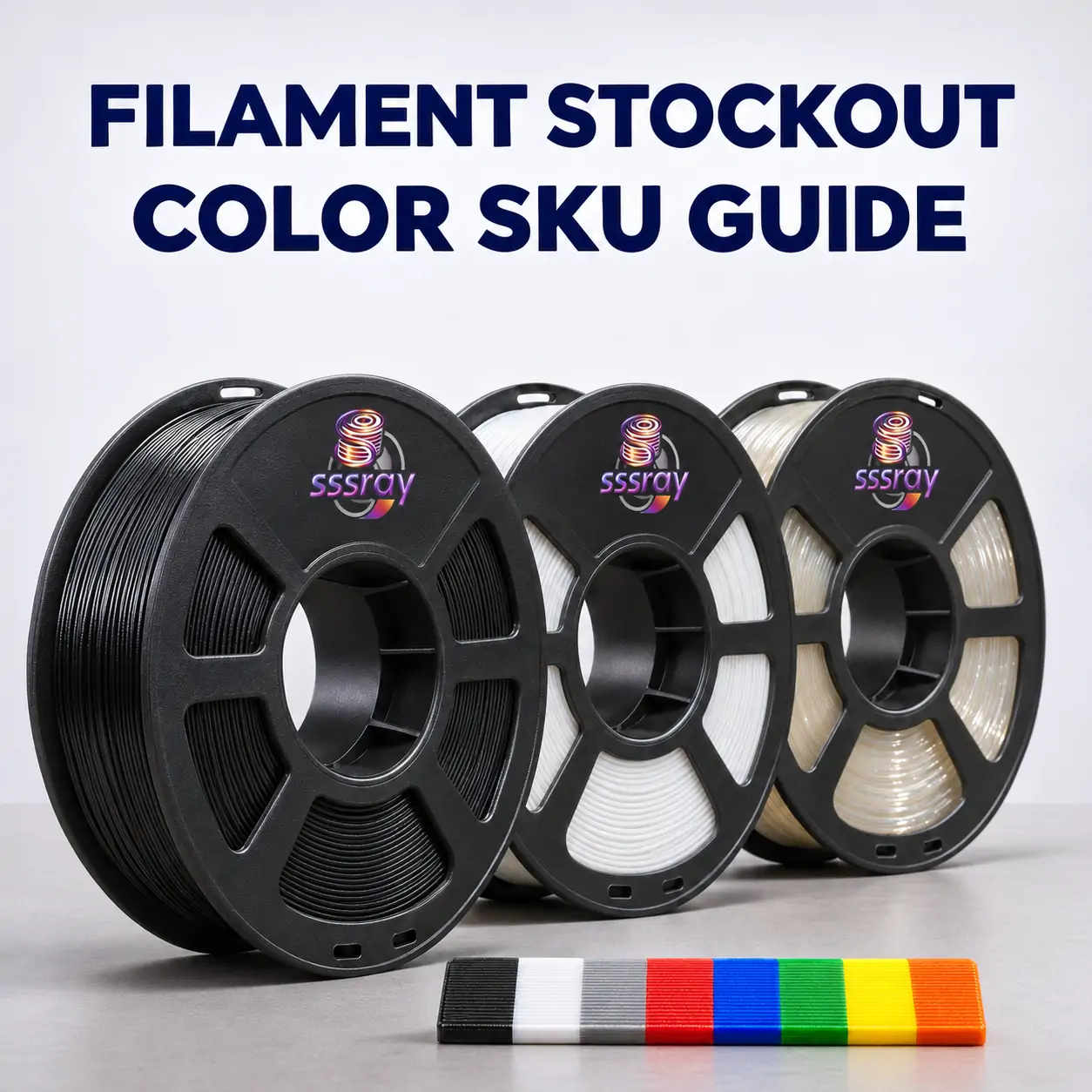
SSSray’s Color SKU Plan for Reliable Filament Reorders
At SSSray, we plan color availability at the SKU and batch level. For distributors and private-label buyers, our starting plan is 8–12 core colors with separate reorder points, a controlled seasonal range, and an approved printed color master for repeat orders.
Core color strategyA core range of 8–12 colors, each with its own reorder point, plus a small seasonal rotation bought as one-off lots.
Avoid overexpansionSkip a wide palette at launch. Under an independent-availability model, a 40-color range with 95% availability per color is fully in stock only 12.9% of the time.
Color acceptanceAn approved printed master and measured color tolerance: our PLA Matte Black example uses mean ΔE*ab below 0.800 across nine readings, with D65/10° and a fixed print profile.
Lot QC evidenceAsk for the lot color record: instrument, D65/10° conditions, readings against your master and the retained sample ID.
Custom-color runsA custom color is a minimum-run decision. At a 1–5 wt% dosage on a finished-blend basis, a 25 kg masterbatch lot corresponds to roughly 500–2,500 kg of finished filament.
How We Keep a Filament Color Range Reorder-Ready
Color stockouts can happen even when base resin is available. In an April 18, 2026 U.S. store snapshot, How-To Geek found about one-third of Bambu Lab PLA Basic colors unavailable and only 11 of 25 PLA Matte variants in stock. The sourcing issue for a distributor is therefore not only material availability: it is whether each color has a production slot, a realistic reorder point and a repeatable shade.
We approach these as one factory-to-buyer plan. Keep the core palette manageable, calculate replenishment by color, approve a physical printed master and verify production lots against that master. The sections below show the purchasing calculations, our color-control procedure and the QC records behind that approach.
1. Why Is 3D Printer Filament Out of Stock by Color, Not by Material?
At SSSray, we schedule color SKUs as distinct production lots. Even when the base resin is available, a color can run short if its masterbatch, extrusion slot or QC release is delayed.
What 2026 filament color availability data shows
- Retail snapshot: How-To Geek’s April 2026 check of Bambu Lab’s US store found a third of PLA Basic colors out of stock, 11 of 25 PLA Matte variants available, about half of basic PETG available and 4 of 11 ABS colors in stock.
- Manufacturer view: Sovol’s 2026 analysis calls it a color problem: the shade was not on the production schedule, or not enough of it passed quality control.
- Buyer view: one Bambu Lab forum user tracked six filaments in the EU store from 21 February to 21 April 2026. All six were in stock together in 107 of 2,839 snapshots, about 3.8%.
- Shade pattern: in another forum thread, the sold-out items were mostly alternative shades, such as Lake Blue, while the base Blue stayed available.
Base colors are usually scheduled more frequently, so they tend to recover sooner. Alternative shades may wait for a longer production interval, leaving one color SKU unavailable while other materials and colors remain in stock.
Three mechanisms behind a color stockout
- Run scheduling. Each color change on an extrusion line costs purge material and time, so lines are sequenced by color and a slow shade waits for its slot.
- Rejected runs. A run that misses its diameter or shade tolerance is reworked or scrapped. Buyers never see those spools; they only see “out of stock.”
- Multi-color demand. Multi-material printers made people buy sets. A customer who needs four colors is lost if one is missing.
The procurement action: ask a supplier which colors run on a fixed schedule and which run only against orders, then build your range on the first group.
2. Filament SKU Planning: How Many Colors Should a Filament Brand Stock?
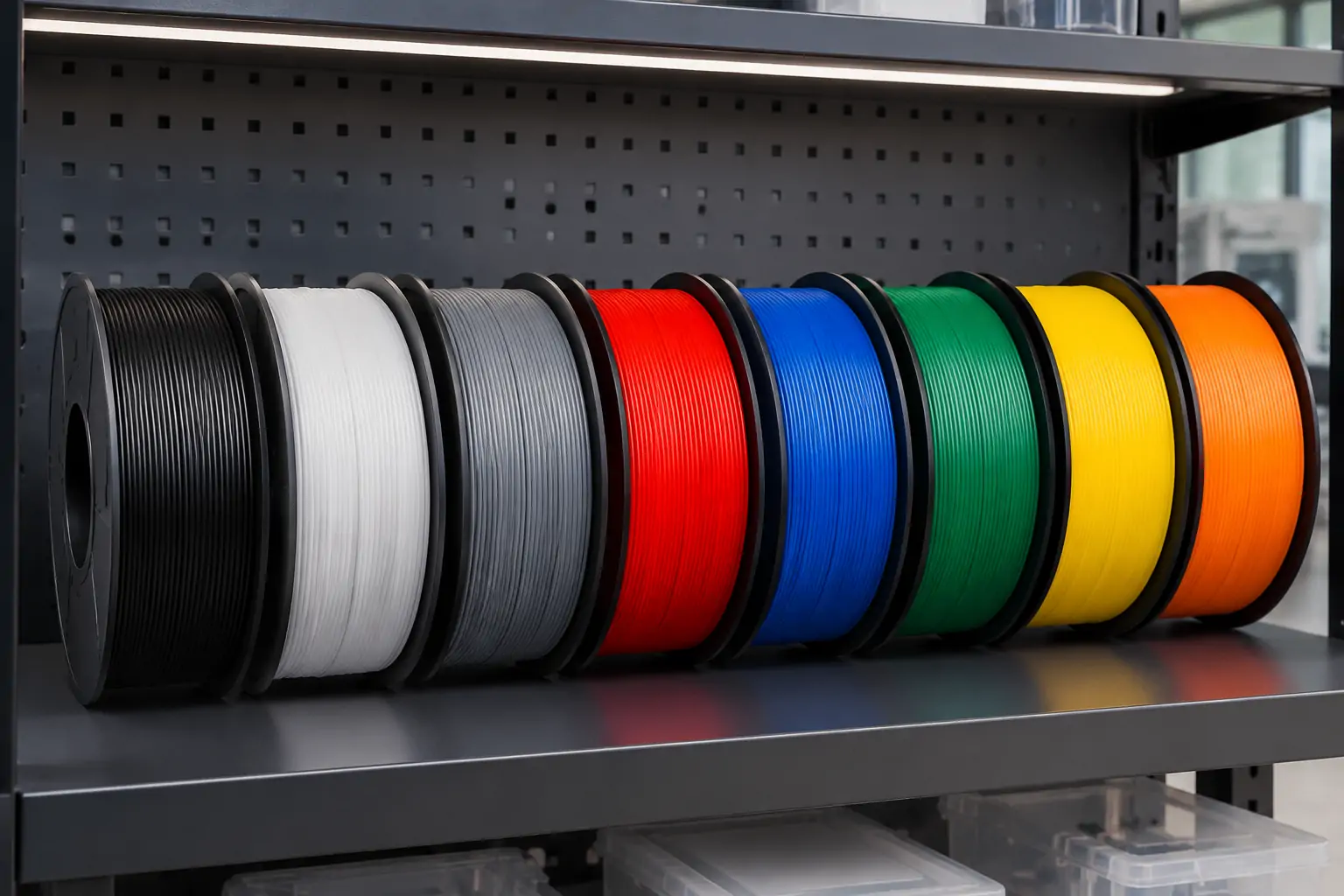
We recommend starting a new reseller assortment with 8–12 core colors, then adding seasonal or made-to-order shades after repeat demand is established. This is our sourcing starting point, supported by the availability model below—not a claimed market-wide benchmark.
The joint-availability math behind a short color range
A shop is not judged on one color. It is judged on whether the customer can fill the basket. If each color is in stock 95% of the time, the chance that all of them are in stock together falls quickly as the range grows.
Chance that every color in the range is in stock at the same time
98% in stock per color95% in stock per color90% in stock per color
At 95% per color, 12 colors are all available 54.0% of the time and 40 colors only 12.9%. Even at 98% per color, a 40-color range is complete less than half the time (44.6%).
Real stockouts are not fully independent because colors share extrusion lines, pigments and production schedules, so read the curve as a scenario model rather than a forecast. The forum tracker recorded six tracked items available together in 107 of 2,839 snapshots (3.8%). If those six items had equal, independent availability, that joint rate would imply about 58% availability per item (0.0381/6); it is an equivalent model rate, not a measured rate for each item.
What are the best-selling filament colors?
No public source provides a universal global ranking by filament sales volume. For a practical starting assortment, the manufacturer survey and available order data both point to black as the volume anchor.
- All3DP asked 46 filament manufacturers in September 2025. Of the 21 that answered, 17 said black is their most sold color; white came next, then natural and clear.
- In the same survey, Polar Filament said black 1.75 mm PLA alone would still be more than half of its business, and linked sudden color surges to the NFL playoffs.
- An older order-level reference comes from a different market: Hubs’ Q4 2018 trend report put black at 46% of 3D printing orders, white at 20% and gray at 5%, with every other color at 4% or less. Those are print-service orders, not filament sales, so use them for ranking only.
Our Search Console reporting export recorded 35 impressions for “pink TPU” and 30 for “gold TPU”. Impressions show search exposure, not clicks, orders or sell-through; these low counts are an early demand signal, not enough evidence to stock a separate color SKU. Test the query with a made-to-order listing, then validate it against quote requests and repeat sales.
A core-and-rotation plan you can copy
- Core (8–12 colors): black, white and gray first, then red, blue, green, yellow and orange, plus clear or natural for PETG. Hold depth and give each color a reorder point.
- Seasonal rotation: pastels, event colors, silk and matte effects. Buy one lot per season, promise no permanence, and reorder only if sell-through beats the target you set before buying.
- Custom or brand color: a Pantone or RAL match made to order against a signed color master and a customer commitment.
The tiers keep you honest with customers. We set a documented replenishment target for core colors, while seasonal colors are clearly marked as limited-run stock.
Procurement implicationBuild the first order from 12 months of sales by color, not from the supplier’s color card.
Mistake to avoidLaunching five blues at once. One strong blue comes first; shade depth comes after repeat demand.
How to verifyTrack in-stock days per color for one quarter and compare them with the joint figure in Figure 1.
3. How Resellers Prevent a Filament Out of Stock Notice: MOQ, Masterbatch Runs and Reorder Points
We set a separate reorder point for each core color using its sales history and the buyer’s full replenishment lead time. A rolling forecast helps us plan color runs before stock reaches the reorder threshold.
Why color MOQ follows the masterbatch, not the spool
Most filament is colored with masterbatch: pellets that carry concentrated pigment and are dosed into natural resin at the extruder. The dose is called the let-down ratio. It is commonly quoted at 1–5%, and one industry guide puts the norm for most colored products at 1–3%.
Now do the arithmetic. If let-down is defined as masterbatch mass divided by finished-compound mass, a 25 kg bag at 2 wt% corresponds to 1,250 kg of finished filament, or 1,250 one-kilogram spools. At 5 wt% it corresponds to 500 kg; at 1 wt%, 2,500 kg. If a supplier defines dosage against base-resin mass instead, the finished-compound total is slightly higher. State the dosage basis in the RFQ so the color-run calculation is comparable.
So a 100-spool order of a new color uses a small part of one bag, and the rest waits for a reorder that may never come. That is why custom colors carry a minimum quantity or a development fee, and why a reorder forecast lowers the price more than negotiation does.
A reorder-point model for three color tiers
The standard inventory formula is short. Reorder point = average weekly sales × lead time in weeks + safety stock. With fixed lead time, safety stock = Z × weekly demand standard deviation × √lead time, where Z = 1.65 for an approximately 95% cycle service level under the model assumptions. The calculation assumes demand observations are sufficiently stable and independent; if supplier lead time also varies, model lead-time variability separately. The method is described in ASCM’s inventory article by Peter L. King.
Table 1 applies it to three colors at an 8-week lead time. The sales figures are illustrative; replace them with your own.
On mobile, swipe horizontally to review every column.
| Color tier | Average sales (spools/week) | Standard deviation (spools/week) | Demand in lead time (spools) | Safety stock (spools) | Reorder point (spools) | Cover at reorder point (weeks) |
|---|---|---|---|---|---|---|
| Core, e.g. black | 60 | 18 | 480 | 84 | 564 | 9.4 |
| Retail, e.g. blue | 15 | 8 | 120 | 37 | 157 | 10.5 |
| Seasonal, e.g. pink | 4 | 4 | 32 | 19 | 51 | 12.8 |
Two things stand out. First, the slow color needs the most weeks of cover, because its sales are erratic relative to their size. Second, lead time drives the buffer: at 3 weeks, the same colors need 51, 23 and 11 spools of safety stock, about 39% less.
For inventory planning, count the full door-to-door replenishment cycle: production, packaging, export paperwork, freight and receiving. For qualifying orders with materials and line capacity available, production can be completed in as few as 5 business days for standard wholesale, 15 business days for OEM/private-label after packaging approval, and 20 business days for custom projects after color-sample approval. These are earliest production windows, excluding freight and transit; we confirm the actual schedule in the written quotation.
Four ways to source a filament color
Table 2 compares the routes a purchasing manager can actually choose between.
| Option | Best use case | Key spec | Advantage | Risk | How to verify | When to reject | SSSray sourcing note |
|---|---|---|---|---|---|---|---|
| Stock standard color | Core range, first order, supplier test | Supplier color ID plus lot ΔE against the supplier’s master | Lowest MOQ and shortest lead time | The supplier defines the shade and may revise it | Keep one spool per lot; ask for the lot color record | No lot number or no retained master | 40+ standard colors; order MOQ starts at 50 spools |
| Forecast-backed core program | Your top 8–12 colors with steady reorders | Rolling forecast, reorder point, agreed run slots | The color is already on the production schedule | You carry a forecast commitment | Written run frequency and reorder plan | Supplier cannot say how often each color runs | Send monthly sales by color; we plan reorder timing around the top SKUs |
| Custom Pantone or RAL match | Brand colors, private label, client programs | Physical master, ΔE limit, measurement conditions | A shade competitors cannot copy quickly | Minimum run, approval time, leftover masterbatch | Approve a printed coupon; sign two masters | Approval offered on a screen image only | Custom color sample preparation can be completed in as few as 3 business days after receipt of the reference, subject to lab capacity and project scope; dispatch and courier transit are additional |
| Seasonal one-off lot | Holiday, event and trend colors | One lot number; no reorder promise | Fresh range without long-tail stock | Leftover stock; a later lot may not match | One lot number across all cartons | Customers will need matching parts later | Add after the core colors show repeat demand |
Most resellers use three of the four at once: stock colors to start, a forecast-backed program for the winners, and seasonal lots for variety. Single-spool made-to-order services are a fifth route for tests; Section 6 compares them.
Procurement implicationGive the supplier a rolling forecast for core colors. It moves you from “next free slot” to “already scheduled.”
Mistake to avoidUsing one reorder rule for every color. Slow colors need more weeks of cover, not fewer.
How to verifyRecalculate reorder points each quarter from actual sales and actual door-to-door lead time.
4. Filament Batch Color Difference: Why the Same Color Looks Different Between Batches
We treat a repeat color as a controlled formulation, not merely a repeated SKU name. Pigment dose, base-resin shade, extrusion conditions and the buyer’s print settings can all change the finished appearance.
Buyers see this in the field. On the Bambu Lab forum, one user reported a clear shift between spools of Matte Desert Tan; the reply was that only spools from the same batch will be identical. Another user compared an older and a newer lot of Jade White and described a different color and surface.
Four technical causes in color masterbatch filament
- Dosing drift. At a 2% let-down, a dosing error of 0.1 percentage point changes the pigment load by 5%.
- Base resin shade. Natural pellets vary slightly from lot to lot. White is base resin plus white pigment, so it has nowhere to hide. PlasticsToday notes that whites and pastels are judged differently from deep, saturated colors.
- Heat history. Melt temperature and time in the barrel shift some pigments and the resin itself, so the same recipe at a different throughput can land apart.
- Print settings. A 2021 FDM color study found that wedge angle, feedstock color and infill density affect the measured appearance of PLA printed parts. We therefore lock the print profile when comparing a new batch with the approved color master.
Color can affect more than appearance. A 2023 study in Polymers tested four PLA colors and four layer heights and reported partial eta-squared values of 97.3% for color and 85.5% for layer height in its two-way ANOVA of tensile strength. Those effect sizes describe that study’s specific materials and test design; they are not universal percentages for all PLA formulations. For our color qualification programs, we use the intended print profile rather than assuming the natural-grade TDS predicts every colored formulation.
Metamerism: the match that fails under shop lights
Two samples can match in daylight and differ under warm LED light. This is metamerism: two recipes reach the same shade with different pigments. A simple test catches it. Put the new lot beside the master near a window, then under the lighting your customers use.
Procurement implicationRequire every lot to be compared with one fixed master, never with the previous lot.
Mistake to avoidApproving color on raw filament, then judging complaints on printed parts.
How to verifyPrint the same coupon from old and new lots on one locked profile and view them side by side.
5. Filament Color Consistency: What Delta E Is Acceptable for Filament Colors?
For side-by-side brand parts and multi-color kits, we propose an initial printed-coupon target such as ΔE00 ≤ 1.0, then agree on the formula, lighting, geometry, specimen and acceptance statistic before production. The final limit is set for the material and application, not copied from an unrelated product.
ΔE (Delta E) expresses the difference between two measured colors. The often-repeated “ΔE ≈ 1 is just noticeable” is a rule of thumb, not a universal visibility threshold: perception changes with hue, gloss, texture, specimen size, lighting, viewing distance and observer. Always pair the instrument result with a visual comparison under agreed conditions.
Do not mix formulas. ΔE*ab is the Euclidean distance in CIELAB; CIEDE2000 (ΔE00), specified by ISO/CIE 11664-6:2022, applies perceptual weighting corrections to the CIELAB coordinates defined by ISO/CIE 11664-4:2019. ASTM D2244-25 highly recommends ΔE00 for small differences in the 0.0–5.0 ΔE*ab range and requires purchaser and seller to agree on the permissible tolerance and calculation procedure.
Working ΔE tiers for reorder approval
These are our starting acceptance tiers for printed-part color discussions; we finalize the release threshold for the buyer’s material and application.
| ΔE against master | What people see | Suitable for | Decision |
|---|---|---|---|
| Up to 1.0 | Tight target; often low perceptibility in controlled comparison, but not guaranteed invisible | Core colors, multi-color sets, replacement parts, brand colors | Accept after visual confirmation |
| Above 1.0 to 2.0 | May be noticeable when lots are adjacent, depending on hue, finish and viewing conditions | Single-color products that are not mixed with older lots | Accept only with written concession; keep lots separate |
| Above 2.0 to 3.0 | Usually a material visual difference in side-by-side review | Utility or internal parts only after application review | Hold; segregate the lot or approve a different shade name |
| Above 3.0 | Clear shade shift is likely | Not suitable under the same color specification without a documented concession | Reject or relabel as a different shade |
For whites and pastels, review the direction of the color shift as well as the total ΔE00. A white may move warmer (positive Δb*) or cooler (negative Δb*) while remaining close on a single scalar score. Record ΔL*, Δa* and Δb* alongside ΔE so the buyer can see whether the shift is lightness, red–green or yellow–blue.
Five things a ΔE limit must state
- The formula: ΔE*ab, ΔE00 or CMC; results from different formulas cannot be compared.
- Illuminant and observer: for example D65 and 10°.
- The specimen: a printed coupon with fixed geometry and print profile, not pellets or raw filament.
- The instrument: model, measuring geometry and calibration status.
- The statistics: how many readings, and whether the limit applies to the mean or the worst reading.
Procurement implicationWrite the ΔE limit and its five conditions into the purchase order, per material.
Mistake to avoidComparing one supplier’s ΔE*ab with another supplier’s ΔE00.
How to verifyAsk for raw L*a*b* values for master and lot; recalculate ΔE yourself in a spreadsheet.
6. Filament Color Matching: Custom Pantone and RAL Filament, Lead Time and MOQ
We match custom filament colors from a Pantone or RAL reference or a physical sample. For repeat wholesale orders, the decisive steps are approving a printed master, confirming the per-color run quantity and fixing the production schedule.
Pantone filament and RAL color filament start from a plastic reference
Most filament color matching problems start with the reference. A paper fan shows ink on paper. Filament is a pigmented, slightly translucent plastic with its own gloss, so the two can share a code and still look different.
- RAL: RAL Classic has 216 colors. The RAL P1 plastics standard reproduces 100 of them as polypropylene plates, and P2 adds 200 RAL Design System plus colors.
- Pantone: Pantone Plastic Chips are polypropylene chips in tiered thickness with gloss and matte finishes, sold per color.
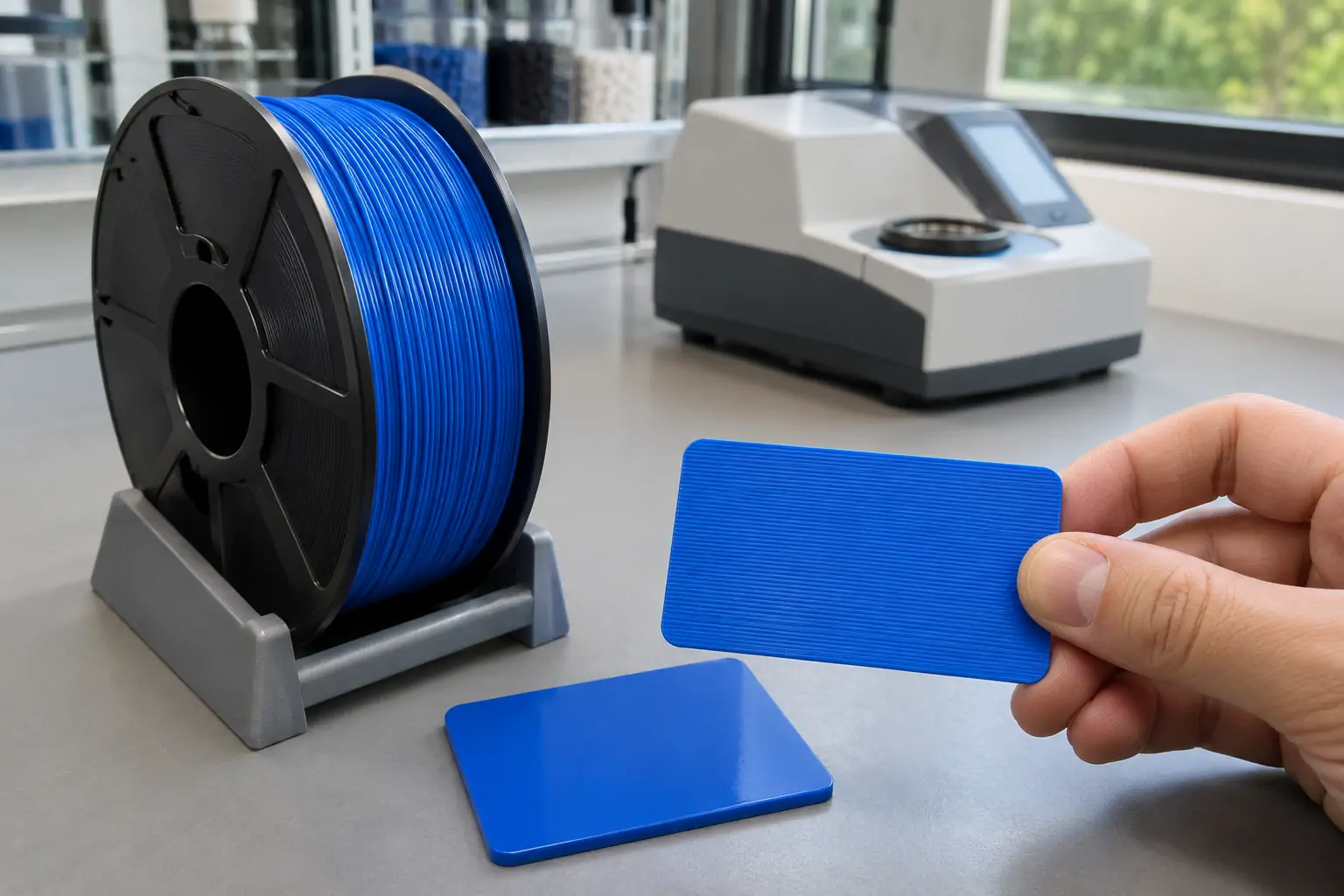
The order of trust: a printed coupon in the final polymer, then a plastic standard, then a paper fan, then a screen image. Sign only the first two as a master.
How long does custom color filament take, and what is the minimum order?
Table 4 lists what four programs publish. The first three are European programs; the last row is our own factory route, shown for comparison.
| Program | Reference system | Published minimum order | Published lead time | Extra cost or option noted |
|---|---|---|---|---|
| colorFabb Color on Demand (PLA) | RAL Classic; custom on request | One 750 g spool for matched RAL colors; 60 kg per color per diameter for other custom materials or colors | Help Centre currently states approx. 6 weeks before dispatch for matched and unmatched colors during its high-demand period; normal matched-color lead time is usually 5–8 business days | Optional color plaque before the spool; timing is subject to change |
| Spectrum Color Wish (PLA) | 213 RAL Classic colors plus custom shades | 1 kg | RAL Classic colors shipped within about 5 business days; individual colors can take longer | Lower price per kg on larger orders |
| Eolas Prints Colour on Request | RAL or Pantone | 30 kg | Not stated on the page | One-time €450 development cost |
| SSSray factory route | Pantone, RAL or a physical sample | Standard wholesale MOQ starts at 50 spools; custom-color quantity per shade is confirmed by project | Color-sample preparation from 3 business days after reference receipt; qualifying custom-color production from 20 business days after sample approval. Both are earliest schedules subject to capacity; dispatch and transit are separate | Quoted per project; written quotation confirms scope and schedule |
A made-to-order service wins when you need one spool soon. A factory route wins when the color must repeat by the pallet, with a lot record each time.
The approval loop, step by step
- Send the reference: a plastic standard, a printed part or a code, plus the material and finish.
- The color lab matches it and sends a sample.
- Print a coupon from that sample on your own printer and profile.
- Sign two masters from the approved coupon. One stays with you, one with the factory.
- Run a pilot lot and measure it against the master.
- Measure every reorder against the same master, and require written notice before any change of pigment or resin.
7. The Color SKU Lock Framework for Filament Color Availability
We use eight checkpoints to approve a color program, from demonstrated demand and a signed master to lot QC and a workable reorder schedule. If any checkpoint is missing, we resolve it before confirming the supply plan.
We call it a lock because each checkpoint fixes one thing that otherwise drifts: the range, the standard, the recipe or the schedule.
| Checkpoint | Why it matters | What to ask | Pass / fail signal | Hidden risk |
|---|---|---|---|---|
| Application requirement | The range should follow what your channel reorders | Which colors sold in the last 12 months? Which are bought together? | Pass: range built from sell-through. Fail: range copied from a color card. | Marketplace listings show supply, not demand |
| Color standard | A name or code is not a specification | Which physical master? Which formula, illuminant and observer? | Pass: sealed printed master in duplicate. Fail: screen image or hex code. | Paper fans and plastics do not look alike |
| Material performance | Pigment changes opacity and can change strength | Was this color tested, or only the natural grade? | Pass: data or coupon for the color. Fail: natural-grade TDS only. | A reformulated color can behave like a new material |
| Printability | Colors can need different temperature or flow | Is there a print profile per color? How does it purge in multi-color jobs? | Pass: locked profile and coupon. Fail: “same as black.” | Light colors show contamination after dark runs |
| Compliance | Pigments are part of the formulation | Do the RoHS and REACH files cover this exact color? | Pass: documents name the grade and color. Fail: generic certificate. | A new masterbatch source can change the status silently |
| Supplier reliability | Availability depends on the run schedule | Who matches the color? How often does each core color run? | Pass: named run rhythm, retained masters. Fail: “always in stock.” | Peak-season slots go to larger orders first |
| Landed cost | Slow colors tie up cash | MOQ per color? Development fee? What happens to leftover stock? | Pass: cost per sold spool. Fail: FOB price only. | Dead stock and unused masterbatch |
| Reorder stability | The next lot must match the first | Is there a lot color record on the COA? A change notice? | Pass: ΔE against your master on every lot. Fail: no retained sample. | Matching each lot to the previous one lets drift add up |
Score each checkpoint pass, conditional or fail. Approve only when nothing fails and every “conditional” has a written action and an owner.
Send your material, target colors or Pantone/RAL references, sales by color, first-order quantity, reorder forecast, destination market and packaging requirements. SSSray can return a core/seasonal SKU split, project MOQ, color-sample preparation schedule, production window and the lot-QC documents available for the selected order.
8. Supplier Claims vs Reality on Custom Filament Colors
We ask buyers to verify color claims against a physical master, a batch record or a defined test. The quotation and release record should show the same specification.
| Vague marketing claim | What it might hide | Document, sample or test to request | What a reliable supplier provides |
|---|---|---|---|
| “Pantone matched” | Matched to a paper fan or a screen, with no tolerance | Reference type, printed coupon, ΔE with formula | A signed master and a lot color record |
| “ΔE below 1” | No formula, illuminant or specimen; pellets measured instead of prints | Full measurement conditions and raw L*a*b* values | Conditions on the record, with mean and worst reading |
| “No color difference between batches” | No retained master; each lot matched to the last | Records for the last three lots against one master | A lot trend against a fixed master |
| “Always in stock” | Stock of some colors; no run schedule | Run frequency per color and a reorder plan | Named core colors, a schedule and lead time by order type |
| “Color sample in 3 days” | The sample is a chip, not filament; courier time is left out | The form of the sample and total days to your desk | Sample form, lab days and shipping days stated separately |
For SSSray orders, we separate lab time, production and freight. Color-sample preparation can be completed in as few as 3 business days after we receive the reference; standard wholesale production from 5 business days after order confirmation; OEM/private-label production from 15 business days after artwork approval; and custom-project production from 20 business days after sample approval. These are our earliest planning windows for qualifying orders, subject to material and line availability, and the quotation confirms the actual dates. Dispatch and transit are additional.
9. How SSSray Controls Filament Color Consistency: Protocol and Lot Record
At SSSray, we compare production-lot color with an approved printed master using spectrophotometer readings. For qualified B2B orders, our lot-specific COA/QC record links the approved shade to the Batch ID on the spool and carton.
Our protocol below defines the sampling and reporting fields for production-lot color checks. Our batch-QC page sets out material-family color release limits, and we issue first-party, lot-linked records for qualified B2B orders. The standard black PLA production record below documents lot-linked diameter, mass, ovality and density control; the separate PLA Matte Black color record reports measured ΔE against the approved master.
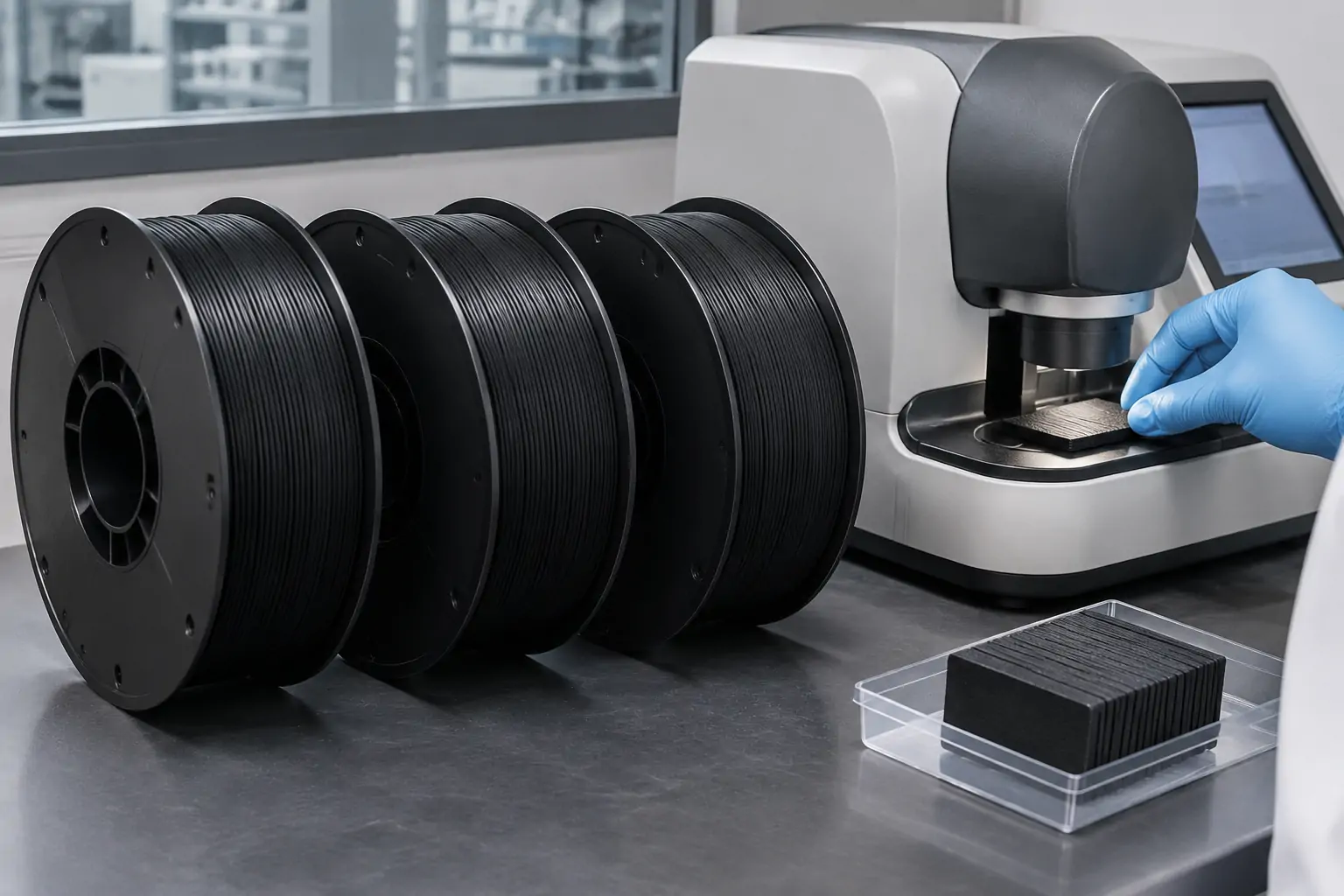
Protocol ID: SSSRAY-COLOR-LOCK-2026-11-R01 · Scope: solid colors in PLA, PETG/PCTG, ABS/ASA and TPU · Sampling plan: 3 spools per lot (start, middle and end of the run), 3 readings per coupon, 9 readings in total.
| Control point | Test condition | Acceptance / record requirement | Why it is controlled |
|---|---|---|---|
| Color master | Two printed coupons from the approved sample, sealed and dated | Master ID on every record; one coupon kept by us, one by the buyer | Reorders are matched to the master, not to the last lot |
| Coupon printing | 40 × 40 × 2 mm plate; 0.4 mm nozzle; 0.2 mm layers; 100% infill; locked profile per material | Profile ID recorded | Print settings change the color the customer sees |
| Measurement | Benchtop spectrophotometer; D65 illuminant; 10° observer; valid calibration record and white/zero verification before each lot; PLA Matte Black coupons conditioned for 24 h at 23 ± 2 °C and 50 ± 5% RH | Instrument model, serial number, calibration certificate, lot-verification status and test date linked to the QC record | A ΔE without conditions cannot be checked |
| Color difference | CIELAB coordinates against the approved master (ISO/CIE 11664-4:2019); report ΔE*ab and, when agreed, ΔE00 separately using ISO/CIE 11664-6:2022 | Published material-family target limits: PLA/PLA+/high-speed PLA ΔE < 0.8; PETG/PCTG ΔE < 1.0; ABS/ASA ΔE < 1.0; TPU ΔE < 1.2. In the PLA Matte Black record below, our release gate is mean ΔE*ab < 0.800 from nine readings. For each customer program, the approved PO specifies the governing ΔE formula and whether the agreed limit applies to the mean or to every individual reading | Never compare ΔE values from different formulas as if they were interchangeable |
| Visual check | Coupon beside the master under D65 daylight and warm-white LED | Pass or fail with inspector initials | Catches metamerism and gloss differences an instrument can miss |
| Change control | Any change of masterbatch, pigment source or base resin grade | Written notice before the change; new master if the shade is affected | Stops silent reformulation between reorders |
Published SSSray Production-Lot Record: Standard Black PLA, 1.75 mm
First-party production record: Batch ID PLA175-BK-260921-L12 · Test Record SSS-PLA-HTSQTY-LV-2026-0923-R1 · Product: standard SSSray black PLA, 1.75 mm, 1 kg net (not HT-PLA) · Produced 21 September 2026 · Measured 22–23 September 2026 · Lot size 600 spools · Sample: 20 spools, every 30th spool off the winder. Source: SSSray’s published Q1 verification and lot-data record.
Recorded equipment and methods: inline laser micrometer at 500 scans/s; bench digital micrometer with 0.001 mm readability; bench scale with 0.1 g readability checked against a 1 kg reference; 0.01 g balance for 1,000 mm linear-mass specimens; density by ISO 1183-1:2025 Method A using deionized-water immersion at 23 ± 2 °C, n = 9 specimens from three sampled spools. Diameter sampling produced 200 readings; ovality sampling produced 100 positions.
| Parameter | Sample size | Measured / calculated result | Release / interpretation |
|---|---|---|---|
| Net filament weight | 20 spools | Mean 1,004.3 g; range 1,001.7–1,007.9 g | Release gate ≥ 1,000 g; 20/20 sampled spools passed |
| Diameter | 200 readings | Mean 1.750 mm; SD 0.008 mm; range 1.729–1.768 mm | Release gate 1.75 ± 0.03 mm; 199/200 readings were within ± 0.02 mm |
| Process capability | 200 diameter readings | Cpk ≈ 1.25 | Approximate capability estimate using the reported 0.008 mm SD and ±0.030 mm diameter limits: 0.030 / (3 × 0.008) = 1.25 |
| Ovality | 100 positions | Mean 0.007 mm; maximum 0.014 mm | Release gate ≤ 0.020 mm; maximum remained below the gate |
| Density | 9 specimens | Mean 1.243 g/cm³; range 1.241–1.246 g/cm³ | Consistent with the 1.24 g/cm³ PLA TDS value used for production planning |
| Linear mass | 20 spools | Mean 2.99 g/m; range 2.95–3.02 g/m | Direct one-metre mass check supporting spool-length and quantity verification |
| Calculated filament length | 20 spools | Mean 335.9 m; range 331.7–341.7 m | Calculated spool by spool from net filament mass ÷ measured linear mass, then averaged |
Our standard black PLA lot record documents spool quantity and dimensional QC. The following PLA Matte Black record demonstrates the color-specific measurements that we use to control repeat shades against an approved master.
Color Batch Consistency: Three-Lot Production Record, PLA Matte Black
For this record, we apply the 3-spool × 3-reading sampling plan to one PLA Matte Black master. The master coordinates are L* = 18.500, a* = 0.200, b* = −0.500. Each lot contains n = 9 individual readings: three positions on each of three spools sampled from the start, middle and end of the run.
Record family: SSS-PLA-MBK-COLOR-2026-11 · Master ID: SSS-MASTER-PLA-MBK-260901 · Material / color: PLA Matte Black, 1.75 mm · Lot production dates: 1, 4 and 7 November 2026 · Release rule: mean ΔE*ab across n = 9 readings < 0.800. Maximum individual reading is also reported but is not part of this mean-based release rule.
Release record: released 3, 6 and 9 November 2026 (two days after each test date) · Inspector / reviewer: QC inspector initials recorded per visual check; color release reviewed and approved by the color QC supervisor · Instrument calibration: X-Rite Ci7800 serial SSS-CI7800-001, calibration certificate SSS-CAL-COLOR-2026-11-R01, valid to 30 November 2026; white/zero verification before each lot · Batch traceability: each Batch ID is printed on the carton and spool label and matches the lot color record.
Equipment and conditions: X-Rite Ci7800 sphere benchtop spectrophotometer, serial SSS-CI7800-001; d/8° geometry; D65; 10° observer; 25 mm reflectance aperture; SCI; white/zero calibration check before each lot. Coupon print setup: 0.4 mm nozzle, 0.20 mm layer height, 100% infill, 40 × 40 × 2 mm plaque; conditioning 24 h at 23 ± 2 °C and 50 ± 5% RH.
Calculation: ΔE*ab is the CIELAB 1976 Euclidean distance; ΔE00 is CIEDE2000. Both are calculated against the same master coordinates. The CIELAB coordinates follow ISO/CIE 11664-4:2019; CIEDE2000 follows ISO/CIE 11664-6:2022. Values are rounded to three decimals after calculation.
| Batch ID | Test Record ID | Test date | n | Mean L*, a*, b* | Mean ΔE*ab | ΔE*ab range | Mean ΔE00 | ΔE00 range | Release decision |
|---|---|---|---|---|---|---|---|---|---|
| PLA-MBK-261101-A | SSS-COLOR-2026-11-A | 2026-11-01 | 9 | 18.861, 0.200, -0.494 | 0.363 | 0.322–0.412 | 0.251 | 0.222–0.283 | PASS by mean rule |
| PLA-MBK-261104-B | SSS-COLOR-2026-11-B | 2026-11-04 | 9 | 19.048, 0.217, -0.519 | 0.550 | 0.501–0.600 | 0.380 | 0.343–0.410 | PASS by mean rule |
| PLA-MBK-261107-C | SSS-COLOR-2026-11-C | 2026-11-07 | 9 | 19.244, 0.210, -0.509 | 0.746 | 0.691–0.804 | 0.512 | 0.474–0.555 | PASS by mean rule; max individual ΔE*ab 0.804 needs review if PO caps every reading at 0.800 |
The three lot means move from ΔE*ab 0.363 to 0.550 to 0.746 against the same master. All three pass the mean-based release rule of < 0.800, but the upward drift is a process signal: investigate pigment dosing, base-resin shade and extrusion history before the next reorder. Lot C’s maximum individual ΔE*ab is 0.804; a buyer who writes a per-reading maximum of < 0.800 into the PO would place that lot on hold even though its mean passes. This is why a COA should show both mean and maximum, not only PASS.
| Batch ID | Test Record ID | Test date | Spool position | Reading | L* | a* | b* | ΔE*ab | ΔE00 |
|---|---|---|---|---|---|---|---|---|---|
| PLA-MBK-261101-A | SSS-COLOR-2026-11-A | 2026-11-01 | Start | 1 | 18.82 | 0.18 | -0.47 | 0.322 | 0.222 |
| PLA-MBK-261101-A | SSS-COLOR-2026-11-A | 2026-11-01 | Start | 2 | 18.88 | 0.22 | -0.52 | 0.381 | 0.262 |
| PLA-MBK-261101-A | SSS-COLOR-2026-11-A | 2026-11-01 | Start | 3 | 18.85 | 0.16 | -0.49 | 0.352 | 0.246 |
| PLA-MBK-261101-A | SSS-COLOR-2026-11-A | 2026-11-01 | Middle | 1 | 18.91 | 0.19 | -0.46 | 0.412 | 0.283 |
| PLA-MBK-261101-A | SSS-COLOR-2026-11-A | 2026-11-01 | Middle | 2 | 18.86 | 0.23 | -0.54 | 0.363 | 0.253 |
| PLA-MBK-261101-A | SSS-COLOR-2026-11-A | 2026-11-01 | Middle | 3 | 18.83 | 0.21 | -0.48 | 0.331 | 0.227 |
| PLA-MBK-261101-A | SSS-COLOR-2026-11-A | 2026-11-01 | End | 1 | 18.89 | 0.17 | -0.51 | 0.391 | 0.270 |
| PLA-MBK-261101-A | SSS-COLOR-2026-11-A | 2026-11-01 | End | 2 | 18.84 | 0.24 | -0.45 | 0.346 | 0.245 |
| PLA-MBK-261101-A | SSS-COLOR-2026-11-A | 2026-11-01 | End | 3 | 18.87 | 0.20 | -0.53 | 0.371 | 0.254 |
| PLA-MBK-261104-B | SSS-COLOR-2026-11-B | 2026-11-04 | Start | 1 | 19.00 | 0.22 | -0.52 | 0.501 | 0.343 |
| PLA-MBK-261104-B | SSS-COLOR-2026-11-B | 2026-11-04 | Start | 2 | 19.06 | 0.18 | -0.48 | 0.561 | 0.384 |
| PLA-MBK-261104-B | SSS-COLOR-2026-11-B | 2026-11-04 | Start | 3 | 19.02 | 0.25 | -0.55 | 0.525 | 0.366 |
| PLA-MBK-261104-B | SSS-COLOR-2026-11-B | 2026-11-04 | Middle | 1 | 19.10 | 0.21 | -0.51 | 0.600 | 0.410 |
| PLA-MBK-261104-B | SSS-COLOR-2026-11-B | 2026-11-04 | Middle | 2 | 19.07 | 0.24 | -0.57 | 0.576 | 0.400 |
| PLA-MBK-261104-B | SSS-COLOR-2026-11-B | 2026-11-04 | Middle | 3 | 19.03 | 0.19 | -0.49 | 0.530 | 0.363 |
| PLA-MBK-261104-B | SSS-COLOR-2026-11-B | 2026-11-04 | End | 1 | 19.09 | 0.23 | -0.53 | 0.592 | 0.407 |
| PLA-MBK-261104-B | SSS-COLOR-2026-11-B | 2026-11-04 | End | 2 | 19.01 | 0.17 | -0.46 | 0.512 | 0.353 |
| PLA-MBK-261104-B | SSS-COLOR-2026-11-B | 2026-11-04 | End | 3 | 19.05 | 0.26 | -0.56 | 0.557 | 0.390 |
| PLA-MBK-261107-C | SSS-COLOR-2026-11-C | 2026-11-07 | Start | 1 | 19.19 | 0.18 | -0.47 | 0.691 | 0.474 |
| PLA-MBK-261107-C | SSS-COLOR-2026-11-C | 2026-11-07 | Start | 2 | 19.25 | 0.23 | -0.54 | 0.752 | 0.516 |
| PLA-MBK-261107-C | SSS-COLOR-2026-11-C | 2026-11-07 | Start | 3 | 19.22 | 0.20 | -0.51 | 0.720 | 0.492 |
| PLA-MBK-261107-C | SSS-COLOR-2026-11-C | 2026-11-07 | Middle | 1 | 19.30 | 0.25 | -0.56 | 0.804 | 0.555 |
| PLA-MBK-261107-C | SSS-COLOR-2026-11-C | 2026-11-07 | Middle | 2 | 19.27 | 0.19 | -0.48 | 0.770 | 0.527 |
| PLA-MBK-261107-C | SSS-COLOR-2026-11-C | 2026-11-07 | Middle | 3 | 19.23 | 0.22 | -0.52 | 0.731 | 0.500 |
| PLA-MBK-261107-C | SSS-COLOR-2026-11-C | 2026-11-07 | End | 1 | 19.28 | 0.17 | -0.45 | 0.782 | 0.538 |
| PLA-MBK-261107-C | SSS-COLOR-2026-11-C | 2026-11-07 | End | 2 | 19.20 | 0.24 | -0.55 | 0.703 | 0.485 |
| PLA-MBK-261107-C | SSS-COLOR-2026-11-C | 2026-11-07 | End | 3 | 19.26 | 0.21 | -0.50 | 0.760 | 0.520 |
Interpretation: compare each lot to the fixed master, calculate both formulas from the same L*a*b* readings, aggregate n = 9, report the range and maximum, and evaluate the trend across sequential lots. Never compare a ΔE*ab limit with a ΔE00 result as if the units were interchangeable.
Each real lot color record then carries eight fields, so a buyer can audit it without visiting the factory:
- Record ID: the lot-linked color QC identifier (for example SSS-COLOR-2026-11-A).
- Date: production date and measurement date.
- Lot number: the Batch ID printed on the master carton and on each spool label.
- Equipment: spectrophotometer model and serial number; printer and profile ID.
- Method or standard: CIELAB per ISO/CIE 11664-4, with the formula named.
- Sample count: 3 spools, 9 readings.
- Conditions: D65, 10°, 23 ± 2 °C, coupon geometry.
- Result: mean L*, a*, b*; mean and maximum ΔE against the master; pass or fail.
Lot traceability: the published release limits are control gates; shipment readings are batch-specific and must match the Batch ID on the carton and spool label. Ask for the actual COA/QC record for your order. Our qualification route starts at 50 spools.
10. Sourcing Specs for a Custom Filament Color Program: What to Put in the RFQ
We quote custom-color orders against eight agreed RFQ fields. Table 11 shows the information we use to confirm material, color, production, packaging and repeat-order control.
| Item | What to specify | Our reference |
|---|---|---|
| MOQ | Per order, per stock color and per custom color | Standard wholesale MOQ starts at 50 spools; custom-color quantity per shade is confirmed by project |
| Lead time | Production, packaging and transit, each in writing | Earliest production windows for qualifying orders: standard wholesale from 5 business days after order confirmation; OEM/private label from 15 business days after packaging approval; custom project from 20 business days after sample approval. Final schedule depends on material and line availability; freight transit is additional |
| Sample approval | Reference type, printed coupon, master IDs | Custom color sample preparation from 3 business days after receipt of the reference for qualifying projects, subject to lab capacity; sample dispatch and courier transit are additional. Standard sample timing depends on material and availability |
| Tolerance | Diameter, plus the ΔE limit with its five conditions | ±0.03 mm diameter; published color release limits by material as in Table 7; state the ΔE formula and acceptance statistic in the PO |
| Documentation | COA with lot color record, TDS, SDS; RoHS or REACH by destination | COA for batch orders; TDS, SDS, RoHS and REACH by material and market |
| Packaging | Vacuum bag, desiccant, color name and lot number on the label | Vacuum packing with desiccant; label and carton details confirmed before production |
| Private label | Your color names, one barcode per color, box artwork | Custom labels, retail boxes, barcodes and carton marks |
| Reorder control | Master ID, change notice, reorder forecast | Reorder spec linked to the approved sample; reorder timing planned around your top colors |
If a quotation leaves any of these eight lines blank, ask for it before comparing prices.
11. Filament Color Availability and Matching FAQ for B2B Buyers
Why are 3D printer filament colors out of stock?
3D printer filament out of stock is often a color-SKU scheduling issue rather than a shortage of base resin. Each color may require its own masterbatch, purge or changeover, production slot and inventory buffer. A stockout in one shade can therefore coexist with available resin and other colors. For a multi-color range, set separate reorder points for core colors and confirm the supplier’s run schedule and lot-specific quality record.
How many colors should a filament brand stock?
Start with 8–12 core colors as a planning rule, not a universal market benchmark. Under an independent-availability model, if each color is in stock 95% of the time, the chance that all 12 are available together is 0.95^12 = 54.0%; for 40 colors it is 0.95^40 = 12.9%. Actual colors are correlated by shared lines and demand, so use this as a scenario model, then replace the inputs with your own SKU availability history.
What are the best-selling filament colors?
All3DP’s September 2025 survey asked 46 filament manufacturers and received 21 responses; 17 respondents named black as their top-selling color, followed by white, natural and clear. The survey reports the leading color, not global sales volume. Hubs’ Q4 2018 order data recorded black at 46%, white at 20% and gray at 5%; those figures describe 3D-printing service orders, not filament sales. Use them as directional evidence and validate against your own sell-through.
Why does the same filament color look different between batches?
Color can shift when masterbatch dosing, base-resin shade, pigment lot, extrusion heat history, throughput or print settings change. Compare each production lot with one approved physical master, not just the previous batch. Record instrument geometry, illuminant, observer, specimen and formula; print comparison coupons using one locked profile because printed appearance can differ from raw filament.
What Delta E is acceptable for filament colors?
There is no universal pass value. For adjacent brand parts or multi-color kits, buyers often start with a tight target such as ΔE00 ≤ 1.0 against an approved printed master, then confirm visual acceptability under agreed lighting. ASTM D2244-25 recommends ΔE00 for small color differences and requires buyer and seller to agree on the tolerance and calculation procedure. The purchase order should identify the formula, illuminant, observer, geometry, specimen, sample count and whether the limit applies to the mean or the maximum.
Can SSSray match a custom Pantone or RAL filament color, and what are the MOQ and lead times?
SSSray supports custom color matching from Pantone, RAL or a physical reference. The standard wholesale MOQ starts at 50 spools; the per-color quantity for a custom shade is confirmed in the project quotation. For qualifying projects, custom color sample preparation can be completed in as few as 3 business days after we receive the reference. Our earliest production windows are 5 business days for standard wholesale after order confirmation, 15 business days for OEM/private-label after artwork approval and 20 business days for custom orders after approved color sampling. Material availability and production capacity determine the actual schedule in our written quotation; dispatch and freight transit are separate.
12. Conclusion: Plan the Colors Before the Shelf Goes Empty
Most recurring color-SKU stockouts become easier to prevent when the color range, reorder threshold and production slot are planned together. That is where we start with our wholesale customers.
Our recommended plan is practical: start with 8–12 core colors, set a reorder point from real sales and door-to-door lead time, approve a printed master with a defined ΔE formula, and quote seasonal or custom shades as separately scheduled runs. That gives buyers a clearer availability target and a repeatable color specification.
The next step is a color plan you can price. Send your sales by color (or top ten SKUs), target market and channel, Pantone/RAL references or a physical sample, the agreed ΔE formula and viewing conditions, first-order quantity, reorder forecast and packaging requirements. The quotation can then specify the core/seasonal split, MOQ by order route, color-sample preparation window, production schedule and the lot-QC documents available for the selected program.
Prefer to start smaller? Request a sample spool in your key color, ask for the TDS, COA and SDS, compare materials across our 3D printer filament supplier range, ask about OEM packaging, or send a bulk quote request for custom PLA.
Request a quote or free samples
Tell us the material, color, spool size and monthly volume. An engineer replies within 24 hours on business days.
13. References
- Sovol: 3D printer filament out of stock, the filament color crisis 2026: scheduling and quality-control causes of color stockouts.
- SSSray: 3D Printer Filament Batch QC Data & Factory COA: published material-family release limits, lot traceability and batch-documentation route.
- SSSray: Chinese New Year 2027 Filament Ordering Guide: published first-party production-lot QC record for standard black PLA, Batch PLA175-BK-260921-L12.
- How-To Geek (via Yahoo Tech), 2026: Bambu Lab US store availability counts by material and color.
- Bambu Lab Community Forum: stock tracking thread, PETG-HF stock thread and Matte Desert Tan color thread: buyer-reported availability and batch color differences.
- All3DP: What’s Everyone 3D Printing With? We Surveyed 46 Filament Companies, 13 September 2025: best-selling colors and seasonality.
- Hubs: Online Manufacturing Trends Q4 2018: most used 3D printing colors by order share; these are print-service orders, not filament sales.
- ASCM: King, P. L. and Bigler, C., Better planning and scheduling with the right cycle stock levels: cycle stock, safety stock and the 2011 “Crack the Code” method.
- Plastics Consultancy Network: Mixing, compounding and masterbatches: let-down ratios and masterbatch consistency.
- ISO/CIE 11664-6:2022 Colorimetry, Part 6: CIEDE2000 colour-difference formula, with ISO/CIE 11664-4:2019 for CIELAB.
- ASTM D2244-25: Standard Practice for Calculation of Color Tolerances and Color Differences from Instrumentally Measured Color Coordinates: recommends ΔE00 for small differences and requires buyer/seller agreement on tolerance and procedure.
- X-Rite: Tolerancing in Flexo and Offset Printing and PlasticsToday: It’s Past Time to Standardize Color Tolerances for Plastics: ΔE visibility and formula choice.
- Frunzaverde, D. et al., Polymers 2023, 15, 2377 and Golhin, A. P., Strandlie, A. and Green, P. J. (2021): color, layer height and printed-part performance; PLA geometry, feedstock color and infill effects on measured color appearance.
- Custom-color programs and plastic standards: colorFabb Color on Demand, its MOQ note and current lead-time guidance; Spectrum Color Wish; Eolas Prints Colour on Request; RAL P1 plastics standard; and Pantone Plastic Chips.
- X-Rite Ci7800 benchtop sphere spectrophotometer: manufacturer specifications for the instrument model used in this record.

He Jiang
Senior Researcher · SSSray · 3D Printing Filament Manufacturing · Jinhua, Zhejiang
He Jiang is a senior researcher at SSSray, a 3D printing filament manufacturer in Jinhua, Zhejiang, China. His work at SSSray covers color range planning, reorder points, ΔE acceptance, and custom Pantone and RAL matching for B2B distributors, private-label brands, and print farms. This work draws on 2026 availability data, published color standards and SSSray’s lot-linked color control records.