Online time
Monday to Friday: 9AM - 8PM
Weekend: 10AM - 5PM

What Australian Filament Importers Should Budget
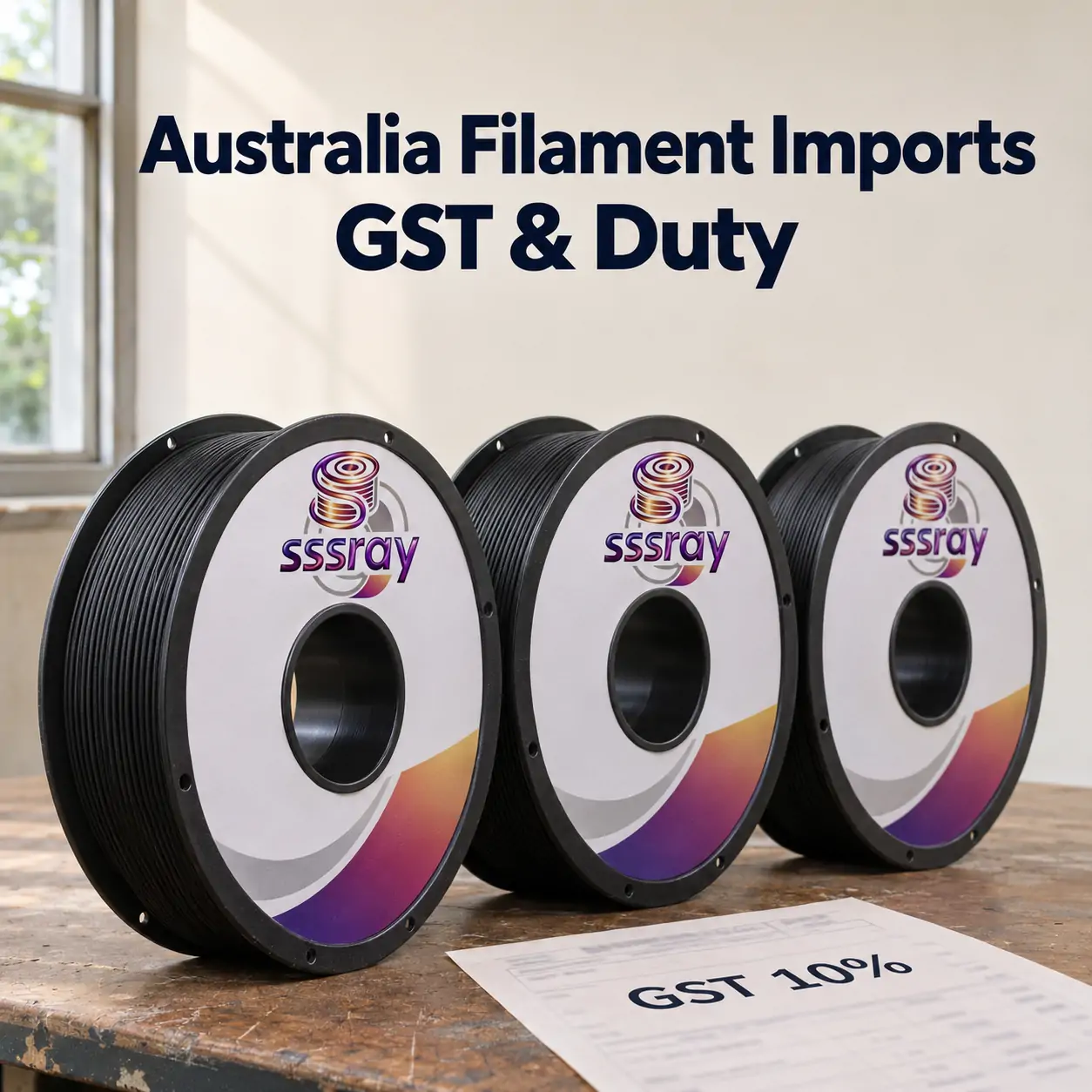
Australia GST on imports is generally 10% of the value of a taxable importation. Eligible 3D printing filament of Chinese origin can enter at 0% customs duty under ChAFTA, while goods and services tax (GST), clearance charges and biosecurity checks still apply as relevant.
Our bulk-shipping approachFor repeat Australian wholesale orders, we quote FOB Ningbo or EXW and help buyers compare sea-freight landed cost with local stock on the same warehouse-delivered basis. The Australian broker confirms tariff and origin treatment.
Qualify before bulkWhen a grade has not passed incoming checks, start with SSSray qualification samples. Australian stock can protect a fixed print deadline while we prepare the repeat-volume plan.
What we documentOur factory quote records the grade, diameter, net filament weight, packing specification and trade term. The Australian broker determines customs value and taxable freight and insurance.
Origin and packing evidenceFor SSSray orders, we confirm production-origin evidence and agree the ChAFTA Certificate of Origin and packing-document workflow with your broker and forwarder before loading.
Cash-flow visibilityWe keep import GST, ABF processing, DAFF biosecurity and destination logistics on separate cost lines. A 0% duty preference still needs an accurate clearance cash plan.
How SSSray Builds an Australian Import Plan
At SSSray, we start an Australian wholesale quote with the filament grade, net weight, packaging and FOB Ningbo or EXW basis. A box of PLA samples and a pallet of the same PLA can follow different clearance paths. Before purchasing approves the landed-cost target, we separate customs-value, transport, insurance and packing assumptions so the Australian broker and forwarder can cost the full route.
The China–Australia Free Trade Agreement (ChAFTA) can eliminate customs duty on a qualifying tariff line. The goods must meet the agreement’s origin requirements, and the importer needs the appropriate evidence to claim the rate. GST follows a separate calculation. In our costing model, we include the relevant transport and insurance that a factory invoice alone cannot capture in the GST base. We also show import GST separately so a buyer funding several replenishment shipments can plan cash as well as price.
We follow a commercial-filament order from quote to warehouse. First we establish what the Australian Border Force (ABF) needs for clearance and which tariff outcomes the buyer should budget. Then we compare two duty scenarios using the same shipment and show where GST, declaration charges and local logistics sit. Finally, we hand off the order through a timeline for origin paperwork, packing, entry, receipt and finance. The same process gives distributors, private-label brands and print farms a fair way to compare factory-direct supply with an Australian filament supplier while protecting product qualification and reorder timing.
Key Takeaways
- Set the tax base before comparing offers. For an ordinary taxable filament shipment, apply 10% to the customs value, relevant freight and insurance, and duty payable.
- Use the AUD 1,000 customs-value decision point. Ordinary goods over it generally need a Full Import Declaration. A small parcel can still raise separate checkout GST questions.
- Budget both plausible duty outcomes. If ABF classification is 3916.90.00, the current general rate is 5%. The ChAFTA rate is 0% when the product qualifies and the preference is supported.
- Get the entry costs itemised. An electronic sea entry over AUD 1,000 and below AUD 10,000 carries an AUD 50 import processing charge and a separate AUD 71 biosecurity declaration charge.
- Check who can claim the GST credit. Match the importing entity on the declaration to finance’s records and confirm eligibility. Approved deferral moves the import GST to the monthly activity statement.
- Treat all solid timber in the load as a packing check. Request the declaration and evidence for pallets, blocking and dunnage. Take photos of the actual marks before loading.
- Compare cost per accepted net kilogram. Include equivalent delivery and handling costs, then check the lot against the approved sample and the receiving specification.
Australia GST on Imports and the AUD 1,000 Threshold
For typical commercial filament, start with the AUD customs value of the consignment. Above AUD 1,000, plan for a Full Import Declaration and calculate GST separately on the taxable importation.
Which amount goes into each calculation?
Customs value is the figure the broker uses for duty and the clearance threshold. A Free on Board (FOB) invoice is a starting point for this purchase scenario. Australian valuation rules determine the declarable value, including adjustments where needed, and the ABF uses the exchange rate on the date of export for foreign-currency goods. Ask the broker to show what it included in its valuation, especially when an OEM quote rolls packaging, tooling or freight into one price.
Value of the taxable importation (VoTI) is the GST base. For the ordinary polymer filament in this guide, it is customs value plus duty payable plus transport and insurance to the Australian place of consignment, to the extent they have not already been included in customs value. GST is 10% of that amount. The place of consignment can depend on the transport document and how the carriage was arranged. Have the broker review any bundled destination legs before reusing a freight figure.
How does the threshold work for samples?
For ordinary non-excisable filament consignments with a customs value of AUD 1,000 or less, most freight clears through a Self-Assessed Clearance process and usually has no GST collected at the border. The postal channel has its own clearance process. An overseas seller or marketplace may collect GST at sale under the low-value rules. Australian GST-registered businesses buying for business use should provide their ABN and confirm their GST registration when ordering. A supplier waiver on the sample price still leaves the broker or courier to determine an appropriate customs value.
For example, use the actual consignment details when several grades share a master carton. Compare the consignment’s customs value with the threshold and check any GST already shown on the seller invoice before dispatch. The ABF explains the entry routes, and the Australian Taxation Office (ATO) explains the business-purchaser treatment. ABF import declarations · ATO low-value goods guidance
ChAFTA Duty on Filament and the Proof of Origin
A filament shipment classified under Australian tariff item 3916.90.00 can qualify for 0% duty under the China–Australia Free Trade Agreement. The general rate for that item is 5%, so verify the product classification and origin before pricing the purchase order.
Check the finished product and the manufacturing inputs
For ordinary 1.75 mm plastic monofilament, such as unfilled PLA or PETG, 3916.90.00 is a starting point for the broker to review. The heading covers plastic monofilament with a cross-sectional dimension exceeding 1 mm. Provide the exact polymer, diameter, additives or reinforcement, spool presentation and anything sold with it. The broker can then check whether blends, kits or unusual grades use the same line and whether a formal ruling would help.
ChAFTA Annex II lists a change in tariff subheading (CTSH) for finished goods under heading 3916 when assessing non-originating inputs under the product-specific rule. For example, extrusion from resin classified in a different subheading can support that analysis if the relevant inputs and production facts qualify. Re-spooling imported finished filament already classified in the same subheading does not establish that tariff change. For SSSray grades, we document the production location and the grade-specific origin basis; the Australian broker reviews the inputs and any applicable exceptions. DFAT product-specific rules · ABF Chapter 39 · ABF Schedule 12
How SSSray Handles Origin and Customs Evidence
- Production origin. For SSSray orders, we identify where the grade is extruded and document its origin basis; a shipment leaving China is not by itself proof of Chinese origin. For an eligible ChAFTA claim, we coordinate the Certificate of Origin from an authorised Chinese issuer and provide it for matching to the invoice and shipment.
- Correct origin document. We do not treat a general self-signed declaration as a substitute for the ChAFTA Certificate of Origin. A Declaration of Origin is an alternative for goods covered by the required advance origin ruling. We agree the appropriate route with the Australian broker before finalising the document pack.
- Destination clearance owner. Under our usual FOB Ningbo or EXW terms, we prepare the agreed factory export documents and coordinate with your nominated forwarder. The Australian importer and broker confirm classification, entry and destination charges. When cargo transits a third country, we ask the forwarder to retain the routing and customs-control evidence needed for ChAFTA review.
Before the Australian sailing is booked, we share the grade description, draft commercial invoice, packing list and agreed origin-document route with the buyer’s broker. While a preference claim is being checked, we keep the 5% general-duty scenario alongside the eligible 0% ChAFTA case, allowing purchasing to approve a realistic budget. Our supplier comparison tool helps your team assess the document pack alongside sample and lot evidence. DFAT guide to using ChAFTA
Australia GST on Imports, Processing Charges and Landed Cost
Budget the ABF import processing charge, the biosecurity declaration charge and private logistics separately from GST. Compare both the cash needed through delivery and the cost after any eligible GST credit.
What is the import processing charge in Australia?
These are Australian government charges for ordinary electronic Full Import Declarations (N10), in AUD. The ABF collects the biosecurity charge for the Department of Agriculture, Fisheries and Forestry (DAFF). The charge schedules in effect on 22 November 2026 give the following sea and air comparisons.
On mobile, swipe horizontally to see the full fee table.
| Consignment value | ABF processing | DAFF air | DAFF sea | Air total | Sea total |
|---|---|---|---|---|---|
| Over 1,000 to under 10,000 | 50 | 48 | 71 | 98 | 121 |
| 10,000 and above | 152 | 48 | 71 | 200 | 223 |
The amounts above cover the two government declaration charges. Documentary lodgement has ABF processing charges of AUD 90 and AUD 192 at those same value bands. Add broker, terminal, courier or local delivery costs where quoted, and allow a separate contingency if inspection, treatment or storage may be charged. ABF declaration charge schedule · DAFF biosecurity charging notice
Work the same sea shipment with and without ChAFTA
Assume 500 spools of ordinary filament at 1 kg net each, shipped by sea from Ningbo to Melbourne on an FOB Ningbo basis. The assumed customs value is AUD 4,000. We use AUD 700 for transport and AUD 40 for insurance to the place of consignment. The destination cost is AUD 350 before GST for broker, terminal and separate onward delivery charges outside this VoTI calculation. Shipment figures are modelled for this comparison; the declaration charges and tax rates are the published rates in force on 22 November 2026.
On mobile, swipe horizontally to compare both duty cases.
| Cost line | ChAFTA accepted | General duty applies |
|---|---|---|
| Customs value | 4,000.00 | 4,000.00 |
| Qualifying freight and insurance | 740.00 | 740.00 |
| Customs duty | 0.00 | 200.00 |
| Value of the taxable importation | 4,740.00 | 4,940.00 |
| Import GST | 474.00 | 494.00 |
| ABF and DAFF declaration charges | 121.00 | 121.00 |
| Other destination charges, ex GST | 350.00 | 350.00 |
| Modelled cash subtotal incl. import GST (excl. local-service GST) | 5,685.00 | 5,905.00 |
| Warehouse cost excl. import and local-service GST | 5,211.00 | 5,411.00 |
| Cost per net kg excl. import and local-service GST | 10.42 | 10.82 |
Same 500 kg sea order, two customs outcomes
On a pay-at-entry basis, the general-duty case adds AUD 220 to the modelled cash subtotal: AUD 200 in duty and AUD 20 in additional import GST. The ongoing cost difference is AUD 200 if the importer can claim a full import GST credit. Both columns use the same Australian shipment assumptions. Because the AUD 350 destination-services input is stated ex GST, any GST charged on those separately billed Australian services must be added to the buyer’s cash plan separately.
When you compare with Australian stock, ask for a delivered price ex GST on equivalent grades, packaging and net weight. In the preferential case, if the full import GST is creditable and every spool passes, the model’s direct cost is AUD 10.42 per accepted kilogram. An equivalent local quote below that figure is cheaper on direct cost. If spools fail inspection, divide the same cost by the accepted kilograms. Ask for both gross weight and carton dimensions so the forwarder can price the actual pack. ABF taxable importation calculation · ABF customs valuation
SSSray costing basis: We use AUD 4,000 as a transparent planning value for the 500-spool configuration, separate from the actual production-lot QC record below. For a live factory-direct price, send us the grade, colour split, net quantity, packaging and Australian destination; we prepare an itemised FOB Ningbo or EXW quotation. The Australian broker and forwarder confirm customs valuation, clearance services and transport charges for the booked shipment.
Tell us the grade, quantity, colour split, pack type and Melbourne postcode or other destination. We normally respond with an initial factory quotation within one business day.
Deferring Australia GST on Imports for Repeat Filament Orders
If the ATO has approved your importing entity for the Deferred GST Scheme, the import GST moves to its monthly Business Activity Statement (BAS). Duty and other import charges still need to be funded at clearance.
Confirm timing and GST credit eligibility separately
Common eligibility requirements include an Australian Business Number (ABN), GST registration, monthly electronic BAS reporting and payment, and electronic dealings with ABF. Check eligibility with the ATO before relying on deferral, and ask your broker to match the approved ABN on the declaration. Finance should reconcile each entry against the monthly BAS and confirm the extent of any GST credit for a creditable importation. Retain the import entry and supporting records even if the liability and credit offset in the same period.
In the preferential Melbourne case, the AUD 474 shifts from the border payment to the BAS when deferral is available. It stays in the GST calculation. For a small or occasional importer without approval, plan for that amount at entry and have finance confirm the credit timing. If a supplier or freight intermediary is listed as the importer under a delivered service, check whether your business is buying a local taxable supply or making a creditable importation itself. A courier receipt alone gives finance little information about who held the import entry. ATO Deferred GST scheme
ISPM 15 Pallets for Australia and Packing Evidence
Australian importers can use solid timber pallets that meet ISPM 15 or another applicable pathway in Australia’s Biosecurity Import Conditions (BICON) system. Declare relevant timber and dunnage in containerised cargo and keep the packing evidence with the shipment records.
Approve the actual pallet and dunnage before loading
Ask the packer what supports the cartons, including loose bracing and blocks. For the ISPM 15 pathway, request clear photos of the official mark on the timber units used and obtain the packing declaration or applicable evidence for the cargo. Heat treatment is one accepted treatment under the standard. Australia can accept alternatives where the relevant BICON conditions are met. A vague “fumigated pallet” note gives your broker little to verify.
Wood packaging made wholly of processed wood such as plywood is generally outside ISPM 15. Verify the whole pallet construction, including any solid wood blocks, and check what declaration your shipment needs even if you choose clean plastic pallets. Look for contamination and ask the packer to flag any substitution before loading. Non-compliant timber can trigger treatment, export or destruction at the importer’s expense, as well as delay. DAFF ISPM 15 guidance and BICON routes

Import Timeline and Compliance Checklist for Filament Buyers
Do classification, origin and cash planning before the purchase order. Do package and document checks before loading. Keep the cleared entry and the lot acceptance record together when the shipment reaches your warehouse.
Give each step a named owner
We use this handoff checklist with first-time Australian buyers and repeat customers. A new polymer formulation, pack format or freight route triggers a fresh check of the affected step before we confirm the next shipment.
On mobile, swipe horizontally to read the full timeline.
| When | Who | Evidence to keep | Approval condition |
|---|---|---|---|
| Before the purchase order | Buyer, finance and broker | Grade specification, tariff assessment, both duty cases and importing ABN | Approve the cost and cash exposure on the same terms as the Australian stock quote. |
| Before booking | Supplier and forwarder | Confirmed quantity and lead time, ship window, grade and pack details, net and gross weights and dimensions | The named route, cutoff and warehouse delivery basis match the quotation. |
| Before loading | Supplier and broker | Commercial invoice and packing list, accepted origin evidence process, pallet or dunnage evidence and packing declaration as applicable | The broker confirms which shipment documents are ready and when any final Certificate of Origin will be available for the claim. |
| Before entry | Broker and finance | Final origin evidence, transport document, freight and insurance amounts, GST basis and fee breakdown | Correct importer, classification and preference, with tax and charges funded or GST deferral approved. |
| At receipt and BAS close | Warehouse, QC and finance | Cleared entry, lot labels, agreed batch record, receipt photos and reconciled BAS entries | Accept released stock against the approved grade, pack and lot criteria. Record discrepancies before reorder. |
The first two approvals determine whether the factory price can turn into a workable delivery. The later approvals tell you why an order cleared late, cost more or produced fewer saleable spools than budgeted.
What changes for each buying team?
Distributor
We help distributors stage their grade-and-colour assortment around demand and MOQ rather than tie up cash in slow-moving colours. Our itemised carton quote gives buyers a clear basis for comparing factory supply with local replenishment and sales turnover.
OEM brand
We align artwork approval with the actual retail pack: barcode position, finished carton, dimensions and a packaging photo tied to the pre-shipment lot. This keeps a signed-off design connected to the goods the buyer will receive.
Print farm
We qualify the proposed grade against your printer and production target before repeat-volume orders. Keep a local buffer for critical jobs, then compare our planned sea shipment with the date your machines need replenishment.
Engineering buyer
We link the approved material grade to available TDS, SDS and lot-specific COA evidence. If a formulation change affects an approved part, we agree the requalification trigger before any substitute material enters the production order.
SSSray Australian Cost Model and Factory Batch Checks
We use the Australian costing model to support the buyer’s import budget and the actual factory batch record to establish the released filament quality. Each new shipment is matched to its own grade-specific sample and production-lot evidence before approval.
Cost model AU-IMPORT-CALC-2026-11-22
22 November 2026 · Two modelled customs duty cases · 500 nominal net kg by sea to Melbourne · 3916.90.00 assumed · Method based on the ABF taxable-importation formula and the published ABF and DAFF entry charges · Reconciled result AUD 10.42 versus AUD 10.82 per nominal net kg ex import GST and local-service GST. This Australia-side planning model uses the product configuration of the actual factory release record below; its customs value and freight inputs are illustrative.
SSSray lot and QC declaration · SSSRAY-PLA-BK-261116-L01
Extruded at the Jinhua plant 16–17 November 2026 · Tested under SSSray TP-07 rev. 3, our dimensional, winding and print-verification protocol · Release record QC-261119-PLA-01, closed 20 November 2026.
Every identifier, reading, exception and release decision in the tables below is taken from the actual production release file of this 500-spool lot. We use the confirmed product grade, unit count and nominal net weight in the Melbourne costing model above; its AUD 4,000 customs value and freight allowances are planning inputs, not a claim that this lot has already cleared Australian customs. Each subsequent order ships under its own lot number, release file and COA.

Linked order, batch and shipment identity
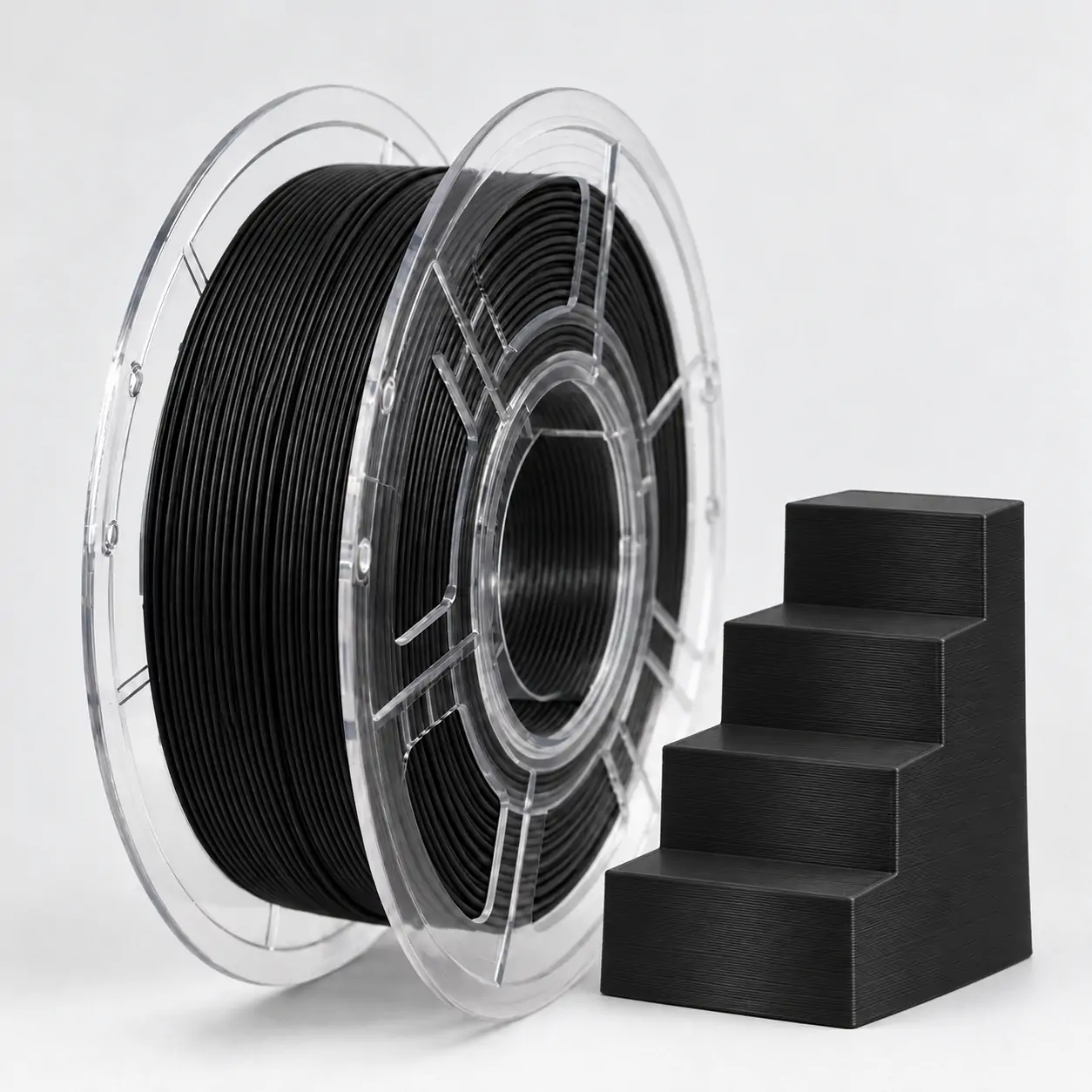
For a like-for-like factory-direct comparison, our quality case uses one actual black PLA Basic production batch rather than mixing materials under a single test result. This released lot contains 500 sale units at 1 kg nominal net filament per spool, matching the 500 kg denominator in the illustrative Melbourne landed-cost model.
On mobile, swipe horizontally to inspect the linked batch record.
| Control field | Recorded value | Reason the buyer keeps it |
|---|---|---|
| Product / specification | SSSray PLA Basic · Black · 1.75 mm · 1.000 kg nominal net per spool | One polymer, colour and diameter against the approved sample |
| Order / production lot | AU-PO-261112-084 / SSSRAY-PLA-BK-261116-L01 | Connects buyer PO, production window and shipped labels |
| Approved reference | PLA-BK-R03 · reference plaque BK-26-07 · drawing revision 03 | Prevents an unapproved colour or specification substitution |
| Production window | 16 Nov 2026, 08:00 – 17 Nov 2026, 22:00 (China time) | Defines the 38-hour window, including the documented hold |
| QC and packing dates | 18–19 Nov 2026 test review · 20 Nov 2026 packing release | Separates extrusion, inspection, release and logistics events |
| Nominal sale quantity | 500 spools × 1.000 kg = 500.000 kg nominal net | Matches the customs cost and accepted-net-kg calculation |
| Traceable serial range | 001–500 · 50 cartons × 10 spools · carton IDs C01–C50 | Every serial appears in exactly one carton |
| Packing geometry | 45 × 23 × 35 cm per carton · 1.811 m³ external carton volume in total | 50 × 0.45 × 0.23 × 0.35 m; pallet voids excluded |
| Gross transport estimate | ≈1.30 kg packed per spool; ≈14 kg per sealed carton; ≈700 kg for 50 cartons, ≈720 kg with pallet/wrap | Distinguishes selling net mass from approximate freight gross mass |
| Cost-model reference | FOB Ningbo model · AUD 4,000 illustrative customs value = AUD 8.00 per sale spool · modelled sea destination: Melbourne | Links the actual lot configuration to the separate Australian cost scenarios |
Inspection plan and lot-release thresholds
Sampling follows the 500-spool serial sequence: the first spool and every 25th spool thereafter (001, 026, 051 … 476), giving 20 sampled reels. Three longitudinal locations on each reel are checked on two perpendicular axes (20 × 3 × 2 = 120 offline diameter readings). Separately, the non-quarantined running filament carries an inline two-axis optical trend. The limits below are SSSray’s internal release limits for this grade under TP-07 rev. 3 — tighter than our published ±0.03 mm diameter control and not a general industry specification for PLA.
On mobile, swipe horizontally to see the criteria, methods and results.
| Characteristic | Method / test count | Release criterion | Recorded observation | Decision |
|---|---|---|---|---|
| Running diameter | Two-axis optical inline record · 60,000 paired points from releasable segments | All recorded axes 1.730–1.770 mm | 1.736–1.765 mm; mean 1.7508 mm; sample σ 0.0041 mm; Cpk 1.56 against the 1.730–1.770 mm band | PASS |
| Offline diameter confirmation | Calibrated two-axis gauge · 20 reels × 3 positions × 2 axes = 120 readings | Every axis 1.730–1.770 mm | 1.740–1.761 mm across the 120 readings; mean of 20 reel means 1.75105 mm | PASS |
| Ovality | Difference between two axes at each of 60 checked positions | Maximum axis difference ≤0.025 mm | Largest sampled-reel ovality 0.018 mm | PASS |
| Net filament mass | Verified bench scale · 20 individually sampled reels, tare removed | Each sampled reel ≥1,000 g net | 1,003–1,009 g; sample mean 1,006.05 g | PASS |
| Finished-filament moisture | Gravimetric moisture analyser · 6 specimens from start / middle / end reels | Each specimen ≤0.050% by mass (≤500 ppm) | 0.020, 0.022, 0.023, 0.024, 0.025, 0.026%; mean 0.0233% | PASS |
| Black colour match | Colourimeter on 6 printed plaques · CIEDE2000 ΔE00 vs BK-26-07 | Each ΔE00 ≤1.50 under the agreed measurement setup | 0.58, 0.62, 0.69, 0.73, 0.77, 0.84; mean 0.705 | PASS |
| Melt-flow consistency | MFR test at 210°C / 2.16 kg · 3 retained material portions | 7.0–10.0 g/10 min for this approved reference | 8.4, 8.6 and 8.5 g/10 min; mean 8.5 | PASS |
| Winding and sealed packaging | 20 sampled reels visual/feed-path checks; 500 serial-label scans; 50 carton counts | No sampled tangles; correct identity and 10 units in each carton | 20/20 feed-path checks passed; 500/500 serial matches; 50/50 carton counts matched | PASS |
| Printer qualification check | 6 dimensional cubes on 3 sampled reels; conditions and results below | Each dimension 20.00 ±0.20 mm; no print interruption | 6/6 cubes inside the ±0.20 mm band; no interruption observed | PASS |
The measurement chain is recorded against the lot, with the capability each instrument was selected for: inline dual-axis optical gauge OG-03 (0.001 mm resolution, ±0.002 mm accuracy at 1.75 mm, 1 kHz sampling logged at 1 s intervals; 1.750 mm reference check at 07:42 on 16 Nov); two-axis bench gauge DG-06 (0.001 mm resolution, 0–25 mm range; zero and reference check on 18 Nov); bench scale SC-07 (0.1 g resolution, 6 kg capacity; 1 kg check-weight verification on 18 Nov); moisture analyser MA-04 (0.001% resolution, 105°C drying; six sealed specimens on 18 Nov); colourimeter CL-02 (D65 / 10° / SCI, ΔE00 repeatability 0.05; six plaques on 19 Nov); melt-flow tester MF-03 (210°C ±0.2°C at 2.16 kg; three portions on 19 Nov); and printer PR-08 (0.4 mm nozzle, direct drive; six coupons on 19 Nov). Every instrument was inside its calibration interval on the test dates, and the certificates are filed with QC-261119-PLA-01.
Measurement interpretation: we calculate the reported Cpk of 1.56 from the release-file sigma and 1.730–1.770 mm limits, and retain the subgroup and control-trace definitions for a detailed capability review. Our 105°C gravimetric moisture results are specific to the loss-on-drying method; comparison with Karl Fischer water-content data requires method correlation.
Spool-level sample ledger
The diameter column below is a reel-level mean of its six offline axis readings; ovality is that reel’s largest paired-axis difference. This ledger supports the 20-sample mass average and the offline-diameter mean above. A lot-level sampling pass does not mean every one of the 500 reels was destructively tested.
On mobile, swipe horizontally for the complete 20-reel ledger.
| Reel serial | Mean diameter (mm) | Max ovality (mm) | Net mass (g) | Winding / seal |
|---|---|---|---|---|
| 001 | 1.749 | 0.012 | 1,006 | PASS |
| 026 | 1.752 | 0.014 | 1,004 | PASS |
| 051 | 1.751 | 0.011 | 1,008 | PASS |
| 076 | 1.750 | 0.015 | 1,005 | PASS |
| 101 | 1.753 | 0.013 | 1,003 | PASS |
| 126 | 1.752 | 0.016 | 1,007 | PASS |
| 151 | 1.749 | 0.012 | 1,006 | PASS |
| 176 | 1.750 | 0.014 | 1,005 | PASS |
| 201 | 1.752 | 0.017 | 1,009 | PASS |
| 226 | 1.751 | 0.013 | 1,007 | PASS |
| 251 | 1.754 | 0.010 | 1,004 | PASS |
| 276 | 1.752 | 0.015 | 1,005 | PASS |
| 301 | 1.751 | 0.014 | 1,008 | PASS |
| 326 | 1.748 | 0.012 | 1,006 | PASS |
| 351 | 1.751 | 0.016 | 1,007 | PASS |
| 376 | 1.750 | 0.018 | 1,004 | PASS |
| 401 | 1.753 | 0.012 | 1,005 | PASS |
| 426 | 1.752 | 0.013 | 1,009 | PASS |
| 451 | 1.750 | 0.015 | 1,006 | PASS |
| 476 | 1.751 | 0.014 | 1,007 | PASS |
Print verification tied to the same lot
Three reels spanning the production sequence (001, 251 and 476) supplied two 20 mm XY/Z calibration cubes each. The verification run used a 0.4 mm brass nozzle, 0.20 mm layers, a 210°C nozzle, 60°C bed and 80 mm/s nominal print speed on a direct-drive desktop printer. Dimensions were taken after cooling at 23°C. These six coupons document our defined factory print-release check; customer-machine qualification and any required mechanical-property tests follow the agreed application-specific plan.
| Reel / coupon | X (mm) | Y (mm) | Z (mm) | Feeding / extrusion |
|---|---|---|---|---|
| 001 / A | 20.04 | 19.98 | 20.07 | PASS |
| 001 / B | 20.02 | 20.00 | 20.05 | PASS |
| 251 / A | 20.06 | 19.97 | 20.09 | PASS |
| 251 / B | 20.03 | 19.99 | 20.06 | PASS |
| 476 / A | 20.05 | 19.96 | 20.08 | PASS |
| 476 / B | 20.01 | 19.98 | 20.04 | PASS |

Exception handling, release and landed-cost sensitivity
Quality reviews are stronger when they retain resolved exceptions. On 17 November at 14:42, the inline gauge logged a transient 1.773 mm axis reading, above the 1.770 mm limit. The line stopped and 0.8 kg of work-in-progress strand was diverted to hold ID QH-261117-04 before spooling. The gauge was rechecked, the line restarted at 14:55, and the next 30-minute trace was 1.740–1.761 mm. The quarantined strand is excluded from the 60,000 release-segment points and from all 500 finished sale units. No released unit is assigned to the hold.
| Control | Disposition / calculation | Buyer consequence |
|---|---|---|
| Held process material | 0.8 kg isolated before winding; not part of 500 sale spools | One resolved process hold does not become a hidden shipment defect |
| Pre-packing sample decision | 20/20 sampled reels passed specified checks; 6/6 print coupons passed | Supports sampling-plan release, not a claim of 100% destructive testing |
| Packed units and declared net | 500 labelled units / 50 cartons / 500 kg nominal net | Matches the 500-spool and 500 kg basis used in the Australian cost model |
| Factory QA release | 20 Nov 2026 · lot released against TP-07 rev. 3; importer incoming QC still required | Factory-sampling release and buyer receipt approval remain separate gates |
| If all 500 kg are accepted | AUD 5,211 / 500 = AUD 10.42/kg excl. import and local-service GST (ChAFTA case) | Matches the cost table above |
| If two 1 kg sale spools are held on receipt | AUD 5,211 / 498 = AUD 10.46/accepted kg excl. import and local-service GST (receiving sensitivity) | Receiving losses raise unit cost even if customs duty is 0% |
| If general duty applies and all are accepted | AUD 5,411 / 500 = AUD 10.82/kg excl. import and local-service GST | Duty eligibility changes cost independently of QC acceptance |
How we qualify the shipment separately from the customs estimate
In our filament test protocol, we start with the customer’s printer, grade and use case. For a bulk order, ask us to agree the sample and lot IDs, test date, instrument or printer, method, sample count, conditioning, measured result and pass criteria before packing. Tie the diameter and ovality records to the lot, verify the print conditions on the approved sample and check that the reel and carton labels can trace the delivered material.
Our batch QC reference describes inline diameter monitoring and material-specific checks such as moisture and colour measurement. At RFQ stage, tell us whether winding, colour match or seam-safe feeding is the bigger risk on your equipment. We can agree which results to review with the quote and again when you approve the shipment lot. The Black PLA Basic product specification identifies the commercial grade, while the lot records above document the particular production release.
SSSray published-data terms: The AU-IMPORT-CALC-2026-11-22 costing model and QC-261119-PLA-01 production-lot measurements are published for buyer review and sourcing qualification. © 2026 SSSray. We retain rights to the dataset; contact us before redistributing, adapting or republishing the data. The public tables remain readable without registration.
Frequently Asked Questions
We use these answers to align Australian buyers, their brokers and freight forwarders on the documentation and cost decisions that matter before the next SSSray shipment.
How do I calculate Australia GST on imports of filament?
Apply 10% to the value of a taxable importation. For ordinary filament, start with the customs value, add duty payable, and add the relevant freight and insurance to the Australian place of consignment to the extent they are not already in the customs value. The normal low-value border treatment and the GST collected by some sellers at checkout are separate questions. For your first order, give the broker the invoice and the freight breakdown and ask for the import GST calculation in writing.
Is there import duty on filament from China to Australia?
Eligible Chinese-origin filament classified under 3916.90.00 can receive 0% ChAFTA duty. The general rate is 5% for that Australian tariff item. The outcome depends on the finished product, the origin rule and the documents supporting the claim. For bulk filament, ask the supplier for the exact material, diameter and production location. Then have your Australian broker confirm the tariff and origin basis for the purchase. Carry the general duty rate in the budget while the preference is pending.
Which Certificate of Origin do I need for ChAFTA?
For a standard preference claim, arrange a shipment-specific ChAFTA Certificate of Origin issued by an authorised body in China. Send it to the broker along with the commercial invoice, packing list and transport document so the importer, product description, tariff details and shipment can be matched. A Declaration of Origin is an alternative when the goods are covered by the required advance ruling. For repeat private-label orders, agree who arranges the paperwork and what filing deadline the factory must meet.
What does the AUD 1,000 import threshold mean for business samples?
The threshold usually determines the border entry route using Australian customs value. An ordinary filament consignment valued at AUD 1,000 or less generally clears without border duty or GST, with different procedures for post and other cargo. The sale may still be subject to the low-value GST rules. Give the seller your ABN and confirm GST registration if you are a GST-registered Australian business buying for business use. Have the courier validate the consignment value and charges when a sample comes with other goods.
Can my business defer GST on a wholesale filament order?
Yes, if the ATO has approved the entity making the import for its Deferred GST Scheme and the entry is eligible. The GST is then accounted for on the monthly BAS, while duty and the relevant entry charges remain payable at clearance. Ask the broker to match the importing ABN to the ATO approval and give finance the entry details. If someone else is named as the importer, have finance check what GST is actually creditable to your business under the agreed shipping arrangement.
Are wooden pallets allowed into Australia with filament?
Yes. Solid timber pallets can enter if they meet the applicable Australian biosecurity conditions. The ISPM 15 route calls for appropriately treated and marked wood. Your shipment may have an alternative route in BICON, which the broker or forwarder should verify. For containerised freight, ask for the relevant packing declaration and photos of the marks on pallets and dunnage before loading. Record the packing type on the purchase order so a last-minute replacement gets checked before the container is sealed.
How long does shipping filament from China to Australia take?
Use a route-specific door-to-door schedule. Lead time includes production, booking and consolidation, transit, customs and biosecurity release, and delivery to your warehouse. Ask the forwarder for both the sailing or flight date and the estimated receiving date, then add a buffer if the order supports a fixed launch or a print-farm job. Courier suits an urgent qualification sample, local stock can cover a tight replenishment window, and consolidated sea freight is worth quoting for predictable volume. Review the estimate again when you book.
Plan an Australian Filament Order with SSSray
At SSSray, we build an Australian factory-direct offer around the approved grade, the importing entity and the warehouse delivery point. We confirm our production and packaging evidence, coordinate the agreed origin-document process and show both relevant duty outcomes in the landed-cost plan. Your broker validates the tariff, ChAFTA claim and GST calculation; your forwarder confirms freight and destination charges. With those figures aligned, our FOB Ningbo or EXW offer can be compared fairly with local Australian stock on the same net weight, grade and packaging basis.
For a quote from our factory, send the filament grade, diameter, quantity and colour split, packaging or OEM labelling requirement, Australian port or postcode, and target delivery window. We normally reply with an initial factory quote within one business day. We can quote the selected configuration and discuss sample qualification, applicable technical files and the paperwork we can arrange for your broker. For a trial, tell us what the sample has to prove on your printers; verified B2B buyers can request up to three complimentary sample spools, with freight paid by the buyer. For a repeat order, tell us which lot and pack checks your team needs before release.
Request a quote or free samples
Tell us the material, color, spool size and monthly volume. An engineer replies within 24 hours on business days.
References
- Australian Border Force — GST and other taxes when importing
- Australian Border Force — Import declarations
- Australian Border Force — Import processing and biosecurity cost recovery charges
- DAFF — Commencement of biosecurity regulatory charges for 2026–27
- Australian Border Force — Current working tariff, Chapter 39, plastics
- Australian Border Force — Schedule 12, Chinese originating goods
- Department of Foreign Affairs and Trade — ChAFTA Annex II, product-specific rules, heading 3916
- Department of Foreign Affairs and Trade — Guide to using ChAFTA to export or import
- Australian Taxation Office — GST and Australian businesses importing low-value goods
- Australian Taxation Office — Deferred GST scheme
- DAFF — ISPM 15 for solid wood packaging material
- Australian Border Force — Valuation of imported goods

He Jiang
Senior Researcher · SSSray · 3D Printing Filament Manufacturing · Jinhua, Zhejiang
He Jiang is a senior researcher at SSSray, a 3D printing filament manufacturer in Jinhua, Zhejiang, China. His focus in this guide is connecting material qualification and lot traceability with the documents Australian buyers need for a bulk order.
