Online time
Monday to Friday: 9AM - 8PM
Weekend: 10AM - 5PM


TL;DR: Undisclosed Calcium Carbonate Is a Spec Failure, Not a Cheap Deal
For most B2B buyers, the best option is a PLA+ built on virgin PLA whose supplier declares the formulation class and any mineral filler relevant to the grade, then backs it with a lot-linked density result and a TGA or ash report. Mineral-filled PLA is not automatically bad: matte and stone-effect grades are legitimate when labeled. The problem, and the reason calcium carbonate screening belongs in incoming QC, is calcium carbonate added to cut resin cost while the spool is sold as tougher “PLA+.”
Do not approve without dataHigh-loading or undeclared mineral-filled PLA for toughness-critical snap-fits, thin clips, drop-exposed housings, or other toughness-positioned SKUs.
Key specMost unfilled PLA+ colors measure about 1.20–1.27 g/cm³. Above 1.30 needs a written explanation.
Verify the supplierAsk for TGA aligned with ASTM E1131-25 or ash per ISO 3451-1:2026 results for the shipped lot, not a generic TDS.
Procurement warningAt 20 wt% filler you get about 10.8% fewer meters per kg, so a “cheap” quote must beat virgin by more than that.
Abstract: Why Calcium Carbonate Screening Belongs in Your Purchasing Process
PLA is the highest-volume 3D printing filament, and “PLA+” is the label buyers pay a premium for. Yet PLA+ has no industry standard. It can mean an impact-modified blend, a nucleated grade, a high-flow grade, or simply PLA with cheap mineral filler inside. That gap is where the calcium carbonate problem lives.
Calcium carbonate (CaCO3) is one of the lowest-cost common mineral fillers used in plastics. IMARC’s Q2 2026 regional assessments put calcium carbonate at roughly USD 96–442 per tonne, while its August 2026 PLA assessment for Northeast Asia was USD 2.34 per kg. When one ingredient costs a small fraction of the other, the economic incentive to substitute is obvious.
Buyers usually make three mistakes. First, they treat any white residue, matte surface, or brittle spool as proof of fraud, when moisture, aging, or a disclosed matte formula may be the cause. Second, they trust a generic TDS that was never linked to the lot they received. Third, they compare price per kilogram, even though filled filament is denser and delivers fewer meters per kilogram.
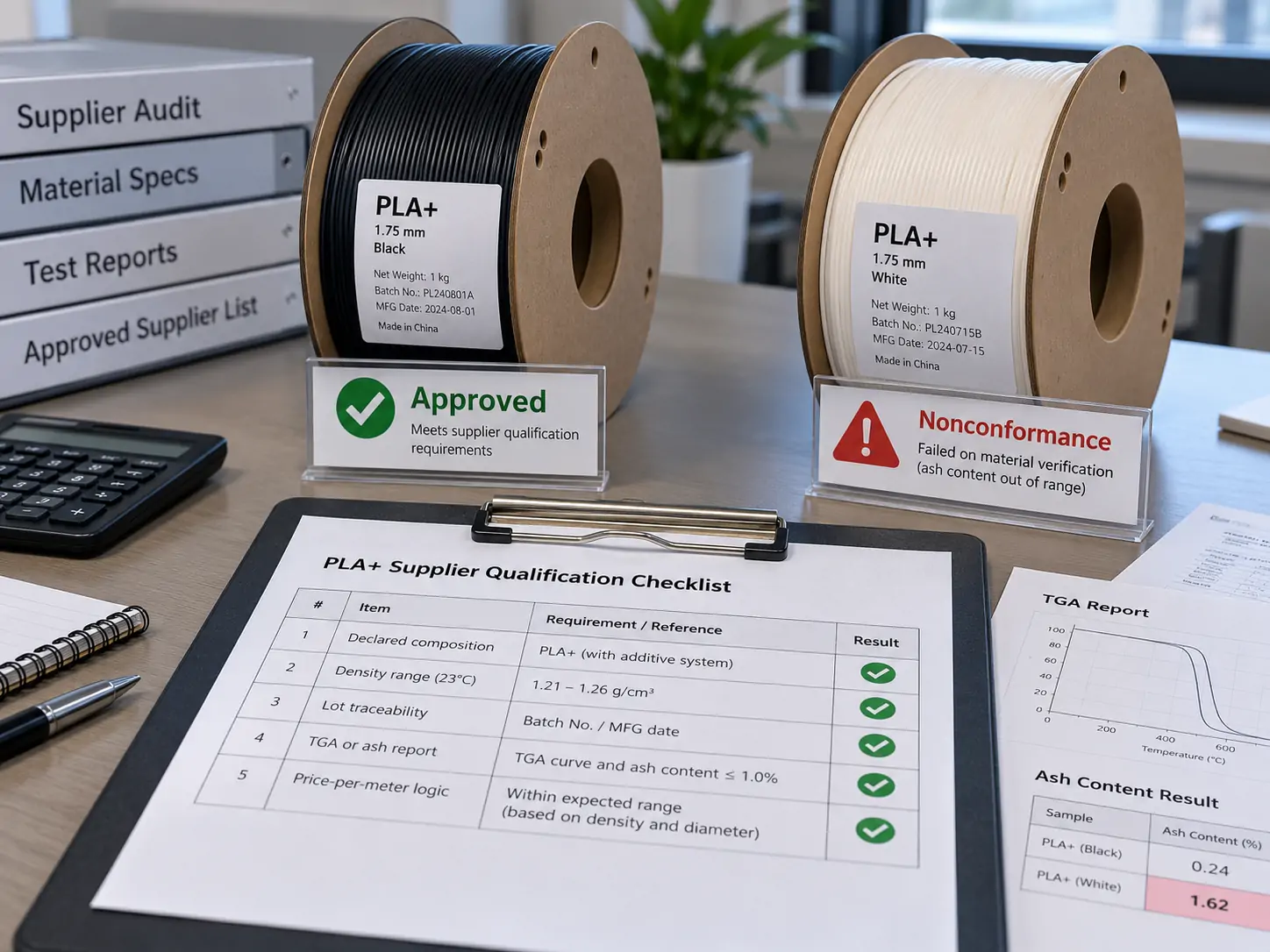
The B2B decision logic is simple once it is written down. Composition is a specification item, just like diameter or color. If a filler is present, it must be declared, justified by the application, and controlled within a tolerance. If it is not declared, it is a nonconformance, whatever the price.
This guide uses a three-level detection method. Level 1 covers arrival checks anyone can do with a scale and calipers. Level 2 covers simple tests without lab equipment, including a water-displacement density test and a burn-and-vinegar carbonate check. Level 3 covers lab verification: thermogravimetric analysis (TGA), ash content, FTIR, DSC, and tensile testing.
Around that method, we add a cost model, a supplier-claims audit, four buyer scenarios, and a PO-ready sourcing spec. The numbers are either cited from public sources or calculated from stated physics, and each calculation shows its assumptions so you can repeat it.
Key Takeaways
- Filled is not automatically nonconforming. A disclosed matte or stone-effect PLA is a legitimate product. The problem is undisclosed filler in a spool sold on toughness.
- Density is your fastest screen. Virgin PLA such as Ingeo 4043D is listed at 1.24 g/cm³; each 10 wt% of CaCO3 adds roughly 0.07–0.09 g/cm³.
- A 1-meter weigh test works on arrival. A 1.75 mm virgin PLA strand weighs about 2.98 g per meter; a 20% CaCO3 strand weighs about 3.35 g.
- You pay for meters, not kilograms. A 20 wt% filled spool must be at least 10.8% cheaper per kg just to match virgin PLA on printable length.
- High-temperature ash tests can under-report carbonate. CaCO3 loses about 44% of its mass as CO2 when it decomposes; use TGA or a validated correction only when the residue chemistry is known.
- TGA is strongest after carbonate identity is confirmed. In a defined PLA/CaCO3 system, a plateau after polymer burn-off followed by a high-temperature CO2-loss step can quantify carbonate; mixed or unidentified mineral residues require additional identification.
- Brittleness has several causes. Moisture uptake and aging also make PLA snap, so dry the sample before blaming filler.
- Put composition in the PO. Write the declared filler content, density range, and test method into the purchase specification so a failure is contractual, not a debate.

He Jiang
Senior Researcher · SSSray · 3D Printing Filament Manufacturing · Jinhua, Zhejiang
He Jiang is a senior researcher at SSSray, a 3D printing filament manufacturer in Jinhua, Zhejiang, China. His research and writing for SSSray focus on filament material qualification, formulation screening, lot-linked QC evidence, supplier documentation, and B2B material verification. For this guide, the emphasis is on density screening, TGA and ash analysis, filler identification, printed-property comparison, and supplier qualification methods relevant to PLA and PLA+ procurement.
Guide scope: This article focuses on polymer composition screening, lot-linked QC evidence, supplier documentation and B2B material qualification.
1. Why Calcium Carbonate Filler in PLA+ Is a 2026 Procurement Risk
Direct answer: Because “PLA+” has no standard definition, and calcium carbonate costs a fraction of PLA resin, a supplier can raise margin by replacing resin with filler while keeping the premium label. The buyer only finds out through returns, broken parts, or a lab test.
PLA+ has no standard definition
Unlike ABS or PC grades sold against a resin maker’s datasheet, “PLA+” is a marketing name. One brand uses it for an impact-modified blend. Another uses it for a heat-resistant nucleated grade. A third uses it for plain PLA with a new color.
In August 2026, Hackaday described PLA+ as a mystery filament whose additives are arbitrary and can include calcium carbonate. That is a fair summary of what buyers face: the label tells you almost nothing about composition.
Filled is not automatically nonconforming — undeclared composition is the issue
Mineral filler has real uses. It raises stiffness, can change shrinkage and crystallization behavior, and creates matte or stone-like surfaces. Protopasta, for example, openly lists a PLA composite with 60% calcium carbonate for bone-simulation printing and notes that the material is not a strong filament at that loading.
So the line is not “filler vs no filler.” The line is disclosure. A matte PLA with declared mineral content is a product. A “tough PLA+” with 20% hidden chalk is a misrepresentation.
Why the risk grows in 2026
Spool prices keep falling in bulk and high-speed PLA, while the resin-to-mineral price gap stays wide. Published research has also found mineral fillers in commercial filaments where suppliers gave no such information; lab analysis revealed them. The label-content gap is documented, and for a distributor or print farm it becomes refund risk.
Procurement implicationTreat composition like diameter: a declared, tolerance-controlled spec item.
Mistake to avoidCalling every matte or chalky spool nonconforming. Check the TDS declaration first.
How to verifyAsk whether the grade contains any mineral filler, and at what wt%, in writing.
2. Virgin Material vs Filled PLA: What Calcium Carbonate Changes
Direct answer: Calcium carbonate makes PLA denser, stiffer, and usually weaker and less ductile at the loadings used for cost cutting. It also shortens the printable length of every kilogram you buy.
Density and the “missing meters” effect
Here is the physics in plain terms. PLA has a density of about 1.24 g/cm³. Calcite, the common form of calcium carbonate, is about 2.71 g/cm³. Mix them, and the filament gets heavier per centimeter.
Because spools are sold by weight, a heavier strand means fewer meters on the spool. Think of it like buying rope by the kilogram: if the rope has sand woven in, the same kilogram is a shorter rope.
The table below uses the standard rule-of-mixtures for density, a 1.75 mm diameter, and no voids. It is a calculation, not a measurement, so treat it as a screening guide.
On mobile, swipe horizontally to see every column.
| CaCO3 loading (wt%) | Calculated density (g/cm³) | Mass per meter (g) | Meters per 1 kg | Fewer meters vs virgin PLA |
|---|---|---|---|---|
| 0% (virgin PLA) | 1.240 | 2.98 | 335 | |
| 5% | 1.275 | 3.07 | 326 | |
| 10% | 1.311 | 3.15 | 317 | |
| 15% | 1.350 | 3.25 | 308 | |
| 20% | 1.391 | 3.35 | 299 | |
| 30% | 1.481 | 3.56 | 281 |
Assumptions: PLA 1.24 g/cm³ (Ingeo 4043D listing), calcite 2.71 g/cm³, ideal mixing, zero porosity, nominal 1.75 mm. Bar scale: full width = 20% fewer meters. Pigments and impact modifiers shift real values slightly.
Even 10% filler removes about 18 meters from every kilogram. For a print farm buying one tonne a month, a 20% load means about 36 km of filament paid for but never delivered.
Strength and toughness: why cheap PLA+ breaks easily
Calcium carbonate is a rigid particle. When it is fine, surface-treated, and well dispersed at low loading, it can hold or even improve some properties. When it is coarse, untreated, and loaded high to save money, it creates weak points where cracks start.
On mobile, swipe horizontally to see every column.
| Study or source | Material and process | CaCO3 level | Reported effect | Buyer reading |
|---|---|---|---|---|
| Building-materials study (PMC8512734) | PLA with ground CaCO3, building-product study | 20 wt% | Tensile strength down 27.3%; Young’s modulus up 31.9% | Stiffer but weaker: the classic cost-filler trade |
| IIETA ACSM (2026) | 3D-printed PLA honeycomb core, fiberglass skins | 0 / 5 / 10 / 15 wt% | Flexural strength 76.5 → 78.6 → 66.0 → 43.4 MPa | Small doses can help; higher doses fall off sharply |
| Polymer Testing (2017) | Amorphous PLA with modified nano and micro CaCO3 | 5 wt% nano | Elongation and toughness roughly doubled; larger untreated particles hurt drawability | Engineered nano filler differs from cheap chalk |
| Results in Materials (2025) | Hot-pressed PLA films with CaCO3 or cellulose microcrystals | Five filler loadings | CaCO3 reduced tensile strength and strain as loading increased, while modulus increased | Dispersion alone does not guarantee good stress transfer; interface quality matters |
| Commercial black PLA study (2026) | Five commercial black PLA filaments analyzed by TGA, DSC, tensile testing and SEM/EDX | Total additives 2.08–27.82 wt% | One filament contained a substantial inorganic fraction with Ca-, Na- and Mg-bearing phases despite being marketed as standard PLA | Nominally similar commercial PLA can differ sharply in composition; lot-level verification adds value |
Notice that test methods and specimens differ across these studies, so compare trends rather than absolute numbers. The recurring pattern is that particle size, surface treatment, dispersion, interface quality and loading all matter: low engineered loadings can preserve or improve selected properties, while higher or poorly bonded mineral loading commonly reduces strength and ductility even as stiffness rises.
That is why a filled “PLA+” often feels rigid in the hand yet snaps in a thin clip. It is stiffer, but it has less capacity to stretch before breaking.
Printing side effects that buyers end up paying for
- Brittle feeding. Filament that breaks in long bowden tubes or multi-material feeders stops unattended jobs.
- Partial clogs. Poorly dispersed agglomerates can cause flow drops, especially with 0.2–0.25 mm nozzles.
- Surface drift. Uneven filler dispersion shows up as gloss and color variation between spools or even along one spool.
- Profile mismatch. A change in filler loading can change melt rheology, pressure, flow stability and interlayer bonding. Re-qualify the flow ratio and print profile when formulation changes; density alone does not determine extrusion multiplier.
Procurement implicationSpecify density and declared filler content on the TDS and the PO.
Mistake to avoidAssuming “stiffer” means “stronger.” Filled PLA often fails in impact and bending.
How to verifyCompare lot density with the approved sample; a grade-specific window such as ±0.02 g/cm³ can be used as an incoming screening limit when it has been established from qualified lots.
3. Level 1 Calcium Carbonate Screening: Checks You Can Run on Arrival
Direct answer: With a 0.01 g scale, digital calipers, and a tape measure, you can flag most heavily filled spools in 15 minutes. Level 1 does not prove fraud, but it tells you which lots deserve a lab test.
Think of this as the first layer of 3D filament quality control. It costs almost nothing, and it turns a vague feeling that “this spool is off” into a number you can send to a supplier.
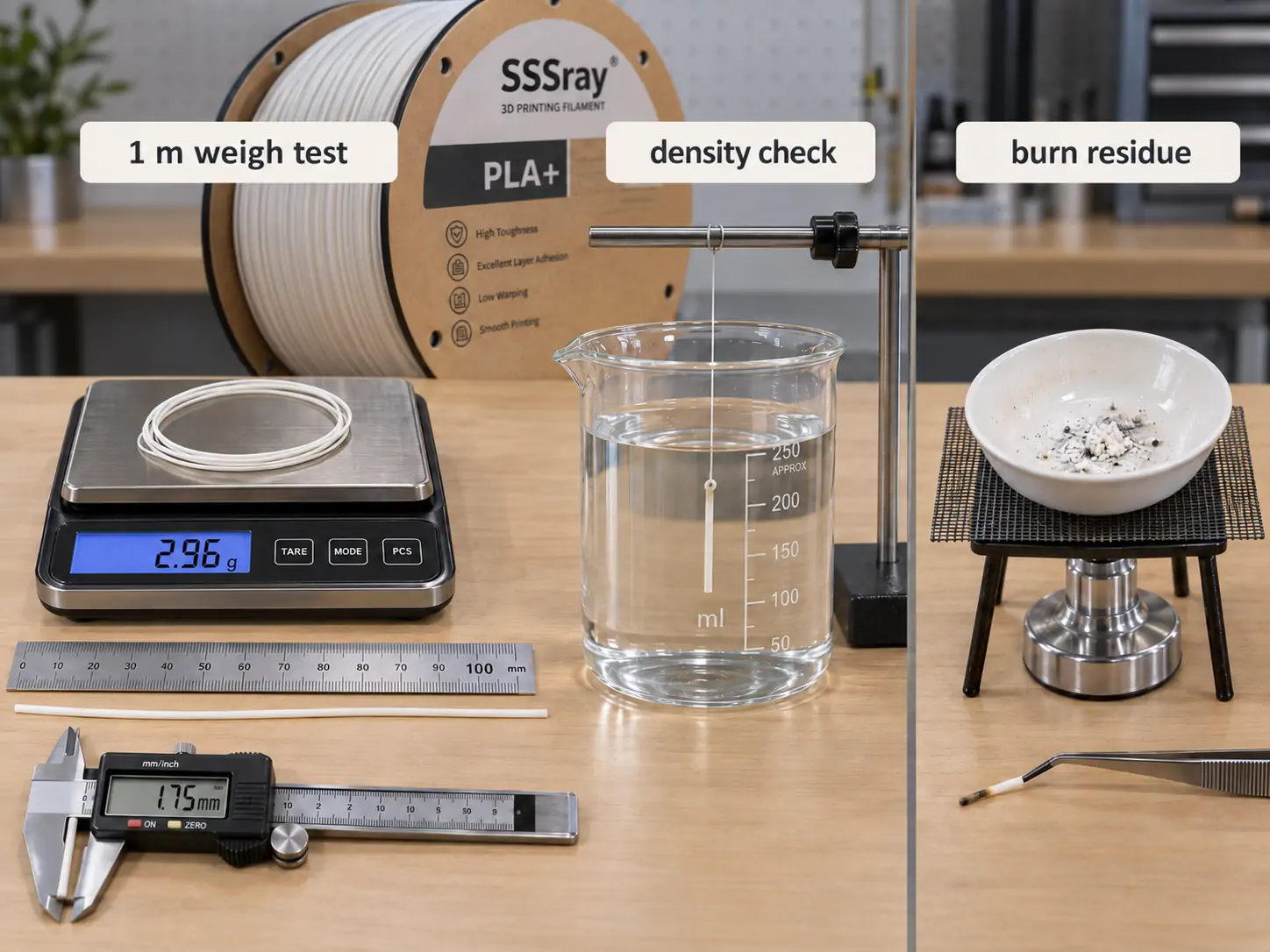
The 1-meter weigh test
This is the most useful arrival check, and almost nobody does it. You are measuring density indirectly, using the filament itself as the sample.
- Cut exactly 1,000 mm of filament from a spool that has been sealed and dry.
- Measure diameter at 10 points along the length, rotating the calipers 90° each time, and average the readings.
- Weigh the strand on a scale that reads to 0.01 g.
- Calculate volume: 3.1416 × (average diameter ÷ 2)² × 1000, in mm³. Divide by 1,000 to get cm³.
- Calculate density: mass in grams ÷ volume in cm³.
For example, a strand averaging 1.75 mm and weighing 3.30 g gives 3.30 ÷ 2.405 = 1.37 g/cm³. That is well above virgin PLA and points to roughly 15–20% mineral content.
Why measure diameter instead of assuming 1.75 mm? Because a ±0.03 mm diameter swing changes the cross-section by about ±3.5%, which is enough to mask or mimic a small filler signal.
Surface, fracture, and spool clues
- Chalky feel on a “glossy” SKU. A white trace on dark cloth from a non-matte product is worth noting.
- Clean, flat snap on a dry strand. Dry a short length first (PLA is commonly dried at about 50–55 °C for several hours). If it still snaps flat at a gentle 90° bend, brittleness is not just moisture.
- Fewer meters than expected. A “1 kg” spool that runs out early deserves a closer look.
- Price below resin logic. If a quoted PLA+ price leaves no room for virgin resin, compounding, packaging, and freight, something in the formula is cheaper than PLA.
Do not skip the drying step. Hydrolysis and aging also make PLA brittle. A wet virgin spool can snap like a filled one, so dry before you judge.
Procurement implicationMake the 1-meter test part of incoming inspection for every new lot.
Mistake to avoidUsing nominal 1.75 mm in the calculation instead of the measured diameter.
How to verifyRepeat on three spools per lot. One high reading is a flag; three is a pattern.
4. Level 2 PLA+ Screening: Can You Flag Undeclared Filler Without Lab Equipment?
Direct answer: Partly. A water-displacement density test plus a burn-and-vinegar check can flag a carbonate-containing mineral fraction and tell you whether a lot deserves laboratory verification. Neither test identifies or quantifies calcium carbonate precisely enough for a contract dispute.
Water-displacement density test (step by step)
This is a simplified screening version of the immersion principle used in ISO 1183-1:2025; it is not a substitute for a controlled laboratory Method A result. It is more accurate than the 1-meter test because it ignores diameter variation.
- Coil about 10–15 g of dry filament loosely and tie it with fine thread.
- Weigh it in air. Record this as A.
- Place a cup of room-temperature water on the scale and tare it. Add one drop of dish soap to reduce bubbles.
- Hang the coil by the thread so it is fully submerged but touches neither the bottom nor the sides. Record the reading as B (this equals the displaced water mass).
- Density ≈ A ÷ B × 0.997 (water density near 25 °C).
As a screening guide, most unfilled PLA and PLA+ colors land around 1.20–1.27 g/cm³. White grades sit at the upper end because titanium dioxide is dense; a 3% TiO2 load alone gives about 1.27 by calculation. A reading at or above 1.30 on a non-matte, non-specialty grade needs an explanation from the supplier.
What is the burn test in PLA filler screening?
The burn test works on one simple fact: PLA burns away almost completely, while calcium carbonate does not burn. The mineral stays behind as a white or grey residue.
- Work outdoors or under an extraction hood, on a ceramic tile, with a fire extinguisher nearby.
- Burn a 5–10 cm piece of filament with a lighter or small torch until the flame stops.
- Look at the residue. Virgin PLA leaves little more than a trace of char or pigment. Heavily filled PLA leaves a white “skeleton” that holds the strand’s shape.
- Drop the cooled residue into a spoon of white vinegar. Steady fizzing indicates carbonate releasing CO2.
The vinegar step adds specificity because many non-carbonate fillers such as talc and silica do not effervesce in dilute acid. Visible fizzing indicates a carbonate-containing residue; it does not by itself prove that calcium carbonate is the only carbonate present or establish its weight percentage.
Safety: Burning plastic releases smoke and irritant gases. Keep the sample small, never burn indoors without extraction, and do not burn filament near the printer or packaging.
What Level 2 cannot prove
A lighter flame is uneven. Part of the residue may convert to calcium oxide, which barely fizzes in vinegar, so a weak reaction does not clear a sample. Nor does residue tell you the percentage.
Use Level 2 to decide whether a Level 3 lab test is worth paying for. For a claim against a supplier, you need a documented lab method.
Procurement implicationLevel 2 results justify quarantining a lot, not rejecting it outright.
Mistake to avoidRelying on smell or flame color. They vary with pigments and modifiers.
How to verifyRun the same tests on your approved reference spool, side by side.
5. Level 3 Lab Verification: TGA Analysis, Ash Content Test, and Tensile Checks
Direct answer: TGA is a strong routine method for quantifying calcium carbonate in a defined PLA/CaCO3 system once the carbonate-related mass-loss step has been chemically assigned. Mixed or unidentified mineral residues require additional identification. A corrected ash test can be less expensive, but it requires a validated correction and known residue chemistry.
How to read a TGA curve for filament composition
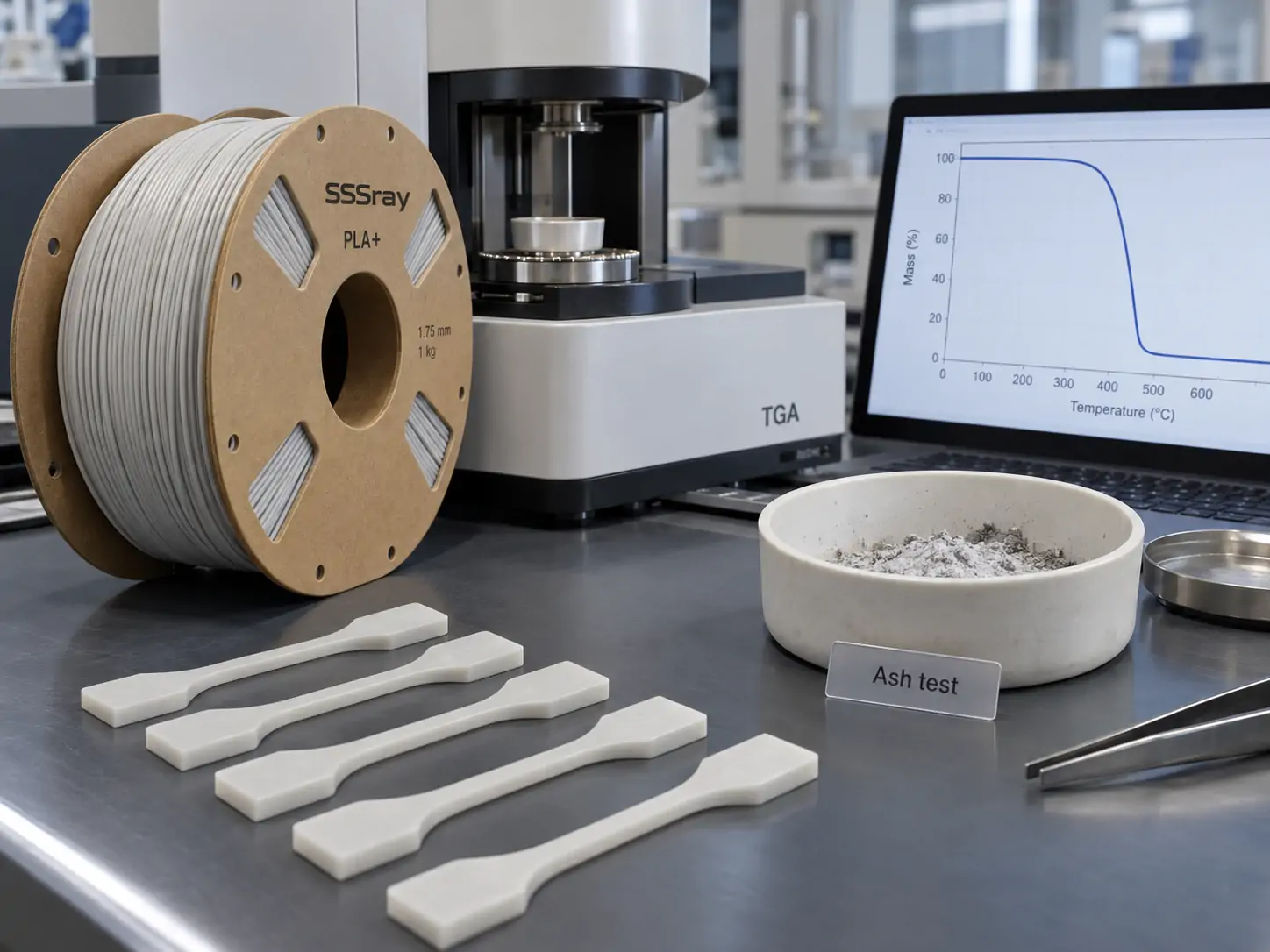
Thermogravimetric analysis heats a small sample on a precision balance and records the mass as temperature rises. ASTM E1131-25 covers compositional analysis by thermogravimetry and notes that test parameters are guidelines that may be adjusted for the analysis when the changes are recorded in the report.
For PLA, the polymer decomposes mainly between roughly 300 and 400 °C. Whatever remains afterward is inorganic. If that residue contains CaCO3, a second step appears at higher temperature as carbonate releases CO2.
On mobile, swipe horizontally to see every column.
| Sample | 300 °C | 420 °C | 600 °C plateau | 700 °C | 800 °C and above | Implied CaCO3 |
|---|---|---|---|---|---|---|
| Virgin PLA | 98.0 | 1.5 | 0.5 | 0.5 | 0.5 | None |
| PLA + 20% CaCO3 | 98.4 | 20.8 | 20.0 | 16.5 | 11.2 | (20.0 − 11.2) ÷ 0.44 = 20% |
| PLA + 30% CaCO3 | 98.6 | 30.7 | 30.0 | 24.7 | 16.8 | (30.0 − 16.8) ÷ 0.44 = 30% |
The reading rule is short, but the chemistry must be assigned correctly. The plateau after polymer burn-off estimates the non-volatile fraction under the stated method. When the high-temperature mass-loss step can be assigned to CaCO3 decomposition, dividing that CO2-related loss by about 0.44 gives the corresponding CaCO3 fraction. Other carbonates, pigments, talc and stable minerals can interfere, so composition assignment should be supported by the formulation, FTIR/SEM-EDX, or another suitable identification method.
The ash-test trap: why results come back too low
A furnace ash test is cheaper than TGA, and ISO 3451-1:2026 covers general methods for determining ash in plastics. Calcium carbonate can decompose over a broad high-temperature range that depends on atmosphere, heating rate, particle size and other conditions, leaving calcium oxide and releasing CO2. Stoichiometrically, complete conversion of pure CaCO3 to CaO leaves about 56% of the original CaCO3 mass as CaO.
As PlasticsToday’s materials analyst explains, a high-temperature ash result can understate the original carbonate loading if CaCO3 decomposes during the procedure. The safer approach is to use TGA or a validated ash method whose final temperature and residue chemistry are documented. The stoichiometric CaO-to-CaCO3 factor of 1.785 is valid only when the CaO can be assigned to CaCO3 and other mineral residues are accounted for.
Ask the lab one question before you pay: “At what final temperature will you ash, and will you correct for carbonate decomposition?” If they cannot answer, use a different lab or order TGA.
FTIR and DSC: confirming identity, not quantity
FTIR confirms identity: carbonate shows bands near 1,420, 875, and 712 cm⁻¹, while PLA shows its ester carbonyl near 1,750 cm⁻¹. It is fast but qualitative. DSC shows glass transition and crystallization; fillers can shift crystallization, which helps when comparing a lot with its approved sample, but DSC does not measure filler content.
Tensile strength PLA+ verification
Composition tells you what is in the spool; mechanical testing tells you whether it matters. For printed comparisons, use a fixed specimen geometry based on ISO 527-2:2025 or ASTM D638, clearly record that the specimens are FFF-printed rather than moulded, and document orientation, infill, nozzle temperature, layer height and conditioning.
The key is to compare like with like. Print your approved reference and the suspect lot on the same machine, same day, same profile. A tensile and elongation gap under identical conditions is far more persuasive than a comparison with a brochure number.
Procurement implicationName the method (TGA aligned with ASTM E1131-25 or ash per ISO 3451-1:2026 with the agreed test conditions) in the PO.
Mistake to avoidAccepting a single-pellet TGA as lot evidence; small samples scatter.
How to verifyRequest replicate runs and the raw curve, not only a summary number.
6. SSSray PLA+ QC Baseline and Calcium Carbonate Qualification Record
Public research explains the chemistry; procurement needs a factory-side baseline that can be repeated lot by lot. SSSray’s current published PLA+ technical reference lists 1.24 g/cm³ density, 60 ± 3 MPa XY tensile strength and 1.75 ± 0.03 mm diameter. Our published PLA / PLA+ factory QC benchmark also controls ovality to ≤0.020 mm, pre-seal moisture to ≤0.02 wt% and color to ΔE < 0.8. The composition screen below adds a dedicated calcium-carbonate qualification route for grades specified as mineral-filler-free.
SSSray test record: SSS-PLA-CACO3-QV-2026-0927-R2
Record scope: qualification and incoming-lot verification for standard or toughness-positioned PLA+ specified as mineral-filler-free. Disclosed matte, stone-effect and other filled grades are controlled against their own approved formulation limits.
Public SSSray baseline: density 1.24 g/cm³; XY tensile 60 ± 3 MPa; diameter 1.75 ± 0.03 mm. Verify the current SSSray PLA+ technical reference and factory batch-QC benchmarks.
Equipment, sample plan and test parameters
- TGA composition screen: calibrated thermogravimetric analyzer with controlled inert and reactive gas capability; 15 ± 3 mg specimen in a recorded open alumina or platinum pan; 10 °C/min; nitrogen at 40 ± 10 mL/min from 35 °C to 600 °C, hold 10 min; switch to air at 600 °C and hold 10 min to remove carbonaceous residue; then 600–900 °C in air at 10 °C/min. Run three independently cut subsamples per qualification lot. Retain raw TGA and DTG curves, sample mass, pan type, gas flow, atmosphere-switch time and instrument ID. This is an SSSray qualification program aligned with ASTM E1131-25; ASTM states that its listed parameters are guidelines and may be adjusted when the changes are recorded.
- CaCO3 calculation: assign a high-temperature mass-loss step to calcium carbonate only when residue chemistry supports that assignment. When the step is attributable to CaCO3, calculate CaCO3-equivalent wt% as CO2 mass loss ÷ 0.4397. Do not apply this conversion to an unidentified mixed-mineral residue.
- Density: ISO 1183-1:2025 Method A immersion method on void-free filament specimens; analytical balance readability 0.0001 g where available; deionized water at 23 ± 2 °C; three specimens from each of three spools for qualification (n=9). Record air mass, immersed mass, liquid temperature and each calculated value before reporting mean and range.
- Printed tensile comparison: fixed ISO 527-2:2025-based A1 geometry used as an FFF comparison coupon, with the print preparation identified in the record rather than presented as a moulded ISO specimen. Use 0.4 mm nozzle, 0.20 mm layer height, 210 °C nozzle, 60 °C bed, 100% infill, fixed XY orientation/raster and five specimens per lot (n=5). Condition for at least 40 h at 23 ± 2 °C and 50 ± 10% RH before same-profile comparison with the approved reference; keep printer, slicer, nozzle and profile fixed.
On mobile, swipe horizontally to see every column.
| Control item | SSSray reference / method | Sample plan | Published result or release gate | Evidence retained |
|---|---|---|---|---|
| PLA+ density reference | Current SSSray PLA+ technical reference | Published grade value; lot verification by ISO 1183-1:2025 Method A, n=9 for qualification | Published SSSray reference: 1.24 g/cm³. Release against the approved grade/color window; an unexplained value ≥1.30 g/cm³ triggers hold and composition verification. | Grade/TDS revision, raw immersion masses, liquid temperature, mean, range and lot ID |
| Diameter / ovality / moisture | SSSray PLA / PLA+ factory QC benchmark | Production-line monitoring plus lot COA checks | 1.75 ± 0.03 mm; ovality ≤0.020 mm; pre-seal moisture ≤0.02 wt%. | Inline diameter log, COA checkpoints, moisture record and finished-goods lot number |
| TGA composition screen | SSS-PLA-CACO3-QV-2026-0927-R2; aligned with ASTM E1131-25 | 3 independent subsamples per qualification lot (n=3) | No undeclared carbonate-related mass-loss step or unexplained inorganic fraction versus the approved formulation. A CaCO3-equivalent shift above the written internal limit triggers hold and identity confirmation before release. | Raw TGA/DTG curves, sample mass, pan, atmosphere, flow, temperature program, instrument ID and analyst/test record |
| Carbonate identity confirmation | FTIR, SEM/EDX or another suitable residue-identification method when assignment is uncertain | Triggered after a composition flag | CaCO3 is reported only when the high-temperature loss and residue chemistry support the assignment. | Spectrum, elemental result or external-lab report linked to the same sample/lot |
| Printed tensile reference | Current SSSray PLA+ technical reference plus fixed FFF comparison protocol | 5 printed coupons per qualification lot (n=5) | Published SSSray XY tensile reference: 60 ± 3 MPa. Lot release uses the approved grade/application window under the same print and conditioning protocol, not a universal PLA+ threshold. | Printer, nozzle, slicer profile, orientation, conditioning record, five individual results, mean and range |
How SSSray uses this record: the published values above establish the brand-side PLA+ baseline; the shipment file then carries the actual finished-goods lot number and lot-specific instrument output required by the agreed qualification plan. This keeps density, composition and mechanical verification tied to the material the buyer actually receives.
7. How Much Cheaper Is Filled PLA vs Virgin PLA? The Real Purchasing Cost
Direct answer: On raw materials alone, replacing 20% of PLA resin with calcium carbonate saves roughly USD 0.38–0.45 per kg of compound using the cited 2026 regional assessments. The buyer, however, loses about 10.8% of printable length, plus the cost of failed prints and returns.
The raw-material arithmetic behind filler substitution
IMARC reported PLA at USD 2.34 per kg in Northeast Asia in August 2026. Its Q2 2026 calcium carbonate assessments ranged from USD 96 per tonne in Malaysia to USD 442 per tonne in the US, with the Netherlands, Germany and India between those endpoints.
Using those published assessments, each kilogram of PLA resin replaced by calcium carbonate changes the raw-material input by roughly USD 1.90–2.24 before compounding, surface treatment, dispersion, scrap and processing costs. The actual manufacturing margin is therefore smaller than the simple resin-minus-filler difference.
Cost per usable meter and per good part
Now flip to the buyer’s side. You print by volume, not by weight. The table converts filler loading into the minimum discount you would need per kilogram just to break even on printable length.
On mobile, swipe horizontally to see every column.
| CaCO3 loading | Supplier raw-material saving per kg | Meters lost per tonne (1.75 mm) | Minimum discount to break even on length | Costs not included |
|---|---|---|---|---|
| 10 wt% | USD 0.19–0.22 | about 18 km | 5.4% | Failed prints, labor, returns |
| 20 wt% | USD 0.38–0.45 | about 36 km | 10.8% | Failed prints, labor, returns |
| 30 wt% | USD 0.57–0.67 | about 55 km | 16.3% | Failed prints, labor, returns |
Market price note: These figures use published regional market assessments available for August/Q2 2026: PLA USD 2.34/kg in Northeast Asia and CaCO3 USD 0.096–0.442/kg across cited regions. They are market-reference inputs, not an SSSray quotation. SSSray can provide highly competitive project pricing based on material grade, order volume, packaging and qualification requirements. Ideal densities are as in Table 1; compounding and processing costs are excluded.
For procurement, price per kilogram is the wrong comparison unit. Here is a quick example. A print farm is offered filled “PLA+” at 8% below its current virgin grade. At 20% filler, the farm actually pays about 3% more per meter, before a single failed job. Once the brittle-feed failures start, the “saving” is gone.
Procurement implicationCompare quotes in cost per meter or per good part, not per kg.
Mistake to avoidTreating a low price as a supplier efficiency without asking what changed.
How to verifyRecord meters printed per spool and failures per 100 jobs for each lot.
8. The SSSray Filler-Disclosure Framework for PLA+ Supplier Qualification
This framework turns the three detection levels into purchasing gates. Use it for new PLA+ suppliers and for any reorder that behaves differently from the approved sample.
On mobile, swipe horizontally to see every column.
| Gate | Why it matters | What to ask | Pass / fail signal | Hidden risk |
|---|---|---|---|---|
| Application requirement | Toughness-driven parts fail first when filler is hidden | Which part features must flex, clip, or survive drops? | Pass: grade chosen for the load case Fail: “PLA+ is fine for everything” | A decorative approval reused for a functional SKU |
| Material performance | High mineral loading or poorly bonded filler can reduce elongation and impact performance | Tensile and elongation on printed ISO 527-2:2025-based or ASTM D638 comparison bars? | Pass: printed-specimen data with method Fail: injection-molded resin data only | Resin datasheet presented as filament data |
| Printability | Brittle feed and clogs stop unattended jobs | Results from long jobs on our printer models? | Pass: feed test on your hardware Fail: “works on all printers” | Short test cubes hide feeder snapping |
| Compliance | Undeclared mineral content can contradict the grade specification and supplier declarations | Does the grade-specific TDS or supplier composition declaration identify mineral fillers and their declared wt% range, and is the SDS consistent with the material’s hazard classification? | Pass: composition declared by grade and documents are mutually consistent Fail: generic “PLA 100%” claim with unexplained high density | Using an SDS as if it were a complete formulation disclosure |
| Supplier reliability | Reliable formulation control requires a traceable manufacturing source, lot records and formal change control | Who controls compounding and extrusion, and can you provide the lot record? | Pass: traceable lot, controlled source and raw data on request Fail: cannot identify the production source or resin grade | Uncontrolled source changes between orders |
| Landed cost | Per-kg price hides length and failure cost | What is the density, so we can price per meter? | Pass: density stated and verified Fail: price far below resin logic | Returns and refunds erase the discount |
| Reorder stability | Production lots can drift from the approved sample if formulation change control is weak | Will you notify us before any formulation change? | Pass: written change notice clause Fail: refuses change control | Golden sample, cheaper production lot |
How to use it: a supplier must pass all seven gates for toughness-critical SKUs. For decorative SKUs, a disclosed filled grade can pass if the price reflects it.
9. PLA+ Option Comparison Table for Purchasing Managers
Not every buyer needs the same grade. Here are the realistic options, including the one to catch before it ships.
On mobile, swipe horizontally to see every column.
| Option | Best use case | Key spec | Advantage | Risk | How to verify | When to reject | SSSray sourcing note |
|---|---|---|---|---|---|---|---|
| Virgin PLA | Visual models, education, general prototypes | Density about 1.24 g/cm³; ash near zero except pigment | Predictable, easy to profile | Brittle under impact | Density and resin grade on TDS | Outside the approved grade/color density window; an unexplained result at or above 1.30 g/cm³ triggers hold and composition verification | Available as wholesale PLA |
| Genuine PLA+ (impact-modified) | Functional prototypes, clips, retail “tough” SKUs | Higher elongation than PLA; density close to virgin | Real toughness gain | Modifier content varies by supplier | Printed tensile and elongation vs PLA | No elongation gain over plain PLA | Ask for modifier type and printed-bar data |
| Disclosed mineral-filled PLA (matte, stone) | Architecture models, décor, matte finishes | Filler wt% declared; density above PLA | Surface finish, stiffness | Lower strength; not for clips | TGA or ash matches declared wt% | Measured filler differs from declaration | Declared on TDS when used |
| Undisclosed CaCO3 “PLA+” | None for B2B | Unexplained density shift plus carbonate evidence despite a mineral-filler-free specification | Low unit price only | Brittle feeding, returns, claims | Density, burn-and-vinegar screening, then TGA or validated laboratory confirmation | Reject when lot-linked composition evidence confirms undeclared filler or the lot fails the written composition/density requirement | We share our test method so you can check any supplier |
If you need a toughness-positioned PLA+ for retail or print-farm use, ask SSSray for a sample of our PLA+ / PLA Pro series together with its declared composition and a lot density result. Then run Level 1 and Level 2 on the sample yourself before comparing it with anyone else’s.
10. PLA+ Supplier Claims Audit: What to Verify Before a Bulk Order
Filler problems usually hide behind vague marketing words. Here is what common claims might conceal, and what evidence closes the gap.
On mobile, swipe horizontally to see every column.
| Vague marketing claim | What it might hide | Document, sample, or test to request | What a reliable supplier provides |
|---|---|---|---|
| “100% virgin PLA+” | Mineral filler counted as “not recycled,” so still called virgin | Grade-specific composition declaration identifying mineral-filler presence or absence, filler type and declared range, plus the approved formulation code and change-control terms | A grade-specific mineral-filler declaration tied to the approved formulation |
| “Stronger than PLA” | Higher stiffness from filler, lower elongation | Printed tensile and elongation data, method and orientation | Side-by-side data against plain PLA |
| “Premium imported resin” | Resin brand used only in the sample lot | Resin grade name and lot traceability for the production order | Lot record linking resin to finished spools |
| “Matte-look PLA+” | Filler used for finish but toughness still claimed | Filler type and wt%, plus impact or elongation data | Honest positioning: finish grade, not tough grade |
| “Every batch tested” | Diameter checks only, no composition control | List of tests per lot, with density or TGA frequency | Batch QC record that includes density |
| “Same quality, lower price” | Formulation change between sample and production | Retained sample and change-notice clause | Written change control before any substitution |
How to screen supplier risk without relying on country of origin
There is no reliable public list of suppliers using calcium carbonate in PLA, and country of origin is not a useful screening criterion. The relevant risk is whether composition, lot traceability, and change control are documented and verifiable.
What predicts risk is supplier documentation and change-control discipline: no declared composition, no lot traceability, a price that ignores resin cost, and reluctance to share density data. Screen for those signals instead of for a flag.
When undeclared filler becomes a contract nonconformance
For a commercial claim, preserve the signed PO or supply specification, retained samples, lot IDs and independent laboratory report; available remedies depend on the governing contract and applicable law. In practice, the strongest position comes from what you wrote before the order: a composition declaration, a density range, a named test method, and a rejection clause.
With those in place, a lot-linked TGA report showing undeclared filler materially strengthens a documented nonconformance claim when the purchase specification or supply agreement defines the relevant composition or test requirement. Without that specification, you may still have evidence, but the dispute can turn into an argument about what “PLA+” was supposed to mean. Keep retained samples, photos, lot labels, and lab reports from day one.
11. B2B Scenarios: How Calcium Carbonate Filler Plays Out by Buyer Type
Distributor
Situation: Adding a low-cost PLA+ line for marketplace sales.
Bad choice: Approving on a sample print and a price sheet.
Consequence: “Snaps in the feeder” reviews and a rising refund rate on one lot.
Better choice: Require declared composition and density on every lot.
Verification: 1-meter weigh test on three spools per incoming lot.
Next step: Request a sample spool with its lot density record.
OEM brand
Situation: Launching a private-label “Tough PLA+” for its printers.
Bad choice: Accepting a golden sample with no change control.
Consequence: Later lots change formula; support tickets blame the printer.
Better choice: Freeze formulation, density range, and test method in the supply agreement.
Verification: TGA on the first production lot vs the approved sample.
Next step: Discuss private label filament with a written composition spec.
Print farm
Situation: Running 100+ printers on bulk PLA+ and chasing unit cost.
Bad choice: Switching to the cheapest per-kg quote.
Consequence: Fewer meters per spool, more feed breaks, overnight job losses.
Better choice: Buy on cost per good part, tracked by lot.
Verification: Meters per spool and failure rate per 100 jobs, lot by lot.
Next step: Request a bulk quote with density stated per lot.
Engineering buyer
Situation: Using PLA+ for jigs and fixtures with snap features.
Bad choice: Relying on a resin datasheet for printed-part design.
Consequence: Clips crack in service; root cause traced to undeclared filler.
Better choice: Qualify on a fixed ISO 527-2:2025-based printed comparison geometry and elongation, then lock the lot.
Verification: TGA plus tensile on the delivered lot, under your print profile.
Next step: Request TDS, COA and SDS for the exact grade.
12. Sourcing Specs and Bulk PLA Procurement Red Flags
Detection only helps if the result has contractual weight. Copy the relevant rows into your RFQ and purchase specification.
On mobile, swipe horizontally to see every column.
| Spec item | What to write in the PO | Why it protects you |
|---|---|---|
| MOQ | Order-specific MOQ confirmed in the written quote, per color and grade | Stops low-MOQ lots from being made on a different line or formula |
| Lead time | Lead time counted from sample approval, with the approved lot reference | Links production timing to the approved formulation |
| Sample approval | Retained approved spool plus its density and TGA or ash result | Creates the reference every later lot is compared with |
| Tolerance | Diameter and ovality limits plus a density range, for example approved value ±0.02 g/cm³ | Density catches filler; diameter alone does not |
| Documentation | Grade-specific TDS plus supplier composition declaration identifying filler type and declared wt% range; SDS consistent with hazard classification; lot COA including measured density | Creates a lot-linked document set that can be checked against incoming test results |
| Packaging | Vacuum-sealed with desiccant; lot number on spool, bag, and carton | Keeps moisture out of the brittleness diagnosis and preserves traceability |
| Private label | Brand artwork tied to one approved formulation code | Prevents your brand from covering several different recipes |
| Reorder control | Written notice and requalification before any resin, filler, or pigment change | Stops the “golden sample, cheaper reorder” pattern |
Bulk PLA procurement red flags to watch for
- The quoted price leaves no margin for virgin resin at current market levels.
- The TDS lists no density, or lists 1.24 while your measurement reads 1.33.
- The supplier cannot name the base resin grade for the production lot.
- “PLA+” toughness is claimed, but no elongation or impact data exists.
- Sample spools arrive faster and from a different address than production goods.
- Change-notice or retained-sample clauses are refused.
Our OEM and ODM team can share how we document composition, so you can hold every supplier, including us, to one standard.
13. Calcium Carbonate in PLA+ FAQ for B2B Buyers
How can I test if PLA filament has calcium carbonate filler?
Start with density, then confirm with chemistry. Measure density with a 1-meter weigh test or a water-displacement test; an unexplained high density on a standard, non-filled grade is a warning sign. Next, burn a small piece outdoors and place the cooled residue in dilute acetic acid; fizzing indicates carbonate-containing residue. For quantitative evidence, use a documented TGA method aligned with ASTM E1131-25 and assign the high-temperature mass-loss step only after the residue chemistry has been identified.
Can I screen PLA+ for undeclared mineral filler without lab equipment?
Yes, you can screen for it, but you cannot prove an exact filler level. A 0.01 g scale, digital calipers, a cup of water, and white vinegar are enough to measure density and check for carbonate-containing residue. These tests are most useful for obvious high-density deviations; sensitivity depends on diameter accuracy, pigment loading, modifier package and test execution. Use them to decide which lots to quarantine and send to a lab, not as final evidence in a supplier claim.
What is the burn-and-residue test for PLA filler screening, and is it reliable?
The burn test is a quick residue check, and on its own it is only moderately reliable. PLA burns away almost completely, while calcium carbonate stays behind as a white skeleton. The problem is that pigments, talc, and silica also leave ash, and a hot flame can convert carbonate into calcium oxide. Always add the vinegar fizz step and a density measurement, and run the same test on a known reference spool. Work outdoors or under extraction, because burning plastic produces irritating smoke.
Why does cheap PLA+ break easily during printing?
There are several common causes, and undisclosed filler is only one of them. High loadings of coarse or poorly bonded calcium carbonate can reduce elongation, so the strand may snap when bent through feeders and bowden tubes. Moisture and hydrolytic degradation can also make PLA brittle, and aging or formulation differences can contribute. Dry the sample, compare it with an approved reference, and use density as a screening signal; confirm the cause with composition testing rather than density alone.
How much cheaper is filled PLA vs virgin PLA for a buyer?
Usually less than it looks, and sometimes more expensive. Using the cited 2026 regional assessments, replacing 20% of PLA resin with calcium carbonate changes the raw-material input by roughly USD 0.38–0.45 per kg of compound before compounding and processing costs. The buyer, however, receives about 10.8% fewer meters per kilogram because filled filament is denser. So a 20% filled spool must be at least 10.8% cheaper per kg to match virgin PLA on length alone. Add failed prints, feeder downtime, and customer returns, and most filled “PLA+” discounts disappear.
What documents prove a PLA+ grade has no hidden filler?
No single document proves it. Ask for a grade-specific TDS, a supplier composition declaration that identifies any mineral filler and its declared range, an SDS consistent with the material’s hazard classification, and a lot COA that includes measured density. For new suppliers or high-risk SKUs, add a TGA or corrected ash report for the lot you will actually receive. Then check the documents against your own density test. A reliable supplier will also agree to written change control before any formula change.
How should I qualify a filament supplier for PLA+ bulk orders?
Qualify the lot, not the brochure. Start by defining the application and the properties that matter, then request an identified sample with its density and composition data. Run Level 1 and Level 2 tests yourself, print on your own hardware, and send one sample for TGA if the SKU is toughness-critical. Put density range, declared filler, test method, and change-notice clauses in the PO. Finally, repeat the density check on the first production lot because weak change control can allow production lots to differ from the approved sample.
What can I do if a supplier shipped PLA+ with undeclared filler?
Quarantine the lot, preserve evidence, and use your contract. Keep sealed spools, lot labels, photos, and your density results, then commission a TGA or corrected ash test from an independent lab. If your PO specified composition, density, or a test method, the result is a documented nonconformance supporting replacement, refund, or damages. If it did not, negotiate with the lab report and update your specification before the next order. For a commercial claim, keep the signed PO or supply specification, retained samples, lot IDs and independent laboratory report together; available remedies depend on the governing contract and applicable law.
14. Conclusion: Make Calcium Carbonate Control Part of the Purchase Order
Calcium carbonate is not the enemy. Undisclosed calcium carbonate in a spool sold on toughness is. The decision logic is straightforward: define the part’s real requirement, demand a declared composition, screen every lot for density, and confirm high-risk lots with TGA or a corrected ash test.
The cost argument supports the same conclusion. Because filled filament is denser, a per-kilogram discount can still cost more per meter, before brittle feeding and returns are counted. That is why price should be compared per meter or per good part.
Your next steps are practical. Add a density range and a named test method to your next RFQ. Run the 1-meter weigh test on the spools already in your warehouse. Then ask each supplier the same question: “What is in this PLA+, and how will you prove it for every lot?”
A supplier that answers with data, retained samples, and a change-notice clause is worth qualifying. One that answers with adjectives is not, however attractive the quote.
Prefer to start with paperwork? Request TDS, COA and SDS, compare grades on our wholesale PLA page, or ask about OEM packaging and a bulk quote.
Request a quote or free samples
Tell us the material, color, spool size and monthly volume. An engineer replies within 24 hours on business days.
15. References and Further Reading
- ASTM E1131-25: Standard Test Method for Compositional Analysis by Thermogravimetry — current TGA method (2025).
- ISO 3451-1:2026: Plastics — Determination of Ash — Part 1: General Methods — current edition published May 2026.
- ISO 1183-1:2025: Plastics — Methods for Determining the Density of Non-Cellular Plastics — Part 1 — current edition covering the immersion method for solid, void-free plastics.
- PlasticsToday, The Materials Analyst Part 106: TGA vs Traditional Ash Tests — CaCO3 decomposition and the ash-test under-reading problem.
- Characterization of CaCO3-Filled PLA and BioPE for Building Applications (PMC) — tensile and modulus effects at 20 wt% ground CaCO3.
- IIETA ACSM (2026): Effect of Calcium Carbonate on 3D-Printed PLA Honeycomb Sandwich Composites — flexural strength across 0–15 wt%.
- Polymer Testing (2017): Matrix Crystallinity, Filler Grain Size and Modification in PLA/CaCO3 — particle size and surface treatment effects.
- Polymers (2022): Commercial PLA-Based Filaments and Their Additives — mineral fillers identified by analysis where supplier information was unavailable.
- IMARC: Polylactic Acid Pricing Report and IMARC: Calcium Carbonate Pricing Report — 2026 regional price assessments.
- NatureWorks Ingeo 4043D Technical Data Sheet — 3D Printing Monofilament — specific gravity 1.24 g/cc by ASTM D792.
- Hackaday (2026): Why Is My PLA So Brittle? — hydrolysis, aging, and PLA+ additives.
- The Impact of Coloring Additives on Thermal, Mechanical, and Tribological Properties of FDM-Printed Components (2026) — five commercial black PLA filaments showed total additive contents from 2.08 to 27.82 wt%, including one substantial inorganic-filled grade marketed as standard PLA.
- Results in Materials (2025): Effect of Cryo-Milling on PLA/CMC and PLA/CaCO3 Composites — filler loading, tensile strength, strain and modulus trends.
- Protopasta Calcium Carbonate PLA Composite — disclosed 60% calcium carbonate specialty filament for high-density and bone-simulation use.
- ISO 527-2:2025: Plastics — Determination of Tensile Properties — Part 2 — current edition for moulding and extrusion plastics; printed comparisons should clearly report the adapted specimen and print protocol.
