Online time
Monday to Friday: 9AM - 8PM
Weekend: 10AM - 5PM

SSSray’s Canada import brief: what to fund before release
When we prepare a wholesale or private-label filament shipment for Canada, we separate our factory quote from the importer’s CARM obligations. The buyer needs its own financial security for Release Prior to Payment (RPP), or enough cash to pay duties and taxes at release. A customs broker can file the entry, but its bond cannot cover an ordinary commercial order entered under the buyer’s importer account.
Repeat pallet ordersWe suggest pricing written security and a cash deposit against the same forecast peak month.
Occasional ordersPaying at release can work if the broker confirms the route and your finance team can fund it on arrival.
CARM accountSecurity follows the importer account’s customs debt, not simply the amount on our factory invoice.
SSSray shipment packWe align polymer grade, spool quantity, currency, origin and carton marks across the invoice, packing list and PO.
Cash-flow checkKeep bond face value, provider premium and broker disbursement fees on separate budget lines.
What SSSray includes in a Canada filament import budget
Our factory quote is one part of a Canadian distributor’s landed-cost decision. Before we confirm shipment paperwork, we ask who will import the goods, when each payment is due and what the customs broker needs to release that load.
For a Canadian distributor ordering our black PETG for stock alongside a private-label pallet, we prepare the factory quote and shipment documents for each order. If both shipments are entered under the distributor’s RM account while their debts overlap, the importer needs security for that combined exposure. Printing a customer’s brand on the second pallet does not create a separate CARM liability account.
Canada’s CBSA Assessment and Revenue Management system (CARM) records the importer’s account. Release is the border decision that lets the goods move; accounting establishes the amount payable; settlement transfers the money. RPP changes the timing. In our Canada-bound orders, we therefore keep the factory payment schedule, freight charges and security-provider terms as distinct parts of one purchase budget.
At SSSray, we work from the purchase order outward. First, identify the business whose account will carry the entry. Then put its projected peak through the security calculation. Finally, reconcile our factory paperwork with the broker’s assumptions before approving dispatch. This gives a buyer a cash requirement for finance and a cost per spool for the sales team. They can differ substantially even when the goods, supplier and freight rate are identical.
Key takeaways for the importer’s purchase approval
We give the buyer’s purchasing team, finance team and broker matching shipment information before a pallet leaves our factory.
- Name the importer on the order. A warehouse address or a brand on the box does not identify the business assuming the customs debt.
- Check the CARM account directly. Registration, broker delegation and active RPP enrolment are separate steps.
- Forecast the busiest month. Include other imports under the same program account, even if a different supplier or broker handles them.
- Apply the correct floor. A written agreement has a CAD 5,000 minimum per importer program account. A cash security deposit has no fixed dollar minimum.
- Fund the tax payment. A potentially recoverable import GST amount still belongs in the cash forecast for its due date.
- Challenge an “all-in” quote. Ask who advances money, what the advance costs and which destination charges remain payable against receipts.
- Release the correct grade. Match the invoice item to the carton mark and the production lot, especially when visually similar black filaments share a load.
Who controls release on a Canadian filament order?
For a regular commercial shipment entered under your Canadian business, your company chooses how to fund release, your broker can submit the entry, and the Canada Border Services Agency (CBSA) decides whether to release the goods.
Identify the importer before accepting the freight offer
Ask the person signing the purchase order for the legal importer name and its import program account (RM). A Canadian business needs its business number, an RM account and access to the CARM Client Portal. If you use a licensed customs broker, complete the agency agreement and delegate the appropriate authority in the portal. Have your account manager verify the intended broker and account. CBSA account setup.
Now choose the release route. With active RPP and the required security, your broker can request release before payment. You still have to complete accounting and pay the balance by the applicable deadline. Without RPP, an ordinary commercial load can clear after full accounting and payment. Ask the broker which office and payment arrangements it will use for a Type C Commercial Accounting Declaration. RPP rules and CBSA release options.
Decide who can commit the funds
A print farm importing a replacement pallet once may prefer paying at release. That works only if someone can authorize the money when the load arrives. A distributor with regular inbound stock may value the days between release and settlement enough to buy a guarantee. Ask finance to price both routes with the expected payment dates in view.
The broker may help arrange a bond issued for your business. CBSA does not allow the broker to lend you its own security or post your cash security deposit on your behalf. Before booking collection, get the importer’s confirmation of the active arrangement or the broker’s written instructions for paying at release. CBSA broker and importer rules.
Our CARM checklist before dispatching filament to Canada
Our export team prepares the shipment records for each handoff, while the Canadian importer and broker control the CARM account, release arrangements and customs payment.
From the factory quotation to the broker’s release message
Use this timeline for a normal commercial pallet imported for sale or business use under the buyer’s RM account. Ask the broker separately about a courier sample, temporary import or a shipment entered under another business.
On mobile, swipe horizontally to follow the timeline.
| Stage | Who acts | Evidence to keep | Cash or security decision |
|---|---|---|---|
| Before the purchase order | Buyer and factory | Named importer, destination, trade term, currency and itemized offer | Schedule factory payments and get a separate destination quote. |
| Before booking freight | Importer, broker and security provider if used | Correct RM, broker authority and active RPP status or agreed pay-at-release plan | Fund the deposit, obtain provider terms or reserve the estimated payment. |
| Before collection | Factory, carrier and broker | Final invoice and packing list reconciled to the carrier’s cargo reference | Refresh duty and tax estimates if a grade, quantity or arrival date changed. |
| At release | Broker or importer submits. CBSA decides. | Release confirmation matched to this cargo | Pay at release on the full-accounting route. Track the liability for later settlement under RPP. |
| After release | Importer’s finance team | Accounting declaration, payment record, broker invoice and relevant account statement | Match amounts advanced by the broker, settle balances and investigate differences. |
Finance can use the last column even if the carrier changes. The broker needs fresh shipment details when a delayed stock order and an urgent OEM order will now arrive together.
Put the settlement date on the cash calendar
For RPP, use the billing period shown on the Statement of Account. CBSA’s 2026 schedule gives December 1 for the November period and December 31 for the December period. A pallet arriving in November does not by itself identify the statement it will appear on. Assign someone to match the entry to the actual statement and check that the payment posted. CBSA payment calendar.
How much CARM security does a Canadian filament importer need?
For an established account, start with the highest monthly amount owed to CBSA over the previous 12 months at enrolment. For a new account expecting taxable imports, forecast the peak from the imports you actually plan.
Start with the account balance
Use Canadian dollars and the relevant RM account. The balance can include duties, GST, surtaxes and other amounts owing to CBSA. An EXW quote in US dollars describes what the manufacturer charges. It tells you little about the customs debt until your broker has reviewed the goods, origin, value for duty and applicable Canadian tariff treatment. Ask for the basis of the estimate alongside the figure. CBSA calculation guidance.
For a written security agreement alone, calculate 50% of the assessed customs-debt requirement, subject to a CAD 5,000 minimum per RM account. CBSA states that CAD 1 of written security covers CAD 2 of debt. For a cash security deposit alone, calculate 100% of the requirement, with no fixed dollar minimum. Security forms can also be combined; the general maximum is CAD 10 million per RM account. These are financial-security calculations, not the premium charged by a guarantee provider. CBSA Memorandum D17-5-2, sections 7.1–7.5.
Check available security coverage against the account’s net open balance throughout the import cycle, not just when the agreement is first issued. CARM monitors utilization and alerts the importer at 75% and 100%. A changing debt balance, other shipments, account credits or a new assessment can require additional security or payment even where the original enrolment was valid. The importer must keep utilization below 100%. CBSA ongoing monitoring, sections 9–11.
A new importer with a zero on screen
A new account can show CAD 0 because it has no transaction history. If you expect amounts owing on your first commercial order, answer the portal’s self-assessment question and enter a realistic estimate. The zero-security path described by CBSA applies when you genuinely expect no amount owing, for example because the imports are exempt from both duty and tax. A duty-free tariff line alone does not establish that. CBSA first-enrolment instructions.
Build the forecast from the broker’s estimate for each expected arrival. Include other goods sharing that account and allow for the month in which several loads may overlap. Keep the purchase orders and arrival assumptions beside the calculation so someone can reproduce it when a sailing slips or a customer brings a reorder forward.
SSSray’s CARM worksheet for overlapping filament orders
If stock and private-label orders create a combined CAD 15,000 peak on the same importer account, the single-form examples give CAD 15,000 in cash security or at least CAD 7,500 in written coverage.
Our four-scenario worksheet for Canadian buyers
We built four purchase-planning scenarios to show how the CARM written-security minimum changes the cash available for a Canadian filament order. Our worksheet CA-RPP-20261126-A was calculated on November 26, 2026, using the CBSA formula and whole Canadian dollars. Its figures model the importer account’s customs debt, not our filament prices or a customer’s actual assessment. For a shipment quotation, we combine the buyer’s own CARM requirement with our production-lot packing information.
Read across each row for one RM account, one form of security and a positive projected or assessed peak. Inputs are drawn from multiples of the official agreement floor. All amounts are Canadian dollars. Provider premiums, collateral, brokerage and product prices require separate quotations. CBSA enrolment guidance and security rules.
On mobile, swipe horizontally to compare the amounts.
| Model case | Peak CBSA balance (CAD) | Minimum written coverage (CAD face value) | Cash security (CAD deposited) |
|---|---|---|---|
| Small opening order | 2,500 | 5,000 | 2,500 |
| Stock order alone | 5,000 | 5,000 | 5,000 |
| Private-label order alone | 10,000 | 5,000 | 10,000 |
| Both orders outstanding together | 15,000 | 7,500 | 15,000 |
The CAD 5,000 floor still determines the written agreement on the CAD 10,000 row. Starting from that private-label order, add the stock order and the minimum agreement face value rises by CAD 2,500. The cash-deposit alternative rises by CAD 5,000. Neither increase tells you the provider’s premium or the cash collateral it might require. Each written-agreement amount is a face value, with CBSA’s two-to-one debt-coverage rule; check the actual utilization shown in your CARM account.
CAD 15,000 model debt: required security, not the cost of the security
On the cash-deposit route, an importer with no opening deposit or credit posts CAD 15,000 before release. If the entries later produce a CAD 15,000 statement while that deposit remains posted, finance must have funded CAD 30,000 by settlement, before goods, freight, fees or any tax recovery. The deposit secures the account; it does not replace payment of the statement. The same statement is payable with written security, while the earlier cash requirement depends on the provider’s premium, fees and collateral.
We support that CARM cash forecast with identifiable goods, not just a freight estimate. Our published batch QC process includes inline laser diameter monitoring and Karl Fischer moisture testing. For a PETG Basic black order, we can match the packed lot’s COA to our carton marks and invoice line. The actual SSSray production batch below shows what that traceability looks like for a Canadian distributor receiving wholesale or private-label stock.
Send grade, spool format, SKU quantities, Canadian postal code, trade term and target arrival date. Our SSSray team typically replies within one business day with the available document scope and quotation route.
What changes on the next purchase order
Use the combined row only if the debts are expected to be outstanding together. If finance has already settled an entry, confirm the payment posted when updating the cash forecast. Use the requirement shown in CARM for the security decision. To price a deposit, multiply the cash tied up by your annual funding rate and the fraction of the year it stays posted. Compare that with the provider’s premium, fees and the funding cost of any collateral over the same period.
For importers already enrolled, the annual review uses October 20 through October 19. An importer receiving the October 2026 notice of a higher requirement has until January 15, 2027 to make that adjustment. That deadline applies to the annual increase. A first-time importer planning a December shipment still needs its initial arrangements in place for its first RPP release. CBSA annual schedule and October industry notice.
How SSSray helps buyers compare Canadian broker quotes
We supply consistent invoice and packing-list details so a Canadian buyer can request broker quotations on the same cargo, destination and arrival assumptions. Each broker can then separate government charges from commercial fees and specify payment dates.
Read the totals as a buyer and as a finance manager
A broker who advances taxes may appear more expensive because its invoice shows both the advance and the service fee. Another may quote only the entry fee and expect you to pay CBSA directly. Translate each offer into the lines below before choosing. CBSA leaves brokerage fees to the parties. CBSA guidance on broker services.
On mobile, swipe horizontally to see which amounts enter each budget.
| Quote line | Ask for in writing | How finance should use it |
|---|---|---|
| Factory and freight | Named EXW or FOB point, currencies, origin charges, transport and destination delivery | Compare both offers at the same receiving dock. Add each missing charge to the offer that excludes it. |
| Duty, surtax and import GST | Separate estimates, classification and origin assumptions, who pays and when | Fund all tax due. Identify any recoverable GST separately when costing the spool. |
| Importer security | Deposit amount or written face value, premium, fees, collateral terms and renewal date | Track cash tied up and actual provider expenses in separate accounts. |
| Brokerage and advances | Entry fee, extra tariff-line charges, disbursement fee, minimums and exclusions | Separate the money advanced from the charge for advancing it. |
| Examination, storage and delivery exceptions | Who bills each item, when it starts and which receipts support it | Carry a contingency. Allocate actual costs when the supporting invoice arrives. |
For landed cost per saleable spool, total the goods, freight, duties, non-recoverable taxes and attributable service charges, then divide by saleable units. Allocate shared fees on a documented basis. Put the cash deposit principal on the liquidity schedule. Keep an eligible GST input tax credit separate from inventory costing and fund the tax until recovery. CRA input tax credit conditions.
Three shipment claims worth checking before you sign
“Customs included.” Ask whose business appears as importer, which charges are included and who sends the accounting record. A dependable offer names the legal entity, destination and exceptions. A freight price with an unnamed importer leaves your tax and release assumptions unresolved.
“Our broker takes care of the bond.” Ask whether the broker is arranging your agreement with a security provider. Request the provider’s terms and have the account manager verify the status for the correct RM in CARM. An email confirming a broker appointment answers only who can file.
“Same price per spool.” Ask for the currency, the named handover point, the spool net weight and the packed gross weight. At SSSray, we reconcile the sales unit with our packing list before dispatch. Our buyer can then compare the cost delivered to its receiving dock and explain any difference to its customer.
Which documents SSSray prepares for a Canadian filament shipment
We prepare draft commercial-invoice and packing-list details for quotation review, finalize the records against the packed goods and connect the shipped grade and lot to the spools our buyer approved.
Give the broker a description it can classify
“Black filament” could describe unfilled PETG or a carbon-fibre-filled grade. Give each distinct grade a line description, manufacturer SKU, base polymer, relevant reinforcement, quantity, unit, currency, unit price and country of origin. Identify the vendor, purchaser and consignee and state the sale terms. A brand’s Canadian address alone tells the broker nothing about where the filament was made.
CBSA accepts a commercial invoice in English or French containing the required fields. Its guidance also describes using a commercial invoice with the remaining information on form CI1, or a completed CI1, as applicable. Send the draft to the broker while wording and carton marks can still be corrected. The importer and broker determine the Canadian classification from the facts supplied for the actual grade. CBSA invoice requirements, Appendix A.
Give the receiving team a description it can trace
Ask for carton marks, spool count by SKU, net filament weight, packed gross weight and the final lot mapping. With private-label boxes, agree how the retail barcode maps to the factory SKU. Your warehouse should be able to start with an unopened carton and find the matching invoice line and batch certificate of analysis (COA).
For an engineering trial, the technical data sheet (TDS) identifies the specified grade, and the batch COA gives the lot-specific results available for that material. Ask for the safety data sheet (SDS) where the project or carrier requires it. Keep the approved sample’s grade and revision on the purchase order. If production uses a different lot, review its COA against the agreed acceptance limits before authorizing dispatch. Factory batch documentation.
Choose the SSSray approval route for your buying role
We use the same lot-mapping principle for all four buyer groups, with a different decision at the end of the evidence trail:
DistributorRequest SKU/carton counts, shelf-ready packaging details and a repeat-order quote you can cost per saleable spool.
OEM / private-label brandApprove retail artwork, barcode-to-factory-SKU mapping, carton labels and the qualification baseline before the order enters production.
Print farmRun full-size evaluation spools through your actual printers and record any feeding, moisture or winding issues before a pallet order.
Engineering purchaserMatch the grade-specific TDS, lot COA, moisture readings and repeatable test protocol to your acceptance criteria.
Our standard wholesale qualification route starts from 50 neutral-pack spools. Custom OEM packaging commonly requires 500–1,000 spools, depending on the artwork and production scope. Qualified B2B buyers may request up to three complimentary 1 kg evaluation spools; freight is agreed separately.
Batch SSB-261118-PB04: a released black PETG lot
SSSray · SSS-QP-07 Rev. 2 · Release record SQC-261119-04
Extruded on line PB-04, Jinhua, Zhejiang, on 18 November 2026 and released on 19 November 2026. The Batch ID printed on the master carton and every spool label is SSB-261118-PB04: SSB for SSSray batch, 261118 for the extrusion date, PB for PETG Basic in black and 04 for the fourth lot of that grade on the day.
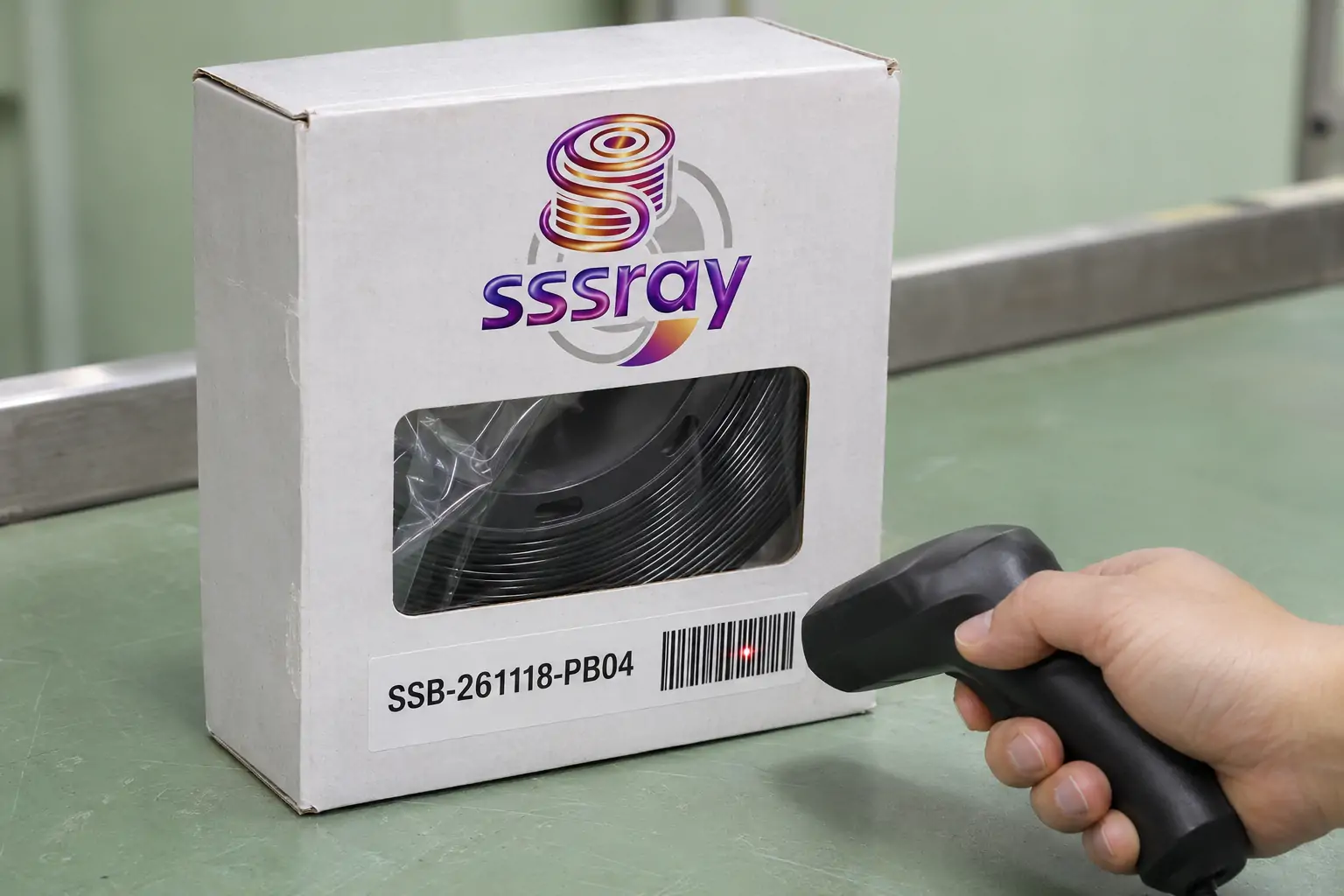
Our batch record connects the private-label PETG lot to the purchase order, packing list and release decision. The C18 packing exception shows how we hold and rebag a reel before the carton and pallet totals are finalized.
- Grade and format
- PETG Basic, black, unfilled · 1.75 mm · 1 kg net
- Factory SKU / private-label item
- SS-PETG-BK-175-1K / SS-PL-PG01
- Batch ID / release record
- SSB-261118-PB04 / SQC-261119-04
- PO / invoice item
- PO-CA-8046 item 010 / INV-261119-012 line 010
- Packing list / pallet
- PL-261119-012 / P01 · C01–C32
- Quantity and origin
- 320 spools · 32 cartons of 10 · China
- Release procedure
- SSS-QP-07 Rev. 2 · SSSray quality procedure 07, unfilled PETG batch release
- Release date and time
- 19 November 2026 · 16:10 CST (UTC+08:00)
Retains B04-E, B04-M and B04-L represent the early, middle and late parts of the extrusion run on November 18, 2026, at 08:36, 11:12 and 14:47 China Standard Time (UTC+08:00). The three carton groups follow that run sequence. Finished reels were sealed in aluminium foil barrier pouches with desiccant overnight, and the three retains were kept in sealed liners beside them. Retains were excluded from the invoice and packing count.
Equipment and method behind the record
- Diameter and ovality
- Inline laser gauge on extrusion line PB-04, 500 scans per second, 0.001 mm read-out. This batch’s QC export records paired X/Y readings at the same position; ovality is calculated from those two readings of one point.
- Automatic purge
- Filament that strays outside ±0.03 mm for more than 3 seconds is cut on the line and diverted to the purge bin before it reaches winding.
- Moisture
- Coulometric Karl Fischer titrator with oven transfer. Blank-corrected water mass in µg divided by the portion mass in g gives ppm by mass; portions are sealed within one minute of cutting.
- Net reel mass
- 0.01 g platform scale. Each empty reel is weighed before winding and the loaded reel again before the pouch and retail box are added, so the figure is filament, not packed weight.
- Seal and packing
- Aluminium foil moisture-barrier pouch with silica desiccant, inspected at carton close. Carton gross weights are taken on the same scale pair after the pouch is sealed.
- Print spot check
- Farm machines from the qualification fleet (Bambu Lab, Creality, Voron), 0.4 mm nozzle, no additional drying before the run. Coupons are inspected for visible open extrusion gaps.
On mobile, swipe tables horizontally to see the remaining columns.
| Check | Sample | Release limit | Recorded result |
|---|---|---|---|
| Filament diameter | 15 paired checkpoints, 30 axis readings | 1.720–1.780 mm on each axis (±0.03 mm) | 1.733–1.768 mm, mean 1.751 mm |
| Paired X/Y ovality | Same 15 checkpoints | ≤0.020 mm at each checkpoint | 0.018 mm maximum |
| Moisture at packing checkpoint | 6 portions, two per retain | ≤250 ppm (0.025%) per portion and ≤20 ppm between duplicates | 141–244 ppm; 186 ppm mean of displayed whole-ppm results; max duplicate spread 16 ppm |
| Net filament per reel | 9 finished reels, three per carton group | 1,000.0–1,020.0 g per reel | 1,002.8–1,013.6 g, mean 1,007.6 g |
| Print spot check | 3 coupons, one per retain | Complete each coupon with zero feed interruptions and zero visible open gaps | 3/3 completed, zero feed interruptions and zero visible open gaps |
| Pouch seal inspection | 320 packed reels, one rebag check | Unbroken seal with no crease crossing the seal at carton close | 319/320 first pass (99.7%), 320/320 accepted after rebagging one reel |
Apply each limit to the individual reading or pair rather than to the lot average. A value exactly at its limit passes. The means let you compare the early, middle and late parts of the run; they do not decide release. SSS-QP-07 Rev. 2 sets these gates, and the procedure is issued with the COA on request.
| Carton marks | Retain group | Cartons | Spools | Nominal net (kg) | Carton gross (kg) |
|---|---|---|---|---|---|
| C01–C10 | B04-E | 10 | 100 | 100.0 | 139.6 |
| C11–C22 | B04-M | 12 | 120 | 120.0 | 167.8 |
| C23–C32 | B04-L | 10 | 100 | 100.0 | 140.1 |
| Carton total | B04-E / M / L | 32 | 320 | 320.0 | 447.5 |
Line 010 and pallet P01 reconcile to 320.0 kg nominal net filament. The carton total includes reels and all carton contents. Pallet, straps and wrap add 23.8 kg to the 447.5 kg carton total, giving 471.3 kg palletized gross.
Packing exception and release
On November 19 at 13:42, a crease crossing the pouch seal on reel S07 put its assigned carton, C18, on hold. The team rebagged the same reel and confirmed the replacement seal at 14:06 before closing the carton. The final tally covered 320 distinct saleable reels. Carton gross weights were recorded after rebagging. The release decision was recorded at 16:10 China Standard Time.
Diameter and moisture readings
Each retained length has five checkpoints, 0.5 m apart, with paired X/Y diameter readings exported from the inline laser gauge. The ovality figure is the absolute difference between those two readings at the same position.
| Retain | Position (m) | X (mm) | Y (mm) | |X − Y| (mm) |
|---|---|---|---|---|
| B04-E | 0.5 | 1.744 | 1.750 | 0.006 |
| B04-E | 1.0 | 1.748 | 1.746 | 0.002 |
| B04-E | 1.5 | 1.751 | 1.743 | 0.008 |
| B04-E | 2.0 | 1.745 | 1.755 | 0.010 |
| B04-E | 2.5 | 1.752 | 1.747 | 0.005 |
| B04-M | 0.5 | 1.753 | 1.744 | 0.009 |
| B04-M | 1.0 | 1.760 | 1.742 | 0.018 |
| B04-M | 1.5 | 1.749 | 1.756 | 0.007 |
| B04-M | 2.0 | 1.755 | 1.750 | 0.005 |
| B04-M | 2.5 | 1.746 | 1.748 | 0.002 |
| B04-L | 0.5 | 1.763 | 1.751 | 0.012 |
| B04-L | 1.0 | 1.768 | 1.752 | 0.016 |
| B04-L | 1.5 | 1.759 | 1.748 | 0.011 |
| B04-L | 2.0 | 1.745 | 1.733 | 0.012 |
| B04-L | 2.5 | 1.764 | 1.757 | 0.007 |
On November 19, two portions from each retain were taken at the pre-seal checkpoint and transferred immediately to sealed vials for oven-transfer coulometric Karl Fischer analysis. Divide blank-corrected water in µg by the sample mass in g to get ppm by mass. Individual results are rounded to whole ppm; the summary mean is calculated from those six displayed values, with 0.5 rounded up.
| Retain / portion | Sample (g) | Water after blank correction (µg) | Moisture (ppm by mass) |
|---|---|---|---|
| B04-E / 1 | 2.417 | 341 | 141 |
| B04-E / 2 | 2.509 | 386 | 154 |
| B04-M / 1 | 2.466 | 416 | 169 |
| B04-M / 2 | 2.538 | 449 | 177 |
| B04-L / 1 | 2.391 | 545 | 228 |
| B04-L / 2 | 2.486 | 606 | 244 |
Finished reel weights and print spot checks
Each empty reel was weighed before winding. The same reel was weighed again after winding, before the bag and retail box were added. Net filament mass is the difference.
| Carton / reel | Empty reel (g) | Loaded reel (g) | Net filament (g) |
|---|---|---|---|
| C03 / S02 | 159.6 | 1,165.7 | 1,006.1 |
| C06 / S08 | 161.4 | 1,170.8 | 1,009.4 |
| C10 / S01 | 158.9 | 1,162.8 | 1,003.9 |
| C12 / S06 | 160.7 | 1,168.2 | 1,007.5 |
| C18 / S07 | 157.8 | 1,163.1 | 1,005.3 |
| C22 / S03 | 161.6 | 1,173.4 | 1,011.8 |
| C24 / S05 | 159.2 | 1,167.5 | 1,008.3 |
| C28 / S04 | 162.1 | 1,164.9 | 1,002.8 |
| C31 / S10 | 160.4 | 1,174.0 | 1,013.6 |
One coupon was printed from each retain on November 19 using the same toolpath and no additional drying. The run used a 0.4 mm nozzle at 245 °C, an 80 °C bed and 0.20 mm layers. Each completed coupon was inspected for visible open extrusion gaps.
| Retain | Elapsed (min:s) | Feed interruptions | Visible open gaps |
|---|---|---|---|
| B04-E | 25:41 | 0 | 0 |
| B04-M | 25:43 | 0 | 0 |
| B04-L | 25:46 | 0 | 0 |
How to check this record against your shipment
- For the PETG lot shown here, start on the master carton: the Batch ID is SSB-261118-PB04 and the carton marks run C01–C32. For your own shipment, match its actual Batch ID and carton marks to the lot-specific COA before the broker files the entry.
- For this example, reconcile PO-CA-8046 item 010, invoice INV-261119-012 line 010 and packing list PL-261119-012; all three total 320 spools and 320.0 kg nominal net. Our export team applies the same document-matching check using the order numbers and packed quantities for each buyer’s actual shipment.
- Compare the diameter column with your own incoming check. The release window is ±0.03 mm and all 30 displayed X/Y readings at the 15 sample checkpoints fall inside ±0.02 mm. If your receiving gauge reads outside ±0.02 mm at a sampled point, repeat that measurement before accepting the pallet.
- If you audit the seal record for this batch, check which carton was held for rebagging. C18 was closed and weighed only after its pouch was replaced, so the first-pass tally of 319/320 and final tally of 320/320 describe the same 320 distinct reels.
- Ask for the documents by name — SSS-QP-07 Rev. 2, the COA, the TDS and the SDS. A file that carries the Batch ID can be checked against the goods; a generic certificate cannot.
SSSray lot release. These recorded measurements come from batch SSB-261118-PB04; the displayed whole-ppm moisture mean follows the rounding method above. Each shipment’s COA identifies its Batch ID, measured values and release date, with retains B04-E, B04-M and B04-L held for inspection. We issue a separate release decision and traceable COA for each subsequent extrusion run.
Canadian filament import questions about CARM and release
Start with whose account carries the entry. That determines where to check the security, the statement and the payment.
Can my customs broker cover my CARM security?
No. For ordinary commercial imports on your account, the importer must arrange its own RPP security. A licensed broker can file after you delegate authority and can help you approach a security provider. Ask the broker to identify the legal entity on the proposed agreement, the RM account covered, the face value and the premium. Have your account manager verify the arrangement in CARM before dispatch. If it is still pending, get a written plan for paying at release. CBSA eligibility guidance.
What should our first Canadian filament-import budget include under CARM?
Use your expected peak customs debt, the route you plan to use and the cash dates for the factory, carrier and broker. Get an entry estimate for each grade under the same trade term, then check whether other orders will be outstanding on the account. Add any cash deposit or provider premium and collateral to the correct dates. Show the duty and GST payment separately. Finance can then see whether funding is tight before collection, at release or when the statement falls due.
Do we fund a new security deposit for every pallet?
No. A posted deposit supports the importer’s RM account across shipments. Another pallet can increase the exposure on that account, so check the available coverage and the amount coming due on the statement. Give treasury a dated schedule showing the original deposit, any top-up, the amount payable for each entry and any money the broker will advance. This keeps purchasing from charging the same deposit to every order while finance reserves the cash to settle the entries. CBSA account monitoring.
Our courier sample arrived without a payment request. Can the pallet follow the same route?
Confirm the pallet’s clearance with the broker before relying on the sample experience. Ask the courier who entered the sample, how it was accounted for and whether charges were billed to another party. Then send the broker the proposed pallet value, material descriptions, origin, destination and importer name. A sample can establish that a grade prints well on your machines. Your purchasing team still needs the release instructions, estimated customs debt and a confirmed payer for the commercial consignment. CBSA commercial release options.
What changes if the supplier quotes Delivered Duty Paid (DDP)?
Ask the seller to name the importer of record and explain how you will receive the accounting evidence. If your Canadian company appears as importer, verify its own account and release arrangements with the broker. If a different entity enters the goods, ask your finance team what documentation supports your purchase and any tax claim. Compare offers at the same delivery point and separate duty, tax, brokerage and conditional charges. A single delivered total gives too little information to approve those items. CRA guidance for importers.
How should a distributor handle one private-label order arriving early?
Rebuild the forecast for the month in which both orders may become payable. Ask the broker for the expected duty and tax on each entry, then check the current account balance and security coverage with finance. If projected exposure rises, review an additional deposit or a provider amendment before collection. Give the warehouse the revised carton and lot mapping at the same time. That prevents a cash-flow decision about the larger shipment from creating a receiving error between similar-looking retail boxes. CBSA monitoring rules.
Get the Canadian filament import document pack before booking
Put the importer name, the broker’s release route and the date finance needs the money on the purchase approval. We can then update the shipment pack without leaving the buyer with an outdated CARM cash forecast when the freight booking changes.
For a bulk or private-label order, send us the material and grade, spool format, quantity per SKU, Canadian destination and postal code, preferred EXW or FOB Ningbo term and target arrival window. We can prepare the draft invoice details and packing list for your broker and identify the TDS, SDS or batch COA available for the order. The final invoice, weights and lot details follow the goods actually packed. We typically reply to a complete B2B request within one business day with the quotation route and document scope.
Ask your broker to return an itemized release estimate against that same pack. You can then compare factory offers at the same receiving dock and approve the order with the cash dates in front of you.
Prefer the factory inquiry form? Use “Canadian shipment document pack” in your message. Compare our wholesale material range, PETG catalogue and supplier comparison tool before finalizing the PO.
Request a quote or free samples
Tell us the material, color, spool size and monthly volume. An engineer replies within 24 hours on business days.
References for Canadian release and factory documentation
Use CBSA’s current enrolment instructions for your account, the payment calendar for settlement and the invoice memorandum for the supplier’s paperwork. Sources checked November 27, 2026.
- Importer accounts, broker delegation and brokerage fees. CBSA · Set up your business to import.
- Release Prior to Payment privileges and the obligation to account and pay. CBSA · Memorandum D17-1-8.
- Eligibility and the limits of a customs broker’s security. CBSA · Who can enrol for RPP.
- The account balance used, forms of security and annual dates. CBSA · Get ready to enrol.
- The first-time importer’s self-assessment and final enrolment step. CBSA · How to enrol for RPP.
- Financial security amounts, the deposit floor rule and ongoing monitoring. CBSA · Memorandum D17-5-2.
- Release routes and full accounting at release. CBSA · Release, account and pay duties and taxes.
- Statements of Account and payment dates. CBSA · Commercial import payments.
- Commercial invoice requirements and the fields in Appendix A. CBSA · Memorandum D1-4-1.
- Eligibility for an input tax credit on imports. Canada Revenue Agency · GST/HST on imports and exports.
- October 2026 notice and the January 2027 adjustment deadline. Canadian Society of Customs Brokers · CARM annual review.
- Factory lot records and certificates of analysis. SSSray · Batch QC Data for B2B.
SSSray Data Reuse Terms (2026). The CA-RPP-20261126-A worksheet and SSB-261118-PB04 batch tables are published by SSSray. © 2026 SSSray. All rights reserved. Reuse requires prior written permission from SSSray.

He Jiang
Senior Researcher · SSSray · 3D Printing Filament Manufacturing · Jinhua, Zhejiang
He Jiang is a senior researcher at SSSray, a 3D printing filament manufacturer in Jinhua, Zhejiang, China. In this guide he connects factory invoices, packing lists and filament batch records to the information a Canadian buyer needs before release.