Online time
Monday to Friday: 9AM - 8PM
Weekend: 10AM - 5PM


TL;DR: The Real B2B Cost of Carbon Fiber Filament
Carbon fiber composite filament can improve stiffness, dimensional stability, surface finish, and heat-performance positioning, but the spool price is only one part of the procurement decision. For B2B users, the real cost is usually driven by abrasive wear on nozzles and feed gears, moisture control for nylon and other hygroscopic matrices, slower qualification cycles, and the cost of failed production runs. A reliable sourcing decision should verify the base polymer, chopped-fiber loading, moisture condition, nozzle compatibility, packaging barrier, and lot-level quality documents before a bulk order is approved.
Tooling BaselineUse hardened steel, tungsten carbide, or other abrasive-rated nozzles; avoid standard brass for filled filaments.
Drying PriorityPA-CF grades require controlled drying and dry feeding; vendor instructions should be verified by grade.
QC EvidenceRequest diameter logs, COA/TDS, moisture data, and ash-content testing for lot-level verification.
Best FitUse CF when stiffness, low warping, matte finish, or heat-positioning justify extra tooling and handling costs.

He Jiang
Senior Researcher · SSSray · 3D Printing Filament Manufacturing · Jinhua, Zhejiang
He Jiang is a senior researcher at SSSray, a 3D printing filament manufacturer in Jinhua, Zhejiang, China. He focuses on EU regulatory shifts that affect filament brands exporting into Europe, including REACH SVHC disclosure, the universal PFAS restriction, and PPWR packaging compliance. He Jiang’s writing for SSSray is grounded in supplier SDS documentation, ECHA publications, and EUR-Lex regulatory texts, and is intended for B2B brand owners, distributors, and OEM partners — not as a substitute for professional regulatory advice.
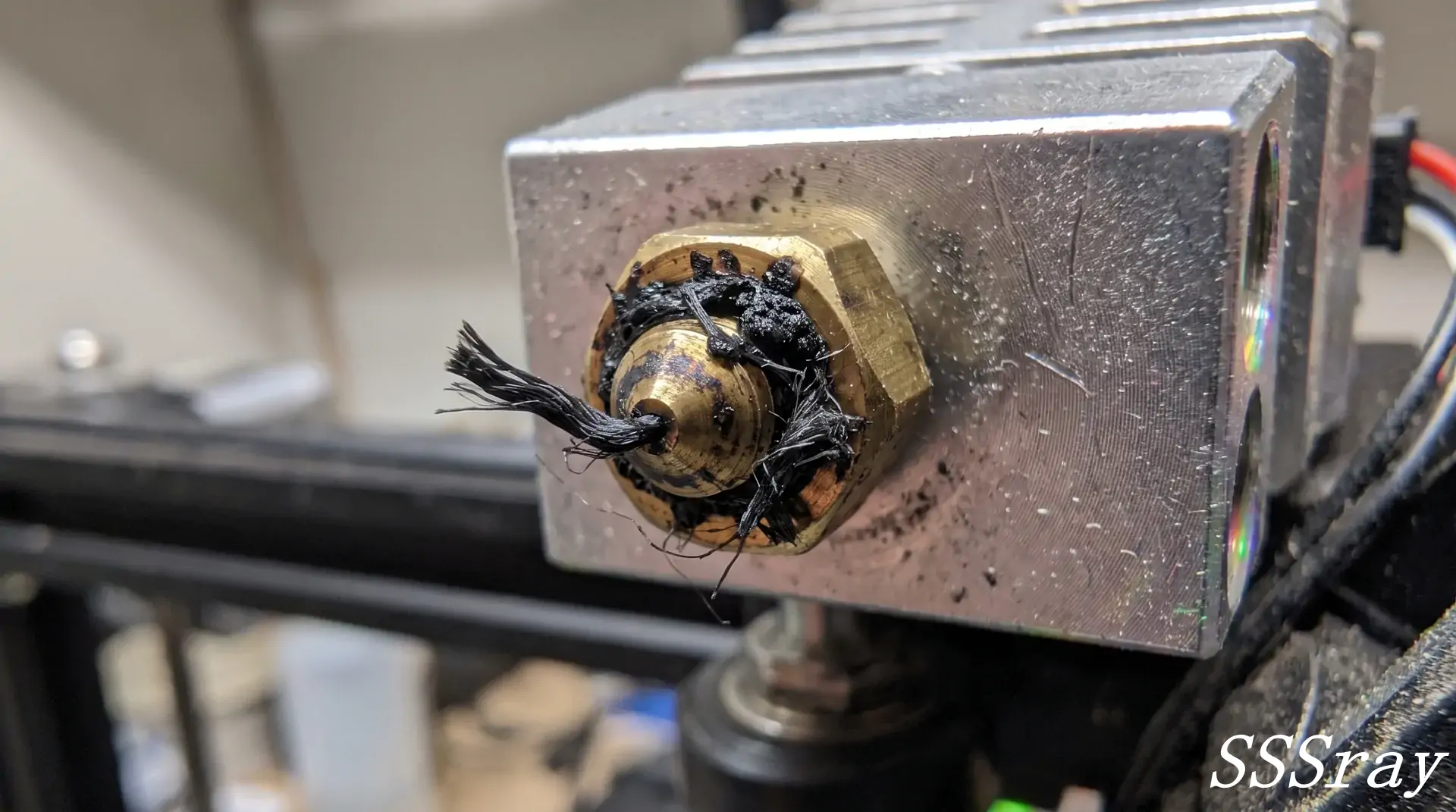
4. Nozzle Material Benchmark: Wear Resistance and Heat Transfer
Nozzle selection is a tradeoff between wear resistance, heat transfer, price, and crash tolerance. The table below should be used as a procurement guide, not as a universal wear-life guarantee. Actual results depend on fiber loading, matrix polymer, nozzle diameter, extrusion temperature, flow rate, and machine calibration.
| Nozzle Material | Typical Advantage | Main Limitation | B2B Application Fit |
|---|---|---|---|
| Standard Brass | High heat transfer and low cost | Poor wear resistance with abrasive filled filaments | Not recommended for true chopped-fiber production runs |
| Hardened Steel | Common abrasive-material upgrade; widely supported by printer vendors | Lower heat transfer than brass; may need temperature or flow tuning | Practical baseline for many CF, GF, and filled materials |
| Tungsten Carbide | High wear resistance with better heat transfer than hardened steel | Higher upfront cost and supplier variation | Strong fit for print farms and repeated composite production |
| Ruby or Gem-Tipped Nozzle | Very wear-resistant tip surface | Higher cost; tip construction can be vulnerable to impact or misuse | Useful for specialized users; validate durability on the target fleet |
5. TCO Checklist for Procurement
The lowest spool price rarely produces the lowest cost per accepted part. Before approving a carbon fiber filament supplier, calculate material cost together with tool wear, drying energy, labor, scrap, downtime, and reorder consistency.

| Cost Driver | What to Measure | Evidence to Request | Why It Matters |
|---|---|---|---|
| Nozzle and Gear Wear | Tool replacement interval on target machines | Supplier guidance plus buyer-side endurance print | Dimensional drift and feed slip can raise scrap cost |
| Drying Overhead | Drying time, temperature, storage RH, and dry-feed setup | Grade-specific drying protocol and moisture limit | Wet nylon composites can print poorly and lose performance |
| Flow Stability | Stable volumetric flow on the buyer’s nozzle size | Flow curve or printed mechanical test bars | High advertised speed may not equal high accepted-part yield |
| Batch Consistency | Diameter tolerance, fiber loading, color/sheen, and moisture | COA, TDS, diameter logs, and ash-content test | Private-label buyers need repeatable reorders |
SSSray Engineering Quality Verification Note
For Wholesale Carbon Fiber Filament programs, SSSray can support B2B qualification with lot-linked technical documentation, diameter-control records, moisture-control targets, and ash-content verification aligned with current ISO ash-testing practice. Buyers should confirm the exact test package required for their market, application, and compliance file before mass production.
6. Buyer Decision Framework: SSSray Composite Sourcing Framework
Use this framework to decide whether carbon fiber filament is necessary, technically suitable, and commercially defendable for your product line.
1. Mechanical and Thermal Demand
Why it matters: Carbon fiber should solve a real stiffness, warping, surface, or heat-positioning problem.
What to ask: What stiffness, HDT, surface finish, and dimensional stability does the finished part require?
Pass signal: CF provides measurable value beyond standard PETG, PLA, ABS, PC, or nylon.
Hidden risk: Over-specifying CF for only a matte look adds unnecessary wear and handling cost.
2. Fiber Loading and Ash Verification
Why it matters: Fiber content affects stiffness, flow, brittleness, surface texture, and wear.
What to ask: Request current ash-content testing and confirm whether the filler is chopped fiber or carbon black.
Pass signal: Lot-linked data matches the advertised formulation and target application.
Hidden risk: Carbon powder can lengthen print times without providing true reinforcement value.
3. Flow and Nozzle Compatibility
Why it matters: Fiber-filled materials can reduce stable flow and increase clog risk.
What to ask: What nozzle size, nozzle material, temperature range, and maximum stable flow are recommended?
Pass signal: The supplier can support 0.4 mm or 0.6 mm validation on the buyer’s target printers.
Hidden risk: A “high-speed” claim without flow data may fail during real production.
4. Regulatory and Chemical Compliance
Why it matters: Finished products may need RoHS, REACH SVHC, or customer-specific chemical declarations.
What to ask: Request current SDS, RoHS declarations, and REACH SVHC statements aligned with the current ECHA Candidate List.
Pass signal: Material disclosures match the latest published regulatory lists and customer file requirements.
Hidden risk: Recycled or untraceable feedstock can introduce restricted additives.
5. Moisture Protection and Packaging
Why it matters: Moisture-sensitive grades can degrade during storage, freight, and printing.
What to ask: What barrier bag, desiccant, vacuum standard, and residual moisture target are used?
Pass signal: The packaging specification matches the polymer matrix and shipping route.
Hidden risk: A standard PE bag may be inadequate for nylon-based composite supply chains.
6. Landed Cost per Accepted Part
Why it matters: Buyers pay for accepted parts, not just kilograms of material.
What to ask: What is the expected scrap rate, drying cost, maintenance interval, and operator load?
Pass signal: The supplier helps qualify a repeatable process, not only a low spool price.
Hidden risk: Cheap composite spools can become expensive when downtime and rework are counted.
7. Reorder Consistency and Private Label Stability
Why it matters: Brands need repeatable performance across purchase cycles.
What to ask: Does the factory provide lot traceability, stable resin sourcing, and private-label documentation?
Pass signal: COA/TDS records and packaging files are tied to each production lot through Private Label 3D Printer Filament programs.
Hidden risk: Unannounced resin or filler changes can alter print behavior and customer experience.
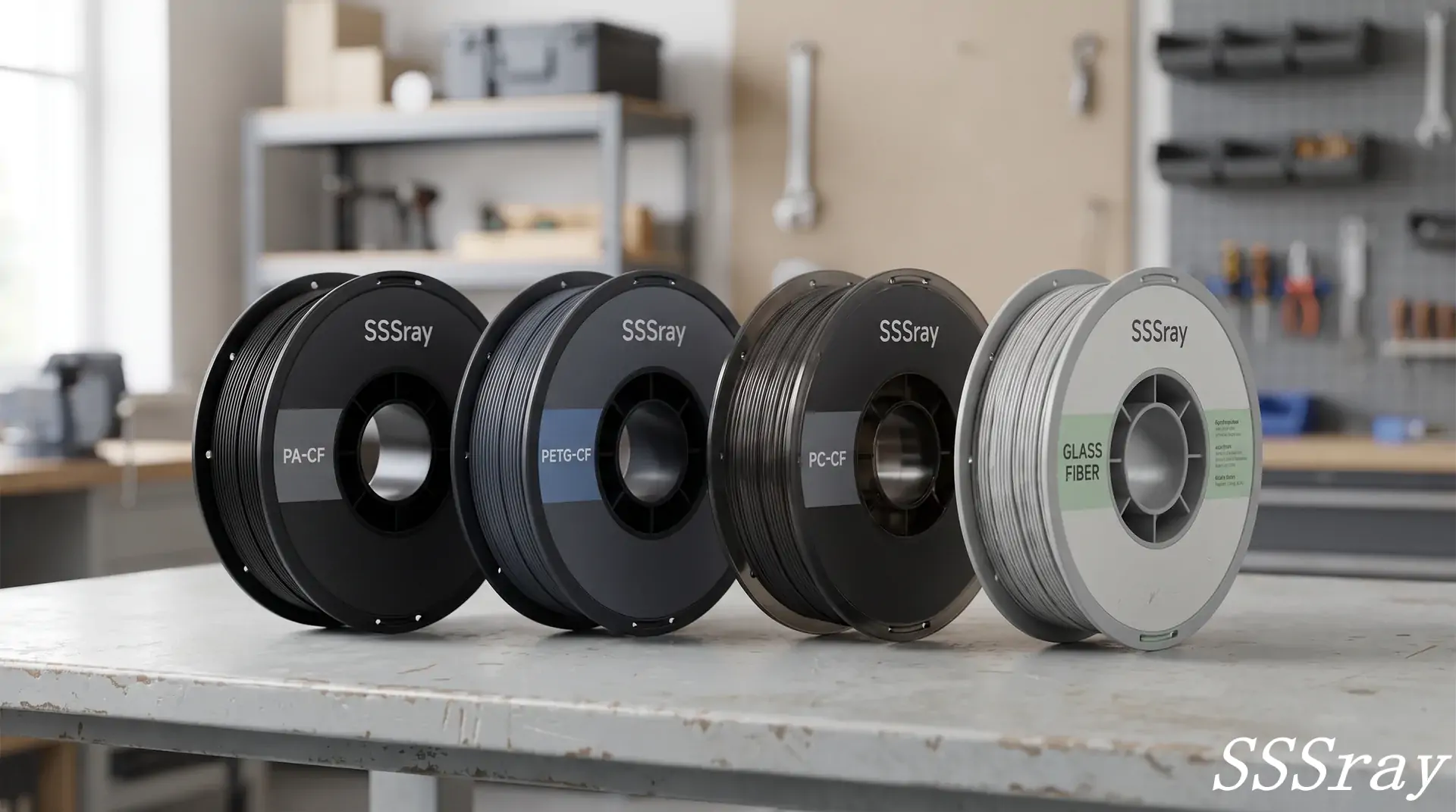
7. Sourcing Comparison: PA-CF, PETG-CF, PC-CF, and Glass Fiber
Carbon fiber is not one material. The base polymer decides much of the drying need, heat resistance, toughness, and printer requirement.
| Composite Grade | Best B2B Use Case | Primary Advantage | Operational Risk | SSSray Sourcing Program |
|---|---|---|---|---|
| PA-CF / PAHT-CF | Fixtures, brackets, robotic end-effectors, functional parts | Strong stiffness-to-weight positioning with useful heat-performance potential | High moisture sensitivity; drying and enclosed printing may be required by grade | Wholesale Carbon Fiber |
| PETG-CF | Industrial jigs, fixtures, matte housings, lower-warping parts | Easier printing than nylon composites and attractive surface finish | Lower heat resistance than engineering nylon or PC grades | Wholesale PETG Filament |
| PC-CF | Higher-temperature housings, tooling, and demanding fixtures | Better heat-performance positioning than PETG-CF | Needs stronger printer capability, drying, and process control | Wholesale PC Filament |
| Glass Fiber Composites | Electrical, RF-sensitive, and non-conductive applications | Non-conductive reinforcement option with good stiffness potential | Abrasive on tooling and usually denser than carbon fiber options | Wholesale Glass Fiber |
8. Supplier Claims vs. Technical Reality
| Marketing Claim | What It May Hide | Evidence to Request | Procurement Action |
|---|---|---|---|
| “Prints easily on standard brass nozzles” | The product may be lightly filled, carbon-black colored, or unsuitable for long production runs. | Ash-content report, filler description, and wear-test guidance. | Reject the claim for structural CF use unless evidence supports it. |
| “Pre-dried and zero moisture sensitivity” | The supplier may be ignoring storage and freight moisture exposure. | Residual moisture limit, packaging barrier spec, and drying protocol. | Require grade-specific storage and drying instructions. |
| “High-speed composite, 300 mm/s+” | Travel speed may be advertised while volumetric flow and part strength are omitted. | Volumetric flow curve and mechanical test bars printed at the target speed. | Validate on the target printer fleet before bulk rollout. |
9. What Each Buyer Type Should Check
Distributor and Brand Owner
Focus: Lower return rates, shelf-life stability, consistent finish, and packaging quality.
Risk: Inconsistent composite sheen or wet nylon grades can create customer complaints.
Action: Use SSSray OEM/ODM Services for custom packaging, batch documentation, and private-label support.
Commercial Print Farm
Focus: Uptime, nozzle life, repeatable flow, and predictable part acceptance.
Risk: Nozzle bore wear, feed-gear slip, and wet material failures during overnight runs.
Action: Standardize abrasive-rated toolpacks and qualify 0.4 mm or 0.6 mm nozzles on the actual machine fleet.
Industrial OEM
Focus: Repeatable mechanical behavior, compliance files, and lot traceability.
Risk: Batch-to-batch formulation changes can shift stiffness, flow, and surface appearance.
Action: Specify custom compounding through Custom Engineering Filament with agreed COA/TDS requirements.
Technical Procurement Manager
Focus: Total landed cost, stable supply, lead time, and supplier accountability.
Risk: A low quotation can become expensive if qualification, scrap, and downtime are ignored.
Action: Compare suppliers by accepted-part cost and documentation strength, not spool price alone.
10. Factory Sourcing Specifications and Quality Standards
The table below shows practical specification items that a B2B buyer can request when qualifying engineering composite filament. Exact values should be confirmed by grade, nozzle size, printer fleet, destination market, and private-label agreement.
| Quality Parameter | Recommended Buyer Requirement | Verification Method | Commercial Note |
|---|---|---|---|
| Filament Diameter | 1.75 mm or 2.85 mm with lot-level tolerance record | In-line laser measurement or equivalent diameter log | Essential for private-label consistency |
| Carbon Fiber Content | Declared weight percentage by formulation | Ash-content testing aligned with current ISO 3451-1 practice | Confirms that the product matches the advertised composite grade |
| Residual Moisture | Grade-specific moisture target at packing | Karl Fischer or supplier-agreed moisture test method | Especially important for PA-CF and PAHT-CF |
| Packaging Barrier | Barrier packaging matched to moisture sensitivity and freight route | Packaging specification and incoming inspection | Protects shelf life and customer experience |
| Lot Documentation | COA, TDS, SDS, and compliance declarations as required | Lot-numbered document package | Supports distributors, OEMs, and regulated customers |
Qualify Your Carbon Fiber Supply with SSSray
Contact SSSray to request evaluation spools, discuss private-label composite programs, or build a lot-documentation package for your carbon fiber filament product line.
11. Supplier Data to Confirm Before Publishing
Before this article is used as a commercial landing asset, SSSray should confirm the product-grade data behind any quotation, sample pack, or private-label discussion. The article avoids unsupported price, MOQ, certification, and performance claims; final sales pages can add those details only after the factory and sales team confirm the exact grade and document package.
| Data Point | Owner | Document to Check | Publish Only If |
|---|---|---|---|
| Fiber loading | Factory QC / R&D | COA, formulation record, ash-content test | The value is tied to a specific grade and lot |
| Diameter tolerance | Production QC | In-line diameter log or inspection report | The tolerance is measured, not only advertised |
| Drying protocol | R&D / Technical sales | TDS and internal print validation record | The temperature and time match the exact polymer matrix |
| Compliance statements | Compliance / Sales | SDS, RoHS, REACH SVHC, customer declaration files | The declaration reflects the current published regulatory list |
| MOQ, lead time, and price | Sales / Operations | Current quotation and production schedule | The numbers are current for the buyer’s order volume and destination |
12. Frequently Asked Questions
Does carbon fiber filament damage brass nozzles?
Yes. True carbon fiber filled filament is abrasive and can wear brass nozzles quickly compared with unfilled materials. For production work, use a hardened steel, tungsten carbide, or other abrasive-rated nozzle and verify the setup on your actual printer fleet.
Does carbon fiber filament require hardened extruder gears?
For long production runs, hardened feed components are recommended where the printer platform supports them. Abrasive filaments can contribute to gear wear, feed slip, and debris, especially on high-hour machines.
Can PA-CF be printed with a 0.4 mm nozzle?
Some PA-CF grades can run through a 0.4 mm hardened nozzle, but the correct answer depends on fiber length, fiber loading, dispersion quality, and the printer. Heavily filled or less consistent formulations are often safer with a 0.6 mm nozzle. Always follow the filament supplier’s grade-specific recommendation.
How should a B2B buyer calculate the real cost of carbon fiber filament?
Use accepted-part cost rather than spool price. Include raw material cost, nozzle and gear wear, drying energy, storage consumables, operator handling, scrap, failed overnight runs, and qualification time.
What drying protocol should be used for PA-CF?
Use the supplier’s grade-specific drying instruction. As a public benchmark, Bambu Lab lists 80°C for 8 to 12 hours before printing for PAHT-CF. Other PA-CF formulations may require different settings, so buyers should confirm temperature, time, storage RH, and dry-feed requirements before production.
How can buyers verify claimed carbon fiber loading?
Ask for lot-linked ash-content testing and a clear filler description. The latest ISO 3451-1 standard page should be used when aligning test documentation, and buyers can also request independent verification for large or regulated purchase programs.
Is tungsten carbide better than hardened steel for carbon fiber filament?
Tungsten carbide can offer strong wear resistance and better heat transfer than hardened steel, but it costs more. Hardened steel is a practical baseline; tungsten carbide is usually more attractive when a print farm runs abrasive materials continuously.
Request a quote or free samples
Tell us the material, color, spool size and monthly volume. An engineer replies within 24 hours on business days.
13. References and Verification Sources
- Prusa Research: official guidance on composite materials filled with carbon, Kevlar, or glass and hardened steel nozzle use.
- Bambu Lab PAHT-CF: official product guidance including hardened steel hotend and drying recommendations.
- ISO 527-2:2025: Plastics – Determination of tensile properties – Part 2: Test conditions for moulding and extrusion plastics.
- ISO 3451-1:2026: Plastics – Determination of ash – Part 1: General methods.
- ISO 15512:2019: Plastics – Determination of water content.
- ECHA Candidate List: current SVHC Candidate List used for REACH supplier disclosure checks.
- ECHA PFAS restriction update: official status update on the universal PFAS restriction proposal and SEAC opinion timing.
- Regulation (EU) 2025/40: Packaging and Packaging Waste Regulation for EU packaging compliance planning.
