Online time
Monday to Friday: 9AM - 8PM
Weekend: 10AM - 5PM


TL;DR: How B2B Buyers Should Manage Filament Moisture and Drying in 2026
Filament moisture is an engineering risk that causes polymer hydrolysis, severe micro-void formation, and mechanical rejection in industrial 3D printing. For high-volume print farms, European distributors facing humid seasonal peaks, and OEM brands, moisture control must be treated as a rigorous procurement discipline. The solution relies on three verified steps: selecting factory-dried materials packed in certified high-barrier pouches, enforcing active forced-air dehydration protocols calibrated below polymer glass transition points ($T_g$), and verifying batch moisture levels via ISO 15512 Karl Fischer titration reports.
Best ProcessActive forced-air thermal drying with direct enclosed PTFE dry box feeding.
When Not to UseNever use uncalibrated domestic kitchen ovens due to severe temperature overshoot spikes (>±15°C).
Key SpecificationsTarget moisture: <0.02% wt (<200 ppm) for PA Nylon; <0.05% wt for TPU and PETG.
Verification GateBatch-specific Karl Fischer COA and high-barrier recyclable vacuum packaging audit.

He Jiang
Senior Researcher · SSSray · 3D Printing Filament Manufacturing · Jinhua, Zhejiang
He Jiang is a senior researcher at SSSray, a 3D printing filament manufacturer in Jinhua, Zhejiang, China. He focuses on EU regulatory shifts that affect filament brands exporting into Europe, including REACH SVHC disclosure, the universal PFAS restriction, and PPWR packaging compliance. He Jiang's writing for SSSray is grounded in supplier SDS documentation, ECHA publications, and EUR-Lex regulatory texts, and is intended for B2B brand owners, distributors, and OEM partners — not as a substitute for professional regulatory advice.
Abstract: Thermal Dehydration Dynamics and Quality Assurance for Engineering Filaments
In high-speed fused filament fabrication, moisture absorption represents an invisible catalyst for part failure. Sourcing managers frequently misdiagnose hydrolytic degradation as extruder gear slippage, flow fluctuations, or bed leveling defects. When hygroscopic polymers enter a 200°C–300°C melt zone, entrapped water rapidly superheats, cleaving macromolecular chains and leaving microscopic internal voids that degrade structural density.
For engineering buyers, brand owners, and production managers, mitigating this risk requires an integrated framework combining factory-grade packaging integrity with verified on-site drying parameters. This 2026 benchmark guide presents empirical dehydration temperatures, compares equipment capabilities (SUNLU FilaDryer S4, eSun eBOX, industrial convection ovens), and outlines an auditable incoming quality checklist to protect volume operations from costly returns.
Key Takeaways for Procurement & Print Farm Operations
1. Hydrolysis is permanent during melt: Wet PA Nylon and PETG suffer irreversible molecular weight loss inside the hotend, reducing tensile strength by up to 45%.
2. PLA moisture failure threshold: Above 0.08% moisture, PLA experiences excessive oozing, brittle spool snapping, and degraded surface finish.
3. PA Nylon requires active airflow: Passive desiccant dry boxes cannot release hydrogen-bonded water in polyamides; forced-air convection at 75°C–85°C is essential.
4. PETG thermal ceiling: Dehydrate PETG strictly at 60°C–65°C; exceeding 75°C approaches its glass transition temperature ($T_g$), causing spool strand fusing.
5. Domestic oven risks: Kitchen ovens exhibit extreme hysteresis cycling, easily warping plastic spools and destroying filament consistency.
6. Storage vs. drying distinction: Desiccant dry boxes serve as holding buffers to prevent reabsorption, but lack the thermal energy to dehydrate saturated reels.
7. European summer moisture peaks: At 25°C and 70% RH, exposed PA Nylon exceeds critical printability thresholds within 2 to 4 hours of unsealing.
8. EU PPWR packaging alignment: In 2026, compliant supply chains require certified high-barrier, recyclable mono-material vacuum packaging meeting Regulation (EU) 2025/40 [1, 2].
1. The Science of Moisture in Extrusion: Hydrolysis and Structural Defects
Thermoplastics processed in fused filament fabrication (FFF) exhibit distinct hygroscopic characteristics based on their molecular backbone. Materials such as Wholesale PLA Filament, Wholesale PETG Filament, Wholesale TPU Filament, and Wholesale PA Nylon Filament feature polar functional groups that readily absorb ambient water vapor.
During extrusion at temperatures between 200°C and 300°C, trapped moisture causes two structural failure mechanisms:
Explosive Micro-Vaporization
Trapped moisture instantly converts to high-pressure steam at the nozzle orifice. This creates audible popping, disrupts laminar extrusion, and introduces internal voids that significantly decrease structural part density.
Hydrolytic Chain Scission
In polyesters and polyamides, high thermal energy causes water molecules to cleave polymer ester and amide chains. This permanently lowers molecular weight, creates severe stringing, and renders the finished part brittle.
Engineering Reality: Hydrolytic degradation cannot be corrected by annealing after printing. Once the polymer is extruded wet, molecular chain shortening is permanent. Filament must be dried before it enters the extruder drive.
2. Verified 2026 Drying Parameter Matrix: Temperature, Time & Dew Points
Effective moisture desorption requires balancing chamber temperature, airflow circulation, and low atmospheric dew point. Drying below target temperatures leaves core moisture trapped, while exceeding the material's glass transition temperature ($T_g$) risks spool deformation and strand fusion.
| Polymer Grade | Glass Transition ($T_g$) | Recommended Drying Temp | Minimum Duration | Target Moisture Limit | Visible Failure Indicator |
|---|---|---|---|---|---|
| Standard & High-Speed PLA | 55°C – 60°C | 45°C – 50°C | 4 – 6 Hours | < 0.05% wt (500 ppm) | Filament brittleness on spool, nozzle stringing |
| PETG / PCTG | 75°C – 80°C | 60°C – 65°C | 4 – 8 Hours | < 0.03% wt (300 ppm) | Severe oozing, surface bubbling, weak Z-weld |
| TPU (85A / 95A) | < -20°C (Softens ~60°C) | 55°C – 60°C | 6 – 8 Hours | < 0.03% wt (300 ppm) | Extrusion popping, under-extrusion, surface voids |
| PA6 / PA66 (Nylon) | 50°C – 65°C | 75°C – 85°C | 8 – 12 Hours | < 0.015% wt (150 ppm) | Foaming at nozzle, severe embrittlement |
| PA-CF / PA-GF Composites | 55°C – 70°C | 80°C – 90°C | 8 – 12 Hours | < 0.02% wt (200 ppm) | Rough surface defects, nozzle clogging, layer separation |
| ABS / ASA | 100°C – 105°C | 70°C – 80°C | 4 – 6 Hours | < 0.05% wt (500 ppm) | Micro-voids, reduced impact resistance |
For custom engineering formulations, review technical specifications in our Custom Engineering 3D Printing Filament data sheets.
3. Empirical Moisture Absorption Benchmarks & Environmental Regain
Understanding moisture uptake kinetics is critical for print farm operations. In an unconditioned production facility during a humid European summer (25°C at 70% Relative Humidity), PA Nylon can reach saturation failure within 4 hours of exposure.
Chart 1: Maximum Equilibrium Moisture Absorption (% by Weight)
Empirical data measured at 23°C and 70% RH (ASTM D570 cross-verified)

Chart 2: Moisture Regain Timeline After Complete Dehydration
Hours exposed at 25°C / 70% RH after initial drying to 0.01% wt baseline
| Exposure Time | PLA (% wt) | PETG (% wt) | TPU 95A (% wt) | PA6 Nylon (% wt) |
|---|---|---|---|---|
| 0 Hours (Dry Baseline) | 0.01% | 0.01% | 0.01% | 0.01% |
| 2 Hours | 0.03% | 0.06% | 0.12% | 0.35% (Defect Zone) |
| 6 Hours | 0.06% (Defect Zone) | 0.14% | 0.28% (Defect Zone) | 0.85% |
| 12 Hours | 0.11% | 0.22% (Defect Zone) | 0.50% | 1.80% |
| 24 Hours | 0.18% | 0.38% | 0.82% | 3.40% |
| 48 Hours | 0.30% | 0.65% | 1.15% | 6.20% |
4. Filament Drying Equipment Benchmarks: 2026 Comparative Review
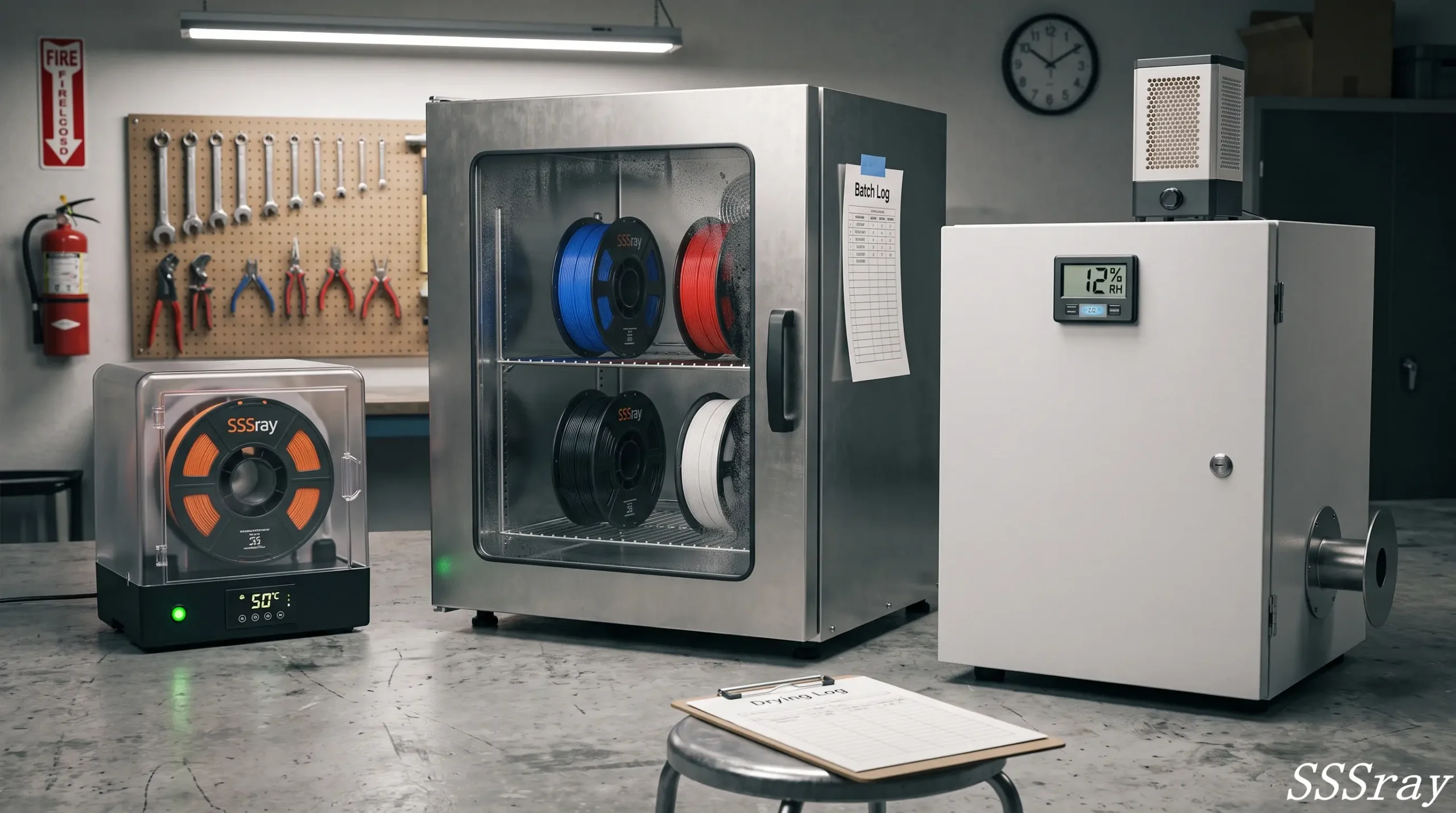
Selecting appropriate drying equipment depends on manufacturing volume and material thermal requirements. Industrial operations utilize four primary categories of thermal dehydration equipment:
| Equipment Class | Max Temp | Airflow Mechanism | Capacity | Recommended Use Case | Key Limitation |
|---|---|---|---|---|---|
| eSun eBOX Series | 50°C – 55°C | Low Static Convection | 1 Spool | PLA / PETG inline feeding buffer | Insufficient temperature for PA Nylon drying |
| SUNLU FilaDryer S4 | 70°C | Forced-Air Dual Fan PTC | 4 Spools | Print farm multi-material setups (PLA/PETG/TPU/PA12) | Chamber max limited for high-temp PA66 composites |
| Food Dehydrator (Modified) | 65°C – 75°C | Radial Forced Air | 2 – 4 Spools | Low-cost batch pre-drying | No direct feed ports; temperature variance (±8°C) |
| Domestic Kitchen Oven | 50°C – 250°C+ | Variable / Natural | 4 – 8 Spools | Not recommended for production | Thermal spikes fuse spools; no moisture exhaust |
| Industrial Desiccant Oven | 120°C+ | Dry Air Sweep (-40°C Dew Point) | 12 – 48 Spools | High-volume composite lines (Carbon Fiber & PA) | Higher initial CAPEX; batch processing only |
Evaluating Alternative Drying Methods
Procurement teams often evaluate whether budget equipment can replace dedicated drying hardware:
Food Dehydrators
Modified food dehydrators with constant airflow offer effective batch pre-drying for PLA, PETG, and TPU. However, they lack PTFE feed ports for continuous printing protection.
Domestic Kitchen Ovens
Kitchen ovens rely on broad duty-cycle heating that generates localized thermal spikes up to 20°C above setpoint, frequently warping plastic spools and fusing filament.
5. B2B Buyer Decision Framework for Moisture Assurance
To eliminate moisture-related defects across client networks, procurement managers should apply this systematic verification framework before approving volume suppliers.
| Audit Dimension | Operational Significance | Key Question for Supplier | Pass Verification Signal | Rejection Risk |
|---|---|---|---|---|
| 1. Packaging Moisture Barrier | Prevents moisture regain during extended sea freight transit. | "What is the MVTR rating and structure of your barrier pouch?" | Multi-layer aluminum or PPWR-compliant high-barrier pouch with desiccant. | Standard single PE bag with unsealed zip closure. |
| 2. Certified Moisture Testing | Confirms factory-level thermal desorption prior to sealing. | "Can you provide batch-linked Karl Fischer moisture COAs?" | ISO 15512 titration report confirming <0.02% water content. | Unverified marketing claim of "dry filament" without data. |
| 3. High-Temperature Spool Cores | Prevents spool flange warping in 70°C–85°C drying chambers. | "What material and heat deflection rating is used for your spools?" | High-$T_g$ Polycarbonate core or reinforced rigid cardboard spool. | Low-grade recycled PS spool that softens at 55°C. |
| 4. Batch Retention Samples | Ensures batch traceability in the event of quality claims. | "Do you retain sealed lot samples from every extrusion batch?" | Documented retention sample archived for 12 months minimum. | No lot numbers printed on spool labels or master cartons. |
| 5. High-Speed Flow Stability | Ensures consistent melt rheology at high extrusion rates. | "What is the maximum volumetric flow rate verified at dry baseline?" | Consistent flow (>20 mm³/s) with zero micro-void formation. | Visible under-extrusion and surface pockmarks above 10 mm³/s. |
6. Production Sourcing Specifications: SSSray Supply Standards
SSSray enforces strict baseline quality benchmarks across all standard and engineering filament product lines:
| Technical Parameter | Standard Industrial Benchmark | Custom / OEM Options Available |
|---|---|---|
| Minimum Order Quantity (MOQ) | 50 kg (Standard Catalog Lines) | 500 kg per custom RAL/Pantone color match (Private Label) |
| Diameter & Roundness Precision | 1.75 mm ± 0.03 mm (Online dual-axis laser monitoring) | High-precision ± 0.015 mm for automated production fleets |
| Ex-Factory Moisture Standard | < 0.03% wt (PLA/PETG/TPU); < 0.015% wt (PA Nylon) | Custom nitrogen-purged packaging upon request |
| Primary Packaging Structure | Vacuum-sealed high-barrier pouch + active desiccant | EU PPWR-compliant mono-material recyclable barrier packaging |
| Spool Flange Construction | Eco-cardboard / High-$T_g$ heat-resistant polymer flange | Custom branded flanges, dimensions, and center labeling |
| Regulatory Compliance | REACH SVHC, RoHS, EU PPWR (Regulation (EU) 2025/40) [1, 2] | Full SDS, TDS, and compliance documentation dossier |
Pricing & Commercial Notice: Market pricing benchmarks cited in technical comparisons reflect statistical averages across global industrial distributors as of mid-2026. SSSray leverages direct factory extrusion lines in Zhejiang to provide direct-from-manufacturer volume pricing. Request a custom quote for specific volume tiers and private-label packaging requirements.

7. Supplier Claims vs. Technical Reality
| Common Marketing Claim | What It May Hide | Evidence to Request | SSSray Engineering Standard |
|---|---|---|---|
| "Hydrophobic / Zero-Moisture Nylon" | All polyamides absorb moisture; additives only slow the absorption rate. | ASTM D570 24-hr water immersion test report. | Transparent TDS detailing exact moisture regain curves and drying steps. |
| "Factory Pre-Dried, Ready to Print" | Filament may have absorbed humidity during storage in thin PE bags. | Batch Karl Fischer titration certificate and packaging MVTR spec. | In-line desiccant drying followed by instant high-barrier vacuum sealing. |
| "High-Speed Grade (No Drying Needed)" | High-flow additives mask surface bubbling but cannot prevent hydrolysis. | Comparative tensile test bars printed dry vs. ambient exposure. | Optimized melt rheology combined with verified thermal drying parameters. |
8. B2B Deployment Scenarios & Risk Management
1. Regional Distributor
Challenge: Managing multi-month inventory in humid regional hubs.
Risk: Standard packaging allows moisture ingress, resulting in brittle PLA complaints.
Solution: High-barrier aluminum vacuum packaging providing 24-month shelf stability.
2. OEM Brand Owner
Challenge: Supplying private-label engineering lines (Wholesale PA Nylon & TPU).
Risk: Inconsistent batch moisture causing client support overhead.
Solution: Batch-specific Karl Fischer COAs and full EU compliance documentation.
3. Industrial Print Farm
Challenge: Continuous 24/7 manufacturing on high-speed CoreXY platforms.
Risk: Moisture-induced micro-voids leading to rejected end-use parts.
Solution: Standardizing on active multi-spool forced-air convection dryers feeding enclosed machines.
4. Engineering Procurement
Challenge: Sourcing structural carbon fiber reinforced components.
Risk: Layer delamination under mechanical load due to polymer chain hydrolysis.
Solution: High-$T_g$ spools capable of withstanding 85°C industrial pre-drying protocols.
Optimize Your Production Supply with Verified Moisture Standards
From full-container wholesale shipments to custom compound development and OEM private-label production, SSSray provides verified manufacturing stability supported by auditable laboratory documentation.
Request a quote or free samples
Tell us the material, color, spool size and monthly volume. An engineer replies within 24 hours on business days.
9. Authoritative References & Standards
- ISO 15512: Plastics — Determination of water content (Standard Karl Fischer titration method for polymer trace moisture measurement).
- ASTM D570: Standard Test Method for Water Absorption of Plastics (Benchmark testing for moisture saturation in industrial polymers).
- Regulation (EU) 2025/40 (Packaging and Packaging Waste Regulation - PPWR) for recyclable barrier packaging requirements across the European Union [1, 2].
- ECHA Candidate List of Substances of Very High Concern (REACH SVHC) for chemical traceability in polymer compounding.
- ECHA PFAS Restriction Proposals regarding fluorinated additives and process aids in technical polymers.
- ISO 868 / ASTM D2240: Plastics and ebonite — Determination of indentation hardness (Shore hardness).
- ASTM D638: Standard Test Method for Tensile Properties of Plastics (Quantifying mechanical loss from polymer hydrolytic scission).
- ISO 11357-2: Plastics — Differential scanning calorimetry (DSC) — Determination of glass transition temperature.
10. Frequently Asked Questions
At what temperature should I dry PLA, and will it warp the spool?
Dry PLA between 45°C and 50°C for 4 to 6 hours. Never exceed 55°C, as this approaches PLA's glass transition temperature ($T_g$), causing filament strands to soften and fuse into a solid block on the spool. When drying high-speed PLA grades, consult the SSSray TDS for formulation-specific guidance.
Should I dry PETG before printing, or is it non-hygroscopic?
PETG must be dried before precision printing. Although it absorbs moisture more slowly than Nylon, PETG absorbs up to 0.85% water by weight, causing severe stringing, oozing, and internal micro-voids at 240°C nozzle temperatures. Dehydrate PETG at 60°C to 65°C for 4 to 8 hours for consistent layer bonding.
How long does dried filament stay dry in an ambient room?
In standard workshop conditions (25°C at 50%–70% RH), PA Nylon reabsorbs moisture to failure levels within 2 to 4 hours. PETG and TPU reach defect thresholds in 12 to 24 hours, while PLA can remain printable for up to 48 hours. For production runs exceeding 4 hours, continuous feeding from an active dry box is strongly recommended.
What is the best filament dryer under $100 for print farm operations?
Under $100, single-spool active units like the eSun eBOX series provide effective inline drying for PLA, PETG, and TPU. However, for commercial operations processing PA Nylon or composite materials, multi-spool forced-air convection units like the SUNLU FilaDryer S4 provide the required 70°C chamber temps and active air exchange.
How can procurement teams verify a supplier's moisture control before ordering?
Request a batch-specific Karl Fischer titration test report (ISO 15512) alongside the Certificate of Analysis (COA). Reputable manufacturers maintain strict moisture controls (<0.03% wt for standard lines, <0.015% wt for PA) verified prior to packaging into high-barrier vacuum pouches.
How do I dry nylon filament during a high-humidity European summer?
During European summer months with ambient humidity exceeding 70% RH, PA Nylon requires forced-air active convection at 75°C to 85°C for 8 to 12 hours. The filament must be transferred immediately to an enclosed dry box (<10% RH) with PTFE routing directly into the printer's extruder to prevent rapid moisture uptake.
Can I use a domestic kitchen oven to dry filament in bulk?
Domestic kitchen ovens should never be used to dry filament. Their heating elements produce wide temperature swings (often ±15°C to ±20°C above setpoint), which will melt plastic spools and fuse filament coils. Print farms should use dedicated convection drying chambers or industrial laboratory ovens.