Online time
Monday to Friday: 9AM - 8PM
Weekend: 10AM - 5PM


TL;DR: Buy the Evidence Chain, Not the "Medical Grade" Label
For a surgical guide that touches bone or tissue, choose a medical PETG grade whose material identity, biological evidence, manufacturing controls, lot traceability, and change-notification terms match the intended patient-contact use. An ISO 13485 certificate and ISO 10993 or USP Class VI evidence are useful only when their scope can be tied to the exact grade, color, and manufacturing route. The hospital or OEM still validates the finished, cleaned, and sterilized guide because material-level evidence does not make the finished device compliant. PETG is not an implant material, and conventional 121–134 °C steam-autoclave cycles are generally unsuitable for typical FFF PETG guides unless the exact material, geometry, and cycle have been specifically validated. For planning models, training parts, and fixtures that do not contact the patient, standard PETG can be qualified on industrial performance and lot consistency without a medical evidence package.
Key specNatural, unpigmented grade; ±0.03 mm diameter or tighter; vacuum-sealed lots; low-temperature sterilization only.
VerifyAsk whose report it is (resin maker, extruder, or device maker) and which contact type and duration it covers.
SterilizeVaporized hydrogen peroxide has strong published dimensional data for PETG guides; EtO or irradiation require grade- and process-specific validation. Conventional 121–134 °C steam is a high-risk route for typical FFF PETG.
Warning"FDA approved filament" is usually misleading. FDA recognized ISO 10993-1:2025 on May 25, 2026, with two exclusions.

He Jiang
Senior Researcher · SSSray · 3D Printing Filament Manufacturing · Jinhua, Zhejiang
He Jiang is a senior researcher at SSSray, a 3D printing filament manufacturer in Jinhua, Zhejiang, China. He writes for B2B distributors, OEM brands, print farms, and engineering buyers on filament material selection, supplier qualification, batch-level QC, technical-document review, and repeat-order control. In this guide, he turns current ISO, FDA, European Commission, and peer-reviewed evidence into a practical PETG sourcing checklist for hospital labs and medical-device buyers.
Abstract
Surgical guides are a well-established application for patient-specific 3D printing. KLS Martin, for example, has produced patient-specific drilling and marking guides on industrial SLS systems for more than a decade, pairing each titanium implant with its own guide set. Hospital and medical-device teams evaluating in-house production may also consider lower-cost FFF workflows and PETG for selected guide, model, and fixture applications.
That is where buying mistakes start. Many buyers assume that a spool labeled "medical grade" or "ISO 10993" makes the printed guide compliant. It does not. Biocompatibility belongs to the finished device and depends on the resin, colorants, extrusion cleanliness, print process, cleaning, and sterilization.
The rules have also moved. ISO 10993-1:2025 retains the risk-management foundation of the 2018 edition but was comprehensively reorganized to align more closely with ISO 14971, with stronger emphasis on exposure duration, material characterization, and biological-hazard identification. FDA partially recognized it in May 2026 and will accept 2018-edition declarations only until July 1, 2029. In the EU, a guide used in surgery for less than 60 minutes is typically assessed under MDR Rule 6.
Buyers also mix up three separate ideas: biocompatible, food safe, and "FDA approved." Each comes from a different test regime or legal pathway, and none of them transfers automatically to a printed guide.
So a B2B decision about PETG for surgical guides is really three decisions. First, is the part patient-contacting at all? Second, whose evidence covers it: the resin maker, the filament extruder, or the device manufacturer? Third, can the supplier keep the material identical from lot to lot?
This guide answers those questions with three lenses. The evidence chain shows who tested what. Process stability shows what sterilization actually does to PETG geometry, using peer-reviewed scan data. The total cost of compliance explains why the filament price is the smallest number in the budget. Each claim links to its source so your regulatory team can verify the evidence behind the purchasing decision. The result is a practical map of what to ask before a purchase order is signed.
Key Takeaways
- The decisive procurement difference is controlled material identity, formulation, evidence, traceability, and change control—not the PETG family name alone. Medical and standard grades may share PETG chemistry while differing in resin grade, additives, pigments, manufacturing controls, and supporting biological evidence.
- ISO 10993 is not a certificate. It is a family of evaluation and test standards; ask for full reports, not a logo.
- USP Class VI is supporting biological-reactivity evidence for the tested material or article. It does not by itself establish the biological safety or regulatory status of a finished printed and sterilized guide.
- Conventional 121–134 °C steam autoclaving is a high-risk route for typical FFF PETG guides. PETG specimens in a 2025 ten-material surgical-guide study were too deformed after autoclaving to provide a usable scan; any steam route requires exact part- and cycle-level validation.
- Vaporized hydrogen peroxide has strong published dimensional evidence for printed PETG guides. In the cited 2025 ten-material study, PETG RMS error changed from 0.093 mm to 0.112 mm after hydrogen-peroxide plasma sterilization.
- Standard PETG remains a practical option for non-patient-contact parts. For planning models, training parts, jigs, and process development, buyers can compare industrial PETG on print performance, lot consistency, and total landed cost without paying for a medical evidence package that the application does not use.
- Material cost is small next to validation. A 30 g guide costs about €3 in medical PETG; a basic biocompatibility program runs to five figures.
- Change control decides reorders. An unannounced resin or colorant change can invalidate your test data.
- Plan for ISO 10993-1:2025 now. FDA stops accepting 2018-edition conformity declarations after July 1, 2029.
1. What KLS Martin Shows About Surgical Guide 3D Printing at Scale
Short answer: serial surgical guide 3D printing works when material, process, and quality system are locked together. KLS Martin's guide line runs on validated SLS polyamide inside a medical device quality system, not on a spool picked from a catalog.
Why guides, not implants, drive the volume
KLS Martin's IPS program starts from the patient's CT data. Engineers plan the surgery virtually, then produce a titanium implant plus the drilling and marking guides that carry that plan into the operating room. According to EOS's case study, the guides are built by selective laser sintering in PA 2200, and this production has run for more than ten years.
Think of a tailor's pattern. The implant is the suit, but every suit needs its own pattern, and the pattern is used once. That makes the guide a batch-of-one product with steady volume.
The program is still expanding. TCT Magazine reported in September 2026 that KLS Martin expected its 500th LCM-printed β-TCP implant in Q3 2026, with those printers running under an ISO 13485 quality system.
What this means for FFF and PETG buyers
For hospital labs evaluating lower-capital in-house workflows, FFF can be attractive alongside outsourced or industrial SLS production. However, the lesson is not "use polyamide." It is that the material is one link in a validated chain.
PETG is not a patient-specific implant material
Buyers searching for a patient-specific implant material sometimes land on PETG pages. PETG may be evaluated for selected non-implant guides, models, and other short-duration applications when the exact grade, process, sterilization route, and biological evidence support the intended use. Permanent implants typically use materials such as titanium, PEEK, or bioceramics under implant-specific controls.
What this means for the buyer: budget for the quality system and validation, not just printers and spools. When a supplier cites a hospital or OEM case, ask which grade, process, and sterilization were actually used. SSSray's filament qualification program shows how material approval can be structured.
2. Medical Grade PETG Filament vs Standard PETG: Where the Difference Lives
Short answer: the PETG family name is only the starting point. What matters for a medical program is the controlled identity of the resin and additives, the biological evidence tied to that exact material, clean and traceable extrusion, lot control, and advance notification before anything changes.
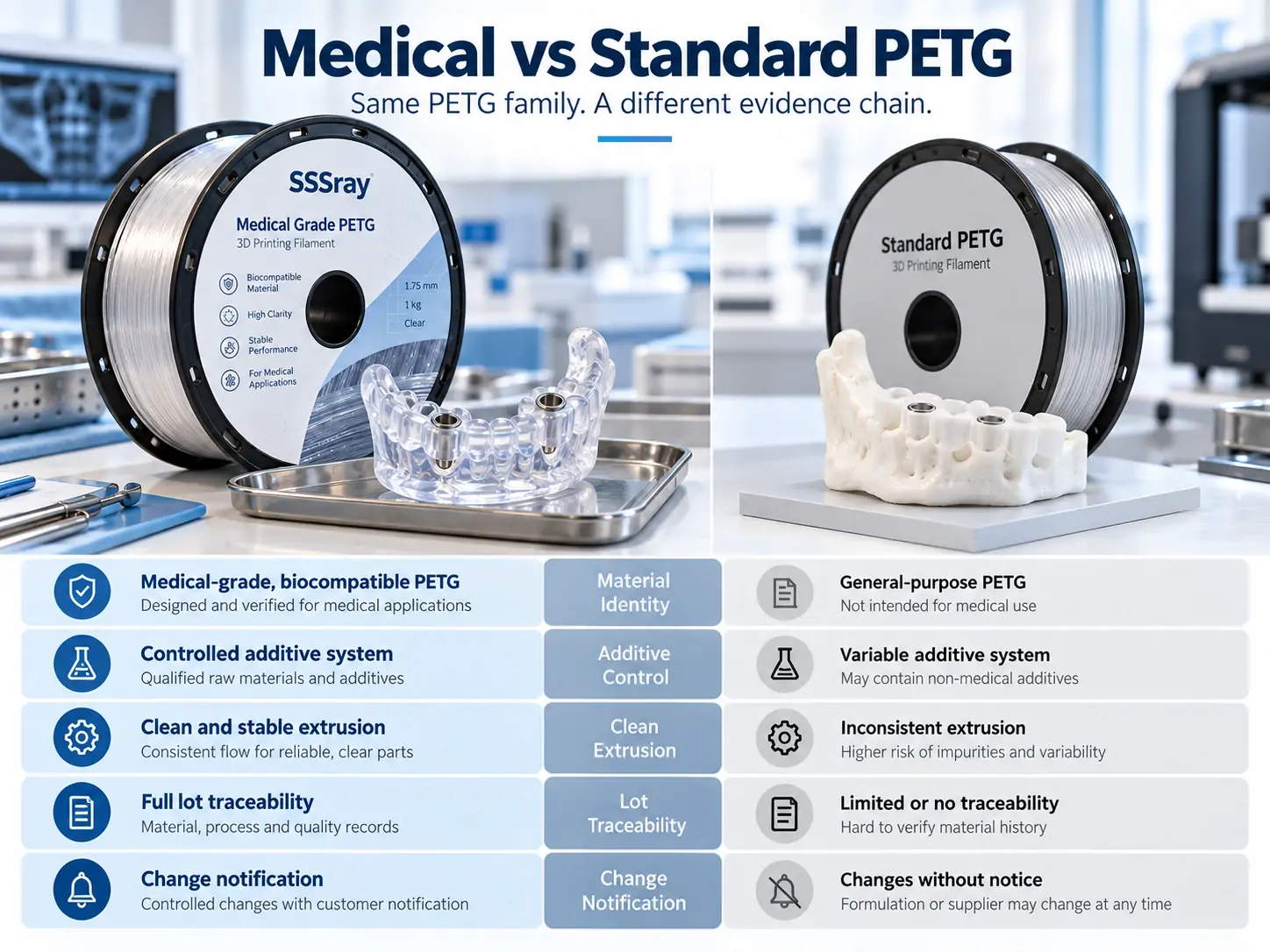
PETG is a glycol-modified PET-family copolyester. Depending on the commercial resin grade, the comonomer package and additive system can differ, so buyers should not assume that every PETG formulation is chemically identical simply because the spool carries the same polymer label.
Colorants, processing aids, recycled content, line residues, and other formulation or process variables can change the chemical profile of the finished filament. Chemical characterization is used to identify and quantify relevant constituents and potential extractables or leachables; biological tests such as cytotoxicity, sensitization, and irritation then evaluate biological responses for the defined test article and exposure scenario.
The five controls behind a medical label
- Tested base resin: the resin maker holds ISO 10993 or USP Class VI data for a named grade.
- Additive control: natural or medically qualified colorants only, with no undisclosed masterbatch.
- Clean extrusion: dedicated or purged lines, controlled cooling water, and controlled packing.
- Traceability: each spool links to a resin lot and a production record.
- Change notification: a written promise that resin, additives, or site will not change without notice.
Novus Life Sciences states that its Ossfila PETG is manufactured in ISO 13485-certified cleanroom facilities, carries USP 88 Class VI biocompatibility claims, and is sterilizable by gamma radiation, e-beam, and EtO. That is the type of grade-specific manufacturing and sterilization evidence a medical program should expect to review.
Can I use standard PETG for surgical guides?
Do not assume standard PETG is acceptable for patient contact. The device manufacturer would need a biological evaluation appropriate to the exact material, manufacturing process, cleaning and sterilization route, intended contact, and duration, together with supply controls that preserve the qualified material identity.
Dimensional accuracy alone is not the gating issue. In the 2025 study in Section 4, a standard consumer PETG was among the most dimensionally accurate tested materials after hydrogen-peroxide sterilization. That result supports PETG's process potential, but it does not establish biological safety for another PETG grade, color, or production route.
What this means for the buyer: separate patient-contact parts from non-patient-contact models and fixtures, then match the grade name and lot on every medical-material report to the spool label and CoA. For models and fixtures, a custom PETG program can be evaluated on industrial performance and total landed cost.
3. ISO 10993, USP Class VI, and FDA Claims: What Each One Covers
Short answer: ISO 10993 provides the risk-based framework for biological evaluation of a medical device, while USP Class VI is a plastics biological-reactivity classification that is commonly cited for materials or resin grades. In the United States, FDA regulates the device; under EU MDR, the manufacturer is responsible for conformity and a notified body is involved where the device class requires it. None of these mechanisms creates a blanket "certified filament" status.
On mobile, swipe horizontally to review every column.
| Framework | What it evaluates | Who holds the evidence | What it does not prove | 2026 status |
|---|---|---|---|---|
| ISO 10993-1:2025 | Risk-based biological evaluation of the finished device in its intended contact and duration | Device manufacturer (hospital or OEM) | That any filament is "certified" | Sixth edition published November 2025; FDA partial recognition May 25, 2026 |
| ISO 10993-5, -10, and -23 | Cytotoxicity, sensitization, and irritation evaluation for a defined test article and exposure scenario | Test laboratory report for the named sample | Performance of other lots, colors, or processes | Common endpoints for many patient-contact devices; selection follows the biological risk assessment |
| USP Class VI | In vivo biological reactivity testing used to classify plastics and commonly cited for materials or resin grades | Evidence holder for the tested material or article | Safety or regulatory status of a printed, sterilized guide | Supporting material evidence, not finished-device clearance |
| FDA 510(k) or registration | A specific medical device, product code, and indications for use | Device sponsor | That a generic filament is "approved" | Classification depends on intended use and product code; many surgical-guide devices are Class II |
| EU MDR Rule 6 | Surgically invasive devices used for less than 60 minutes | Manufacturer, with a notified body for Class IIa and above | Material suitability by itself | Default Class IIa; reusable surgical instruments Class Ir |
The table shows why "certified filament" is the wrong mental model. Evidence sits at different levels, and each level covers only what was tested.
ISO 10993-1:2025 and FDA recognition
The sixth edition of ISO 10993-1 was published in November 2025 and was reorganized around biological safety within the ISO 14971 risk-management process. It strengthens the role of exposure duration, material characterization, and identification of biological hazards rather than treating biological evaluation as a fixed test checklist.
On May 25, 2026, FDA recognized the new edition as Recognition No. 2-313, but only partially. FDA does not recognize the phrase "consumer products" in clause 6.5.11.3 or clause 6.9 on biological risk estimation. Declarations of conformity to the 2018 edition remain acceptable for premarket submissions until July 1, 2029. For device teams, the practical shift is toward a stronger risk-based justification supported by material characterization and relevant biological evidence rather than a fixed pass/fail test list.
USP Class VI filament: useful, not sufficient
USP Class VI is the highest of the traditional USP plastics biological-reactivity classes and uses systemic injection, intracutaneous, and implantation testing. When the evidence applies to the exact resin or filament being purchased, it can be a useful supporting input. It still does not establish the biological safety of a finished printed and sterilized guide, nor does it automatically cover pigments, later processing, or a different production lot.
Is there an FDA approved 3D printing material?
For generic FFF filament, there is no blanket FDA approval category that makes a spool suitable for surgical guides. FDA clearance or approval attaches to a specific medical device, product code, intended use, and supporting evidence. Some dental surgical-guide resins are sold within cleared device workflows, which is fundamentally different from a generic filament seller using the phrase "FDA approved material."
Biocompatible vs food safe filament
Food-contact compliance, such as EU 10/2011, limits what migrates into food. Biocompatibility asks how living tissue reacts to a device. The tests differ, so one never substitutes for the other.
Mistake to avoid: accepting a one-page "ISO 10993 certificate" with no test-article description. Check the laboratory, GLP status, sample ID, extraction conditions, and date, and write the required standard edition, contact category, and duration into your RFQ. SSSray's filament test protocol shows what a traceable test record looks like.
4. Sterilization Compatible PETG: Methods, Data, and Limits
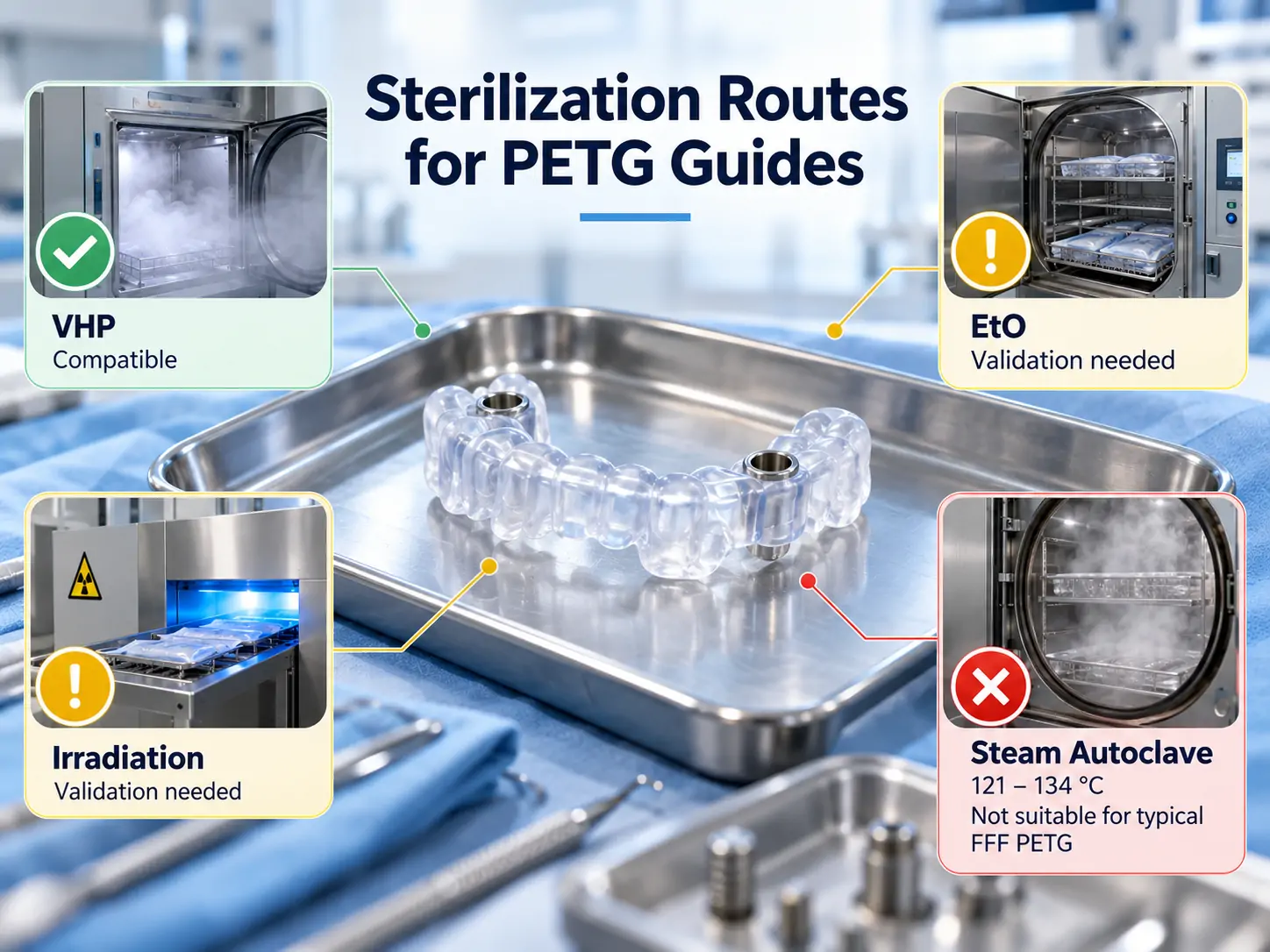
Short answer: start with a validated low-temperature route. Vaporized hydrogen peroxide has strong published dimensional data for printed PETG guides; EtO and irradiation can be workable for qualified medical PETG grades with the required residual, dose, and performance validation. Conventional 121–134 °C steam-autoclave cycles are generally unsuitable for typical FFF PETG guides unless the exact material, geometry, and cycle have been specifically validated.
Why autoclaving fails
PETG is amorphous. Above its glass transition, near 79 °C, the chains loosen and a printed part relaxes toward its internal stresses. A 121–134 °C steam cycle sits far above that point, so thin features droop and fitting surfaces move. Picture a chocolate bar on a car dashboard: it does not turn to liquid, but the shape is gone.
On mobile, swipe horizontally to review every column.
| Method | Typical conditions | PETG compatibility | Evidence | Buyer note |
|---|---|---|---|---|
| Steam autoclave | 121–134 °C, saturated steam | High risk for typical FFF PETG | PETG guides in Popescu et al. (2025) were too deformed after autoclaving to provide a usable scan | Require exact material-, geometry-, and cycle-level validation before accepting any "autoclavable PETG" claim |
| Vaporized H2O2 (gas plasma) | About 45–50 °C, low pressure | Strong published dimensional compatibility | PETG RMS 0.0935 to 0.112 mm in Popescu et al. (2025); Oth et al. also reported limited deformation in PETG genioplasty guides | Supported by the cited printed-guide studies; still validate your exact part and cycle |
| Ethylene oxide | Low temperature plus validated aeration | Potentially compatible with qualified grades | Medical PETG suppliers such as Novus list EtO compatibility; residual EO/ECH limits and release are addressed by ISO 10993-7:2026 | Ask for the validated cycle, aeration, and residual-release evidence |
| Gamma or e-beam | Validated dose for the exact grade | Possible with validation | Some medical PETG suppliers, including Novus, list gamma and e-beam sterilization for their qualified grades | Verify dose, color change, mechanical retention, and the supplier's exact grade-specific evidence |
| 70% alcohol wipe | Room temperature | Dimensionally safe | Disinfection only, not sterilization | Never a substitute for a validated sterile process |
What the 2025 ten-material study measured
The most useful recent dataset comes from a Bucharest team that printed a real tibial tumor cutting guide in ten filaments on a Bambu P1S, then scanned each guide before and after cleaning, disinfection, and sterilization. Their open-access paper reports PETG printed at 260 °C nozzle, 80 °C bed, 0.2 mm layers, and 100% infill.
The pattern is clear. PLA's error jumps by roughly 444% after sterilization, while PETG moves by about 20%. In addition, PETG kept the lowest maximum local deviation across conditions, and autoclaved PETG guides were too deformed to scan.
On mobile, swipe horizontally to review every column.
| Material | As printed | After H2O2 plasma | Change | After autoclave |
|---|---|---|---|---|
| PETG | 0.093 | 0.112 | +19.6% | Severely deformed |
| PETG-CF | 0.129 | 0.121 | −5.9% | Severely deformed |
| PC | 0.127 | 0.117 | −8.0% | 3.642 |
| ABS | 0.122 | 0.133 | +8.6% | Severely deformed |
| PA6-CF | 0.198 | 0.313 | +58.0% | 1.078 |
| PLA | 0.093 | 0.508 | +443.7% | Severely deformed |
Change percentages calculated by SSSray from the paper's unrounded values. Three guides per material; the authors reported low inter-sample variability.
What this means for the buyer: fix your sterilization method before you choose a PETG grade, because it decides which supplier data is relevant. Then scan guides before and after your own cycle against a fit tolerance agreed with the surgeon. If you need better radiation stability, compare PCTG filament, a related copolyester.
5. ISO 10993 Compliance Roadmap for 3D Printed Surgical Guides
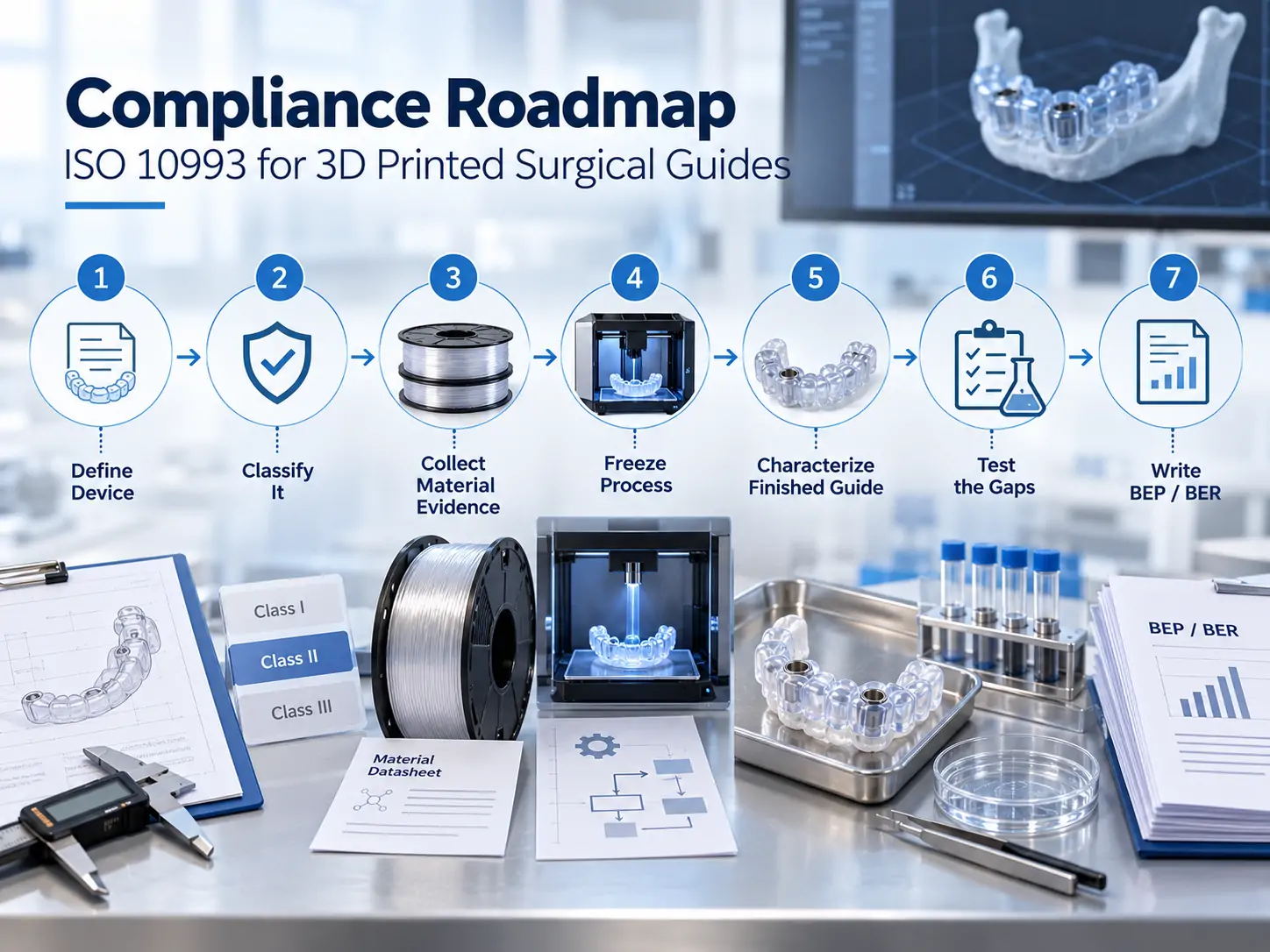
Short answer: you cannot buy ISO 10993 certification for printed parts. You build the evidence: define the intended use, gather supplier data, characterize the finished guide, test the gaps, and document everything in a biological evaluation plan and report.
R1
Define the device
Write the intended use, anatomy, contact type (for example bone and tissue, externally communicating), and duration. Most guides are limited contact, under 24 hours. Stop if nobody has signed the intended use.
R2
Classify it
In the EU, check MDR Annex VIII Rule 6 with MDCG 2021-24 Rev.1. In the US, identify the product code and whether 510(k) applies. Stop if the class is still a guess.
R3
Collect material evidence
Resin reports, filament reports, formulation disclosure (often under NDA), CoA, and a change-control letter. Stop if reports do not name the grade you will buy.
R4
Freeze the process
Lock the printer, slicer profile, cleaning agents, and sterilization cycle. Stop if any of them is still changing, because a later change reopens the file.
R5
Characterize the finished guide
Use the ISO 10993-1:2025 risk process to determine what material and chemical characterization is needed for the finished device. ISO 10993-18 and ISO 10993-17 can support chemical characterization and toxicological risk assessment where applicable. Stop if the evidence only describes a raw spool and cannot be connected to the finished, cleaned, and sterilized guide.
R6
Test the gaps
Select biological endpoints from the device-specific risk assessment, contact type, duration, material/process history, and available evidence. Cytotoxicity, sensitization, and irritation are common endpoints for many patient-contacting devices, but they are not a universal fixed checklist. Where ISO 10993-5 cytotoxicity testing is applicable, a reduction in cell viability by more than 30% is considered a cytotoxic effect under the standard's interpretation framework.
R7
Write the BEP and BER
The biological evaluation plan and report tie everything together for an auditor or notified body. Stop reorders if a material change arrives without a documented impact review.
For context, a cytotoxicity study of extrusion-printed guide polymers found the tested filaments stayed above the 70% threshold. That result applies to the specific products tested, not to every filament in the category.
How long does ISO 10993 testing take for a new filament?
Laboratory turnaround ranges from about three weeks to several months, depending on the endpoints. Some GLP labs issue a cytotoxicity report within roughly two weeks after the experimental phase. Sensitization and irritation take longer, especially when in vitro methods need confirmation.
In practice, plan for three to six months from first supplier contact to a signed evaluation report for a limited-contact guide. That is a planning assumption, not a promise; chemistry-heavy programs can take longer.
What this means for the buyer: lock the supplier before testing, because switching material afterward means paying for tests again. Lot records such as SSSray's batch QC data show how a traceability file can be supported.
6. Medical Grade PETG Cost per kg and the Real Cost of Compliance
Short answer: the current public-market examples in this guide put medical PETG at about six times the price of standard bulk PETG per kilogram, but the premium per guide is still only a few euros. Validation, not filament, dominates the budget.
Now run the numbers per guide. At the public prices above, a 30 g guide uses about €0.46 of standard PETG and about €2.75 of medical PETG, a material-price gap of roughly €2.30. That difference is small next to biological evaluation, laboratory work, sterilization validation, documentation, and any revalidation triggered by a material or process change. As one public 2026 market calculator illustrates, even a basic limited-contact biocompatibility package can run into several thousand dollars; obtain project-specific quotes from qualified laboratories before budgeting.
That is why the cheapest spool is rarely the cheapest decision. A supply change that forces one repeat test costs more than years of filament.
Bulk pricing for hospital 3D labs
Medical filament usually ships in 500 g to 1 kg vacuum packs, and volume discounts are smaller than for industrial filament. Better leverage comes from annual agreements that fix the grade, reserve lots, and guarantee change notification.
Dental model resin vs filament for guides
Dental labs mostly print guides in cleared SLA or DLP resins. Their advantage is regulatory: several are cleared as finished dental devices, some are autoclavable, and the resin maker documents the workflow. Their downside is cost per litre, post-curing, and printer lock-in.
FFF PETG makes more sense for larger orthopedic or maxillofacial guides, where part volume is high and low-temperature sterilization is already in place. For small dental implant guides, resin remains the lower-risk choice.
SSSray cost rule: compare total cost, not unit price. Build a sheet with material, scrap, sterilization, testing, and revalidation lines. The supplier comparison tool helps structure quotes side by side.
7. The GUIDE-7 Buyer Decision Framework for Surgical Guide PETG
GUIDE-7 turns the sections above into seven checks for supplier meetings. For patient-contact use, any fail in compliance or reorder stability should stop the order.
On mobile, swipe horizontally to review every column.
| Check | Why it matters | What to ask | Pass signal | Fail signal | Hidden risk |
|---|---|---|---|---|---|
| Application requirement | Contact type and duration set the evidence needed | Is the part patient-contacting, for how long, and sterile? | Written intended use signed by the clinical lead | "We will decide later" | Planning models reused in the sterile field |
| Material performance | Guides must keep their fit after sterilization | Do you have post-sterilization dimensional data? | Scan data on printed parts for your method | Raw-resin datasheet values only | Thin drill sleeves deforming locally |
| Printability | Moisture and stringing change surface and fit | Diameter tolerance, moisture spec, drying advice? | ±0.03 mm or tighter, vacuum-sealed with desiccant | No tolerance stated | Wet spools leaving voids on bone-contact faces |
| Compliance | Evidence must match the exact grade and color | Full ISO 10993 or USP VI reports and an ISO 13485 certificate? | Named lab, sample ID, and grade matching the label | A logo or summary sheet only | Reports covering the natural color only |
| Supplier reliability | A lapsed quality system voids your file | Certificate scope, issuer, expiry, and audit access? | Current certificate covering filament production | Certificate held by a sister company or trading office | Undisclosed outsourced extrusion |
| Landed cost | Validation and scrap outweigh unit price | Price per kg, MOQ, shipping, and shelf life? | Annual pricing with reserved lots | Price only, with no terms | Short remaining shelf life on arrival |
| Reorder stability | Unannounced changes invalidate test data | What is the written change-notification period? | Advance-notice clause in the supply agreement | "We always use good resin" | Silent resin substitution during shortages |
Why the checks are separate: a spool can print perfectly and still fail compliance, and a well-documented grade can still fail on reorder stability. Approve each check on its own evidence.
8. Surgical Guide Material Comparison for Purchasing Managers
Here is the one-page view for purchasing managers, including when to walk away from each option.
On mobile, swipe horizontally to review every column.
| Option | Best use case | Key spec | Advantage | Risk | How to verify | When to reject | SSSray sourcing note |
|---|---|---|---|---|---|---|---|
| Standard PETG | Planning and training models, jigs, trays, prototypes | Tg near 80 °C; ±0.03 mm standard SSSray release target | Low cost, accurate, easy to print | No medical biological-evidence package or medical change-control claim | CoA, TDS, lot QC, dimensional scans | Patient-contact use without device-specific biological evaluation and controlled supply | SSSray core product for non-patient-contact use |
| Medical grade PETG (resin data only) | Early feasibility work | USP Class VI resin claim | Better starting point than standard PETG | Extrusion and colorants not covered | Match the resin grade to the formulation | The supplier cannot name the resin grade | Outside SSSray's published scope |
| Medical grade PETG (ISO 13485 extruder) | Limited-contact guides with low-temperature sterilization | ISO 10993 or USP VI reports; ISO 13485 | Complete documentation chain | Higher price, smaller spools | Certificate scope, full reports, lot trace | No change-notification commitment | Buy from a medical specialist; SSSray can review specs with you |
| PETG-CF | Stiff non-patient fixtures | Stable after plasma in the 2025 study | Rigidity, low warp | Medical evidence is uncommon and grade-specific; abrasive to nozzles | Supplier fiber-content data plus any exact-grade biological evidence | Patient contact without grade-specific evidence and device validation | Available for industrial fixtures |
| PC | Guides needing a higher heat margin (medical grade only) | Tg about 119 °C | Good plasma stability | Still distorted by autoclave in the 2025 study | Post-sterilization scans | A steam cycle is mandatory | Industrial PC only |
| SLA surgical guide resin | Dental implant guides | Device-cleared for guides in some markets | Autoclavable, documented workflow | Cost, post-curing, printer lock-in | Clearance for your indication | Large orthopedic guides with FFF capacity | Not an SSSray product |
| SLS PA12 or PA 2200 | Industrial-scale guide production | Validated powder and process | Proven at scale (KLS Martin) | Capital cost, powder management | Process validation records | Low-volume hospital labs | Not an SSSray product |
Two patterns stand out. Standard PETG wins wherever the patient is not involved. The medical rows differ mainly in documentation depth, which is where buyers should spend their questions.
9. Supplier Claims vs Reality for Biocompatible Filament
Marketing language around biocompatible filament is loose. The table below translates common claims into the documents that should back them.
On mobile, swipe horizontally to review every column.
| Vague claim | What it might hide | What to request | What a reliable supplier provides |
|---|---|---|---|
| "Medical grade PETG" | No defined meaning; may describe only the resin | List of standards met, with report numbers | Grade-specific reports plus ISO 13485 scope |
| "ISO 10993 certified filament" | One old cytotoxicity test on one sample | Full reports with test article, lab, and date | Reports naming the exact grade and color |
| "FDA approved" | Food-contact compliance of the resin | 510(k) number or cited regulation | Accurate wording such as "the resin complies with..." |
| "USP Class VI" | Base resin only; pigments added later | Resin supplier letter and formulation statement | A statement covering the finished filament |
| "Autoclavable PETG" | Datasheet claim with no part data | Before-and-after scans of printed parts | Honest guidance to use low-temperature methods |
| "Biocompatible and food safe" | Two different test regimes merged into one phrase | Separate food-contact and ISO 10993 documents | Clear separation of both claims |
| "Made in an ISO 13485 facility" | A certificate for another product line or site | Certificate copy, scope, issuer, and expiry | A certificate scope that names filament production |
A good sign: honest suppliers state limits plainly. Lattice Services, for instance, says its medical PETG must never be implanted and that each medical use must be assessed by the user. Candor like that is a strength, not a weakness.
10. Buyer-Specific Scenarios for Surgical Guide Materials
Distributor
Situation: a European distributor wants a "medical PETG" SKU for hospital customers.
Bad choice and consequence: relabeling standard PETG with a biocompatibility claim, which creates liability and loses hospital trust.
Better choice: carry an ISO 13485 specialist's grade for patient contact and clearly labeled standard PETG for models and fixtures. Verify with the Table 6 documents before listing.
Next step with SSSray: compare wholesale PETG for the non-medical side of the range.
OEM Brand
Situation: a brand wants filament for anatomical education models.
Bad choice and consequence: printing "biocompatible" on the box without test data, which creates regulatory exposure.
Better choice: accurate labeling, such as "for models and training, not for patient contact," on a stable, color-matched PETG. Verify with a lot CoA and color approval.
Next step with SSSray: discuss private label packaging with correct claims.
Print Farm
Situation: a print farm receives requests for pre-surgical models and some guides.
Bad choice and consequence: using one PETG and one workflow for everything. Once the farm supplies patient-contacting guides, its regulatory role and medical-device responsibilities can change depending on jurisdiction, intended use, and contractual role.
Better choice: keep models and fixtures on a standard industrial workflow, and only accept patient-contact guide work under a clearly defined, validated medical-device process with the responsible manufacturer identified. Verify with a written intended use from each customer.
Next step with SSSray: see filament for print farms.
Engineering Buyer
Situation: a hospital lab plans in-house maxillofacial guides on FFF printers with an existing hydrogen peroxide sterilizer.
Bad choice and consequence: the cheapest "ISO 10993" spool online, leading to reports that do not match the grade and a retest when the seller changes resin.
Better choice: a medical grade with change control for guides, and standard PETG for practice prints. Verify with GUIDE-7 and scans after the lab's own cycle.
Next step with SSSray: request standard PETG samples to build printer profiles before medical stock arrives.
11. PETG Sourcing Specs SSSray Will Confirm for Your Program
Whatever grade you choose, put the following terms in writing. The right-hand column shows what SSSray publishes for its standard PETG program, which serves industrial, model, and fixture work rather than patient contact.
On mobile, swipe horizontally to review every column.
| Item | What to lock for a medical grade program | SSSray standard PETG (published) |
|---|---|---|
| MOQ | Annual volume with reserved lots | From 50 spools |
| Lead time | Stock held from one approved lot | Confirmed in the written quotation |
| Sample approval | Printed and sterilized test guides signed off | Sample spool before the bulk order |
| Tolerance | Define diameter and ovality in the approved specification | 1.75 ±0.03 mm standard production release; selected OEM/high-speed projects can be qualified to ±0.02 mm when agreed in writing |
| Documentation | ISO 13485 certificate, ISO 10993 or USP VI reports, CoA | CoA, TDS, SDS, RoHS, and REACH support |
| Packaging | Sealed, desiccated, lot-labeled, with stated shelf life | Vacuum packaging; 1, 3, and 5 kg spools |
| Private label | Claims reviewed by regulatory staff | OEM labels, boxes, and cartons |
| Reorder control | Written change-notification period | Color, spool, and packing details kept consistent across reorders |
For teams building printer profiles, validating fixtures, or producing training models, SSSray's custom PETG program is a practical fit: stable diameter, repeatable color, and lot records at an industrial price. For guides that touch patients, pair it with a qualified medical grade; we are glad to review a medical supplier's spec sheet with you.
SSSray data rule: the SSSray column is tied to our published PETG program, batch QC controls, and published internal printer-flow reference series. Standard SSSray PETG is an industrial filament and is not marketed as ISO 10993 or USP Class VI medical material.
On mobile, swipe horizontally to review every column.
| Record field | Published SSSray record | How a buyer should use it |
|---|---|---|
| Record identity | SSSray Internal Flow and Feeding Reference Series — Standard PETG, published in the Third-Party Filament for Bambu Lab B2B Procurement Guide (31 August 2026) | Material-specific SSSray process reference; not an ISO 10993 medical test and not a substitute for lot-specific COA data |
| Material | Standard PETG, 1.75 mm class | Use as the industrial PETG reference layer; lock the exact SKU and production lot for an actual order |
| MFR result | 6.2 g/10 min at 230 °C / 2.16 kg | Compare only with PETG measured under the same MFR conditions |
| Printer/process scope | X1/H2D internal reference series; nozzle setting 230 °C | Do not transfer the flow ceiling to a different hotend, nozzle, printer, or PETG formulation without qualification |
| Reported maximum flow | 11.8 mm³/s | Use as a published reference point for process qualification, not as a universal speed guarantee |
| Feeding result | 6.2 jams per 100 spool-hours; the metric is normalized by operating time, not a percentage of failed prints | Compare feeding reliability on the same metric and target hardware |
| Diameter QC method | Continuous inline dual-axis/tri-axis laser micrometer monitoring; standard release target 1.75 ±0.03 mm | Request the lot-matched laser record and COA for the production batch you buy |
| PETG/PCTG ovality gate | ≤0.020 mm published factory QC limit | Confirm the delivered lot against the agreed COA and acceptance plan |
| PETG/PCTG moisture gate | ≤0.025 wt% published material-family limit before packing; Karl Fischer is used in SSSray batch QC | For a medical or other critical project, require the exact lot result and conditioning record rather than relying on the family limit alone |
| Color and packaging QC | ΔE <1.0 published PETG/PCTG color target; aluminum-foil moisture-barrier packaging | Lock the approved color reference, pack format, and reorder change-control terms |
SSSray publishes PETG flow and feeding reference data alongside our lot-level QC methods. For a commercial order, request the exact Batch ID, lot CoA, diameter/ovality record, moisture result, printer/nozzle/profile, and acceptance result tied to the shipment.
12. Frequently Asked Questions
What is the difference between medical PETG and regular PETG?
The PETG family name can be the same while the qualified material identity and evidence package are very different. A medical PETG program should control the exact resin grade, additives or pigments, manufacturing route, biological evidence, lot traceability, and change notification. Standard PETG may print just as accurately, but that does not establish biological safety for patient contact. For a surgical guide, the evidence has to stay connected to the exact material and finished-device process that were evaluated.
Can I use standard PETG for surgical guides?
Do not assume a standard industrial PETG is suitable for a patient-contacting guide. The device manufacturer must evaluate the exact material and finished process for the intended contact and duration and must control the supply against unreviewed changes. Standard PETG can still be dimensionally strong: the 2025 surgical-guide study found PETG among the most stable tested FFF materials after hydrogen-peroxide sterilization. For non-patient-contact planning models, training parts, fixtures, and process development, standard PETG can be evaluated on industrial performance and lot consistency; patient-contact use requires the appropriate medical evidence and device-level validation.
Which sterilization method works with medical PETG?
Vaporized hydrogen peroxide has strong published dimensional data for printed PETG guides and provides a practical starting point for validation in the cited literature. Ethylene oxide and gamma or e-beam are also listed for some qualified medical PETG grades, but they require exact-grade validation; EtO also requires residual control under ISO 10993-7:2026. Conventional 121–134 °C steam-autoclave cycles are generally a poor fit for typical FFF PETG guides because the temperature is well above PETG's glass transition and severe deformation has been reported. Accept a steam route only when the exact material, geometry, and cycle have been specifically validated.
How long does ISO 10993 testing take for a new filament?
There is no single ISO timetable. Individual laboratory studies can take weeks, while the complete biological evaluation can extend into months depending on the device's contact category, required endpoints, chemical-characterization needs, laboratory capacity, and whether existing evidence is usable. Under ISO 10993-1:2025, plan the work from the device-specific biological risk assessment rather than assuming a fixed test package. For procurement, lock the supplier and material identity before the program begins so a later formulation change does not force unnecessary repeat work.
What is the cost per kg of medical grade PETG vs standard PETG?
In the September 2026 public-market snapshot used in this guide, FormFutura Bulk PETG is €15.19/kg on 3DJake NL and Lattice Services Medical PETG is €45.90 per 500 g, or €91.80/kg—about six times higher. At those examples, 30 g of material is about €0.46 versus €2.75. These are public list-price examples, not a universal market average or an SSSray quotation. SSSray provides competitive B2B pricing based on grade, packaging, volume, Incoterm, and destination.
Where can I buy ISO 10993 certified filament in bulk?
Buy from specialist medical filament makers or their authorized distributors, and verify documents rather than labels. Look for an ISO 13485 certificate that covers filament production, full ISO 10993 or USP Class VI reports naming the grade, lot traceability, and a written change-control clause. Bulk in this market usually means an annual agreement with reserved lots, not pallets of large spools. Avoid marketplace listings that show a logo but cannot send full reports before purchase.
Is there an FDA approved 3D printing material for surgical guides?
There is no blanket FDA approval category for generic FFF filament. FDA clearance or approval applies to a specific medical device, product code, intended use, and supporting evidence. Some dental surgical-guide resins are supplied within cleared device workflows, but that does not turn generic PETG filament into an "FDA approved material." When a supplier uses that phrase, ask for the exact 510(k), device listing, regulation, or other regulatory basis that supports the claim.
What should a hospital 3D lab ask before a bulk medical filament order?
Ask five things: which standards and editions the reports cover, whether the reports match your exact grade and color, who holds the ISO 13485 certificate and what its scope is, how much advance notice you get before any formulation change, and whether a full lot can be reserved for you. Also confirm shelf life and packaging, since PETG absorbs moisture once opened. Finally, request samples early so printer profiles and sterilization scans are ready before the bulk order arrives.
Choose Medical Grade PETG Filament on Evidence, Not Labels
Choosing between medical grade PETG filament and standard PETG is an evidence-and-control decision as much as a materials decision. Both can print dimensionally accurate parts, but patient-contact suitability and sterilization performance depend on the exact grade, manufacturing route, finished-device process, and evidence package. A medical program needs documentation that can support the biological evaluation and remain tied to the material used in production.
If the part touches the patient, buy a grade with the appropriate medical manufacturing controls, grade-specific biological evidence, lot traceability, and written change control, then validate the finished guide within the ISO 10993-1:2025 risk-management framework. Vaporized hydrogen peroxide has strong published dimensional data for PETG; EtO and irradiation require exact-grade validation, and conventional 121–134 °C steam should be treated as unsuitable for typical FFF PETG unless the exact material, part, and cycle have been specifically validated. If the part does not touch the patient, standard PETG can be qualified on industrial performance, lot consistency, and total landed cost without requiring a medical evidence package for that application.
Your next steps are practical. Write and sign the intended use, run GUIDE-7 on two or three suppliers, and scan test guides after your own sterilization cycle before any purchase order. For models, fixtures, and printer setup, request a sample spool, TDS, CoA, or bulk quote from SSSray, or ask us to compare materials with you.
SSSray supplies standard PETG for models, fixtures, training parts, printer qualification, and other non-patient-contact applications. For patient-contact surgical guides, we do not position standard PETG as a substitute for a properly qualified medical material and validated device process.
Request a quote or free samples
Tell us the material, color, spool size and monthly volume. An engineer replies within 24 hours on business days.
13. Regulatory and Technical References
- ISO 10993-1:2025: Biological Evaluation of Medical Devices, Part 1 — current risk-based framework for biological evaluation.
- U.S. FDA: Use of International Standard ISO 10993-1 — FDA biocompatibility guidance.
- NAMSA: The FDA's Recognition of ISO 10993-1:2025 — partial recognition and excluded clauses.
- Thema Med: FDA Partially Recognizes ISO 10993-1:2025 — transition date of July 1, 2029.
- European Commission: MDCG 2021-24 Rev.1 Guidance on Classification of Medical Devices — April 2026 revision covering EU MDR classification rules, including Rule 6.
- Popescu, Iacob, and Marinescu (2025): Dimensional Accuracy of 3D-Printed Surgical Cutting Guides After Hospital Sterilization — 3D Printing in Medicine 11:44.
- Oth et al. (2019): Deformation of PLA and PETG Genioplasty Guides After Hydrogen Peroxide Gas Plasma — Open Dentistry Journal.
- Cytotoxicity of Polymers Intended for Extrusion-Based Additive Manufacturing of Surgical Guides — ISO 10993-5 testing of printed guide materials.
- EOS: KLS Martin Scales Personalized Surgery with Industrial 3D Printing — SLS guide production case study.
- TCT Magazine: KLS Martin Set to Deliver 500th LCM 3D Printed Implant in Q3 2026 — current program status.
- Measurlabs: ISO 10993-1:2025 Key Changes at a Glance — practical summary of the revision.
- Novus Life Sciences: Medical PETG Documentation — example of supplier claims to verify.
- U.S. FDA Recognized Consensus Standard 2-313 — partial recognition of ISO 10993-1:2025 and transition through July 1, 2029.
- ISO 10993-7:2026 — ethylene oxide and ethylene chlorohydrin residual limits and release requirements.
- 3DJake NL: FormFutura Bulk PETG — September 2026 public PETG list-price reference.
- Lattice Services: PETG Medical — September 2026 public medical PETG list-price reference.
- Formlabs: Surgical Guide Resin — September 2026 public EU surgical-guide resin price and product workflow reference.
- SSSray: Third-Party Filament for Bambu Lab — B2B Procurement Guide — published SSSray internal PETG flow and feeding reference series.
- SSSray: Batch QC Data & Factory COA — published PETG/PCTG diameter, ovality, moisture, color, packaging, and lot-traceability controls.
- Cruxi: Biocompatibility Testing Cost Calculator — public market cost illustration; obtain laboratory quotations for actual budgeting.
