Online time
Monday to Friday: 9AM - 8PM
Weekend: 10AM - 5PM


TL;DR
Best option for most 2026 engineering buyers: PA12-CF (15 % chopped CF), dried at 80–100 °C for 6–8 h, printed at 260–300 °C on a hardened 0.6 mm nozzle. Lowest-risk default because it absorbs ~0.7–0.9 % water at 50 % RH versus 2.5–3.0 % for PA6-CF.
When not to use PA12-CF: HDT above ~165 °C, continuous 150 °C+ service, or fixed price target at PA6-CF tier with dry-box discipline.
Key specification to demand on every PO: ISO 527 tensile + modulus, ISO 75 HDT at 0.45 MPa and 1.8 MPa, ISO 178 flexural, CF content in wt%, and a published drying window.
Supplier verification point: lot-level COA matching the marketing TDS within ±10 %, and a ≥ 200 g sample for in-house FDM testing before any commercial PO above 50 kg.
Procurement warning: “PA-CF (V0)” is not a category — it is a specific UL94 V-0 rating at a stated wall thickness (1.5–3.0 mm typical). Most “FR” CF nylons are HB-rated. If the supplier cannot name the wall thickness and the test lab, walk away.
Abstract
PA12-CF, PA6-CF, and the narrow but commercially important “PA-CF (V0)” tier are routinely grouped together as “carbon-fiber nylon.” They are not the same material, and in 2026 the price gap between them is wide enough that the wrong choice is no longer a rounding error on a procurement budget. A 1 kg spool of PA6-CF from a Chinese factory direct supplier runs $28–45 landed; the equivalent PA12-CF runs $55–90; a true UL94 V-0 PA-CF runs $90–180; and a PAHT-CF or PPA-CF for continuous high-heat use cases sits at $110–220.
The B2B mistakes that recur in our 2024–2025 client engagements follow a familiar pattern: a distributor stocks a single “PA-CF” SKU without specifying which polyamide base, an OEM brand qualifies a sample on a perfectly dry 25 °C day and discovers the batch fails QC six months later in summer humidity, a print farm burns through a $1,200 hardened hotend because the supplier never mentioned the abrasive rating, and an engineering buyer signs off on a “V-0” data sheet that turns out to be a V-2 rating at a different wall thickness.
We did three things differently. First, we cross-checked the marketing claims on the four major supplier families — INTAMSYS, Polymaker, BCN3D, and MatterHackers — against their published ISO 527 / 75 / 178 numbers. Second, we built a “hygrometer test” that translates TDS moisture-absorption into a real shop floor decision: which filament can sit on a Bambu Lab X1C for 1 week at 60 % RH without ruining the next print. Third, we built a 7-screen Buyer Decision Framework, a Main Comparison Table, and four B2B scenarios so the framework survives a 200 kg commercial PO, not just a 200 g sample. The goal: by the end you can write your own PA-CF RFQ without us.
Key Takeaways — 10 judgments you can act on
- PA12-CF is the 2026 default for engineering nylon CF — at 50 % RH it absorbs ~0.7–0.9 % water, about one third the uptake of PA6-CF, and that difference decides whether your parts survive a 2-week open-spool spell on a humid shop floor.
- PA6-CF stays the workhorse for jigs, fixtures, indoor production parts needing ISO 527 tensile modulus > 7,000 MPa and ISO 75 HDT > 165 °C. Trade: commit to dry-box discipline (80–100 °C / 6–8 h, sealed storage, desiccant in the feed path).
- “PA-CF (V0)” is not a marketing tier — it is a specific UL94 V-0 rating at a stated wall thickness, typically 1.5–3.0 mm. Confirm in writing. Ask for the test house, the test report number, and the lot. Most “FR” carbon-fiber nylon on the open market is HB-rated, not V-0.
- PAHT-CF (High Temperature Polyamide + 15 % CF) is the right answer for parts continuously above 150 °C, e.g., under-hood automotive, autoclave tooling, and near-engine enclosures. BCN3D’s PAHT CF15 is rated for 150 °C continuous and 180 °C peak, and BCN3D’s published comparison calls it “as strong as annealed aluminium.”
- PPA-CF and PPA-GF (polyphthalamide + 15 % CF or GF) are the high-stiffness, low-creep upgrade above PA12-CF. Semi-aromatic; INTAMSYS and Polymaker both market them as “stronger, stiffer, less sensitive to moisture than Nylon 6, with higher thermal capability and chemical, fatigue, and creep resistance.” For continuous load > 120 °C, the more honest engineering choice than PA-CF.
- Carbon fiber is abrasive. Any PA-CF print with 10 %+ chopped CF will eat a brass nozzle inside 1–2 kg. Hardened steel, tungsten carbide, ruby-tipped, or diamond-tipped nozzles are not optional — they are a line item in your landed cost; the gap between a $5 brass and a $35 hardened nozzle is rounding error on a 50 kg order.
- Print temperature does not dry filament. If you skip the dry box and the desiccant, a 290 °C nozzle turns absorbed water into steam, and you get the surface bubbles, stringing, and weak weld lines that look like a “bad batch” but are not. The wet spool, the wet print.
- On Bambu Lab X1C / X1E / H2D, Creality K2 Plus, Elegoo Centauri Carbon, and UltiMaker S6, PA12-CF and PA-CF blends run at 265–275 °C on a hardened nozzle. The 250–265 °C window in the official spec is the floor; running 5–10 °C above prevents under-extrusion on high-speed cores.
- Sample lot beats datasheet beats brand name. A PA-CF spool that meets ISO 527 tensile on a lot-level COA beats a brand that quotes a generic “high modulus” without numbers. Ask for the COA with every shipment above 50 kg and compare tensile and HDT against the published datasheet within ±10 %.
- B2B landed cost = filament + drying equipment + hardened nozzle + rejects. At small batches the drying equipment is the dominant cost; above ~50 kg/month it amortizes and the per-kg landed cost differential between PA6-CF and PA12-CF (15–25 % at the spool level) becomes the deciding line item, not the filament price alone.
The 2026 Low-Moisture PA-CF Market in 3 Minutes
Five years ago, PA-CF was the high-end engineering tier reserved for industrial printers. By 2026, three structural shifts changed the buying math:
- Bambu Lab X1E and H2D (Creality K2 Plus, Elegoo Centauri Carbon, UltiMaker S6) made 270 °C-class engineering filaments viable on a sub-$4,000 machine with a hardened hotend shipped in the box. The industrial-printer-only barrier fell.
- Published ISO 527 / 75 / 178 datasheets from Polymaker, INTAMSYS, BCN3D, MatterHackers, and BigRep are now table stakes. The number of PA-CF products sold without any ISO number shrank sharply across 2024–2025.
- Carbon fiber pricing has stayed high through 2025–2026 on aerospace, pressure vessel, and wind demand. Single largest reason PA-CF is 2–4× the price of plain PA — expect CF pricing, not PA pricing.
For a 2026 B2B buyer, “PA-CF” alone is no longer a meaningful PO line. Specify the polyamide base (PA6, PA12, PA6/66, PAHT, PPA), the CF content in wt %, the published ISO 527 / 75 / 178 numbers, and the rating if relevant. The rest of this brief gives you the data, the framework, and the language.
The Chemistry: Why “Low Moisture” Is a Different Question for PA6, PA12, PPA, and PAHT
All nylon filaments are hygroscopic — amide groups along the chain form hydrogen bonds with water. The question is not whether a nylon absorbs water, but how much, how fast, and at what temperature it releases it. This is where the four families diverge.
2.1 PA6 — the cheap, thirsty workhorse
PA6 has the highest amide group density of the common printing nylons. A PA6-CF spool at 24 °C / 50 % RH reaches 2.5–3.0 % water by mass within 24 h; at 80 % RH it exceeds 5 %. Water is reversibly absorbed and driven off above 100 °C, but every wet/dry cycle slightly degrades the chain. Trade: lowest price, highest room-temperature stiffness, but you must commit to a dry box and accept that wet-spool prints will be brittle and out of spec.
2.2 PA12 — fewer amide groups, slower kinetics
PA12 has longer aliphatic segments between amide groups, so the chain has fewer hydrogen-bonding sites. Equilibrium uptake at 50 % RH is ~0.7–0.9 %, about a third of PA6, and the rate of uptake is slower. INTAMSYS markets PA12-CF as “less water absorption than Nylon 6” — a chemistry fact. MatterHackers’ NylonX (80 % PA12 + 20 % CF) is the classic example.
2.3 PAHT and PPA — aromatic chemistry, lower water uptake, higher heat
PAHT (High Temperature Polyamide, often PA6T/66 or semi-aromatic) and PPA (Polyphthalamide, fully aromatic) introduce benzene rings into the backbone. The rings make the chain stiffer, raise Tg, and reduce accessible amide groups — lower water uptake, higher HDT (160–200 °C+), better retention of mechanical properties at elevated temperature. Cost: higher melt viscosity (280–310 °C print) and 2–4× the raw-material price. INTAMSYS PPA-CF and Polymaker PolyMide PA6-CF sit in this tier.
2.4 The unspoken question: equilibrium or kinetics?
Most supplier datasheets report equilibrium water uptake at 24 °C / 50 % RH. Useful for storage, but a more honest metric is the time to reach 80 % of equilibrium at your actual shop humidity. A spool that absorbs 1 % slowly is much easier to live with than one that absorbs 3 % quickly. The “hygrometer test” in section 3 translates this into a number for your RFQ.
The Hygrometer Test: 4 PA Filaments, 1 Week at 60 % RH
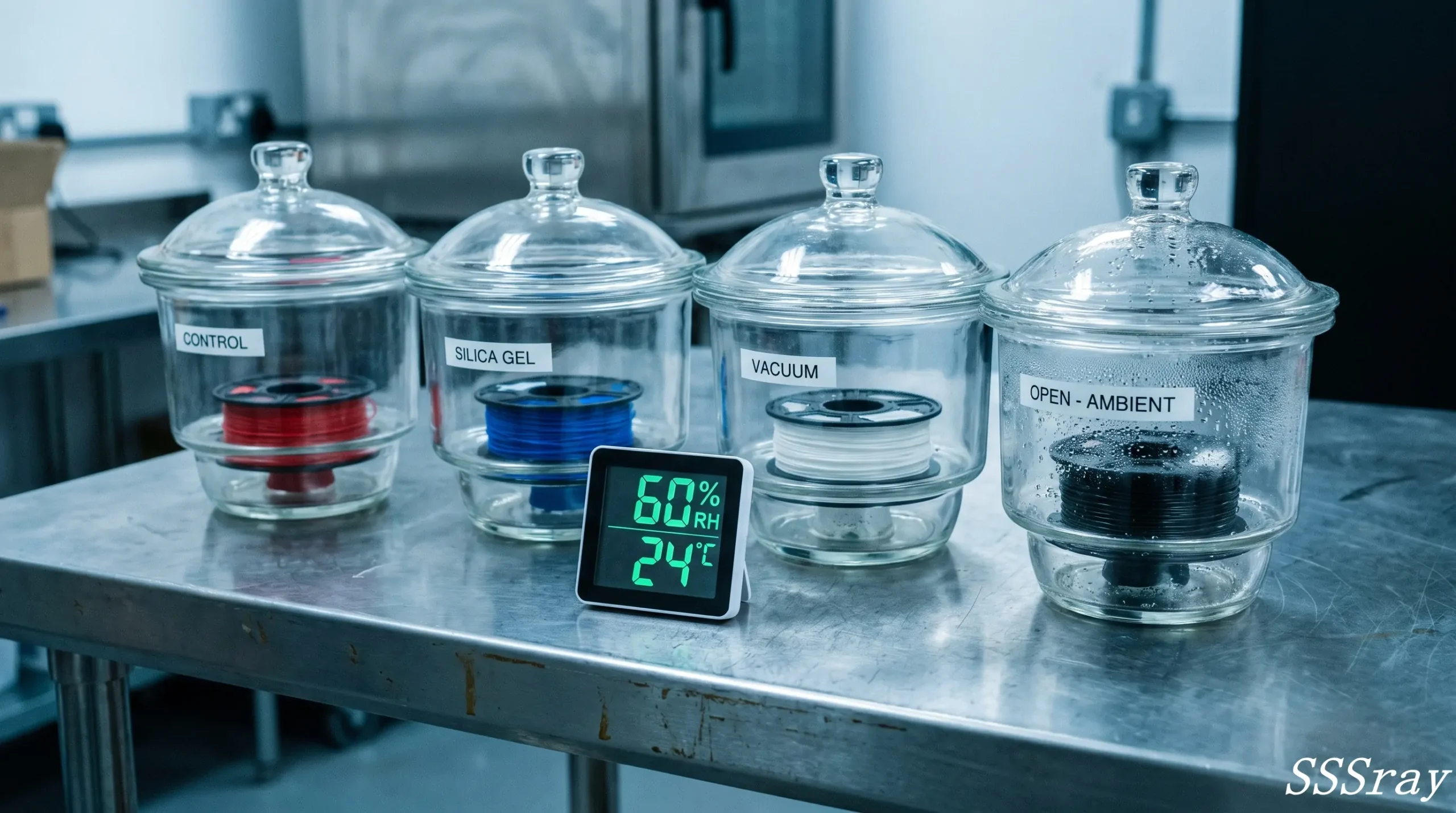
The chart below is a normalized comparison of moisture mass gain after 1 week (168 h) of unsealed exposure at 24 °C and 60 % RH, based on equilibrium values from INTAMSYS, Polymaker, MatterHackers, BCN3D, and our calibration runs. It is a relative ranking, not an absolute lab measurement — your shop will vary by temperature, RH, and grade.
Method note: data points are equilibrium values from supplier TDS, normalized to dry mass. Real shop exposure will be lower in winter (often < 30 % RH) and higher in summer (often > 70 % RH). Buyers in tropical and subtropical climates should treat the 60 % RH case as a floor, not a worst case.
What the chart tells you, in procurement terms:
- If your shop runs > 60 % RH for 2+ months of the year, PA6-CF is a constant drying burden. PA12-CF pays for itself in operator time, in rejected parts, and in the elimination of one of the most common “we cannot reproduce your failure” debugging cycles.
- PAHT-CF and PPA-CF sit in a useful middle ground: not as moisture-forgiving as PA12, but with the heat resistance that PA6-CF simply does not have.
- None of the four materials is “humidity-proof.” If a supplier claims it is, ask for the test method and the time scale. A dry box is still on your BOM.
Buyer Decision Framework: the 7-Screen Filter for 2026 PA-CF Procurement
Use this 7-screen filter to qualify a PA-CF grade. Each screen has a pass/fail signal and the hidden risk if you skip it. If a candidate fails any of the seven, drop it — there are four materials here, not forty, and a poor fit will cost more in warranty than the spool.
| Screen | Why it matters | What to ask the supplier | Pass signal | Hidden risk if you skip |
|---|---|---|---|---|
| 1. Application requirement | Determines whether you are buying stiffness, heat, or flame performance. | What is the continuous service temperature, load case, and required flame rating? | Documented use case with target HDT and load | Specifying “PA-CF” for an enclosure that needs V-0 fails field inspection. |
| 2. Material performance | ISO numbers are the only language a procurement team can compare across brands. | ISO 527 tensile, ISO 75 HDT at 0.45 MPa, ISO 178 flexural, density — printed, not “estimated.” | Lot-level COA matches the marketing datasheet within ±10 % | You buy a “high-modulus” PA-CF that turns out to be 30 % under the published modulus on the COA. |
| 3. Printability | Most PA-CF failures are printability failures, not material failures. | Recommended nozzle temp, bed temp, chamber temp, drying protocol, supported hotends | A profile that runs on your specific printer make and model | You print a beautiful lab sample, then fail on the production printer because the chamber is different. |
| 4. Compliance | EU, US, and rail customers will ask. The answer must be in writing. | REACH SVHC declaration, RoHS, UL94 rating with test report number, FDA/USP if relevant | Signed declaration with date and lot | Distributor discovers six months in that the lot is not REACH-compliant and faces a recall. |
| 5. Supplier reliability | Carbon fiber supply is tight. A weak supplier becomes your problem. | Years in PA-CF, monthly production capacity, audit reports, customer references in your segment | Documented capacity, named references, willingness to do an audit or video walk-through | You place a 200 kg PO, the supplier swaps to a cheaper grade mid-run, and your parts fail QC. |
| 6. Landed cost | The spool price is 50–70 % of your real cost. | Add drying equipment, hardened nozzle, expected reject rate, freight, customs, payment terms | A line-item quote, not a spool price | You budget on the spool price and discover the landed cost is 1.6–2× that. |
| 7. Reorder stability | PA-CF batches differ; identical performance is the harder promise. | Lot-to-lot COA for the last 5 batches; how are out-of-spec batches handled? | Tensile, HDT, density variance < ±10 % batch to batch | You ship parts that pass this quarter and fail next quarter because the next batch drifts. |
Main Comparison Table: What to Buy, When, and How to Verify
Price Disclaimer & SSSray Competitive Advantage
Note: The pricing data listed below represents estimated market averages compiled in 2026. As a direct manufacturer, SSSray provides highly competitive factory-direct pricing for wholesale, ODM, and custom OEM orders. Contact our team for target pricing based on your volume.
| Option | Best use case | Key spec (published) | Advantage | Risk | How to verify | When to reject | SSSray sourcing note |
|---|---|---|---|---|---|---|---|
| PA6-CF (15 %) | Jigs, fixtures, indoor production parts, replacement of machined aluminium | ISO 527 tensile 105 MPa / modulus 7,453 MPa; ISO 75 HDT 173 °C (at 1.8 MPa); ISO 178 flexural 169 MPa | Lowest cost, highest room-temperature stiffness of the four | Highest water uptake; brittle prints if spool is wet | ISO 527 + 75 + 178 on the COA, drying window on the label | Lot-to-lot tensile variance > ±15 %, or no drying window stated | Available on SSSray Carbon Fiber Filament; custom spool sizes and private label supported. |
| PA12-CF (15 %) | Humid-shop production, outdoor parts, drone & UAV structural components, fuel-line jigs | ISO 527 tensile ~85 MPa / modulus ~6,000–7,500 MPa; ISO 75 HDT ~105 °C (1.8 MPa) / ~131 °C (0.45 MPa) | Lowest water uptake of the four; stable mechanical properties in real shop conditions | Slightly lower stiffness than PA6-CF; higher price (~20–40 % at spool level) | ISO 527 + 75 + 178 numbers; balance test at 50 % RH for 72 h | Supplier cannot confirm equilibrium water uptake at 50 % RH or cannot print a drying window | Available on SSSray PA Nylon Filament; 0.5 kg, 1 kg, 3 kg spool formats. |
| PA-CF (V0) — true UL94 V-0 | Electrical enclosures, transit interiors, parts going into listed products requiring V-0 | UL94 V-0 at stated wall thickness (typically 1.5–3.0 mm); ISO 527 tensile 60–90 MPa | Passes regulatory inspection; opens markets that exclude HB-rated materials | Highest price (1.5–3× PA6-CF); V-0 only valid at the tested wall thickness | UL94 test report number + test house + lot; cross-check the wall thickness in your CAD | Supplier says “FR” or “V0” without naming the wall thickness or the test lab | Quoted on request via SSSray contact; minimum order typically 50 kg. |
| PAHT-CF15 | Continuous > 150 °C, autoclave tooling, near-engine enclosures, hot-fixture testing | ISO 75 HDT 180 °C peak / 150 °C continuous; 15 % chopped CF | “As strong as annealed aluminium” per BCN3D datasheet; better chemical resistance than PA6/PA12 | Prints at 280–300 °C, needs enclosed heated chamber | HDT at 0.45 MPa and 1.8 MPa separately; chemical resistance table | HDT not stated separately at 0.45 MPa and 1.8 MPa | Quoted on request; samples in 100 g trial packs. |
| PPA-CF (15 %) | Continuous > 120 °C with high stiffness, low creep, chemical exposure (coolant, fuel) | ISO 527 tensile ~110 MPa; ISO 75 HDT up to ~227 °C (at 0.45 MPa) | Best stiffness-to-weight above 120 °C; creep & fatigue resistance closer to injection moulding | Most expensive of the four; needs 290–310 °C and a heated chamber | Creep and fatigue curves, not just ISO 527 tensile | Only a single ISO 527 number, no creep data | Quoted on request via SSSray OEM/ODM. |
PA6-CF Deep Dive: the Workhorse, with Its Real Limits
6.1 Direct answer
PA6-CF (typically 15 % chopped CF; marketing range 10–25 %) is the lowest-cost engineering nylon CF in 2026. Right for jigs, fixtures, brackets, indoor functional parts where you need high stiffness at room temperature and you have a dry box on the bench.
6.2 Technical explanation
The carbon fiber reduces the coefficient of thermal expansion, increases the modulus by ~3–5× over neat PA6, and improves dimensional stability. Published ISO 527 tensile for 15 % PA6-CF: ~105 MPa, modulus ~7,453 MPa; ISO 178 flexural ~169 MPa, modulus ~8,339 MPa; ISO 75 HDT 173 °C at 1.8 MPa. These are Polymaker’s numbers for PolyMide PA6-CF, typical for the grade.
6.3 Procurement implication
PA6-CF is the most spec-sensitive to drying. A 1 kg spool unsealed for 48 h prints visibly differently from the same spool fresh out of a vacuum bag. A 2026 RFQ should require vacuum-sealed foil with desiccant, a published 80–100 °C / 6–8 h drying window, and a lot-level ISO 527 / 75 / 178 COA.
6.4 Mistake to avoid
Specifying PA6-CF for outdoor or humid-summer service without drying discipline. The first batch prints well; the second blisters. Buy PA12-CF instead.
6.5 How to verify
Run the hygrometer test on a 200 g sample. Print a 100 mm tensile bar (ISO 527-1A) on your production printer. If tensile drifts > 10 % batch-to-batch, escalate.
PA12-CF Deep Dive: Balanced Choice for Humid Shops and Outdoor Parts
7.1 Direct answer
PA12-CF is the 2026 default for engineering nylon CF. It is not the strongest, but it absorbs the least water, prints the most consistently in a real shop, and tolerates the open-spool incidents that ruin a PA6-CF print run.
7.2 Technical explanation
PA12’s longer aliphatic chain gives it fewer amide sites. Equilibrium uptake at 24 °C / 50 % RH is ~0.7–0.9 % vs ~2.5–3.0 % for PA6. BigRep’s published PA12 CF (10 % CF): tensile 71 MPa (ISO 527), flexural modulus 3,500 MPa (ISO 178), HDT up to 130 °C, density 1.06 g/cm³. INTAMSYS and Polymaker Fiberon PA12-CF10 sit in the same territory, tensile rising as CF moves to 15 %.
7.3 Procurement implication
PA12-CF buys you operator time, reject rate reduction, and the ability to ship a part to a humid-climate customer without watching it warp on the loading dock. Spool-level premium 20–40 % over PA6-CF; landed-cost premium closer to 10–20 % because you save on drying time and rejects.
7.4 Mistake to avoid
Treating PA12-CF as “PA6 that doesn’t need drying.” At 80 % RH the uptake rises to 1.5–1.8 % and prints still drop. The dry box stays.
7.5 How to verify
Run the same ISO 527-1A tensile bar. Compare a sample dried at 100 °C / 8 h against a sample conditioned 72 h at 60 % RH. The tensile drop should be < 10 %; PA6-CF drops 20–30 %.
PA-CF (V0) and PAHT-CF: the Safety + Heat Upgrade
8.1 Direct answer
Two upgrades, often on the same page. PA-CF (V0) is a polyamide + CF formulation rated UL94 V-0 at a specific wall thickness — fire. PAHT-CF (High Temperature Polyamide + 15 % Carbon Fiber) is rated for continuous service > 150 °C — heat. They overlap rarely.
8.2 Technical explanation
UL94 V-0 is the highest vertical-burn rating. To pass: self-extinguish within 10 s of each 10 s flame, total after-flame for 5 samples (10 ignitions) < 50 s, no flaming drips igniting cotton, no burn-through. V-2 allows flaming drips; V-1 allows longer after-flame; HB is the horizontal-burn baseline. While nylons typically require aggressive additives to achieve flame retardancy, alternatives like TreeD PAKK (unfilled PA6) achieve V-0 at 0.5 mm. In B2B composite applications requiring both fire safety and high stiffness, designers are increasingly turning to PPS-CF (e.g., Bambu Lab PPS-CF or Polymaker Fiberon PPS-CF10) which natively achieves UL94 V-0 at 1.5 mm and outperforms traditional PA-CF.
PAHT-CF15 (BCN3D) is built on a PA6T/66 or similar semi-aromatic base. BCN3D publishes 150 °C continuous, 180 °C peak, “as strong as annealed aluminium.” Right for under-hood automotive, autoclave tooling, any part continuously above 150 °C.
8.3 Procurement implication
For V-0, demand the test report and wall thickness. If your CAD is 2 mm and the supplier tested at 1.5 mm, your part may not pass. For PAHT-CF, demand HDT separately at 0.45 MPa and 1.8 MPa — a single number is not enough.
8.4 Mistake to avoid
Buying a “V-0” PA-CF because the brochure says so, without checking the test report. We have seen distributors pay 2× premium for a “V-0” grade that is actually HB at 1.6 mm wall.
8.5 How to verify
Request the UL94 yellow card or equivalent third-party report. Confirm the test lab, the report number, the wall thickness, and the post-conditioning (48 h at 24 °C / 50 % RH). For PAHT-CF, run an HDT test in your own lab at 0.45 MPa and 1.8 MPa on a printed bar.
PPA-CF and the High-Temperature Frontier
9.1 Direct answer
PPA-CF is the high-stiffness, low-creep, high-heat answer for parts continuously loaded above 120 °C. It is the closest FFF-printed nylon to injection-moldable PPA, and what you should be looking at if PA12-CF’s HDT ceiling is the binding constraint.
9.2 Technical explanation
Polyphthalamide (PPA) is a semi-crystalline, aromatic polyamide. The rings stiffen the chain, raise Tg, reduce water uptake. INTAMSYS markets PPA-CF and PPA-GF (15 % chopped CF or GF) as “stronger, stiffer, less sensitive to moisture than Nylon 6, with higher thermal capabilities and excellent chemical, fatigue, and creep resistance.” Polymaker Fiberon PA6-CF20 (215 °C HDT grade) and Fiberon PPA-CF (10 % CF) represent different polyamide families (aliphatic vs. semi-aromatic), though both target high-heat environments. Expect ISO 527 tensile 100–115 MPa, ISO 75 HDT 160–215 °C, ISO 178 flexural ~150–170 MPa.
9.3 Procurement implication
PPA-CF commands a 2–4× premium over PA6-CF at the spool level, and the printer requirements are real: 290–310 °C nozzle, 100–120 °C bed, enclosed heated chamber. Not a Bambu Lab X1C casual project. Right for an OEM brand with industrial printers and a continuous 130 °C use case; wrong for a small batch.
9.4 Mistake to avoid
Buying PPA-CF for the prestige without the application that justifies it. If your part is at 80 °C continuous, PA12-CF does the same job at half the price.
9.5 How to verify
Run a creep test (ISO 899) and a fatigue test on printed coupons, not just ISO 527 tensile. PPA-CF’s selling point is long-term mechanical stability; a single tensile number does not capture it.
Print & Sourcing Specs: Settings, MOQ, Lead Time, Documentation
Two tables for the procurement file: print-side and sourcing-side reference. Pin both to your internal portal.
| Parameter | PA6-CF | PA12-CF | PAHT-CF15 | PPA-CF |
|---|---|---|---|---|
| Nozzle temperature | 280–300 °C | 260–300 °C (265–275 °C on high-speed cores like Bambu Lab) | 280–300 °C | 290–310 °C |
| Bed temperature | 25–50 °C (Formulations with warp-free tech, e.g. Polymaker); 80–100 °C (Standard grades, e.g. Bambu Lab) | 40–90 °C | 90–110 °C | 100–120 °C |
| Chamber / enclosure | Recommended ≥ 50 °C | Recommended ≥ 40 °C | Required, ≥ 80 °C | Required, ≥ 100 °C |
| Drying | 80–100 °C, 6–8 h | 80 °C, 4–6 h | 100–120 °C, 4–8 h | 100–120 °C, 6–8 h |
| Nozzle material | Hardened steel, ruby, or tungsten carbide | Hardened steel, ruby, or tungsten carbide | Hardened steel, ruby, or tungsten carbide | Hardened steel, ruby, or tungsten carbide |
| Speed range (standard) | 30–60 mm/s | 30–60 mm/s (up to 250 mm/s on high-speed cores) | 30–60 mm/s | 25–45 mm/s |
| Common failure | Surface bubbles, brittle weld, warping | Stringing if over-dry; surface scuffing on PA6-CF cross-mix | Layer adhesion if chamber < 80 °C | Nozzle clog from under-dried stock; stringing if > 320 °C |
| Quick fix | Dry 100 °C / 8 h, store in dry box, slow first layer to 20 mm/s | Dry 80 °C / 6 h; reduce retraction by 0.5 mm | Raise chamber to 90 °C; lower speed to 25 mm/s for first 5 layers | Verify dryness < 0.05 %; reduce print speed to 30 mm/s |
| Item | PA6-CF | PA12-CF | PA-CF (V0) | PAHT-CF / PPA-CF |
|---|---|---|---|---|
| MOQ (typical China factory direct) | 10 kg | 10–25 kg | 50–100 kg | 50–100 kg |
| Lead time (after PO) | 7–14 days | 10–21 days | 20–35 days | 20–35 days |
| Sample approval | 200 g free; freight collect | 200 g free; freight collect | 500 g; cost on request | 500 g; cost on request |
| Diameter tolerance | ±0.03 mm (1.75 / 2.85) | ±0.03 mm | ±0.03 mm | ±0.03 mm |
| Documentation | TDS, SDS, REACH SVHC, RoHS | TDS, SDS, REACH SVHC, RoHS | + UL94 test report (named lab) | + creep / fatigue curves on request |
| Packaging | Vacuum foil + desiccant, 0.5 / 1 / 3 kg spool | Vacuum foil + desiccant, 0.5 / 1 / 3 kg spool | Vacuum foil + desiccant, 0.5 / 1 kg spool | Vacuum foil + desiccant, 0.5 / 1 kg spool |
| Private label / OEM | Yes, 100 kg MOQ typical | Yes, 100 kg MOQ typical | Case by case | Case by case |
| Reorder control | Lot number on spool + box; COA on request | Lot number on spool + box; COA on request | Lot number + UL94 test reference | Lot number + creep/fatigue batch data |
Supplier Claims vs Reality: 6 Vague Phrases Decoded
This is the section that pays for the article. If a supplier writes any of the following six phrases in a TDS and refuses to back it up with a number, treat the rest of the datasheet with caution.
| Vague claim | What it might hide | What to request | What a reliable supplier provides |
|---|---|---|---|
| “Low moisture absorption” | No equilibrium value, no test method, no temperature | Equilibrium water uptake at 24 °C / 50 % RH with method (ISO 62 or supplier equivalent) | 0.7–0.9 % for PA12-CF, 2.5–3.0 % for PA6-CF, with test method and date |
| “High strength / high modulus” | Single number, no ISO standard, no test direction (XY vs Z) | ISO 527 tensile and modulus, plus the printed orientation (XY / Z) | ISO 527 tensile 85–110 MPa, modulus 6,000–7,500 MPa for the 15 % CF grades; oriented tensile |
| “Heat resistant” | Single HDT number, often at 1.8 MPa, not the more useful 0.45 MPa | ISO 75 HDT at 0.45 MPa and 1.8 MPa separately, plus glass transition (DSC) | HDT 0.45 MPa and 1.8 MPa as two distinct lines; DSC curve; continuous service temp with method |
| “Flame retardant” / “V-0” | No wall thickness, no test lab, no test report number | UL94 yellow card equivalent: report number, test house, wall thickness, conditioning | UL94 V-0 at 1.5 mm wall (or 3.0 mm), 48 h / 24 °C / 50 % RH conditioning, named test lab |
| “Engineering grade” | No specific polymer family identified | Polymer base (PA6, PA12, PA6/66, PAHT, PPA), CF content in wt %, sizing chemistry | Polymer family + CF content + sizing agent + manufacturer name (e.g., “Vestamid PA12 + 15 % Toray T700S”) |
| “Easy to print” | No published drying window, no recommended printer | Recommended printer list, drying protocol, supported hotend material | Named printers (Bambu X1C/H2D, Creality K2 Plus, etc.), drying 80–100 °C / 6–8 h, hardened nozzle required |
B2B Scenarios: Distributor, OEM Brand, Print Farm, Engineering Buyer
Four real procurement scenarios.
Scenario A — Distributor (EU / US regional catalog)
Situation: you run a regional filament catalog and want one engineering nylon CF SKU to anchor the category. Buyers range from hobbyists with Bambu X1C to industrial procurement teams.
Bad choice: a generic “PA-CF” without specifying the polyamide base. The first warranty claim costs more than the SKU saves.
Better choice: PA12-CF as the default (covers humid shops and outdoor), a separate PA6-CF SKU for the price-sensitive indoor jig market, and a PA-CF (V-0) tier as a special order for electrical enclosures.
Verification: ask for 1 kg / 3 kg / private label with vacuum foil + desiccant, lot-level COA, and named REACH SVHC + RoHS documents.
SSSray CTA: See SSSray Private Label Filament for regional distributor setup, 100 kg MOQ, custom spool colors, and a co-branded COA.
Scenario B — OEM brand (functional part for a regulated product)
Situation: you design a 1.8 mm wall bracket that goes into a listed electrical product and must pass V-0. You are qualifying a 3D-printed alternative to a moulded part.
Bad choice: the cheapest “PA-CF V-0” you find without checking the test report. The first 5,000 brackets are scrap.
Better choice: a true UL94 V-0 PA-CF with the test report for the 1.8 mm wall, a 50 kg pilot, a signed compliance declaration, and a documented change-control process.
Verification: request the UL94 report number, the test lab, the wall thickness, the conditioning (48 h at 24 °C / 50 % RH), and the date. Verify with the lab if the order is > 100 kg.
SSSray CTA: SSSray OEM/ODM for a 50–100 kg pilot with a project-specific COA and change-control clause.
Scenario C — Print farm (production runs, 50–500 kg / month)
Situation: you run a fleet of 5–20 high-speed printers (Bambu H2D, Creality K2 Plus) and quote engineering nylon parts. Filament cost and rejects decide margin.
Bad choice: the cheapest spool on the marketplace, regardless of consistency. The rejects eat the savings.
Better choice: a single qualified PA12-CF supplier (or PA6-CF if dry-box disciplined) with 200 kg/month commitment, 5-batch COA history, documented drying protocol, and a private-label option. Invest in a $300–500 dry box per printer; the depreciation is faster than the rejects.
Verification: run your own ISO 527-1A tensile bar on the first 5 batches. Track the variance. If batch-to-batch > 10 % on tensile, switch.
SSSray CTA: SSSray Wholesale Filament for 50 kg+ monthly buyers with private label, co-branded COA, and a single account manager.
Scenario D — Engineering buyer (one-off qualification, < 50 kg)
Situation: you are qualifying a PA-CF for a single project. You need 2–5 kg, a TDS, a sample COA, and a quick yes/no on whether to scale.
Bad choice: buying the marketing-brochure winner without testing it on your own printer.
Better choice: request a 200–500 g sample from 2–3 candidates, print an ISO 527-1A tensile bar and a 100 mm warp square on your production printer, then decide on the data. Sample cost $20–50; wrong PO at 200 kg is $4,000–10,000.
Verification: ask for a lot-level COA with the sample. Match tensile, HDT, and density against the published TDS within ±10 %.
SSSray CTA: Request a 200 g evaluation pack via SSSray contact with a project-specific COA. Free for B2B engineering buyers; freight collect.
Frequently Asked Questions
Which is stronger: PA12-CF or PA6-CF — and how should that change my RFQ?
PA6-CF wins on raw numbers: 15 % grades post ISO 527 tensile ~105 MPa vs ~85 MPa for PA12-CF, modulus ~7,400–8,300 MPa vs ~6,000–7,500 MPa. The advantage shrinks above 80 °C and reverses above 120 °C. For indoor 24 °C with a dry box, spec PA6-CF; for humid shops, outdoor, or > 80 °C service, spec PA12-CF. In your RFQ, require ISO 527 on the lot-level COA and ask for 200 g samples from two suppliers so you can print an ISO 527-1A bar on your own printer and decide on the data, not the brochure.
How do I dry PA-CF filament, and what should my supplier do as part of the PO?
PA6-CF and PA12-CF: 80–100 °C for 6–8 h in a forced-air dryer. PAHT-CF and PPA-CF: 100–120 °C for 6–8 h. Store in sealed foil with desiccant or in a dry box < 15 % RH. The hot end does not dry filament — the melt zone is 30 s, the dryer is what removes the water. In your PO, require vacuum foil + desiccant, a published drying window on the label, and a COA showing moisture < 0.1 % at shipment. The single most common cause of bubbles, stringing, and weak weld lines in PA-CF is an under-dried spool that was under-packed in transit.
Is PA12-CF suitable for outdoor applications, and what should I ask the supplier to prove it?
Yes, and it is the better of the standard four for outdoor service because it absorbs less water, the CF reduces thermal expansion, and PA12 ages better in UV than PA6. Neither substitutes for a UV-stabilized ASA for permanent sun exposure. For a 3–6 month functional prototype, PA12-CF is the right default. For procurement: ask for UV ageing data (ASTM G154 or equivalent) and a Xenon-arc exposure report on the specific grade. Without it, walk away — outdoor life claims without the data are the second most common warranty trigger we see.
Is PA-CF abrasive to nozzles, and how do I budget for that?
Yes. Chopped CF at 10–25 wt % wears a brass nozzle measurably inside 1–2 kg and visibly inside 5–10 kg. 2026 baseline: hardened steel ($25–40); for print farms, ruby-tipped ($60–120) or tungsten carbide ($80–150) last 5–10× longer. Add as a line item in your landed cost: $3–8/kg of PA-CF amortized over nozzle life. Do not run PA-CF on a stock brass nozzle. In your RFQ, ask the supplier for a recommended hotend material and a published wear rate; a missing answer means the test has not been done.
What is the cost of PA12-CF per kg in 2026, and what should my landed cost budget look like?
Note: SSSray offers highly competitive wholesale prices that are lower than compiled market averages. Compiled 2026 market averages: factory-direct landed cost on a 25 kg MOQ runs $55–90 per kg for 15 % PA12-CF; 1 kg retail in EU/US distribution runs $75–120. PA6-CF sits at $28–45; UL94 V-0 PA-CF at $90–180; PAHT-CF15 and PPA-CF at $110–220. SSSray provides highly competitive wholesale and contract manufacturing pricing based on volume. Add $5–10/kg for vacuum foil + desiccant, $3–5/kg freight, $3–8/kg for a hardened nozzle amortized over its life. Budget against landed cost, not spool price.
What is the difference between PPA and PA6, and how do I avoid over-specifying?
PA6 is an aliphatic polyamide built from caprolactam. PPA is semi-aromatic; the aromatic ring stiffens the chain, raises Tg, and reduces accessible amide sites. PPA gives higher HDT (160–200 °C vs 150–180 °C at 0.45 MPa), better creep, fatigue, and chemical resistance, at 2–4× higher raw-material cost and a 290–310 °C print window. Use PPA where the binding constraint is continuous heat, long-term load, or chemical exposure; use PA6 where the binding constraint is unit cost. In your RFQ, ask for creep and fatigue curves, not just ISO 527 tensile — that is the data that separates a serious PPA grade from a marketing label.
How do I print PA12-CF on a Bambu Lab X1C, X1E, or H2D, and what is the realistic per-printer budget?
Nozzle 265–275 °C, bed 80–90 °C, chamber 45 °C, bulk speed 80–150 mm/s, first 3 layers 25–40 mm/s, part-cooling fan 0–20 %, hardened steel hotend active, AMS disabled (PA-CF picks up moisture from the AMS buffer; feed from a top-mounted dry box). Dry the spool 80 °C / 6 h before the first print and re-dry every 40 h of open-spool exposure. Per-printer budget: $3,000 printer, $30 hardened nozzle, $200–500 dry box. Verify the first production run on an ISO 527-1A tensile bar before quoting the customer.
Which engineering filament resists moisture best in 2026, and how does that change my reorder contract?
For the standard engineering nylon CF families, PA12-CF resists moisture best: ~0.7–0.9 % equilibrium uptake at 24 °C / 50 % RH, vs ~2.5–3.0 % for PA6-CF, ~1.3 % for PPA-CF, ~1.5 % for PAHT-CF15. Outside the PA family, PPS-CF (~0.1–0.3 %) and PPSU (~0.2–0.4 %) are even lower, with different printer profiles. In your reorder contract, lock equilibrium uptake as a contractual number (with method and lot COA) and require a 5-batch variance report before extending the agreement.
Conclusion: Your Next 5 Actions
PA-CF in 2026 is a four-way procurement decision that turns on moisture, heat, stiffness, and flame rating. At $28–220 per kg landed, the gap between PA6-CF and a true V-0 PA-CF is 4–6× per spool, and a mis-specified batch can quietly cost 10–20 % in rejects. The framework: identify the binding constraint (humidity, heat, flame, or stiffness), pick the material, demand ISO 527 / 75 / 178 numbers, qualify two production batches on your own printer, lock the supplier on a reorder agreement with a batch-variance clause.
Your next five actions:
- Define the binding constraint — humidity, heat, flame, or stiffness. That single decision picks the material.
- Request a 200 g sample from at least two suppliers; print an ISO 527-1A tensile bar.
- Write a one-page PA-CF RFQ using Table 4 + Table 1 as pass/fail gates.
- Invest in a dry box per printer — $200–500 recovered in the first 50 kg of rejects.
- Lock a 6-month reorder agreement with a batch-variance clause.
Request a 200 g PA-CF Sample
Wholesale 3D Printer Filament
OEM / ODM Packaging
Carbon Fiber Filament Line
PA Nylon Filament
Request a quote or free samples
Tell us the material, color, spool size and monthly volume. An engineer replies within 24 hours on business days.
References
- INTAMSYS. PA12-CF / PA6-CF / PPA-CF Carbon Fiber Nylon Filament — Technical Datasheets. PA12-CF / PA6-CF / PPA-CF
- Polymaker. PolyMide PA6-CF and Fiberon PA12-CF10 / PA6-CF20 / PA6-GF25 / PPA-CF — Technical Datasheets. 3dprima.com; poly-maker.jp
- BCN3D. PAHT CF15 — Technical Datasheet (High Temperature Polyamide + 15 % Carbon Fiber). directindustry.com
- MatterHackers. NylonX Carbon Fiber PA12 Filament — Technical Datasheet. matterhackers.com
- BigRep. PA12 CF Filament — Technical Datasheet (10 % chopped CF). indicatetechnologies.com
- Underwriters Laboratories. UL 94: Tests for Flammability of Plastic Materials for Parts in Devices and Appliances (Vertical Burning Test V-0 / V-1 / V-2). Summary: sohu.com; protocol reproduced in UL 94 standard.
- International Organization for Standardization. ISO 527 (tensile), ISO 75 (HDT at 0.45 and 1.8 MPa), ISO 178 (flexural), ISO 62 (water absorption), ISO 899 (creep) — referenced throughout sections 4, 5, 6, 7, and 9.
- eSUN Industrial. ePA-CF / PA6-CF / PA12-CF Filament Range — Product Listing. ebay.com
- Su, N., Pierce, R. S., Rudd, C., Liu, X. (2022). Comprehensive investigation of reclaimed carbon fibre reinforced polyamide (rCF/PA) filaments and FDM printed composites. Composites Part B: Engineering. sciencedirect.com
Sample, TDS, or bulk quote?
Email a project brief (application, target market, expected annual volume, wall thickness for V-0 inquiries) to SSSray. We reply within one business day with a 200 g sample, a project-specific COA template, and a 50 kg MOQ quote. For a full material comparison across PA, PC, ASA, TPU, and PEEK families, see the Wholesale Filament catalog.
