Online time
Monday to Friday: 9AM - 8PM
Weekend: 10AM - 5PM


TL;DR: China PA6 Moved from a June Low to a September High — Do Not Treat Resin Price as a Filament Quote
China's PA6 market did not experience a simple "August collapse." CCFGroup recorded East China bright conventional-spinning PA6 chip at roughly ¥10,800–11,500 per metric ton at the end of June 2026, when some low-priced cargoes traded below high-end caprolactam settlement levels. August then followed a different pattern: an early correction, a strong rebound and a late-month plateau, with tight caprolactam supply rather than strong end demand providing the main support. By early September (reported September 11), mainstream East China PA6 chip was around ¥14,000 per metric ton; the SunSirs PA6 benchmark was ¥15,400 per metric ton on September 22.
For a 3D printing filament buyer, those numbers are upstream market signals, not finished-spool prices. Resin or chip cost is only one input. Compounding, material conditioning, extrusion yield, diameter and moisture QC, spooling, packaging, documentation, order size, Incoterm, freight and supplier margin all sit between a PA6 benchmark and the price on a filament quotation.
Latest Data Cut-OffSeptember 22, 2026: PA6 benchmark ¥15,400/metric ton; benchmark definition must stay attached to the number.
Buyer RuleUse PA6 market data to challenge the cost basis of a quote, not to convert yuan/ton directly into a $/kg filament price.
QC GateRequire lot traceability, diameter evidence, moisture evidence and the TDS/SDS set for the exact grade you qualify.
Material RuleDo not switch PA12 to PA6 on resin price alone; validate moisture handling, printer capability and application requirements first.

He Jiang
Senior Researcher · SSSray · 3D Printing Filament Manufacturing · Jinhua, Zhejiang
He Jiang is a senior researcher at SSSray, a 3D printing filament manufacturer in Jinhua, Zhejiang, China. His work focuses on engineering filament performance, nylon moisture control, production-lot QC, raw-material market signals and B2B supplier qualification. His SSSray articles connect published market data with factory test records and lot-level manufacturing evidence for distributors, OEM brands and industrial buyers.
How SSSray Reads PA6 Market Data: We keep every PA6 benchmark tied to its date, grade and commercial basis because two resin quotations are not automatically the same material or the same transaction. The June East China bright-chip range, the early-September East China market level reported on September 11 and the September 22 SunSirs benchmark are therefore used as dated procurement signals rather than merged into an artificial continuous price series. For SSSray buyers, these upstream PA6 indicators help explain raw-material cost pressure, but they are not the selling price of our finished PA6/66 filament.
1. What Actually Happened to China PA6 Prices in 2026
The useful procurement story is not "August crash, September recovery." Public evidence shows a weak PA6 chip market in late June, a cost- and supply-driven rebound through August, and another strong move higher in September. That distinction matters because a contract decision built around the wrong market turning point can produce the wrong buying signal.
China's PA6 sector entered 2026 with substantial installed capacity and persistent competitive pressure. Structural supply remains important, but short-term prices can still move sharply when caprolactam supply tightens, benzene moves or downstream participants replenish lean inventories.
Swipe horizontally to review all market signals on mobile devices.
| Date / Period | Public Market Signal | What the Source Actually Shows | Procurement Meaning |
|---|---|---|---|
| End-June 2026 | East China bright CS chip: roughly ¥10,800–11,500/metric ton | CCFGroup reported severe margin pressure and some low-priced cargoes trading below the high-end CPL settlement level. | Evidence of weak chip pricing and reduced pricing power in that specific market segment; not a finished-filament quote. |
| August 2026 | Moderate correction → strong rebound → plateau | CCFGroup identified persistent CPL supply tightness as the primary upside catalyst; end demand remained cautious. | August should be read as a volatility and upstream supply-tightness month, not as the location of the June market low. |
| Early September 2026 (reported September 11) | Mainstream East China PA6 chip around ¥14,000/metric ton | China Plastics Online reported higher upstream costs, tighter supply and seasonal restocking support. | Useful near-term negotiation context, but still upstream material data rather than spool pricing. |
| September 22, 2026 | SunSirs PA6 benchmark: ¥15,400/metric ton | The benchmark stood 16.96% above the beginning-of-month reference of ¥13,166.67/metric ton. | Confirms a strong September increase in the monitored benchmark; buyers should re-check quote validity dates and any resin-index clauses. |
Market Data Notice: The values above are dated public market averages, ranges or benchmark indicators from their respective sources, not SSSray finished-filament prices. SSSray provides B2B quotations according to the exact PA grade, formulation, spool format, packaging, order volume, Incoterm and destination.
Why SSSray Tracks the Market Without Treating It Like a Filament Price List
For distributors, OEM brands and print farms, the useful question is not whether PA6 rises or falls next week. The useful question is whether a supplier's quotation still reflects the raw-material environment, whether the validity period is reasonable and whether conversion and QC costs are transparent enough to compare two offers on the same basis.
That is why SSSray does not convert a public resin benchmark directly into an expected filament price. A low raw-material number cannot compensate for uncontrolled moisture, unstable diameter, poor winding, weak packaging or an undocumented formulation change.
2. Why PA6 Resin Price Is Not Nylon Filament Price
A public PA6 chip number is normally quoted per metric ton under a defined regional and commercial basis. Finished FDM filament is a converted, quality-controlled and packaged product. Treating ¥11,000 per metric ton of resin as if it directly implies a specific dollar-per-kilogram spool price creates a false comparison.
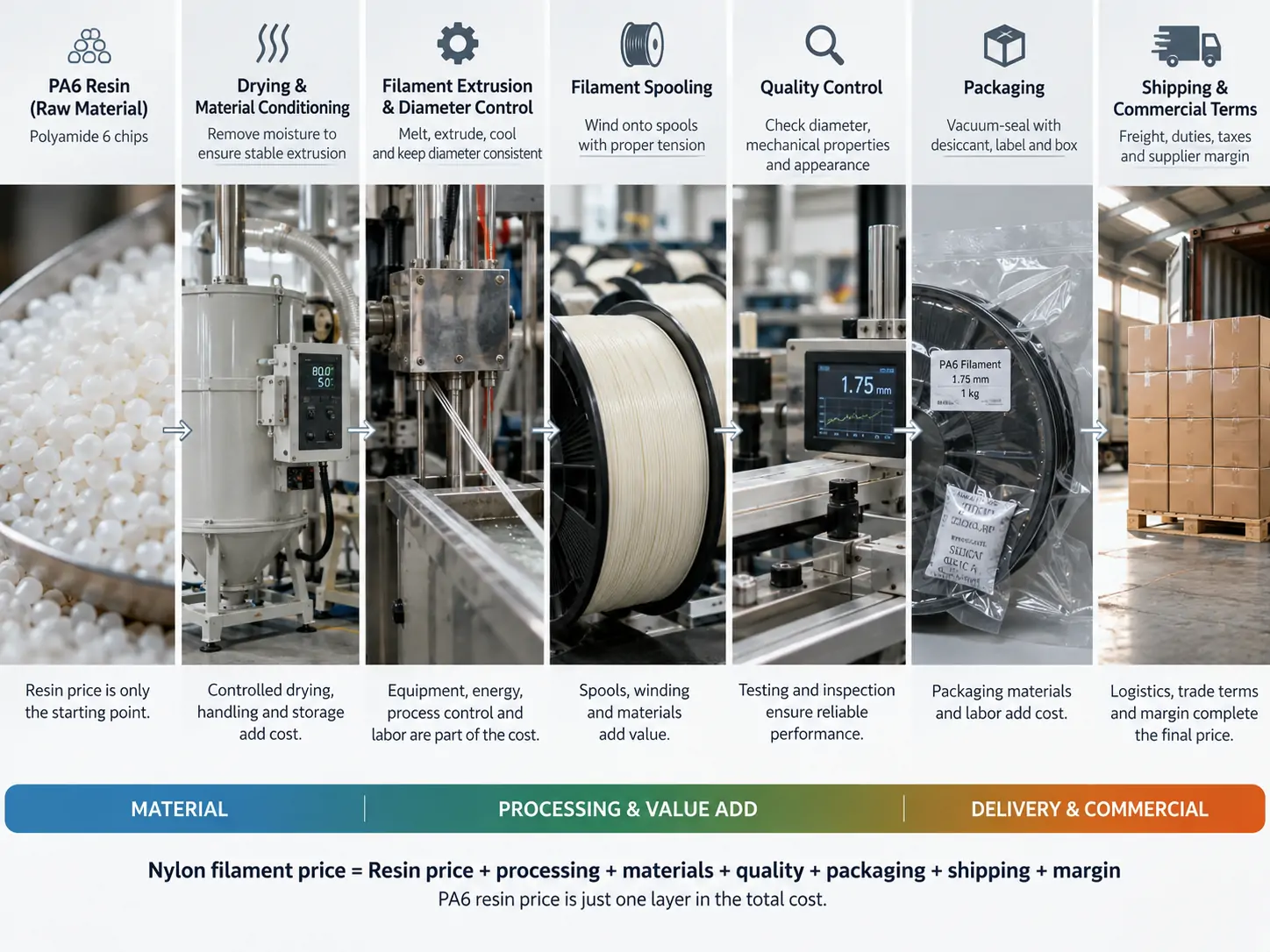
Swipe horizontally to review the full conversion stack on mobile devices.
| Cost / Risk Layer | What Changes the Number | What a B2B Buyer Should Ask |
|---|---|---|
| Base polymer / compound | PA grade, viscosity, modifier package, reinforcement, color and resin supplier basis | Which resin or compound grade is being used, and is that grade controlled for repeat orders? |
| Material conditioning | Pre-drying, moisture control, additives and rework policy | What moisture method and release limit are used before extrusion and before packing? |
| Extrusion yield | Line speed, start-up purge, off-spec scrap, diameter control and changeovers | How is out-of-tolerance material detected, rejected and segregated? |
| QC | Laser diameter monitoring, ovality, moisture, color, winding and batch records | Can the supplier provide a lot-matched COA or QC record instead of only a generic TDS? |
| Spool and packaging | Spool format, vacuum barrier, desiccant, box, labels and private-label artwork | Is packaging included in the quote and identical for qualification and production orders? |
| Commercial terms | MOQ, payment terms, Incoterm, freight, duty, insurance and quote validity | Which costs are inside the quoted unit price, and which will be added later? |
SSSray Quote Comparison Rule: Compare suppliers only after normalizing material grade, net filament weight, packaging, QC documentation, Incoterm and payment terms. A nominally cheaper spool is not cheaper if the quote excludes the documentation, packaging or process control your channel requires.
3. SSSray Four-Gate Procurement Framework for PA6 Filament
SSSray uses four gates to translate upstream PA6 market movements into a procurement decision. A market move can trigger a purchasing review, but it should never override the approved material specification or production-lot qualification record.
GATE 1
Market Basis
Record the quote date, public PA6 reference used by the supplier, grade definition, payment basis and validity period. If two suppliers use different PA6 grades or different delivery and payment bases, the raw benchmark comparison is not like-for-like.
GATE 2
Conversion Basis
Separate the resin signal from compounding, conditioning, extrusion, QC, packaging and commercial costs. Ask for the exact finished-filament deliverable instead of attempting a theoretical polymer-to-spool conversion.
GATE 3
Quality Evidence
Qualify the production lot with traceable diameter, ovality, moisture, winding and packaging records. For an engineering grade, use the product TDS and lot evidence together; neither should substitute for the other.
GATE 4
Supply Continuity
Confirm repeat-order grade control, change notification, realistic lead time, raw-material sourcing continuity and a defined response process if a future lot drifts from the approved sample or specification.
Contract, Spot or Hybrid?
There is no universal kilogram threshold that makes one strategy correct. A contract becomes more attractive when demand is predictable, the material grade is stable, storage is available, quality has already been qualified and the pricing mechanism is clear. Spot purchasing becomes more attractive when demand is uncertain, grades change frequently or the buyer requires greater flexibility. A hybrid structure can work when core demand is predictable but the buyer still wants room for trials, new SKUs or opportunistic purchases.
| Buyer Condition | Purchasing Tendency | What Must Be Written Down |
|---|---|---|
| Stable monthly consumption, fixed grade | Contract or hybrid structure can reduce budget volatility | Grade, tolerance, packaging, change control, price review mechanism, lead time and claim process |
| Uncertain demand or frequent grade changes | Spot or shorter commitment preserves flexibility | Quote validity, minimum order, lot traceability and sample-to-order equivalence |
| New supplier under qualification | Qualification order before long commitment | Acceptance criteria, sample lot ID, production-lot QC evidence and corrective-action path |
| Large repeat program with approved material | Hybrid or contract structure may be appropriate | Index basis if used, review dates, forecast tolerance and documented material-change notification |
4. PA6 vs PA12: Price Cannot Make the Material Decision
The raw-material gap between PA6 and PA12 can be commercially meaningful, but substituting one for the other remains an engineering decision first. PA6 is generally more moisture-sensitive and usually demands tighter drying and storage discipline. PA12 generally offers easier moisture management and can be attractive where dimensional stability and lower water uptake are priorities. Exact mechanical and thermal properties depend on the specific grade, formulation, reinforcement, conditioning state and test method.
For full mechanical-property and material-selection data, use the SSSray PA12 vs PA6 Engineering Guide. Here, the buying decision stays focused on raw-material pricing, supplier qualification, lot-level quality evidence and procurement risk. This keeps material selection tied to engineering requirements while the commercial discussion stays tied to the cost and supply signals a B2B buyer can actually act on.
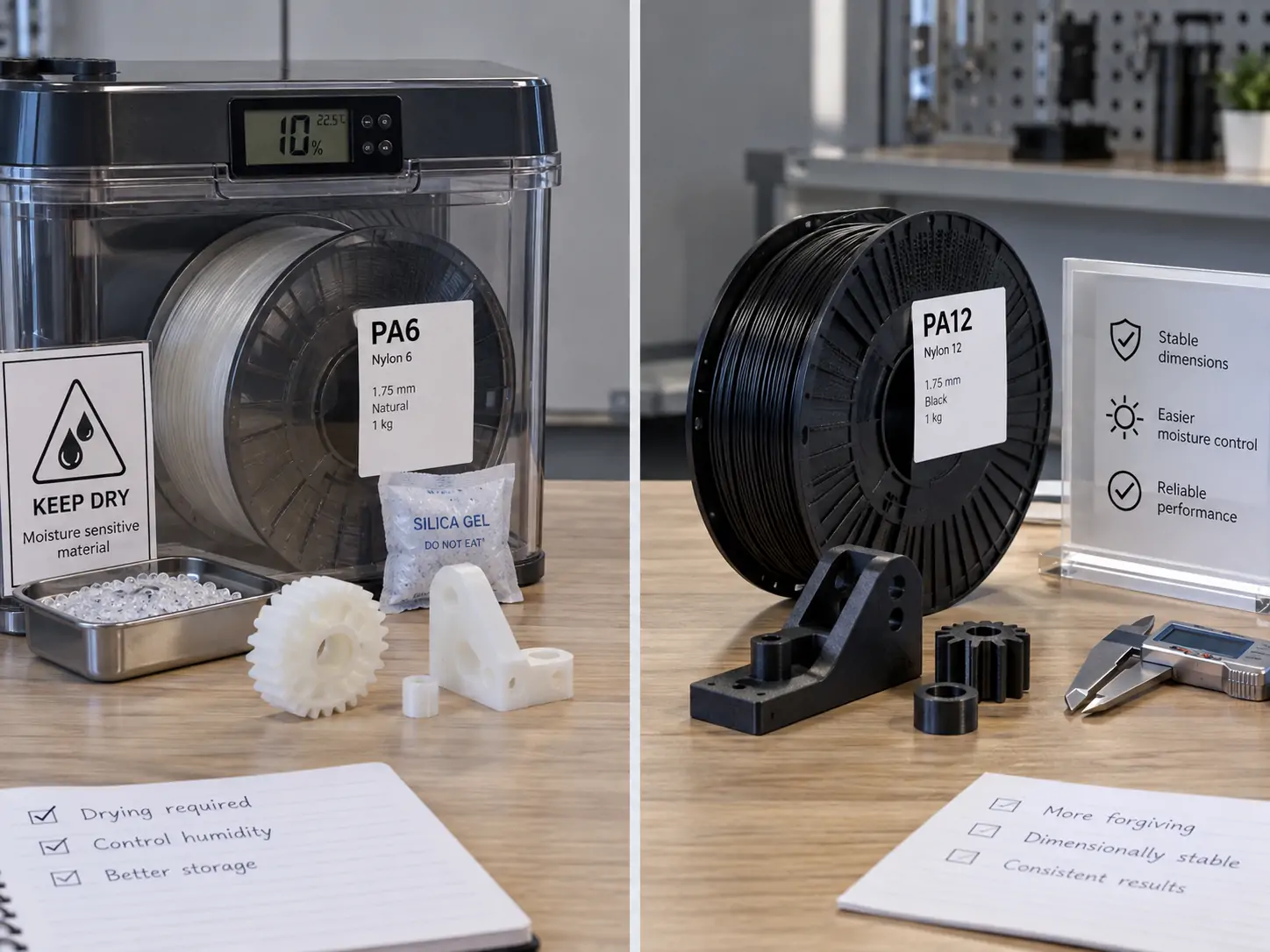
Evaluate PA6 When
- The approved application benefits from the specific PA6 grade's mechanical or thermal profile.
- Your process can dry and protect nylon consistently before and during printing.
- Your printers are qualified for the supplier's required nozzle, bed and chamber conditions.
- The production lot can be traced back to the grade and QC records you approved.
Stay with PA12 When
- Lower moisture sensitivity and easier handling reduce operational risk for your workflow.
- The existing PA12 grade already meets the application requirements.
- A material switch would force new printer profiles, validation or customer approvals.
- The apparent saving exists only in the resin benchmark, not in validated total cost per successful part.
5. Supplier Verification Before a Volume PA6 Order
Market volatility makes supplier verification more important. A practical B2B qualification process focuses on evidence the buyer can inspect and tie directly to the material being purchased.
Swipe horizontally to review all verification evidence on mobile devices.
| Verification Area | Evidence to Request | What Good Evidence Looks Like | Red Flag |
|---|---|---|---|
| Supplier identity and production role | Legal entity, factory address, manufacturing scope, production photos/video or audit evidence | The entity on the quotation and documents can be tied to the actual manufacturing arrangement | Trader/factory role changes depending on who asks |
| Material identity | Grade name, TDS, SDS, formulation or reinforcement description where relevant | Documents refer to the same commercial grade and revision | Generic nylon datasheet with no grade control |
| Lot QC | Batch ID, COA, diameter/ovality evidence, moisture result, winding and packaging release checks | The data can be mapped to the sample or production lot being shipped | Only marketing claims such as "high quality" or "clog-free" |
| Measurement control | Instrument identification and calibration or verification records appropriate to the method | The method and instrument are clear enough for the buyer to understand how the result was produced | Pass/fail values with no measurement context |
| Reorder continuity | Lead-time history, grade-change notification process, retained sample policy, complaint/CAPA process | The supplier can explain how an approved first lot remains controlled on the next order | No change-control path and no lot-specific retention |
| Commercial clarity | MOQ, quote validity, Incoterm, payment terms, packaging and documentation scope | All quote assumptions are explicit before the purchase order | A low unit price expands after packaging, documents or freight are added |
6. SSSray First-Hand Nylon Manufacturing Evidence
SSSray has published controlled nylon-composite moisture data that is directly useful for procurement teams designing storage and handling procedures. In a Q1 2026 study, four SSSray PA-CF production batches were exposed at 23°C and 50% RH. Samples were measured at seven time points using a calibrated moisture balance; the published table reports the mean of n=3 samples per grade. The protocol used 0.5 mm printed tensile bars stored open on a rack under a humidity-exposure protocol based on ISO 62:2008 Method 4.
For the PA6-CF grade in that study, the reported moisture values were <0.10% at 0 hours, 0.18% at 6 hours, 0.55% at 24 hours, 1.05% at 72 hours, 1.55% at 168 hours, 2.00% at 336 hours and 2.40% at 720 hours. These results are PA6-CF handling evidence; they are not presented as unfilled-PA6 resin data or as a universal value for every PA6 formulation.
| Test Item | Published Detail | Procurement Use |
|---|---|---|
| Test period | Q1 2026; 30-day exposure study | Provides a dated SSSray evidence set rather than a generic nylon handling statement |
| Environment | 23°C, 50% RH | Defines the exposure condition required to interpret the moisture curve |
| Sample plan | Mean of n=3 samples per grade; seven time points | Provides a defined sampling basis for the published results |
| Instrument / method | Calibrated moisture balance; humidity-exposure protocol based on ISO 62:2008 Method 4 | States how the measurements were generated |
| PA6-CF result | <0.10% at 0 h → 0.55% at 24 h → 2.40% at 720 h | Supports strict opened-spool storage and re-drying discipline for this tested grade |
SSSray PA6/66 Production-Lot Verification
Moisture-uptake testing shows how nylon behaves after exposure; production-lot QC answers a different question: what condition did the filament actually leave our line in? The PA6/66 lot below records the diameter, ovality and pre-seal moisture controls used on a commercial 1.75 mm engineering-nylon production run.
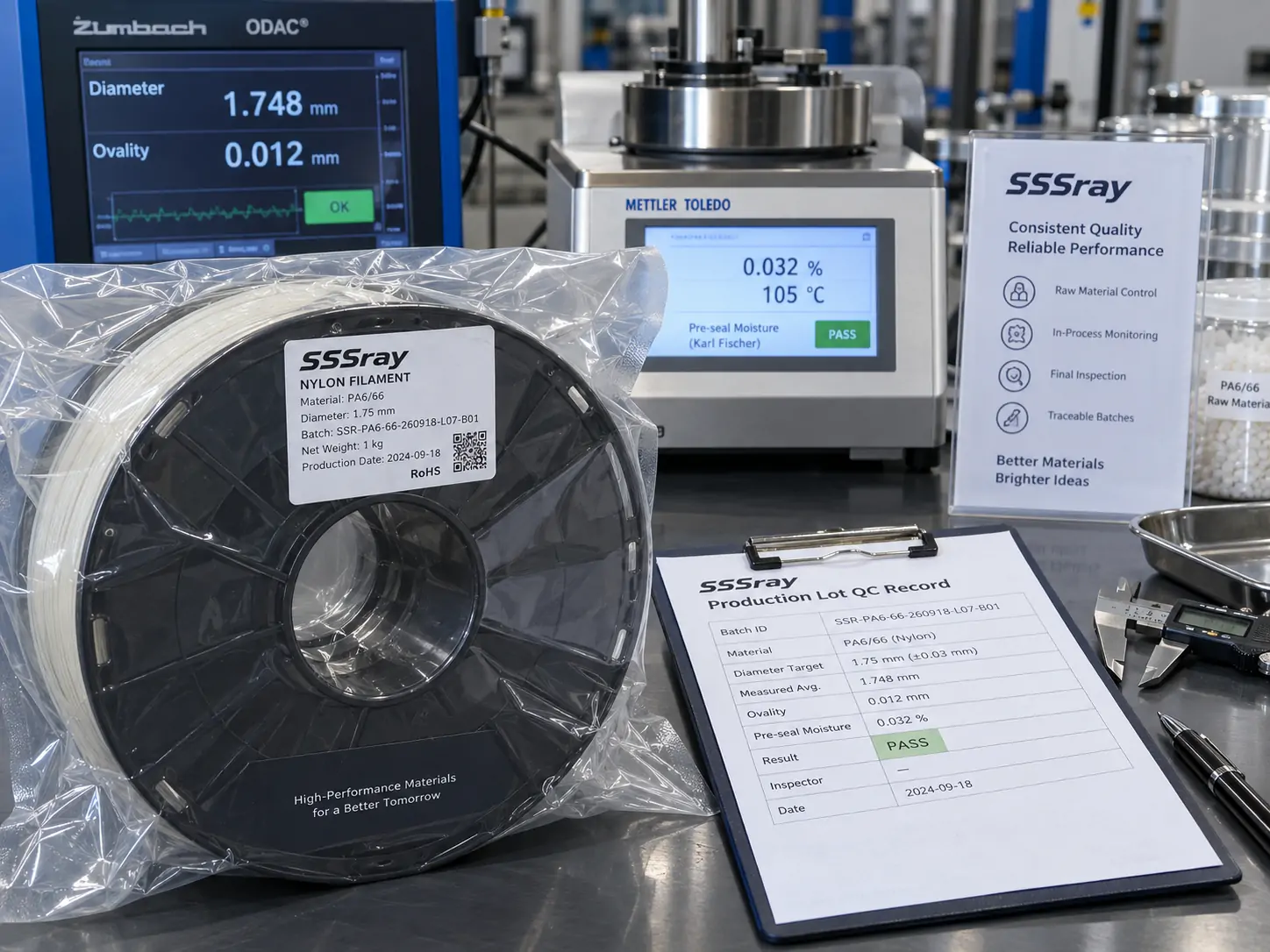
Swipe horizontally to review the complete production-lot record on mobile devices.
| QC Item | Production-Lot Record | SSSray Release Requirement | Result |
|---|---|---|---|
| Public Batch ID | SSR-PA6-66-260918-L07-B01 | Unique production-lot traceability | PASS |
| Material | SSSray PA6/66 Engineering Nylon Filament, 1.75 mm | Approved commercial nylon formulation | PASS |
| Production / Test Date | September 18, 2026 | Lot-matched QC before packing | PASS |
| Extrusion Line | Line 07 | Production-line traceability recorded with the batch | PASS |
| Diameter Measurement | Continuous inline laser micrometer monitoring | 1.75 ±0.03 mm | PASS |
| COA Diameter Audit Sample | 10 spools × 3 archived laser checkpoints per spool = 30 measurement sets | Representative checkpoints remain inside release tolerance | PASS |
| Mean Diameter | 1.751 mm | 1.72–1.78 mm | PASS |
| Observed Diameter Range | 1.731–1.772 mm | 1.72–1.78 mm | PASS |
| Maximum Ovality | 0.018 mm | ≤0.020 mm | PASS |
| Pre-Seal Conditioning | 80°C × 8 h | Controlled drying before final moisture release | PASS |
| Moisture Measurement | Karl Fischer titration, n=3 | <0.020 wt% before vacuum sealing | PASS |
| Mean Pre-Seal Moisture | 0.017 wt% (170 ppm) | <0.020 wt% (200 ppm) | PASS |
| Final Lot Release | Diameter, ovality and moisture gates passed | All mandatory production QC gates passed | RELEASED |
What This SSSray Lot Proves: The upstream PA6 market explains part of the raw-material cost environment; this production record shows what SSSray controls after that polymer enters filament manufacturing. Buyers receive a traceable production lot with diameter, ovality and pre-seal moisture checked against defined release limits rather than relying on a generic resin benchmark or marketing datasheet alone.
Read the complete protocol and all four material curves in the SSSray 30-Day PA-CF Moisture Test. For production orders, SSSray's Batch QC Data program covers lot-level traceability, inline laser diameter monitoring, moisture checks and COA support.
What the Two SSSray Tests Show Together: The 30-day PA6-CF exposure study shows how the tested nylon composite gains moisture after opening, while the PA6/66 production-lot record shows how SSSray controls diameter, ovality and moisture before a commercial lot is released and vacuum sealed. Together, they connect material handling behavior with the factory QC evidence a B2B buyer needs before qualification and repeat ordering.
7. Buyer Playbook by Business Model
Distributor / Reseller
Priority: repeatable SKU quality, packaging consistency, quote stability and reorder continuity.
Action: use the public PA6 market as a quote-check signal. Approve a specific production lot, packaging set and documentation bundle before increasing volume.
SSSray next step: review private-label options or request a qualification sample.
OEM Brand
Priority: printer compatibility, change control, labeling, documentation and consistent customer experience.
Action: freeze the qualified grade and printer profile before signing a long supply program. Do not allow a lower resin benchmark to trigger an unvalidated material substitution.
SSSray next step: define the OEM/ODM specification.
Print Farm
Priority: successful-part cost, drying workload, throughput and lot-to-lot consistency.
Action: measure failure rate, drying energy and operator handling together with filament unit cost. A cheaper spool that increases failed-print rate is not a cost saving.
SSSray next step: review SSSray batch QC evidence and qualify a production lot.
Engineering Buyer
Priority: application performance, traceable grade, test method, conditioning state and change control.
Action: select PA6 or PA12 from service requirements first, then optimize the commercial structure. Keep raw-material market timing out of the engineering acceptance criteria.
SSSray next step: send the application requirements for technical review.
Frequently Asked Questions
What actually happened to China PA6 prices in 2026?
Public data shows an important low in late June rather than a simple August collapse. CCFGroup reported East China bright conventional-spinning PA6 chip around ¥10,800–11,500 per metric ton at the end of June. August then moved through a moderate correction, strong rebound and plateau as caprolactam supply remained tight. Mainstream East China PA6 chip was around ¥14,000 per metric ton by early September (reported September 11), and the SunSirs PA6 benchmark was ¥15,400 per metric ton on September 22.
Is ¥15,400 per metric ton the price of PA6 3D printing filament?
No. It is a PA6 market benchmark, not a finished-filament quotation. A filament price also includes the selected polymer or compound grade, material conditioning, extrusion yield, QC, spooling, packaging, documentation, commercial terms, freight and supplier margin.
Should a B2B buyer lock a long PA6 filament contract after the September price rise?
Not from the market chart alone. First confirm demand certainty, the qualified material grade, lot-level QC, storage capacity, the supplier's change-control process and the contract's pricing basis. A longer commitment is useful only when the material and supply conditions are already controlled.
Should I switch from PA12 to PA6 because PA6 resin is cheaper?
No. Treat the switch as a material qualification project. Compare the exact grades, moisture handling, printer requirements, dimensional behavior, mechanical and thermal requirements, validation cost and successful-part cost before changing the approved polymer.
What evidence should a PA6 filament supplier provide before a volume order?
Ask for the exact grade TDS and SDS, a traceable Batch ID, lot-matched QC or COA data, diameter and ovality evidence, moisture test method and result, packaging specification, measurement-control information, lead time, change-control process and clear commercial terms.
What first-hand nylon data has SSSray published?
SSSray has published controlled PA-CF moisture-uptake data and production-lot filament QC evidence. The PA6-CF exposure study uses a 23°C and 50% RH environment, seven time points and a mean of n=3 samples per grade. The PA6/66 production-lot record separately documents inline diameter monitoring, ovality and pre-seal Karl Fischer moisture verification for a commercial filament batch.
Conclusion: Use PA6 Market Data as a Procurement Signal, Not a Shortcut
The 2026 PA6 market gives B2B filament buyers useful negotiating context, but the strongest procurement decision is still built on a qualified material and a traceable production lot. The verified market sequence is late-June weakness, an August supply-tightness rebound and a strong September benchmark increase — not an August collapse followed by a simple seasonal recovery.
SSSray's approach is practical: normalize quotations before comparing them, keep PA6-versus-PA12 selection tied to application requirements, and require production evidence that survives the move from sample spool to repeat order. If you are qualifying nylon for distribution, private label or production use, send the target grade, monthly forecast, spool format, destination and required document set so the quotation and qualification plan can be built around the same specification.
Request a quote or free samples
Tell us the material, color, spool size and monthly volume. An engineer replies within 24 hours on business days.
References
- CCFGroup — Nylon 6 in June: when "flour costs more than bread" becomes the norm, July 7, 2026.
- CCFGroup — PA6 chain caught in cost-driven volatility against weak end-use demand, August 21, 2026.
- CCFGroup — CPL & PA6: supply tightness overrides benzene volatility in August, August 31, 2026.
- China Plastics Online — "Golden September" market kicks off, nylon prices rise!, September 11, 2026.
- SunSirs — PA6 benchmark at ¥15,400 per metric ton, September 22, 2026.
- SSSray — PA12-CF vs PA6-CF: 30-Day Moisture Test, 2026.
- SSSray — 3D Printer Filament Batch QC Data & Factory COA, 2026.
- SSSray — Industrial PA6/66 Nylon 3D Printing Filament, 2026.
Market data cut-off for this guide: September 22, 2026. Check the current PA6 benchmark and the validity date on each supplier quotation before purchase-order approval.
