Online time
Monday to Friday: 9AM - 8PM
Weekend: 10AM - 5PM



Engineering Composite Series | PPS-GF | OEM / ODM Supply
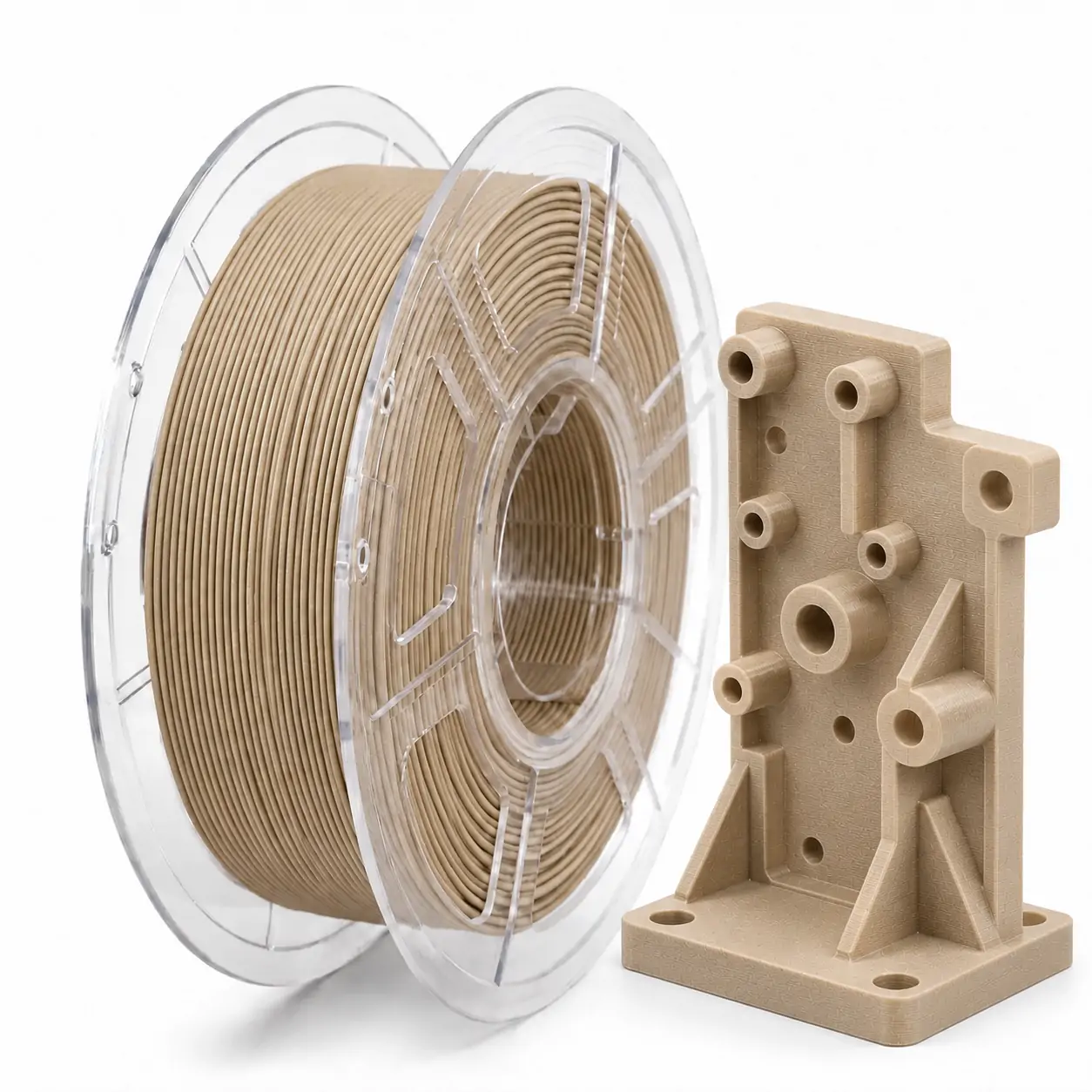
SSSray PPS-GF FDM Filament for Structural Brackets & Mounting Plates – glasfaserverstärktes PPS-Filament in Desert Tan
Glass-fiber-reinforced PPS filament developed for brackets, mounting plates, standoffs, jigs and other high-temperature structural components where dimensional stability matters.
Desert Tan gives engineering parts a warm khaki finish that is visibly deeper and more yellow-brown than natural sand beige. The printed surface is matte with fine fiber texture and subtle orientation streaks, keeping bosses, through-holes and lattice ribs visually crisp without a silk, metallic, marble or wood-filled effect.
MaterialPPS-GF
SeriesEngineering Composite
Color EffectDesert Tan Matte
Diameter1.75mm
Tolerance±0.03mm
Net Weight1kg
Gross Weight1.3kg
Nozzle Temp320–340°C
Bed Temp90–110°C
Print Speed50–120 mm/s
PackagingVacuum + Desiccant
Spool TypePlastic Spool
MOQ: Neutral packaging from 50 spools; OEM packaging typically 500–1,000 spools.
Production Note: PPS-GF requires a high-temperature all-metal hotend and a wear-resistant nozzle. Final settings should be qualified on the buyer’s printer, part geometry and target load case.
Product Overview
SSSray PPS-GF Desert Tan is a glass-fiber-reinforced polyphenylene sulfide filament for buyers who need a high-temperature engineering composite for structural brackets, mounting plates, standoffs, machine fixtures and other rigid FDM parts. PPS is a semi-crystalline polymer valued for dimensional stability and chemical resistance, while glass-fiber reinforcement helps control shrinkage and increases rigidity compared with unfilled PPS. This grade is intended for high-temperature printers with an all-metal hotend, heated bed and wear-resistant nozzle.
The Desert Tan color is a medium warm khaki with a deeper yellow-brown tone than natural sand beige. Printed parts develop a fine matte fiber texture rather than a glossy decorative surface, which suits industrial hardware where geometry, hole definition and consistent appearance matter. We supply this grade in 1kg plastic spools with vacuum packaging, neutral or OEM programs, export-oriented lead times and sample-to-bulk support for engineering projects.
Desert Tan PPS-GF for Structural Hardware Programs
We developed this Desert Tan PPS-GF offering for rigid brackets, mounting plates, standoffs and fixtures that need better heat, chemical and dimensional performance than commodity filaments. The PPS matrix has much lower moisture sensitivity than PA6-GF materials, while glass-fiber reinforcement supports stiffness and dimensional control. The warm khaki matte finish also gives engineering hardware a distinct non-black option. We support the full B2B path from sample testing and print-setting guidance to OEM packaging, repeat-batch supply and export delivery.
PPS-GF Advantages for Structural Parts
Glass-Fiber Reinforced PPS
Designed for rigid brackets, plates, standoffs and fixtures where lower shrinkage and higher stiffness are useful.
High-Temperature Processing
Built for 310–350°C-class all-metal hotends with controlled bed temperature and dry-material handling.
Dimensional Stability Focus
Suitable for parts with bosses, through-holes, ribs and mounting interfaces that require repeatable geometry.
Desert Tan Industrial Finish
Warm khaki matte appearance with visible fiber texture for differentiated engineering and hardware programs.
Export-Oriented Supply
Neutral packaging from 50 spools with FOB Ningbo / EXW support for distributors, importers and industrial buyers.
OEM / ODM Ready
Custom labels, branded boxes, color programs, carton marking and private-label support for qualified volume projects.
Material & Supply Features
| Feature | Practical Buyer Benefit |
|---|---|
| PPS Matrix with Glass-Fiber Reinforcement | Targets rigid, dimensionally stable engineering parts rather than decorative consumer prints |
| Desert Tan Matte Color | Adds a technical non-black SKU for brackets, fixtures and visible mounting hardware |
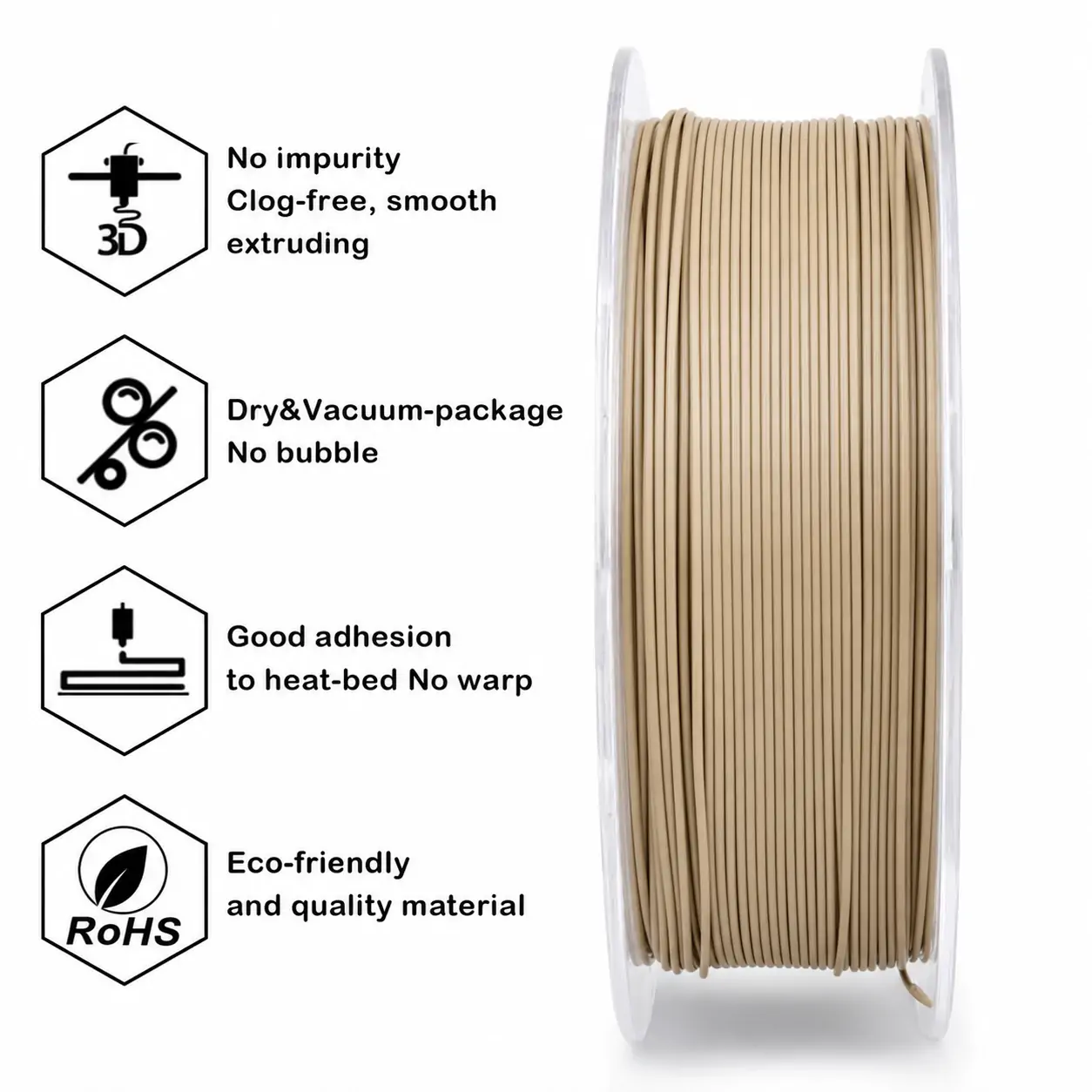
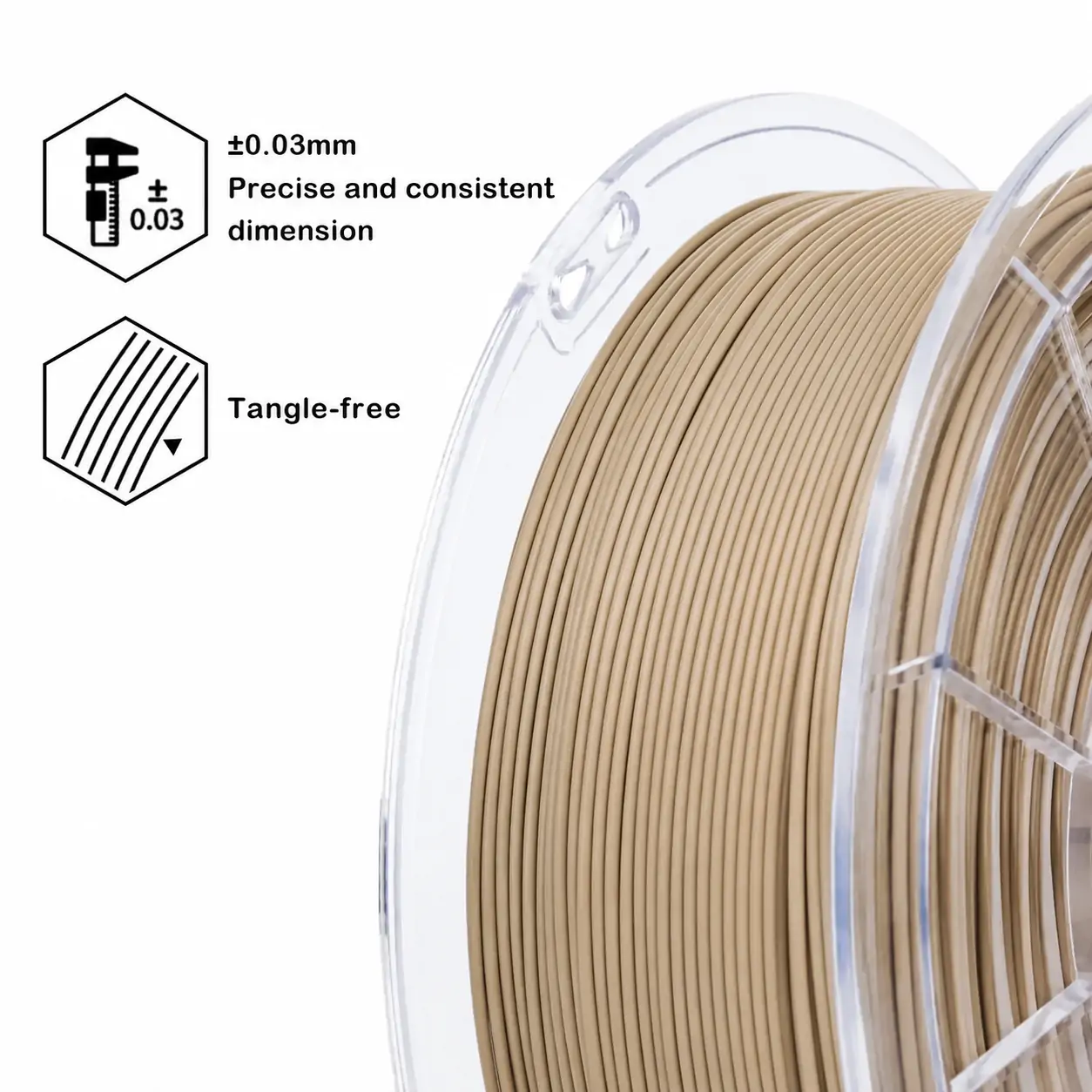
| 1.75mm Diameter, ±0.03mm Tolerance | Supports consistent feeding across qualified high-temperature FDM systems |
| Wear-Resistant Nozzle Processing | Matches the abrasive nature of glass-filled engineering composites |
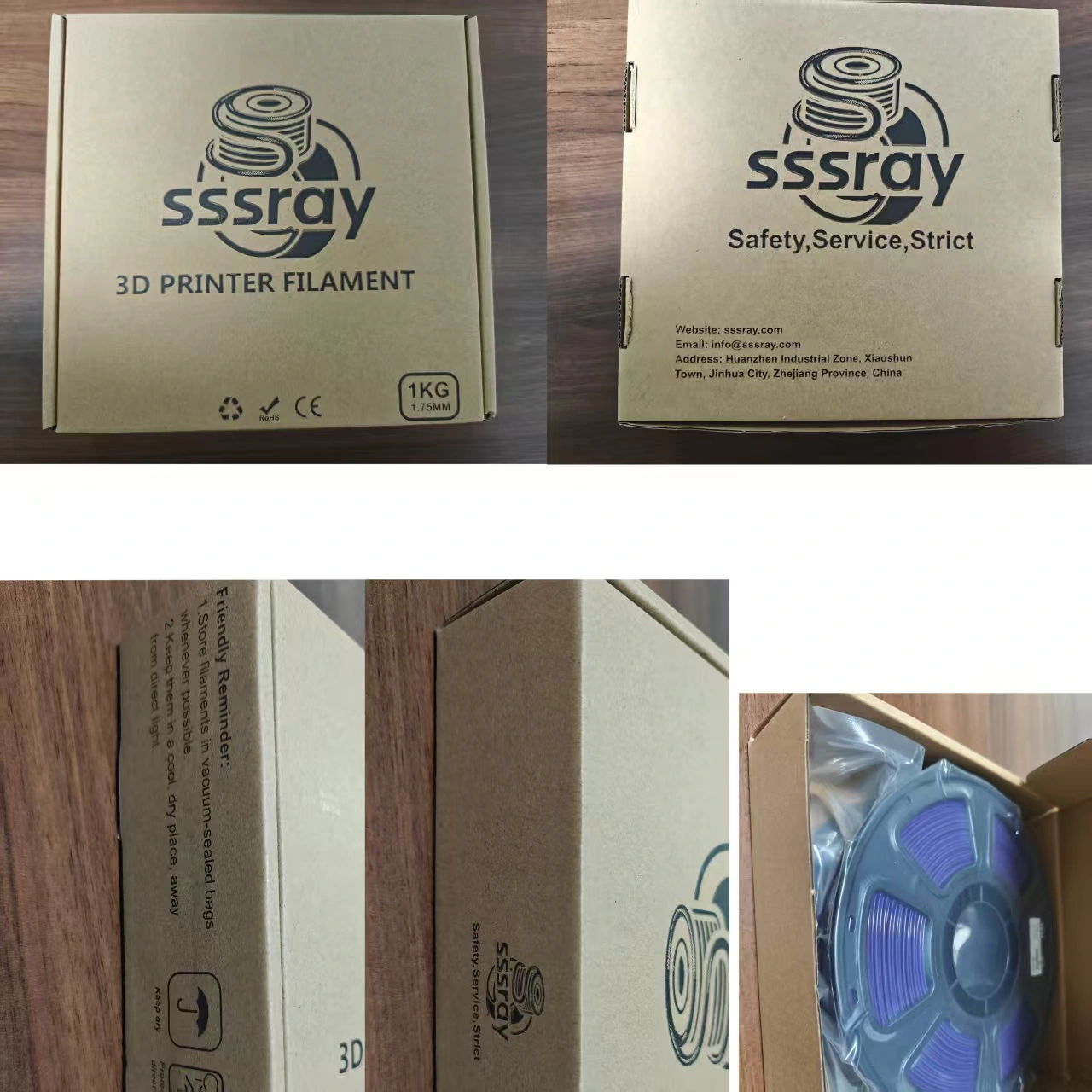
| Vacuum Sealed with Desiccant | Helps control storage condition before the spool reaches the buyer’s production line |
| OEM / ODM Supply | Supports private label, custom packaging and engineering-material portfolio expansion |
Where PPS-GF Adds Value Between PA-GF and PEEK-Class Materials
For buyers moving beyond PA-GF, this PPS-GF route offers lower moisture sensitivity, broad PPS chemical resistance and stronger dimensional stability for heat-exposed structural hardware. At the same time, its 310–350°C processing window is less demanding than typical PEEK- and PEI-class programs. That makes Desert Tan PPS-GF a practical step-up material for industrial fixtures, brackets, mounting systems and private-label engineering lines that need more performance without jumping directly to the highest-temperature polymer platforms.
How We Work
1
Application & Load Review2
Specification Confirmation3
Sample & Print Check4
Color & Packaging Approval5
Production & Batch QC6
Inspection & Export ShipmentMaterial Comparison Guide
| Material | Reinforcement / Structure | Typical Print Hardware | Material Behavior | Typical Use |
|---|---|---|---|---|
| PPS-GF | PPS + glass fiber | High-temperature all-metal hotend, heated bed, wear-resistant nozzle, dry feed | High-temperature semi-crystalline matrix with glass-fiber stiffness and dimensional-control focus | Brackets, mounting plates, standoffs, fixtures, industrial hardware |
| PPS-CF | PPS + carbon fiber | High-temperature all-metal hotend, heated bed, hardened nozzle, dry feed | Rigid PPS composite with low thermal expansion; usually supplied in dark carbon-fiber appearance | Precision fixtures, stiff housings, high-temperature functional parts |
| PPA / PA-GF | Polyamide + glass fiber | High-temperature hotend, heated bed, hardened nozzle, dry box strongly recommended | High stiffness with greater moisture-management demand than PPS-based systems | Jigs, automotive brackets, tooling, structural prototypes |
| PC-GF | Polycarbonate + glass fiber | Enclosed printer, heated bed, wear-resistant nozzle | Rigid engineering composite with lower processing temperature than PPS in many formulations | Housings, fixtures, machine components, functional prototypes |
Technical Specifications
| Product Name | SSSray PPS-GF FDM Filament for Structural Brackets & Mounting Plates – glasfaserverstärktes PPS-Filament in Desert Tan |
|---|---|
| Material | Polyphenylene Sulfide (PPS) reinforced with glass fiber |
| Material Type | Semi-crystalline engineering thermoplastic composite for FDM / FFF |
| Series | SSSray Engineering Composite Series – PPS-GF Tan for Lightweight Structural Brackets & Mounting Hardware |
| Color / Effect | Desert Tan; medium warm tan-khaki, soft matte to low-sheen, fine fiber-textured printed surface |
| Filament Diameter | 1.75mm standard; 2.85mm available on request |
| Tolerance | ±0.03mm |
| Net Weight | 1kg; 3kg / 5kg available on request |
| Gross Weight | 1.3kg |
| Spool Type | Plastic spool |
| Packaging | Vacuum sealed with desiccant |
| Recommended Nozzle | Wear-resistant hardened steel or equivalent; 0.6mm preferred for production, 0.4mm usable for smaller features |
| Printer Requirement | High-temperature all-metal hotend capable of at least 310°C; heated bed; enclosure recommended for larger parts |
| Typical Applications | Structural brackets, mounting plates, standoffs, machine fixtures, jigs, rigid housings and high-temperature functional hardware |
| OEM / ODM | Supported: labels, boxes, private-label packaging, color programs, carton marking and project-specific presentation |
Recommended Print Settings
| Parameter | Recommended Guidance | Usable / Tuning Range |
|---|---|---|
| Nozzle Temperature | 320–340°C starting window | 310–350°C for tuning across different hotends and nozzle sizes |
| Bed Temperature | 90–110°C | 80–120°C depending on build surface, part footprint and adhesive system |
| Print Speed | 50–120 mm/s | 30–200 mm/s when melt flow, layer bonding and dimensional accuracy remain stable |
| Retraction – Direct Drive | 1–3mm at 20–40 mm/s | Tune to hotend path and nozzle size |
| Retraction – Bowden | 3–5mm at 20–35 mm/s | Use only on high-temperature Bowden systems designed for this material class |
| Layer Height | 0.15–0.30mm | Match to 0.4–0.6mm wear-resistant nozzle |
| Cooling Fan | 0% for structural parts | 0–10% only for bridges or small overhangs that need localized cooling |
| Wall Count | 4–6 perimeters | Increase for bosses, holes and load-bearing walls |
| Infill | 30–50% for fixtures and plates | 40–60% for higher-demand structural parts; geometry and orientation remain critical |
| First Layer Speed | 15–25 mm/s | Keep first-layer flow stable before increasing production speed |
| Bed Adhesion | High-temperature PEI / engineering plate with compatible adhesive or release layer | Validate textured PEI or glass only with a suitable high-temperature interface |
| Chamber | Enclosure recommended; 50–60°C is the general SSSray starting target for larger structural parts | Platform-specific SSSray starting profiles may extend to 65–70°C where stable active chamber control is available; small parts can be qualified at lower chamber temperature if warping and layer bonding remain controlled |
| Drying | 100°C for 10h after moisture exposure | Keep the filament dry during printing; use a dryer and spool system rated for the selected temperature |
Print Optimization Guide
| Item | Guidance |
|---|---|
| Nozzle Selection | Use a hardened steel, ruby or comparable wear-resistant nozzle. A 0.6mm nozzle is preferred for longer production runs with glass-filled material. |
| Moisture Control | Dry before critical jobs and feed from a sealed dry box where practical. Keep the material below 20% RH during extended printing when the equipment allows. |
| Warp Control | Use an enclosure, stable bed temperature, a clean build surface and a brim for large flat mounting plates or long ribbed brackets. |
| Hole & Boss Accuracy | Print the actual interface geometry or a dimension coupon before volume production, then lock hole compensation after the printer-material profile is stable. |
| Part Orientation | Orient primary load paths to reduce reliance on Z-direction layer adhesion, especially around bosses, pivots and mounting ears. |
| Annealing | For projects that need higher crystallinity, use a controlled annealing cycle and check critical dimensions after heat treatment before releasing the part design. |
SSSray-Tested PPS-GF Starting Profiles by Printer Platform
| Printer / Platform | Nozzle | Bed | Chamber | Starting Speed | Practical Note |
|---|---|---|---|---|---|
| Bambu Lab H2D | 320–340°C | 90–110°C | 55–65°C | 50–120 mm/s | Use a hardened 0.6mm nozzle for production and confirm first-layer adhesion before increasing speed |
| Prusa CORE One / CORE One L family with HT Hotend | 320–340°C | 90–110°C | 50–55°C (CORE One); 50–60°C (CORE One L) | 50–100 mm/s | Use the compatible wear-resistant HT nozzle and high-temperature print surface; keep chamber temperature within the specific printer variant’s supported limit |
| Creality K2 Plus | 320–340°C | 90–110°C | 50–60°C | 50–100 mm/s | K2 Plus has the required 350°C-class hotend; standard K2 / K2 Pro temperature limits are lower |
| Industrial 350°C+ FDM Platform | 320–340°C | 90–110°C | 50–70°C | 50–150 mm/s | Use this as a production starting profile when the printer has hardened extrusion hardware and stable chamber control |
These values are SSSray-tested starting profiles for this PPS-GF grade, not printer-manufacturer material presets. Fine-tune flow, first-layer adhesion and speed for the actual nozzle size, build surface and part geometry.
PPS-GF Material Behavior for Structural Parts
| Characteristic | Material / Production Reference | Buyer Relevance |
|---|---|---|
| Matrix Type | Semi-crystalline PPS engineering thermoplastic | Targets higher-temperature industrial use than PLA, PETG, ABS or standard PC programs |
| Reinforcement | Glass-fiber reinforced; fiber loading is listed in the current TDS supplied with the confirmed grade | Supports rigidity and dimensional control for brackets and mounting hardware |
| Thermal Behavior | High-temperature PPS material class; HDT and continuous-use data are supplied from the current grade TDS | Relevant to fixtures and components operating above commodity-filament temperature ranges |
| Chemical Behavior | PPS is generally selected for resistance to many fuels, oils, solvents, acids and bases | Useful for industrial environments after media-specific compatibility validation |
| Abrasion | Glass fiber is abrasive to standard brass nozzles | Wear-resistant nozzle and extrusion hardware are required for stable production |
| Surface Appearance | Fine fiber-textured matte Desert Tan with diffuse highlights | Creates a technical finish for visible brackets, fixtures and hardware without a carbon-black look |
Structural Brackets, Mounts & Industrial Applications
| Application Focus | Practical Notes |
|---|---|
| Structural Brackets | Use for truss-style brackets, pivot arms and support structures after validating load direction, wall count and layer orientation. |
| Mounting Plates | Suitable for plates with bosses, through-holes and ribbing where flatness and hole position are important. |
| Standoffs & Spacers | Useful for rigid mounting interfaces exposed to heat or industrial chemicals; validate compression and fastener torque. |
| Machine Fixtures & Jigs | Useful for production aids that require more heat and chemical resistance than commodity filaments. |
| Automotive / Equipment Hardware | Suitable for under-hood or equipment hardware when the project temperature, chemical exposure and vibration requirements match the confirmed material data. |
| Industrial Housings & Mounts | Appropriate where dimensional stability, matte appearance and high-temperature processing justify a PPS composite. |
Storage Guide
- Keep unopened spools in the original vacuum-sealed package until production use
- After opening, store in a sealed dry box with fresh desiccant and minimize long ambient exposure
- Dry before critical printing when the spool has been exposed to humidity or when extrusion shows moisture symptoms
- For extended production, feed directly from a controlled dry box where practical
- Confirm that the plastic spool and dryer are rated for the selected drying temperature before using high-temperature drying cycles
OEM / ODM Services
SSSray supports PPS-GF programs for distributors, engineering-material brands, industrial sourcing teams and private-label buyers. Available project options can include neutral packaging, custom labels, branded retail or industrial boxes, barcode and carton marking, approved color matching, custom spool presentation, private-label documentation layout and multi-SKU engineering-material programs.
MOQ Reference: Neutral packaging from 50 spools; OEM packaging typically 500–1,000 spools. Custom color, spool or packaging projects are confirmed after artwork, material and volume review.
Quality Control
- Diameter and ovality checks against the stated 1.75mm / ±0.03mm product specification
- Winding and spool condition inspection before final packing
- Desert Tan appearance comparison against the approved production reference
- Vacuum seal and desiccant inclusion check before carton packing
- High-temperature print verification for production batches using the approved process window
- Batch / lot identification and shipment preparation review for B2B order traceability
PPS-GF Technical Documents & Compliance Support
For PPS-GF orders, we prepare the document set around the confirmed material grade and destination-market requirements so your purchasing and engineering teams receive the files needed for project approval.
- Current TDS / technical specification for the confirmed PPS-GF grade
- SDS / MSDS for material handling and transport documentation
- RoHS / REACH declaration or third-party report when covered by the ordered SKU
- SGS or other third-party test reports available for projects covered by the applicable report
- Batch QC records available for agreed production programs and repeat-order traceability
Frequently Asked Questions
What is the MOQ for SSSray PPS-GF Desert Tan?
Neutral packaging starts from 50 spools. OEM or private-label packaging typically starts from 500–1,000 spools depending on label, box, spool and color customization.
What printer hardware is required for this PPS-GF filament?
Use a high-temperature all-metal hotend capable of at least 310°C, a heated bed and a wear-resistant nozzle. A 0.6mm hardened nozzle is preferred for longer production runs. An enclosed or actively heated chamber is recommended for larger structural parts.
What starting temperature should I use?
Start around 320–340°C nozzle temperature and 90–110°C bed temperature, then fine-tune flow and adhesion for your build surface, nozzle size and part geometry.
Does PPS-GF need drying before printing?
Keep PPS-GF dry for stable high-temperature extrusion. If the spool has absorbed moisture, dry at 100°C for 10 hours, then print from a dry box or reseal promptly after use. Confirm the spool and dryer are rated for the drying temperature.
Can I print PPS-GF with a brass nozzle?
Brass is not recommended for production because glass fiber is abrasive. Use hardened steel, ruby or another wear-resistant nozzle and inspect extrusion hardware during long-running programs.
Is this material suitable for load-bearing brackets?
It is intended for structural brackets, mounting plates and rigid fixtures, but final allowable load depends on part geometry, print orientation, layer bonding, infill, fastener design and service temperature. Qualify the actual part before safety-critical or load-rated use.
Can SSSray provide samples and OEM / ODM packaging?
Yes. Qualified B2B buyers can request up to 3 complimentary sample spools for pre-order testing. OEM / ODM options include custom labels, branded boxes, carton marking, color programs and private-label presentation.
What is the standard lead time and trade term?
Standard orders are typically 7–15 days and customized orders 15–25 days. Standard trade terms are FOB Ningbo or EXW, with project-specific shipment planning confirmed before production.
Source Desert Tan PPS-GF for Structural Brackets & Mounting Plates
Send us your printer model, target part, annual volume and packaging requirement. We will match the sample plan, print-setting guidance, bulk quotation and OEM / ODM packaging path to your structural-parts program.


Related products
-

PC‑CF Carbon Fiber Polycarbonate 3D Printer Filament 1.75mm 1kg — High‑Temp Rigid Engineering Material for Functional Gears & Fixtures
-
Industrial PA6/66 Nylon 3D Printing Filament 1.75mm 1kg – High Toughness & Heat Resistant Copolymer Nylon for Engineering Prototypes & Translucent Lamp Shades
-
Premium UV-Resistant ASA Carbon Fiber Filament 1.75mm 1KG | High-Stiffness CF-ASA for Outdoor Aerospace & Automotive Prototypes | Industrial OEM Supply
-
PPA (Polyphthalamide) High-Performance 3D Printing Filament 1.75mm 1kg – Ultra-High Temperature Resistance & Chemical Inertness for Heavy-Duty Industrial Parts


