Online time
Monday to Friday: 9AM - 8PM
Weekend: 10AM - 5PM

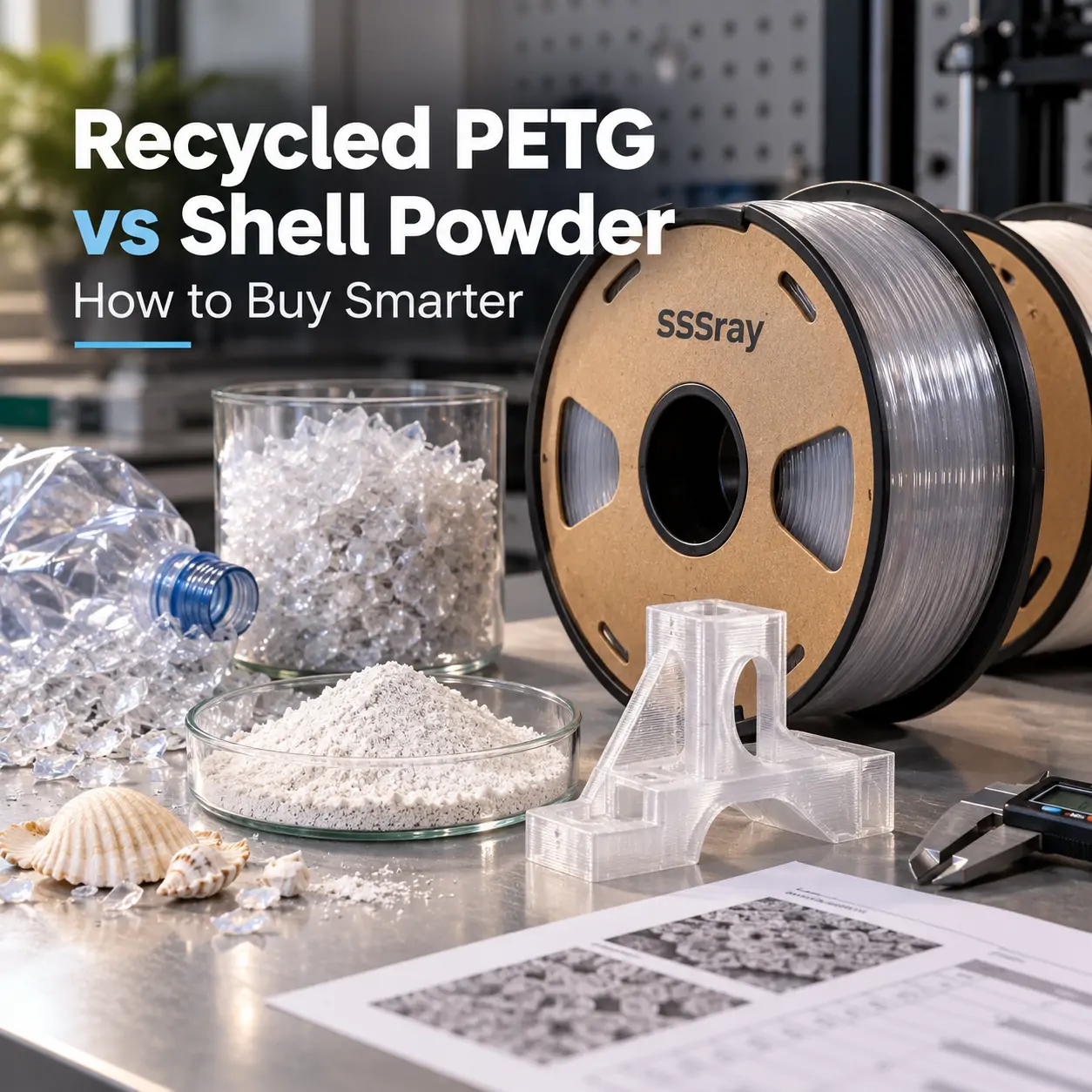
TL;DR: How to Buy Recycled PETG Without Paying for Shell Powder
For a recycled PETG purchase, separate three questions: is the base polymer really PETG, what supports the recycled-content claim, and does the approved grade perform consistently? A density or ash result can help screen composition; it cannot alone prove recycled origin or identify seashell as the source of calcium carbonate. Use this guide to connect the claim, chain-of-custody evidence, filler screen and print trial to the same order.
The specification most buyers never write is the one that catches shell powder: a ceiling on inorganic content, confirmed by TGA or ash testing with the test temperature stated, plus a density band tied to the approved sample. A tensile report will not do the job. In published work, 10 wt% powder additions made PETG test stronger in tension.
From suppliers, ask for scheme-matched evidence, not a logo: for GRS/RCS, the scope certificate plus the transaction certificate for the shipment; for UL 2809 or SCS Recycled Content, the validated or certified product, percentage and claim scope. One procurement warning: since 27 September 2026, specified generic environmental claims and sustainability labels that are not based on a qualifying certification scheme or public authority are prohibited in EU consumer-facing commercial practices; an unsubstantiated "recycled" or "eco" claim creates legal exposure for the reseller.
Best optionCertified post-industrial rPETG with a per-lot filler screen
Higher-risk useFor load-bearing or audited parts, qualify the recycled grade against a virgin baseline before release
Key specMax inorganic content (TGA, temperature stated) + density band
VerifyScope certificate + transaction certificate matching invoice weights
Abstract
Recycled filament has moved from a niche shelf into distributor catalogs and OEM starter kits. That growth created a pricing puzzle. Genuine recycled PETG carries sorting, cleaning, drying, and certification costs, so it rarely undercuts virgin resin by much. When a spool labeled "recycled" is priced well below virgin PLA, the difference has to come from somewhere.
One place it can come from is mineral filler. Ground seashell is mostly calcium carbonate. It is cheap, it adds weight to a product sold by the kilogram, it whitens mixed-color recyclate, and it even arrives with its own sustainability story. In a declared "shell composite," that is a legitimate product. Undeclared inside a spool sold as recycled PETG, it means the buyer pays polymer prices for powdered shell.
SSSray’s evidence review through 29 September 2026 found no public enforcement action or peer-reviewed study documenting shell powder being passed off as recycled PETG filament specifically. What is documented is the surrounding risk: recycled-content fraud in adjacent PET markets, research showing shell powder can raise PETG's tensile strength, and laboratory data showing that a routine FTIR scan can miss 10 wt% calcium carbonate in PET. That combination is why this guide treats shell powder as a risk to design controls around, not as rumor.
Buyers usually make four mistakes. They treat "recycled" as a quality grade, accept a certificate logo as proof of physical content, read a tensile report as a composition check, and assume one FTIR scan settles material identity. Each can fail.
This guide follows an evidence ladder: claim, document, chain of custody, laboratory screen, print trial, and lot control. We apply it through seven purchasing gates (application, performance, printability, compliance, supplier reliability, landed cost, and reorder stability). Then we translate the chemistry into purchase-order language that a distributor, OEM brand, print farm, or engineering buyer can actually enforce.
Key Takeaways
- Recycled vs virgin PETG is not a quality ranking. Good post-industrial rPETG sits close to virgin; the risk is unverified feedstock and additives.
- A tensile report cannot rule out shell powder. In a 2024 study, 10 wt% powder additions raised PETG tensile strength.
- Screen with four tests, not one: density, TGA or ash (temperature stated), FTIR on the residue, and XRF or a cross-section.
- Mid-IR ATR FTIR alone is weak here; 10% calcium carbonate in PET was not easily discerned in Thermo Fisher work.
- Filler shortens every kilogram. At 20 wt% calcium carbonate, 1.75 mm PETG gives about 293 m/kg instead of 327 m/kg (SSSray calculation).
- A 10% discount on a 20%-filled spool costs slightly more per meter than the genuine product.
- Recycled-content certification does not prove filler-free purity. GRS/RCS track certified recycled material through their system, UL 2809 validates recycled-content claims, and SCS certifies recycled content using permitted chain-of-custody models; none makes a lot-level filler screen unnecessary.
- ISCC PLUS mass balance is an accounting claim; the spool may not physically contain the certified recycled material.
- Post-consumer PETG claims deserve extra scrutiny. The rPETG product disclosures in SSSray’s current market review state post-industrial feedstock.
- Since 27 September 2026, the EU prohibits specified generic environmental claims and sustainability labels that are not based on a qualifying certification scheme or public authority in consumer-facing commercial practices.

He Jiang
Senior Researcher
SSSray · 3D Printing Filament Manufacturing · Jinhua, Zhejiang
He Jiang is a senior researcher at SSSray, a 3D printing filament manufacturer in Jinhua, Zhejiang, China. He focuses on EU regulatory shifts that affect filament brands exporting into Europe, including REACH SVHC disclosure, the universal PFAS restriction, and PPWR packaging compliance. His work for SSSray translates supplier SDS documentation, ECHA publications, EUR-Lex regulatory texts, and material-testing evidence into practical sourcing requirements for B2B filament buyers.
Why Shell Powder Is Showing Up in "Recycled" PETG Filament
Direct answer: ground shell is a calcium carbonate filler that costs far less than copolyester resin, adds weight to a product sold by the kilogram, evens out mixed-color recyclate, and slips past the tests most buyers request. Every percent of undeclared filler is a percent of polymer you paid for and did not receive.
Think of watered milk: the carton looks the same, and only a solids test tells you. Filament works the same way, except the "water" is heavier than the product.
What is documented, and what is not
Recycled-content fraud is documented in neighboring PET markets. A September 2025 RECOUP study of UK packaging manufacturers found that weak verification lets cheaper virgin plastic pass as "recycled". UL Solutions cites an estimate that over half of the rPET sold in textiles is actually virgin polyester.
Now the gap. We found no public enforcement case that names shell powder in recycled PETG filament. So this guide does not call it a proven scandal; it treats it as a credible, testable risk and gives you the controls to rule it in or out.
Why shell powder is the "convenient" adulterant
- Almost pure mineral: one study measured shell powder at over 95 wt% calcium carbonate.
- Adds density: 20 wt% lifts PETG from about 1.27 to 1.42 g/cm³ (our calculation), so each kilogram holds less polymer.
- Hides color drift in gray or beige mixed recyclate.
- Can stiffen parts, so some test numbers improve.
- Comes with a story: "upcycled seashells" makes a double green claim easy to write.
Declared shell composites are legitimate; undeclared filler inside a "100% recycled" claim is not.
Why 2026 raises the stakes for buyers
Two EU rulebooks landed this year. The Empowering Consumers Directive (EU) 2024/825 has applied since 27 September 2026. The Packaging and Packaging Waste Regulation has applied since 12 August 2026, with the recycled-content verification method scheduled for 31 December 2026.
In short, brands will buy more recycled-labeled material and carry more liability for the claims printed on it.
Procurement implicationPut composition limits in the PO, not just "recycled PETG."
Mistake to avoidReading a low price as cheap recycling.
How to verifySigned formulation statement listing additives above 1 wt%.
Virgin vs Recycled PETG: What the Strength Data Really Shows
Direct answer: properly processed recycled PETG usually gives up a modest amount of strength and gains variability. In one controlled study, 100% recycled PETG averaged about 13 MPa lower tensile strength than a commercial virgin filament, while a 50/50 blend matched it. Bottle-derived recycled PET fell further: 30 MPa versus 45 MPa for virgin PET.
The table normalizes each published comparison to its own corresponding virgin control. The rows come from different studies, polymers and properties, so use them to compare direction within each row, not to rank one row against another.
On mobile, swipe horizontally to see every column.
| Material compared | Property | Reported result | Ratio vs corresponding virgin control | Source |
|---|---|---|---|---|
| Virgin reference | Any | Baseline | — | |
| Recycled PET from water bottles vs virgin PET | Tensile, optimized settings | 30 vs 45 MPa | Ben Amor et al., 2025 | |
| 100% recycled PLA vs virgin PLA filament | Tensile | About 43 vs 50 MPa | Comparative PLA study, 2024 | |
| PETG + 10 wt% seashell powder | Flexural | +4% vs virgin PETG | Castanon-Jano et al., 2024 | |
| PETG + 20 wt% seashell powder | Flexural | −23% vs virgin PETG | Castanon-Jano et al., 2024 | |
| PLA + 20 wt% seashell powder | Tensile | −35% vs virgin PLA | Castanon-Jano et al., 2024 |
Bar widths use a 0–110% visual scale. Each 100% baseline belongs only to its own study and property.
Two lessons stand out. Recycling can cost strength depending on feedstock and processing, and a modest shell loading can make PETG look better on one test while a heavier loading hurts it.
PET is not PETG, so "rPET filament" behaves differently
Bottle PET is semi-crystalline; PETG is an amorphous copolyester. That changes shrinkage, clarity, and print windows. The rPET study above linked its strength gap mainly to crystallinity loss during reprocessing. A bottle-derived recycling stream therefore starts as PET; if a supplier markets the finished filament as PETG, require the material route and formulation to show how the final copolyester grade is produced rather than assuming the bottle feedstock itself was PETG.
Why a tensile certificate can hide shell powder
In the 2024 Castanon-Jano study, 10 wt% of any tested powder raised PETG tensile strength, by up to 48% for the best additive; shell ranked second. At 20 wt%, flexural strength with shell fell 23% below virgin, with more voids.
That is the procurement trap. A tensile report can beat virgin PETG while the spool holds 10% mineral. Strength describes performance, not composition.
What to specify instead
- Tensile strength and elongation per ISO 527, at least five specimens per condition.
- Notched impact, since mineral fillers usually cost toughness first.
- Orientation, nozzle, temperature, and drying state for each specimen.
- A coefficient-of-variation limit, because recycled lots scatter more.
- A composition check on the same lot.
To make the comparison fair, run a control spool beside the candidate on the same printer and profile. For example, a virgin baseline from SSSray custom PETG filament printed next to the recycled sample removes machine and slicer noise from the result.
Procurement implicationAccept only printed-specimen data from your lot.
Mistake to avoidApproving on average strength alone.
How to verifyCandidate vs virgin control under ISO 527.
RelatedFilament test protocol
Shell Powder Filler Detection: The Four-Test Screen for Recycled PETG
Direct answer: combine density, TGA or ash with the temperature stated, FTIR on the burn-off residue, and a quick XRF or cross-section check. Each test has a blind spot; together they close the gaps.
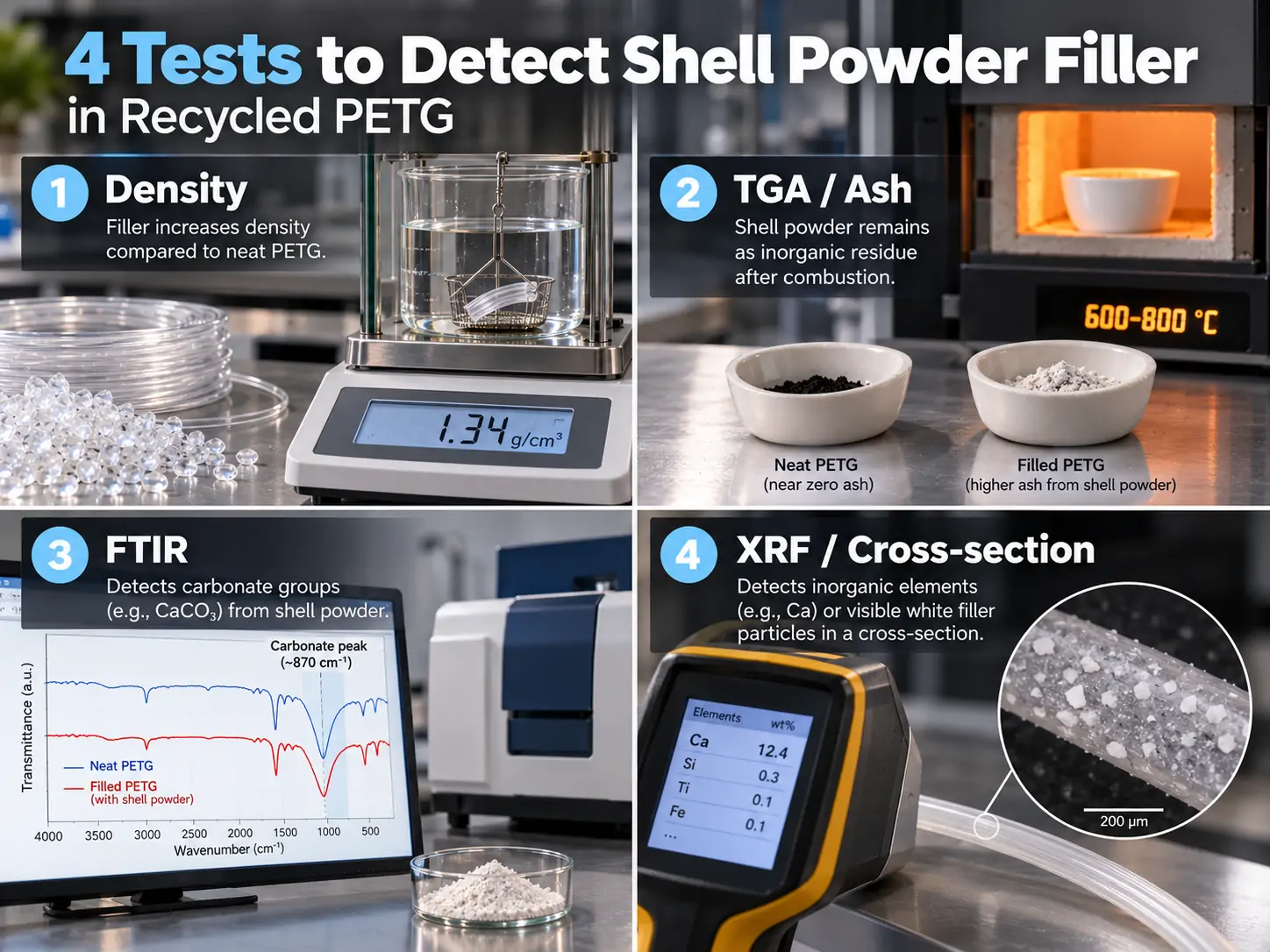
Test 1: Density, a fast first screen with one catch
Calcite (about 2.71 g/cm³) is roughly twice as dense as PETG, so each 1 wt% of filler adds about 0.007 g/cm³ at low loadings. The chart shows what that does to length per kilogram.
On mobile, swipe horizontally to see every column.
| CaCO₃ content (wt%) | Filler share by volume | Calculated density (g/cm³) | Length per kg, 1.75 mm (m) | Length lost vs unfilled |
|---|---|---|---|---|
| 0% | 0% | 1.270 | 327.4 | — |
| 5% | 2.4% | 1.305 | 318.7 | 2.7% |
| 10% | 4.9% | 1.341 | 310.0 | 5.3% |
| 15% | 7.6% | 1.380 | 301.3 | 8.0% |
| 20% | 10.5% | 1.421 | 292.6 | 10.6% |
| 30% | 16.7% | 1.511 | 275.2 | 15.9% |
Assumptions: PETG 1.27 g/cm³, calcite 2.71 g/cm³, 1.75 mm, no voids. Shell aragonite is slightly denser, raising density a little further.
Now the catch. In the Castanon-Jano study, PETG with 20 wt% shell powder did not come out denser than virgin, most likely because of voids. Porosity can cancel the signal, so a "normal" density never clears a spool on its own. Use ISO 1183-1 immersion density on specimens from the start, middle, and end of several spools.
Test 2: TGA or ash, with the temperature written down
TGA is the most direct quantitative check. Calcium carbonate breaks down into calcium oxide and CO₂ roughly between 600 and 850 °C, and the CO₂ is 44% of its mass. PETG decomposes much earlier (from about 357 °C in the cited study), so the steps stay separate.
That gives a simple estimate: CaCO₃ ≈ mass loss in the 600–850 °C step ÷ 0.44. An 8.8% step points to roughly 20 wt% carbonate. TGA also separates filler from pigment, because titanium dioxide stays as residue with no CO₂ step.
Ash tests (ISO 3451; Part 2 covers PET-type polyesters) work too, but temperature matters. Above the breakdown range the residue is calcium oxide, only 56% of the original carbonate mass. Ask the lab to state the temperature and whether results are reported as carbonate or oxide.
Test 3: FTIR for filament composition, useful but not alone
FTIR identifies the polymer well but struggles to spot calcium carbonate inside PET-family polymers. In a Thermo Fisher application study, carbonate peaks near 1838, 870, and 712 cm⁻¹ were masked by PET bands in mid-IR ATR spectra, and 10% carbonate was not easily discerned. In the far-IR range, a carbonate band near 281 cm⁻¹ showed clearly.
PET's ring band near 1410 cm⁻¹ also overlaps the broad carbonate absorption. The practical fix: burn off the polymer around 550 °C, below carbonate breakdown, and run FTIR on the residue. Without polymer bands in the way, peaks near 1420, 875, and 712 cm⁻¹ become obvious.
Test 4: Fast incoming checks with XRF, microscope, or acid
- Handheld XRF flags calcium in seconds; a receiving screen, not a quantity.
- Cross-section microscopy at 50–200× shows mineral particles and voids; SEM-EDS confirms calcium.
- Acid test: dilute hydrochloric acid on the low-temperature residue fizzes if carbonate is present (lab use only).
On mobile, swipe horizontally to see every column.
| Method | What it tells you | Catches CaCO₃ filler? | Main blind spot | Best use |
|---|---|---|---|---|
| Density (ISO 1183-1) | Mass per volume | Often | Voids can offset filler | Every lot, fast screen |
| TGA (ISO 11358-1) | Mass-loss steps and residue | Yes, quantitative | Needs a qualified lab | Approval and disputes |
| Ash (ISO 3451) | Total inorganic residue | Yes, if temperature is stated | Carbonate vs oxide confusion | Contract limit check |
| ATR-FTIR, mid-IR | Polymer identity | Unreliable at 10% | PET bands mask carbonate | Confirm PETG vs PET |
| FTIR on residue, or far-IR | Mineral identity | Yes | Extra sample preparation | Confirm what the residue is |
| Handheld XRF | Elements present | Flags calcium | Surface-weighted, semi-quantitative | Receiving inspection |
| Microscopy / SEM-EDS | Particles and voids | Yes | Slow, small sample | Root-cause work |
| Tensile test (ISO 527) | Mechanical performance | No | Filler can raise strength | Performance, not identity |
Procurement implicationName method, temperature, and sample count in the PO.
Mistake to avoidTreating "FTIR matches PETG" as filler-free.
How to verifyIndependent lab test of a retained lot sample.
RelatedBatch QC data
Can Shell Powder Filler Clog Nozzles or Harm Printers Long Term?
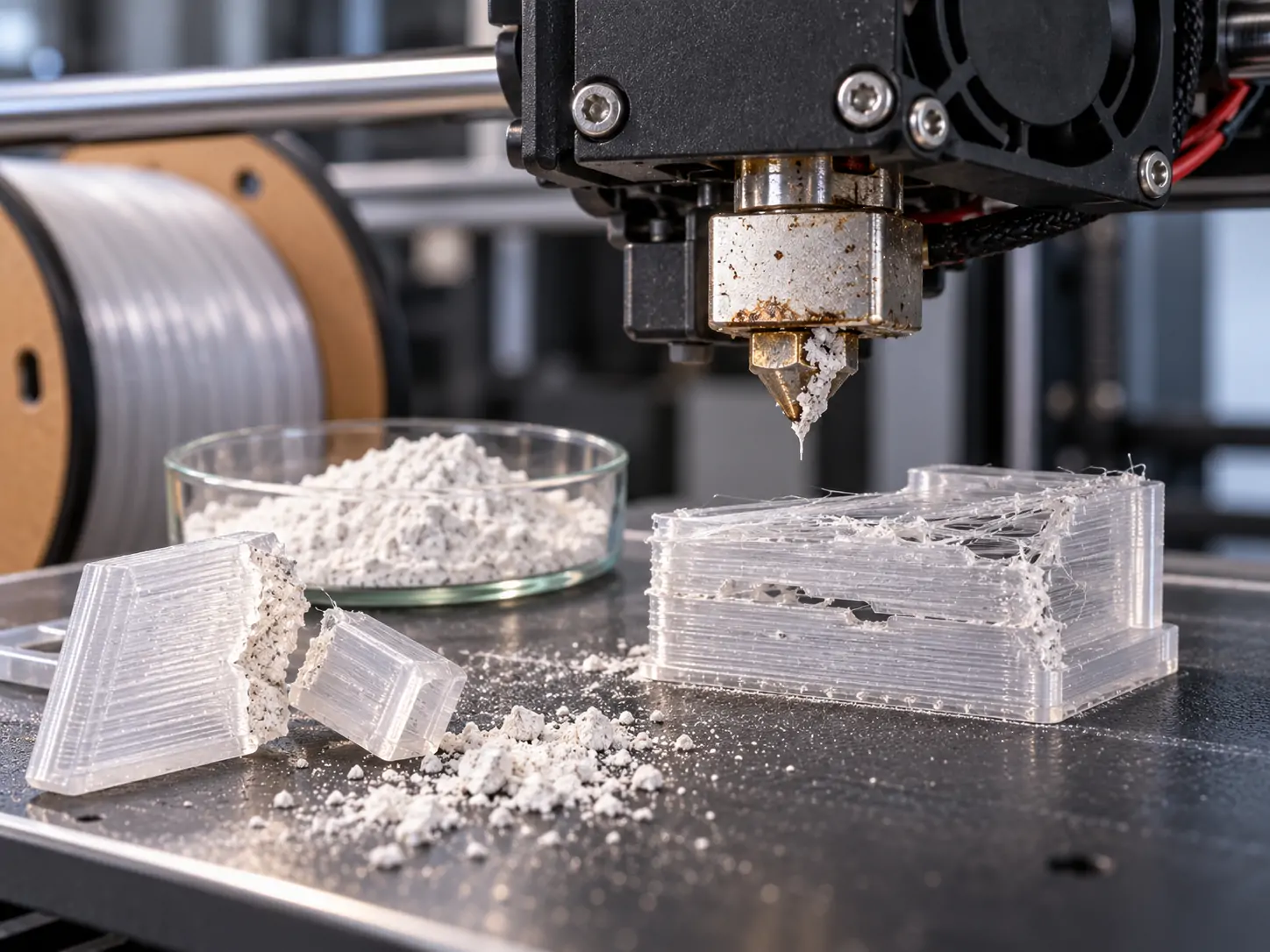
Direct answer: clogging is the likelier problem, especially at 0.4 mm and below. Pure calcium carbonate is soft next to glass fiber, so fast wear is less certain, but poorly refined grit can carry harder debris, and undried powder brings moisture into the melt.
Why partial clogs happen
Particle size relative to the bore is what counts. The 2024 study sieved powders to under 0.09 and 0.18 mm; one 0.18 mm particle is 45% of a 0.4 mm bore, and particles cluster.
As a working rule, SSSray treats any particle or cluster above about one-fifth of the bore as a bridging risk; that is a rule of thumb, not a published limit. On a print farm, the symptom is intermittent under-extrusion that looks like a slicer problem.
How abrasive shell powder really is
Calcite sits near 3 on the Mohs scale, while glass fiber is commonly placed at 5–7, so refined carbonate is far gentler. The uncertainty is the grit itself: crushed mixed shells can carry sand or other debris unless washed and classified. With no published wear data for undeclared shell filler in PETG, treat it as potentially abrasive until tested.
Moisture, hydrolysis, and brittle parts
Shells contain an organic matrix and fine pores, so untreated powder holds moisture. PET-family polyesters react with water at melt temperature, which shortens chains and causes bubbles, stringing, and brittle parts. If a spool still pops after correct drying, send a sample for TGA.
- Print 1 kg continuously on a 0.4 mm brass nozzle and log every extrusion fault.
- Check the orifice with a pin gauge before and after the run.
- Compare against a virgin control spool on the same machine.
Procurement implicationAdd a continuous-print test to approval.
Mistake to avoidBlaming the slicer for intermittent under-extrusion.
How to verify1 kg print with pin-gauge checks.
RelatedWholesale PETG filament
Which Sustainable Filament Certifications Are Trustworthy for Recycled PETG?
Direct answer: use the evidence model that matches the scheme. GRS and RCS are Textile Exchange chain-of-custody standards with transaction certificates; UL 2809 is third-party validation of defined recycled-content claims; SCS Recycled Content is product/material certification that can use physical-segregation or mass-balance chain-of-custody models. ISCC PLUS mass balance is an accounting allocation, not proof that the certified recycled molecules are physically present in a specific spool. None of these routes proves a spool is free of undeclared filler.
The table compares the schemes most likely to appear on a filament quote. Read the last two columns closely.
On mobile, swipe horizontally to see every column.
| Scheme | What it verifies | Recycled material physically in your spool? | Shipment-level proof | Rules out undeclared filler? | What to ask for |
|---|---|---|---|---|---|
| GRS 5.0 (Textile Exchange) | Recycled content from 20% for certification, chain of custody, plus social, environmental, and chemical criteria | Tracked as certified claimed material through the certified chain | Transaction certificate | No | Scope certificate and the TC for your shipment; check claim/label rules separately |
| RCS 3.0 (Textile Exchange) | Recycled content from 5%, with chain-of-custody verification | Tracked as certified claimed material through the certified chain | Transaction certificate | No | Scope certificate, TC and the stated recycled percentage |
| UL 2809 validation | Validates pre-consumer, post-consumer or total recycled-content claims for a product | Validates the product claim and percentage | Product-specific validation | No | Validated product name, percentage and exact claim wording |
| SCS Recycled Content | Third-party recycled-content certification under SCS-103; physical segregation or mass balance may be used | Depends on the certified chain-of-custody model | Product/material certificate; transaction certificates are optional under SCS-103 | No | Certificate, product/material scope, percentage and chain-of-custody model |
| ISCC PLUS (mass balance) | Bookkeeping of certified inputs to outputs | Not guaranteed | Sustainability declaration | No | Allocation method and claim wording |
| ISO 14021 self-declared | Rules for how a claim is worded | Only if the data supports it | None by default | No | The calculation and any third-party check |
| OBP certification | Collection origin of ocean-bound plastic | Yes, if the chain holds | Program documents | No | Category, certificate, and feedstock trail |
Current standard versions as of 29 September 2026: GRS 5.0 and RCS 3.0, published and effective 1 July 2026. The revised Reclaimed Material Declaration Form becomes mandatory for GRS/RCS certifications on 31 December 2026; Textile Exchange's Materials Matter Standard becomes effective the same day and mandatory for eligible Tier 4 audits from 31 December 2027.
Notice the pattern: the filler column is "no" every time. Always pair recycled-content evidence with the lab screen above.
How to check that a recycled-content certificate is real
- The scope certificate names the company invoicing you.
- Site and product category cover filament or extruded plastics.
- It is valid on the shipment date.
- For GRS/RCS, a transaction certificate covers the certified shipment; for UL/SCS, verify the validated or certified product, percentage and claim scope.
- The issuing certification body has confirmed it.
Watch for a broken chain. Under GRS and RCS, the certified supply chain and transaction documents must cover the relevant certified stages and selling route. A pellet supplier's certificate does not automatically make filament from an uncertified extruder a certified GRS/RCS product.
Mass balance is honest accounting, but a different claim
Mass balance assigns certified recycled inputs to chosen outputs. ISCC's own explainer states that a finished good may not physically contain the certified material.
That is why a mass-balance recycled-content claim is not the same as saying the same percentage of molecules in one specific spool physically came from recycled feedstock. Keep the scheme's required mass-balance wording next to the recycled-content claim rather than presenting it as physically segregated content.
Procurement implicationRequire a transaction certificate per shipment.
Mistake to avoidTreating a logo as proof of composition.
How to verifyConfirm scope and validity with the certifier.
RelatedSupplier comparison tool
rPET Filament Authenticity and Post-Consumer PETG Verification
Direct answer: ask what the feedstock physically was, then ask for the paperwork that proves it. The rPETG product disclosures in SSSray’s current market review state post-industrial feedstock, such as manufacturing offcuts. A claim of post-consumer PETG, or "rPETG from bottles," needs both a documented collection trail and a material-route explanation for the final filament grade.
Bottle streams are mainly PET; clean PETG scrap is the simpler mechanical-recycling route
The beverage-bottle stream is overwhelmingly PET, while mechanically recycled PETG is more straightforward when the input is known PETG production scrap, offcuts or returned PETG parts. Filamentive, Spectrum, and Recycling Fabrik describe rPETG products based on industrial PETG waste. If a supplier calls bottle-derived feedstock "rPETG," ask for the material route and final resin identity, not only the collection story.
What lab tests can and cannot prove about recycled origin
Lab tests are good at proving what is in a spool, and weak at proving where the polymer came from.
- Isophthalic acid (IPA) testing works in textiles because bottle-grade PET usually contains a little IPA. Virgin bottle resin does too, so IPA signals bottle-grade origin, not recycling.
- Research methods can separate virgin from recycled PET. One study reached over 99% accuracy on 127 batches using volatile-compound fingerprints, but that is not a routine commercial test.
- UL Solutions finds chain-of-custody auditing more reliable than testing for recycled content.
So split the job: paperwork proves the recycled share, and the lab proves the absence of filler.
"Ocean plastic" filament: separating certified OBP from marketing
"Ocean plastic" and "ocean-bound plastic" are not the same thing. Under the Zero Plastic Oceans program, ocean-bound plastic covers mismanaged waste within 50 km of a coastline, plus shoreline, waterway, and fishing-gear categories. It is plastic intercepted before it reaches the sea.
The claim is unverified until you see the certificate and feedstock trail. And shell powder is not plastic, so it can never count toward a recycled-plastic percentage.
Procurement implicationGet feedstock type in writing on the quote.
Mistake to avoidAsking a lab to prove recycled origin.
How to verifyMatch certificates to a filler-free lab screen.
RelatedPrivate label filament
Greenwashing in 3D Printing Materials: What Changed on 27 September 2026
Direct answer: Directive (EU) 2024/825 now treats generic environmental claims without recognised excellent environmental performance, and sustainability labels not based on a certification scheme or public authority, as unfair commercial practices in EU consumer-facing commercial practices. Brands and distributors selling to consumers carry that exposure.
What EU consumer-facing claims must look like now
Member States had to transpose the directive by 27 March 2026, and it has applied since 27 September 2026. "Eco-friendly" or "green" can no longer stand alone where the Directive's generic-claim prohibition applies, and a self-designed sustainability badge needs to meet the certification-scheme or public-authority conditions. The separate Green Claims Directive proposal remains pending as of 29 September 2026; Directive (EU) 2024/825 is already in force and applicable.
Claims to retire, and claims you can defend
Retire now
- "Eco-friendly PETG"
- "Green filament"
- Self-made sustainability badges
- "Ocean plastic" with no OBP proof
- "100% recycled" with no certificate
Defensible wording
- Use the exact recycled-content percentage and claim wording permitted by the applicable certification scheme and the certified supply-chain scope.
- "Contains X% recycled content (mass balance)"
- "Spool made from X% recycled plastic"
- Claim scope limited to the part it covers
Outside the EU
In the US, the FTC Green Guides (16 CFR Part 260) expect recycled-content claims to be substantiated. For a multi-region sustainable sourcing audit, meet the strictest standard everywhere.
Procurement implicationSupplier owns the evidence for every claim it prints.
Mistake to avoidReprinting old eco-badges after 27 Sept 2026.
How to verifyMap each packaging claim to one document.
RelatedOEM/ODM filament
Supplier Claims vs Reality: Recycled Filament Red Flags
Marketing language is not dishonest by default, but each phrase below needs a matching document, sample, or test.
On mobile, swipe horizontally to see every column.
| Vague marketing claim | What it might hide | Document, sample, or test to request | What a documented supplier provides |
|---|---|---|---|
| "100% recycled PETG" | Virgin blending, filler, or PET feedstock presented without the final material route | Scheme-specific evidence (GRS/RCS: scope + TC), feedstock statement, and TGA on the lot | Certificate or validation details, feedstock type, material route, and a lot-linked filler result |
| "Eco / green / sustainable filament" | No measurable basis | The specific claim and its evidence | A quantified, certified statement, or none |
| "Ocean plastic filament" | Ordinary recyclate or uncertified sourcing | OBP certificate and feedstock trail | Category, certificate, and chain documents |
| "Enhanced with natural shell minerals" | High, variable filler loading | Declared filler percentage and particle size | Loading range with TGA method and tolerance |
| "Certified recycled" (logo only) | Expired, out-of-scope, or borrowed certificate | Certificate copy, confirmed with the certifier | A valid certificate in the invoicing company's name |
| "Same strength as virgin" | Filler-boosted tensile, low impact, high scatter | ISO 527 and impact data with n, orientation, and CV | Full reports for the grade, plus a virgin control |
| "Composition verified by FTIR" | Mid-IR ATR that can miss about 10% carbonate | TGA or ash, plus FTIR on the residue | Thermal plus spectral results with lab details |
| "Cheaper than virgin PLA, same quality" | Less polymer per kilogram | Density, meters per kg, and TGA | Price explained by feedstock and process |
The Real Cost: Why Some Recycled PETG Is Cheaper Than Virgin PLA
Direct answer: some low prices are legitimate, such as clean in-house scrap or mixed-color lots. Others come from filler that shortens every kilogram. Price per kilogram hides the difference, so compare cost per usable meter and cost per good part instead.
Two formulas worth putting in your sourcing sheet
Cost per usable meter = price per kg ÷ meters per kg
Cost per good part = (material used per part × price per kg) ÷ first-pass yield + downtime cost per part
A worked example with normalized index prices
Use 100 index units per kg as a normalized comparison, not as a market-price quote. At about 327 m/kg, 100 m costs about 30.5 index units. A spool with 20 wt% calcium carbonate yields about 293 m/kg under the calculation above.
- Priced 15% lower (85 per kg): 100 m costs about 29.1. The real saving shrinks from 15% to about 5%.
- Priced 10% lower (90 per kg): 100 m costs about 30.8. You now pay slightly more per meter than for the genuine spool.
- Per part: the same part geometry weighs about 12% more, because density rose from 1.27 to 1.42 g/cm³.
Failed prints and returns widen that gap.
Legitimate reasons for a low price
- Re-extruded clean, in-house production scrap.
- Mixed or random colors, which cut pigment and sorting cost.
- Lighter formats such as cardboard spools or refills.
Reasons that should trigger testing
- The price sits below virgin PLA with no explanation tied to feedstock.
- Density or meters per kilogram differ from the approved sample.
- The supplier declines to state the additive package.
Procurement implicationCompare meters per kg at approved density.
Mistake to avoidRanking suppliers on price per kg.
How to verifyWeigh a sample spool; compute cost per 100 m.
RelatedFilament supplier overview
The SSSray RC-7 Buyer Decision Framework for Recycled Filament
RC-7 means seven recycled-claim gates. Use it as the backbone of a sustainable sourcing audit; a candidate advances only when every gate passes.
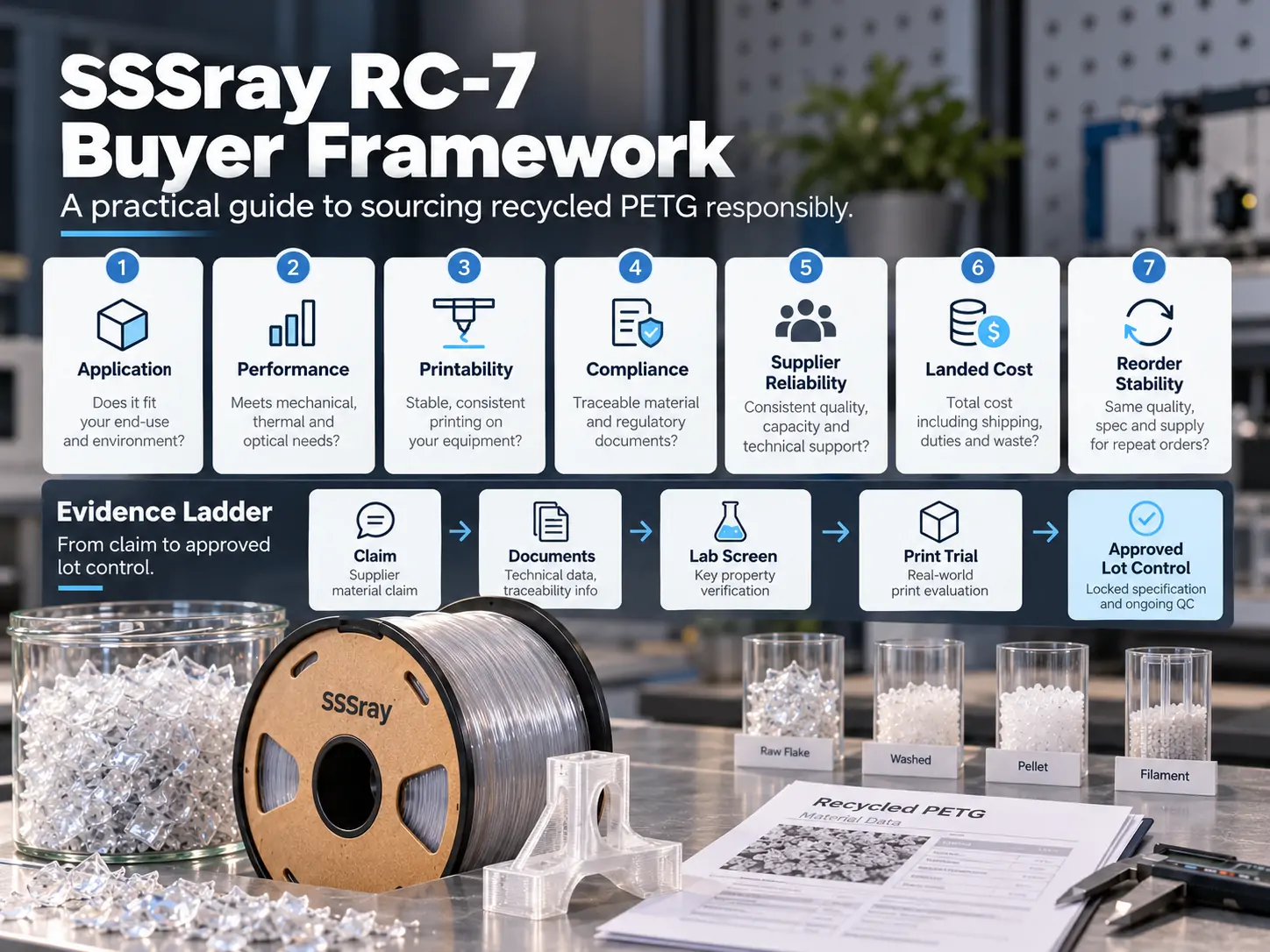
G1
Application requirement
Why it matters: a desk tidy and a machine guard need different evidence.
What to ask: What load, temperature, and exposure will the part see?
Pass / fail: Pass with a written use case; fail when the RFQ says only "recycled PETG."
Hidden risk: buying one grade for every application.
G2
Material performance
Why it matters: filler can raise tensile strength while cutting toughness.
What to ask: ISO 527 and impact data, with n, orientation, and CV?
Pass / fail: Pass beside a virgin control; fail on an average with no scatter.
Hidden risk: datasheet values from a different grade.
G3
Printability
Why it matters: partial clogs cost print-farm hours, not just plastic.
What to ask: Has this lot run 1 kg continuously on a 0.4 mm nozzle?
Pass / fail: Pass with zero feed faults; fail on bubbles after proper drying.
Hidden risk: particle clusters that appear only in some spools.
G4
Compliance and claims
Why it matters: unsupported EU consumer claims are now unfair practices.
What to ask: Scheme-specific evidence (GRS/RCS: scope + TC; UL/SCS: product claim scope), plus the TGA result for this lot?
Pass / fail: Pass when every printed claim maps to evidence; fail on logo-only proof.
Hidden risk: a certificate held by the pellet supplier, not the extruder.
G5
Supplier reliability
Why it matters: the sample is made once; the lots are made every month.
What to ask: Who extrudes it, and which tests run in-house versus at a lab?
Pass / fail: Pass with named methods and records; fail when the "factory" is a trader.
Hidden risk: undisclosed subcontracted extrusion.
G6
Landed cost
Why it matters: a cheaper kilogram can be a dearer meter.
What to ask: Meters per kg, plus freight, duty, and testing?
Pass / fail: Pass on cost per good part; fail on price per kg only.
Hidden risk: testing and returns left out of the model.
G7
Reorder stability
Why it matters: recycled feedstock varies more than virgin resin.
What to ask: Will you give notice before feedstock, additive, or site changes?
Pass / fail: Pass with a signed change clause and per-lot screen; fail on silence.
Hidden risk: a clean first order followed by filled reorders.
Result
How to use the gates
Score each gate pass, fail, or open. Any fail stops the order; any open item becomes a PO condition with a method and deadline.
Run them on a shared plan through our qualification program.
Main Comparison Table: Recycled vs Virgin PETG Sourcing Options
Each row is a sourcing route, not a brand; use the last three columns on supplier calls.
On mobile, swipe horizontally to see every column.
| Option | Best use case | Key spec | Advantage | Risk | How to verify | When to reject | SSSray sourcing note |
|---|---|---|---|---|---|---|---|
| Virgin PETG | Functional, load-bearing, or audited parts | Density near 1.27 g/cm³; low, pigment-dependent residue | Most consistent lot to lot | No recycled claim available | Grade identity, TDS, lot-linked QC | Grade identity cannot be traced | Useful as the control spool in any recycled trial |
| Post-industrial rPETG, certified | Retail lines with verified recycled claims | Certified recycled share plus inorganic limit | Credible, auditable feedstock | Color drift and more scatter | Scheme-specific recycled-content evidence; for GRS/RCS, scope + TC; plus TGA per lot | Evidence out of scope, or carbonate step outside the agreed limit | Quoted only with certificate or validation evidence for that grade |
| Post-consumer rPET (bottle-derived) | Non-critical parts with a circular story | Start qualification as PET unless the supplier documents how the final PETG/copolyester grade is produced | Genuine post-consumer origin | Crystallization, contamination and a different print window from PETG | Collection trail, DSC/material identity check, print trial | Sold as PETG with no documented material route, or no collection evidence | Qualify on its own material identity and print profile |
| Recycled-content PETG (mass balance) | Programs that accept attributed recycled content under an approved mass-balance scheme | Declared allocation method and percentage | Certified accounting without requiring physical segregation into each spool | Claim misread as physical content | ISCC PLUS declaration and scheme-compliant claim wording | Presented as physically segregated recycled content without evidence | Artwork must retain the required mass-balance wording |
| Declared shell or mineral-filled PETG | Decorative or stiffness-driven parts | Stated loading range, particle size, method | Honest composite with a design purpose | Lower toughness, clog risk | TGA against the declared range | Loading outside the declared range | Loading and method go into the OEM spec |
| "Recycled" PETG with no evidence | None for B2B resale | Unknown | Low price | Filler, virgin blending, claim liability | Full four-test screen | Supplier refuses documents or testing | We do not print unverified claims on private-label packaging |
If two routes look equal, choose the one with evidence for the lot you will receive, not just the sample.
Four B2B Scenarios: Recycled PETG Decisions in Practice
Distributor
Situation: adding a "recycled PETG" line for EU webshops.
Bad choice: the cheapest spool with an "eco" badge.
Consequence: an unsupported badge can breach EU claim rules; clog complaints drive returns.
Better choice: certified post-industrial rPETG with specific claim wording.
Verify: certificate check plus TGA on each inbound lot.
Next step: request sample spools.
OEM brand
Situation: a starter spool in the box of a new printer.
Bad choice: recycled material chosen on price, with a vague label.
Consequence: first-print failures get blamed on the printer.
Better choice: virgin PETG, or certified rPETG approved on the shipped hardware.
Verify: first-print success test on production units.
Next step: discuss OEM packaging.
Print farm
Situation: 200 printers, a sustainability target, and a tight margin.
Bad choice: switching every machine at once to the lowest-priced "rPETG."
Consequence: intermittent under-extrusion and lost machine hours.
Better choice: a 10-printer pilot against a virgin control.
Verify: fault log, pin-gauge checks, and cost per good part.
Next step: request a bulk PETG quote.
Engineering buyer
Situation: fixtures with a corporate recycled-content goal.
Bad choice: accepting a tensile report as proof of equivalence.
Consequence: brittle fixtures and a claim that fails audit.
Better choice: a mass-balance or certified grade, with impact testing.
Verify: ISO 527 plus impact in the critical orientation, plus TGA.
Next step: send the application requirement.
Sourcing Specs for Bulk Recycled PETG Orders
These items turn the screening logic into order terms. Confirm every starting reference against your approved sample.
On mobile, swipe horizontally to see every column.
| Spec item | What to define | Starting reference | Why it matters for filler risk |
|---|---|---|---|
| MOQ | Per color, per grade, and per certified claim | Confirmed per written quote | Uncertified top-up lots invite substitution |
| Lead time | Production plus testing and certificate issue | Add lab turnaround to the production time | Skipping tests to meet dates defeats the screen |
| Sample approval | Sample IDs, lot, and a retained reference | At least two spools, plus a virgin control | The retained sample settles disputes |
| Tolerance | Diameter, ovality, density band, inorganic ceiling | SSSray PETG family release target: 1.75 ±0.03 mm, max ovality ≤0.020 mm; set the recycled-content density band from the approved sample, such as ±0.015 g/cm³ | A ±0.015 g/cm³ density movement is roughly equivalent to about 2 wt% carbonate at low loading under the calculation above |
| Documentation | TDS, SDS, COA per lot, certificates, TC | COA should include TGA or ash with temperature | A generic COA cannot catch filler |
| Packaging | Pouch, desiccant, spool material, labels | Moisture barrier suited to PETG | Moisture can mimic filler symptoms |
| Private label | Every environmental claim and its evidence | Specific, quantified, certified wording only | The brand faces EU claim enforcement |
| Reorder control | Change notice for feedstock, additives, or site | Written notice before any change, then requalify | Substitution usually starts after a clean first lot |
SSSray PETG Factory Test Record and Recycled-Content Screening Controls
SSSray uses its published PETG factory QC and Internal Flow and Feeding Reference Series as the baseline control layer, then adds density, TGA and residue-identity checks when a recycled-content PETG program requires filler verification. The published PETG record below is traceable to our Batch QC Data and Bambu Lab B2B Procurement Guide.
Published SSSray test record: Internal Flow and Feeding Reference Series — Standard PETG, 1.75 mm class, published 31 August 2026. This is the factory PETG process/QC reference used to set qualification baselines; recycled-content lots add the filler-specific gates shown below.
On mobile, swipe horizontally to see every column.
| Check | Method and equipment | Key parameters | Inspection scope | SSSray release / qualification rule | Published record |
|---|---|---|---|---|---|
| Record identity | SSSray Internal Flow and Feeding Reference Series | Standard PETG, 1.75 mm class | Published factory process reference | Use with lot-specific COA/QC for the commercial order | Published 31 Aug 2026 |
| Diameter | Inline dual-axis / tri-axis laser micrometer | Continuous monitoring; SSSray publishes 500 scans/s on factory lines | Every spool, full extrusion length | 1.75 ±0.03 mm standard PETG family release target | ±0.03 mm |
| Ovality | Inline multi-axis laser measurement | Perpendicular-axis diameter comparison | Continuous production QC | PETG/PCTG max ovality ≤0.020 mm | ≤0.020 mm |
| Moisture | Karl Fischer moisture titration | Post-drying, before moisture-barrier packing | Batch QC before packing | PETG/PCTG moisture gate ≤0.025 wt% | ≤0.025 wt% |
| Color consistency | Spectrophotometer Delta E check | Approved master color reference | Production-lot color QC | PETG/PCTG ΔE <1.0 | ΔE <1.0 |
| MFR reference | Melt-flow reference series | 230 °C / 2.16 kg | Standard PETG internal reference | Compare only under the same MFR conditions | 6.2 g/10 min |
| Maximum flow reference | X1/H2D internal process reference | 230 °C nozzle setting in the published series | Printer/process reference | Requalify for another hotend, nozzle or PETG formulation | 11.8 mm³/s |
| Feeding reference | Internal flow and feeding series | Normalized by operating time | Published spool-hour reference | Compare only on the same metric and target hardware | 6.2 jams / 100 spool-hours |
| Density for recycled-content grade | ISO 1183-1 immersion with analytical balance and density kit | 23 °C; start, middle and end samples | Qualification lot | Set the band from the approved recycled-content sample; investigate material outside the signed band | Lot-specific result linked to the recycled grade COA |
| Inorganic content for recycled-content grade | TGA per ISO 11358-1 | 10 K/min; extend through the carbonate decomposition region and report the temperature program | Qualification lot and dispute check | No carbonate step above the signed formulation limit | Lot-specific result required for a filler-controlled recycled claim |
| Residue identity for recycled-content grade | ATR-FTIR on low-temperature residue; XRF / SEM-EDS when required | Identify carbonate/mineral residue after polymer removal under a controlled method | Triggered by inorganic residue or supplier declaration | Mineral identity must match the signed formulation | Recorded with the qualification lot when triggered |
Buyer use: request the exact Batch ID and lot COA for the shipment you buy. The published PETG reference fixes the factory baseline; the recycled-content density/TGA/FTIR record is tied to the actual recycled grade and lot rather than copied from another formulation.
Recycled PETG and Shell Powder Filler: Frequently Asked Questions
How can I tell if recycled PETG has shell powder filler?
Order a TGA test and look for a mass-loss step between roughly 600 and 850 °C, where calcium carbonate releases CO₂; dividing that step by 0.44 estimates carbonate content. Confirm with a density check against the approved sample and FTIR on the burn-off residue, where carbonate peaks near 1420, 875, and 712 cm⁻¹ stand out. A handheld XRF reading with strong calcium justifies further testing. Do not rely on appearance or tensile data, because filler can raise tensile strength.
What is the strength difference between rPET and virgin PETG?
The gap is usually modest for recycled PETG and larger for bottle PET. In one controlled study, 100% recycled PETG averaged about 13 MPa lower tensile strength than a commercial virgin filament, and a 50/50 blend matched it. Recycled bottle PET printed at 30 MPa versus 45 MPa for virgin PET, a gap linked to crystallinity loss. Remember that rPET and PETG are different polymers, and ask for tensile, elongation, and impact data with specimen count and variability.
Can shell powder filler cause nozzle clogging, and is it harmful long term?
Yes, it can cause partial clogs, and the risk rises as nozzles get smaller. Coarse particles and clusters can bridge a 0.4 mm bore; research powders sieved to 0.18 mm are already close to half that diameter. Long-term wear is less certain, since refined calcium carbonate is soft (about Mohs 3), but unwashed shell grit may carry harder debris. Moisture in the powder can also degrade PETG in the melt. Approve only after a 1 kg continuous print with pin-gauge checks.
Which recycled filament certifications are trustworthy?
Match the evidence to the scheme. GRS 5.0 and RCS 3.0 use Textile Exchange chain-of-custody controls and transaction certificates. UL 2809 validates defined recycled-content claims for a product. SCS Recycled Content certifies product or material recycled content and may use physical segregation or mass balance. ISCC PLUS mass balance is credible accounting, but it does not prove that the certified recycled molecules are physically present in a specific spool. Confirm the certificate or validation scope and remember that none of these schemes proves the absence of undeclared mineral filler.
How do I verify a supplier's recycled content claims?
Verify the paperwork and the material separately. Request the scope certificate in the invoicing company's name, a transaction certificate listing your shipment weights, and the feedstock type in writing, then confirm the certificate directly with the certification body. Next, run density and TGA on a retained sample from the same lot, plus FTIR on the residue if a carbonate step appears. Finally, write both checks into the purchase order so a failed result triggers a contractual remedy.
Why is some recycled PETG cheaper than virgin PLA?
Sometimes for good reasons, sometimes not. Legitimate savings come from re-extruding clean in-house scrap, selling mixed colors, or using lighter spool formats. Less legitimate savings come from mineral filler, off-spec regrind, or repeated reprocessing. Filler is the easiest to check: at 20 wt% calcium carbonate, a kilogram of 1.75 mm filament is about 10.6% shorter, so a 10% price cut can cost slightly more per meter. Compare cost per usable meter and per good part instead.
What quality standards should a bulk recycled filament contract include?
Include identity, composition, and consistency limits, each tied to a named method. Specify the polymer and feedstock type; the recycled share with certificate and transaction-certificate requirements; a maximum inorganic content by TGA or ash with the temperature stated; a density band under ISO 1183-1; diameter, ovality, and moisture limits; and a locked print test. Then add per-lot sampling, retained samples, a change-notice clause for feedstock or additives, and the right to independent testing.
Is "ocean plastic" filament a scam?
Not necessarily, but the claim is unverified until you see a certificate and a feedstock trail. Credible products usually mean ocean-bound plastic: mismanaged waste collected within 50 km of a coastline or near waterways, not plastic pulled from the open sea. The Zero Plastic Oceans program certifies that category. Red flags include no certificate, no stated recycled share, and stories about sea shells, which are not plastic at all. Since 27 September 2026, unsupported claims also carry EU legal risk.
Conclusion: Buy Recycled PETG on Evidence, Not on the Label
Write the PO around an approved formulation, the declared recycled-content scheme and scope, a defined composition screen and the accepted printed part. Retain lot references and agree which changes require a new review. For EU-facing label wording and packaging responsibilities, use our REACH, PFAS and PPWR order review. A legitimate declared shell composite and an undeclared filler in a different product are different purchasing propositions.
The decision logic is short. Scheme-specific documentation substantiates the recycled-content claim; the lab checks composition and whether the lot carries undeclared mineral filler. Price per kilogram means little until converted into cost per usable meter and per good part. And after 27 September 2026, any green claim printed on a spool or box must be provable.
Next step: take one recycled SKU you already buy and screen a retained sample with density, TGA (temperature stated), FTIR on the residue, and a 1 kg print beside a virgin control. Then compare suppliers on evidence, not adjectives.
You can also request the TDS, COA, and MSDS for your shortlist, compare suppliers side by side, ask about OEM packaging with defensible claim wording, or send your volumes for a bulk PETG quote. For the wider material landscape, see our 2026 guide to biodegradable and recycled filaments.
For regulated markets, SSSray maps the final packaging claim to the applicable market rule and the supporting document set before artwork release.
Request a quote or free samples
Tell us the material, color, spool size and monthly volume. An engineer replies within 24 hours on business days.
References
- Directive (EU) 2024/825 on empowering consumers for the green transition — official text.
- European Commission: PPWR (EU) 2025/40 implementation timeline — milestones incl. recycled-content method.
- RECOUP (2025): Incorrect and fraudulent claims of recycled content in plastic packaging
- UL Solutions: Recycled PET, know what's in your products
- ISCC System: Mass balance explained
- Castanon-Jano et al. (2024), Int J Adv Manuf Technol 133: seashell, glass, and metal powders in PLA and PETG filament
- Ben Amor et al. (2025): FFF of recycled PET from water bottles versus virgin PET
- SN Applied Sciences (2022): Influence of plastic recycling on PETG for additive manufacturing
- Thermo Fisher Scientific: Characterization of inorganic fillers in complex matrices
- Intertek: Global Recycled Standard and Recycled Claim Standard
- tide ocean material: What is ocean-bound plastic?
- U.S. FTC Green Guides, 16 CFR Part 260 (eCFR)
- Textile Exchange Standards Policy & Resource Updates — GRS 5.0 / RCS 3.0 effective 1 July 2026 and transition dates.
- European Commission: Green Claims — proposal status: pending.
- UL Solutions Environmental Claim Validation — UL 2809 recycled-content validation scope.
- SCS Global Services Recycled Content Certification — SCS-103 chain-of-custody and mass-balance approach.
