Online time
Monday to Friday: 9AM - 8PM
Weekend: 10AM - 5PM


TL;DR: Chinese-Origin 3D Filament Pays 44.0% Duty in October 2026
No new Section 301 rate on 3D printer filament took effect in October 2026. The real change came on July 24, 2026, when a 12.5% Section 301 forced-labor duty replaced the expired 10% Section 122 surcharge. Stacked on the 25% List 2 duty and the 6.5% general rate, the Section 301 tariff on 3D filament from China brings the total to 44.0% of entered value. October itself brings higher CBP fee limits, the third phase of CBP’s IEEPA refund process and a tariff-relief list that leaves filament out.
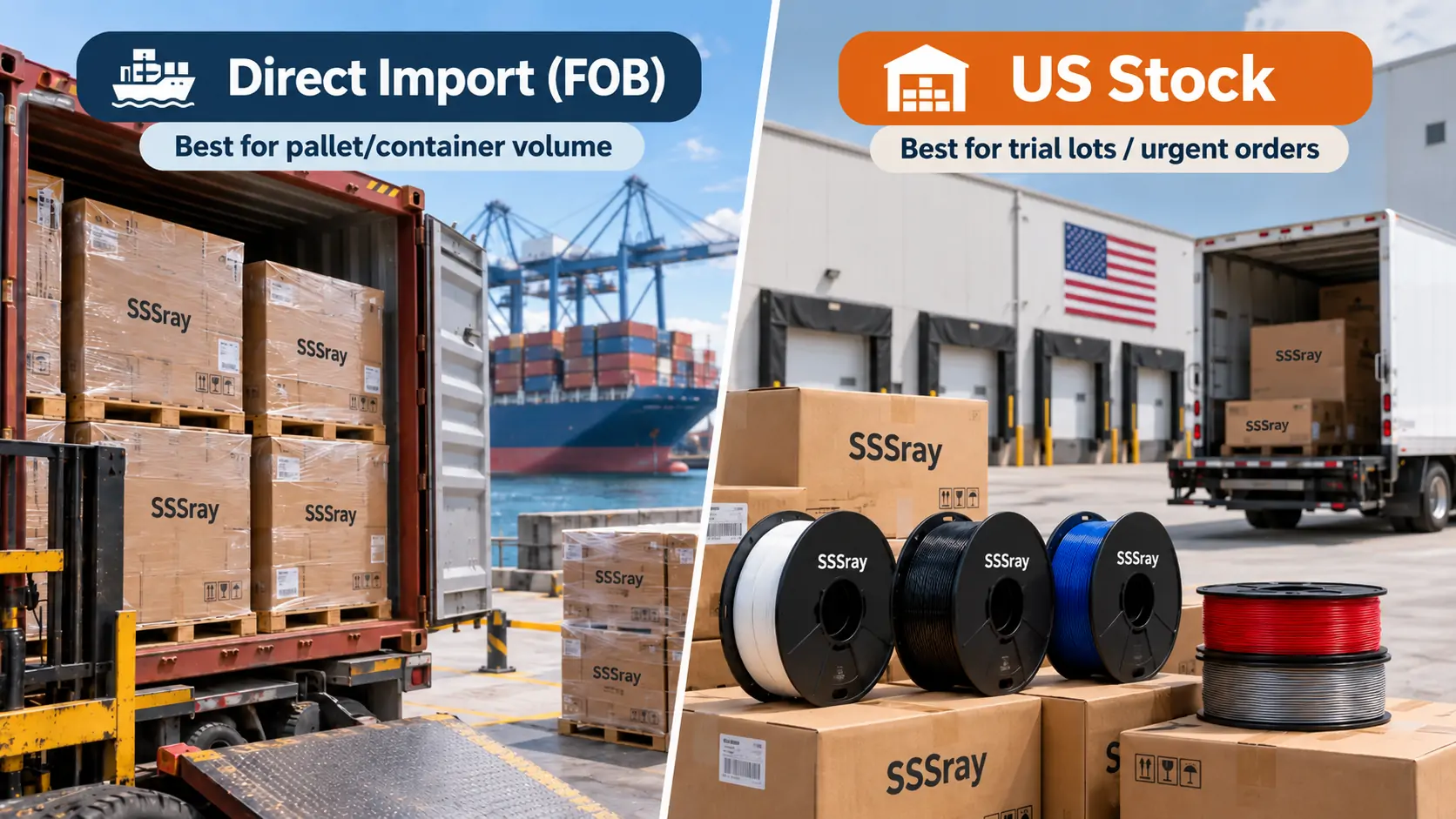
Best optionFor pallet and container volumes, import directly on FOB terms through a licensed customs broker, budget 44.0% duty, and claim 2025 IEEPA refunds and drawback on re-exports.
When not to use itFor trial quantities or two-week deadlines, US-held stock is usually simpler. Fixed entry costs and exam risk do not shrink with the order.
Key specificationHTS 3916.90.3000, quantity reported in meters, origin China, with Chapter 99 headings 9903.88.02 and 9903.05.31 on the entry.
Verify the supplierAsk for an invoice showing polymer, diameter, net kilograms and meters per spool, plus resin purchase records. “Made in Vietnam” needs proof of extrusion there.
Procurement warningRouting Chinese-made spools through a third country does not change origin. Section 301 follows where the filament was made, not where it shipped from.
Abstract
US importers of 3D printing filament have lived through four tariff regimes in under two years. Emergency (IEEPA) tariffs pushed the bill on Chinese filament as high as 176.5% in April 2025, the Supreme Court struck those tariffs down in February 2026, a temporary Section 122 surcharge filled the gap, and a new Section 301 action replaced it in July 2026.
As a result, many purchasing teams are working from numbers that are simply out of date. Search results still quote “145%”, “25%” or “tariffs were cancelled”, sometimes on the same page.
Four misunderstandings come up again and again. First, that October 2026 introduced a new Section 301 rate for filament; it did not. Second, that the Supreme Court ruling removed the China tariffs; it removed only the IEEPA layer. Third, that US duty is charged on the freight-inclusive price; it is generally charged on the price paid for the goods, with international freight and insurance excluded when they are itemized. Fourth, that paying the new “forced-labor duty” clears a shipment under the Uyghur Forced Labor Prevention Act (UFLPA); the two are separate rules.
The B2B decision logic is straightforward once the facts are straight. A filament purchase is only as good as its cost per usable kilogram, delivered and cleared. That cost is driven by four things a buyer can check before paying a deposit: classification, origin, declared value and paperwork. A cheap spool with a weak invoice is a risk, not a saving.
This guide, written from SSSray’s position as a filament manufacturer in Jinhua, Zhejiang, uses six tools. They are a dated status check of what changed and what did not; the duty stack for HTS 3916.90.30 with its legal sources; a landed-cost model you can rebuild in a spreadsheet; a comparison of mitigation options, from duty drawback to foreign-trade zones; the Tariff-Ready Sourcing Framework, a seven-checkpoint scorecard for approving a supplier and a reorder; and a measured SSSray lot record that ties net weight and diameter to the meters declared on the invoice.
All rates behind the Section 301 tariff on 3D filament were checked against the Harmonized Tariff Schedule (2026 Revision 20, September 28, 2026) and Federal Register notices on October 4, 2026. Trade policy moves fast, so confirm every entry with a licensed customs broker.
Key Takeaways
- The October 2026 total is 44.0%. Chinese-origin filament under HTS 3916.90.30 pays 6.5% general duty, 25% Section 301 (List 2) and 12.5% Section 301 forced-labor duty.
- October changed fees, not the rate. From October 1, 2026 the Merchandise Processing Fee (MPF) minimum is $34.58 and the maximum $670.86; the 0.3464% rate is unchanged.
- Filament is not on the relief list. The 77 HTS lines published on September 27, 2026 for possible reduced tariffs cover consumer goods such as toys and small appliances, not plastic monofilament.
- In the Table 3 ocean-entry example, every $1.00 of entered customs value becomes about $1.44. The 44.0% duty plus MPF and HMF add about 44.5% before freight, brokerage and delivery, provided the MPF remains within its minimum and maximum limits.
- Duty is assessed on customs value, not automatically on the FOB price. International freight and insurance are generally excluded when separately identified and supported; applicable additions such as assists, certain royalties, selling commissions, packing costs and certain proceeds may have to be included.
- The HTS reports this product in meters. A 1 kg spool of 1.75 mm PLA holds about 335 m, and our measured lot averaged 335.7 m. Your invoice should state both kilograms and meters.
- Transshipment is not a strategy. Routing, repacking, relabeling or rewinding Chinese-made filament through a third country does not change origin. A third-country process must result in a substantial transformation under CBP’s case-by-case test before origin can change, and a false origin claim exposes the importer to penalties.
- The forced-labor duty and UFLPA are different. One is a tax on almost all Chinese goods; the other can detain a shipment until the supply chain is documented.
- Some money is recoverable. IEEPA duties paid between February 2025 and February 2026 are being refunded through CBP’s CAPE process, and Section 301 duties qualify for drawback when goods are exported.
- Plan for movement in 2027. A court challenge to the 12.5% layer, a second four-year review of the China tariffs and an excess-capacity investigation are all open.

He Jiang
Senior Researcher
SSSray · 3D Printing Filament Manufacturing · Jinhua, Zhejiang
He Jiang is a senior researcher at SSSray, a 3D printing filament manufacturer in Jinhua, Zhejiang, China. He works with SSSray’s export documentation, lot-QC records and B2B sourcing data, focusing on US customs classification, Section 301 duty changes, landed-cost modeling and the document sets used for distributor and OEM orders. His SSSray research cross-checks factory records with CBP, USTR and USITC sources so buyers can trace key claims back to the current rule or the named SSSray test record.
Guide scope: US customs classification, Section 301 duty stacking, landed-cost modeling and import documents for 3D printing filament, written from SSSray’s export documentation and lot QC records and checked against USTR, CBP and USITC sources.
1. USA–China Tariff 2026 Update: What Changed for Filament Importers by October
Direct answer: the Section 301 tariff on 3D filament from China did not move in October 2026. The total duty moved on July 24, 2026, from 41.5% to 44.0%. October adds a small CBP fee adjustment, a new refund phase and a relief list that does not include filament.
That matters for purchasing, because a buyer waiting for “the October change” to re-quote is waiting for something that already happened.
A dated status check
Table 1 lists the events that affect a filament purchase order, in order. Read the third column first; it tells you whether the event touches your product at all.
On mobile, swipe horizontally to review every column.
| Date | What happened | Effect on HTS 3916.90.30 from China | Buyer action |
|---|---|---|---|
| Feb 20–24, 2026 | Supreme Court voided the IEEPA tariffs; collection ended February 24 | The 20% IEEPA layer disappeared | Review 2025 and early-2026 entries for refunds |
| Feb 24 – Jul 23, 2026 | Temporary Section 122 surcharge of 10% | Total of 41.5% during this window | Legacy entries only |
| Jul 24, 2026 | Section 301 forced-labor duty: 12.5% on products of China (heading 9903.05.31) | Total rises to 44.0% | Re-price open purchase orders |
| Sep 23, 2026 | US–China truce extension announced: November 10, 2026 moves to January 10, 2027 | No rate change for filament | Watch for the USTR notice |
| Sep 27, 2026 | “30-for-30” list: 77 HTS lines recommended for reduced tariffs | Filament is not listed | Do not budget for relief |
| Sep 30, 2026 | Court of International Trade heard arguments against the Section 301 forced-labor duties | The 12.5% layer stays in force unless a court orders otherwise | Keep duty paid and liquidation date for every entry |
| Oct 1, 2026 | CBP FY2027 user fees: MPF minimum $34.58, maximum $670.86; 0.3464% rate unchanged | A few dollars per entry | Update landed-cost sheets |
| Oct 6, 2026 | CBP is scheduled to open Phase 3 of its IEEPA refund process (CAPE) for finally liquidated entries under a court reliquidation order | Refund route for IEEPA duties paid in 2025 and early 2026 | Ask your broker which CAPE phase covers each entry |
| Nov 9, 2026 | 178 Section 301 product exclusions scheduled to expire unless USTR extends them | None is known to cover filament | Confirm against the notice text |
Two items deserve a closer look. First, the US “30-for-30” import list contains only three Chapter 39 lines, covering plastic tableware and beads. It does include retail-packed fishing line (9507.90.20), another monofilament. However, that is a different product under a different heading, so it offers no route for 3D printing filament.
Second, the refund process is real money, but the route depends on the status of each entry. CBP’s Consolidated Administration and Processing of Entries (CAPE) tool has opened in phases. Phase 1, from April 20, 2026, covers unliquidated entries and entries within 80 days of liquidation. Phase 2, from June 29, covers entries flagged for reconciliation. Phase 3, scheduled to open on October 6, covers finally liquidated entries, and only for importers that hold a Court of International Trade reliquidation order and gave CBP a valid importer of record number by July 30, 2026.
According to a C.H. Robinson trade update, CBP has certified about $122 billion in IEEPA refunds and interest. An importer who brought in Chinese filament during 2025 paid between 10% and 145% in IEEPA duties on top of everything else, so one broker report by entry is worth the request.
What is still open after October
- Second four-year review. USTR opened it on May 6, 2026. Filament sits on List 2, one of the two original actions under review, so the 25% layer is formally in play. The windows for continuation requests closed on July 5 and August 22, 2026, and no second-phase notice had been published when we checked.
- Excess-capacity investigation. USTR opened Section 301 investigations into structural excess capacity in China and 15 other economies on March 11, 2026. Vietnam, Malaysia, Taiwan and Japan are among them. No determination had been published when we checked.
- Court challenges. Twenty-five states and several importers are challenging the 12.5% forced-labor duties at the Court of International Trade, which heard arguments on September 30, 2026. Separately, the same court ruled the 10% Section 122 surcharge unlawful on May 7, 2026; the Federal Circuit stayed that ruling on June 11, and the appeal is pending. Both duties were collected on filament. In the IEEPA refunds, finally liquidated entries are covered only for importers that went to court, so ask your broker or customs counsel now how to preserve refund rights on these entries.
Procurement implicationQuote validity and price-adjustment clauses should reference the duty rate in force on the entry date, not the order date.
Mistake to avoidBudgeting from a 2025 article. Rates of 25%, 55% and 145% were each correct once, and each is now wrong.
How to verifyLook up 3916.90.30 in the current HTS revision and ask your broker for the Chapter 99 lines and liquidation date on a recent entry summary.
2. HTS Code 3916.90 Duty Rate: How the Section 301 Tariff on 3D Filament Reaches 44.0%
Direct answer: CBP classifies spooled 3D printer filament as plastic monofilament under HTS 3916.90.3000. The general duty rate is 6.5%. The Section 301 tariff on 3D filament from China has two layers on top of that: 25% (List 2) and 12.5% (forced labor). The total is 44.0% ad valorem, meaning 44.0% of the entered value.
Why filament is “monofilament”, not a printer part
Heading 3916 covers plastic monofilament with a cross-section above 1 mm. Both common diameters, 1.75 mm and 2.85 mm, clear that line. Thinner strands are classified elsewhere, mostly in the textile chapters.
CBP has ruled on this directly. In ruling NY N296007 (April 30, 2018), ABS and PLA filaments from China, 1.75 mm or 3 mm in diameter on 1 kg or 2.2 kg spools, were classified in 3916.90.3000 at 6.5%. In an earlier ruling, NY N266336 (July 23, 2015), an importer argued that a nylon filament spool cartridge from Taiwan was a printer part under heading 8443. CBP disagreed and classified it by the filament.
Think of it like buying copper wire for a motor. Customs taxes the wire as wire, whatever machine it later feeds.
Two practical details follow. The subheading’s unit of quantity is meters, so the entry needs a length, not only a weight. Also, 3916.10 (polymers of ethylene) and 3916.20 (PVC) carry 5.8%, but those polymers are rare in desktop filament. Filled grades, such as carbon-fiber or glass-fiber nylon, should be confirmed with your broker; a binding ruling request is the safe route for unusual composites.
The three layers behind 44.0%
On mobile, swipe horizontally to review every column.
| Layer | HTS heading reported | Rate | In force since | Duty on $10,000 entered value |
|---|---|---|---|---|
| General (Column 1) duty | 3916.90.3000 | 6.5% | Standing rate | $650.00 |
| Section 301, List 2 | 9903.88.02 | 25% | Aug 23, 2018 | $2,500.00 |
| Section 301, forced-labor action | 9903.05.31 | 12.5% | Jul 24, 2026 | $1,250.00 |
| Total ad valorem duty | — | 44.0% | — | $4,400.00 |
| CBP fees (ocean entry) | MPF 0.3464% + HMF 0.125% | 0.4714% | MPF limits updated Oct 1, 2026 | $47.14 |
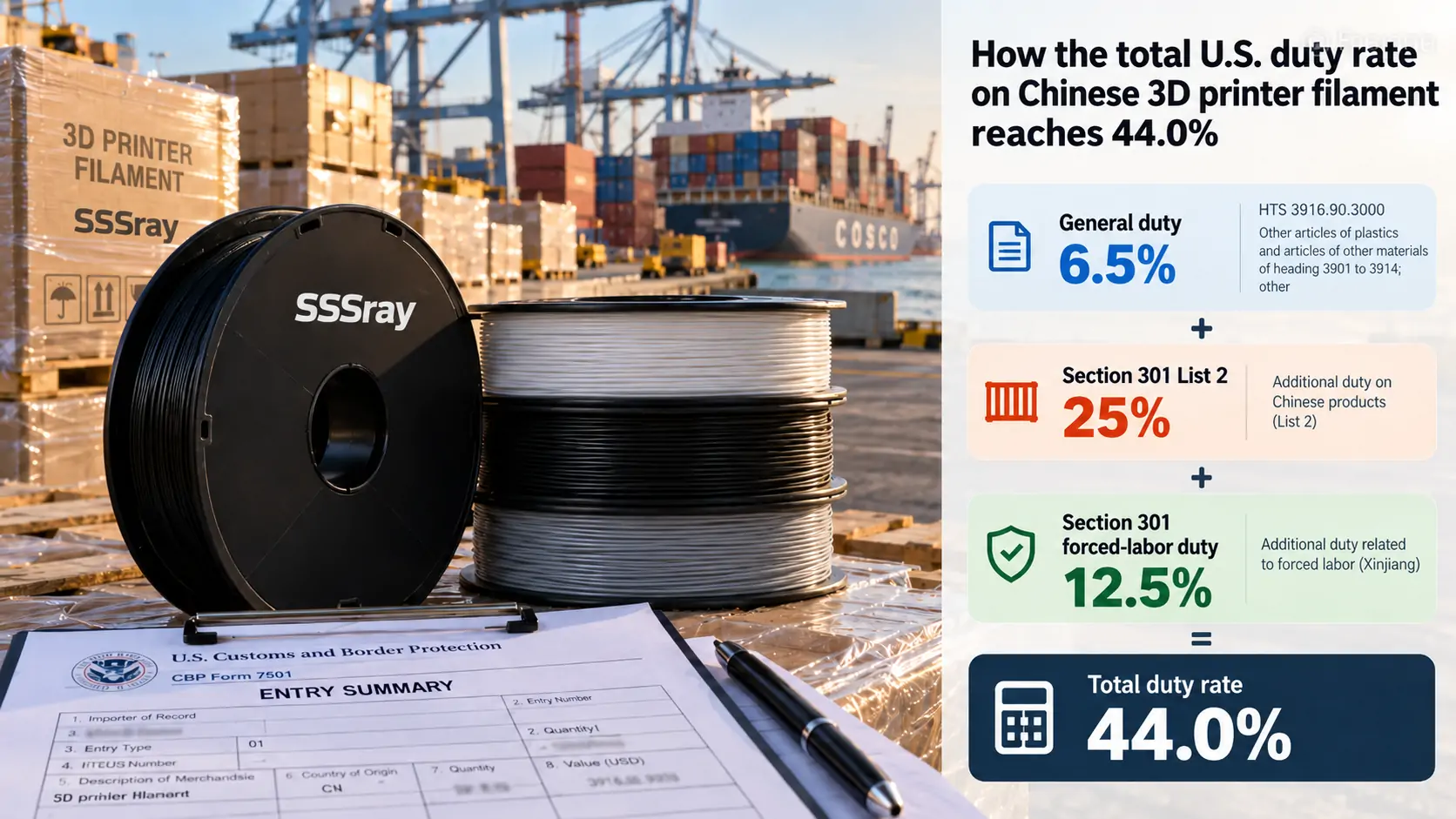
The forced-labor layer comes from a USTR notice published on July 28, 2026 covering 60 economies. It sets 12.5% on products of China, and it applies in addition to the older China lists. CBP’s filing instructions, CSMS #69326983, assign heading 9903.05.31 to products of China. Goods covered by Section 232 are exempt from it, but filament is not a Section 232 product.
Why the rate moved so much since 2025
Total ad valorem duty on Chinese-origin filament, HTS 3916.90.30
Rate in force from each dateApril 2025 peak and current rate
The spike explains today’s confusion. In April 2025, IEEPA tariffs on China reached 145%, which put filament at 176.5%. A May 2025 truce cut that sharply, and the Supreme Court later removed the IEEPA layer entirely. In other words, the long-standing 31.5% base never left; only the layer on top kept changing.
Procurement implicationPut the 10-digit HTS code and all Chapter 99 headings in the purchase file, so finance can audit each entry.
Mistake to avoidAccepting “plastic rods” or “printer consumables” on an invoice. Vague descriptions invite reclassification and exams.
How to verifyCompare the supplier’s description with the CBP ruling language: polymer, diameter, spool weight, intended use.
3. Import Cost of Filament to the USA: Calculating Total Landed Cost with Tariffs
Direct answer: landed cost per kilogram equals the entered customs value per kilogram, plus 44.0% duty and about 0.47% in CBP fees on that value, plus freight, insurance, brokerage and delivery, divided by net kilograms. With the Section 301 tariff on 3D filament at its October 2026 level, every $1.00 of entered customs value becomes roughly $1.44 before logistics.
What CBP actually taxes
US duty is normally based on transaction value: the price actually paid or payable for the goods, plus any dutiable additions required by CBP, such as assists, certain royalties, selling commissions, packing costs and certain proceeds. International freight and insurance are generally excluded when they are separately identified and supported. In Table 3, we assume the FOB price equals the entered customs value because no additional dutiable additions apply.
This is where many online calculators go wrong, because they copy the European method of taxing the freight-inclusive (CIF) value. In the Table 3 example, that mistake would overstate duty by $1,100. On a lump-sum invoice with no supporting freight or insurance documentation, however, CBP may not allow those actual international freight and insurance costs to be deducted from transaction value.
A worked example you can rebuild
Table 3 models 5,000 one-kilogram PLA spools. The $6.00/kg FOB price is a worked-example reference input and the logistics figures are illustrative inputs; replace them with your own numbers.
Worked-example price note: for this model, the $6.00/kg FOB input is assumed to equal the entered customs value because no additional dutiable assists, royalties, selling commissions, packing costs or proceeds apply. It is a procurement reference used to rebuild the landed-cost model; it is not an SSSray quotation or a claimed market average. SSSray provides factory-direct pricing based on material, color, order volume and packaging. Request a current quote.
On mobile, swipe horizontally to review every column.
| Cost line | Basis | Amount | Per kg |
|---|---|---|---|
| Goods (entered customs value) | 5,000 kg × $6.00 model input (FOB assumption) | $30,000.00 | $6.00 |
| General duty | 6.5% | $1,950.00 | $0.39 |
| Section 301, List 2 | 25% | $7,500.00 | $1.50 |
| Section 301, forced labor | 12.5% | $3,750.00 | $0.75 |
| Merchandise Processing Fee | 0.3464% (min $34.58, max $670.86) | $103.92 | $0.02 |
| Harbor Maintenance Fee | 0.125%, ocean only | $37.50 | $0.01 |
| Ocean freight and insurance | Illustrative | $2,500.00 | $0.50 |
| Brokerage, ISF, bond, delivery | Illustrative | $900.00 | $0.18 |
| Total landed cost | Sum of all lines | $46,741.42 | $9.35 |
Landed cost per kilogram in the Table 3 example: $9.35
Figure 2 shows where the $9.35 goes. Duty alone is $13,200, or $2.64 per kilogram. That is more than five times the freight line. Therefore, a 5% negotiation on unit price saves more than a 20% negotiation on freight.
- Confirm the Incoterm and get goods, freight and insurance itemized on the invoice.
- Multiply the goods value by 44.0% for duty.
- Add MPF at 0.3464% (between $34.58 and $670.86 per entry) and, for ocean cargo, HMF at 0.125%.
- Add freight, insurance, brokerage, bond and inland delivery.
- Divide by net kilograms, then by your usable yield if you track scrap.
Three costs buyers forget
- Bond sufficiency. A continuous customs bond is generally sized at 10% of the duties and fees paid in the past 12 months, with a $50,000 minimum. At 44.0%, an importer bringing in $2 million of filament a year pays about $889,000 in duties and fees, which points to a bond of about $90,000.
- The MPF band. The minimum applies below about $9,983 of entered value and the maximum above about $193,666. Splitting one order into many small entries multiplies the minimum.
- Cash timing. Duties are due within 10 working days of release, usually weeks before the filament is sold. Importers on CBP’s Periodic Monthly Statement pay on the 15th working day of the following month instead, so ask your broker to set it up.
Procurement implicationCompare suppliers on landed cost per usable kilogram, using the same Incoterm and the same entry date.
Mistake to avoidApplying 44.0% to a freight-inclusive price, or accepting a lump-sum invoice with no cost breakdown.
How to verifyRebuild one past shipment from its entry summary (CBP Form 7501) and compare it with your spreadsheet.
4. Is Importing from China Still Worth It Versus Buying USA Stock?
Direct answer: for pallet and container volumes, direct import usually still wins on cost per kilogram, even with the Section 301 tariff on 3D filament taking duty to 44.0%. For small or urgent orders, US-held stock often wins once fixed entry costs, lead time and exam risk are counted. The break-even is a formula, not an opinion.
The same HTS line from other origins
Figure 3 compares the duty on the same product by country of origin. As a Chinese manufacturer, we would rather you see the real gap now than discover it on an entry summary.
Ad valorem duty on HTS 3916.90.30 by country of origin, October 2026
The gap is 25 to 34 percentage points. It is not guaranteed to last, because the open excess-capacity investigation covers Vietnam, Malaysia, Taiwan and Japan as well as China. Moreover, duty is only one line. Resin cost, extrusion scale, color range and consistency still decide the unit price, and a lower duty on a higher price can land at the same number.
The break-even formula
For the Table 3 ocean-entry assumptions, where HMF applies and MPF remains within its minimum and maximum limits, import directly when this holds: US stock price per kg > (entered customs value per kg × 1.4447) + logistics per kg + carrying cost per kg.
In the Table 3 example, that is $6.00 × 1.4447 + $0.68 = $9.35 per kilogram before carrying cost. Carrying cost covers the weeks your cash sits in transit, plus safety stock. If a US warehouse offers the same grade below your own break-even, buy locally and keep the cash free.
- US stock tends to win for trial lots, new colors with uncertain demand and deadlines under two weeks.
- Direct import tends to win for repeat SKUs, private-label packaging and any volume where fixed costs spread thin.
- A hybrid often works best: containers for core colors, local stock for peaks.
Procurement implicationRun the break-even for each SKU group. Core colors and specialty grades rarely give the same answer.
Mistake to avoidComparing a FOB quote with a delivered US price without adding duty, fees and logistics to the first.
How to verifyAsk the US seller who the importer of record was. US stock of Chinese filament already carries the same duty in its price.
5. Customs Clearance for 3D Printing Materials: Documents, Marking and CBP Release Time
Direct answer: Based on our forwarder planning benchmarks, a clean, pre-filed ocean entry is often released within one to three business days of arrival. A non-intrusive scan typically adds two to five business days, and an intensive exam five to ten business days or more, plus exam and storage charges. These are planning ranges from forwarder experience, not CBP service standards; actual release time varies by port, filing quality, holds and exam type.
What documentation is needed for a filament import
- Commercial invoice with polymer type, diameter, color, net weight, length in meters, unit price, Incoterm, country of origin and the manufacturer’s name and address.
- Packing list by carton and pallet, with gross and net weights.
- Bill of lading or air waybill.
- Importer Security Filing (ISF) for ocean cargo, filed at least 24 hours before loading. Late filing can cost $5,000 per violation.
- Customs bond, continuous or single-entry.
- Entry summary (CBP Form 7501) and duty payment within 10 working days of release.
- Supporting technical files: TDS and SDS, which help answer CBP questions on composition. Ours are in the SSSray technical document center.
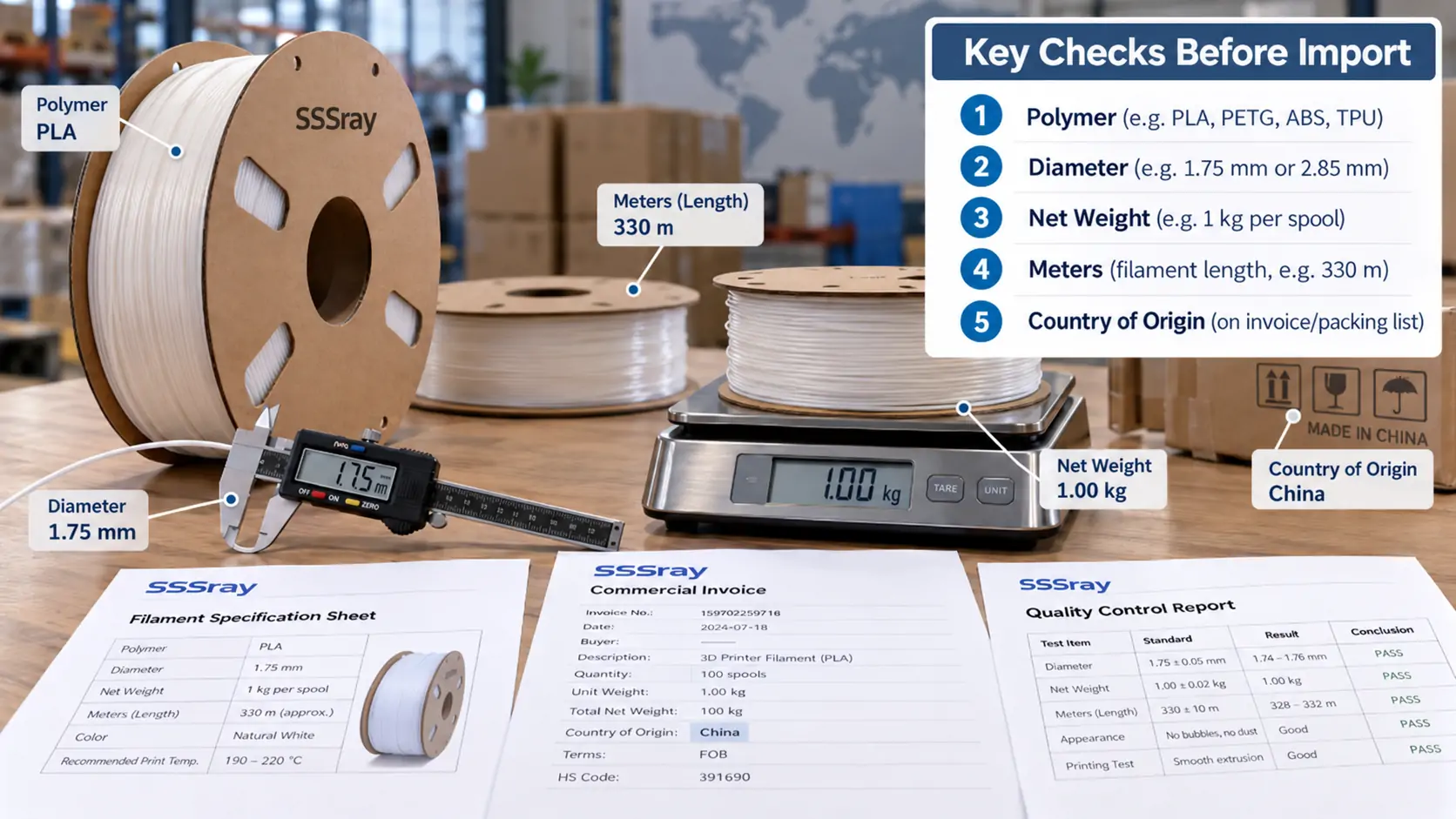
Keep everything for five years. CBP typically liquidates (finalizes) an entry about 314 days after it is filed, and questions can arrive well after the spools are sold.
Country of origin marking on spools and boxes
US law (19 U.S.C. 1304 and 19 CFR Part 134) requires imported goods to be marked with their country of origin in English, legibly and as permanently as the article allows, so the final buyer can see it. For filament, that normally means “Made in China” on the retail box and spool label. Goods found unmarked can be charged an extra 10% marking duty.
Private-label buyers should note one detail. If the box shows a US address, such as “Distributed by Brand X, Austin, TX”, the origin statement must appear close to that address in comparable lettering. Check this on the artwork proof, not at the port.
Forced labor import restrictions: a duty and a prohibition
Two rules now share similar names, and they do different jobs.
- The Section 301 forced-labor duty is a 12.5% tax on almost all Chinese goods. It says nothing about your specific supply chain.
- The UFLPA is a prohibition. CBP can detain goods linked to Xinjiang or to a listed entity until the importer proves otherwise. The Entity List grew to 187 companies in August 2026.
Paying the first does not protect you from the second. Plastics appear among the sectors on the Entity List, and polyvinyl chloride, aluminum and caustic soda are high-priority sectors. For that reason, ask your filament supplier for resin and additive sources by name, with purchase records, before the first shipment.
Procurement implicationMake the document set a condition of payment. Balance is due against a complete, matching invoice and packing list.
Mistake to avoidTreating the 12.5% forced-labor duty as proof of UFLPA compliance.
How to verifyBefore production, review a draft invoice and a label photo with your broker.
6. Tariff Mitigation for Bulk Filament Procurement: What Works and What Fails
Direct answer: no legal method removes the Section 301 tariff from Chinese-made 3D filament sold in the United States. The realistic gains come from correct valuation, refunds of past IEEPA duties, duty drawback on re-exports and cash-flow tools such as a foreign-trade zone. Third-country reshipping and “de minimis” parcels do not work.
On mobile, swipe horizontally to review every column.
| Option | Best use case | Key spec | Advantage | Risk | How to verify | When to reject | SSSray sourcing note |
|---|---|---|---|---|---|---|---|
| Correct valuation (FOB, itemized) | Every importer | Goods, freight and insurance listed separately | Duty only on the goods value | Lump-sum invoices may be fully dutiable | Match invoice to payment records | Supplier offers to under-declare value | We quote FOB or EXW with itemized invoices |
| IEEPA refund (CAPE) | Importers with entries from February 2025 to February 2026 | Entry numbers, duty paid and liquidation status | Recovers duties already paid, with interest | Phase 3 is limited to importers with a court reliquidation order | Broker report of IEEPA lines by entry and CAPE phase | Never; it costs only a review | We can re-issue past invoices on request |
| Preserving refund rights on contested duties | Importers paying the 12.5% forced-labor duty, or who paid the 10% Section 122 surcharge | Liquidation date per entry; protest and court-filing deadlines | Keeps a refund route open if a court strikes the duty down | No refund is certain; deadlines are strict | Broker report of liquidation dates; customs counsel advice | Never; tracking costs little | Our invoices carry PO and Batch ID for entry matching |
| Duty drawback | Distributors re-exporting to other countries | Import and export records linked by lot | Up to 99% of duties refunded, Section 301 included | Heavy record-keeping; narrower rules for Canada and Mexico | Drawback specialist review | Exports are occasional and small | Lot numbers on cartons support tracing |
| Foreign-trade zone (FTZ) | High-volume or re-exporting operations | Privileged foreign status at admission | Duty deferred until goods leave the zone; none on re-exports | Section 301 still applies at the admission-date rate | Zone operator’s cost schedule | Volume too low to cover zone fees | Pallet labels can be aligned to zone inventory |
| First-sale valuation | Buyers purchasing through a trading company | Documented factory-to-middleman sale for US export | Duty on the lower factory price | Strict proof; often challenged | Customs counsel review | Middleman will not open its books | Buying factory-direct removes the middleman margin anyway |
| Tariff engineering (reclassification) | Rarely applicable to filament | Product must truly differ as imported | Legal when genuine | Standard spooled thermoplastic filament over 1 mm generally remains in heading 3916; unusual composites or further-worked forms should be confirmed | Binding ruling request | Change is only on paper | We describe goods as CBP rulings do |
| Third-country reshipping | None | — | None | False origin; penalties and seizure | — | Always | We state Chinese origin on every document |
Can you avoid Section 301 by reshipping through a third country?
No. Section 301 applies by country of origin, not country of export. Origin changes only when goods are substantially transformed, which means becoming a new article with a new name, character or use. Rewinding, relabeling or repacking spools in a third country does not do that.
Extruding filament from resin pellets in another country is a different case, because pellets and monofilament are different products. Even then, get a binding ruling before you rely on it. A false origin declaration can bring penalties under 19 U.S.C. 1592 up to the domestic value of the goods.
De minimis exemption, tariff exclusions and duty drawback eligibility
- De minimis. Duty-free entry for shipments valued at $800 or less remains suspended. A CBP interim final rule published on June 24, 2026 made the suspension indefinite for courier and freight shipments, and a companion rule covers international mail. As a result, sample spools sent by courier are dutiable.
- Exclusions. The 178 active Section 301 exclusions are product-specific, mostly machinery, components and solar manufacturing equipment. We are not aware of one covering 3D printer filament, and no new request process is open.
- Drawback. CBP confirmed in August 2026 (CSMS #69567203) that the forced-labor headings are drawback-eligible, alongside the older China lists.
Procurement implicationRank options by net benefit after professional fees. For most filament buyers, valuation and refunds come first.
Mistake to avoidPaying a premium for “tariff-free routing”. The importer of record carries the liability, not the forwarder.
How to verifyAsk who the importer of record is and request the entry summary for any “duty included” shipment.
7. The Tariff-Ready Sourcing Framework for Filament Importers
With the Section 301 tariff on 3D filament lifting duty to 44.0%, a rejected batch costs far more than the spools. You have already paid freight and duty on goods you cannot sell. So qualification has to cover the product and the paperwork together.
The Tariff-Ready Sourcing Framework uses seven checkpoints. Score each one pass, conditional or fail before the first production order, and again before each reorder.
On mobile, swipe horizontally to review every column.
| Checkpoint | Why it matters | What to ask | Pass / fail signal | Hidden risk |
|---|---|---|---|---|
| Application requirement | Duty is paid on every kilogram, including the wrong grade | Which printers, speeds and end uses was this grade validated for? | Pass: named printers and profiles. Fail: “works on all printers.” | Over-specifying an engineering grade multiplies the duty base |
| Material performance | Returns after import cannot recover duty easily | Lot COA with test methods? Mechanical data on printed samples? | Pass: lot-linked numbers. Fail: brochure values only. | Data from a different lot or resin source |
| Printability | Scrap raises the cost per usable kilogram | Diameter tolerance with raw data? Recommended profile? | Pass: sample prints as received. Fail: needs undisclosed drying. | Sea-freight humidity changes behavior on arrival |
| Compliance | Wrong origin, marking or description triggers exams and penalties | HTS description, origin statement, marking artwork, resin sources? | Pass: draft invoice matches the ruling language. Fail: “we can adjust the paperwork.” | UFLPA detention despite duty paid |
| Supplier reliability | The importer is liable for the supplier’s declarations | Who is the manufacturer of record? Can we see the extrusion site? | Pass: factory name on invoice and label. Fail: trading company with no site access. | Production quietly subcontracted |
| Landed cost | FOB price is only about two-thirds of the delivered cost | Itemized quote by Incoterm? Net kilograms and meters per spool? | Pass: cost per usable kg modeled. Fail: “DDP, all included” with no entry data. | Undervalued entries filed in your name |
| Reorder stability | A rate change between orders shifts margin overnight | Price validity? Change notice for resin and packaging? Duty clause? | Pass: written change control. Fail: silent substitution. | Problems surface on the second container |
Approve a supplier only when nothing fails and every “conditional” has a written action with an owner. Our filament qualification program follows the same sequence.
8. Supplier Claims vs Reality on Tariffs and Import Paperwork
When duty is this high, some offers sound better than they are. Table 6 turns each claim into a request you can make by email.
On mobile, swipe horizontally to review every column.
| Vague marketing claim | What it might hide | Document, sample or test to request | What a reliable supplier provides |
|---|---|---|---|
| “Tariff-free, ships from Vietnam” | Chinese-made spools relabeled abroad | Production records and photos of the extrusion line at the stated site | The true origin on invoice, label and carton |
| “DDP price, all duties included” | An unknown importer of record, or an undervalued entry | Importer of record name and the entry summary showing value and Chapter 99 lines | Transparent entry data, or plain FOB terms |
| “We can declare a lower value” | Customs fraud that falls on the importer | Nothing; decline the offer | Invoice value equal to the amount paid |
| “We use an HS code with lower duty” | Misclassification as rods, printer parts or fishing line | The ruling or legal basis for the code | HTS 3916.90.30 with the CBP ruling reference |
| “No forced-labor risk” | No traceability beyond the factory gate | Resin and additive suppliers by name, with purchase records | A supply-chain map back to the resin producer |
| “1 kg net per spool” | Short weight, or length that does not match the declaration | Weighing records by lot; measured length on a sample spool | Net weight and meters stated per lot on the COA |
9. SSSray Measured Lot Data: Meters per Spool and Our US Shipment Document Protocol
Because HTS 3916.90.30 is reported in meters, a filament invoice that shows only kilograms leaves the broker to estimate. We therefore publish both the conversion we use and a measured production lot, so any buyer can repeat the check with a micrometer and a scale.
Calculated reference: length per kilogram
Method: grams per meter = density (g/cm³) × π × (diameter ÷ 2)² × 100, with diameter in centimeters. Meters per kilogram = 1,000 ÷ grams per meter. Values below use the nominal 1.75 mm diameter and typical densities; the grade’s TDS density governs.
On mobile, swipe horizontally to review every column.
| Material | Typical density (g/cm³) | Grams per meter | Meters per 1 kg net |
|---|---|---|---|
| PLA | 1.24 | 2.98 | 335 |
| PETG | 1.27 | 3.05 | 327 |
| ABS | 1.04 | 2.50 | 400 |
| ASA | 1.07 | 2.57 | 389 |
| TPU 95A | 1.21 | 2.91 | 344 |
| PA6 | 1.14 | 2.74 | 365 |
| PC | 1.20 | 2.89 | 346 |
For comparison, 2.85 mm PLA works out to about 126 m per kilogram. A diameter that runs 0.02 mm above nominal shortens a 1 kg PLA spool by roughly 2%, which is one reason diameter data and net weight belong on the same lot record.
Measured lot record: SSSray PLA 1.75 mm on 1 kg spools
A calculation only helps if real spools match it. The record below comes from one production lot of our standard black PLA, measured in our QC lab in Jinhua before packing.
Test record: SSS-PLA-HTSQTY-LV-2026-0923-R1 · Batch ID: PLA175-BK-260921-L12 · Product: SSSray PLA, black, 1.75 mm, 1 kg net · Produced: September 21, 2026 · Measured: September 22–23, 2026 · Lot size: 600 spools · Sample: 20 spools, every 30th spool off the winder
- Inline diameter control: laser micrometer on the extrusion line, 500 scans per second. Any segment outside ±0.03 mm for more than 3 seconds is cut and purged before winding.
- Net weight: bench scale with 0.1 g readability, checked against a 1 kg reference weight before the run. Net weight is the wound spool minus the tare of the empty spool.
- Diameter and ovality: digital micrometer with 0.001 mm readability. Five positions at 2 m intervals on each spool, two perpendicular readings per position, 200 readings in total.
- Linear mass: one 1,000 mm length cut from each spool against a steel rule and weighed on a 0.01 g balance.
- Density: ISO 1183-1 Method A immersion in deionized water at 23 ± 2 °C, three specimens from each of three spools.
- Length per spool: net weight ÷ linear mass, calculated spool by spool.
On mobile, swipe horizontally to review every column.
| Parameter | Sample size | Mean | Minimum to maximum | Release gate or declared value | Result |
|---|---|---|---|---|---|
| Net filament weight per spool | 20 spools | 1,004.3 g | 1,001.7 to 1,007.9 g | At least 1,000 g | Pass |
| Diameter | 200 readings | 1.750 mm (SD 0.008) | 1.729 to 1.768 mm | 1.75 ± 0.03 mm | Pass; 199 of 200 within ±0.02 mm |
| Ovality | 100 positions | 0.007 mm | Maximum 0.014 mm | 0.020 mm or less | Pass |
| Density | 9 specimens | 1.243 g/cm³ | 1.241 to 1.246 g/cm³ | TDS value 1.24 g/cm³ | Consistent |
| Linear mass | 20 spools | 2.99 g/m | 2.95 to 3.02 g/m | 2.98 g/m calculated at nominal | Consistent |
| Length per spool | 20 spools | 335.7 m | 332.8 to 340.9 m | 335 m declared on the invoice | +0.2% on average; −0.7% to +1.8% by spool |
Three things follow for a US entry. First, every sampled spool held more than 1,000 g of filament, so the net kilograms on the packing list are not overstated. Second, the 335 m we declare per spool sits within 2% of every measured spool, which gives the broker a defensible figure for the meters field. Third, length moves with diameter and net weight, so we declare meters from the nominal value in Table 7 and keep the measured values on the lot’s Certificate of Analysis (COA).
You can repeat the check on arrival in about 15 minutes: weigh a full spool, subtract the empty-spool tare stated on the COA, cut and weigh one meter, and divide.
Document protocol for US-bound orders
Protocol ID: SSSRAY-US-ENTRY-2026-10-R01 · Scope: spooled FDM filament shipped to US importers of record · Terms: FOB or EXW unless agreed otherwise.
- Description line: “3D printing filament, [polymer] monofilament, [diameter] mm, on spools”, following CBP ruling language.
- Quantities: spools, net kilograms and meters per SKU, using the method above.
- Value: goods price itemized separately from any freight or insurance.
- Origin: “Country of origin: China” on invoice, carton and retail label.
- Manufacturer: SSSray factory name and address in Xiaoshun Town, Jindong District, Jinhua, Zhejiang, as it should appear for the importer’s ISF.
- Lot link: Batch ID on invoice, spool label, master carton and COA.
- Technical set: TDS, SDS and lot COA sent with the draft invoice for broker review before loading.
Lot traceability: the measured net weight, diameter and length for your shipment sit on that lot’s batch QC record, tied to the Batch ID on your invoice, spool label and master carton. Production runs on 50+ extrusion lines at our factory in Jinhua.
10. B2B Scenarios: Where Filament Importers Lose Money on Tariffs
Distributor
Situation: a regional reseller imports mixed pallets and also ships to customers in other countries.
Bad choice: prices from a 2025 cost sheet and ignores re-exports.
Consequence: margin disappears on domestic sales, and refundable duty on exports is never claimed.
Better choice: rebuild cost at 44.0%, keep lot-level records and review drawback on exported stock.
Verification: reconcile three entry summaries against the price list.
Next step with SSSray: plan a reseller and distributor order.
OEM Brand
Situation: a printer brand launches private-label filament with its US address on the box.
Bad choice: approves artwork without an origin statement near that address.
Consequence: marking notice, relabeling at the port and a possible 10% marking duty.
Better choice: fix “Made in China” placement on the proof and spool label before printing.
Verification: broker sign-off on the label proof.
Next step with SSSray: ask for OEM packaging proofs.
Print Farm
Situation: a farm using two tonnes a month buys “DDP, duty included” to keep things simple.
Bad choice: never asks who the importer of record is.
Consequence: a detained shipment, idle printers and no entry data to show customers or auditors.
Better choice: import under its own bond with a broker, or buy US stock with clear paperwork.
Verification: request the entry summary for the last delivery.
Next step with SSSray: plan a print-farm production-lot trial.
Engineering Buyer
Situation: an R&D team needs carbon-fiber nylon for fixtures and orders by brand habit.
Bad choice: assumes the composite classifies and performs like plain PA.
Consequence: a broker query delays release, and the grade misses the stiffness target.
Better choice: confirm classification early and qualify the grade on the real part.
Verification: TDS review plus a printed test coupon.
Next step with SSSray: request TDS, COA and SDS for an engineering grade.
11. Sourcing Specs: What to Put in a US-Bound Filament RFQ
On mobile, swipe horizontally to review every column.
| Item | What to specify | SSSray reference |
|---|---|---|
| MOQ | Qualification quantity vs. production quantity, per color | Qualification orders from 50 spools; OEM private label from 500 rolls |
| Lead time | Production, packing and transit, in writing, with the expected entry month | Samples in 3–7 days; bulk PLA and PETG in 10–20 days after approval |
| Sample approval | Sample ID, lot, print results; note that courier samples are dutiable | B2B qualification samples tied to a sample ID and Batch ID |
| Tolerance | Diameter and ovality with method and raw data; net weight per spool | Diameter ±0.03 mm; PLA ovality 0.020 mm or less; measured lot in Table 8 |
| Documentation | Itemized invoice with HTS description, meters and origin; lot COA, TDS, SDS | Draft invoice, packing list, lot COA, TDS and SDS before loading |
| Packaging | Origin marking on spool, box and carton; sea-freight carton and moisture barrier | Vacuum-sealed with desiccant; 5-layer export cartons; marking per approved proof |
| Private label | Artwork with origin statement near any US address; barcode | OEM and private-label labels, boxes and cartons |
| Reorder control | Change notice for resin, additives and packaging; clause for duty changes | Reorder spec linked to the approved sample and Batch ID |
12. Section 301 and Filament Import FAQ for B2B Buyers
What is the current Section 301 rate for 3D filament?
Chinese-origin 3D printer filament pays two Section 301 duties in October 2026: 25% under List 2 and 12.5% under the forced-labor action that began on July 24, 2026. Added to the 6.5% general rate for HTS 3916.90.30, the total is 44.0% of entered value. CBP fees come on top: a Merchandise Processing Fee of 0.3464% and, for ocean cargo, a Harbor Maintenance Fee of 0.125%. The Section 301 tariff on 3D filament depends on where the filament was made, so the same spool shipped from a warehouse in another country still pays the Chinese rate.
How do I calculate total landed cost for filament with tariffs?
For the Table 3 ocean-entry assumptions, start with the entered customs value per kilogram and multiply it by 1.4447 to cover 44.0% duty plus MPF and HMF, provided MPF remains within its minimum and maximum limits. In this model, the $6.00/kg FOB input is assumed to equal the entered customs value because no additional dutiable additions apply. Then add ocean freight, insurance, brokerage, bond and inland delivery, and divide by net kilograms. The 5,000 kg example reaches $9.35 per kilogram. Next, adjust for your own scrap or return rate to reach cost per usable kilogram. Keep actual freight and insurance support with the entry file, because CBP may not allow those deductions when the actual costs cannot be substantiated.
Can I avoid Section 301 by reshipping through a third country?
No. The Section 301 tariff on 3D filament follows country of origin, not country of export, and origin changes only through substantial transformation into a new product. Repacking, relabeling or rewinding Chinese-made spools elsewhere leaves them Chinese for customs purposes. Declaring another origin exposes the importer of record, not the forwarder, to penalties that can reach the domestic value of the goods, as well as seizure. If a supplier truly extrudes filament in another country from resin, ask for production evidence and consider a binding ruling before you rely on the lower rate.
Which filament materials qualify for tariff exclusions?
None that we have identified. Standard spooled PLA, PETG, ABS, ASA, TPU, nylon and PC filaments over 1 mm are generally entered under 3916.90.30 when imported as plastic monofilament; unusual composites or further-worked forms should be confirmed separately. The 178 active exclusions are product-specific and mainly cover machinery, components and solar manufacturing equipment; they run to November 9, 2026 unless USTR extends them. In addition, the 77-line relief list published on September 27, 2026 contains no plastic monofilament. Ask your broker to confirm against the current notice text before you budget for any exclusion.
Can I get a refund of tariffs already paid on filament?
Partly. IEEPA duties paid on entries between February 4, 2025 and February 24, 2026 are refundable through CBP’s CAPE process. Phase 1, open since April 20, 2026, covers unliquidated entries and entries within 80 days of liquidation; Phase 2, since June 29, covers entries flagged for reconciliation; Phase 3 is scheduled to open on October 6 for finally liquidated entries covered by a Court of International Trade reliquidation order. The 25% List 2 duty and the 12.5% forced-labor duty are outside that process. They come back through drawback when the filament is exported or destroyed under CBP supervision, and any wider refund of the 12.5% duty depends on the pending court cases. Ask your broker for a report of IEEPA lines by entry and liquidation date.
Are sample spools still duty-free under the de minimis exemption?
No. Duty-free de minimis treatment for shipments valued at $800 or less is suspended, and a CBP interim final rule published on June 24, 2026 made the suspension indefinite for courier and freight shipments, with a companion rule for international mail. As a result, a courier parcel of sample spools from China is dutiable at the same rates as a container, and the carrier will usually bill duty and a handling fee to the receiver. For qualification, budget this into the sample plan and combine samples into one shipment where possible. Check current postal and courier rules with your carrier before sending.
How long does CBP take to release filament shipments?
Based on our forwarder planning benchmarks, a clean, pre-filed ocean entry is often released within one to three business days of arrival. A non-intrusive scan typically adds two to five business days, and an intensive exam five to ten business days or more, plus exam and storage charges. These are planning ranges from forwarder experience, not CBP service standards; actual release time varies by port, filing quality, holds and exam type. The best protection is a precise invoice description, a filed ISF and a supplier who can answer origin and composition questions within a day.
What documentation is needed to import filament into the USA?
You need a commercial invoice, packing list, bill of lading or air waybill, a customs bond and, for ocean freight, an Importer Security Filing at least 24 hours before loading. Your broker then files the entry and the entry summary, with duties due within 10 working days of release. The invoice should state polymer, diameter, net weight, length in meters, unit value, Incoterm, country of origin and manufacturer. Keep the TDS, SDS and lot COA on file as well, since they help answer CBP questions quickly.
Is it worth importing from China versus buying USA stock?
It depends on volume and urgency. Direct import usually costs less per kilogram for repeat SKUs at pallet or container scale, even with the Section 301 tariff on 3D filament taking duty to 44.0%, because fixed costs spread thin and you control packaging. US stock is often the better choice for trial lots, uncertain colors and short deadlines. For the same ocean-entry assumptions used in Table 3, compare the US price with your own break-even: entered customs value per kilogram × 1.4447, plus logistics and carrying cost per kilogram. In Table 3, the FOB model input is assumed to equal the entered customs value. Remember that US stock of Chinese-made filament already has the same duty built into its price.
13. Conclusion: Price the Section 301 Tariff on 3D Filament Before You Order
The Section 301 tariff on 3D filament did not change in October 2026, but the cost of misunderstanding it keeps rising. Chinese-origin filament under HTS 3916.90.30 pays 44.0%, and that number, not a 2025 headline, belongs in your cost sheet.
The decision logic is short. First, fix the facts: classification, origin and entered value. Next, model landed cost per usable kilogram and compare it with US stock for each SKU group. Then recover what you can, through IEEPA refunds and drawback on re-exports. Finally, run the Tariff-Ready Sourcing Framework so that documents, marking and reorders stay under control.
Your next step is practical. Send your broker a draft invoice and label proof before production, and ask your supplier for net kilograms and meters per spool. Meanwhile, watch four items: the November 9 exclusion deadline, the January 10, 2027 truce date, the outcome of the four-year review and the Court of International Trade ruling on the 12.5% layer. Any of them can change the number in your cost sheet.
Prefer to start with documents? Ask for the TDS, COA and SDS with our test protocol, compare materials across our 3D printer filament supplier range, or discuss OEM packaging.
SSSray prepares the factory-side invoice, origin, quantity and lot documents from the applicable order record. Rates and dates in this guide were rechecked on October 4, 2026; the importer’s licensed customs broker confirms the final entry filing.
Request a quote or free samples
Tell us the material, color, spool size and monthly volume. An engineer replies within 24 hours on business days.
14. References
- USTR, Notice of Actions in Section 301 Investigations Related to Forced Labor Import Prohibitions (91 FR 47318): 12.5% duty on products of China, effective dates and FTZ status.
- CBP Ruling NY N296007 and NY N266336: classification of 3D printing filaments and a nylon filament spool cartridge in 3916.90.3000.
- USITC, Harmonized Tariff Schedule of the United States, 2026 Revision 20: general rate, unit of quantity and Chapter 99 headings.
- CBP, Section 301 Trade Remedies FAQ: origin-based application of the China duties.
- CBP, Customs User Fees To Be Adjusted for Inflation in Fiscal Year 2027 (91 FR 48398): MPF minimum and maximum from October 1, 2026.
- The White House, U.S.-China Board of Trade “30-for-30” lists: 77 HTS lines recommended for reduced tariff treatment.
- USTR, Notice of Product Exclusion Extensions (90 FR 55232): 178 exclusions through November 9, 2026.
- USTR, Initiation of Second Four-Year Review Process (91 FR 24636).
- CBP CSMS #69567203: drawback eligibility of the Section 301 forced-labor headings.
- CBP, Indefinite Suspension of the De Minimis Exemption for Merchandise Arriving Through All Modes Other Than the International Postal Network (91 FR 37789): interim final rule.
- Executive Order 14389, Ending Certain Tariff Actions (91 FR 9437): end of IEEPA duty collection.
- DHS, 2025 Updates to the UFLPA Strategy and Troutman Pepper Locke analysis of the August 2026 Entity List expansion: priority sectors and the 187-entity list.
- Supply Chain Dive, “US, China to extend trade war truce by 2 months” and C.H. Robinson, October 2026 trade updates: truce extension, CAPE Phase 3 and refund status.
- CBP CSMS #69326983: entry filing instructions for the Section 301 forced-labor duties, including heading 9903.05.31 for China.
- C.H. Robinson client advisory, September 17, 2026: CAPE Phase 3 eligibility and filing date.
- Quartz, Section 301 forced-labor tariffs challenged in trade court and GHY International, Section 122 ruling and stay: status of the court challenges.