Online time
Monday to Friday: 9AM - 8PM
Weekend: 10AM - 5PM


TL;DR: Filament Tangling Is Usually a Handling Knot — the Costly Cases Start at the Winder
SSSray qualification approach: for recurring production, we use closed-loop tension control with radius compensation and a synchronized traverse, with the winding profile and calibration record tied to the production lot.
When not to use it: “closed-loop” alone does not rescue soft TPU or brittle fiber-filled grades. Those need their own low tension band, a larger hub, or a different spool format.
Key specification: a documented tension setpoint per material (one filament-line maker publishes a 1.0–2.5 N starting band for 1.75 mm PLA), a traverse pitch matched to measured diameter, and no wraps trapped at either flange.
Lot verification: we tie the winder profile and calibration date to the production lot, then buyers can verify spool behavior through their own feed path with a controlled unwind test.
Claim rule: a true knot cannot form during uninterrupted continuous winding, so winding claims should distinguish handling knots from flange traps, buried wraps and edge collapse. We recommend defining the defect evidence and photo rules in the purchase specification before the first shipment.
Root causeSeparate handling knots from flange traps and buried wraps.
Line controlTension, traverse pitch and flange quality decide spool behavior.
Buyer testOpen a statistically sized sample and unwind it on your equipment.
ContractDefine a winding nonconformity before you need to claim one.

He Jiang
Senior Researcher · SSSray · 3D Printing Filament Manufacturing · Jinhua, Zhejiang
He Jiang is a senior researcher at SSSray, a 3D printing filament manufacturer in Jinhua, Zhejiang, China. In this guide, he explains how winding tension, traverse control, flange condition and lot-level unwind testing affect B2B filament qualification and recurring production consistency.
Abstract: Why Spool Tangling Is a Procurement Problem, Not Only a User Problem
The 3D filament tangling problem is one of the most common complaints in printer communities, yet the factory side of it is rarely explained. In August 2026, filament-line equipment maker Wanplas described winder tension instability as the single most common reason well-extruded filament fails spool-quality acceptance. At the same time, filament brands such as Prusa and colorFabb state that a knot cannot physically form while one continuous strand is being wound. Both statements are true, and the gap between them is where most tangling disputes live.
Here is the practical split. A true knot — the free end slipping under another loop — almost always forms after the spool leaves the line, usually when someone lets go of the end. However, the winder can build spools that behave like tangled spools: wraps caught between the coil and the flange, edges that pile up and collapse, and loose outer layers that slide into gaps. To a print farm operator, all three look the same: the printer stops.
That is why buyers get stuck. Many distributors treat every stoppage as a supplier defect, while many suppliers treat every claim as user error. Neither side has objective evidence, so the refund conversation becomes an argument. Meanwhile, multi-material feeders increasingly detect abnormal feed resistance, so more winding weaknesses show up as logged feed interruptions instead of vague complaints.
This guide takes the factory view and turns it into buyer decisions. First, it separates handling knots from winding defects using physical evidence. Next, it explains the three production variables that matter most — tension control, traverse pitch and flange quality — with a simple model of how tension changes as a spool fills. Then it converts those variables into an inspection protocol sized with ISO 2859-1 sampling tables, a supplier-claim checklist, and contract language for returns.
The analysis framework is simple: origin → control → evidence → acceptance. For each failure mode, we ask where it originates, which production control prevents it, what evidence proves the control was working for your lot, and what acceptance rule the buyer should sign. Section 6 adds SSSray winding verification record SSS-WIND-QC-20260930-01, tying the control settings, calibration checks, sampling plan and unwind acceptance rule to one named qualification record.
Key Takeaways for B2B Filament Buyers
- Classify before you claim. An end tucked under a loop in the outer layers is a handling knot; a wrap wedged against the flange or buried mid-spool points to winding.
- Tension falls as the spool grows unless the winder compensates. In our 1 kg PLA model, constant motor torque loses about 44% of line tension from core to full spool.
- The weakest wraps are wound last and unwound first. Outer layers with low tension are the ones your customer meets on day one.
- Traverse error is a major source of crossed winding. General traverse-engineering references use roughly 2–3% ratio drift as a practical warning range for gaps or pile-ups; treat it as an engineering reference, not a 3D-filament standard.
- Diameter control and winding quality are linked. A ±0.05 mm tolerance on 1.75 mm filament is ±2.9% — already inside that drift range if the traverse is not re-synchronized.
- A 1 kg spool is built from only about two dozen layers. Every layer ends in a flange turnaround, and each turnaround is a chance for an edge defect — so edge inspection matters more than surface neatness.
- Material changes the tension window. Published starting bands run from about 0.5–1.5 N for TPU to 1.5–3.5 N for ABS; one profile for every grade is a warning sign.
- Split your inspection. Use ISO 2859-1 general level II for external checks and a special level (S-3 or S-4) for destructive unwind tests.
- No public standard sets a winding tension value. Your purchase specification must define the acceptance rule, or nobody will.
1. The 3D Filament Tangling Problem: Knot, Snag or Winding Defect?
Short answer: most stopped prints blamed on “tangling” fall into three groups. There are true knots created after the free end is released and crosses under another wrap, flange traps or collapsed edges created on the winder, and feed resistance that only looks like a tangle.
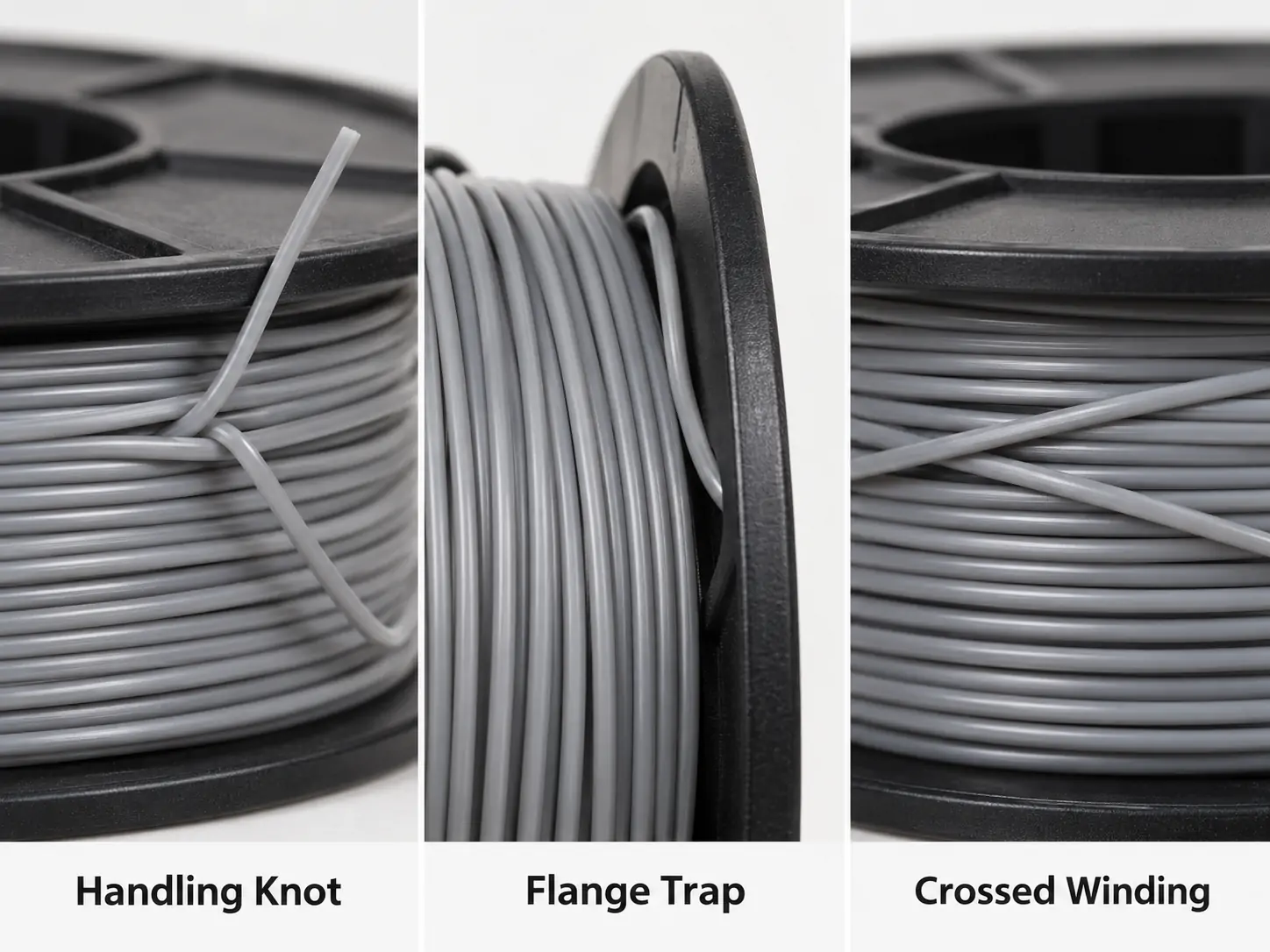
The true knot: an end that went under a loop
Prusa’s knowledge base is blunt about this. A spool is one continuous strand wound from start to finish, so a coil cannot get under another coil during production. Instead, the knot appears when the filament end is released — for example during unloading — and slips under another loop.
colorFabb gives the factory-side reason. Its line keeps the strand under constant tension, and the only moment an operator could let go is when the end is cut and fastened. Even then, a knot would sit on the very first wraps and cause trouble immediately at loading.
Factory-side look-alikes: flange traps, collapsed edges and buried wraps
So far, this sounds like a clean acquittal for suppliers. It is not. Winding can create defects that stop a printer just as hard as a knot.
For example, a traverse-device patent from the wire industry describes wire that piles up at the reel ends during regular winding; once the pile grows, it collapses and causes entanglement. Similarly, Bambu Lab’s troubleshooting page for its “filament may be tangled or stuck” error lists filament caught on the edge of the spool as a separate cause from an actual tangle.
Think of it like stacking books on a shelf. If one row is slightly shorter, the next row leans into the gap. On a spool, that gap usually sits against a flange, and the wrap that falls into it gets pinned by everything wound on top.
Why does my filament tangle even when the spool looks fine?
Because the visible surface is the least informative part of the spool. A neat outer layer can hide a buried wrap five layers down or a trapped loop against the flange wall. In addition, a spool wound under high tension stores elastic strain; when the end is released, that stored energy helps outer wraps spring loose, which turns a small handling slip into a real knot.
On mobile, swipe horizontally to review every column.
| Symptom | Where it shows | Most likely origin | Evidence to collect before touching the spool | Usually owned by |
|---|---|---|---|---|
| Free end found under a loop | Outer few layers | End released during unloading or storage | Photo of the end path and clip position | User / handling |
| Wrap wedged between coil and flange | At either flange, any depth | Edge gap, traverse overshoot, loose layers or flange flex | Flange-side photos, lot label, remaining mass at stop | Supplier if it repeats in one lot |
| Resistance or tension spike once per revolution | Any spool depth | Eccentric core or out-of-round roller first; a buried wrap is more likely when the spike is not phase-locked to each revolution | Mark the spool/core, compare spike periodicity with rotation, then keep an unwind log with stop position and remaining mass | Supplier / spool body |
| Outer layers spring off when the bag opens | Whole surface | Low winding tension or poor end securing | Unopened-pack photo and opening video | Supplier |
| Feed stops, no knot, spool hard to turn | Holder, dryer or feeder | Spool fit, spool slip, holder friction or brittle filament | Spool dimensions versus holder specification; bend test | Shared — check the specification |
| Same symptom on several spools of one lot | Lot level | Process drift on one winding shift or line | Lot numbers and count of affected versus opened spools | Supplier containment |
Procurement implicationA claim without origin evidence will be rejected; a claim with it becomes a corrective action.
Mistake to avoidUntangling the spool before photographing it destroys the only proof of origin.
How to verifyLog the lot, stop position and flange condition for every stoppage for 30 days.
2. Filament Tension Instability: How Winder Physics Shapes Every Spool
Short answer: winding tension decides how firmly each wrap sits on the one below. When tension drifts, the outer layers loosen or the inner layers get crushed — and both conditions raise the risk of snags later.
Torque, radius and a 44% drop
The core physics is one line: winding torque equals tension multiplied by radius. As the spool fills, the radius grows, so a winder that holds torque constant delivers less and less tension to the filament.
To size the effect, we modelled a common 1 kg format. The RepRap wiki notes that spools have no dimensional standard, but the market has converged on 200 mm flanges with 85–100 mm hubs and about 68 mm width for 1 kg. Our model uses a 100 mm core, 60 mm winding width and PLA at 1.24 g/cm³. That gives about 335 m of 1.75 mm filament and a finished winding radius of roughly 86–91 mm, depending on how densely the wraps pack.
Consequently, the radius grows by a factor of about 1.8. Under constant torque, tension falls from 2.00 N at the core to about 1.13 N at the surface — a drop of roughly 44%.
Notice what the orange line means commercially. The loosest wraps are wound last, so they are the first wraps your customer unwinds. In other words, open-loop winding concentrates its weakest layers exactly where the out-of-box experience happens.
Too loose versus too tight: two different failure families
Wanplas describes both directions. With too little tension, inner layers slacken and outer layers sink into the gaps, so the spool releases in jerks. With too much, the filament is stretched below its set diameter and the core can be crushed; the same source states that doubling the PLA band can thin the strand by more than 0.05 mm.
There is also a stored-stress effect. Research on filament-wound composite rotors found that winding tension is the main source of residual stress and deformation in the wound layers. Filament spools are far simpler, but the principle transfers: high tension leaves the hub and inner layers under load for months of storage and shipping.
Closed-loop tension control and taper
A closed-loop winder measures actual tension with a load cell or dancer arm, compares it with the setpoint, and corrects the servo in real time. Better lines add radius compensation and a gentle taper, which lowers tension slightly as the spool fills so outer layers do not crush inner ones. Wanplas reports that a calibrated cascade loop with radius compensation can maintain tension within a few percent of the setpoint across a full spool. Treat that as an engineering reference and verify the actual result on the lot record rather than assuming a universal industry tolerance.
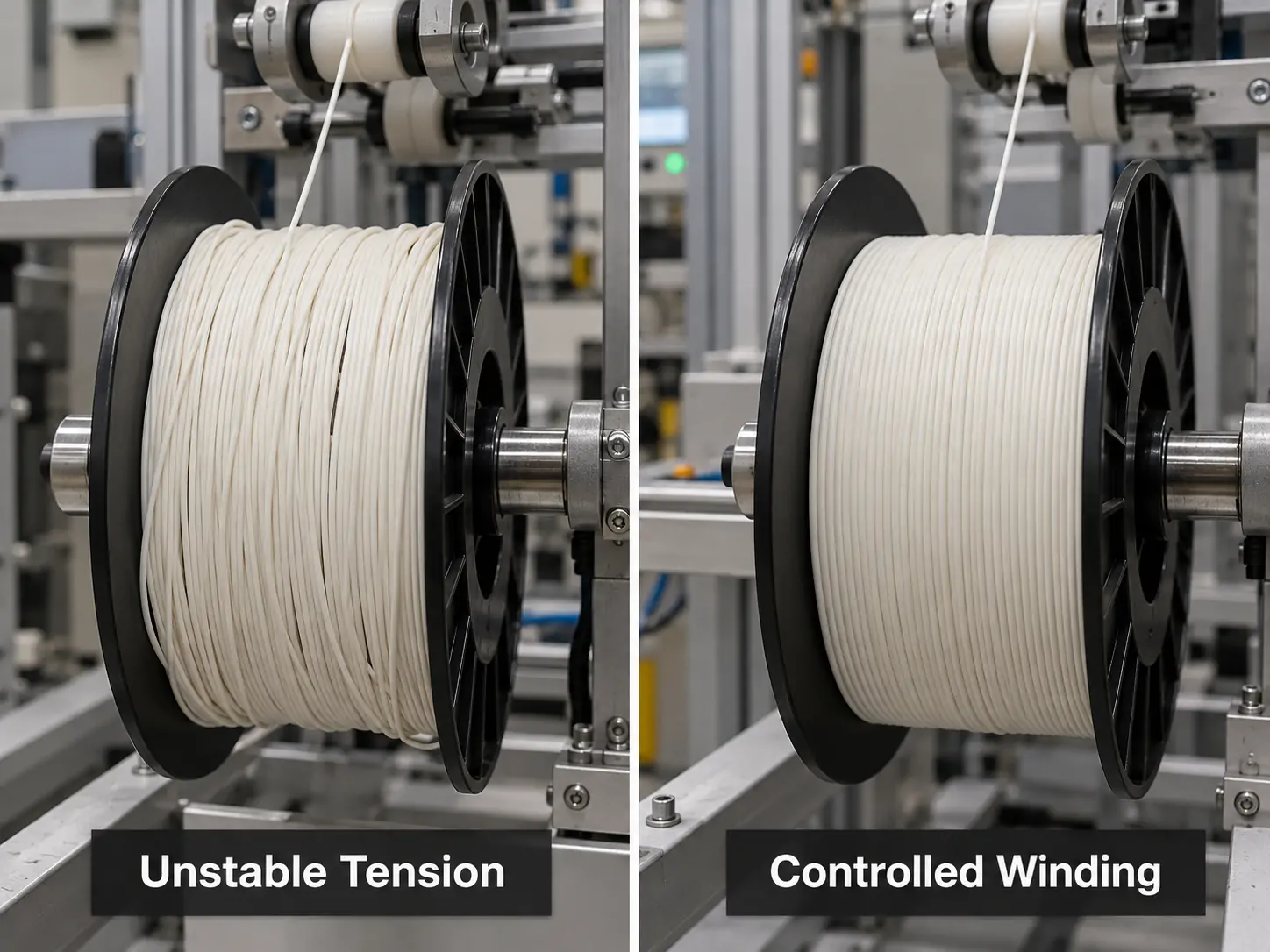
Procurement implication“Automatic winding” says nothing about control mode; ask whether tension is measured, compensated and tapered.
Mistake to avoidJudging winding by the neatness of the outer layer, which may be the loosest part of the spool.
How to verifyRequest the winder profile, sensor calibration date and tension setpoint recorded against your lot number.
3. Crossed Winding Detection: Traverse Pitch, Flange Reversals and Edge Defects
Short answer: crossed winding comes mostly from the traverse — the guide that walks the filament back and forth — rather than from tension. When its travel per revolution drifts away from one filament diameter, wraps pile up or leave gaps, and the flanges are where the damage concentrates.
What causes crossed winding during filament production?
For level winding, the rule is that the guide should move sideways by about one material diameter for every spool revolution. General traverse-engineering references use about 2–3% ratio drift as a practical warning range: positive drift can open gaps, while negative drift can make wraps climb onto each other. This is an engineering reference for commissioning, not a 3D-filament acceptance standard.
Here is the connection most buyers miss. On 1.75 mm filament, ±0.03 mm diameter variation equals ±1.7%, and ±0.05 mm equals ±2.9%. Therefore, a supplier with loose diameter control can move a fixed-pitch traverse toward the same gap-or-pile-up range even when the traverse drive itself has no mechanical fault.
Why the flange turnaround matters
With a 60 mm winding width, each layer holds about 34 wraps of 1.75 mm filament. Our 1 kg model needs roughly 770 wraps, or about 22–25 layers. Since every layer ends with the guide reversing at a flange, a single spool goes through roughly two dozen turnarounds — each one sitting against a flange wall.
Each reversal is a small event. If the guide lingers, wraps stack against the flange; if it turns early, a gap forms that the next layer can fall into. As one wire-traverse reference puts it, a missed reversal lets material run past the flange and pile up on the spool head.
Precision winding versus random winding
Textile and yarn engineering distinguishes two traverse laws. In random winding, the traverse frequency stays constant while the spool slows as it grows, so the winding ratio keeps changing and “ribbons” form whenever it passes an integer. In precision winding, the traverse is locked to spindle speed, so the ratio stays fixed and ribboning can be designed out. Yarn patents link ribbons to unwinding disturbances and loop formation — a useful warning for any filament line that cross-winds.
How to check if filament is pre-tangled from the factory
- Before opening, look through the pouch at both flanges for daylight gaps, ridges or a wrap lying diagonally across its neighbours.
- After opening, rotate the spool three full turns by hand and watch both edges for wraps that lift or snap back.
- Press lightly near each flange; a soft, sinking edge suggests low tension or a gap underneath.
- Confirm the free end is locked in a flange hole, not tucked loosely under the outer layer.
- Finally, run a controlled unwind through your real feed path (see Section 7).
Procurement implicationDiameter tolerance is a winding specification too; tighter diameter control protects traverse accuracy.
Mistake to avoidAccepting a “perfect winding” photo of the outer surface as evidence of edge quality.
How to verifyAsk how the traverse pitch is set against measured diameter and how reversal dwell is tuned.
4. Which Spool Winding Method Prevents Tangling Best?
Short answer: for recurring B2B supply, a cascade tension loop (dancer plus load cell) with radius compensation, taper and a synchronized traverse gives the most repeatable spools. However, method only matters if the supplier can prove it ran correctly on your lot.
The table below is written for purchasing managers. Use it to decide which answers to demand before a sample order, and which answers should end the conversation.
On mobile, swipe horizontally to review every column.
| Option | Best use case | Key spec | Advantage | Risk | How to verify | When to reject | SSSray sourcing note |
|---|---|---|---|---|---|---|---|
| Hand-guided or semi-manual winding | R&D samples, very short specialty runs | Operator-dependent; no tension record | Flexible, low setup cost | Variable pitch and tension; edge gaps | Unwind 100% of sample spools | Any recurring retail or OEM SKU | Acceptable only for clearly labelled development samples |
| Automatic winder, constant torque (open loop) | Basic PLA with low feed-path sensitivity | Fixed torque or slip clutch | Simple, low cost | Tension falls ~40–45% as spool fills; brake heat drift | Ask how torque changes with radius | TPU, multi-material feeder SKUs, print-farm contracts | Ask whether radius compensation is active before quoting |
| Closed loop, dancer arm | General production | Dancer position feedback to servo | Absorbs extrusion surges | Spring or counterweight wear shifts the setpoint | Dated dancer calibration record | No calibration record available | Request calibration interval in writing |
| Cascade: dancer + load cell, radius compensation and taper | OEM brands, print farms, feeder-based printers | Setpoint and taper per material; trace per lot | Most repeatable tension across the spool | Only as good as sensor zero and span | Tension record linked to lot number | Records exist but cannot be tied to your lot | Preferred route for recurring OEM and farm programs |
| Synchronized (precision) traverse | All level-wound spools | Pitch ≈ measured diameter; profiled reversal | Clean layers and edges | Pitch drift if diameter changes | Edge inspection plus wraps-per-layer check | Visible ridges or gaps on sample spools | Ask how pitch is reset after diameter changes |
| Spool body: injection-molded plastic vs cardboard | Plastic for feeders; cardboard for sustainability SKUs | Flange flatness, hub concentricity, rim finish | Rigid flanges keep edges stable | Flange flex opens edge gaps; cardboard can slip or shed debris | Measure flange runout and spool width | Warped flanges or out-of-round hubs | Approve the exact spool body in the sample, not a substitute |
Why the spool body is in a winding table: Bambu Lab’s official AMS technical overview states that the original AMS does not like cardboard spools because paper debris can jam the system. A flange that flexes during winding or feeding can also open an edge gap similar to a poor traverse.
Procurement implicationAsk for control architecture, not just “automatic” — the difference shows up in the outer layers.
Mistake to avoidApproving a sample wound on a lab spooler and receiving production wound on a different line.
How to verifyWrite the line or winder ID into the approved sample record and the PO.
5. Material-Specific Winding Tension: PLA, PETG, ABS, TPU and Filled Grades
Short answer: there is no universal winding tension. Stiffness, elongation and moisture sensitivity change how much tension a filament can hold without stretching, cracking or loosening.
Below the glass transition, a polymer behaves like a glassy spring and stores tension as recoverable strain. Above it, the same tension causes permanent draw. That is why filament must be fully cooled before it reaches the winder — otherwise tension quietly changes diameter as well as spool shape.
On mobile, swipe horizontally to review every column.
| Material | Published starting band* | Main winding risk | Spool and hub consideration | What to ask the supplier |
|---|---|---|---|---|
| PLA | 1.0–2.5 N | Over-tension makes brittle strands snap in later handling | Large hub helps; small diameters can break PLA | PLA profile ID and hub diameter |
| PETG | 1.2–3.0 N | Stretches if over-tensioned; moisture affects modulus | Standard 1 kg format usually fine | Drying record before extrusion; taper setting |
| ABS | 1.5–3.5 N | Undried resin creates voids and diameter spikes | Standard format usually fine | Resin drying condition and diameter log |
| TPU | 0.5–1.5 N | Low modulus and high elongation: easy to stretch thin | Often unsupported by multi-material feeders | TPU-specific low-tension profile and acceleration limits |
| CF / GF filled grades | No public band found | Brittleness and fiber-dependent stiffness | Hub size and bend radius matter; many feeders exclude them | Grade-specific profile and a bend test on the shipped lot |
*Starting bands published by filament-line maker Wanplas (August 2026) as commissioning starting points, not a standard or acceptance limit. The PLA hub note comes from the RepRap filament-spool page.
Procurement implicationA supplier using one tension profile for PLA and TPU is not controlling winding by material.
Mistake to avoidApplying PLA acceptance rules to flexible or fiber-filled spools.
How to verifyAsk for the profile ID per grade and check it appears on the lot record.
6. Spool Winding Quality Control: Filament QC Inspection Points on the Line
Short answer: good winding comes from about eight controlled points between the haul-off and the packing table. A supplier that records them per lot can defend every spool; one that does not can only promise.
Wanplas reports that even a 0.5% speed mismatch between the haul-off and the winder can build into large tension swings within seconds, and that an eccentric core creates a tension ripple once per revolution. These are line-level causes a buyer will never see — which is exactly why the records matter.
At SSSray, winding qualification is tied to a named verification record before a profile is released for recurring production. The reference record below is SSS-WIND-QC-20260930-01 for 1.75 mm PLA on a 1 kg spool. It fixes measurable control settings and acceptance rules; shipment-level measured values are recorded against the actual production lot.
On mobile, swipe horizontally to review every column.
| Inspection point | What must be controlled | Record kept | Reject signal | SSSray qualification baseline |
|---|---|---|---|---|
| Lot and line identity | Lot number, line ID, winder ID, date | Lot traveller | Spool cannot be traced to a line | Test record SSS-WIND-QC-20260930-01 · PLA · 1.75 mm · 1 kg; production lot, line and winder IDs recorded at release |
| Haul-off to winder speed sync | Shared speed reference | Drive settings | Sawtooth tension pattern | Shared speed reference required; any mismatch approaching 0.5% is treated as a corrective-action trigger |
| Tension sensor zero and span | Checked with known masses at changeover | Calibration log | No dated calibration | Zero/span check at every product changeover; full calibration at least every 3 months in continuous service; monthly verification for high-throughput 16 h/day operation |
| Tension setpoint and taper | Profile per material and diameter | Profile ID on lot record | Same profile for every grade | PLA qualification baseline: 1.80 N at the core, 20% taper to about 1.44 N at full spool, radius compensation enabled; instantaneous tension acceptance ±5% of setpoint |
| Traverse pitch and reversal | Pitch set to measured diameter; reversal profiled | Traverse setting | Edge ridges or gaps | Nominal 1.75 mm/rev for 1.75 mm filament, reset to measured diameter; roughly 2–3% ratio drift is treated as an engineering warning range |
| Spool flange and hub | Flatness and concentricity of the spool body | Incoming spool check | Flange runout or eccentric hub | Approved 1 kg plastic spool body; flange flatness, hub concentricity and free rotation checked against the approved sample before winding |
| Start and end securing | Start locked in core; end locked in flange hole | Packing photo standard | Loose end inside the pouch | 100% end-lock check before vacuum packing; any unsecured end is rejected before packing |
| Edge inspection before packing | Visual check of both flanges | Inspector ID and count | Trapped or diagonal wraps | ISO 2859-1 general level II sampling; for a 1,201–3,200-spool lot, n=125 under the SSSray external-check plan |
| Unwind audit | Periodic full or partial unwind on a feed path | Audit log with stop positions | Any stop caused by winding | For a 1,201–3,200-spool lot, S-4 opened sample n=32; SSSray commercial release target: 0 winding-caused feed stops in the agreed qualification path |
How to read a production line defect rate
A defect rate is only meaningful with its denominator. Ask for winding-nonconforming spools divided by spools inspected, per lot, with the inspection method named. For example, “0 rejects” from 5 visually checked spools says far less than “2 rejects” from 200 edge-inspected spools.
Next, ask for the trend across at least the last several lots of the same grade. A single good lot proves the line can work; a stable trend suggests it usually does.
Procurement implicationRecords per lot turn winding from a promise into a verifiable specification.
Mistake to avoidAccepting a defect percentage without the number of spools inspected.
How to verifyPick one shipped lot and ask the supplier to show its full winding record.
7. How to Test Spool Quality Before a Bulk Order: A Spool Inspection Protocol
Short answer: inspect in two layers. Check a larger sample from the outside without breaking the seal, then open a smaller, statistically sized sample and unwind it through your own feed path.
Size the sample with ISO 2859-1
ISO 2859-1 is the reference system for lot-by-lot attribute inspection, and its third edition was published in January 2026, adding skip-lot procedures that can reduce inspection for suppliers with a good record. Its sample-size code letters give different sample sizes for general levels (routine checks) and special levels, which suit destructive or expensive tests.
The logic is practical. Opening a vacuum-sealed pouch turns a saleable spool into a test spool, so destructive checks should use a special level. For example, a 2,000-spool lot needs 125 spools for external checks at level II, but only 13 (S-3) or 32 (S-4) opened spools for unwind testing.
Acceptance numbers for external checks
On mobile, swipe horizontally to review every column.
| Lot size (spools) | Sample size | Accept if defects ≤ | Reject if defects ≥ | Typical external defects counted |
|---|---|---|---|---|
| 151–280 | 32 | 2 | 3 | Visible edge gaps or ridges, flange cracks or warp, loose end, label or lot mismatch, damaged seal |
| 281–500 | 50 | 3 | 4 | |
| 501–1,200 | 80 | 5 | 6 | |
| 1,201–3,200 | 125 | 7 | 8 | |
| 3,201–10,000 | 200 | 10 | 11 |
SSSray commercial inspection plan, not an ISO product requirement: Table 5 uses AQL 2.5 for external spool defects, while the opened unwind sample uses a zero-winding-stop release target. ISO 2859-1 supplies the sampling framework; the chosen AQL and unwind acceptance rule are buyer-supplier quality terms that should be written into the PO.
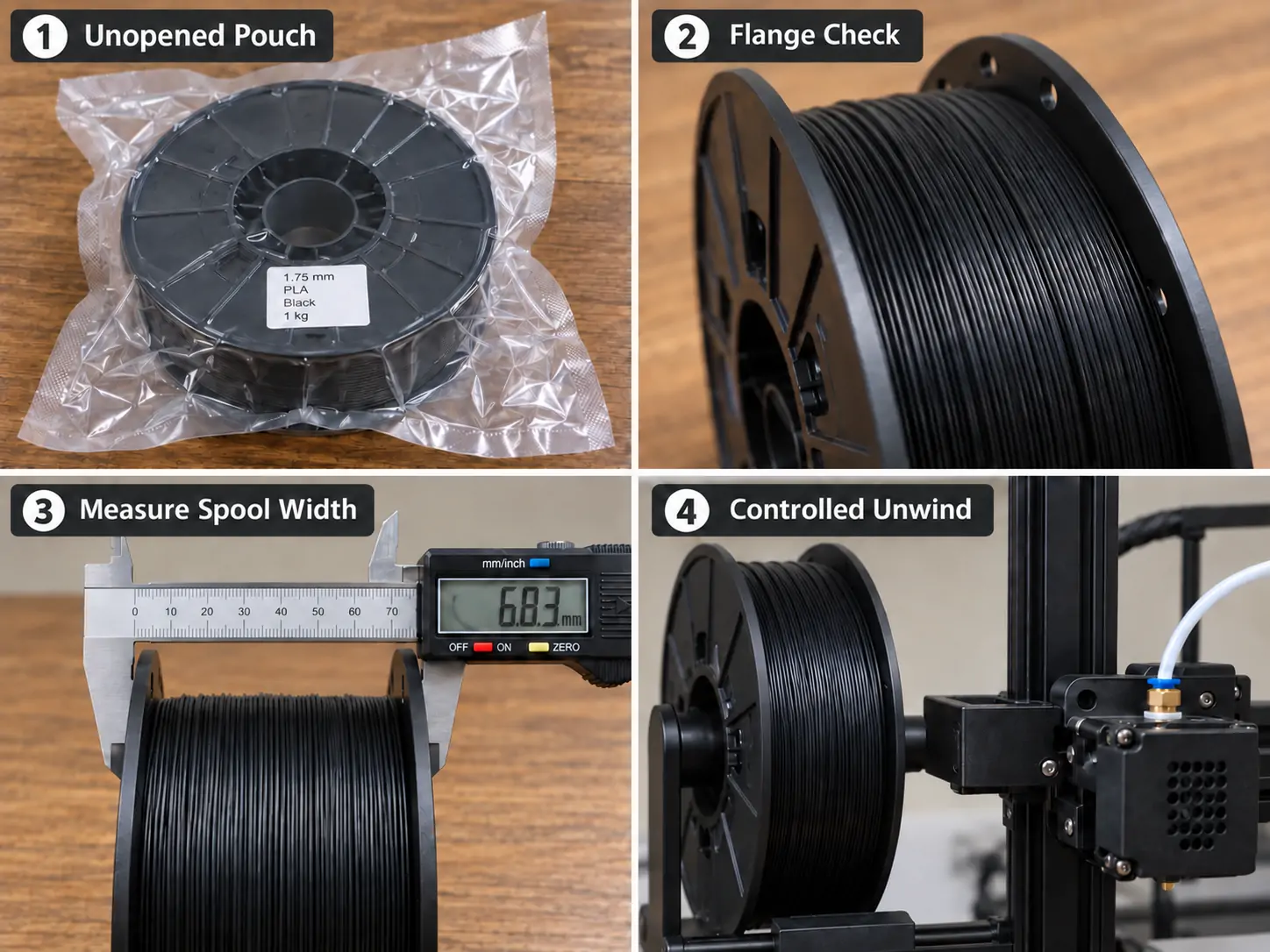
Step-by-step unwind test
- Photograph each selected pouch unopened, with the lot label readable.
- Measure spool outer diameter and width and compare them with your holder, dryer or feeder specification.
- Open the pouch, rotate three turns and inspect both flanges as described in Section 3.
- Load the spool into the real feed path — for example a multi-material feeder, buffer or dryer — not a free-spinning test rod.
- Run a long representative job, or unwind at a controlled rate, and log every stop with the remaining spool mass.
- Classify each stop with Table 1 and keep the spool untouched until it is photographed.
- Retain failed spools until the supplier agrees on disposition.
Procurement implicationDestructive testing costs saleable stock; include it in landed cost, not as an afterthought.
Mistake to avoidTesting on a free-spinning rod when customers use feeders that pull harder and detect resistance.
How to verifyRepeat the unwind test on the first production lot, not only on the approval sample.
8. Can I Return Tangled Filament to the Supplier? Contracts and Claims
Short answer: yes — if your purchase specification defines a winding nonconformity objectively and your evidence shows the defect’s origin. Without that, expect the reply that knots cannot form in production, which is technically correct for true knots.
What to write into the purchase specification
- Definitions: separate “handling knot” from “winding nonconformity” (flange trap, buried wrap, collapsed edge, loose outer layers, unsecured end).
- Evidence rule: unopened-pack photo, lot label, flange photos before untangling, and remaining mass at the stop.
- Lot trigger: the number of confirmed winding nonconformities that triggers containment, root-cause analysis and replacement.
- Remedy: replacement spools, credit, and whether freight and inspection costs are covered; printer downtime is rarely covered unless negotiated.
- Change control: advance notice before changing winder, spool body, traverse settings or line.
Supplier claims versus reality
On mobile, swipe horizontally to review every column.
| Vague marketing claim | What it might hide | Document, sample or test to request | What a reliable supplier provides |
|---|---|---|---|
| “Tangle-free guarantee” | “Tangle” defined as a knot only, so winding defects are excluded | Written defect definitions and claim procedure | Definitions that include flange traps and buried wraps |
| “Fully automatic winding” | Open-loop constant torque without compensation | Control mode and radius-compensation statement | Architecture, setpoint per material and calibration interval |
| “Perfect, neat winding” | Cosmetic outer layer only | Edge inspection method and unwind audit | Lot-level edge and unwind results with sample counts |
| “Tension controlled” | Setpoint entered once, sensor never checked | Sensor zero and span records | Dated calibration linked to the production period |
| “±0.02 mm diameter” | Average value; no link to traverse setting | Raw diameter readings for the lot | Readings plus how traverse pitch follows diameter |
| “Low defect rate” | No denominator or method | Rejects ÷ inspected per lot, by method | Trend across recent lots of the same grade |
| “Works with multi-material systems” | Fits dimensionally but never feed-tested | Spool dimensions and feed-test log | Test log on the named feeder with stop count |
Procurement implicationRefund risk is decided when the PO is written, not when the complaint arrives.
Mistake to avoidUsing a retail-style “satisfaction” policy for B2B volume without defect definitions.
How to verifyAsk the supplier to mark up your draft definitions before the sample order.
9. The Unwind-Ready Framework: A Buyer Decision Tool for Spool Winding Quality
This framework puts winding inside the full purchasing decision. Each row asks one question the buyer should answer before approving a supplier, and it lists the hidden risk that usually appears only after the first reorder.
On mobile, swipe horizontally to review every column.
| Check | Why it matters | What to ask | Pass / fail signal | Hidden risk |
|---|---|---|---|---|
| Application requirement | Feeders, farms and retail users stress spools differently | Which feed path and run length must the spool survive? | Pass: test mirrors the real path · Fail: rod-only test | Feeder upgrades make old spools fail new checks |
| Material performance | Tension window changes by grade | Which profile and taper apply to this grade? | Pass: profile ID per grade · Fail: one profile for all | Color or additive changes shift stiffness |
| Printability | Winding defects appear as feed stops | What were the stop counts in your unwind audit? | Pass: zero winding-caused stops in the agreed test · Fail: unexplained stops | Stops blamed on the printer instead of the spool |
| Compliance | Feedstock requirements cover packaging, marking and QA | Which documents and lot marking come with each shipment? | Pass: lot on spool, pouch and carton · Fail: carton-only lot | Mixed lots in one carton break traceability |
| Supplier reliability | Controls must hold across shifts and lines | Can you show records for a lot you shipped last month? | Pass: complete record on request · Fail: “we check everything” | Approval sample made on a different line |
| Landed cost | Cheap spools with stops cost more per good part | What do inspection spools and stops cost per 1,000 kg? | Pass: cost model includes testing and downtime · Fail: price per kg only | Labor for untangling and reprints stays invisible |
| Reorder stability | Winding settings drift after maintenance or line moves | Will you notify winder, spool or line changes? | Pass: written change notice · Fail: silent substitution | New spool body with different flange stiffness |
ISO/ASTM 52903-1 supports the compliance row: it describes how to define requirements for material-extrusion feedstock, including packaging, package marking and quality assurance. It does not, however, set a winding-tension value — so your specification still has to.
10. Four B2B Scenarios: How Winding Quality Changes the Buying Decision
Distributor
Situation: a new private range gets one-star reviews mentioning tangles.
Bad choice: switch supplier on price without defining the defect.
Consequence: the same complaints return because nobody separated handling knots from winding defects.
Better choice: classify returns with Table 1 and add end-securing instructions to packaging.
Verify: track complaints per lot, not per month.
Next step: review wholesale supply terms.
OEM brand
Situation: starter spools ship inside new printers with a multi-material feeder.
Bad choice: approve a sample tested on a free-spinning rod.
Consequence: feed-resistance stops appear as first-print failures and support tickets.
Better choice: approve winding on the shipped feeder with the shipped spool body.
Verify: S-4 unwind sample on the first production lot.
Next step: ask for OEM spool and packaging options.
Print farm
Situation: 60 printers run overnight; one stop costs a full plate.
Bad choice: buy the lowest price per kilogram.
Consequence: untangling labor and scrapped plates erase the saving.
Better choice: contract for closed-loop wound spools with lot records and a stop-rate limit.
Verify: log stops per 100 spools by lot for 60 days.
Next step: compare high-speed grades for farms.
Engineering buyer
Situation: TPU and CF grades feed unattended fixtures.
Bad choice: apply PLA acceptance rules to every grade.
Consequence: stretched TPU and cracked CF wraps near the hub.
Better choice: grade-specific tension profiles, hub sizes and bend tests.
Verify: profile ID per grade on each lot record.
Next step: discuss engineering grades.
11. Sourcing Specs: What to Put in the RFQ for Winding Quality
Use this table as the winding section of your RFQ. SSSray values are those currently published on our qualification pages; confirm them for your grade, color and packaging before ordering.
On mobile, swipe horizontally to review every column.
| Spec | What to define | Winding-specific clause | SSSray published starting point |
|---|---|---|---|
| MOQ | Per SKU and color | Same line and winder for the full lot | From 50 spools under the qualification program |
| Lead time | Production plus inspection | Include time for unwind audit before release | Typically 10–20 days for standard bulk production |
| Sample approval | Grade, color, spool body, pouch | Record line or winder ID in the approval | Full-size samples on request |
| Tolerance | Diameter, ovality, net mass | Traverse pitch tied to measured diameter | ±0.03 mm diameter |
| Documentation | TDS, SDS, COA, lot record | Winding profile ID and calibration date per lot | TDS, SDS/MSDS, COA available for applicable products |
| Packaging | Pouch, desiccant, carton | End locked in flange hole; one lot per carton | Confirm per order |
| Private label | Spool, label, box, artwork | Spool body change triggers requalification | Spool molding and packaging in-house |
| Reorder control | Approved sample as baseline | Notice before winder, spool or line changes | Confirm in writing per program |
If you are building a range around feeder-based printers, SSSray can supply its custom PLA filament on the spool body you approve, with the winding record attached to each lot — which keeps the spool you tested and the spool you receive the same product.
12. FAQ: Filament Tangling and Spool Winding Quality
Why does my filament tangle even when the spool looks fine?
Because the outer surface tells you little about what lies beneath it. A neat top layer can hide a wrap trapped against the flange or buried several layers down. Also, the outer layers are often the loosest, since open-loop winders lose tension as the spool grows. If you find the free end tucked under a loop near the surface, it is almost certainly a handling knot. If resistance repeats once per revolution, first check for an eccentric core or out-of-round roller; if it is not phase-locked to each revolution, inspect for a buried wrap or collapsed edge. Photograph the condition before untangling anything.
How can I check if filament is pre-tangled from the factory?
Start with the unopened pouch: look at both flanges for gaps, ridges or wraps lying diagonally across their neighbours. After opening, turn the spool three full revolutions and watch the edges, then press gently near each flange to find soft spots. Check that the end is locked in a flange hole. Finally, run an unwind test through your real feeder or holder and log any stop with the remaining spool mass. Visual checks catch edge defects; only an unwind test catches buried wraps.
Can I return tangled filament to the supplier?
Usually yes, but only when the defect is clearly a winding nonconformity and your contract defines one. Many manufacturers state that knots cannot form during production, which is correct for true knots, so claims without evidence tend to fail. Photograph the unopened pack, the lot label and the flange area before untangling, and record the remaining mass at the stop. For B2B supply, agree the definitions, evidence rules, lot-level trigger and remedy in the purchase specification before the first order ships.
Which spool winding method prevents tangling best?
For recurring B2B supply, a closed-loop cascade (dancer arm plus load cell) with radius compensation, taper tension and a traverse synchronized to measured diameter gives the most repeatable spools. Constant-torque open-loop winding is cheaper but lets tension fall roughly 40–45% as a 1 kg spool fills in our model. The method is only half the answer, though. Ask the supplier to show the tension profile, calibration date and edge-inspection result for the specific lot you receive.
Is there an industrial standard for spool winding tension?
No public standard sets a tension value for filament winding. ISO/ASTM 52903-1 describes how to define requirements for material-extrusion feedstock, including packaging, marking and quality assurance, but leaves numerical limits to the buyer and supplier. Equipment makers publish commissioning starting bands, such as 1.0–2.5 N for 1.75 mm PLA and 0.5–1.5 N for TPU. Treat those as starting points, then write your own acceptance rule based on unwind results and lot records.
How many spools should we test before a bulk order?
Split the sample. For external, non-destructive checks, use ISO 2859-1 general inspection level II: 80 spools for a lot of 501–1,200, or 125 for 1,201–3,200. For opened unwind tests, which destroy saleable packs, a special level is more economical: 13 spools at S-3 or 32 at S-4 for a 1,201–3,200 lot. Confirm the values against ISO 2859-1:2026, and repeat the unwind test on the first production lot rather than trusting the approval sample alone.
Can a spool problem cause a layer shift?
Sometimes, but rarely directly. Most layer shifts come from motion issues such as belts, acceleration or collisions. However, a spool that snags can add a sudden pull on the filament path; on some setups that drag reaches the toolhead or extruder and shows up as skipped extrusion, grinding or, occasionally, a shift. If shifts coincide with high spool resistance or a feeder stop, inspect the spool edges and log the lot number before retuning the printer.
Conclusion: Treat Spool Winding Quality as a Purchase Specification
Filament tangling looks like one problem, but the evidence splits it in two. A true knot forms after the free end is released and crosses under another wrap; it cannot self-form in the middle of uninterrupted continuous winding. Flange traps, collapsed edges and loose outer layers can originate at the winder, and they stop printers just as effectively.
For SSSray qualification, we document how tension is controlled, compensated and tapered by material, how the traverse follows measured diameter, and how winding-defect evidence is recorded. Buyers can then verify the result on their own equipment with an ISO 2859-1-sized sample and carry the agreed defect definitions into the purchase specification.
For a qualification order, we can provide the winding record tied to the lot; buyers can then run the seven-step unwind test on 13–32 opened spools from the approval sample and compare the results with the recorded profile. That keeps the sample, the lot record and the acceptance decision on the same evidence trail.
As feeder systems add more resistance and loading diagnostics, a larger share of winding defects can appear as logged feed interruptions instead of vague user reports. For SSSray orders, lot-level winding records give us a traceable basis to compare those interruptions with the corresponding winding profile and inspection record, so claims can be investigated faster and with better evidence.
Also useful: request TDS / COA / MSDS or a bulk quote · compare materials and suppliers · ask for OEM packaging
Request a quote or free samples
Tell us the material, color, spool size and monthly volume. An engineer replies within 24 hours on business days.
13. References
- Prusa Knowledge Base: Tangled filament — why a coil cannot pass under another during continuous winding.
- colorFabb Support: Preventing filament from tangling — constant-tension winding and end-fastening risk.
- Wanplas (Aug 2026): Filament winder tension instability and closed-loop calibration — equipment-maker tension bands and root causes.
- Bambu Lab Wiki: “Filament may be tangled or stuck” HMS error — tangle detection and filament caught on the spool edge.
- RepRap Wiki: Filament spool — absence of a spool dimension standard and common hub sizes.
- ISO 2859-1:2026, Sampling procedures for inspection by attributes (AFNOR listing) — current edition, January 2026.
- QC Advisor: ISO 2859-1 sample-size table — public reproduction of code letters and sample sizes.
- ISO/ASTM 52903-1:2020, Material extrusion feedstock materials — requirement framework including packaging, marking and QA.
- US Patent 9,656,831: Traverse device and traverse method — pile-up at reel ends and resulting entanglement.
- US Patent 5,577,676: Controlling traversing frequency in a yarn winding system — random versus precision winding and ribbon formation.
- Firgelli Engineering Library: Traverse motion — one-diameter pitch rule and 2–3% drift threshold.
- Polymers (2022): Influence of filament winding tension on composite rotor deformation — winding tension as a source of residual stress.