Online time
Monday to Friday: 9AM - 8PM
Weekend: 10AM - 5PM


TL;DR: TPU 60A vs 70A for 3D-Printed Soft Robotic Grippers
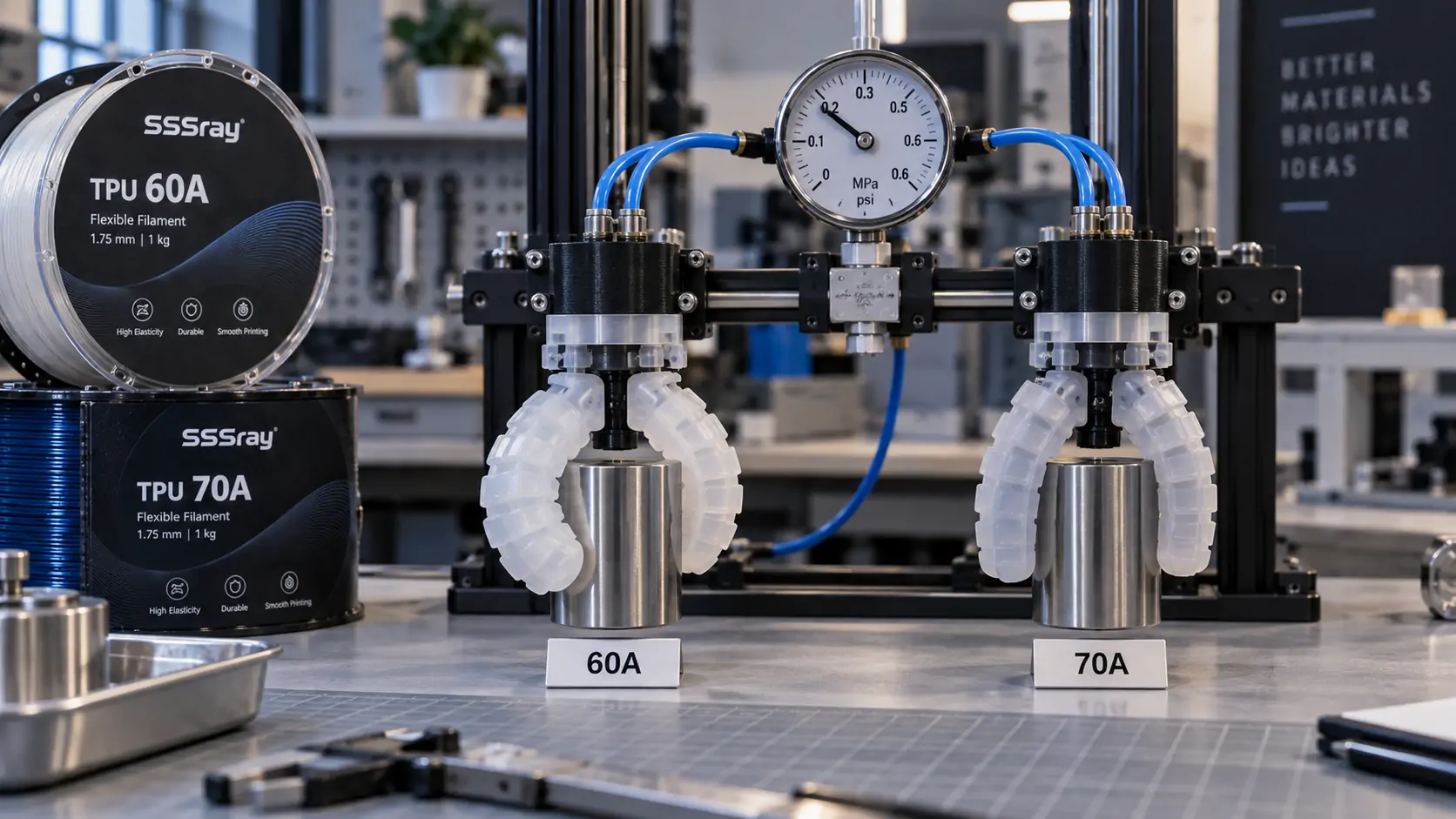
For pneumatic soft robotic grippers, TPU 60A and 70A give engineers a much more compliant material window than conventional 85A–95A flexible filament. In a 2025 IEEE Access study using the same printed finger geometry, 60A TPU reached approximately 104° of bending at 200 kPa while 70A reached approximately 81°. The same study measured elastic modulus values of approximately 4.43 MPa for 60A and 6.62 MPa for 70A, confirming the higher compliance of the softer grade.
At SSSray, we treat those published results as an engineering benchmark—not as a substitute for production qualification. A commercial gripper program still has to prove filament feeding, dimensional stability, drying, airtightness, pressure response, grip performance and cycle behavior on the customer’s actual printer and actuator design. For custom-engineered TPU 60A/70A projects, our starting MOQ is 150 spools, with the final material route, color, spool configuration, test scope and documents confirmed before bulk production.
60A Advantage
Maximum compliance and bending response for delicate or irregular-object gripping.
70A Advantage
Very high flexibility with greater self-support than 60A for selected actuator designs.
Print Priority
Direct drive, tightly constrained feeding, controlled flow and verified drying.
SSSray Route
Custom engineering TPU 60A/70A projects start from 150 spools after scope confirmation.

He Jiang
Senior Researcher · SSSray · 3D Printing Filament Manufacturing · Jinhua, Zhejiang
He Jiang is a senior researcher at SSSray, a 3D printing filament manufacturer in Jinhua, Zhejiang, China. His work focuses on engineering-filament qualification, material selection, supplier technical documentation, batch-level QC and repeat-order control for B2B distributors, OEM brands, print farms and engineering buyers. He also follows REACH, RoHS and other regulatory requirements when they affect material documentation or export projects.
From Soft-Robotics Research to a Production TPU Specification
Soft robotic grippers solve a problem that rigid end effectors handle poorly: making stable contact with objects that are fragile, irregular, deformable or difficult to pick with suction. FFF/FDM manufacturing adds another advantage because pneumatic chambers, bellows and compliant contact surfaces can be produced directly from a digital design without building a mold for every geometry change.
Low-hardness TPU, however, is not simply “softer TPU 95A.” As hardness falls, the filament becomes more sensitive to unsupported feed length, spool drag, melt back-pressure, moisture, retraction and the exact geometry of the pressure-retaining walls. That is why SSSray evaluates a low-hardness TPU project as a complete material-and-process route rather than approving it from Shore hardness alone.
For procurement, Shore hardness is the starting point. Gripper geometry, filament formulation and the print profile determine whether that hardness becomes repeatable production performance.
What SSSray Wants Buyers to Confirm Before Bulk Production
- 60A and 70A are proven FFF gripper materials: peer-reviewed research has successfully printed and tested pneumatic fingers in both hardness grades.
- 60A delivers higher compliance: the cited IEEE study measured approximately 4.43 MPa elastic modulus for 60A versus 6.62 MPa for 70A under its printed-specimen test method.
- Gripper geometry can materially change performance: 2026 published work showed that chamber and channel design changes altered flexion by approximately 20–33%.
- Direct-drive feeding should be the default starting route: very soft TPU requires a tightly controlled filament path and low resistance between spool and hotend.
- Drying must follow the exact formulation: different published low-hardness TPU sources use different validated drying conditions.
- Pressure and payload belong to actuator validation: they should not be copied from a research paper into a commercial filament specification.
- Food-contact projects need exact-grade documentation: resin chemistry, color, article construction and intended use all matter.
- Custom TPU 60A/70A starts from 150 spools: SSSray confirms formulation, color, spool format, testing and documents before the bulk PO.
1. What Published 60A/70A Gripper Testing Shows
The most useful evidence for a buyer is experimental data, not a market-growth headline. A 2025 IEEE Access study characterized low-hardness 60A and 70A TPU, fitted hyperelastic models, printed pneumatic fingers and measured bending, fingertip force and grasping performance. A separate 2026 study in Results in Materials demonstrated that actuator geometry itself can materially shift flexion and blocking force.
Swipe horizontally on mobile to view the complete evidence table.
| Evidence | Test Setup | Key Result | What It Means for a Buyer | What Still Needs SSSray / Buyer Validation |
|---|---|---|---|---|
| IEEE Access, 2025 | 60A and 70A commercial TPU grades; Original Prusa MK4; 0.4 mm nozzle; pneumatic bellows-style fingers | Elastic modulus approximately 4.43 MPa for 60A and 6.62 MPa for 70A. At 200 kPa, the same finger geometry reached about 104° with 60A and 81° with 70A. The demonstrated gripper grasped a 1297.2 g object in its test set. | Confirms the strong compliance advantage of low-hardness TPU and demonstrates that FDM can produce functional pneumatic soft grippers. | Exact formulation, print profile, wall geometry, object surface, pressure range and production duty cycle. |
| Results in Materials, 2026 | Four FFF TPU pneumatic-actuator designs using chamber and channel variations | Channel-type modifications increased flexion by approximately 20–33% versus the respective base designs. The assembled gripper handled tested objects up to 254 g. | Material hardness alone does not determine gripper performance. Chamber geometry and contact design are major engineering variables. | The buyer’s own geometry, friction surface, pressure, payload and long-term fatigue requirement. |
| Current commercial 60A/70A manufacturer guidance | Published low-hardness TPU print guidance for direct-drive systems | Current 0.4 mm reference settings include approximately 2.0 mm³/s at 235°C for 60A and 2.5 mm³/s at 240°C for 70A, with 55°C drying for at least one hour. | Provides a useful external benchmark for how conservative low-hardness TPU flow can be compared with conventional harder TPU. | SSSray must establish the final print window for the actual custom formulation rather than copying another supplier’s profile. |
SSSray engineering rule: published research tells us what is technically achievable. Our job before bulk supply is to confirm whether the selected formulation can reproduce the required feeding, printing and actuator behavior on the customer’s actual process.
2. TPU 60A vs 70A: Which Route Fits the Gripper?
Shore A hardness is useful for material identification and production control, but it is not a complete actuator model. ISO 868 treats durometer hardness as an empirical test, so our engineering discussions also consider tensile response, hysteresis, tear behavior, compression set, environmental exposure and the geometry of the printed gripper.
Swipe horizontally on mobile to compare the two grades.
| Decision Factor | TPU 60A | TPU 70A | SSSray Engineering Direction |
|---|---|---|---|
| Compliance | Highest compliance of the two grades and lower measured modulus in the cited study. | Higher modulus and more self-support while remaining highly flexible. | Start with 60A when maximum wrap-around deformation is the target; evaluate 70A when the design needs additional shape control. |
| Published bending benchmark | Approximately 104° at 200 kPa in the cited finger geometry. | Approximately 81° at 200 kPa in the same geometry. | Use the comparison to select a trial direction, then generate a new pressure-angle curve on the production gripper. |
| External commercial elongation reference | One current commercial 60A reference reports up to 950% elongation at break. | One current commercial 70A reference reports up to 900% elongation at break. | These values are external references. SSSray provides the final property data for the approved custom grade rather than transferring another brand’s values. |
| Feeding sensitivity | Extremely high because very low column stiffness magnifies gaps, drag and back-pressure. | Still demanding, but its higher stiffness gives the feed path more support than 60A. | Direct-drive testing and a constrained filament path are part of our qualification route. |
| Typical project direction | Fragile products, maximum conformability, low-contact-force designs and research actuators. | Highly compliant grippers needing more dimensional or self-support stability. | Final selection depends on the real object, pressure, cycle rate, grip geometry and production printer. |
For an RFQ, give us more than “60A.” Send the object being handled, desired pressure range, printer/extruder, wall geometry, expected cycle rate and target quantity. That gives our engineering team enough information to recommend a useful trial rather than only quoting a hardness number.
3. Soft-Gripper Material Decision Matrix
A good gripper material must match the complete duty cycle. A formulation that feeds easily may be too stiff for the required bend angle, while an ultra-soft material may demand tighter control of extrusion, moisture and geometry. Silicone remains valuable when the selected silicone grade offers a required thermal, compression-set, medical or food-contact route that dominates the application.
Swipe horizontally on mobile to view the full matrix.
| Material Route | Best Fit | Main Advantage | Main Production Risk | Evidence SSSray Recommends |
|---|---|---|---|---|
| TPU 60A FFF | Maximum-compliance pneumatic fingers and very soft contact surfaces | High deformation plus direct printing of internal pneumatic geometry | Feed-path buckling, moisture, stringing and pressure-wall leakage | Grade TDS/SDS, hardness method, diameter record, print profile, leak test and actuator validation |
| TPU 70A FFF | Highly compliant grippers that benefit from more self-support | Maintains very soft behavior while providing higher stiffness than 60A | Still requires flexible-filament-optimized feeding and flow control | Same evidence as 60A plus side-by-side performance if positioned as a stronger or more stable alternative |
| TPU 85A–95A FFF | Flexible fixtures, wear pads, protective parts and lower-deformation gripper elements | Wider printer compatibility and easier feeding | Higher stiffness can reduce bending for the same actuator geometry and pressure | TDS, printer profile and pressure-angle testing against the low-hardness candidate |
| Molded Silicone | Applications where the selected silicone’s thermal, compression-set or regulated-use performance is decisive | Extremely soft formulations and mature molding options | Tooling and curing can slow design revisions and add process steps | Exact silicone grade, cure record and application-specific compliance files |
4. The SSSray Elasto-Grip Qualification Framework
When we review a TPU 60A/70A request, we do not start by asking only which hardness the buyer wants. We first define the actuator, printer, commercial quantity and acceptance target, then build the trial around those conditions.
SSSray Elasto-Grip 7-Pillar Qualification Framework
1. Application
Object type, contact sensitivity, pressure range, cycle rate, payload, temperature and cleaning environment.
Risk: selecting hardness before defining the actuator target.
2. Material Route
TPU chemistry, Shore target, tolerance, color/additive system and relevant mechanical test methods.
Risk: treating all materials labeled “60A” as mechanically identical.
3. Feed Stability
Printer, direct-drive path, spool drag, nozzle, drying, temperature and volumetric-flow ceiling.
Risk: the filament fails in the feed path before actuator performance can be tested.
4. Airtight Printing
Wall strategy, seam position, leak test, pressure hold and dimensional repeatability.
Risk: a visually good gripper still leaks through seams or thin walls.
5. Grip Performance
Pressure-angle curve, contact behavior, object damage, payload and release performance.
Risk: a material benchmark is mistaken for finished-gripper performance.
6. Commercial Control
150-spool custom MOQ, spool format, packaging, lead time, documents and destination requirements.
Risk: a successful engineering sample cannot be reproduced as the intended commercial SKU.
7. Reorder Control
Approved formula, color, QC limits, document revision, packaging and retest triggers.
Risk: silent material or process changes invalidate the first qualification.
Soft-Gripper Qualification Chain
1. Material Identity
Hardness, formulation route, TDS/SDS and batch identity.
2. Feed Stability
Drying, direct-drive path, winding and volumetric-flow control.
3. Airtightness
Wall integrity, seam strategy, pressure hold and leakage.
4. Grip Performance
Bending, contact, payload, object protection and release.
5. Cycle Validation
Representative duty cycle, environment and defined failure criteria.
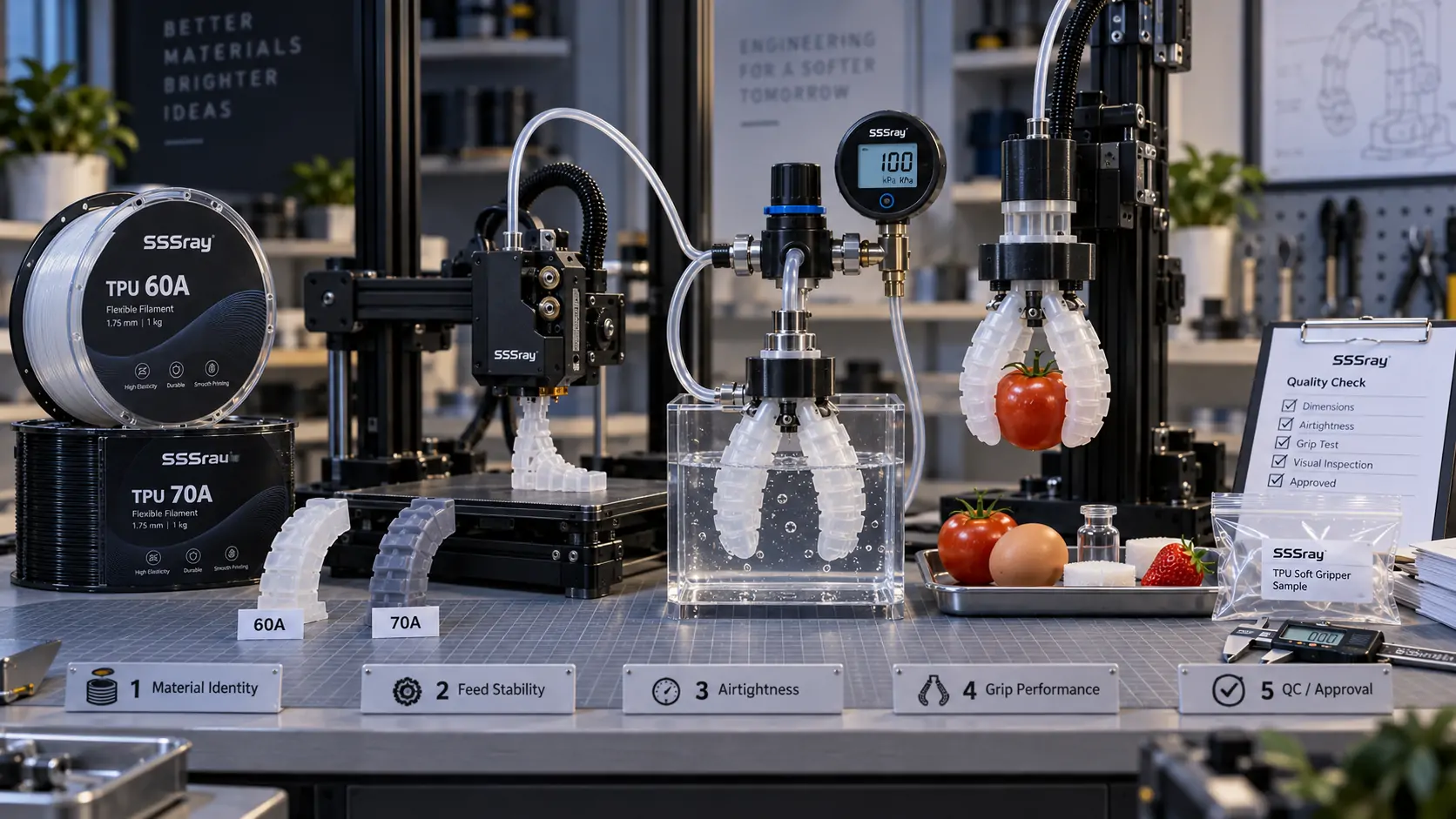
How we move from sample to PO: use the SSSray Filament Qualification Program to record the purchasing route, then use our Filament Test Protocol and Batch QC Data workflow to keep the approved sample, test record and bulk specification connected.
5. Printing Low-Hardness TPU Without Feed Instability
The main cold-end challenge is column buckling. A soft filament transmits compressive force from the drive gears toward the melt zone, and its resistance to sideways buckling decreases as elastic modulus falls and unsupported feed length increases:
Pcr = (π² · E · I) / (K · L)²
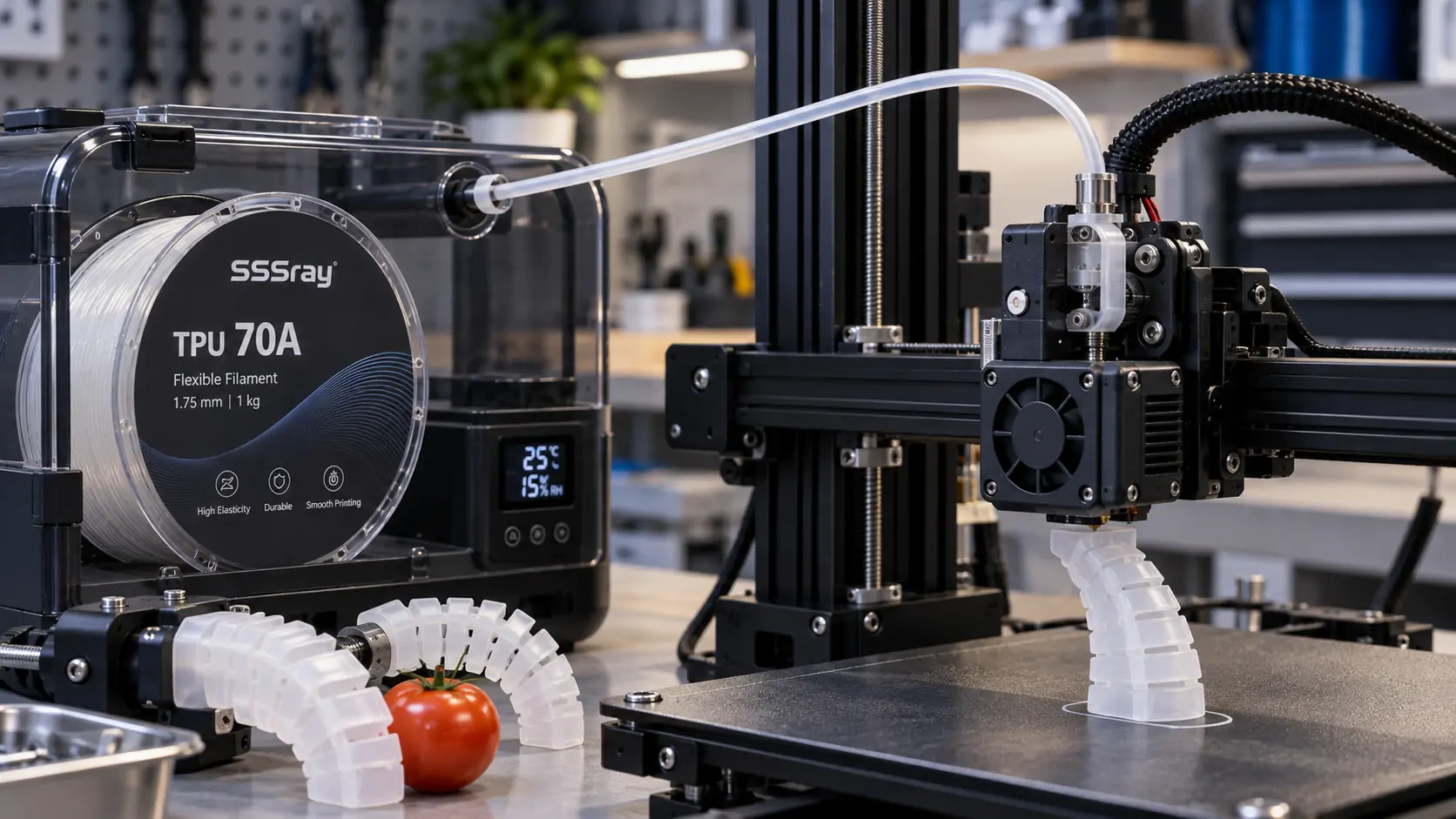
That relationship explains why we focus on a short, constrained feed path instead of publishing one arbitrary universal “maximum gap.” The practical goal is simple: keep the filament supported, keep spool resistance low and avoid creating more melt back-pressure than the soft strand can transmit reliably.
Hardware Priorities
Direct drive: our default starting route for 60A/70A development because the unsupported path is shorter.
Constrained feeding: the filament should remain guided between drive gears and hotend entry.
Low spool resistance: drag, sharp bends and overtight drive tension can destabilize extrusion.
Nozzle selection: nozzle size and volumetric flow should be validated together because both affect back-pressure and wall resolution.
Process Priorities
Dry before qualification: moisture can create bubbles, inconsistent extrusion and pressure-wall leakage.
Control volumetric flow: establish a stable material-flow ceiling before chasing higher linear speed.
Keep retraction under control: very soft filament is more sensitive to aggressive pressure changes in the feed path.
Print the real actuator: a calibration cube cannot validate airtightness, seam placement or pressure cycling.
Swipe horizontally on mobile to view all reference settings.
| Parameter | IEEE 2025 Test | External 60A Commercial Reference | External 70A Commercial Reference | SSSray Use of the Data |
|---|---|---|---|---|
| Printer / nozzle | Original Prusa MK4, 0.4 mm | 0.4 mm published reference available | 0.4 mm published reference available | Useful baseline, but the customer’s real printer and extruder must be tested. |
| Drying | At least 8 h at 45°C before and during printing | 55°C, minimum 1 h | 55°C, minimum 1 h | The difference itself shows why the approved SSSray custom grade needs its own drying instruction. |
| Nozzle temperature | 225°C for 60A; 230°C for 70A | 235°C with a 0.4 mm reference setup | 240°C with a 0.4 mm reference setup | We establish a formulation-specific range during qualification rather than copying a competitor profile. |
| Volumetric flow | Study profile developed through print iteration | 2.0 mm³/s with the published 0.4 mm setup | 2.5 mm³/s with the published 0.4 mm setup | Volumetric flow is a useful control variable for limiting back-pressure on soft filament. |
| Actuator pressure | Bending measured from 40–200 kPa | Not a filament profile parameter | Not a filament profile parameter | Pressure belongs in the finished-gripper test plan, not in a generic filament guarantee. |
External commercial print references in this table are based on current Recreus Filaflex 60A and 70A manufacturer guidance. They are used as third-party benchmarks only; SSSray custom TPU specifications are confirmed through the project qualification process.
6. Supplier Claims SSSray Recommends Verifying Before Bulk Supply
A label such as “60A super soft TPU” is not a complete purchasing specification. For repeat B2B supply, we want the commercial claim connected to a measurable method, batch record or application test.
Swipe horizontally on mobile to view all verification requirements.
| Supplier Claim | What We Recommend Checking | Why It Matters | Retest / Hold Trigger |
|---|---|---|---|
| “TPU 60A / 70A” | Shore A method, conditioning, tolerance, sample geometry and grade identity | Hardness does not define the complete mechanical response. | Material identity or hardness moves outside the approved specification. |
| “±0.03 mm precision” | Diameter definition, ovality method, gauge method, sampling plan and batch traceability | Soft filament feeding can amplify dimensional or ovality variation. | Incoming material exceeds the agreed measurement rule. |
| “No plasticizer” | Manufacturer formulation declaration plus an agreed analytical method when this is critical to the application | A simple FTIR spectrum alone should not be treated as proof that every possible low-level additive is absent. | The supplier cannot define the claim or the agreed restricted-substance test. |
| “Millions of cycles” | Gripper geometry, wall thickness, pressure, frequency, environment, sample count and failure definition | Fatigue life is a system result rather than a Shore-hardness constant. | The claimed cycle number is not linked to a reproducible test. |
| “Food-contact compliant” | Exact grade/color, applicable regulatory basis, test conditions, food type, contact time and temperature | Authorization depends on formulation and intended use, not only the word “TPU.” | The document applies to a different resin, color or use condition. |
| “Works on all printers” | Qualified extruder type, known exclusions, profile and buyer-side trial | Very soft TPU feeding is strongly hardware-dependent. | The material cannot produce stable flow on the approved production setup. |
For repeat orders: we recommend keeping the approved sample identity, print profile, applicable TDS/SDS/CoA, QC record and PO specification together. That gives both sides a written baseline if a future material, pigment or process change needs review.
7. Multi-Material Gripper Design and Food-Contact Scope
A production end effector often combines a rigid mounting structure with a soft gripping element. PCTG, PETG, PC, PA, aluminum or another structural route may carry the tool flange while low-hardness TPU forms the pneumatic finger or contact pad. SSSray recommends qualifying the exact rigid-to-soft joint rather than assigning one universal TPU-to-PCTG or TPU-to-PETG bond-strength value.
How We Recommend Qualifying the TPU-to-Rigid Interface
Print coupons using the intended temperatures, overlap geometry, surface condition and cooling strategy. Compare several replicate parts, then repeat after conditioning that represents the factory environment. For pneumatic assemblies, add a pressure-hold test because a joint can remain mechanically attached while still losing air. Where polymer adhesion is not sufficient, mechanical interlocks, dovetails, holes, clamps or fasteners can make the design more repeatable.
Food Contact: Confirm the Exact Chemistry and Intended Use
For EU projects, Regulation (EU) No 10/2011 remains a key legal framework for plastic materials and articles intended to come into contact with food. In the United States, the applicable FDA route depends on the exact polyurethane chemistry and intended conditions of use. Relevant provisions may include 21 CFR 177.2600 for qualifying repeated-use rubber articles or 21 CFR 177.1680 for specified polyurethane resins used under its defined dry-food conditions. A buyer should therefore verify the exact filament grade, color, applicable legal basis, food type, contact time, temperature, cleaning process and responsibility for the finished printed article before approving a production gripper.
8. B2B Buyer Routes for Low-Hardness TPU
Distributor
What matters: clear 60A/70A positioning, printer compatibility, after-sales support, documents and repeat-batch stability.
SSSray route: define the intended customer and printer range before deciding how the material should be positioned and packaged.
Next step: use our Supplier Comparison Tool to compare the qualification route with your current source.
OEM / Private-Label Brand
What matters: formula stability, branding, packaging, technical files and controlled repeat orders.
SSSray route: approve the low-hardness filament and the final commercial configuration together.
Next step: review SSSray Private Label Filament requirements before artwork and packaging approval.
Commercial Print Farm
What matters: unattended feed stability, moisture control, long-print yield and consistent winding.
SSSray route: test the real printer fleet with locked drying and slicer conditions before bulk approval.
Next step: use the SSSray Test Protocol to document machine-level results.
Robotics / Engineering Buyer
What matters: material model, pressure response, airtightness, grip performance and controlled change management.
SSSray route: send the actual actuator target instead of only a hardness request.
Next step: submit the project through Custom Engineering Filament.
9. RFQ and PO Acceptance Criteria for Custom TPU 60A/70A
For SSSray custom-engineered TPU 60A/70A, the starting MOQ is 150 spools. Final quotation and production planning depend on the confirmed formulation, color, spool weight, test scope, packaging and document requirements.
Before requesting the 150-spool production order: confirm the Shore target, TPU route, color, spool size, dimensional tolerance, drying/print profile, sample acceptance result, required TDS/SDS/CoA and any application-specific regulatory documents.
Swipe horizontally on mobile to view the complete PO checklist.
| PO Item | What to Confirm | Evidence | Bulk-Order Rule |
|---|---|---|---|
| Material identity | TPU route, Shore A target/tolerance, color and approved formula revision | TDS/SDS and sample / order identity | Bulk material must follow the approved specification. |
| Diameter & ovality | Nominal diameter, tolerance definition, ovality rule and inspection method | Batch QC record and buyer incoming check where required | Use the agreed measurement rule rather than an undefined “high precision” claim. |
| Print process | Drying, extruder type, nozzle, temperature, volumetric-flow limit and profile revision | Saved slicer profile and qualification print log | Retest when a critical hardware, material or profile variable changes. |
| Gripper validation | Pressure range, leak test, bend target, object set, payload/contact behavior and cycle conditions | Application test report | Passing the filament TDS does not replace passing the gripper requirement. |
| Custom MOQ | TPU 60A/70A custom engineering projects start from 150 spools | Final SSSray quotation | Formula, color, spool, packaging and testing complexity are confirmed before production scheduling. |
| Documents | Required CoA, TDS, SDS/MSDS, REACH/RoHS or application-specific documents | Files matched to the approved material route and order | Document requirements should be confirmed before the PO rather than after production. |
| Change control | Material, pigment, additive, QC, packaging and document changes that require notification | Approved production specification | Changes affecting the qualified route trigger review or retesting. |
10. Frequently Asked Questions
What is the best TPU hardness for a soft robotic gripper?
There is no universal best hardness. TPU 60A is the stronger starting route when maximum compliance and wrap-around deformation are required, while 70A is worth evaluating when the design benefits from greater self-support. SSSray recommends comparing both grades on the same gripper geometry, object set and pressure range when the application is sensitive to this trade-off.
Is there peer-reviewed evidence that TPU 60A and 70A can be 3D printed into pneumatic grippers?
Yes. A 2025 IEEE Access study characterized low-hardness 60A and 70A TPU, printed pneumatic soft fingers and experimentally measured their tensile, bending, force and grasping behavior. It provides strong evidence that these hardness grades can work for FDM soft grippers when the material, printer and actuator are properly engineered.
What quantitative difference did the IEEE study find between 60A and 70A?
Under the study’s printed-specimen tensile method, elastic modulus was approximately 4.43 MPa for 60A and 6.62 MPa for 70A. In the tested finger geometry at 200 kPa, the 60A finger reached approximately 104° of bending and the 70A finger approximately 81°. SSSray uses these values as external engineering benchmarks rather than as product guarantees for a custom formulation.
How do you print TPU 60A without feed jams?
Use a direct-drive system with a tightly constrained filament path, minimize spool resistance and unsupported gaps, dry the material according to the approved formulation and establish a conservative volumetric-flow limit before increasing print speed. Very soft TPU is more sensitive to melt back-pressure and feed-path geometry than conventional TPU 95A.
Can TPU 60A or 70A be specified for millions of gripper cycles?
Only after a defined fatigue test. A meaningful cycle specification should include the actual gripper geometry, print orientation, pressure, frequency, environment, object or load, sample count and failure criterion. For production projects, SSSray recommends validating cycle life on the customer’s real actuator instead of transferring a generic cycle claim from another design.
Does food-grade TPU automatically make a printed gripper compliant for food handling?
No. The applicable compliance route depends on the exact formulation, color, finished article and intended conditions of use. EU projects may require evaluation under Regulation (EU) No 10/2011, while relevant U.S. polyurethane routes can depend on the exact chemistry and may involve provisions such as 21 CFR 177.2600 or 177.1680. The correct documentation must match the actual filament and application.
What evidence should I request when sourcing custom low-hardness TPU?
Request the exact material identity, Shore A test method and tolerance, TDS and SDS, diameter and ovality method, drying and print guidance, applicable CoA or batch evidence, sample identification, required regulatory files and written change-control terms. Then validate the material on the printer and gripper that will be used in production.
What is SSSray’s MOQ for custom TPU 60A or 70A?
SSSray custom engineering TPU 60A/70A projects start from 150 spools. Final confirmation depends on the formulation, color, spool configuration, test requirements, packaging and documents. Send us the target hardness, printer, application, quantity and destination so we can confirm the most practical development route.
11. Start a Low-Hardness TPU Qualification Project with SSSray
TPU 60A and 70A are no longer only experimental soft materials. Current peer-reviewed work shows that properly printed low-hardness TPU can produce highly compliant pneumatic fingers and functional robotic grippers. The commercial challenge is turning that capability into a repeatable spool, print profile and actuator result.
That is where SSSray’s role begins. We connect the material formulation with feeding, drying, printing, pneumatic performance, QC documentation and the repeat-order specification. For custom TPU 60A/70A, the production route starts from 150 spools after the project scope is confirmed.
Send your target hardness, printer/extruder, nozzle, gripper geometry, operating pressure, object type, quantity, destination and document requirements. SSSray will review the material route before trial and bulk production.
Request a quote or free samples
Tell us the material, color, spool size and monthly volume. An engineer replies within 24 hours on business days.
12. Technical References
- Meitani, K. & Nisar, S. Materials and Methods for Designing 3D-Printed Soft Robot Grippers in Low-Hardness TPU (60A–70A). IEEE Access, 2025. DOI: 10.1109/ACCESS.2025.3642169.
- Moreno Garces, C., Morales Pavez, G. & Guerra Silva, R. Design and evaluation of 3D-printed soft pneumatic actuators. Results in Materials, Vol. 29, 2026, 100906. DOI: 10.1016/j.rinma.2026.100906.
- Recreus Filaflex 60A technical and printing guidance.
- Recreus Filaflex 70A technical and printing guidance.
- ISO 868:2003, Plastics and ebonite — Determination of indentation hardness by means of a durometer.
- ISO 34-1:2022, Rubber, vulcanized or thermoplastic — Determination of tear strength.
- ISO 1133-1:2022, Plastics — Determination of melt mass-flow rate and melt volume-flow rate.
- Commission Regulation (EU) No 10/2011, consolidated version applicable to plastic food-contact materials and articles.
- 21 CFR 177.2600, Rubber articles intended for repeated use.
- 21 CFR 177.1680, Polyurethane resins.