Online time
Monday to Friday: 9AM - 8PM
Weekend: 10AM - 5PM


TL;DR: How B2B Buyers Should Control TPU 95A Printing Problems
Use a controlled comparison to diagnose TPU 95A failures: hold the printer, part and profile steady, then compare a properly prepared reference spool with the suspect lot. Record moisture history, feed-path resistance, extrusion behavior and the failure location. This page focuses on separating material, feeding and process causes before changing a supplier or approving a production lot.
Best starting profileDirect drive, dry box feed, grade-specific nozzle temperature, moderate bed heat, low retraction.
QC gateDiameter log, Shore hardness report, moisture-control record, TDS, SDS or safety information, REACH SVHC statement.
Procurement riskGeneric “high speed TPU” claims without test conditions should be treated as unverified.
SSSray fitUse this guide to request batch-specific evidence before approving bulk TPU supply.

He Jiang
Senior Researcher · SSSray · 3D Printing Filament Manufacturing · Jinhua, Zhejiang
He Jiang writes for SSSray on filament qualification and B2B sourcing. This guide connects flexible-filament feeding, drying, process records and incoming-lot checks for production buyers.
Why TPU 95A Printing Problems Are Often Procurement Problems
TPU is a thermoplastic elastomer. Its flexible behavior is useful for seals, protective cases, footwear components, vibration dampers, soft-touch parts, and industrial fixtures. The same flexibility also creates process risk. Compared with PLA or PETG, TPU is easier to compress in the feed path, more sensitive to moisture, and more likely to show stringing, oozing, under-extrusion, or gear slippage when the material and printer profile are not matched.
For B2B buyers, the important question is not “can TPU 95A print?” The useful question is: “Can this TPU 95A be printed repeatedly across my machines, packaging conditions, customer support promises, and compliance requirements?” That is why this guide combines print settings with incoming quality control and supplier verification.
Seven TPU 95A Pitfalls to Avoid
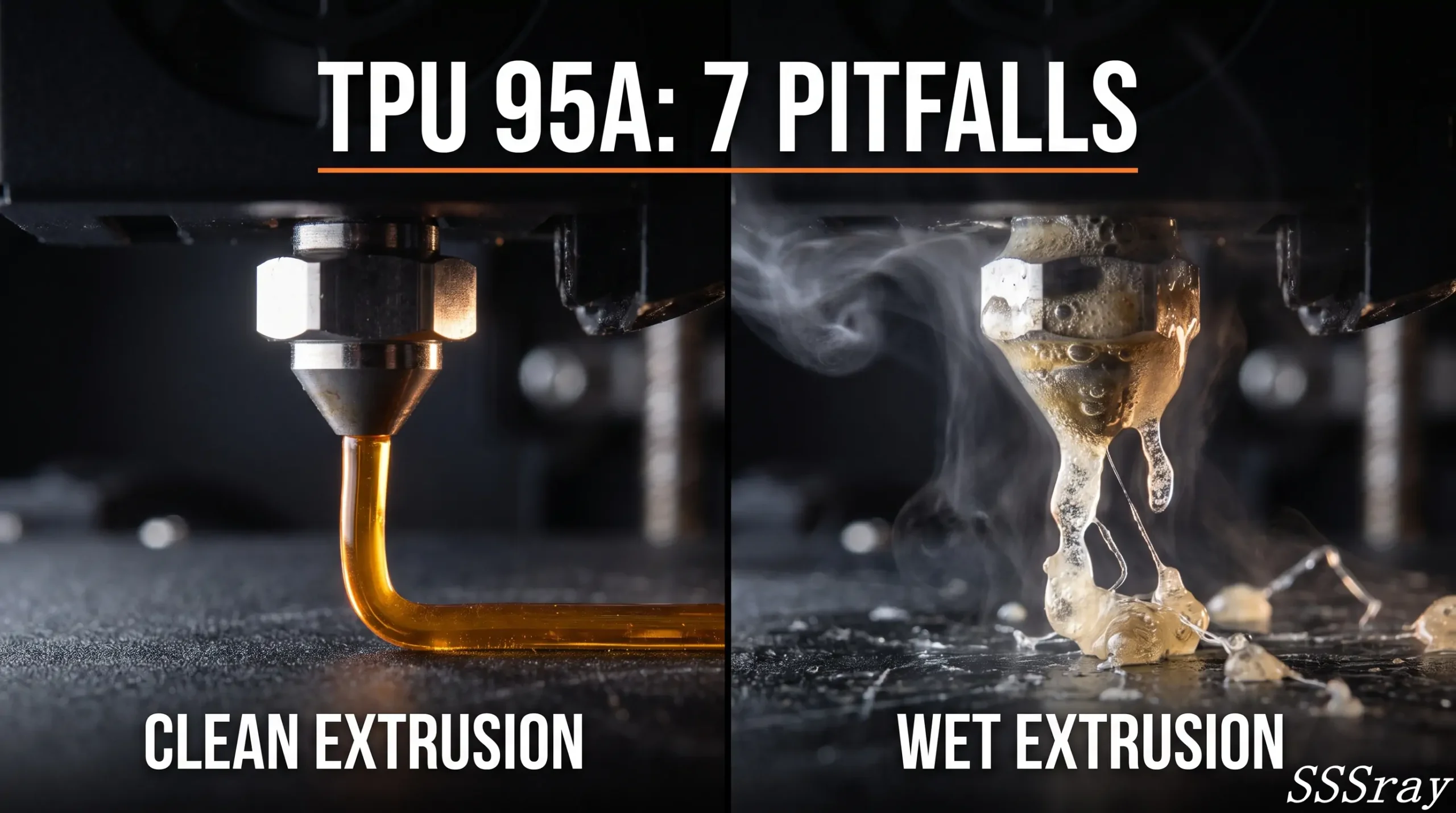
1. Printing TPU before drying it
Problem: Moisture in TPU can cause bubbles, popping, rough surface texture, stringing, weaker layer bonding, and inconsistent extrusion. In heated processing, moisture can also contribute to polymer degradation.
Fix: Dry TPU before production printing when storage history is uncertain or moisture symptoms appear. Use the approved SSSray grade-specific drying condition and verify both the dryer and spool limits. Do not apply one generic temperature to every TPU formulation.
How to verify: For incoming QC, request a moisture test method such as Karl Fischer titration or a supplier moisture-control report tied to the batch number.
2. Assuming Bowden and direct-drive printers behave the same
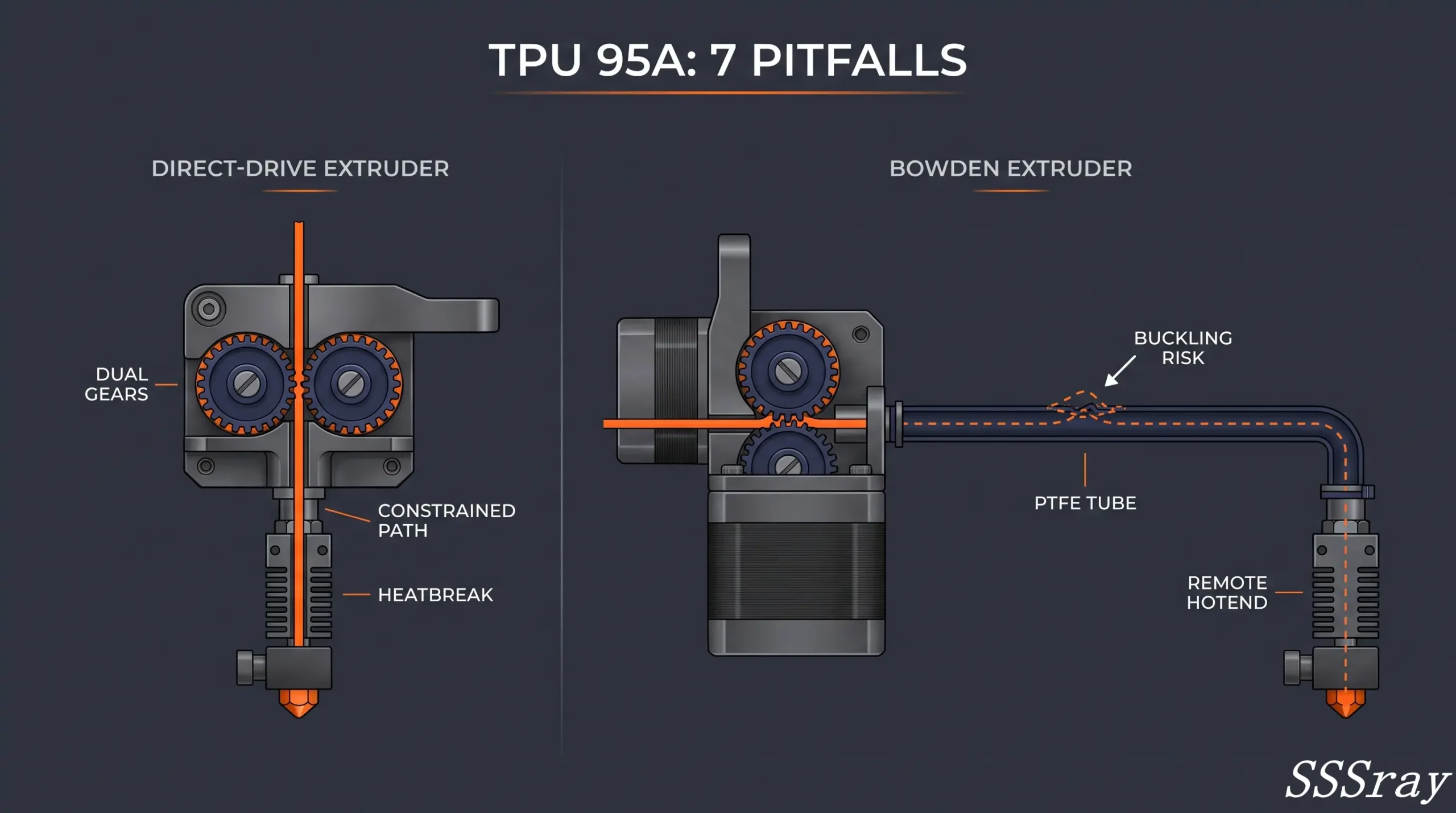
Problem: TPU can compress and buckle when pushed through a long Bowden tube. The longer and less constrained the feed path is, the more likely the filament is to behave like a spring instead of a rigid column.
Fix: Use direct-drive extruders for production. If a customer must use Bowden hardware, specify a slower profile, very low retraction, and a well-constrained path.
How to verify: Ask the supplier for test profiles by printer class, not only a generic nozzle temperature range.
3. Using PLA-style retraction settings
Problem: Aggressive retraction can stretch TPU, pull softened material into the heat break, increase grinding, and trigger jams.
Fix: Start with low retraction. For many direct-drive systems, 0.5-1.5 mm is a safer tuning window than rigid-filament settings. Some TPU profiles perform better with retraction disabled and travel moves optimized instead.
How to verify: Run a retraction tower and inspect not only stringing, but also extrusion recovery after travel moves.
4. Selling “high speed TPU” without volumetric-flow evidence
Problem: Linear speed claims are misleading because nozzle size, layer height, hotend capacity, and melt viscosity change the actual extrusion load.
Fix: Ask for a maximum volumetric flow range with test conditions: nozzle diameter, layer height, nozzle temperature, printer model, part geometry, and failure definition.
How to verify: Print a stepped-flow test and stop at the first visible under-extrusion, surface tearing, grinding, or dimensional drift.
5. Ignoring bed adhesion and over-adhesion
Problem: TPU can either lift during printing or bond too aggressively to PEI/glass surfaces, damaging the build plate during removal.
Fix: Use a controlled first layer, moderate bed temperature, and a release layer when needed. Do not treat maximum bed adhesion as a success metric for TPU.
How to verify: Include part-removal behavior in the qualification record, especially for print farms that remove hundreds of parts per week.
6. Buying only by Shore hardness
Problem: Two TPU 95A products can behave differently because resin chemistry, additives, melt flow, moisture control, colorants, and compounding stability vary.
Fix: Match ether-based or ester-based TPU to the application. Polyether TPU is generally favored where hydrolysis resistance matters; polyester TPU is often selected for abrasion or oil-resistance priorities, depending on the grade.
How to verify: Request the resin family, SDS/TDS, hardness test method, and application notes before committing to private-label or bulk supply.
7. Treating compliance documents as after-sales paperwork
Problem: EU importers and brand owners may need evidence related to REACH SVHC disclosure, PFAS-related restrictions, PPWR packaging compliance, and customer safety communication. RoHS evidence may also be requested when the filament is sold into electronics-related supply chains.
Fix: Ask for TDS, SDS or safety information, REACH SVHC documentation, RoHS statements where relevant, packaging material details, and batch traceability before the order is approved.
How to verify: Check that documents name the supplier, material, batch or product family, date, and responsible contact. Generic certificates without product connection should not pass supplier verification.
Starting Print Settings for TPU 95A
Use these as conservative starting ranges, then tune by SSSray grade, printer model, hotend capacity, nozzle size, part geometry, and customer acceptance criteria.
| Parameter | Starting range | Why it matters | Buyer verification action |
|---|---|---|---|
| Nozzle temperature | 210-235°C | Too low can under-extrude; too high can increase oozing or stringing. | Ask for grade-specific TDS and printer test profile. |
| Bed temperature | 45-60°C | Controls first-layer adhesion and part removal risk. | Record surface type and removal method during sampling. |
| Print speed | 20-50 mm/s | TPU usually needs lower pressure than rigid filament profiles. | Validate with the target machine, not a demo printer only. |
| Retraction | 0-1.5 mm for many direct-drive systems | Excess retraction can stretch the filament and cause jams. | Run retraction tests and inspect recovery after travel moves. |
| Drying | Use SSSray TDS; common TPU 95A public references sit around 60-70°C for several hours | Moisture causes bubbles, stringing, surface defects, and weak parts. | Request batch moisture control evidence for bulk orders. |
| Storage while printing | Dry box feed recommended | Prevents moisture reabsorption during long jobs. | Test the customer workflow, including overnight printing. |
Incoming QC Framework for TPU 95A Buyers
This is the procurement framework that should separate a B2B supplier from a generic product listing. It helps buyers decide whether a TPU spool is ready for distributor inventory, OEM branding, or production use.
| QC item | Document or test to request | Pass signal | Fail signal |
|---|---|---|---|
| Diameter and ovality | Laser diameter log or batch QC report | Batch-linked tolerance record | Only a catalog claim with no measurement evidence |
| Shore hardness | ASTM D2240 or ISO 868 report | Method, date, batch/product family identified | “95A” listed without test method |
| Moisture control | Drying record, packaging spec, or Karl Fischer test where available | Packaging and storage method documented | Standard plastic bag with no barrier claim |
| Chemical disclosure | TDS, SDS or safety information, REACH SVHC statement, RoHS statement where relevant | Current documents tied to TPU product family | Expired or unrelated certificates |
| Application fit | Polyether/polyester resin family and application notes | Supplier explains trade-offs by end use | One material recommended for all applications |
| Print validation | Profile sheet with printer, nozzle, layer height, and failure criteria | Real test conditions shown | Only “easy to print” or “high quality” language |
Supplier Claims vs. Buyer Evidence
| Supplier claim | What it may hide | Evidence to request | Buyer decision |
|---|---|---|---|
| “High speed TPU” | Nozzle, layer height, hotend, and part geometry may not be disclosed. | Volumetric-flow test with conditions and failed-sample photos. | Do not compare speed claims unless test conditions match. |
| “Vacuum sealed” | Packaging may still have weak moisture-barrier performance. | Bag structure, desiccant specification, shelf-life storage recommendation. | Approve only after packaging sample inspection. |
| “REACH compliant” | Certificate may be generic or out of date. | Product-family declaration, SDS, date, issuer, and SVHC review scope. | Require updated documents for EU-facing customers. |
| “Food contact safe” | Printed parts introduce printer and layer-line risks. | Exact regulatory basis, tested formulation, and use limitation. | Avoid broad food-safe claims unless SSSray confirms the legal basis. |
What Each Buyer Type Should Check
Distributor
Distributors care about complaint rate, storage stability, packaging damage, sell-through, and whether customer support can answer print-setting questions. Trust increases when SSSray provides shelf-life guidance, packaging photos, SDS/TDS, and a troubleshooting sheet for common printers.
OEM brand
OEM brands care about private-label consistency, repeatable color, hardness tolerance, compliant documents, and carton/spool customization. Trust increases when SSSray provides batch traceability, retained samples, packaging approval, and pre-shipment QC records.
Print farm
Print farms care about uptime, low jam frequency, drying workflow, speed limits, and predictable part removal. Trust increases when SSSray helps validate the exact printer fleet profile before a bulk order.
Engineering buyer
Engineering buyers care about end-use performance: hydrolysis resistance, abrasion, compression, service temperature, and chemical exposure. Trust increases when SSSray explains resin-family selection instead of selling every TPU as universal.
Supplier Data That Buyers Should Confirm
For bulk TPU 95A orders, buyers should confirm the current MOQ, lead time, diameter tolerance, packaging structure, available colors, certification scope, SDS/TDS availability, PFAS-related statement wording, REACH documentation, RoHS statement where relevant, food-contact claim policy, and whether product images are actual SSSray product photos or representative editorial images.
When to Contact SSSray
Send us the printer and extruder type, nozzle, current profile, drying history, spool batch and a photo of the failure. First compare a short, constrained feed path and a known-good prepared spool; change one variable at a time. If the problem is part of a wider rigid-material workflow, use our general filament troubleshooting sequence. Accept a lot against the agreed print and QC criteria rather than a hardness label alone.
Request a quote or free samples
Tell us the material, color, spool size and monthly volume. An engineer replies within 24 hours on business days.
References and Verification Sources
- ECHA Candidate List of substances of very high concern for REACH SVHC verification and supplier disclosure obligations.
- ECHA PFAS topic page for the current status of broad PFAS restriction evaluation and PFAS-related EU restriction activity.
- Regulation (EU) 2025/40 for packaging and packaging waste requirements relevant to EU-facing filament packaging strategy.
- ASTM D2240 for durometer hardness testing of elastomeric materials and thermoplastic elastomers.
- ISO 15512 for plastics water-content determination methods, including Karl Fischer-based approaches.
- ISO 868 for indentation hardness testing by durometer, relevant to Shore hardness verification.
Frequently Asked Questions
How do I know whether TPU 95A problems come from settings or filament quality?
Dry the spool, print on a direct-drive machine, use a conservative speed profile, and check diameter consistency. If popping, severe stringing, under-extrusion, or jams remain after controlled drying and profile reduction, request batch QC data from the supplier.
Can TPU 95A be printed on a Bowden extruder?
It can sometimes be printed slowly on a well-constrained Bowden setup, but direct drive is the safer choice for commercial production. Bowden systems increase compression, friction, and delayed extrusion response.
What drying temperature should I use for TPU 95A?
Use the approved SSSray grade instructions and verify the dryer and spool temperature limits. TPU formulations differ, so a generic internet temperature is not a production drying specification. Record the cycle and keep the material protected during printing.
What documents should a B2B TPU supplier provide?
Ask for TDS, SDS or safety information, REACH SVHC documentation, RoHS statements where relevant, batch hardness data, diameter tolerance evidence, packaging specifications, and print-profile test conditions. For EU-facing brands, also check PFAS-related wording and PPWR packaging compliance requirements.
Is TPU 95A better than TPU 85A for print farms?
TPU 95A is usually easier to feed and qualify because it is stiffer. TPU 85A is softer and more flexible, but it usually requires slower printing, tighter feed-path control, and more careful drying.
Should distributors publish fixed TPU performance claims?
Only publish fixed claims when SSSray confirms the test method, batch scope, and application limit. Otherwise, describe the claim as a document to request or a qualification point to verify.
How can I isolate a TPU feed-path problem?
Compare a properly prepared reference spool and the suspect lot on the same printer and part. Inspect feed-path resistance and signs of buckling, and change one variable at a time. Record the spool batch and profile before escalating the failure.