Online time
Monday to Friday: 9AM - 8PM
Weekend: 10AM - 5PM


TL;DR: Amazon FBA Buys Reach; Distributors and Direct B2B Keep the Margin
An Amazon FBA filament business lives or dies on one number: the fixed fulfillment fee. On a 1 kg spool priced at $19.99, Amazon keeps $9.30, or 46.5%, before storage, ads and returns. Independent distributors and direct bulk accounts cost a discount of roughly 35–45% off list instead, but they buy by the case and carry part of the support load. Figures were checked on .
Best optionA hybrid: core PLA and PETG by the case to distributors, print farms and schools; multipacks and higher-priced specialty or engineering spools on Amazon FBA.
When not to use itSkip single 1 kg commodity spools on FBA below your break-even price, about $21 at a $9.35 landed cost. Skip a master distributor if your margin cannot fund two discount tiers.
Key specificationPacked gross weight and box size per SKU. 2.75 lb and 3.00 lb are FBA fee lines; 18 × 14 × 8 in is the Large Standard limit.
Verify the supplierAsk for measured gross weight on 20 packed units, carton dimensions, and invoices that name your trademark.
Procurement warningFrom October 15, 2026 to January 14, 2027, Amazon’s peak rate lifts the same spool’s fulfillment fee from $6.90 to $7.33. USPS holiday prices began on October 4.
Abstract
Selling filament in the United States got more expensive in 2026, and not only at the border. For Chinese-origin filament entered under HTSUS 3916.90.3000 and not covered by an applicable exclusion, this guide models the current duty stack at 44.0%. Amazon raised fulfillment fees in January, added a 3.5% fuel and logistics surcharge in April, and applies holiday peak rates from October 15. USPS changed its Ground Advantage prices three times, then added temporary holiday prices on October 4.
So brand owners, distributors and print farms keep asking the same thing: which channel still makes money? It depends on the price of the spool, the size of the order and how much help the buyer needs.
Three misunderstandings cause most of the damage. First, that Amazon’s cut is “about 15%.” For filament the referral fee is 12%, but the fixed fulfillment fee is the bigger line, so the real take runs from about 21% on an $80 spool to about 61% on a $14 one. Second, that a distributor takes 35% for nothing; that discount pays for inventory, small-order shipping, credit and first-line support. Third, that fulfillment is a warehouse question. It is mostly a packaging question, because fee bands follow packed weight and box size, both fixed at the factory.
The B2B decision logic follows from those facts. Match the channel to three things you can measure: selling price per spool, spools per order, and the support each sale needs. Cheap, repeat products move best in cases and pallets. Higher-priced or more visual products can carry marketplace fees.
This guide compares the three main B2B filament sales channels in the USA: Amazon FBA, independent distributors, and direct bulk programs for print farms, makerspaces and schools. It uses six tools: the 2026 Amazon fee stack on one spool, with a break-even table by landed cost; a fulfillment-cost curve by order size, in standard and holiday pricing; a margin model across distribution tiers; a decision path with a material-by-material table; the seven-checkpoint Channel-Fit Scorecard; and an SSSray measured lot record, turned into a packaging weight budget for each FBA fee band.
Fee and postage figures come from published 2026 rate cards. The margin examples use one stated landed cost, so you can swap in your own. Retail price points are June 11, 2026 brand-store retail benchmarks from manufacturers’ own stores, not SSSray prices.
Key Takeaways
- Amazon’s take on filament depends on price. Referral fee (12%) plus FBA fulfillment ($6.90 for a 2.75–3 lb unit) equals 61.3% of a $13.99 spool, 46.5% at $19.99 and 21.0% at $79.99.
- A single commodity spool on FBA breaks even near $21. With a $9.35 landed cost and ads at 10% of sales, break-even is $21.08; with no ads it is $18.68. Each $1.00 off landed cost lowers it by $1.14 to $1.28.
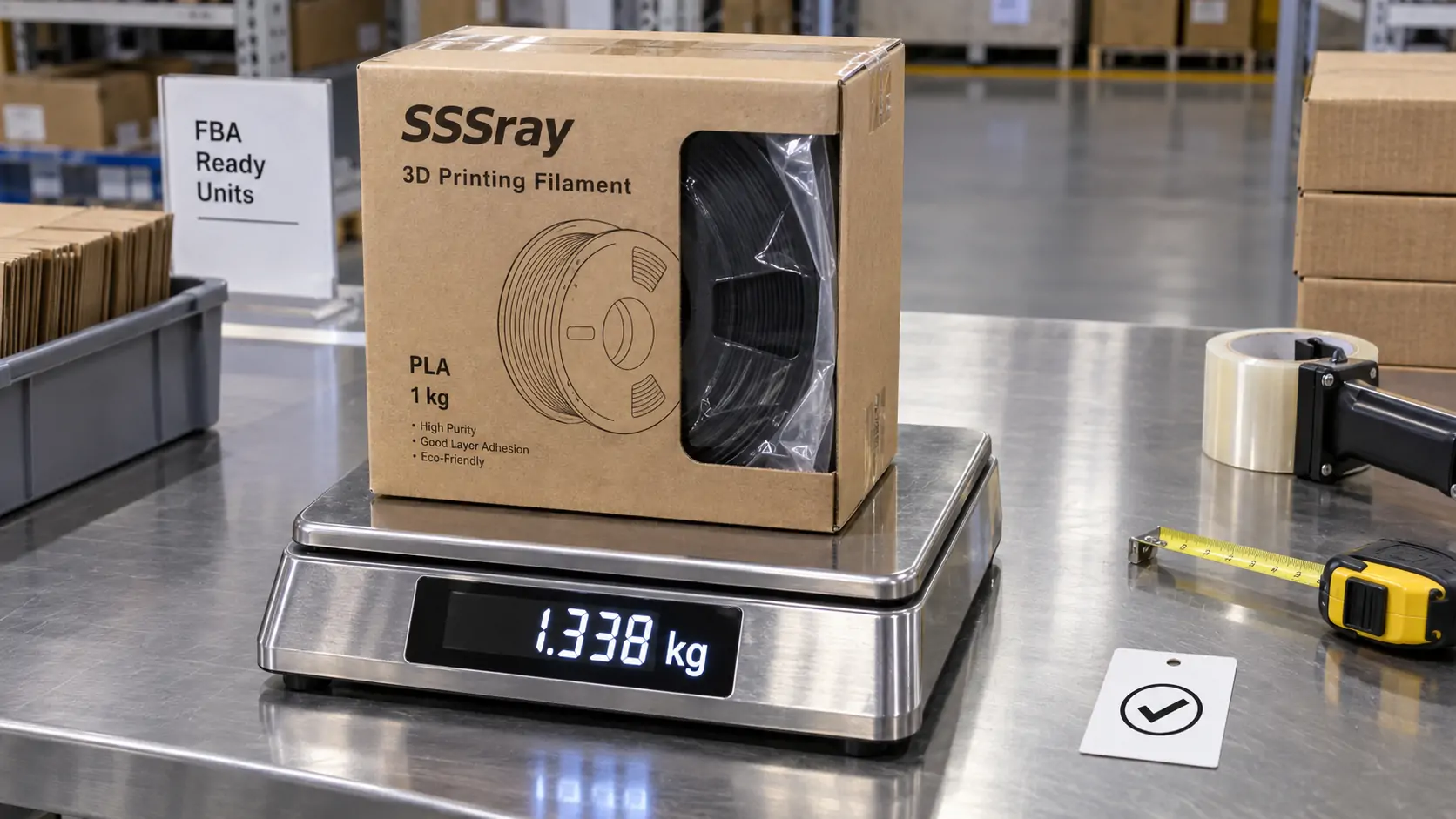
- Packed weight is a fee decision. Under 2.75 lb the fee is $6.48; just over 3.00 lb it is $7.30. That $0.82 gap is set by spool, box and desiccant choices.
- Multipacks change the FBA math. A two-pack costs about $4.10 per spool to fulfill and a four-pack about $2.55, provided the carton stays inside 18 × 14 × 8 in.
- Your own warehouse wins from about four spools per order. On published USPS rates and 3PL benchmarks, cost per spool falls from $14.77 for one spool to $5.89 for four and $4.81 for six. Holiday pricing lifts both routes; three spools are effectively break-even, while four spools clearly favor the warehouse or 3PL route.
- Published US wholesale programs run about 35–45% off MSRP. At 35% off a $19.99 list, the brand keeps $3.64 per spool on a $9.35 landed cost; at 45% off, $1.64, so a second tier needs room.
- Amazon paperwork starts at the factory. Brand Registry needs a registered or pending trademark shown on the packaging, and FBA stock must arrive labeled now that Amazon’s US prep service has ended.
- Engineering filament is a two-step sale. Fees are light on a $50–80 spool, but the first sale needs application support; use online channels for reorders.
- A measured lot sets the packaging budget. SSSray lot PLA175-BK-260921-L12 averaged 1,004.3 g net, with a maximum of 1,007.9 g. That leaves 239 g of packaging under the 2.75 lb line and 352 g under the 3.00 lb line.
1. Amazon FBA Filament Fees: What One Spool Really Pays in 2026
Direct answer: on a 1 kg spool that ships at 2.75–3 lb and sells for $19.99, Amazon keeps $2.40 in referral fee and $6.90 in fulfillment fee. That is $9.30, or 46.5% of the price, before storage, advertising and returns. The fulfillment fee is fixed per unit, so the cheaper the spool, the bigger Amazon’s share.
The 2026 fee stack, line by line
Table 1 works as a one-page Amazon FBA fees calculator for 3D printing filament, using Amazon’s 2026 US rates for a Large Standard unit priced $10–$50. For this model, we use the 12% referral fee that Amazon’s fee schedule lists for Business, Industrial, and Scientific Supplies.
On mobile, swipe horizontally to review every column.
| Fee line | 2026 rate | On one $19.99 spool | When it applies |
|---|---|---|---|
| Referral fee | 12% of the total price; $0.30 minimum | $2.40 | Every sale |
| FBA fulfillment fee, non-peak | $6.67 for 2.75+ to 3 lb | $6.67 | Units shipped January 15 – October 14, 2026 |
| Fuel and logistics surcharge | 3.5% of the fulfillment fee | $0.23 | Since April 17, 2026; no end date announced |
| Holiday peak fulfillment fee | $7.08 for 2.75+ to 3 lb, plus 3.5% | $7.33 instead of $6.90 | Units shipped October 15, 2026 – January 14, 2027 |
| Monthly storage | $0.78 per cu ft (Jan–Sep); $2.40 (Oct–Dec) | About $0.09, or $0.29 in Q4, per month | While in stock; a boxed spool is about 0.12 cu ft |
| Low-inventory-level fee | $0.36–$0.97 per unit (Large Standard up to 3 lb) | $0 at 28 or more days of supply | When 30-day and 90-day supply both fall below 28 days |
| Inbound placement fee | $0 with Amazon-optimized splits; $0.34–$0.60 with minimal splits (Large Standard, 1.5–3 lb) | $0, or $0.34–$0.60 if sent to one location | Per inbound shipment plan |
Add the first three lines and you get $9.30. The remaining $10.69 has to cover landed cost, storage, ads and returns.
One caution: Amazon notes that a fee category can differ from the category shoppers see, so confirm the 12% on your own listing.
Why a fixed fee punishes a cheap spool
Think of the fulfillment fee as a taxi’s flag-drop charge: the same whether the ride is short or long. A $14 spool and a $50 spool of the same weight both pay $6.90; above $50 the fee becomes $7.17.
Amazon’s share of the selling price on one 1 kg spool (referral + FBA fulfillment)
In the budget PLA tier, Amazon keeps most of the money. Above $50, it keeps about a quarter or less. From October 15 the peak rate adds about two points at $19.99, to 48.7%, and three at $13.99, to 64.4%.
Market price note: the retail price points in Figure 1 and the $19.99 list price used throughout this guide are June 11, 2026 retail benchmarks checked across manufacturers’ own stores. They are not SSSray prices. SSSray quotes factory-direct, highly competitive pricing by material, color, order volume and packaging. Request a current quote.
What is the average margin selling filament on Amazon FBA?
No audited average exists. Margin depends on the price point, so model it:
Break-even price = (landed cost + fulfillment fee + storage) ÷ (1 − 12% − ad share).
We use $9.35 per kilogram as the landed cost. It comes from the landed-cost model in our Section 301 filament tariff guide, which assumes a $6.00/kg FOB reference input and, for Chinese-origin filament entered under HTSUS 3916.90.3000 and not covered by an applicable exclusion, a 44.0% duty stack after the July 24, 2026 Section 301 action. It is a worked-example input, not an SSSray quotation, and a lower factory price moves every number below in your favor.
With two months of storage ($0.19), break-even is $18.68 with no advertising and $21.08 with ads at 10% of sales. At $19.99 the spool leaves $1.15 before ads, or 5.8% of the price. During peak season, break-even with ads rises to about $22.12.
Now compare that with the market. A June 2026 price survey put the PLA median near $20 per kilogram, with a budget tier near $14. So a single commodity spool bought at this landed cost does not pay its way on FBA.
Break-even price at your own landed cost
Landed cost is the input a buyer controls most, so Table 2 reruns the formula at five levels. Every $1.00 taken off landed cost lowers break-even by $1.14 without ads and by $1.28 with ads at 10% of sales.
On mobile, swipe horizontally to review every column.
| Landed cost per spool | Break-even, no ads | Break-even, ads at 10% of sales | Break-even in peak season, ads at 10% | Left at $19.99 before ads | Share of price |
|---|---|---|---|---|---|
| $6.50 | $15.44 | $17.42 | $18.47 | $4.00 | 20.0% |
| $7.50 | $16.58 | $18.71 | $19.75 | $3.00 | 15.0% |
| $8.50 | $17.72 | $19.99 | $21.03 | $2.00 | 10.0% |
| $9.35 (model input) | $18.68 | $21.08 | $22.12 | $1.15 | 5.8% |
| $10.50 | $19.99 | $22.55 | $23.60 | $0.00 | 0.0% |
Calculated by SSSray from Table 1. The peak column uses the $7.33 fulfillment fee and fourth-quarter storage. At an $8.50 landed cost, break-even with ads lands exactly on the $19.99 market median. At $10.50, the spool only breaks even with no advertising at all. So the factory price, duty and freight you negotiate decide whether a single-spool listing is viable.
Procurement implicationAsk every supplier for packed gross weight and box dimensions before you price a listing.
Mistake to avoidWriting “Amazon takes 15%” into a filament business plan.
How to verifyEnter price, weight and dimensions in Amazon’s Revenue Calculator and compare the result with Table 1.
2. Cost Comparison: Amazon FBA vs Own Warehouse in the USA
Direct answer: for one or two spools per order, FBA is cheaper than shipping from your own warehouse or a 3PL. From about four spools per order, your own warehouse wins. FBA charges per unit, while a parcel carrier charges per box, so the cost per spool falls as the box fills.
Fulfillment cost per spool by order size
Figure 2 compares three routes. The FBA lines use the 2026 rate card with the 3.5% surcharge. The warehouse line uses USPS Ground Advantage commercial prices for Zone 5, effective July 12, 2026, plus a modeled 3PL handling input of $3.20 for the first item and $0.50 for each extra one. Both sit inside published 2026 pick-and-pack ranges; $0.50 is the low end of the published additional-item range.
Fulfillment cost per 1 kg spool vs. spools per order
FBA, single-spool listingFBA, multipack listing (2-pack, 4-pack)Own warehouse or 3PL + USPS Ground Advantage
A single spool shipped from a 3PL costs $14.77, more than twice FBA’s $6.90. At three spools the two routes are level, at $6.99 and $6.90. At six spools the warehouse route is down to $4.81 per spool.
That is why channel follows order size: hobby buyers take one or two spools, while print farms, makerspaces and resellers take cases.
Holiday pricing: October 2026 to January 2027
Both routes cost more in the fourth quarter. USPS added temporary holiday prices on October 4, 2026, in force until January 17, 2027. For commercial Ground Advantage parcels to Zones 5–9, the increase is $0.55 up to 3 lb, $1.05 from 4 to 10 lb and $1.75 from 11 to 25 lb. Amazon’s peak fulfillment rates run from October 15, 2026 to January 14, 2027. Table 3 applies both to the parcels in Figure 2.
On mobile, swipe horizontally to review every column.
| Spools per order or pack | Own warehouse or 3PL, standard | Own warehouse or 3PL, holiday | FBA single-spool listing, non-peak | FBA single-spool listing, peak | FBA multipack, non-peak | FBA multipack, peak |
|---|---|---|---|---|---|---|
| 1 | $14.77 | $15.32 | $6.90 | $7.33 | — | — |
| 2 | $9.30 | $9.83 | $6.90 | $7.33 | $4.10 | $4.38 |
| 3 | $6.99 | $7.34 | $6.90 | $7.33 | — | — |
| 4 | $5.89 | $6.33 | $6.90 | $7.33 | $2.55 | $2.69 |
| 5 | $5.27 | $5.62 | $6.90 | $7.33 | — | — |
| 6 | $4.81 | $5.10 | $6.90 | $7.33 | — | — |
Calculated by SSSray from the Figure 2 inputs plus the published holiday increases. The season raises every line by roughly 4–8%. At three spools the two routes are effectively break-even at $7.34 and $7.33 per spool; at four spools the warehouse or 3PL route is clearly cheaper. A four-pack priced above $50 pays the higher price band, $2.62 per spool non-peak and $2.76 in peak.
Why a 1 kg spool sits on a fee line
Amazon’s Large Standard bands step every quarter pound. A boxed 1 kg spool carries roughly 200–400 g of spool, bag, desiccant and carton, so it lands between about 2.6 and 3.1 lb, right across two fee lines.
Under 2.75 lb the fee is $6.48. Up to 3.00 lb it is $6.90. Just over 3.00 lb it is $7.30. In other words, a lighter spool or carton can be worth $0.42 on every unit. Section 10 turns this into a gram budget.
Multipacks and the 8-inch rule
Large Standard allows up to 20 lb and 18 × 14 × 8 in. A 200 mm spool is 7.87 in across, so its retail box is usually a little over 8 in on two sides. A multipack therefore stays Large Standard only when the stack height is the short side.
- Two-pack, stacked: about 8.3 × 8.3 × 6 in; about $8.21 to fulfill, or $4.10 per spool.
- Four-pack, 2 × 2 slab: about 16.6 × 8.3 × 6 in; about $10.19, or $2.55 per spool ($10.46 if priced above $50).
- Three or more in one column: every side exceeds 8 in, so the unit leaves Large Standard for Small Bulky, at $7.55 plus $0.38 per pound above the first. A four-spool column of about 8.3 × 8.3 × 12 in costs about $12.14 with the surcharge, against $10.19 for the slab.
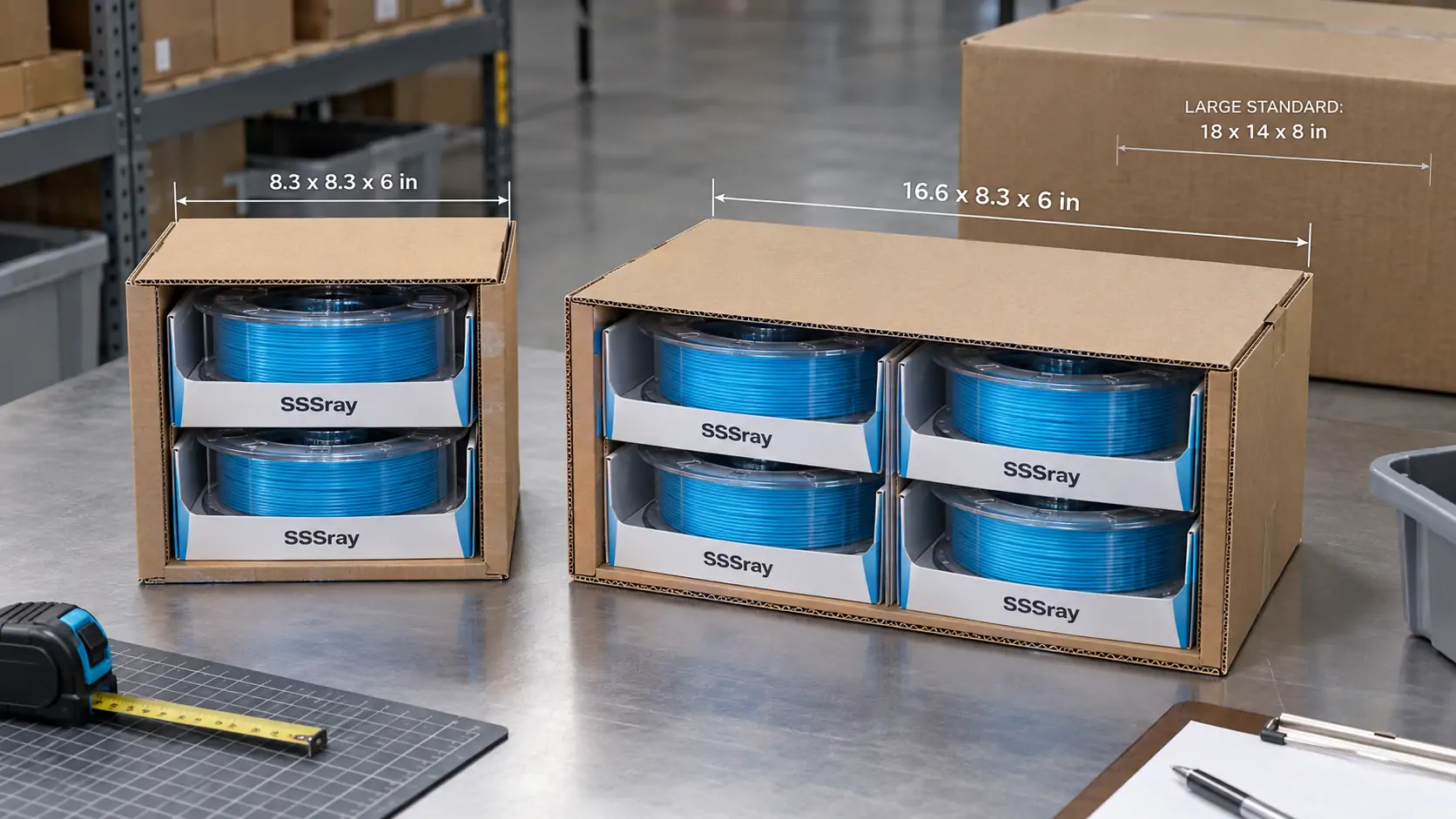
These figures assume an 8.3 × 8.3 × 3.0 in retail box, a model input. Measure your own carton first. Bulky units also pay higher inbound placement fees when sent to one location. Two-spool and four-spool bundles are how established brands list core PLA and PETG on Amazon, and the carton layout is what keeps them in Large Standard.
Storage, by contrast, is a small line: about $0.09 per spool per month at Amazon and $0.29 in Q4. The larger cost is stock that sits, because Amazon adds aged-inventory surcharges from day 181.
Procurement implicationSpecify spool type, carton size and multipack layout in the purchase order, not after the goods land.
Mistake to avoidComparing FBA with a 3PL on storage rates. The real gap is per-unit versus per-box shipping.
How to verifyWeigh 20 packed units, measure five cartons, and test one ASIN in Fee Preview before the bulk order.
3. 3D Printing Distributor USA: Margin Structure Across Distribution Tiers
Direct answer: published US filament wholesale programs give resellers roughly 35–45% off MSRP. That discount is the distributor’s whole income. It has to pay for inventory, small-order shipping, customer credit and first-line support, and each extra tier needs its own slice.
What the discount pays for
Public programs show the range. Polymaker’s US wholesale site sets a $1,000 minimum order, takes 10% off case packs of 10, ships large orders free ($3,500 on its banner when we checked) and advertises print-farm materials at “as low as 45% off MSRP.” Overture’s wholesale program advertises up to 35% off.
At a $19.99 list price, 35% off means the dealer pays $12.99 and has $7.00 to cover shipping, returns, promotions and staff. Figure 2 applies to dealers too: one spool posted to a hobbyist can eat the whole margin.
For the brand, the same sale leaves $3.64 on a $9.35 landed cost. That is 28.0% of the wholesale price, with no ad bill and no per-unit platform fee.
One-step or two-step distribution
Economists call the tier problem double marginalization: each independent business in a chain adds its own markup, so the shelf price rises or someone’s margin shrinks. Picture toll booths on one road. Each is reasonable alone; four in a row change the trip.
- One-step: brand → dealer or reseller → user. One discount.
- Two-step: brand → master distributor → dealers → user. The master needs a further slice. If it buys at 45% off ($10.99) in our example, the brand keeps $1.64 per spool, or 14.9%.
Two-step earns its place when the master distributor does something you cannot, such as holding US stock for dozens of small dealers or extending credit.
How to become an authorized filament distributor in the USA
- Set up the basics: a registered business, an EIN and a state resale certificate. HATCHBOX, for example, asks wholesale members for an EIN and a seller’s permit.
- Show where you sell and meet the opening order. Published programs start around $1,000 or a set number of case packs.
- Accept the channel rules in writing. Some brands exclude marketplaces. HATCHBOX’s wholesale program does not extend its discounts to Amazon resellers, and 3D-Fuel’s reseller terms bar Amazon listings and require minimum advertised price (MAP) compliance.
- Ask for an authorization letter and proper invoices with the first order. Marketplaces may request both.
Regional distributor agreement terms and exclusive rights
US antitrust guidance is friendlier than many buyers expect. The FTC’s guide on manufacturer-imposed requirements says territory and customer restrictions are generally legal when a manufacturer sets them on its own. Its guide on exclusive dealing adds that exclusive distribution arrangements are usually permitted.
So the question is commercial, not legal. To negotiate exclusive distribution rights for a US region, trade exclusivity for commitments:
- Scope: states or ZIP ranges, customer types and channels. Decide early who controls Amazon and other marketplaces.
- Minimum purchase: an annual volume with quarterly checkpoints; exclusivity lapses to non-exclusive if they are missed.
- Carve-outs: printer OEM accounts, national chains and the brand’s own website.
- Term and exit: 12–24 months, renewal tied to performance, a notice period and buy-back of unsold stock.
- Pricing policy: a minimum advertised price (MAP) policy issued by the brand on its own, not an agreed resale price.
State dealer and franchise laws differ, so have counsel review the final text.
Procurement implicationPrice every tier from the same MSRP and landed cost before you sign with anyone.
Mistake to avoidGranting national exclusivity on a first order with no volume commitment.
How to verifyAsk a prospective distributor for 12 months of sell-through by SKU and a list of its marketplace accounts.
4. Direct B2B Filament Sales Channels: Print Farms, Makerspaces and Education
Direct answer: direct bulk accounts give the best margin per kilogram once orders reach case or pallet size. Nobody else takes a tier, and shipping is per box. They also ask the most of your supplier: steady batches, documents and delivery dates.
Print farm bulk procurement
A print farm buys on cost per usable kilogram, not price per spool. Therefore farms care about three things a marketplace listing cannot show: batch-to-batch consistency, one color lot across an order, and delivery on a schedule.
- Format: 3 kg and 5 kg spools cut changeovers. Confirm the printer’s spool holder and feeder first.
- Ordering: a monthly call-off against a quarterly forecast keeps price stable and stock fresh.
- Proof: a COA per lot, plus a retained sample ID for reorders.
Makerspace bulk buying program: how much do they buy monthly?
We found no public census of makerspace filament purchases. So use a formula and the buyer’s own records. One classroom planning rule from Makers Empire budgets about 1 kg per printer every three weeks when the printer runs most of the school day. That is roughly 1.4 kg per printer per month.
By that rule, an eight-printer makerspace uses about 12 kg a month in term time, and a 20-printer university lab about 29 kg. Real use swings with class schedules, so ask for last year’s purchase orders before you size a program.
A workable makerspace bulk buying program is simple: one or two materials, eight to ten colors, case packs, two or three deliveries a term and one price for the year.
Education market filament sales
Schools and libraries buy differently from companies. Expect a vendor form, a W-9, a written quote and a purchase order, with payment usually net 30. An SDS for each material is a routine request.
Many US school fiscal years start on July 1, so orders cluster before each term. PLA dominates, because ABS and nylon need ventilation and enclosures that many classrooms lack. Volume per account is modest, but reorders are regular and price pressure is lower than on a marketplace.
Procurement implicationTie program pricing to an annual volume and a delivery schedule, then lock the spec to a sample ID.
Mistake to avoidQuoting a school like a print farm. One wants paperwork and simplicity; the other wants uptime.
How to verifyRequest 12 months of purchase orders or usage logs, plus a list of printer models, before quoting.
5. Direct-to-Customer vs Wholesale: Three Filament Channels Side by Side
Direct answer: per spool, wholesale and multi-spool direct orders leave more money than a single-spool marketplace sale at the same list price. Amazon wins on reach and speed of launch. The right mix depends on where your price sits in Figure 1 and where your order size sits in Figure 2.
What is left per spool
Table 4 uses one product: a private-label 1 kg PLA spool with a $19.99 list price and a $9.35 landed cost. Other inputs are two months of storage ($0.19 at Amazon; $0.11 at a 3PL, from a $22 pallet-month and about 400 boxed spools per pallet), a standard online card rate of 2.9% + $0.30 per order, and buyer-paid freight on wholesale orders. Replace them with your own.
On mobile, swipe horizontally to review every column.
| Channel and order size | Price received | Channel fees and fulfillment | Left after landed cost | Share of price received | Not yet deducted |
|---|---|---|---|---|---|
| Amazon FBA, 1 spool, non-peak | $19.99 | $9.49 (referral $2.40, fulfillment $6.90, storage $0.19) | $1.15 | 5.8% | Ads, returns, inbound freight |
| Own store via 3PL, 1 spool, free shipping | $19.99 | $15.76 (card $0.88, fulfillment $14.77, storage $0.11) | −$5.12 | Loss | Customer acquisition |
| Own store via 3PL, 4 spools, free shipping | $19.99 | $6.65 (card $0.65, fulfillment $5.89, storage $0.11) | $3.99 | 20.0% | Customer acquisition |
| Wholesale to a dealer, 35% off list | $12.99 | $0 (buyer pays freight) | $3.64 | 28.0% | Sales cost, payment terms |
| Wholesale via master distributor, 45% off list | $10.99 | $0 (buyer pays freight) | $1.64 | 14.9% | Sales cost, payment terms |
Seen as return on inventory, each $1.00 of landed stock earns about $0.12 per turn through single-spool FBA before ads. It earns $0.39 through 35%-off wholesale and $0.43 through four-spool direct orders.
However, turn speed decides the year. Six turns at $0.12 beat one turn at $0.39. That is the real case for Amazon: speed and reach, not margin per unit.
The comparison a purchasing manager can use
Read the “when to reject” column of Table 5 first; it saves the most time.
On mobile, swipe horizontally to review every column.
| Option | Best use case | Key spec | Advantage | Risk | How to verify | When to reject | SSSray sourcing note |
|---|---|---|---|---|---|---|---|
| Amazon FBA, single spool | Specialty and engineering spools above about $25 | Packed weight under 2.75 or 3.00 lb; 12% referral fee | Reach, fast delivery, quick launch | 40–60% fee take on low-priced PLA; peak fees | Revenue Calculator with real weight and box size | Break-even price sits above the market tier | Ask for packed gross weight and carton size per SKU |
| Amazon FBA, multipack | Core PLA and PETG colors | Carton within 18 × 14 × 8 in and 20 lb | Fulfillment near $2.55–$4.10 per spool | A column layout moves the unit from Large Standard to Small Bulky | Fee Preview on a test ASIN | Carton cannot keep an 8 in short side | Two-pack and 2 × 2 four-pack cartons under OEM packaging |
| Own store with 3PL (direct-to-customer) | Orders of four or more spools; repeat buyers | Average spools per order; carrier zone mix | Customer data; no referral fee | Single-spool orders lose money with free shipping | 3PL quote plus 90 days of order-size data | Average order is under three spools | Case packs in mixed colors help lift order size |
| Independent dealer or reseller (one-step) | Regional coverage; walk-in and technical buyers | Discount off MSRP; opening order; MAP policy | No per-unit platform fee; dealer carries stock and support | Price control lost without a clear policy | Sell-through by SKU; marketplace accounts disclosed | Dealer will not share sell-through data | Start with core PLA and PETG colors; add specialty grades as reorders show demand |
| Master distributor (two-step) | National reach to many small dealers | Second-tier discount; stock commitment | One account, wide coverage | Double margin; distance from end users | Dealer list and stock reports | Under about 15% is left after both tiers | OEM labels, barcodes and cartons can carry the distributor’s part numbers |
| Direct bulk program (print farm, makerspace, school) | Case and pallet orders on a schedule | Annual volume; delivery calendar; documents | Best margin per kilogram; steady reorders | Needs forecasting and consistent batches | 12 months of purchase orders or usage logs | No usage data and no forecast | 1 kg, 3 kg and 5 kg spools; COA, TDS and SDS per order |
6. Which Channel Works Better for Each Filament Material?
Direct answer: let price point and support need decide. Low-priced, easy materials belong in cases and multipacks. Visual specialty filaments suit Amazon. Engineering filament carries marketplace fees easily, but it sells first through people who can answer application questions.
The channel decision path
- Price the spool. If a single 1 kg unit sells below your FBA break-even (about $21 in our model; Table 2 gives yours), do not list it alone.
- Check order size. If buyers take four or more spools, ship from your own warehouse or sell through dealers. If they take one or two, build a multipack.
- Check support need. If the material needs drying, an enclosure or a hardened nozzle, lead with channels that can advise.
- Check your rights. No trademark filed, or no importer of record? Start with wholesale while you fix that.
- Check supply. If you cannot keep 28 days of stock at Amazon, list fewer SKUs.
Most brands end with a hybrid: cases and pallets for volume, Amazon for discovery.
The optimal channel by material
On mobile, swipe horizontally to review every column.
| Material | Price position | Support need | Lead channel | Supporting channel | Why |
|---|---|---|---|---|---|
| Standard PLA and PETG | Low | Low | Direct bulk and dealers | Amazon multipacks | Amazon’s referral and fulfillment fees take 46–61% of a $14–20 spool |
| Silk, matte, dual-color and other specialty PLA | Medium | Low | Amazon FBA | Dealers | Sold on looks; photos and reviews do the selling |
| High-speed PLA and PETG | Low to medium | Medium | Dealers and print farms | Amazon multipacks | Buyers want printer-specific profiles and proof at speed |
| ABS and ASA | Medium | Medium | Dealers and direct accounts | Amazon, with clear enclosure guidance | Warping without an enclosure turns into returns |
| TPU | Medium | Medium to high | Dealers and direct accounts | Amazon, with extruder guidance | Feeding problems on unsuitable extruders drive bad reviews |
| PA, PC, carbon-fiber and glass-fiber grades | High | High | Distributors and engineering accounts | Online channels for reorders | Fees are light, but the first sale needs drying, nozzle and data-sheet advice |
| PVA and HIPS support | High | High | Distributors and printer OEM bundles | Direct accounts | Moisture-sensitive; long storage outside your control is a risk |
Which channel works better for engineering filament sales?
Both, in sequence. A $49.99 spool gives Amazon 25.8% and a $79.99 spool 21.0%, so fees are not the obstacle. The obstacle is the first print: nylon needs drying, fiber-filled grades need a hardened nozzle, and PC wants a hot enclosure. A buyer who learns that from a failed part returns the spool.
So qualify through a distributor or a direct engineering account, with a TDS, a tested profile and a sample. After approval, Amazon or your own store is a convenient reorder route. In addition, the half-kilogram spools common for carbon-fiber nylon sit in lower FBA weight bands.
Procurement implicationBuild the SKU plan per channel: multipacks for Amazon, case packs for dealers, large spools for farms.
Mistake to avoidListing the whole catalog on every channel at the same price.
How to verifyRun the Figure 1 and Figure 2 math for your top ten SKUs.
8. The Channel-Fit Scorecard for Filament Buyers
A channel plan fails for the same reason a batch fails: something was assumed instead of checked. The Channel-Fit Scorecard reviews the supplier and the channel together, using seven checkpoints.
Score each one pass, conditional or fail before the first production order.
On mobile, swipe horizontally to review every column.
| Checkpoint | Why it matters | What to ask | Pass / fail signal | Hidden risk |
|---|---|---|---|---|
| Application requirement | The end use decides the channel: hobby, farm, classroom or engineering | Who is the end user? Which printers? How many spools per order? | Pass: named segments with order-size data. Fail: “everyone with a printer.” | A hobby catalog pushed to engineers, or the reverse |
| Material performance | Marketplace reviews and dealer returns both punish inconsistent lots | Lot COA with test methods? Data on printed samples? | Pass: lot-linked numbers. Fail: brochure values only. | Data from a different resin source than the shipped lot |
| Printability | A remote buyer judges the spool exactly as received | Diameter data? Tested profiles by printer? Winding checks? | Pass: sample prints as received on target printers. Fail: tuning nobody documented. | One-star reviews for problems a profile would have solved |
| Compliance | Each channel has its own gate: customs, Amazon, school purchasing | Origin marking, SDS, trademark on packaging, barcode, brand-named invoices? | Pass: document set matches the channel checklist. Fail: “we will sort it out later.” | A listing blocked or a shipment held after stock has landed |
| Supplier reliability | Stock-outs cost fees on Amazon and trust with dealers | Lead time in writing? Peak-month capacity? Manufacturer of record? | Pass: dated commitments and a factory name. Fail: a trading company with no site access. | Peak-season orders quietly subcontracted |
| Landed cost | Channel math starts from cost per usable kilogram | Itemized quote by Incoterm? Packed gross weight and carton size per SKU? | Pass: landed cost and fee band modeled per SKU. Fail: FOB price only. | A few grams of packaging moving every unit into a higher fee band |
| Reorder stability | Dealers and farms reorder the same color for years | Change notice for resin, pigment, spool and carton? Retained samples? | Pass: written change control tied to a sample ID. Fail: silent substitution. | A new spool or box that changes packed weight and fees |
Approve a supplier-and-channel plan only when nothing fails and every “conditional” has a written action and an owner. Our filament qualification program follows the same order.
9. Supplier Claims vs Reality in Filament Sales Channels
Channel promises are easy to make and slow to disprove. Table 8 turns the common ones into requests you can send by email.
On mobile, swipe horizontally to review every column.
| Vague marketing claim | What it might hide | Document, sample or test to request | What a reliable supplier provides |
|---|---|---|---|
| “Amazon-ready packaging” | No measured weight; a carton sized without the fee tiers in mind | Gross weight on 20 packed units; outer dimensions; barcode scan photo | Measured weight and dimensions per SKU, checked against the fee band |
| “Best seller on Amazon” | Someone else’s listing, or reviews earned by a different formula | ASIN, seller name and the lot COA for the product behind it | The exact grade and batch record for what you will receive |
| “Exclusive distributor rights available” | The same promise made to several buyers | Draft agreement with territory, channels, minimums and term | A written scope with carve-outs listed |
| “DDP to Amazon, all included” | An unknown importer of record, or an undervalued entry | Importer name and the entry summary | Itemized terms and transparent entry data |
| “1 kg net” | Short weight, or heavy packaging counted in | Net and tare weights by lot | Net weight records and a stated tare per spool type |
10. SSSray Measured Data: Net Weight and the FBA Packaging Weight Budget
A fee band is a weight limit, so it can be planned like any other tolerance. We start from a measured production lot and work out how many grams of packaging each band allows.
The measured lot
Test record: SSS-PLA-HTSQTY-LV-2026-0923-R1 · Batch ID: PLA175-BK-260921-L12 · Product: SSSray PLA, black, 1.75 mm, 1 kg net · Produced: September 21, 2026 · Measured: September 22–23, 2026, SSSray QC lab, Jinhua · Lot size: 600 spools · Sample: 20 spools, every 30th spool off the winder.
- Net weight: bench scale with 0.1 g readability, checked against a 1 kg reference weight before the run. Net weight is the wound spool minus the tare of the empty spool.
- Diameter and ovality: digital micrometer with 0.001 mm readability. Five positions at 2 m intervals on each spool, two perpendicular readings per position, 200 readings in total.
- Inline diameter control: laser micrometer on the extrusion line at 500 scans per second. Any segment outside ±0.03 mm for more than 3 seconds is cut and purged before winding.
On mobile, swipe horizontally to review every column.
| Parameter | Sample size | Mean | Minimum to maximum | Release gate | Result |
|---|---|---|---|---|---|
| Net filament weight per spool | 20 spools | 1,004.3 g | 1,001.7 to 1,007.9 g | At least 1,000 g | Pass; 20 of 20 above 1,000 g |
| Fill above the declared 1,000 g | 20 spools | +4.3 g (+0.43%) | +1.7 to +7.9 g | Zero or more | Pass |
| Net-weight spread within the lot | 20 spools | — | 6.2 g, maximum minus minimum | Recorded | 0.6% of net weight |
| Diameter | 200 readings | 1.750 mm (SD 0.008) | 1.729 to 1.768 mm | 1.75 ± 0.03 mm | Pass; 199 of 200 within ±0.02 mm |
| Ovality | 100 positions | 0.007 mm | Maximum 0.014 mm | 0.020 mm or less | Pass |
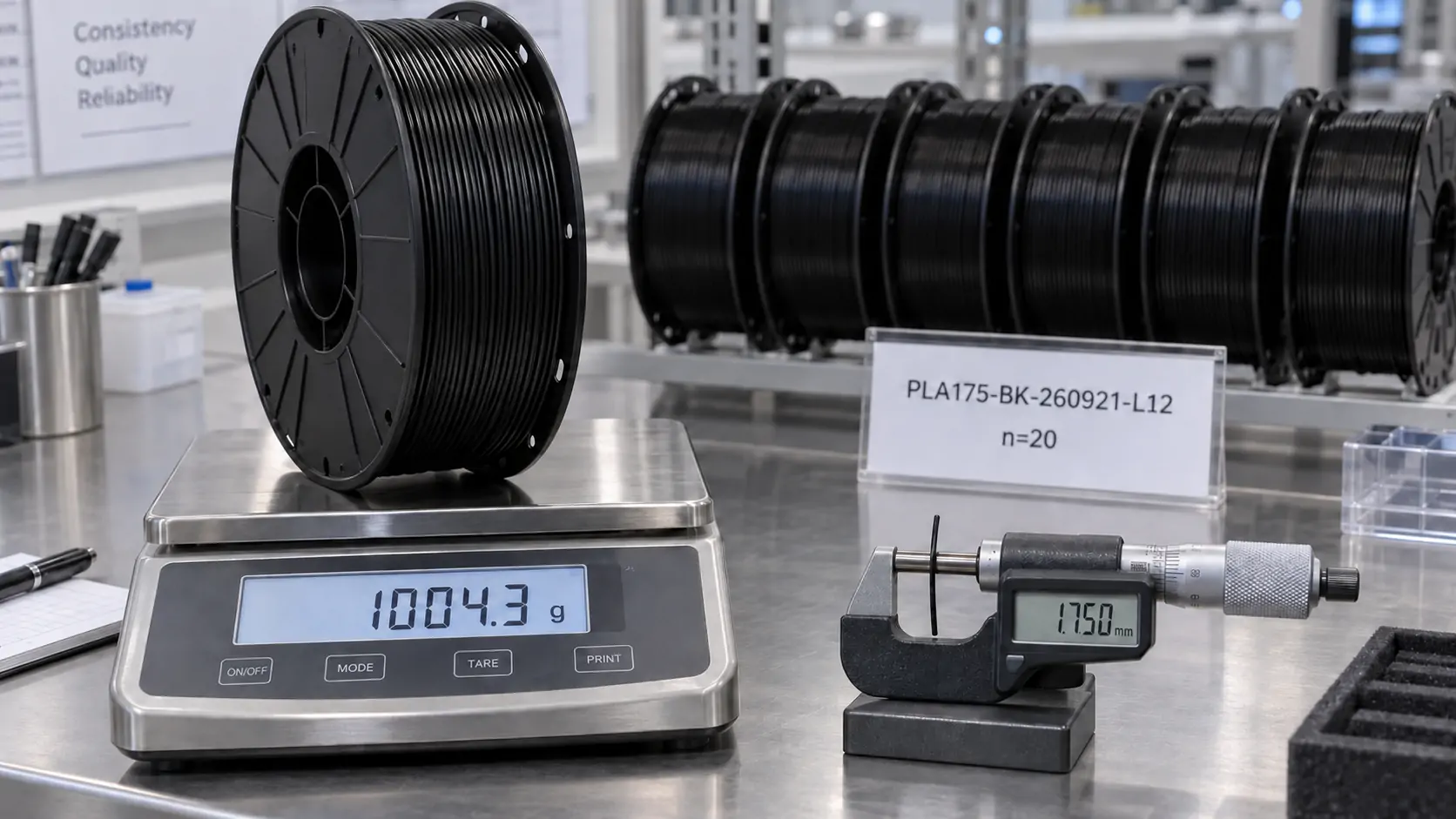
Two results matter for a marketplace listing. First, every sampled spool held more than 1,000 g, so a “1 kg net” label is not short. Second, net weight moved by only 6.2 g across the sample. The filament is therefore the predictable part of packed weight; the spool and the box decide the fee band.
Density, linear mass and length per spool from the same record are published in our Section 301 filament tariff guide; lot records are described on the batch QC data for B2B page.
From net weight to a packaging budget
Subtract the heaviest measured net weight, 1,007.9 g, from each band’s ceiling. What remains is the allowance for everything else: spool, vacuum bag, desiccant, box and labels.
On mobile, swipe horizontally to review every column.
| FBA weight band (Large Standard) | Band ceiling | Fulfillment fee, non-peak (incl. 3.5%) | Fulfillment fee, peak (incl. 3.5%) | Packaging budget at 1,007.9 g net |
|---|---|---|---|---|
| 2.5+ to 2.75 lb | 1,247 g | $6.48 | $6.89 | Up to 239 g |
| 2.75+ to 3 lb | 1,360 g | $6.90 | $7.33 | Up to 352 g |
| 3+ to 3.25 lb | 1,474 g | $7.30 | $7.86 | Up to 466 g |
Staying under 2.75 lb instead of 3.00 lb saves $0.42 per unit, or $420 per 1,000 spools. Tipping over 3.00 lb costs another $0.40. In peak season those gaps widen to $0.44 and $0.53. Which band a spool reaches depends mainly on spool material and carton board, so packed weight has to be measured, not estimated.
Where common packaging lands
Table 11 applies the budget to four packaging build-ups. The component weights are typical market values used as model inputs: an empty 1 kg cardboard spool commonly weighs about 130–190 g and a molded plastic spool about 200–250 g. Your own configuration is weighed under the protocol below.
On mobile, swipe horizontally to review every column.
| Packaging build-up | Spool | Bag and desiccant | Retail box | Packaging total | Packed weight | FBA band and non-peak fee | Headroom to the band ceiling |
|---|---|---|---|---|---|---|---|
| Cardboard spool, lightweight box | 150 g | 20 g | 60 g | 230 g | 1,237.9 g (2.73 lb) | 2.5+ to 2.75 lb · $6.48 | 9 g; inside the band, but under our 15 g margin |
| Cardboard spool, standard box | 150 g | 20 g | 90 g | 260 g | 1,267.9 g (2.80 lb) | 2.75+ to 3 lb · $6.90 | 92 g |
| Molded plastic spool, standard box | 220 g | 20 g | 90 g | 330 g | 1,337.9 g (2.95 lb) | 2.75+ to 3 lb · $6.90 | 22 g |
| Heavy plastic spool, heavier box | 250 g | 20 g | 100 g | 370 g | 1,377.9 g (3.04 lb) | 3+ to 3.25 lb · $7.30 | 17 g over the 3.00 lb line |
Packaging weight per build-up against the budget for each FBA band
Three things follow. The band under 2.75 lb is reachable only with a cardboard spool and a box near 60 g, and then with single-digit grams to spare. Most boxed 1 kg spools sit in the 2.75–3 lb band. And a heavy plastic spool in a sturdy box can tip the unit over 3.00 lb, which costs $0.40 on every sale, or $0.53 in peak season.
The packaging check for marketplace-bound orders
Protocol ID: SSSRAY-CHANNEL-PACK-2026-10-R01 · Scope: private-label spools and multipacks bound for US marketplace fulfillment · Sampling: 20 packed units per packaging configuration.
- Configuration lock: spool type, vacuum bag, desiccant, retail box and labels are recorded against the approved sample ID.
- Gross weight: each sampled unit is weighed packed on a 0.1 g bench scale; mean, minimum and maximum are recorded.
- Outer dimensions: length, width and height are measured to 1 mm on five units and rounded up to the next inch.
- Band check: the maximum gross weight must sit at least 15 g under the target band ceiling, and the carton inside 18 × 14 × 8 in.
- Multipacks and record: two-pack and four-pack cartons are checked the same way; results go on the lot’s QC record with the Batch ID.
The 15 g margin exists because Amazon weighs and measures the unit itself, and its figure sets the fee. You can repeat the check on arrival with a scale and a tape measure.
11. B2B Scenarios: Where Filament Buyers Lose Money on Channel Choice
Distributor
Situation: a regional reseller adds a private-label line beside the brands it already stocks.
Bad choice: lists single 1 kg PLA spools on Amazon at $15.99 to “build volume.”
Consequence: Amazon keeps about 55% of each sale, and every unit loses money at a $9.35 landed cost.
Better choice: sell PLA by the case to local accounts; list four-packs and specialty colors online.
Verification: Fee Preview on test ASINs and 90 days of order-size data.
Next step with SSSray: plan a reseller order with packed weights per SKU.
OEM Brand
Situation: a printer brand launches own-label filament for its installed base.
Bad choice: appoints a national exclusive distributor on a handshake and files no trademark.
Consequence: no Brand Registry, no control of listings, and a partner with no volume commitment.
Better choice: file the trademark, keep marketplaces brand-owned, and grant regional rights against minimums.
Verification: counsel review of the draft agreement; a packaging proof showing the mark.
Next step with SSSray: ask for OEM packaging and label proofs.
Print Farm
Situation: a 40-printer farm buys single spools on Amazon every week.
Bad choice: pays retail per spool and mixes whatever lots arrive.
Consequence: color shifts between lots, and a price that carries a marketplace fee.
Better choice: a direct bulk program on 3 kg or 5 kg spools, one lot per color per delivery.
Verification: a lot COA with each delivery; a 30-day failure log before and after.
Next step with SSSray: plan a print-farm production-lot trial.
Engineering Buyer
Situation: an R&D team needs carbon-fiber nylon for jigs and orders the best-reviewed listing.
Bad choice: treats star ratings as a data sheet.
Consequence: parts miss the stiffness or heat target, and weeks are lost.
Better choice: qualify the grade with a TDS, a dried sample and a test coupon, then set up reorders.
Verification: a printed coupon on the real printer, plus the lot COA.
Next step with SSSray: request TDS, COA and SDS for an engineering grade.
12. Sourcing Specs and Contract Terms for a Channel-Ready Filament Order
Sourcing specs: what to put in the RFQ
On mobile, swipe horizontally to review every column.
| Item | What to specify | SSSray reference |
|---|---|---|
| MOQ | Qualification vs. production quantity, per color and per packaging version | Qualification orders from 50 spools; OEM private label from 500 rolls |
| Lead time | Production, packing and transit in writing; note peak and school-term dates | Samples in 3–7 days; bulk PLA and PETG in 10–20 days after approval |
| Sample approval | Sample ID, lot, as-received print results; packed weight of the sample | B2B qualification samples tied to a sample ID |
| Tolerance | Diameter and ovality with method; net weight per spool; packed gross weight limit | Diameter ±0.03 mm; net weight measured by lot (see Table 9) |
| Documentation | COA per lot, TDS, SDS; invoices naming the brand; itemized commercial invoice | COA, TDS and SDS; RoHS or REACH by SKU and market |
| Packaging | Spool type, box size, moisture barrier, origin marking, multipack carton layout | Vacuum-sealed with desiccant; export cartons; layout per approved proof |
| Private label | Trademark on box and spool label; scannable barcode; lot number | OEM labels, boxes, cartons and barcodes |
| Reorder control | Change notice for resin, pigment, spool and carton; price validity; duty clause | Reorder spec linked to the approved sample and Batch ID |
Bulk filament sales contract template: the clauses that matter
A B2B filament contract is a sale of goods. In the US that generally places it under Article 2 of the Uniform Commercial Code. A template is only as good as its blanks, and these are the ones to fill:
- Product definition: grade, color, diameter, spool size, the approved sample ID and the TDS revision.
- Quality terms: tolerance, net weight, packed weight limit, lot COA and an inspection window after delivery.
- Delivery: the Incoterms 2020 rule and named place, the schedule and call-off rules.
- Price and payment: validity period, volume tiers, a clause for duty changes, deposit and net terms.
- Change control: written notice before any change to resin, pigment, spool or packaging.
- Brand, channel and remedies: trademark and artwork ownership, any territory rights, the MAP policy, remedies for non-conforming lots and governing law.
Use this checklist to define the commercial draft before governing law, exclusivity and remedies are finalized for the agreement.
13. Amazon FBA Filament Business and Sales Channel FAQ
What is the average margin selling filament on Amazon FBA?
There is no reliable published average, because margin depends on the spool’s price and landed cost. In our model, a 1 kg PLA spool at $19.99 with a $9.35 landed cost leaves $1.15, or 5.8%, after the referral fee, the $6.90 fulfillment fee and two months of storage, before ads and returns. Break-even is $18.68 without advertising and $21.08 with ads at 10% of sales, and each $1.00 off landed cost lowers it by $1.14 to $1.28. Higher-priced spools do better because the fulfillment fee is fixed. Run these numbers for your own Amazon FBA filament business before ordering stock.
How much does Amazon take on a 1 kg filament spool?
On a $19.99 spool that ships at 2.75–3 lb, Amazon takes $9.30, or 46.5%. That is a 12% referral fee of $2.40 plus a $6.90 fulfillment fee, which is the $6.67 rate with the 3.5% fuel and logistics surcharge. The share falls as the price rises, from 61.3% at $13.99 to 21.0% at $79.99, because the fulfillment fee is fixed per unit. From October 15, 2026 to January 14, 2027, the peak rate lifts the fulfillment fee to $7.33. Storage, advertising, returns and inbound freight come on top.
Can I sell OEM filament directly without a distributor?
Yes. No US rule requires a distributor between an OEM brand and its customers. You need three things instead: rights to the brand, ideally a trademark printed on the packaging; an importer of record who pays duty and answers for origin marking; and the documents each channel asks for, such as an SDS, invoices and barcodes. Going direct keeps the dealer discount, but you take over stock, shipping, credit and support. Many new brands start with wholesale and direct bulk accounts, then add a marketplace.
How do I become an authorized filament distributor in the USA?
Apply to the brand or manufacturer with proof that you are a real reseller. Expect to provide a registered business, an EIN, a state resale certificate and a description of where you sell. Most programs set an opening order, around $1,000 on published examples, plus written channel rules that may limit marketplace selling. Ask for a letter of authorization and proper invoices with your first order. Before signing, check the discount against your own shipping and support costs, because that discount is your entire margin.
Which channel works better for engineering filament sales?
Distributors and direct engineering accounts work better for the first sale, and online channels work well for reorders. Marketplace fees are light on a $50–80 spool, about 21–26% in our model. The risk is technical: nylon needs drying, fiber-filled grades need hardened nozzles, and PC needs a hot enclosure. Buyers who learn that from a failed part return the product. A distributor or supplier engineer can match grade to application and supply a TDS, a tested profile and a sample. After approval, reorders can move to whichever channel is most convenient.
How much inventory do makerspaces buy monthly?
It varies widely, and we found no public census, so estimate from printer count and confirm with purchase records. One classroom planning rule budgets about 1 kg per printer every three weeks when printers run most of the school day, or roughly 1.4 kg per printer per month. On that basis an eight-printer makerspace uses about 12 kg a month in term time, and a 20-printer lab about 29 kg. For a bulk buying program, ask for last year’s purchase orders and plan two or three deliveries per term.
Is Amazon FBA cheaper than my own warehouse in the USA?
For one or two spools per order, yes; for four or more, usually no. FBA charges about $6.90 per 1 kg spool however many the customer buys. A 3PL shipping by USPS Ground Advantage at published Zone 5 rates costs about $14.77 for a single spool, but $5.89 per spool for four and $4.81 for six, because the parcel price is shared. Multipack listings change the FBA side: about $4.10 per spool in a two-pack and $2.55 in a four-pack. Holiday pricing from October to mid-January raises both routes by roughly 4–8%; three spools are effectively break-even, while four or more usually favor the warehouse or 3PL route. Compare using your real order sizes.
Do multipacks lower FBA fees for filament?
Yes, as long as the carton stays Large Standard: no side over 18 in, a median side of 14 in or less, a short side of 8 in or less, and no more than 20 lb. A stacked two-pack costs about $8.21 to fulfill, or $4.10 per spool, and a 2 × 2 four-pack about $10.19, or $2.55 per spool, against $6.90 for a single spool. A four-spool column has no side under 8 in, so it bills as Small Bulky at about $12.14. Measure the carton and test one ASIN in Fee Preview before you order packaging.
How much packaging weight can a 1 kg spool carry and stay under 3 lb for FBA?
About 352 g. Three pounds is 1,360 g, and the heaviest spool sampled from SSSray lot PLA175-BK-260921-L12 held 1,007.9 g of filament, so the spool, bag, desiccant, box and labels together must stay under 352 g. For the cheaper band under 2.75 lb the allowance is 239 g, which in practice means a cardboard spool and a light box. SSSray keeps the heaviest packed unit at least 15 g under the ceiling, because Amazon’s own measurement sets the fee.
14. Conclusion: Build Your Amazon FBA Filament Business Around the Numbers
Channel choice in the US filament market is arithmetic before it is strategy. An Amazon FBA filament business works when the spool’s price can carry a fixed $6.90 fee and a 12% commission. For a single commodity PLA spool at a $9.35 landed cost, that point is around $21, above where much of the market sells.
The decision logic is short. First, price each SKU against Figure 1. Next, check order size against Figure 2: one or two spools favor FBA, while four or more favor your own warehouse or a dealer. Then weigh support need, and send engineering grades through people who can advise. Finally, run the Channel-Fit Scorecard so packaging, documents and reorders match the channel.
Your next step is small and concrete. Weigh a packed sample, measure its box, and run three numbers: the FBA fee band, the break-even price, and the wholesale margin at 35% and 45% off. We found no 2027 US fee announcement from Amazon when we checked on October 5, 2026. Amazon usually publishes next year’s fees in the fourth quarter, so keep the model in a spreadsheet you can update in minutes.
Prefer to start with paperwork? Request the TDS, COA and SDS, review our filament test protocol, compare materials across our 3D printer filament supplier range, ask about OEM packaging, or read answers on shipping and terms in our 3D printing filament FAQ.
Rates and dates in this guide were checked on October 5, 2026. Confirm the fee for your own ASIN in Seller Central before you order stock. Production runs at our factory in Jinhua.
Request a quote or free samples
Tell us the material, color, spool size and monthly volume. An engineer replies within 24 hours on business days.
15. References
- Amazon: Selling on Amazon pricing and referral fee schedule: 12% category rate and per-item minimum.
- Amazon Seller Central: 2026 US FBA fulfillment fee changes and the 2026 US referral and FBA fee announcement.
- BriskCalc: Amazon FBA fees 2026 rate tables, AMZ Prep: 2026–2027 holiday peak FBA fulfillment fees, M2E Cloud: Amazon FBA fulfillment fees in the US and Seller Labs: Amazon FBA size tiers 2026: secondary rate and size-tier tables used as a cross-check.
- Amazon: What is Amazon Brand Registry and the Brand Registry application guide.
- Jungle Scout: Amazon seller insurance requirements (Business Solutions Agreement, section 9).
- USPS Postal Explorer: Notice 123 price list: Ground Advantage commercial prices, July 12, 2026; and USPS: 2026 postage price change: temporary holiday prices, October 4, 2026 to January 17, 2027.
- WarehousingCosts.com: 3PL and fulfillment costs in 2026.
- FTC: Manufacturer-imposed requirements and Exclusive dealing or requirements contracts.
- CBP CSMS #69326983: Section 301 forced-labor duties on products of China.
- Polymaker US Wholesale, Overture 3D wholesale program, HATCHBOX 3D wholesale program and 3D-Fuel reseller terms: published US wholesale terms.
- 3D Printing Cost Calculator: PLA and PETG filament price per gram and per kg (June 2026).
- Makers Empire: filament budgeting for schools.
- Spengler, J. J. (1950). “Vertical Integration and Antitrust Policy.” Journal of Political Economy, 58(4), 347–352.
- Cornell Legal Information Institute: Uniform Commercial Code, Article 2 (Sales) and ICC: Incoterms 2020.
- SSSray QC lab, Jinhua: test record SSS-PLA-HTSQTY-LV-2026-0923-R1, Batch ID PLA175-BK-260921-L12, measured September 22–23, 2026. Full record in our Section 301 filament tariff guide.

He Jiang
Senior Researcher
SSSray · 3D Printing Filament Manufacturing · Jinhua, Zhejiang
He Jiang is a senior researcher at SSSray, a 3D printing filament manufacturer in Jinhua, Zhejiang, China. For this guide, his research focuses on B2B filament sourcing, production-lot QC, OEM and private-label packaging, landed cost, fulfillment and US sales-channel economics for brand owners, distributors, print farms and other bulk buyers. The analysis combines SSSray lot records with published platform, postal, customs and wholesale-channel data.