Online time
Monday to Friday: 9AM - 8PM
Weekend: 10AM - 5PM


TL;DR: Match Filament Qualification to the Printer, AMS/MMU Path and Hotend
For B2B buyers running Bambu Lab, Prusa and QIDI fleets, the useful procurement question is not "which filament brand is best," but whether the exact material, spool, profile and production lot have been qualified on the target hardware. CONTEXT reported that Chinese vendors accounted for more than 90% of global Entry-level 3D-printer shipments in 2025, accelerating adoption of high-speed CoreXY machines, automated material systems and actively heated chambers. That makes diameter and ovality control, maximum volumetric speed, moisture conditioning, spool fit, abrasive-material hardware compatibility and lot-to-lot repeatability part of one qualification system rather than isolated datasheet claims.
Bambu LabQualify material + AMS generation + spool + hotend; ±0.03 mm is used by several Bambu AMS-compatible filaments
Prusa MK4SFactory Input Shaper; Nextruder typical 15–20 mm³/s; tune filament-specific flow and Pressure Advance
QIDI Plus4Direct extruder; 65°C active chamber; 370°C hotend; moisture and grade conditioning matter for engineering materials
SSSray QCLot ID + inline diameter record + moisture result + target-printer qualification + reorder baseline

He Jiang
Senior Researcher · SSSray · 3D Printing Filament Manufacturing · Jinhua, Zhejiang
He Jiang is a senior researcher at SSSray, a 3D printing filament manufacturer in Jinhua, Zhejiang, China. His work focuses on printer-specific filament qualification, maximum volumetric flow testing, diameter and ovality control, moisture conditioning, abrasive-filament hardware compatibility, and lot-level QC for B2B distributors, OEM brands, print farms, and engineering buyers. His SSSray research connects manufacturer documentation with production records and target-printer validation across Bambu Lab, Prusa, QIDI, Creality, and other FFF platforms.
Key Takeaways
- CONTEXT's 2025 figure applies to the Entry-level 3D-printer segment: Chinese vendors accounted for more than 90% of global shipments in that segment, which includes consumers, prosumers, professionals and manufacturing print farms.
- Do not turn diameter tolerance into an AMS pass/fail rule: Bambu PLA Basic, PETG HF and PLA-CF are published at 1.75 mm ±0.03 mm and are listed as AMS/AMS lite compatible. Diameter distribution, ovality, material stiffness, surface, spool geometry, winding and AMS generation must be qualified together.
- Maximum volumetric speed is more useful than a headline travel or print speed: the limiting value is set by the weaker combination of material and hotend under the chosen temperature, nozzle and part conditions.
- Prusa MK4S Input Shaper is factory pre-calibrated: stock machines normally do not need Input Shaper recalibration for every filament change. Filament onboarding should focus on temperature, flow ratio, Pressure Advance, MVS and accepted-part verification.
- QIDI Plus4 uses a direct extruder with hardened-steel gears: its official specification lists up to 65°C active chamber heating, 120°C bed and 370°C hotend. It is now discontinued, but the installed fleet remains relevant to B2B material qualification.
- Moisture is a material-condition problem, not moisture created by an enclosure: hygroscopic filament absorbs water before printing; high melt temperature then exposes that moisture through bubbles, stringing, hydrolysis or unstable extrusion depending on the polymer.
- SSSray uses ±0.03 mm as a standard production release tolerance for major catalog families: selected high-speed or OEM programs can be qualified to a tighter ±0.02 mm project specification when the SKU and purchase requirement call for it.
- Abrasive CF/GF materials require wear-resistant hardware: nozzle selection should follow the exact grade, fiber loading and printer guidance rather than an unsupported universal "kg per nozzle" replacement number.
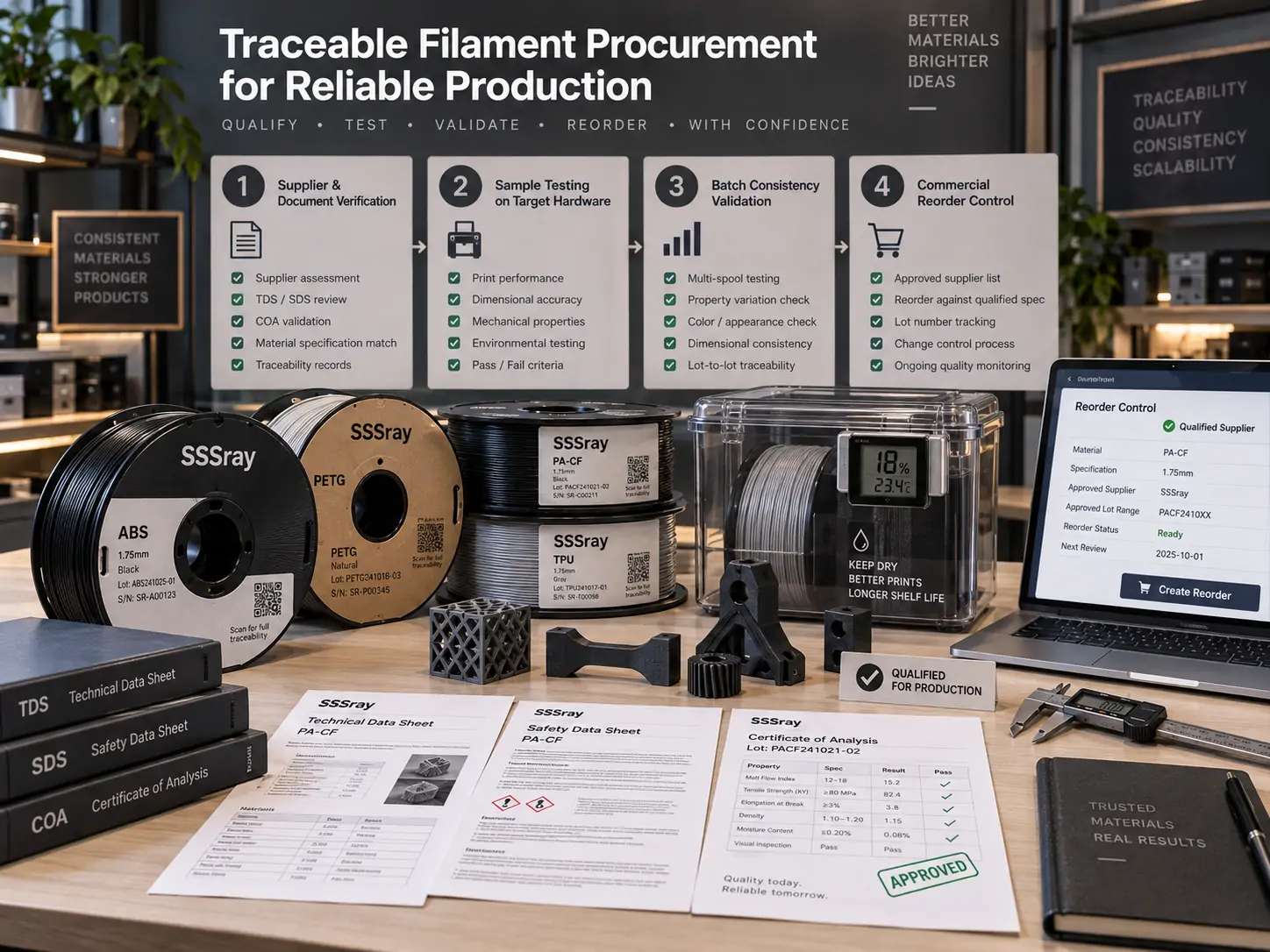
- B2B approval must be lot-based: the supplier should connect a production lot to diameter/ovality data, moisture conditioning, spool identity, printer/profile records, acceptance criteria and reorder change control.
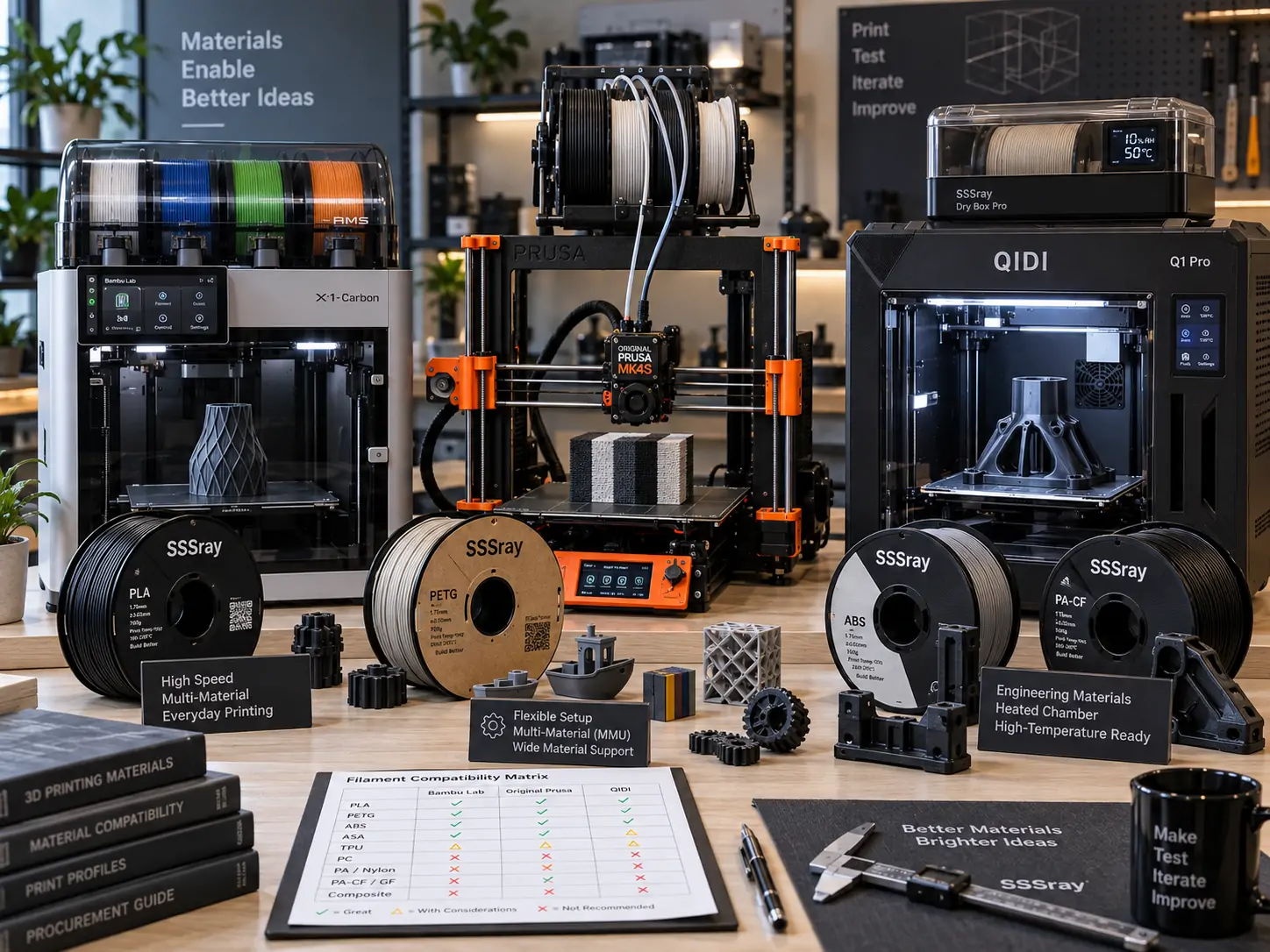
- For mixed fleets, standardize the evidence—not one arbitrary number: define a common qualification record and then apply printer-specific limits for AMS/MMU path, hotend flow, chamber use and abrasive-material hardware.
Abstract: The 2026 Printer-Filament Qualification Problem
CONTEXT reported that Entry-level 3D-printer shipments grew 47% year over year in Q4 2025 and 26% for the full year, with Chinese vendors accounting for more than 90% of global shipments in this under-US$2,500 segment. The segment includes consumers, prosumers, professionals and manufacturing print farms. For filament procurement, the practical change is a much larger installed base of high-speed CoreXY machines, automated material systems and enclosed platforms that expose differences in spool fit, feed behavior, hotend throughput, moisture condition and batch consistency.
At SSSray, we treat printer compatibility as a controlled qualification problem. A filament label such as "high-speed," "AMS compatible" or "±0.02 mm" is not enough by itself. The approved record should identify the exact material grade, production lot, spool format, target printer, automated material system if used, nozzle, slicer/profile, conditioning state, flow limit and accepted-part criteria.
This guide maps current Bambu Lab, Prusa MK4S and QIDI Plus4 hardware requirements to measurable B2B purchasing checks. It also publishes SSSray lot-level evidence and an existing printer-flow reference series so a buyer can see how a marketing specification is converted into a traceable release and qualification record.
Why Entry-Level Printer Growth Changed Filament Procurement
More Than 90% Chinese Share—In the Entry-Level Segment
The useful market fact is specific: CONTEXT reported that Chinese vendors accounted for more than 90% of global Entry-level 3D-printer shipments in 2025, while Bambu Lab held 37% share in that segment. Entry-level is defined by CONTEXT as systems below US$2,500 and includes professional and print-farm buyers as well as consumers. That scope is materially different from claiming that Chinese brands hold 90% of every desktop FDM or professional printer category.
For B2B filament buyers, the procurement implication is still significant. High-throughput hotends, CoreXY motion systems, automated multi-material units and enclosed printers make a generic "works on most FDM printers" statement too weak for purchase approval.
Automated Material Systems Need System-Level Qualification
AMS/MMU reliability is influenced by more than nominal diameter. A commercial qualification should record:
- Diameter distribution and ovality: verify continuous production control and a lot-specific audit rather than relying only on the nominal tolerance printed on a box.
- Material behavior: stiffness, brittleness, surface roughness and moisture condition affect feeding and repeated retract/load cycles.
- Spool fit and winding: outer diameter, width, hub geometry, flange condition and winding tension can determine whether an otherwise printable filament feeds reliably.
- AMS generation: compatibility differs between AMS, AMS lite, AMS 2 Pro and AMS HT; a material should be approved against the system the buyer actually uses.
Bambu's own catalog demonstrates why diameter cannot be used as the only gate: PLA Basic, PETG HF and PLA-CF are published at 1.75 mm ±0.03 mm and are listed as compatible with AMS/AMS lite for their stated use cases.
High-Speed Claims Require Volumetric Flow Verification
Marketing speeds such as 300, 500 or 600 mm/s do not define melt throughput. A useful B2B specification records maximum volumetric speed in mm³/s together with material, hotend/nozzle, temperature, layer geometry and the pass/fail condition used to establish the limit.
SSSray procurement rule: a high-speed filament approval record must include maximum volumetric flow, the exact printer/hotend/nozzle, test temperature, conditioning state and accepted-part criteria. A speed number without those fields is not enough for a commercial reorder baseline.
Bambu Lab Filament Requirements and AMS Compatibility
Diameter: Control the Process, Not an Invented AMS Cutoff
Bambu's current product specifications do not support treating ±0.02 mm as a universal AMS requirement. Bambu PLA Basic, PETG HF and PLA-CF are each published at 1.75 mm ±0.03 mm and listed as AMS/AMS lite compatible. For SSSray B2B programs, ±0.03 mm is the standard release tolerance across major catalog families, while selected high-speed or OEM programs can be qualified to a tighter ±0.02 mm project specification when the SKU, printer platform and PO require it.
For AMS procurement, the stronger approval package is a lot-specific diameter/ovality record plus spool fit, winding inspection and repeated feed/retract testing on the buyer's actual AMS generation.
Official High-Flow Reference Values Must Stay Hardware-Specific
Bambu's current H2D high-flow hotend page shows why MVS must be tied to exact hardware. The values below are H2D reference figures for the listed materials; they should not be copied into X1, P1 or A1 profiles as universal limits.
Swipe horizontally to view all columns on mobile.
| Material | 0.4 mm Hardened Standard Hotend | 0.4 mm High-Flow Hotend | Platform Scope | B2B Procurement Use |
|---|---|---|---|---|
| PLA Basic | 24 | 40 | H2D reference | Use as a hardware/material benchmark; validate the purchased grade on the actual fleet. |
| PLA Matte | 28 | 48 | H2D reference | Shows that material formulation changes the effective flow ceiling even on the same hotend. |
| PETG HF | 24 | 32 | H2D reference | Keep drying condition and temperature in the qualification record. |
AMS Compatibility Is Generation- and Material-Specific
Bambu AMS 2 Pro officially supports a defined list that includes "TPU for AMS," while generic TPU, TPU 95A and many third-party CF/GF filaments are not listed as supported in that system. At the same time, Bambu PLA-CF is published as AMS/AMS lite compatible at ±0.03 mm. That combination makes a simple rule such as "all TPU fails" or "all CF fails" technically wrong in 2026.
- Standard rigid materials: qualify grade, spool and feed behavior on the exact AMS generation.
- Flexible materials: distinguish engineered "TPU for AMS" from generic TPU/TPU 95A; follow the selected AMS generation's material list.
- CF/GF composites: verify both AMS allowance and abrasive-hardware requirements for the exact grade; do not generalize one branded composite to all third-party composites.
- Nozzle selection: use wear-resistant hardware for abrasive grades. Bambu's PLA-CF page supports hardened-steel 0.4/0.6/0.8 mm, while Bambu generally promotes 0.6 mm hardened steel as a robust first choice for fiber-filled materials.
Prusa MK4S Filament Requirements and Maximum Volumetric Speed
Input Shaper: Factory Pre-Calibrated on a Stock MK4S
Prusa states that Input Shaper on the MK4/S family is pre-calibrated from the factory and that accelerometer calibration is usually unnecessary on a stock printer. Recalibration becomes relevant after hardware modifications that materially change the machine's vibration behavior. Changing filament is therefore not, by itself, a reason to re-run Input Shaper calibration.
For a new third-party filament, SSSray qualification focuses instead on temperature, flow ratio, Pressure Advance/flow dynamics, MVS and accepted-part quality. These are the parameters that directly respond to material extrusion behavior.
Prusa's Current MVS Ranges Are Material + Hotend Limits
Prusa's Knowledge Base states that effective MVS is limited by the weaker link between the hotend and the material. Its current typical ranges are:
Swipe horizontally to view all columns on mobile.
| Material / Hotend | Typical MVS | Qualification Note |
|---|---|---|
| PLA | 12–20 mm³/s | Material range; higher values require a capable hotend and validated filament. |
| PETG | 8–15 mm³/s | More viscous than PLA; verify temperature and part quality. |
| ABS / ASA | 10–16 mm³/s | Use the required thermal environment for the part size and grade. |
| TPU | 2–5 mm³/s | Flexible materials require substantially lower flow. |
| PC | 6–10 mm³/s | High viscosity and slower melting limit throughput. |
| PA / Nylon | 8–12 mm³/s | Blend-dependent; moisture conditioning is part of the test. |
| Prusa Nextruder (MK4/XL) | 15–20 mm³/s | Hotend range; effective MVS is the lower of hotend and material capability. |
| High-flow nozzle | 20–35 mm³/s | Hardware upgrade range; qualify the exact nozzle and material combination. |
What ±0.03 mm Means on a Prusa Fleet
Prusa's direct-drive Nextruder removes some of the feed-path variables found in long automated material systems, but that does not make ±0.03 mm a blanket guarantee or a reason to accept weak process control. For B2B purchasing, retain the same lot evidence—diameter distribution, ovality, winding, moisture and printer profile—and qualify MMU3 separately if multi-material feeding is part of the customer use case.
QIDI Plus4 Engineering-Filament Requirements
2026 product status: QIDI states that Plus4 has been discontinued and that Plus5 is its direct successor. Plus4 remains important for distributors and print farms supporting installed fleets, so this guide keeps it as a qualification platform rather than presenting it as QIDI's current production model.
Direct Extrusion + Active Chamber Heating
QIDI's official Plus4 specification lists a direct extruder with hardened-steel gears, not a long Bowden-style dual-extrusion path. It also lists a 305 × 305 × 280 mm build volume, hot bed up to 120°C, print head up to 370°C, second-generation active chamber heating up to 65°C and a maximum toolhead speed of 600 mm/s.
The supported-material list includes PLA, ABS, ASA, PETG, TPU, PA, PC and carbon/glass-fiber reinforced polymers. That makes Plus4 useful for engineering-material qualification, but the 600 mm/s motion specification must not be mistaken for a universal filament flow capability.
Moisture Control: Condition the Polymer Before the Melt Zone
Hygroscopic filaments absorb moisture during storage and handling. When wet material enters the hotend, water can generate bubbles and unstable extrusion, and moisture-sensitive polymers such as polyamides can suffer hydrolytic degradation at processing temperature. The enclosure does not create that absorbed water; it provides a controlled thermal environment for printing the already-conditioned material.
For QIDI engineering-material procurement, request:
- lot-matched moisture measurement method and result before sealing;
- vacuum/moisture-barrier packaging specification plus desiccant where required;
- material-specific drying temperature/time based on the exact grade TDS;
- a saved printer/nozzle/profile record and accepted part after conditioning;
- for hygroscopic grades, an opened-spool handling and re-drying SOP.
Nozzle and Material Scope
For CF/GF grades, use wear-resistant nozzle hardware and inspect extrusion quality, bore wear and dimensional drift as part of preventive maintenance. Do not plan nozzle replacement from a universal "X kg per nozzle" figure; fiber loading, particle morphology, nozzle material, temperature and throughput can change wear rate materially.
SSSray QIDI qualification gate: lock the exact polymer grade, drying record, nozzle, chamber setting, MVS, spool ID and accepted production part. Reorders are checked against that same baseline instead of being approved from a generic "QIDI compatible" label.
Diameter Tolerance: ±0.02 mm vs ±0.03 mm Real-World Impact
Diameter tolerance matters, but the number on the datasheet is meaningful only when the measurement method and production distribution are controlled. SSSray's standard production release tolerance for major 1.75 mm catalog families is ±0.03 mm with inline laser monitoring; selected high-speed/OEM programs can use a tighter ±0.02 mm project specification when defined in the approved order.
What the Geometry Actually Means
Using a circular cross-section approximation for 1.75 mm filament:
- ±0.02 mm: diameter 1.73–1.77 mm; cross-sectional area about 2.351–2.461 mm². That is approximately −2.27% to +2.30% relative to nominal area.
- ±0.03 mm: diameter 1.72–1.78 mm; cross-sectional area about 2.324–2.489 mm². That is approximately −3.40% to +3.46% relative to nominal area.
- Nominal 1.75 mm: cross-sectional area about 2.405 mm².
The theoretical difference is real, but it does not establish AMS compatibility by itself. Bambu's own ±0.03 mm AMS-compatible filaments are a direct example. B2B buyers should therefore combine nominal tolerance with actual lot distribution, ovality and printer-specific feeding results.
Measurement Method Verification
For a commercial order, SSSray recommends retaining:
- Continuous inline measurement: laser-micrometer monitoring through production rather than only end-of-spool caliper checks.
- Ovality control: record the maximum difference between orthogonal dimensions or the production system's equivalent ovality metric.
- Lot audit: archive representative checkpoints across beginning, middle and end of the production run.
- Traceability: map the spool/batch code to the production line, date and QC record.
Swipe horizontally to view all columns on mobile.
| Tolerance | Bambu / AMS | Prusa MK4S | QIDI Plus4 | SSSray Procurement Position |
|---|---|---|---|---|
| ±0.02 mm | Tighter custom target; still qualify spool/material/AMS generation | Useful where a tighter OEM specification is contractually required | Useful for selected precision/engineering programs with agreed evidence | Project-specific tighter control, not a universal compatibility requirement |
| ±0.03 mm | Published by Bambu on multiple AMS-compatible grades | Strong commercial baseline when backed by lot control | SSSray standard release baseline for major catalog families | Default SSSray production release tolerance for major 1.75 mm catalog families |
| ±0.05 mm | Requires grade- and system-specific evidence | May print on some setups but offers a wider extrusion-area band | Not SSSray's default B2B release target | Do not use as the cross-platform default; approve only from application evidence |
Volumetric Flow Rate Matching for High-Speed Printing
Understanding Volumetric Flow (mm³/s)
For quick procurement calculations, a rectangular extrusion approximation is:
Approx. Volumetric Flow (mm³/s) = Layer Height (mm) × Line Width (mm) × Print Speed (mm/s)
Example: 0.20 mm layer height × 0.45 mm line width × 250 mm/s = 22.5 mm³/s. Actual slicer bead geometry can differ from a perfect rectangle, so use the slicer's volumetric-flow preview and the printer/material profile for final validation.
If the configured MVS is below the flow demanded by a feature, slicer behavior can cap or reduce achievable speed depending on the speed mode and profile. The important purchasing number is therefore the tested material/hotend flow limit, not the printer's headline motion speed.
Why "High-Speed" Marketing Claims Need a Test Record
For print farms, OEM bundles and engineering buyers, retain:
- Maximum volumetric flow in mm³/s for the exact grade;
- Hardware: printer, hotend and nozzle diameter/material;
- Thermal condition: nozzle temperature, material conditioning and chamber condition if relevant;
- Geometry: layer height, line width and representative production part;
- Failure boundary: the observed condition where clicking, under-extrusion, mass loss, weak bonding or surface degradation begins;
- Production limit: a repeatable working limit set below that failure boundary and verified across representative spools.
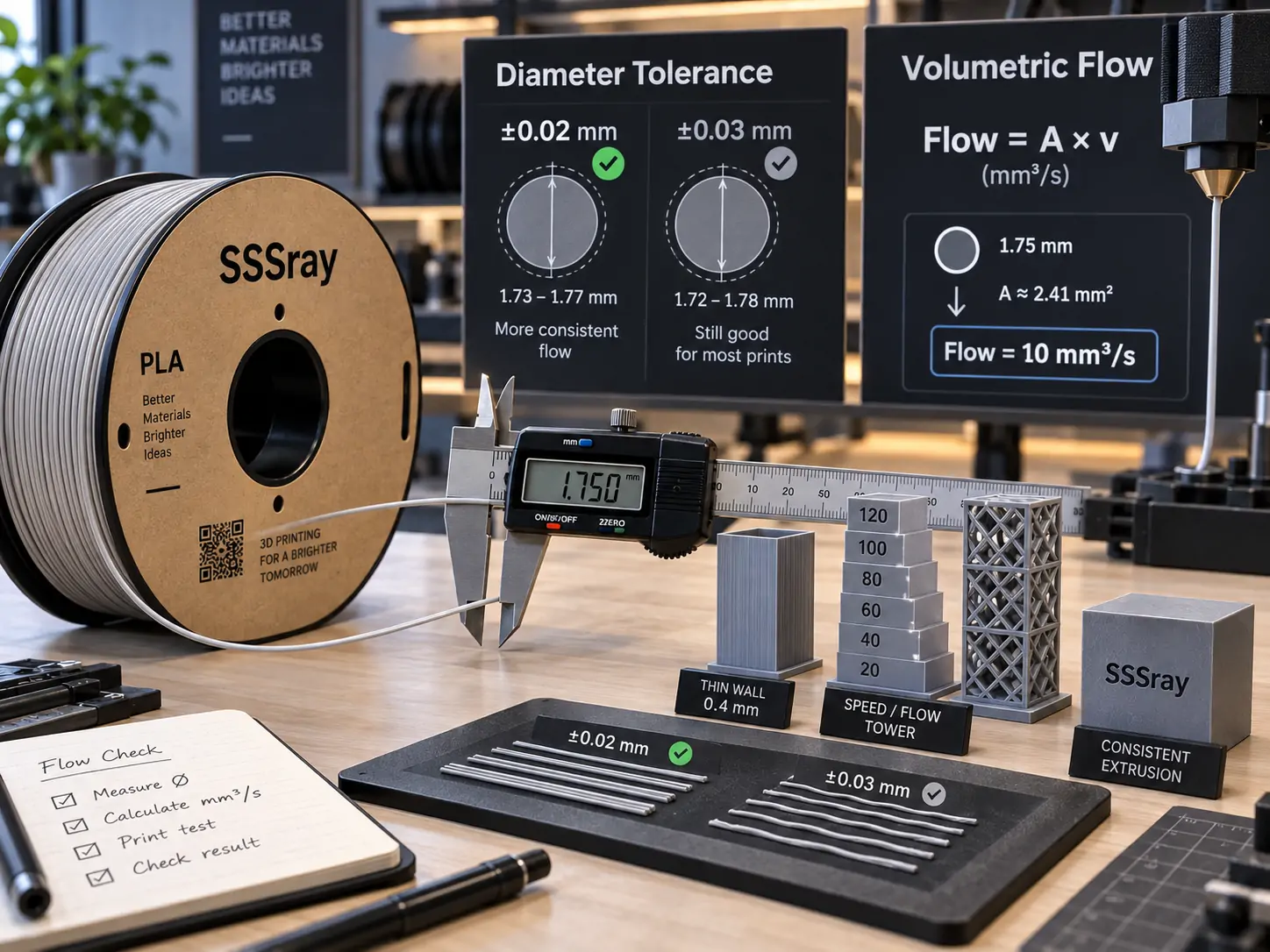
Flow-Rate Ladder Test Protocol
- Start from the grade's TDS and a known-good printer/hotend baseline.
- Lock nozzle, temperature, layer height, line width, cooling and material conditioning.
- Increase the requested volumetric flow in controlled steps rather than changing multiple variables together.
- Record clicking, under-extrusion, part mass, surface changes, dimensional result and any layer-bonding loss.
- Confirm the candidate limit on a representative production part, not only a flow tower.
- Repeat across representative spools and retain the lot/profile record before commercial approval.
SSSray First-Hand Data: Traceable Lot QC and Printer-Flow Records
SSSray buyer evidence is built around a traceable production lot plus a separate printer/process qualification record. The production-lot record below is already published on SSSray.com and shows the level of evidence we use to connect a commercial filament batch to measured diameter, ovality and pre-seal moisture.
Swipe horizontally to view all columns on mobile.
| QC Item | Production-Lot Record | Release Requirement | Result |
|---|---|---|---|
| Public Batch ID | SSR-PA6-66-260918-L07-B01 | Unique production-lot traceability | PASS |
| Material | SSSray PA6/66 Engineering Nylon Filament, 1.75 mm | Approved commercial nylon formulation | PASS |
| Production / Test Date | September 18, 2026 | Lot-matched QC before packing | PASS |
| Extrusion Line | Line 07 | Production-line traceability recorded with the batch | PASS |
| Diameter Measurement | Continuous inline laser micrometer monitoring | 1.75 ±0.03 mm | PASS |
| COA Diameter Audit Sample | 10 spools × 3 archived laser checkpoints per spool = 30 measurement sets | Representative checkpoints remain inside release tolerance | PASS |
| Mean Diameter | 1.751 mm | 1.72–1.78 mm | PASS |
| Observed Diameter Range | 1.731–1.772 mm | 1.72–1.78 mm | PASS |
| Maximum Ovality | 0.018 mm | ≤0.020 mm | PASS |
| Pre-Seal Conditioning | 80°C × 8 h | Controlled drying before final moisture release | PASS |
| Moisture Measurement | Karl Fischer titration, n=3 | <0.020 wt% before vacuum sealing | PASS |
| Mean Pre-Seal Moisture | 0.017 wt% (170 ppm) | <0.020 wt% (200 ppm) | PASS |
| Final Lot Release | Diameter, ovality and moisture gates passed | All mandatory production QC gates passed | RELEASED |
Printer throughput is kept as a separate evidence layer. SSSray's published Bambu procurement guide contains the following internal X1/H2D reference series at a 230°C nozzle setting. Jam rate is normalized per 100 spool-hours; it is not a percentage of failed prints.
Swipe horizontally to view all columns on mobile.
| Test Category | MFR | Reported Maximum Flow | Jams / 100 Spool-Hours | Published Test Scope |
|---|---|---|---|---|
| Standard commodity PLA | 8.5 g/10 min at 190°C / 2.16 kg | 14.2 mm³/s | 4.8 | X1/H2D reference; nozzle setting 230°C |
| Generic high-speed PLA | 18.0 g/10 min at 190°C / 2.16 kg | 22.5 mm³/s | 2.1 | X1/H2D reference; nozzle setting 230°C |
| Standard PETG | 6.2 g/10 min at 230°C / 2.16 kg | 11.8 mm³/s | 6.2 | X1/H2D reference; nozzle setting 230°C |
| SSSray High-Speed PLA Pro | 32.5 g/10 min at 190°C / 2.16 kg | 34.8 mm³/s | 0.2 | X1/H2D reference; nozzle setting 230°C |
| SSSray Engineered High-Speed PETG | 24.0 g/10 min at 230°C / 2.16 kg | 28.5 mm³/s | 0.4 | X1/H2D reference; nozzle setting 230°C |
How SSSray uses these records: the production-lot table proves traceability and release QC for one commercial lot; the printer-flow table is a separately published process reference. For a new B2B order, SSSray connects the buyer's exact SKU and production lot to the target printer/nozzle/profile and retains the resulting qualification baseline for reorders.
Material-by-Material Compatibility Matrix
This matrix keeps official hardware limits separate from SSSray purchasing controls. It is designed for mixed fleets where the same SKU may be sold to Bambu, Prusa and QIDI users.
Swipe horizontally to view all columns on mobile.
| Material | Bambu Lab | Prusa MK4S | QIDI Plus4 | Critical Procurement Check |
|---|---|---|---|---|
| PLA Standard | Bambu PLA Basic is published at ±0.03 mm and AMS/AMS lite compatible; H2D official reference is 24 mm³/s standard / 40 mm³/s high-flow for Bambu PLA Basic. | PLA typical MVS 12–20 mm³/s; Nextruder typical 15–20 mm³/s. | PLA officially supported; direct extruder. Active chamber is not a requirement for normal PLA. | Lot diameter/ovality + spool fit + actual printer/hotend flow profile. |
| PLA High-Speed | Do not transfer H2D flow values to X1/P1/A1; qualify exact hotend. SSSray selected HS/OEM routes can specify ±0.02 mm. | Stock Nextruder typical 15–20 mm³/s; high-flow nozzle range 20–35 mm³/s. | 600 mm/s toolhead rating does not define material flow; validate MVS on the selected nozzle/temperature. | Require MVS test conditions and repeatability, not only a "300/500/600 mm/s" label. |
| PETG | Bambu PETG HF is ±0.03 mm, AMS/AMS lite compatible and marked dry before use; H2D reference 24 / 32 mm³/s standard/high-flow. | PETG typical MVS 8–15 mm³/s. | PETG officially supported; condition moisture before high-throughput testing. | Packaging barrier, drying record, lot moisture and surface/flow result. |
| ABS / ASA | Use enclosed-capable platform and grade-specific profile; AMS compatibility depends on material/spool/system. | ABS/ASA typical MVS 10–16 mm³/s; enclosure improves thermal control for larger parts. | ABS and ASA officially supported; active chamber up to 65°C is available. | Warping control, ventilation, part geometry and lot color/flow consistency. |
| TPU | AMS compatibility is product/system-specific: AMS 2 Pro supports "TPU for AMS" but lists generic TPU and TPU 95A as unsupported. | TPU typical MVS 2–5 mm³/s; direct-drive path is advantageous. | TPU officially supported with direct extruder; qualify hardness and flow at low MVS. | Shore hardness, feed path, drying and exact automated-material-system generation. |
| PLA-CF / PETG-CF | Bambu PLA-CF is ±0.03 mm and AMS/AMS lite compatible; use hardened-steel nozzle. Third-party CF/GF must be checked against AMS generation. | Use wear-resistant nozzle; material MVS depends on base polymer and fiber formulation. | CF/GF reinforced polymers officially supported; direct hardened-steel gears help feed durability. | Fiber %, particle/fiber distribution, nozzle material, drying and wear inspection. |
| PA / PA-CF | Use grade- and AMS-generation-specific guidance; condition hygroscopic material and use wear-resistant nozzle for CF grades. | PA typical MVS 8–12 mm³/s; dry and qualify the exact blend. | PA and CF/GF reinforced polymers officially supported; 65°C chamber available. | Lot moisture, drying SOP, nozzle, chamber setting and retained accepted part. |
| PC / PC-CF | Use model-specific high-temperature capability and wear-resistant nozzle for CF grades. | PC typical MVS 6–10 mm³/s; enclosure and bed/nozzle limits must match the grade. | PC officially supported; hotend up to 370°C and bed up to 120°C. | Exact PC grade, drying condition, Tg/HDT evidence and application validation. |
B2B Buyer Decision Framework by User Type
Filament procurement priorities differ by business model. Use the same evidence system, then weight the acceptance criteria around the cost of failure for your buyer type.
Distributor / Reseller
Primary concern: SKU coverage, return rate, compatibility wording and reorder consistency.
Procurement focus:
- Use SSSray standard ±0.03 mm lot control as the catalog baseline; specify ±0.02 mm only for selected HS/OEM projects that require it
- Publish compatibility by material + printer/AMS generation where relevant
- Track returns by material, batch and printer combination
- Lock spool dimensions, winding and packaging alongside material grade
- Keep batch/COA evidence for repeat orders
Next step: Use SSSray supplier comparison tool
OEM Printer Brand
Primary concern: first-print success, support-ticket reduction and a repeatable bundled profile.
Procurement focus:
- Validate exact shipping hardware, hotend and feeder/AMS configuration
- Freeze temperature, flow ratio, Pressure Advance and MVS for the approved SKU
- Approve packaging and spool geometry together with material
- Require change notification for resin/additive/pigment/process changes
- Retain a reference lot and accepted printed part
Next step: Define the SSSray OEM/ODM specification
Print Farm
Primary concern: uptime, accepted-part cost, nozzle/feed wear and batch consistency.
Procurement focus:
- Measure jams and downtime per operating hours rather than anecdotal spool failures
- Run representative long jobs on the installed fleet
- Record material conditioning and opened-spool exposure
- Link failures to batch and spool IDs
- Use larger spool formats only after feed-system and winding approval
Engineering Buyer
Primary concern: material identity, process repeatability, application performance and traceability.
Procurement focus:
- Grade-specific TDS/SDS and lot-matched QC/COA evidence
- Conditioning state and moisture method for hygroscopic polymers
- Printed-part mechanical testing in the orientation relevant to the application
- Application-specific thermal, UV or chemical validation where required
- Change control before resin, additive or process substitutions
Next step: Review the SSSray filament test protocol
Printer-Specific Qualification Protocol
SSSray uses a gated process so a good sample becomes a controlled commercial specification rather than a one-off demonstration.
Stage 1: Supplier, SKU and Document Verification
- Identify the quoted commercial entity, production site and party responsible for manufacturing QC.
- Match TDS, SDS and applicable compliance files to the exact material SKU and revision.
- Record production-lot coding, spool format and packaging specification.
- Confirm diameter/ovality measurement method and request lot-level evidence.
- For hygroscopic grades, confirm moisture method, release target and drying SOP.
Stage 2: Sample Testing on Target Hardware
For Bambu Lab + AMS users:
- Identify printer, hotend/nozzle, AMS generation and spool dimensions.
- Use the exact material grade and conditioning state intended for commercial supply.
- Run repeated load/unload plus a representative multi-hour job with the approved profile.
- Inspect feed path, spool rotation and any debris/wear relevant to abrasive materials.
- Judge dimensional and functional results against the buyer's drawing or agreed acceptance criteria, not a universal ±0.1 mm rule.
For Prusa MK4S users:
- Keep factory Input Shaper settings on a stock MK4S; recalibrate only when relevant hardware modifications justify it.
- Calibrate filament-specific temperature, flow ratio and Pressure Advance/flow dynamics.
- Set MVS from the weaker material/hotend limit and verify it on the actual part.
- Inspect ringing/ghosting as a machine/part-speed issue separately from extrusion under-flow.
- If MMU3 is required, qualify MMU3 feeding as a separate system-level gate.
For QIDI Plus4 installed fleets:
- Use the direct-extruder configuration and the exact nozzle installed on the fleet.
- Condition moisture-sensitive material per grade TDS and record the drying cycle.
- Use chamber heating only as required by the material/part; machine capability is up to 65°C.
- Keep bed and nozzle settings within the exact grade and machine limits; Plus4 hardware limits are 120°C bed and 370°C hotend.
- For engineering parts, test the printed coupon/part with the method and orientation required by the application.
Stage 3: Batch Consistency Validation
- Approve a pilot production lot after the sample grade/profile is frozen.
- Sample spools across the beginning, middle and end of the run.
- Review the continuous inline diameter record and a retained lot audit rather than relying only on manual end checks.
- Repeat the target-printer test on representative spools and record spool ID, profile and result.
- For color-critical programs, compare against the approved master using the agreed visual or instrumental method.
- Define the rejection/containment rule before the commercial PO is released.
Stage 4: Commercial PO and Reorder Controls
- Freeze grade, color reference, spool format, packaging, tolerance, moisture requirement and documents.
- Require advance notification before resin source, additive package, pigment, spool supplier, production site or test method changes.
- Map every delivered lot to the QC record and field-performance feedback.
- If a reorder falls outside the approved baseline, hold release and complete containment/root-cause review before scale shipment.
SSSray best practice: the approved printer profile, production lot and buyer acceptance criteria are retained as one reorder reference. A supplier cannot preserve repeatability by keeping only the material name while changing the process behind it.
How to Verify Supplier Claims vs Reality
A B2B supplier claim becomes useful only when it points to a record the buyer can retain and compare on the next order.
Swipe horizontally to view all columns on mobile.
| Supplier Claim | What It May Hide | Evidence to Request | Hold / Reject Signal |
|---|---|---|---|
| "High-speed filament" | Headline mm/s without material-flow evidence. | MVS in mm³/s, printer/hotend/nozzle, temperature, conditioning, test geometry and acceptance criteria. | No flow value or no repeatable test condition. |
| "±0.02 / ±0.03 mm" | Only nominal tolerance with no distribution or ovality record. | Inline measurement method, lot audit, observed range, ovality and batch traceability. | Cannot link the claimed tolerance to the delivered lot. |
| "Vacuum sealed" | Packaging appearance without a moisture-control specification. | Barrier/seal specification, desiccant where applicable, pre-seal moisture method/result and storage guidance. | No defined moisture gate for a moisture-sensitive grade. |
| "Bambu / AMS compatible" | Printer tested once, but no AMS generation, spool or feed record. | Exact AMS generation, spool dimensions, material grade, load/retract result and representative print completion. | Compatibility cannot be tied to a named system and material condition. |
| "Consistent color" | Visual matching only or no retained master. | Approved color master plus agreed visual or instrumental ΔE/L*a*b* method for color-critical programs. | No approved master or no method for handling lot-to-lot drift. |
| "ISO 9001 certified" | Certificate not tied to the relevant manufacturing site/process or no current validity. | Current certificate, certification body, site/entity linkage and scope relevant to the manufacturing operation. | Certificate cannot be tied to the site/process supplying the quoted filament. |
| "Factory direct" | Commercial entity, production site and QC responsibility are unclear. | Quoted legal entity, production-site identity, responsible QA contact, factory audit/video access, equipment and batch-linkage evidence. | Supplier changes its stated manufacturing role or cannot connect the shipment to a production site and QC record. |
| "Premium quality" | Marketing tier with no measurable difference. | Defined difference in formulation, tolerance, flow, moisture, color, mechanical property or QC—linked to a test method. | No measurable distinction from the standard grade. |
Procurement rule: sample print quality and supplier capability are two different gates. Approve the sample only when the supplier can also preserve the same material identity, production controls, lot traceability and reorder evidence.
Frequently Asked Questions
Does ±0.02 mm tolerance matter for Bambu AMS?
A tighter tolerance can reduce theoretical extrusion-area variation, but ±0.02 mm is not a universal Bambu AMS requirement. Bambu PLA Basic, PETG HF and PLA-CF are published at ±0.03 mm and listed as AMS/AMS lite compatible. For B2B approval, check the complete system: lot diameter distribution, ovality, material stiffness/surface, moisture, spool dimensions, winding and the exact AMS generation. SSSray uses ±0.03 mm as a standard production release tolerance for major catalog families and can qualify selected projects to ±0.02 mm when required.
Can I use the same filament across Bambu Lab, Prusa and QIDI printers?
Often yes, but do not force one printer's profile onto all three platforms. Keep the material grade and lot constant, then qualify printer-specific hotend flow, temperature, feeder/AMS or MMU path, chamber use and nozzle hardware. The most scalable B2B approach is one traceable material specification plus separate approved printer profiles.
What is the actual maximum print speed I can achieve with high-speed filament?
Convert the part's layer height, extrusion width and requested speed into volumetric flow, then compare that demand with the verified material/hotend MVS. For example, 0.20 mm × 0.45 mm × 250 mm/s is approximately 22.5 mm³/s before accounting for slicer bead geometry. A printer advertised at 600 mm/s can still be material-flow limited far below that speed on thick layers or high-flow features.
How should I verify filament moisture for a QIDI Plus4 engineering-material program?
Use the exact grade's release target and method rather than a universal moisture percentage for every polymer. SSSray's lot evidence can use Karl Fischer titration for pre-seal moisture, with the drying cycle, sample count and result tied to the batch. For the published PA6/66 lot SSR-PA6-66-260918-L07-B01, pre-seal conditioning was 80°C × 8 h and Karl Fischer n=3 measured a mean 0.017 wt% against a <0.020 wt% release requirement.
Can third-party filament be qualified for Bambu automated material systems?
Yes. The qualification must name the AMS generation, material grade, spool dimensions, conditioning state and feed/retract test. Current Bambu documentation itself distinguishes AMS 2 Pro support for "TPU for AMS" from generic TPU/TPU 95A and lists specific Bambu CF grades separately, so compatibility must be product- and system-specific rather than a blanket brand claim.
Why can a filament print well on Prusa MK4S but behave differently in Bambu AMS?
The feed system is different. MK4S uses a direct Nextruder, while an AMS adds spool handling, repeated loading/retraction and a longer guided path before the toolhead. A material that extrudes cleanly on MK4S can still need separate AMS qualification for spool fit, winding, stiffness, surface and repeated feeding. That is why SSSray records the target printer and automated-material system separately from the filament lot.
What documents should I request from a filament supplier for B2B procurement?
Request the exact SKU TDS and SDS, applicable compliance files, a traceable batch ID, lot-matched diameter/ovality and moisture evidence, spool/packaging specification, printer qualification record where compatibility is claimed, and a change-control rule for reorders. Engineering grades may also require lot COA data and application-specific mechanical or thermal test reports.
How often should I replace a nozzle when printing carbon- or glass-fiber filament?
Do not use a universal kilogram replacement interval. Wear depends on fiber loading and morphology, nozzle material, bore size, temperature, flow and operating time. Use a wear-resistant nozzle specified for the printer and grade, then inspect bore condition, extrusion consistency, part dimensions and surface quality on a preventive-maintenance schedule. Replace the nozzle when measured or process evidence shows wear outside the approved production baseline.
Can I qualify a filament supplier based on one good sample spool?
No. A good sample establishes a candidate material/profile, not reorder repeatability. Move from sample to a traceable pilot lot, test representative spools, retain the batch/profile/accepted-part baseline, and then verify the first reorder against the same specification. SSSray's published PA6/66 record shows the production-lot layer: batch ID, line, inline diameter record, 30 archived diameter measurement sets, ovality, conditioning and Karl Fischer moisture result.
Conclusion: Qualify the Filament, Printer and Production Lot as One System
The 2025 Entry-level printer market shifted strongly toward Chinese platforms, but the procurement lesson is not "Chinese printer equals ±0.02 mm." The useful lesson is that Bambu automated material systems, Prusa's Nextruder/Input Shaper workflow and QIDI's enclosed direct-extrusion platforms expose different limits in feeding, melt throughput, moisture handling and abrasive-material hardware.
SSSray's approach is to keep those variables traceable. Standard production release across major catalog families is built around ±0.03 mm lot control, while selected high-speed/OEM projects can move to a tighter ±0.02 mm specification when the agreed application justifies it. Printer compatibility is then approved with the exact spool, material condition, hotend/nozzle, feeder/AMS/MMU configuration, profile and accepted part.
For a mixed fleet, do not buy one universal marketing number. Buy a controlled material specification, a traceable production lot and a set of printer-specific qualification records that can be repeated on the next shipment. That is how a sample result becomes a reliable B2B supply program.
SSSray supports lot traceability, inline diameter control, moisture verification, target-printer qualification and OEM/ODM specification locking for distributors, print farms, filament brands and engineering buyers.
Request a quote or free samples
Tell us the material, color, spool size and monthly volume. An engineer replies within 24 hours on business days.
References
- CONTEXT. "Quarterly Industrial 3D Printer Shipments Rebound Amid Continued Record-Breaking Entry-Level Growth." 2026 market update covering Q4/full-year 2025 shipment data. Accessed September 23, 2026.
- Bambu Lab Official Store. "PLA Basic" — diameter 1.75 mm ±0.03 mm; AMS & AMS lite compatible. Accessed September 23, 2026.
- Bambu Lab Official Store. "PETG HF" — diameter 1.75 mm ±0.03 mm; AMS & AMS lite compatible; dry before use. Accessed September 23, 2026.
- Bambu Lab Official Store. "PLA-CF" — diameter 1.75 mm ±0.03 mm; AMS & AMS lite compatible; hardened-steel nozzle guidance. Accessed September 23, 2026.
- Bambu Lab Official Store. "AMS 2 Pro" — supported and unsupported filament lists, spool dimensions and drying capability. Accessed September 23, 2026.
- Bambu Lab Official Store. "Bambu High Flow Hotend — H2D" — material-specific standard/high-flow volumetric reference values. Accessed September 23, 2026.
- Prusa Research Knowledge Base. "Accelerometer (CORE One, MK4/S, MK3.9/S)" — factory pre-calibration guidance for Input Shaper. Accessed September 23, 2026.
- Prusa Research Knowledge Base. "Max volumetric speed" — material and hotend typical MVS ranges. Accessed September 23, 2026.
- QIDI Tech. "QIDI Plus4 TechSpecs" — direct extruder, 65°C active chamber, 120°C bed, 370°C hotend and supported-material list. Accessed September 23, 2026.
- QIDI Tech. "QIDI Plus4 3D Printer" — product status showing Plus4 discontinued and Plus5 as the direct successor. Accessed September 23, 2026.
- SSSray. "PA6 Price 2026: China Market Trends, Nylon Filament Costs & B2B Buyer Guide" — public batch record SSR-PA6-66-260918-L07-B01. Published September 22, 2026.
- SSSray. "Third-Party Filament for Bambu Lab: B2B Procurement Guide" — internal X1/H2D flow and feeding reference series. Published August 31, 2026.
- SSSray. "3D Printer Filament Batch QC Data & Factory COA" — standard diameter, ovality, moisture and lot-traceability controls. Accessed September 23, 2026.
- ISO 527-1:2019. Plastics — Determination of tensile properties — Part 1: General principles.
- ASTM D638. Standard Test Method for Tensile Properties of Plastics.
