Online time
Monday to Friday: 9AM - 8PM
Weekend: 10AM - 5PM


TL;DR: Where CNF Nylon Filament Beats PA6-CF, and Where It Doesn't
CNF nylon filament, led by Asahi Kasei's KARAKSA™ F grades, is a strong fit when you need reinforced nylon that can print fine detail through 0.2 mm nozzles, retain a smoother surface than conventional chopped-fiber nylon, and reduce sliding wear in the maker's published test. It is not the first choice when maximum dry stiffness and strength per euro decide the purchase; a mainstream PA6-CF still posts higher dry flexural strength and costs roughly a third as much per kilogram at the September 2026 retail snapshot used in this guide.
Key specs to anchor on: the February 2026 KARAKSA F TDS lists BX113 at 4,100 MPa tensile modulus, 1.13 g/cm³ density, and 167 °C heat deflection temperature at 0.45 MPa; DX205 is listed at 4,200 MPa, 1.16 g/cm³, and 178 °C. Before approval, ask the supplier for conditioned mechanical data and a grade-specific product carbon footprint, not only a "sustainable" label. Procurement warning: the commercial grades are currently sold in 500 g, 1.75 mm spools through a small reseller network, and channel terms include end-use restrictions that must be checked before resale.
Best fitBX113 for toughness and surface appearance; DX205 for low warpage and dimensional accuracy.
Not forCost-driven, maximum-stiffness structural parts where PA6-CF already passes.
Key spec4,100–4,200 MPa tensile modulus, 167–178 °C HDT, 260–280 °C nozzle.
VerifyConditioned vs dry data, CNF loading, lot ID, ISO 14067 carbon footprint.
Warning500 g spools only, limited colors, restricted end uses, few bulk channels.
Abstract: Why Cellulose Nanofiber Composites Matter to Reinforced-Filament Buyers
For most of the last decade, "reinforced nylon" in material extrusion meant chopped carbon fiber or glass fiber. Those fillers raise stiffness and cut warping, but they also bring abrasive wear, clogging risk in small nozzles, rough surfaces, and a supply chain that sustainability teams increasingly question.
In 2025–2026 a different route reached the market. Asahi Kasei developed cellulose nanofiber (CNF) from cotton linter for polyamide filament and launched commercial KARAKSA™ F sales in March 2026. Earlier development grades disclosed 5% and 7% CNF, while the February 2026 commercial BX113/DX205 TDS does not state the exact loading. Psych0h3ad's hands-on testing covered the commercial material on several current printers, while European reseller Filament2Print lists both grades. That makes CNF-reinforced nylon a real purchasing option rather than a development-only concept.
However, buyers tend to make three mistakes with this material. First, they read "CNF" as "carbon fiber, but green," and expect PA6-CF stiffness. Second, they treat "bio-based" as "biodegradable." Third, they compare spool prices instead of cost per accepted part, which hides both the premium and the savings.
A B2B decision needs a different logic. A distributor has to ask whether the product can be restocked and supported. An OEM brand has to ask whether a private-label route exists at all. A print farm has to count nozzle changes, scrap, and conditioning time. An engineering buyer has to ask what happens to the properties after the part absorbs moisture.
So this guide uses a four-lens framework. We read the published data side by side (performance). We translate the filler's physics into hardware and scrap consequences (printability). We test the sustainability claim against peer-reviewed life-cycle data (compliance and ESG). Finally, we price the switch per usable part and per reorder (landed cost and supply stability). At SSSray, each section turns that framework into three procurement controls: what the buyer should request, how the evidence should be verified, and the condition that should stop approval.
At SSSray, we use three evidence levels for this comparison: manufacturer TDS values for material screening, named printer tests for machine-specific observations, and SSSray factory records for our own control-side qualification. That keeps every claim tied to the source that produced it and gives B2B buyers a clean path from sample screening to repeat-order control.
Key Takeaways for Procurement and Engineering Teams
- CNF is a nanoscale filler, not a carbon-fiber substitute by default. Its fibrils are roughly 10–100 nm wide versus about 7 µm for carbon fiber. Asahi Kasei links the CNF system to thixotropic flow, small-nozzle printability and reduced wear; those effects should not be read as a claim of higher peak strength.
- The cited Bambu PA6-CF data shows higher dry flexural strength. Bambu lists 151 ± 8 MPa versus 120 MPa for BX113 and 130 MPa for DX205 in the current KARAKSA TDS.
- Heat resistance is grade-specific. At 0.45 MPa, Bambu PA6-CF is listed at 186 °C HDT; KARAKSA DX205 is 178 °C (8 °C lower) and BX113 is 167 °C (19 °C lower).
- Wear is where CNF is clearly different. In Asahi Kasei's own sliding test, the PA/CNF specific wear rate was about 48% lower than PA6/CF.
- KARAKSA has demonstrated brass-nozzle and 0.2 mm printing in third-party hands-on testing. Asahi Kasei states that the smaller, more flexible CNF reduces nozzle wear and clogging risk versus conventional fiber reinforcement; Psych0h3ad's test supplies the brass-nozzle and 0.2 mm observation.
- "Bio-based" does not mean "biodegradable." The matrix is polyamide; earlier development grades disclosed 5% and 7% CNF, while exact CNF loading for commercial BX113/DX205 is not stated in the current TDS.
- The carbon story depends on the CNF process. Published nanocellulose footprints range from 1.8 to 1,100 kg CO₂e per kg, so ask for a product footprint.
- Expect a 2.6–2.9× retail premium per kilogram over a mainstream PA6-CF on the same European reseller.
- Condition parts before loading them. Psych0h3ad's hands-on test reported that freshly printed, very dry parts could split under stress, while behavior normalized after moisture uptake.
- Supply is still narrow. 500 g, 1.75 mm spools, limited colors, and a handful of resellers mean distributors and OEM brands must plan inventory differently.

He Jiang
Senior Researcher · SSSray · 3D Printing Filament Manufacturing · Jinhua, Zhejiang
He Jiang is a senior researcher at SSSray, a 3D printing filament manufacturer in Jinhua, Zhejiang, China. His work focuses on engineering-filament qualification, nylon moisture control, diameter and ovality stability, abrasive-filament hardware compatibility, production-lot QC, and B2B supplier verification. For this guide, he connects current manufacturer TDS data with SSSray's published PA6-CF moisture study and lot-level nylon QC records so distributors, OEM brands, print farms, and engineering buyers can compare CNF and PA6-CF on a traceable basis.
1. What CNF Nylon Filament Is — and What Asahi Kasei KARAKSA Actually Launched
Direct answer: CNF nylon filament is polyamide with a few percent of cellulose nanofiber dispersed at the nanoscale. Asahi Kasei sells two commercial KARAKSA™ F nylon grades, BX113 and DX205, plus a separate CNF-blended SEBS flexible grade.
How a cellulose nanofiber composite works
Cellulose is the load-bearing polymer in plant cell walls. When it is broken down into fibrils only tens of nanometers wide, those fibrils can form a network inside a plastic. Asahi Kasei describes its CNF as a heat-resistant biomass filler made from cotton linter, which gives the composite a higher modulus, lower thermal expansion, and lower friction and wear.
Think of it like rebar versus steel wool in concrete. Carbon fiber is the rebar: fewer, thicker, very stiff pieces. CNF is closer to a fine mesh spread everywhere. The mesh does not carry as much load per strand, but it changes how the whole mass flows and settles.
That is also why "wood-based nylon reinforcement" is only partly accurate here. CNF can be made from wood pulp, but Asahi Kasei's source for KARAKSA is cotton linter, the short fibers left on cotton seed after ginning.
The thixotropy effect: why CNF prints differently
Asahi Kasei's key technical claim is thixotropy. Under high shear inside the nozzle, viscosity drops and the melt flows easily. Once deposited and the shear stops, viscosity rises again and the bead holds its shape.
For a printer, that is a very practical property. It explains the reported gains in bridges, overhangs, and low warping, and it is the reason the maker says CNF-filled nylon extrudes through small nozzles without clogging.
The commercial grades and their published data
Development grades DX101 (7% CNF) and BX102 (5% CNF) were disclosed before commercialization. The grades now sold are KARAKSA F BX113, which Asahi Kasei positions for toughness and good surface appearance, and DX205, positioned for reduced warpage and improved dimensional accuracy. The February 2026 commercial TDS does not state the exact CNF loading, so treat commercial loading as a supplier-confirmation item rather than carrying development-grade percentages forward.
In October 2024, Asahi Kasei and Aquafil announced a CNF compound based on chemically recycled ECONYL® PA6 and stated that trial filament sales were planned for Q3 2025 in the EU, US, and Japan. That planned date has passed. SSSray uses the announcement as evidence of the recycled-PA6/CNF development route, not as proof of current standard commercial availability; buyers who need recycled-content CNF should confirm the current grade, TDS, stock, and sales terms directly with Asahi Kasei.
Availability outside Japan
In Japan, current hands-on coverage identifies two retail channels. In Europe, Filament2Print lists both grades in 1.75 mm, 500 g spools, with a published HS code of 3916.90 on the DX205 page. As of September 2026, the public channel information does not publish a standard bulk or private-label KARAKSA program, so volume buyers should obtain written allocation and lead-time terms directly.
Procurement implicationYou are buying a branded, single-source material. Plan for reseller pricing, small spools, and limited colors.
Mistake to avoidAssuming development-grade data (DX101/BX102) describes the commercial BX113/DX205 lots you receive.
How to verifyRequest the current TDS and SDS by grade code, and ask the channel for lot number and production date on every spool.
Related reading on our site: PA nylon filament supply options and our sustainable filament guide, which covers recycled and natural-fiber grades rather than CNF.
2. CNF vs Carbon Fiber Strength: Reading CNF Nylon and PA6-CF Data Side by Side
Direct answer: On published dry data, PA6-CF is stronger in bending and slightly more heat-resistant. KARAKSA's advantages are finish, detail, wear, and printability, not higher peak strength.
Published data compared
The table below puts the two KARAKSA grades next to a widely used PA6-CF benchmark. At SSSray, we keep each value tied to its source and test basis: Asahi Kasei TDS values define the KARAKSA screening baseline, Bambu Lab data defines the PA6-CF benchmark, and final approval is based on a lot-specific side-by-side qualification under the same printer, orientation, and conditioning state.
On mobile, swipe horizontally to see every column.
| Property | KARAKSA F BX113 (PA/CNF) | KARAKSA F DX205 (PA/CNF) | Bambu Lab PA6-CF (benchmark) | What it means for buyers |
|---|---|---|---|---|
| Density | 1.13 g/cm³ (ISO 1183) | 1.16 g/cm³ (ISO 1183) | 1.09 g/cm³ | Similar part weight per volume |
| Tensile strength | 80 MPa (ISO 527) | 90 MPa (ISO 527) | 102 ± 7 MPa | PA6-CF higher on listed dry values |
| Tensile modulus | 4,100 MPa (ISO 527) | 4,200 MPa (ISO 527) | Not listed on Bambu's current product-page property table | Do not substitute bending modulus for tensile modulus |
| Flexural strength | 120 MPa (ISO 178) | 130 MPa (ISO 178) | 151 ± 8 MPa | PA6-CF about 16–26% higher |
| Flexural modulus | Not listed | Not listed | 5,460 ± 280 MPa | Request CNF value before stiffness-critical use |
| Heat deflection temperature | 167 °C (ISO 75-2, 0.45 MPa) | 178 °C (ISO 75-2, 0.45 MPa) | 186 °C (0.45 MPa) | DX205 is closer to the PA6-CF benchmark; BX113 is lower |
| Nozzle temperature | 260–280 °C | 260–280 °C | 260–290 °C | Same hotend class |
| Smallest nozzle cited | ≥0.2 mm (Asahi Kasei); brass-nozzle use demonstrated in third-party hands-on testing | ≥0.2 mm (Asahi Kasei); brass-nozzle use demonstrated in third-party hands-on testing | Hardened 0.4/0.6 mm preferred | CNF opens fine-detail work |
Sources: Asahi Kasei KARAKSA F TDS CNFF-TD002-1, Version 1.0, February 2026; Asahi Kasei current PA filament page; Bambu Lab current PA6-CF product data. Mechanical test methods and specimen preparation are not identical across brands, so these values are screening benchmarks rather than an equivalence claim.
Stiffness-to-weight ratio: a useful but narrow metric
Because both materials weigh about the same, the stiffness-to-weight ratio tracks raw stiffness. BX113's 4,100 MPa at 1.13 g/cm³ works out to roughly 3.6 GPa per g/cm³. Compare that only with a PA6-CF tensile modulus measured the same way and in the same orientation.
In other words, CNF nylon is a lightweight sustainable filament candidate only in the sense that it avoids a heavy mineral filler. It does not magically make parts lighter than PA6-CF for the same stiffness.
The dry-versus-conditioned trap
Nylon absorbs water, and its properties move a lot as it does. One published CF-PA6 data sheet shows XY tensile modulus falling from about 8.6 GPa dry to about 2.5 GPa wet. Most filament data sheets quote the dry state, which flatters every nylon.
For CNF nylon, Psych0h3ad's hands-on KARAKSA test documented the opposite side of the moisture effect: some freshly printed parts split when stressed immediately, while the same material behaved normally after moisture uptake. SSSray therefore treats service humidity as a controlled qualification condition, not an afterthought.
Procurement implicationSpecify the conditioning state in the RFQ, or two suppliers' "strength" values will not be comparable.
Mistake to avoidApproving CNF nylon for a stiffness-critical bracket because it is "reinforced." Check flexural modulus first.
How to verifyPrint ISO 527 and ISO 178 specimens in XY and Z, test dry and conditioned (for example per ISO 62/ISO 291 practice), n ≥ 5 each.
For CF benchmarks and handling, see carbon fiber filament supply and our earlier carbon fiber printing guide.
3. Printability of CNF-Reinforced Nylon: Nozzles, Wear, and Print Settings
Direct answer: KARAKSA gives buyers a reinforced-nylon route that can use brass and 0.2 mm nozzles in hands-on testing, while Asahi Kasei reports lower nozzle-wear and clogging risk than conventional fiber reinforcement. It still requires controlled drying and a defined post-print conditioning state.
Why the filler size changes the nozzle math
A 0.2 mm nozzle orifice is 200 µm wide. Carbon fibers at around 7 µm diameter, and often longer than that, can bridge and jam a small orifice, and they erode brass over time. CNF fibrils are one to two orders of magnitude thinner, and the maker describes them as softer than CF or GF.
Third-party hands-on testing demonstrated KARAKSA with brass and 0.2 mm nozzles, so it can support fine-detail workflows that are difficult for conventional chopped-CF filament. For production qualification, SSSray still records nozzle condition before and after the trial spool. Psych0h3ad also ran the filament through several multi-material feeders without bypassing the feed path.

Wear in the finished part
The chart below uses Asahi Kasei's current reciprocating sliding test: 31 N load, 15 Hz, 10 mm stroke, 10,000 reciprocations, SUS 6.5 mm counter material, and 23 °C / 50% RH. At SSSray, we use this wear test as a screening benchmark. Production approval is then repeated against the customer's actual load, speed, counterface, and service environment.
Chart 1. Specific wear rate relative to ABS (ABS = 100%)
Lower is better. Absolute values: ABS 1.98×10⁻³, PA6/CF 1.08×10⁻⁴, PA/CNF 5.62×10⁻⁵ mm³/(N·m).
The practical reading is simple. Both reinforced nylons wear far less than ABS, and the CNF grade wears about half as much as the PA6/CF sample. For printed gears, guides, and hinges, that is a meaningful difference.
Recommended print settings for qualification
At SSSray, we separate maker specifications from printer-specific observations before locking a profile. In the table below, Asahi Kasei TDS values define the KARAKSA temperature, bed, drying, speed, and nozzle baseline; Bambu Lab data defines the PA6-CF benchmark; Psych0h3ad is used only where a hands-on printer observation adds information not stated in the TDS.
On mobile, swipe horizontally to see every column.
| Setting | KARAKSA F (PA/CNF) | Typical PA6-CF benchmark | Common failure | Fix |
|---|---|---|---|---|
| Nozzle temperature | 260–280 °C — Asahi Kasei TDS | 260–290 °C — Bambu Lab | Weak layers at the low end | Start inside the maker window, then lock temperature with your production part |
| Bed temperature | BX113 ≤80 °C; DX205 ≤65 °C — Asahi Kasei TDS | 80–100 °C with glue — Bambu Lab | Corner lift on large flat parts | Use PA-compatible adhesive and qualify the largest flat geometry |
| Enclosure | Not specified in the KARAKSA TDS; Psych0h3ad tested on enclosed printers | Enclosed printer — Bambu Lab | Draft-driven cracking or warpage | For buyer qualification, keep chamber condition fixed and recorded |
| Drying | Hot air 100 °C × 7 h or 120 °C × 2–4 h; vacuum 80 °C × 48–72 h — Asahi Kasei TDS | 80 °C × 8–12 h — Bambu Lab | Bubbling, stringing, weak parts | Use a dryer that reaches the stated temperature; store and feed from a dry environment |
| Nozzle material | Asahi Kasei states lower nozzle-wear/clogging risk; Psych0h3ad printed with brass and confirmed 0.2 mm capability | Hardened steel 0.4/0.6 mm recommended — Bambu Lab | Nozzle wear on CF or avoidable hardware changes | Use CNF's low-wear advantage where brass-nozzle or fine-detail access creates real value |
| Speed / flow | 30–120 mm/s — Asahi Kasei TDS; Psych0h3ad used a 4 mm³/s cap for a 0.2 mm profile | <100 mm/s — Bambu Lab | Layer splitting when flow is pushed too high | Lock volumetric flow on the actual nozzle and load-bearing geometry |
| Post-print handling | Psych0h3ad observed that very dry fresh parts, especially 0.2 mm prints, benefited from about one day of moisture conditioning before stressing | Bambu Lab reports higher toughness after humid exposure | Fresh dry parts crack during aggressive support removal | Define the conditioning state in the work order and mechanical test record |
| Slicer profile | Psych0h3ad used PC/PA-CF-derived profiles on machines without a native KARAKSA profile | Native Bambu PA6-CF profile available | Material/profile mismatch | Record the base profile, every override, and the approved revision |
Evidence hierarchy used by SSSray: maker TDS/product data for specification values; Psych0h3ad only for printer-specific observations not stated in the TDS; SSSray qualification controls for the final customer approval record.
Procurement implicationHardware savings are real, but most farms already own hardened nozzles. Count the saving only if it frees printers or enables 0.2 mm work.
Mistake to avoidSkipping drying because "CNF is easy." A standard 60–85 °C dryer may not reach the maker's recommendation.
How to verifyRun the same part on your production printer with a locked profile; log completion, flow limit, and nozzle condition over a full spool.
Our filament test protocol for bulk and OEM orders shows how to log these trials so results survive a reorder.
4. Is Bio-Based Reinforced Filament Really a Sustainable Carbon Fiber Alternative?
Direct answer: It can be, but only if the CNF is produced by a low-energy route. CNF nylon is bio-based in its filler, not biodegradable, and its carbon benefit must be proven with a product footprint.
Bio-based is not biodegradable
KARAKSA's matrix is polyamide. Earlier development grades disclosed 5% and 7% CNF, but the current BX113/DX205 TDS does not state commercial CNF loading. That is enough to call CNF a plant-derived filler, not enough to call the finished polyamide filament biodegradable or compostable. Any biodegradation claim needs its own applicable test standard and result.
What CNF does offer is a renewable, non-mineral filler. Asahi Kasei also states that CNF composites are more recyclable than glass-fiber compounds, which matters for regrind and end-of-life plans.
What the life-cycle data actually says
Carbon fiber is energy-intensive. One Japanese life-cycle study put conventional PAN-based carbon fiber at about 24.8 kg CO₂e per kg at a 3,000 t/yr production scale. Cellulose nanofiber varies far more. A harmonized review of 18 nanocellulose processes found 1.8 to 1,100 kg CO₂e per kg, with mechanical and enzymatic routes at the low end.
That range is the whole story. At a low CNF loading, a low-energy production route can keep the filler's contribution modest, while an energy- or chemical-intensive route can erase the apparent advantage. Because commercial BX113/DX205 loading is not stated in the current TDS, the chart below is a sensitivity analysis, not a product-footprint claim for either grade.
Chart 2. Filler-attributable CO₂e per kg of filament vs filler loading
SSSray calculation: filler loading × published filler footprint. Nylon matrix, compounding, and transport excluded.
Carbon fiber, 24.83 kg CO₂e/kg
CNF, 50 kg CO₂e/kg scenario
CNF, 1.8 kg CO₂e/kg (low end)
Read the chart as a sensitivity test, not as KARAKSA's product carbon footprint. At an illustrative 7% loading, low-end CNF at 1.8 kg CO₂e/kg adds about 0.13 kg CO₂e per kg of filament, while carbon fiber at 15% loading and 24.83 kg CO₂e/kg adds about 3.72 kg. At a 50 kg CO₂e/kg CNF scenario, the same 7% loading contributes 3.5 kg. Ask for a grade-specific cradle-to-gate footprint before putting a comparative carbon claim on packaging or sales material.
Procurement implicationAn ESG claim you publish must rest on a product footprint, not on the word "cellulose."
Mistake to avoidPrinting "biodegradable" or "carbon-neutral" on private-label packaging without a third-party basis.
How to verifyRequest an ISO 14067 cradle-to-gate footprint per grade, with the CNF route and bio-based content method stated.
6. Which Applications Suit CNF Nylon Better Than Traditional Carbon Fiber
Direct answer: CNF nylon fits fine-detail functional parts, sliding components, visible parts, and printers without hardened nozzles. PA6-CF remains the stronger procurement fit when maximum dry stiffness and established structural validation are the primary requirements.
Good fits for CNF-reinforced nylon
- Small gears, racks, and hinges where the wear data and 0.2 mm detail both matter.
- Jigs and fixtures with tight-fit features or visible surfaces touching finished goods.
- Large, flat nylon parts where warping has blocked unfilled PA in the past.
- Mixed fleets with brass nozzles, or education and lab settings that avoid abrasive fillers.
Poor fits, at least for now
- Load-bearing brackets sized around PA6-CF flexural data.
- Parts that must visually mask layer lines; Psych0h3ad's hands-on test found that CNF's finer reinforcement hides layer lines less aggressively than conventional CF or GF-filled nylon.
- High-volume consumer SKUs that need many colors and 1 kg spools.
- Any medical, food-contact, or military product, which the reseller's terms prohibit.
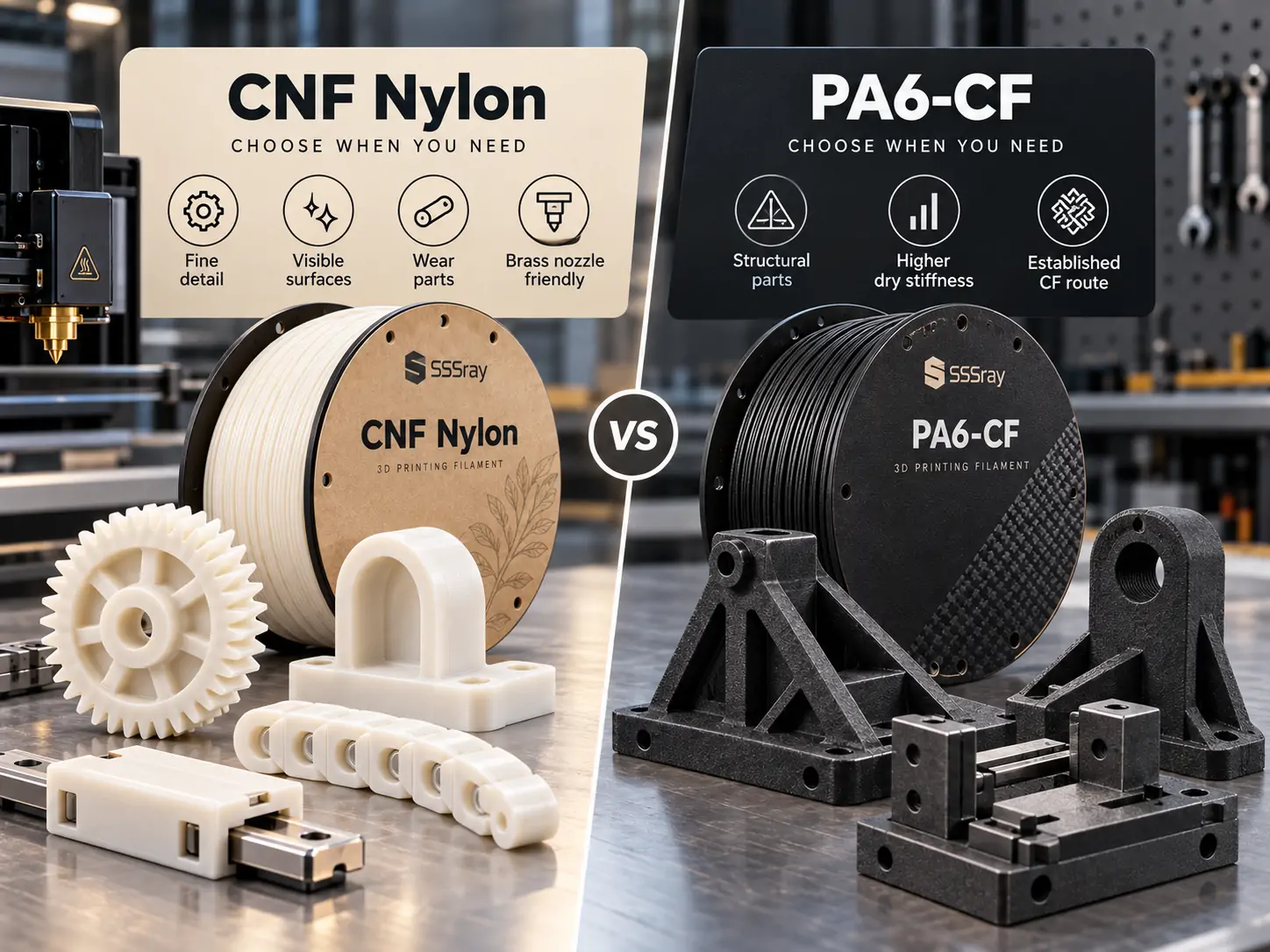
Can CNF reinforced nylon replace PA6-CF in automotive?
For printed tooling, check fixtures, and prototypes in automotive plants, CNF nylon fits applications where fine features, dimensional control, or lower-abrasion contact surfaces matter. Asahi Kasei also identifies automotive and aeronautical potential for its recycled-PA6/CNF development route.
For end-use vehicle parts, approval requires heat-aging, humidity, fatigue, and fluid-resistance evidence against the OEM's own specifications. Asahi Kasei's current public KARAKSA materials do not provide a complete printed-part automotive qualification package, so SSSray would treat automotive end-use approval as a separate customer validation program.
Procurement implicationKeep PA6-CF as the default for structural work and add CNF as a targeted SKU for detail and wear.
Mistake to avoidUsing a maker's "automotive potential" statement as evidence of automotive qualification.
How to verifyTest the actual part geometry under the service humidity and temperature, not just coupons.
If glass fiber is still on your shortlist, compare it on our glass fiber reinforced filament page.
7. The CNF Switch Gate: A Buyer Decision Framework for CNF Nylon Filament
Use the seven gates below before moving any SKU from PA6-CF or unfilled PA to a CNF nylon filament. If a gate fails, stop and fix it; do not average a failure against other passes.
On mobile, swipe horizontally to see every column.
| Gate | Why it matters | What to ask | Pass / fail signal | Hidden risk |
|---|---|---|---|---|
| 1. Application requirement | CNF is strongest on finish, detail, and wear | Which property actually limits the part today? | Pass: detail or wear limited. Fail: stiffness limited | Switching for the story, not the part |
| 2. Material performance | Published values are dry and maker-reported | Dry and conditioned ISO 527/178 data, XY and Z | Pass: both states supplied. Fail: dry only | Overestimating wet stiffness |
| 3. Printability | Drying and profiles differ from PA6-CF | Validated profile for your printer model? | Pass: full-spool run with no stops. Fail: flow-limited splits | Dryer cannot reach 100–120 °C |
| 4. Compliance | End-use restrictions and ESG claims carry liability | SDS, RoHS/REACH statement, permitted uses, footprint | Pass: grade-specific documents. Fail: generic PDF | Prohibited-use clauses passed to your customers |
| 5. Supplier reliability | Single-source branded material | Who holds stock, where, and on what lead time? | Pass: written allocation. Fail: "check stock later" | Channel runs out mid-project |
| 6. Landed cost | 2.6–2.9× retail premium per kg | Bulk price, spool size, Incoterm, duty on HS 3916.90 | Pass: cost per accepted part ≤ target. Fail: above | Retail prices used in the business case |
| 7. Reorder stability | Formulation and loading are not public | Lot traceability and change-notice commitment | Pass: lot ID + notice clause. Fail: none | Silent grade change between reorders |
For the evidence behind gates 2, 3, and 7, our filament qualification program describes how sample IDs, test logs, and change control connect.
8. Procurement Comparison: CNF Nylon Filament vs PA6-CF, PA-GF, and Unfilled Nylon
This table is written for a purchasing manager who has to pick a route this quarter. The SSSray column shows what we can and cannot supply, so you know where a second source exists.
On mobile, swipe horizontally to see every column.
| Option | Best use case | Key spec | Advantage | Risk | How to verify | When to reject | SSSray sourcing note |
|---|---|---|---|---|---|---|---|
| KARAKSA F BX113 (PA/CNF) | Tough, visible functional parts and fine-detail mechanisms | 4,100 MPa tensile modulus; 120 MPa flexural strength; 167 °C HDT | 0.2 mm-capable, low nozzle-wear risk, good surface appearance | 500 g retail format; conditioned data still needed for your application | Conditioned tests + full-spool print | Stiffness below PA6-CF-based design | Asahi Kasei benchmark; SSSray does not sell KARAKSA |
| KARAKSA F DX205 (PA/CNF) | Dimension-sensitive fixtures, low-warp parts and sliding mechanisms | 90 MPa tensile; 4,200 MPa tensile modulus; 130 MPa flexural strength; 178 °C HDT | Low warpage, dimensional accuracy and low published wear | 500 g retail format; validate conditioned properties | Wear, dimensional and full-spool print test | No written stock allocation | Asahi Kasei benchmark; SSSray does not sell KARAKSA |
| PA6-CF | Stiff brackets, structural fixtures | ≈151 MPa flex; ≈186 °C | Highest dry stiffness per € | Abrasive; hardened nozzle; wet property drop | Dry vs wet data, lot CoA | 0.2 mm detail or brass-only fleet | SSSray PA-CF route with OEM packaging |
| PA-GF | Tough, cost-sensitive functional parts | Grade-specific; ask TDS | Lower cost than CF, good impact | Rough surface, abrasive | Surface and impact check | Visible or small-detail parts | SSSray PA-GF route available |
| Unfilled PA6/PA12 | Tough, flexible, low-friction parts | Grade-specific; ask TDS | Ductile, easy to source | Warping, stringing | Warp test on largest part | Large flat parts or stiffness needs | SSSray PA route with private label |
| Recycled PA6/CNF (ECONYL® compound) | Recycled-content programs | 2024 announcement; Q3 2025 trial-sales plan | Recycled PA6 matrix plus bio-based CNF route | The old announcement does not establish current standard commercial availability | Ask Asahi Kasei for the current grade, TDS, stock, lead time, and sales terms | Your launch depends on an unconfirmed supply route | Development-route benchmark; not an SSSray product |
SSSray supply route: we manufacture PA, PA-CF, and PA-GF filament for SSSray-branded and OEM programs; we do not produce or resell KARAKSA. For a CNF project, we can provide the PA/PA-CF/PA-GF control grades, align the trial through our Filament Qualification Program, prepare OEM/ODM packaging and repeat-order controls, and start qualified buyers with sample spools.
9. Supplier Claims vs Reality for Bio-Based Reinforced Filament
New materials attract loose marketing, and CNF sits at the intersection of "nano," "bio," and "carbon fiber alternative." Use this table to turn claims into requests.
On mobile, swipe horizontally to see every column.
| Vague marketing claim | What it might hide | Document, sample, or test to request | What a reliable supplier provides |
|---|---|---|---|
| "Sustainable carbon fiber alternative" | Lower stiffness; no footprint data | ISO 14067 footprint and flexural modulus | Both numbers, same grade, with method |
| "Biodegradable CNF filament" | Conventional nylon matrix | Composition statement and test standard | "Bio-based filler" wording, no biodegradation claim |
| "As strong as carbon fiber" | Different test orientation or dry-only data | ISO 527/178 in XY and Z, dry and conditioned | Full report with specimen and conditioning |
| "Zero nozzle wear" | Short tests only | Nozzle diameter before/after a full spool | Measured wear log or honest "low wear" |
| "No drying needed" | Moisture-driven failures later | Moisture spec at packing, drying guidance | Clear drying temperature and time |
| "Available worldwide" | One reseller with limited stock | Stock location, lead time, allocation | Written availability for your volume |
| "Same as Asahi Kasei CNF" | Unrelated filler or unverified source | Resin source letter, lot traceability | Traceable grade code and maker's documents |
10. CNF Nylon Filament in Four B2B Buying Scenarios
Distributor
Situation: A European reseller wants a "green reinforced nylon" SKU.
Bad choice: Stocking CNF nylon as a PA6-CF replacement.
Consequence: Returns from customers who expected CF stiffness.
Better choice: List it as a detail-and-wear nylon beside PA6-CF.
Verify: Channel stock, lot IDs, and approved product wording.
Next step: Plan the PA6-CF and PA core range with SSSray.
OEM brand
Situation: A printer brand wants a branded "bio-reinforced" nylon.
Bad choice: Announcing a private-label CNF SKU before securing supply.
Consequence: A launch with no source for 1 kg spools or custom labels.
Better choice: Confirm a compound supply route first, then packaging.
Verify: Written compound supply terms and footprint data.
Next step: Discuss an OEM/ODM feasibility review.
Print farm
Situation: A farm prints small nylon gears for a robotics client.
Bad choice: Forcing PA6-CF through 0.4 mm and reaming every bore.
Consequence: Labor cost and scrap on tight fits.
Better choice: Pilot CNF nylon on 0.2 mm with conditioning built in.
Verify: Cost per accepted part over 20–50 parts.
Next step: Request PA-CF samples for the control run.
Engineering buyer
Situation: A plant engineer needs fixtures that touch painted parts.
Bad choice: Approving from a dry data sheet alone.
Consequence: Fixtures soften in humid summer shifts.
Better choice: Test at plant humidity, then compare with PA6-CF.
Verify: Conditioned ISO 527/178 data on the actual geometry.
Next step: Send the fixture requirement for a document review.
11. How SSSray Structures a CNF Nylon vs PA6-CF Side-by-Side Qualification
When a customer evaluates CNF against PA6-CF, we do not mix third-party CNF numbers with SSSray factory results. We use Asahi Kasei's KARAKSA data to screen the CNF side, then anchor the control side with SSSray's own published nylon records. That gives the buyer a traceable baseline before a customer-specific CNF lot is run on the same printer, geometry, conditioning state, and locked profile.
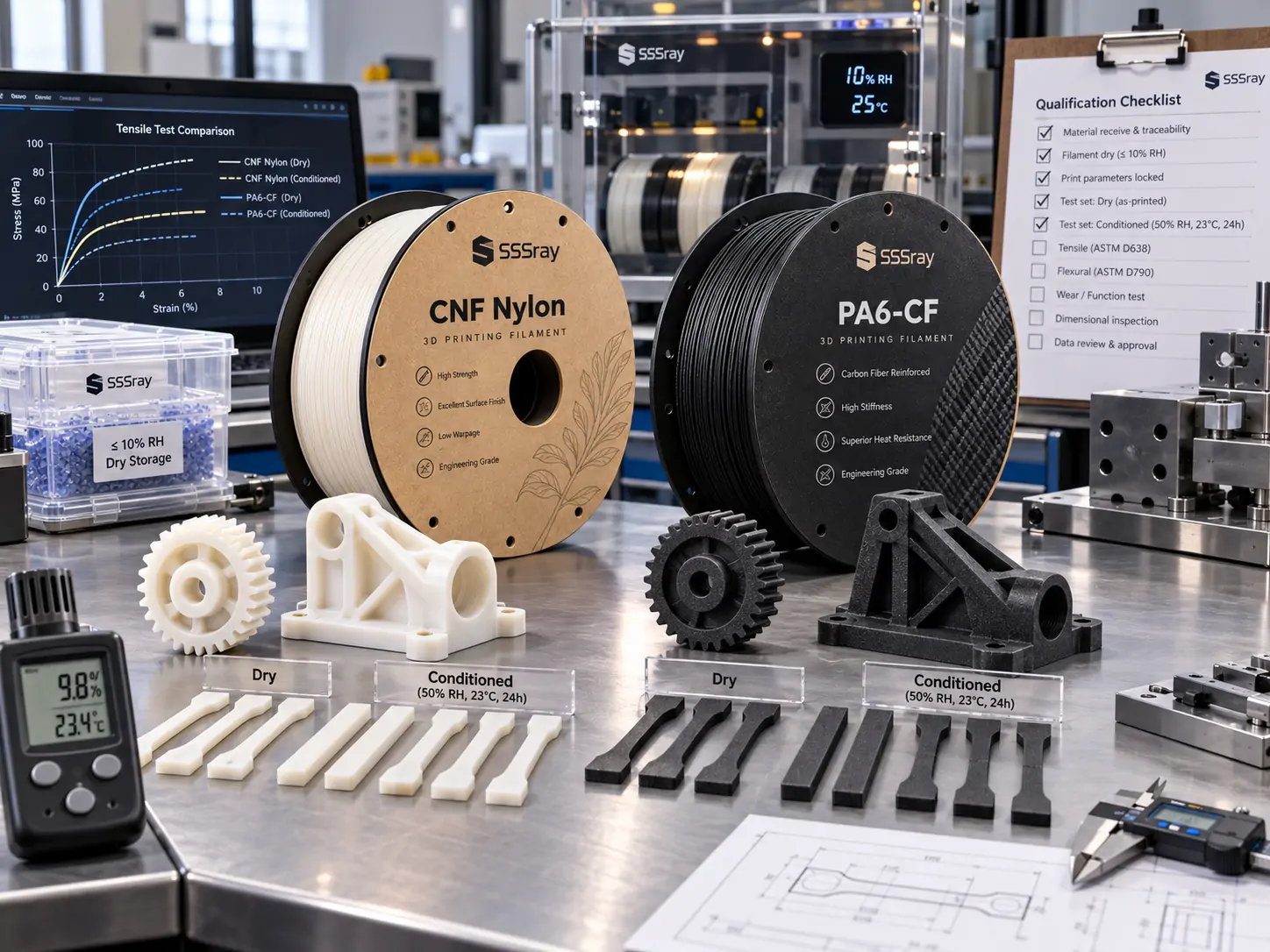
On mobile, swipe horizontally to see every column.
| Test | Method | Specimens | Conditioning | Record to capture |
|---|---|---|---|---|
| Tensile strength and modulus | ISO 527, printed XY and Z | n = 5 per orientation per material | Dry and conditioned | Lot ID, printer, profile, mean ± SD |
| Flexural strength and modulus | ISO 178 | n = 5 per material | Dry and conditioned | Mean ± SD, failure mode photos |
| Heat deflection | ISO 75, load stated | n = 3 per material | Dry | Load, span, result |
| Nozzle wear | Orifice measured before/after 1 kg | Brass and hardened 0.4 mm | Same flow rate | Diameter change in µm |
| Fine-detail fit | Gear and snap-fit test part at 0.2 mm | n = 10 parts | 24 h conditioned | Fit gauge pass rate |
| Moisture uptake | ISO 62 practice | n = 3 | Fixed temperature and RH | Mass gain over time |
SSSray CNF qualification control-side evidence
For this CNF buyer guide, we use two published SSSray records for one specific purpose: to establish the PA6-CF moisture baseline and the nylon production-lot release controls that a CNF candidate must be compared against. These are SSSray first-hand control records, not claimed KARAKSA measurements.
On mobile, swipe horizontally to see every column.
| Record | Batch / sample plan | Equipment / conditions | Measured result | What this proves |
|---|---|---|---|---|
| PA6-CF 30-day moisture uptake | Q1 2026; four SSSray PA-CF production batches in the study; PA6-CF values reported as mean of n=3 samples per grade at seven time points | 23 °C, 50% RH; calibrated moisture balance; 0.5 mm printed tensile bars stored open; controlled-humidity exposure protocol cross-checked against ISO 62:2008 | <0.10% at 0 h; 0.18% at 6 h; 0.55% at 24 h; 1.05% at 72 h; 1.55% at 168 h; 2.00% at 336 h; 2.40% at 720 h | Quantifies how quickly the SSSray PA6-CF control absorbs moisture after opening and why dry/conditioned state must be specified |
| PA6/66 production-lot QC | Public Batch ID SSR-PA6-66-260918-L07-B01; production/test date 18 September 2026; Line 07; COA audit 10 spools × 3 archived laser checkpoints = 30 measurement sets | Continuous inline laser micrometer; pre-seal conditioning 80 °C × 8 h; Karl Fischer titration n=3 | Mean diameter 1.751 mm; observed range 1.731–1.772 mm; maximum ovality 0.018 mm; mean pre-seal moisture 0.017 wt% (170 ppm); lot released | Shows the traceable lot-to-line diameter, ovality, conditioning, moisture and release-control system used for SSSray engineering nylon |
SSSray control-side traceability: the PA6-CF moisture baseline is published in our 30-day PA-CF moisture study. Production lot SSR-PA6-66-260918-L07-B01 is published in our printer and filament qualification guide and linked to our Batch QC Data program. When a CNF lot enters an SSSray qualification project, its supplier lot ID, printer, profile revision, sample count, conditioning state, and measured result are added to the project record; until then, KARAKSA-specific performance remains attributed to Asahi Kasei and the cited printer test.
12. CNF Nylon Filament FAQ for B2B Buyers
How does CNF-nylon compare to PA6-CF mechanically?
On published dry data, Bambu Lab PA6-CF is stronger in bending at 151 ± 8 MPa. The current KARAKSA TDS lists BX113 at 120 MPa flexural strength and 167 °C HDT, and DX205 at 130 MPa and 178 °C; Bambu Lab PA6-CF lists 186 °C HDT at 0.45 MPa. CNF nylon's purchasing advantages are different: lower published sliding wear, 0.2 mm nozzle capability, lower nozzle-wear risk, dimensional control and smoother surface appearance. Final approval still requires the same orientation, conditioning state, printer and part geometry.
Is CNF filament truly biodegradable or just bio-based?
It is bio-based in its filler, not automatically biodegradable. KARAKSA uses polyamide as the matrix. Earlier development grades disclosed 5% and 7% CNF, while the current commercial BX113/DX205 TDS does not state exact CNF loading. If a supplier claims a CNF nylon filament is biodegradable or compostable, ask for the applicable test standard and product-specific report before using that wording on private-label packaging.
What is the cost premium of CNF vs carbon fiber filament?
At retail, about 2.6–2.9 times per kilogram. In September 2026 a European reseller listed KARAKSA F at roughly €100–110 per 500 g, against about €37.81 per 500 g for a mainstream PA6-CF excluding VAT. Bulk pricing is not public, so request a written quote. More importantly, compare cost per accepted part: CNF can close the gap if it removes machining, scrap, or nozzle-related workflow constraints, but it will not if PA6-CF already passes your part at high yield.
Where can I buy cellulose nanofiber filament in bulk?
Public September 2026 channels show KARAKSA F mainly as 500 g, 1.75 mm retail spools, while a standard public bulk or private-label program is not listed. For volume, contact Asahi Kasei directly through the KARAKSA site, state annual quantity, spool format, destination, and required documents, and obtain written allocation and lead time. SSSray can supply the PA6-CF, PA-GF, and unfilled-PA control grades around that CNF program.
Is Asahi Kasei KARAKSA available outside Japan?
Yes, in limited commercial channels. Filament2Print currently lists BX113 and DX205 in Europe, while Asahi Kasei's KARAKSA site lists commercial PA filament sales in Japan. Separately, Asahi Kasei and Aquafil's October 2024 ECONYL® announcement said trial sales were planned for Q3 2025 in the EU, US, and Japan; because that date has passed, SSSray does not use the old announcement as proof of current ECONYL/CNF availability. Confirm current stock, TDS, lead time, and sales terms in writing before committing to a customer delivery date.
Can CNF reinforced nylon replace PA6-CF in automotive parts?
For printed jigs, fixtures, and prototypes in automotive plants, CNF nylon fits applications where fine features, dimensional control, or low sliding wear matter. End-use vehicle components still require heat-aging, humidity, fatigue, and fluid-resistance validation to the OEM's specification. Current public KARAKSA information does not provide that complete printed-part qualification package, so automotive approval must be application-specific.
Do I need a hardened nozzle for CNF nylon filament?
Asahi Kasei states that the smaller, more flexible CNF reduces nozzle wear and clogging risk versus conventional fiber reinforcement. Psych0h3ad's hands-on test demonstrated both brass-nozzle use and 0.2 mm printing. You still need a hotend that holds 260–280 °C reliably and drying suitable for the material. For long production runs, measure nozzle condition against your approved baseline rather than assuming zero wear.
What documents should I request before approving a CNF nylon lot?
Request the current TDS and SDS for the exact grade code, a lot-linked certificate of analysis if available, a RoHS/REACH statement for your destination, the permitted-use terms, and a product carbon footprint if you plan any environmental claim. Ask for dry and conditioned mechanical data with test methods. Finally, get a written commitment on lot traceability and advance notice of formulation changes, because the CNF loading of the commercial grades is not publicly disclosed.
Conclusion: Approve CNF Nylon Filament Where It Solves a Real Part Problem
CNF nylon filament is a genuine new option, not a rebranded carbon fiber. Asahi Kasei's KARAKSA F brings 0.2 mm nozzle capability, smooth surface appearance, a DX grade targeted at reduced warpage and dimensional accuracy, and lower sliding wear in Asahi Kasei's published comparison. It does not beat the PA6-CF benchmark on dry flexural strength, and the September 2026 reseller snapshot prices it at roughly 2.6–2.9 times the PA6-CF reference per kilogram.
So the decision logic is narrow and clear. Use CNF where detail, wear, finish, or brass-nozzle compatibility limits the part today. Keep PA6-CF where stiffness per euro decides. Treat the sustainability case as unproven until you hold a grade-specific footprint, and never market it as biodegradable.
Your next step: pick one part, run CNF and PA6-CF side by side on your production printer, test dry and conditioned, and calculate cost per accepted part. If you need the PA6-CF or unfilled-PA control material, TDS/COA/MSDS documents, OEM packaging, or a bulk quote for the rest of your nylon range, start with a sample request.
Include your printer model, nozzle size, part drawing, service humidity, and target quantity so we can confirm documents and a bulk quote in one reply.
Request a quote or free samples
Tell us the material, color, spool size and monthly volume. An engineer replies within 24 hours on business days.
References
- Asahi Kasei Engineering Plastics: Development of CNF-reinforced resins for 3D printing — thixotropy, 5–10% CNF loading, DX101/BX102 development grades.
- Asahi Kasei Engineering Plastics: CNF-reinforced thermoplastics — cotton-linter CNF, regrindability, product overview.
- Asahi Kasei Europe: CNF and recycled PA6 for 3D printing — October 2024 development announcement; Q3 2025 trial sales were planned, so the page is not used as evidence of current standard availability.
- Asahi Kasei: KARAKSA™ F CNF-blended PA filament — current grade positioning, wear-test conditions and recommended printing window.
- Asahi Kasei KARAKSA™ F TDS CNFF-TD002-1, Version 1.0, February 2026 — BX113/DX205 density, ISO 75-2 HDT and ISO 527/178 mechanical values.
- Filament2Print: KARAKSA™ F BX113 product data — density, print settings, ISO 527/178/75 values, use restrictions.
- Filament2Print: KARAKSA™ F DX205 product data — strength values, bed temperature, HS code.
- Psych0h3ad: Asahi Kasei KARAKSA CNF filament review — multi-printer testing, drying, conditioning, wear data.
- Bambu Lab: PA6-CF product page — PA6-CF benchmark handling and nozzle notes.
- Environmental Science & Technology: Harmonized life-cycle inventories of nanocellulose — 1.8–1,100 kg CO₂e/kg range.
- Sustainable Materials and Technologies: Life cycle GHG emissions of carbon fibers — 24.83 kg CO₂e/kg conventional CF at 3,000 t/yr.
- ISO 14067:2018 Carbon footprint of products — basis for grade-specific footprint requests.
- ISO 62:2008 Plastics — Determination of water absorption — framework for moisture-conditioning tests.
- SSSray: PA12-CF vs PA6-CF 30-Day Moisture Test — Q1 2026 first-hand PA6-CF moisture record, 23 °C / 50% RH, n=3 per grade.
- SSSray: Bambu, Prusa & QIDI Filament Requirements 2026 — public production-lot record SSR-PA6-66-260918-L07-B01 with line, laser-diameter and Karl Fischer QC.
