Online time
Monday to Friday: 9AM - 8PM
Weekend: 10AM - 5PM


TL;DR: A Speed Number on the Box Is Not a Spec
Most high speed PLA filament claims fail for one reason: 300 mm/s describes how fast the print head moves, not how much plastic the hotend can melt. At a 0.42 mm line and 0.20 mm layer, 300 mm/s needs about 25 mm³/s of molten PLA. Bambu Studio’s own Generic PLA and Generic PLA High Speed profiles cap flow at 12 and 18 mm³/s.
Best option: a PLA grade whose supplier states a measured maximum volumetric flow on a named hotend and temperature, plus a lot-level melt flow index with test conditions and a tolerance band.
When not to use itSmall, detailed or cosmetic parts, where cooling time limits speed and a glossier high-flow finish may not suit the SKU.
Key specificationAt least 25 mm³/s for 300 mm/s walls, with 95% or more mass delivered in a flow test on your hardware.
Supplier verificationAsk for the flow-test record and MFI of the lot you will receive, not a grade brochure.
Procurement warningReject any “300–600 mm/s” claim that omits nozzle, layer, line width, temperature and printer.
Abstract: Why High-Speed PLA Claims Need Verification in 2026
High-speed CoreXY printers are now the default in many print farms and retail channels, so “high-speed PLA” has become one of the most crowded filament labels. Many spools now print a speed on the box: 300, 350, 500 or even 600 mm/s.
The problem is that none of these numbers can be tested as written. Print speed is a motion setting. What actually limits a print is volumetric flow: how many cubic millimeters of plastic the hotend can melt and push out each second. The same “300 mm/s” can mean 18 mm³/s on a thin line or 40 mm³/s on a thick one.
Buyers tend to make three mistakes. First, they compare speed claims across brands as if they were measured the same way. Second, they treat melt flow index (MFI) as proof of speed, even though MFI is measured at a shear rate hundreds of times lower than inside a nozzle. Third, they approve one good sample and assume every later lot will behave the same.
For a B2B buyer, the decision logic is different from a hobbyist’s. A distributor needs fewer returns. A print farm needs more good parts per machine-hour. An OEM brand needs every reorder to match the approved sample. All three need a spec they can test, write into a purchase order, and enforce.
This guide uses a simple framework. We start with the flow math, then compare it against published limits from Bambu Lab and Prusa. Next, we explain what MFI can and cannot prove, why unverified “high-speed” grades can clog or under-extrude, and how to run a three-level verification without a lab. Finally, we turn the results into a cost model, a supplier-claims audit, a seven-gate qualification framework, and a sourcing spec.
Where we cite a number, we name the source; where we calculate, we show the assumptions.
Key Takeaways
- Convert every speed claim into flow. Line width × layer height × speed gives mm³/s; 0.42 × 0.20 × 300 = 25.2 mm³/s.
- Your slicer may already cap you. Bambu Studio’s default X1C profile asks for 300 mm/s inner walls (about 27 mm³/s); its generic PLA profiles allow 12–18.
- Hardware can matter more than filament. Bambu lists PLA Basic at 24 mm³/s on the H2D standard 0.4 mm hardened steel nozzle and 40 mm³/s on the H2D 0.4 mm High Flow nozzle.
- Verified high-speed PLA gains are measurable but hardware-dependent. Prusa publishes 28 mm³/s for PLA High Speed versus 24 mm³/s for regular Prusament PLA on the CORE One+; its high-speed setup uses a 0.4 mm High-Flow (CHT) nozzle.
- MFI is a screening number, not a pass mark. Published high-speed grades range from about 5 to 20 g/10 min at 190 °C, and one “HS” grade matches its brand’s PLA+.
- MFI values need matching conditions. 190 °C and 210 °C results are not comparable, and PLA should be tested as moisture-sensitive.
- Diameter tolerance becomes a flow problem at speed. ±0.05 mm swings cross-section by about ±5.7%; ±0.03 mm by about ±3.4%.
- A weigh test needs no lab. Extrude at your target flow for 20 seconds, weigh the output, and reject below 95% of the expected mass.
- Buy on cost per good part. In our illustrative model, a spool costing 14% more per kg delivers parts about 26% cheaper once flow and failures are counted.

He Jiang
Senior Researcher
SSSray · 3D Printing Filament Manufacturing · Jinhua, Zhejiang
Our senior researcher He Jiang focuses on filament qualification for high-speed FDM printing, including maximum volumetric flow, MFI/MFR, diameter and ovality, moisture control, printer-specific validation and lot-level QC. His work supports our B2B sample approval, batch verification and technical sourcing guides.
1. Why “300 mm/s” Is Not a High Speed PLA Filament Specification
Direct answer: A print speed only becomes testable when you add line width and layer height. Multiply the three and you get volumetric flow in mm³/s. That is the number a filament and hotend either sustain or fail.
The one formula every buyer should use
Think of the hotend as a kitchen tap. The head can move as fast as you like, but the tap only delivers so much per second; move faster than it can fill the line, and the line comes out thin.
Volumetric flow (mm³/s) = line width (mm) × layer height (mm) × speed (mm/s)
For a 0.4 mm nozzle printing a 0.42 mm line at 0.20 mm layers, 300 mm/s works out to 25.2 mm³/s. To supply that, a 1.75 mm filament has to enter the hotend at about 10.5 mm every second, and melt all the way through on the way down.
That is all a filament flow rate calculator does. It is a simple width × height estimate; slicers that model rounded line edges calculate about 10% less.
The same “300 mm/s” can mean very different flow
Line width changes everything. Bambu Studio’s default X1C profile uses 0.42 mm outer and 0.45 mm inner walls, so two walls “at 300 mm/s” need different flow. The chart shows how fast demand climbs past common published caps.
On mobile, swipe horizontally to see every column.
| Print speed (mm/s) | Flow at 0.42 × 0.20 mm (mm³/s) | Flow at 0.45 × 0.20 mm (mm³/s) | Within 18 mm³/s cap? (0.42 line) | Within 21 mm³/s cap? (0.42 line) | Within 28 mm³/s cap? (0.42 line) |
|---|---|---|---|---|---|
| 100 | 8.4 | 9.0 | Yes | Yes | Yes |
| 150 | 12.6 | 13.5 | Yes | Yes | Yes |
| 200 | 16.8 | 18.0 | Yes | Yes | Yes |
| 250 | 21.0 | 22.5 | No | Yes (at limit) | Yes |
| 300 | 25.2 | 27.0 | No | No | Yes |
| 350 | 29.4 | 31.5 | No | No | No |
| 400 | 33.6 | 36.0 | No | No | No |
| 450 | 37.8 | 40.5 | No | No | No |
| 500 | 42.0 | 45.0 | No | No | No |
Where the slicer quietly caps your speed
In the official Bambu Studio profile library, the default 0.20 mm X1C process asks for 300 mm/s inner walls on a standard nozzle. At a 0.45 mm line, that is about 27 mm³/s.
However, the same library caps Generic PLA at 12 mm³/s, Generic PLA High Speed at 18 mm³/s, and Bambu PLA Basic at 21 mm³/s. As the Bambu Lab Wiki explains, when a feature would exceed the filament’s maximum volumetric speed, the slicer reduces the speed automatically.
So the settings say 300 mm/s, but the walls print slower. A “300 mm/s” filament adds nothing unless it justifies a higher flow cap on your hardware.
Procurement implicationWrite flow, not speed, into the RFQ: “≥ X mm³/s at Y °C on printer Z, 0.4 mm nozzle.”
Mistake to avoidComparing “350 mm/s” from one brand with “500 mm/s” from another; neither is a measured quantity.
How to verifySlice your top-selling model and read the flow graph; see where the cap, not the speed, limits the job.
2. Volumetric Flow Rate PLA Limits: What 2026 Printers Actually Allow
Direct answer: Across the 0.4 mm examples below, published PLA flow caps range from 21 to 40 mm³/s depending on the printer and nozzle. The standard-nozzle examples sit around 21–24 mm³/s, while Prusa publishes 28 mm³/s for PLA High Speed on the CORE One+ with a 0.4 mm High-Flow (CHT) nozzle and Bambu lists 40 mm³/s on the H2D 0.4 mm High Flow nozzle.
Published flow caps, side by side
These values come from slicer profiles and manufacturer pages. They are conservative quality settings, not physical limits, but they are what your customers’ printers will actually use.
On mobile, swipe horizontally to see every column.
| Filament and hardware | Published cap (mm³/s) | Bar (red line = 25.2 mm³/s need) | Max wall speed at 0.42 × 0.20 mm | Reaches 300 mm/s walls? | Source |
|---|---|---|---|---|---|
| Bambu Studio Generic PLA profile | 12 | 143 mm/s | No | Bambu Studio profiles | |
| Bambu Studio Generic PLA High Speed profile | 18 | 214 mm/s | No | Bambu Studio profiles | |
| Bambu PLA Basic, X1C standard nozzle profile | 21 | 250 mm/s | No | Bambu Studio profiles | |
| Bambu PLA Basic, H2D 0.4 mm hardened steel nozzle | 24 | 286 mm/s | No (close) | Bambu Lab store | |
| Prusament PLA on CORE One+ (230 °C) | 24 | 286 mm/s | No (close) | Prusa product page, Sep 2026 | |
| Prusament PLA High Speed on CORE One+ with 0.4 mm High-Flow (CHT) nozzle (215 °C) | 28 | 333 mm/s | Yes | Prusa product page, Sep 2026 | |
| Bambu PLA Basic, H2D 0.4 mm High Flow nozzle | 40 | 476 mm/s | Yes | Bambu Lab store |
Below 300 mm/s needAbove 300 mm/s need25.2 mm³/s requirement
Bar scale: full width = 40 mm³/s. Bambu Studio values checked in the official GitHub profile library in September 2026. Max wall speed = cap ÷ 0.084 mm², rounded.
Notice that even the best-profiled standard PLA sits just under 300 mm/s walls, and that the biggest jump in the chart comes from a nozzle change, not a filament change.
Can I use standard PLA at 300 mm/s on Bambu Lab printers?
On an X1 or P1 with the standard nozzle, not for walls at 0.20 mm layers under the current Bambu Studio PLA Basic profile used here: 21 mm³/s corresponds to about 250 mm/s for a 0.42 mm wall at 0.20 mm layer height.
With the H2D 0.4 mm High Flow nozzle, Bambu lists 40 mm³/s for PLA Basic, so 300 mm/s walls fit within that published material-specific flow value. Bambu’s H2D High Flow Hotend page is hardware-specific; do not transfer the H2D figure to X1/P1/A1 without separate qualification.
So “Bambu Lab high speed compatible” on a spool means little unless the supplier names the printer, nozzle and validated flow cap.
Standard PLA vs high speed: what the upgrade really buys
Verified high-speed PLA gains are usually measured in percent, not multiples. Prusa’s current product data lists 28 mm³/s at 215 °C for PLA High Speed versus 24 mm³/s at 230 °C for regular Prusament PLA on the CORE One+; the published high-speed setup uses a 0.4 mm High-Flow (CHT) nozzle. Its launch article also reports 20–40% print-time savings depending on part shape.
Prusa also reports a Z-to-XY tensile ratio of 0.60 versus 0.33 for its standard PLA, and a glossier surface that shows imperfections more: more flow and adhesion, a different finish.
When a supplier promises “3–5× faster,” ask what baseline they used.
Procurement implicationMatch the grade to your customers’ installed hotends; the same spool behaves differently on each.
Mistake to avoidBuying a premium HS grade for machines whose nozzle caps flow below what the grade can use.
How to verifyAsk for validation logs per printer family, including nozzle type and temperature.
3. Melt Flow Index Verification: What MFI Proves and What It Hides
Direct answer: MFI shows how easily a melt flows under a light load at one temperature. It is excellent for checking that lots are consistent, and weak as proof of 300 mm/s performance, because the nozzle works at far higher shear.
What an MFI test actually measures
In an MFI test (ISO 1133 or ASTM D1238), molten plastic is pushed through a standard 2.095 mm die by a fixed weight, often 2.16 kg for PLA. The result is grams per 10 minutes, and the temperature and load are part of the value: PLA flows noticeably faster at 210 °C than at 190 °C, so the two cannot be compared.
What MFI values do published high-speed PLA grades use?
There is no industry threshold. The published values below show why a single “high-speed MFI” number does not exist.
On mobile, swipe horizontally to see every column.
| Product | Positioning | Published MFI (g/10 min) | Condition | Method stated | What a buyer should read into it |
|---|---|---|---|---|---|
| NatureWorks Ingeo 3D850 | Base resin for 3D filament | 7–9 | 210 °C / 2.16 kg | ASTM D1238 | Resin data; filament after compounding will differ |
| eSUN PLA+ | Toughened PLA | 5 | 190 °C / 2.16 kg | GB/T 3682 | Baseline for the same brand’s HS grade |
| eSUN ePLA-HS | High-speed PLA | 5.2 | 190 °C / 2.16 kg | Listed on product page | HS gain is not explained by MFI alone |
| Flashforge PLA Matte | Matte PLA | 4–8 | 190 °C / 2.16 kg | ISO 1133 | Typical standard-flow range |
| Flashforge HS PLA | High-speed PLA | 10–20 | 190 °C / 2.16 kg | ISO 1133 | Clearly higher flow, but a wide 2× range |
One brand’s high-speed PLA reads 5.2, almost the same as its PLA+ at 5, so its speed gain must come from other properties. Another reads 10–20: clearly higher, but too wide a band to control lots on its own.
The shear-rate gap: why MFI cannot prove 300 mm/s
Here is the physics in plain terms. In an MFI test, PLA flows slowly through a wide die. Using a simple Newtonian estimate and a melt density of roughly 1.1 g/cm³, a 7 g/10 min PLA sees an apparent wall shear rate of only about 10 per second.
Inside a 0.4 mm nozzle at 25 mm³/s, the same estimate gives roughly 4,000 per second, several hundred times higher. Polymers are shear-thinning: they get runnier as they are forced faster, like ketchup that suddenly pours once you shake the bottle. Two grades with the same MFI can therefore behave quite differently in the nozzle.
How to make MFI useful in a purchase spec
- Demand the full condition: standard, temperature, load and pre-drying. For moisture-sensitive polyesters, ISO 1133-2 tightens temperature, time and sample handling.
- Use it for lot consistency: agree a band around the approved sample, the way Bambu Lab prints “6.4 ± 1.2 g/10 min” on a PLA-family support product.
- Question an unusually high MFI: hydrolysis and heavy reprocessing shorten chains and raise MFI, so a “fast” lot may simply be degraded.
Procurement implicationPut MFI with condition and ± band in the PO, and pair it with a flow test.
Mistake to avoidRanking suppliers by MFI numbers measured at different temperatures or standards.
How to verifyRequest MFI for the shipped lot and the approved sample, tested the same way, same day.
4. Why Unverified “High-Speed” PLA Clogs or Under-Extrudes at High Flow
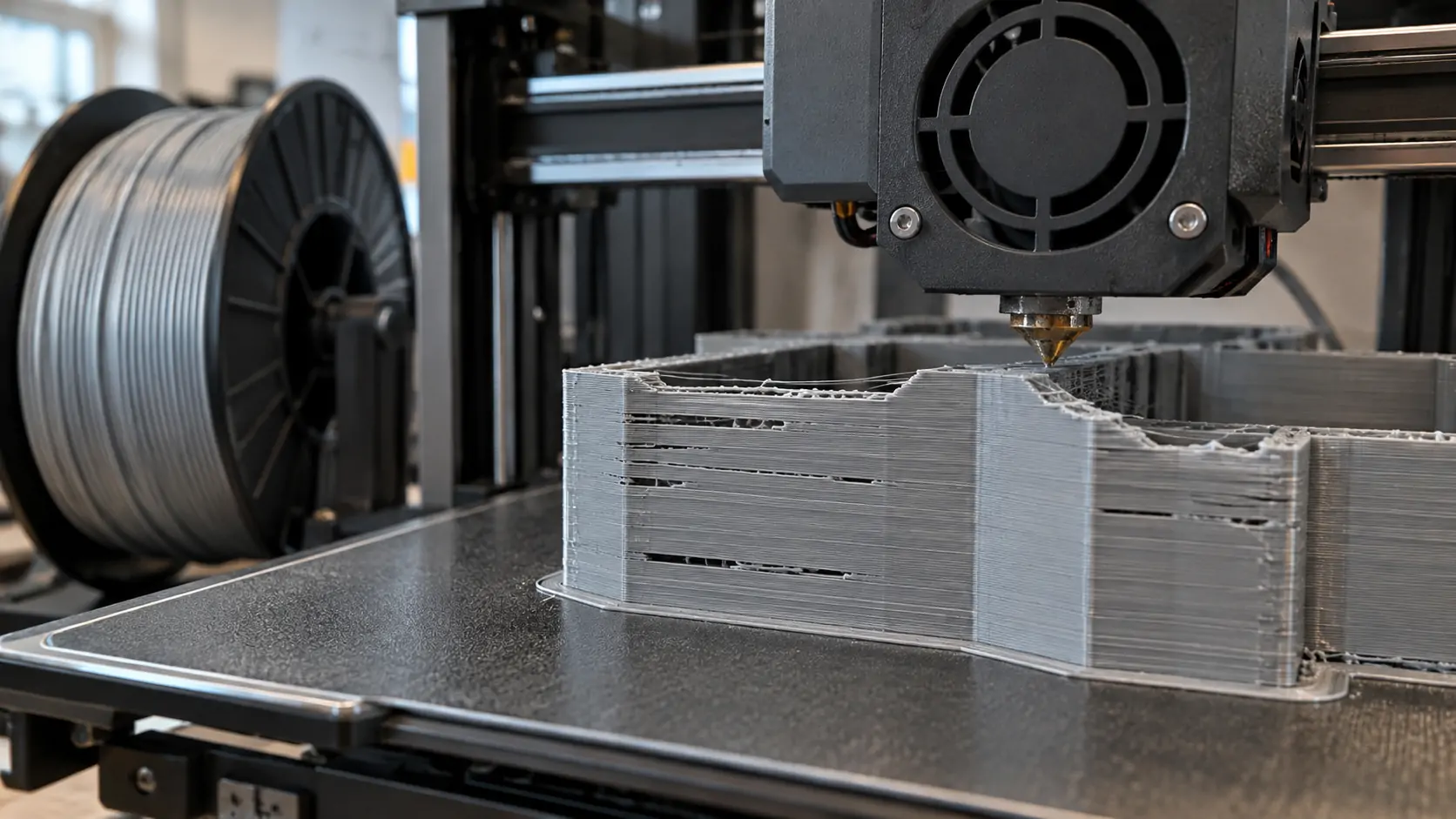
Direct answer: At high flow, the filament spends a fraction of a second in the melt zone. Any weakness in the spool, such as moisture, diameter swings, unstable melt or contamination, shows up as clicking, thin walls or partial clogs long before it appears at slow speed.
Heat has to reach the core of the filament
A hotend melts filament from the outside in. At slow speed, heat has time to reach the center; at 25 mm³/s, it does not.
MIT researchers Go, Schiffres, Stevens and Hart (Additive Manufacturing, 2017) found that FFF build rate is limited together by the extruder’s grip on the filament, by heat conduction into the filament core, and by gantry speed. When the core arrives too cold, back-pressure rises, the drive gear slips, and the extruder clicks or grinds.
A properly qualified high-speed grade delays this point; a relabeled standard grade can hit it earlier.
Diameter swings become flow swings
The extruder pushes a length, not a volume. For 1.75 mm filament, ±0.03 mm moves the cross-section by about ±3.4%, and ±0.05 mm by about ±5.7%. At 25 mm³/s, that is up to ±1.4 mm³/s of unplanned flow: thick sections push a near-capped hotend over its limit, and thin sections leave gaps.
Moisture quietly changes viscosity
PLA is a polyester, so water attacks it in the melt. NatureWorks’ 3D850 datasheet recommends less than 0.025% (250 ppm) moisture before processing to prevent viscosity degradation.
Wet filament pops, strings and loses viscosity as chains break, so flow becomes unpredictable. Poorly packed budget spools are most exposed during sea freight.
Heat creep and contamination
PLA softens at about 55–60 °C (3D850’s glass transition). In a warm enclosure, filament can soften above the melt zone and jam, especially when a fast print slows for small features. Poor compounding adds gels or specks that pass at slow speed but lodge in the nozzle at high flow.
Why can unverified high-speed PLA clog? A quick diagnosis list
- Clicking at steady speed: flow above what the grade can melt; run the Section 6 test.
- Random thin lines: measure diameter and ovality at 10 points per meter.
- Popping and strings: dry a sample and reprint; improvement means moisture.
- Jams after slowdowns: heat creep; open the enclosure, check the heatsink fan.
- Sudden partial clogs: contamination; keep the nozzle and spool segment as evidence.
Procurement implicationSpecify diameter, ovality and moisture limits alongside the flow claim.
Mistake to avoidBlaming the printer before testing a dried segment of the same spool.
How to verifyLog failures by lot number; a cluster in one lot points to material, not machines.
5. Extruder Temperature for High Speed PLA and the Print Speed vs Quality Trade-Off
Direct answer: Routine high-speed PLA commonly starts around 210–230 °C, but tuned 300–600 mm/s-class profiles on capable high-flow systems can move into roughly 230–260 °C. The temperature only means something when it is published together with hotend, nozzle, volumetric flow, cooling and the resulting print quality.
Why hotter nozzles help at speed
Published starting points are hardware- and grade-specific. Prusa publishes 28 mm³/s for PLA High Speed at 215 °C and 24 mm³/s for standard Prusament PLA at 230 °C. Bambu Studio PLA profiles commonly use 220 °C as a profile setpoint, while eSUN lists 210–230 °C for ePLA-HS.
A hotter nozzle lowers viscosity and pushes heat into the core faster, like turning up the stove to cook pasta faster: it works, within limits.
When a higher temperature needs qualification
A higher setpoint is not automatically a warning sign. Our RapidFlow PLA-HS, for example, uses 210–230 °C for routine high-speed setup and a 230–260 °C tuning range for 300–600 mm/s-class operation on capable high-flow systems. The warning sign is an undisclosed test condition: compare suppliers only when printer, hotend, nozzle, temperature, volumetric flow, cooling and surface-quality trade-offs are stated together.
Print speed vs quality trade-off: what you give up
- Surface finish: Prusa’s HS grade is glossier and shows imperfections more.
- Small features: layer time and cooling cap speed, so HS filament adds little.
- Dimensional accuracy: high-flow pressure swings bulge corners without pressure advance tuning.
- Layer adhesion: can improve, as Prusa’s higher Z-to-XY ratio shows.
The practical rule: use high-speed PLA for large, flow-limited parts such as enclosures, fixtures and trays, and keep standard or matte grades for cosmetic, detailed SKUs.
Procurement implicationAsk for the temperature window used to validate the flow claim, not just a range on the label.
Mistake to avoidLetting a supplier’s claim depend on a temperature your customers will not use.
How to verifyRun the flow test at two temperatures and compare the pass point.
6. How to Verify High-Speed PLA: A Three-Level 300 mm/s Filament Test
Direct answer: Check the paperwork, then run an extrude-and-weigh flow test on your own printer, then use lab MFI for lot control. The flow test is the one that settles the “300 mm/s” question, and it needs only a scale.
How to verify if PLA is truly high speed rated
Work in three levels. Documents tell you whether a claim is testable at all. A flow test on your own printer tells you whether it is true for your setup. Lab checks tell you whether each lot stays the same.
Level 1: the document check
A testable claim names the printer or hotend, nozzle, temperature and flow in mm³/s, plus MFI with its condition, diameter and ovality tolerance, and a moisture spec. If any are missing, you cannot hold the supplier to it.
Level 2: how to test filament flow without lab equipment
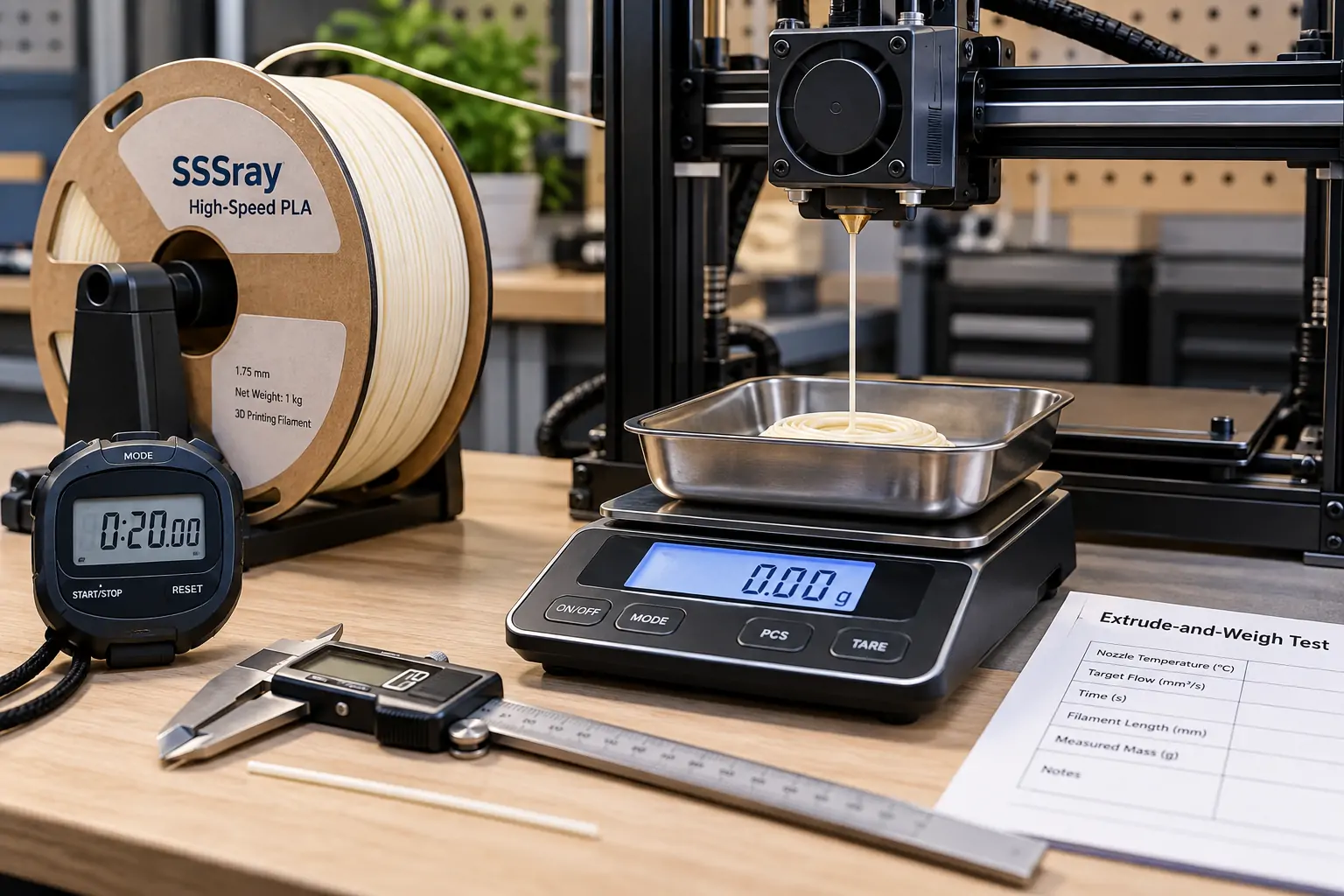
This extrude-and-weigh test turns “300 mm/s” into a pass/fail number on your hardware. Here it is for 25 mm³/s (300 mm/s walls at 0.42 × 0.20 mm).
- Dry the sample according to the exact grade’s TDS when available. If no grade-specific condition is supplied, 55 °C for 8 hours is a practical PLA-family reference; record the drying method with the result.
- Work out the feed rate: 25 mm³/s ÷ 2.405 mm² (the 1.75 mm cross-section) ≈ 10.4 mm/s, or about 624 mm/min.
- Extrude 208 mm of filament into the air over 20 seconds at about 624 mm/min. On firmware that permits manual extrusion, use relative extrusion and split the move into firmware-safe segments at the same feed rate; for example, four consecutive 52 mm moves. On closed firmware, use the printer or slicer’s supported max-flow calibration.
- Collect and weigh the extrudate. At a working PLA density of 1.24 g/cm³, 500 mm³ corresponds to about 0.62 g. If the exact grade publishes a different density, use that density in the expected-mass calculation.
- For a 95% mass-delivery screening threshold at the 1.24 g/cm³ assumption, 0.59 g is the minimum. Repeat at 16, 20, 24, 28 and 32 mm³/s and record delivered mass, clicking and extrusion continuity; confirm the selected cap with a printed max-flow ladder or representative production part.
Test three spools per lot plus your reference spool on the same day; the comparison matters more than the absolute value.
Level 3: lab checks that control the lot
- MFI on sample and lot, same standard and condition, tested side by side.
- Moisture by Karl Fischer titration on as-shipped filament, to check the packaging did its job.
- Capillary rheometry (ISO 11443), which measures viscosity near nozzle shear rates, when two grades share an MFI but print differently.
Cross-brand results need a common method. We have not identified a widely accepted public blind benchmark that controls printer, hotend, temperature, lot and sample plan across brands. Any published “pass rate” should therefore include its method, samples and hardware.
Procurement implicationMake the Level 2 flow test part of sample approval and first-lot inspection.
Mistake to avoidTesting a wet sample, then blaming the formula for a moisture problem.
How to verifyKeep the extrudate, weights and settings in the approval file for later disputes.
7. Our High-Speed PLA Flow Test Record
We publish a material-specific internal flow and feeding reference series for our high-speed PLA. These figures are already public on SSSray.com and are kept separate from shipment-specific COA data, so buyers can distinguish our process-reference results from production-lot release records.
Our Published High-Speed PLA Test Record
Test record: SSSray Internal Flow and Feeding Reference Series — SSSray High-Speed PLA Pro.
Published scope: X1/H2D internal reference series, nozzle setting 230 °C.
Measured result: MFR 32.5 g/10 min at 190 °C / 2.16 kg; reported maximum flow 34.8 mm³/s; feeding record 0.2 jams per 100 spool-hours.
On mobile, swipe horizontally to see every column.
| Record item | Method / scope | Published result | Buyer use |
|---|---|---|---|
| Public test record | SSSray Internal Flow and Feeding Reference Series | High-Speed PLA Pro entry | Trace the result back to our published reference series |
| Printer / process scope | X1/H2D internal reference series; nozzle setting 230 °C | Named test scope | Do not transfer the flow ceiling to a different hotend without qualification |
| MFR | 190 °C / 2.16 kg | 32.5 g/10 min | Use only against values tested under matching conditions |
| Reported maximum flow | Our internal printer-flow reference | 34.8 mm³/s | Use as the published process baseline for sample qualification |
| Feeding record | Normalized operating-time metric | 0.2 jams per 100 spool-hours | Not a failed-print percentage and not a prediction for one spool |
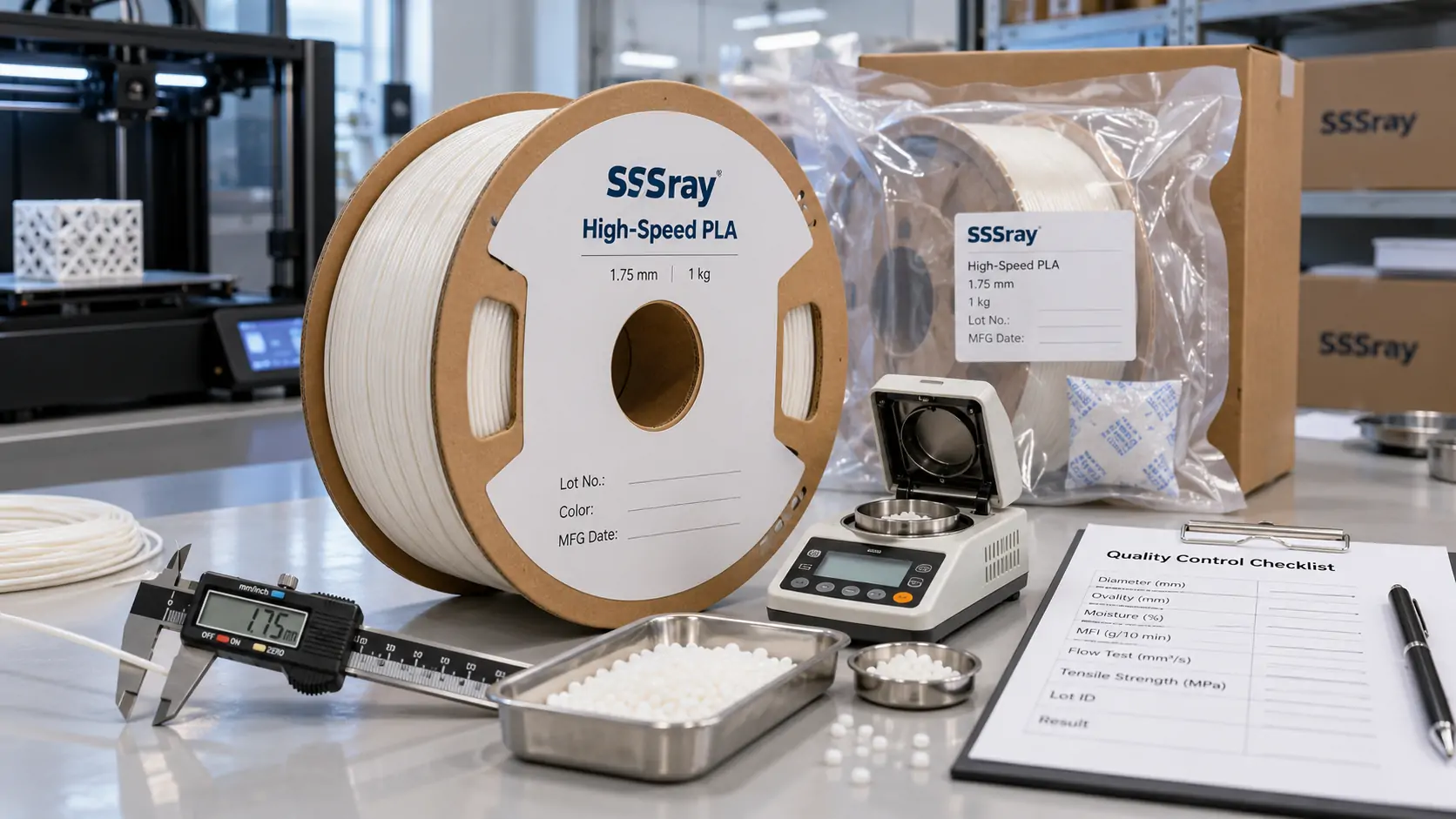
| PLA / PLA+ / High-Speed PLA diameter release target | Inline laser monitoring | 1.75 mm ±0.03 mm | Request the lot-linked laser record for the shipment |
| Maximum ovality | Our published family QC gate | ≤ 0.020 mm | Controls roundness separately from nominal diameter |
| Moisture before sealing | Karl Fischer in our batch QC system | ≤ 0.02% | Request the exact production-lot result on the COA |
| Vacuum protection | Vacuum bag + desiccant | −0.09 MPa reference | Protect the released moisture condition through storage and shipping |
The published process-reference source reports the flow and feeding metrics above but does not reproduce a PLA-HS production Batch ID or replicate count. For our commercial orders, the exact SKU is linked to a unique shipment Batch ID and lot COA; that lot record should carry the buyer’s spool/sample plan, diameter/ovality audit and moisture result.
Our qualification rule: use the 34.8 mm³/s result as the published process-reference value, then qualify the buyer’s exact PLA-HS lot against its Batch ID, COA, printer/nozzle/profile and retained sample before a reorder baseline is frozen.
8. Cost Difference Between Verified and Unverified High-Speed PLA
Direct answer: For flow-limited parts, a verified high-speed PLA can cost more per kilogram and still produce cheaper parts. Machine-hours and failed jobs usually outweigh the spool price difference.
Calculate cost per good part, not per kilogram
Cost per good part = (material cost + machine-time cost) ÷ (1 − failure rate)
Below, the formula is applied to one large part (100 cm³, about 124 g). The USD 7.00 and USD 8.00 figures are illustrative scenario inputs, not a market-average price survey and not our quotation. Replace them with your actual landed prices; we can quote the confirmed material, volume, packaging and Incoterm.
On mobile, swipe horizontally to see every column.
| Input or result | Spool A: unverified “HS” | Spool B: verified HS | Note |
|---|---|---|---|
| Price per kg | USD 7.00 | USD 8.00 | Illustrative; B is 14% dearer |
| Practical flow cap | 18 mm³/s | 26 mm³/s | From your Level 2 test |
| Average flow achieved | 10.8 mm³/s | 15.6 mm³/s | Assumed 60% of cap |
| Print time for 100 cm³ | 2.57 h | 1.78 h | Volume ÷ average flow |
| Material cost | USD 0.87 | USD 0.99 | 124 g × price |
| Machine-time cost | USD 3.86 | USD 2.67 | Assumed USD 1.50 per hour |
| Failure rate | 6% | 1% | Illustrative |
| Cost per good part | USD 5.03 | USD 3.70 | B about 26% cheaper |
The lesson is where the money sits: filament is under a quarter of the part cost here, machine time most of it. A spool that cannot sustain flow makes every machine-hour dearer.
Costs the model leaves out
Refunds and reviews, retuning time for each drifting lot, and missed deliveries after overnight failures all add to the gap. On small, detail-limited parts, however, the gap shrinks, because cooling rather than flow caps speed. Let the SKU mix decide how much high-speed PLA you buy.
Procurement implicationAsk each supplier for data that lets you fill in this model, especially flow cap and lot consistency.
Mistake to avoidComparing quotes per kg while your farm is paid per part.
How to verifyTrack print hours and failures per lot for one month before switching grades.
9. Supplier Claims vs Reality: How to Identify Unverified High-Speed Filament
An unverified high-speed claim often relies on a number measured under conditions that are not disclosed. We treat the claim as incomplete until printer, nozzle, temperature, line width, layer height and volumetric flow are stated together.
On mobile, swipe horizontally to see every column.
| Vague marketing claim | What it might hide | Document, sample or test to request | What a reliable supplier provides |
|---|---|---|---|
| “300–600 mm/s print speed” | Tested on thin lines, low layers or infill only | Flow in mm³/s with printer, nozzle, temperature, line width and layer | A flow-test record tied to a lot number |
| “2–3× higher melt flow” | An unnamed baseline, or MFI measured at a different temperature | MFI of the HS grade and the baseline, same standard and condition | Both values with a ± band |
| “Bambu Lab compatible” | Fits the AMS spool; says nothing about flow | Validated printer list and the profile values used | Profile file plus test log per printer family |
| “Never clogs at high speed” | A few short demo prints | Run length, flow, spool count and failure count | Hours printed, spools used, failures logged |
| “±0.02 mm precision” | Measured on the sample, not the lot; ovality ignored | Laser gauge log excerpt for your lot, including ovality | Lot data, not a brochure line |
| “Same formula every batch” | Resin or additive changes between orders | Change-notice clause and lot MFI vs approved sample | Written change control before any substitution |
10. The Flow-Proof Framework: Seven Gates for Bulk High-Speed PLA Supplier Verification
These gates turn the tests above into purchasing decisions, for new suppliers and for any reorder that prints differently.
On mobile, swipe horizontally to see every column.
| Gate | Why it matters | What to ask | Pass / fail signal | Hidden risk |
|---|---|---|---|---|
| Application requirement | HS PLA only pays off on flow-limited parts | Which SKUs are limited by flow, and which by cooling or detail? | Pass: grade matched to SKU mix Fail: “use HS for everything” | Paying for speed that small parts cannot use |
| Material performance | Speed means nothing if layers split | Printed tensile data in XY and Z, with method? | Pass: printed-bar data with orientation Fail: resin data only | Resin datasheet sold as filament data |
| Printability | The claim must survive your hotend | Flow cap on our printer family, at what temperature? | Pass: ≥ 95% mass at target flow Fail: speed claim with no conditions | Headline speed depends on undisclosed temperature, hotend or cooling conditions |
| Compliance | Distributors need clean paperwork per market | TDS, SDS, COA, RoHS and REACH for this grade? | Pass: grade-specific documents Fail: generic “PLA” template | Documents that do not match the lot |
| Supplier reliability | Direct producers can control compounding, extrusion and lot records at the production source | Do you compound and extrude in-house? Lot records? | Pass: lot traceability and raw data Fail: cannot name the base resin | Uncontrolled factory switching between orders |
| Landed cost | Per-kg price hides machine time | What data lets us model cost per good part? | Pass: flow cap and failure data shared Fail: price-only quote | Cheaper spools, dearer parts |
| Reorder stability | Drift usually starts after approval | Will you notify us before any formula change? | Pass: MFI band and change notice in contract Fail: refuses change control | Golden sample, weaker production lots |
How to use it: for production SKUs, a supplier should pass all seven gates. For a trial listing, gates one to four are the minimum before any stock order.
11. Standard PLA vs High Speed PLA: Main Comparison Table for Purchasing Managers
Most buyers are choosing between five realistic routes, including one hardware route that is often overlooked.
On mobile, swipe horizontally to see every column.
| Option | Best use case | Key spec | Advantage | Risk | How to verify | When to reject | Our sourcing note |
|---|---|---|---|---|---|---|---|
| Well-made standard PLA | Cosmetic and detail SKUs; walls up to about 250 mm/s on standard nozzles | Known flow cap on your hotend | Finish, color range, price | Slowed by caps on large parts | Level 2 flow test | Cap well below peers, or unstable between lots | See wholesale PLA |
| Unverified “high-speed” label | None for production | Speed claim only | Low price | Slicer caps, clicking, returns | Level 1, then Level 2 | No flow data after a written request | We share our test method so you can check any supplier |
| Verified high-speed PLA | Large, flow-limited parts; print farms | ≥ 25 mm³/s at stated temperature; MFI band; ±0.03 mm | Shorter jobs; often better Z adhesion | Glossier finish; needs capable hotends | Level 2 plus lot MFI | Below 95% mass at the claimed flow | Ask for the PLA-HS flow record per lot |
| Standard PLA plus high-flow nozzle | Farms running supported high-flow hardware | Nozzle-rated cap, e.g. 40 mm³/s listed for PLA Basic on Bambu H2D | Largest single flow gain | Hardware cost; not every printer supports it | Flow test after the upgrade | Printer not on the supported list | Tight diameter matters more at high flow; see custom PLA |
| Private-label high-speed PLA | Brands and printer OEMs | Frozen formula; flow and MFI in the supply agreement | Brand control and repeatability | Drift after the golden sample | First lot vs approved sample, same tests | Supplier refuses change control | See private label filament |
If you are building a high-speed line, request our PLA-HS sample with its flow record, then run the Level 2 test on it and your current spool side by side.
12. B2B Scenarios: How High-Speed PLA Claims Play Out by Buyer Type
Distributor
Situation: Adding a “500 mm/s PLA” line for marketplace buyers.
Bad choice: Listing the supplier’s speed claim word for word.
Consequence: Slicers cap flow, buyers see no gain, and reviews question the high-speed claim.
Better choice: Sell on validated flow per printer family, with honest wording.
Verification: Level 2 test on the two most common printers in your market.
Next step: Request a sample spool with its flow record.
OEM brand
Situation: Launching a branded high-speed PLA to ship with its printers.
Bad choice: Approving one golden sample with no MFI band.
Consequence: Later lots print differently; support tickets blame the printer.
Better choice: Freeze formula, MFI band and flow cap in the supply agreement.
Verification: First production lot vs approved sample, same day, same tests.
Next step: Discuss OEM packaging and specs.
Print farm
Situation: 60 printers making large enclosures and trays.
Bad choice: Switching to the lowest-priced “HS” quote per kg without flow and lot data.
Consequence: Walls stay capped at the old speed, and overnight clogs rise.
Better choice: Buy on cost per good part; add high-flow nozzles where supported.
Verification: Print hours and failures per lot for 30 days.
Next step: Request a bulk quote with 3 kg or 5 kg spool options.
Engineering buyer
Situation: Printing jigs and fixtures fast for a production line.
Bad choice: Choosing on speed alone, without Z-strength data.
Consequence: Fast parts that crack between layers under clamping loads.
Better choice: Qualify on printed XY and Z tensile bars at the production flow rate.
Verification: Tensile bars printed at your target flow, not at slow test speed.
Next step: Request TDS, COA and MSDS for the exact grade.
13. High-Speed PLA Print Settings and Sourcing Specs
The first table gives print starting references; the second turns qualification into purchase-order language.
Print settings: starting references for high-speed PLA
On mobile, swipe horizontally to see every column.
| Setting | Starting reference | Why |
|---|---|---|
| Nozzle temperature | 220–230 °C, starting at the supplier’s validated value | Matches published HS profiles; step 5 °C at a time |
| Bed temperature | 45–60 °C on PEI | Typical PLA range; eSUN lists 45–60 °C for its HS grade |
| Enclosure | Door or lid open on enclosed printers | A cool chamber reduces heat creep |
| Drying | 55 °C for 8 h in a blast oven if exposed; store below 20% RH | Bambu’s PLA-family guidance; moisture shifts flow |
| Nozzle material | Brass or steel for unfilled PLA; hardened steel for mineral or effect grades | Abrasive particles wear brass |
| Speed range | Set max volumetric speed to about 90% of your Level 2 cap | Let the slicer set speed from flow, not the reverse |
| Common failure | Clicking, thin walls, stringing, jams after slowdowns | Flow above cap, moisture, heat creep |
| Fix | Lower the cap 10% or add 5 °C; dry the spool; open the enclosure | Address the cause shown in the diagnosis list, Section 4 |
Sourcing specs: what to write in the purchase order
On mobile, swipe horizontally to see every column.
| Spec item | What to write in the PO | Why it matters at high speed | Our reference |
|---|---|---|---|
| MOQ | MOQ per color and grade, confirmed in the quote | Odd small runs drift more | 50 spools entry order |
| Lead time | Counted from sample approval, citing the approved lot | Links production to the tested formula | 10–20 days regular bulk planning |
| Sample approval | Retained spool plus flow test, MFI and moisture result | The reference every lot is judged against | Free B2B samples |
| Tolerance | Diameter, ovality, MFI band and minimum flow cap | Diameter alone does not control flow | ±0.03 mm standard; ±0.02 mm by agreement |
| Documentation | Grade TDS, SDS, lot COA with MFI and moisture | Turns drift into a documented nonconformance | COA, TDS, SDS/MSDS, RoHS, REACH |
| Packaging | Vacuum sealed with desiccant; lot number on spool, bag and carton | Moisture changes melt flow | −0.09 MPa vacuum plus desiccant |
| Private label | Artwork tied to one approved formula code | Stops one brand covering several recipes | Private label program |
| Reorder control | Written notice and requalification before any change | Prevents golden-sample drift | Confirm clause during RFQ |
14. High-Speed PLA Filament FAQ for B2B Buyers
Can I use standard PLA at 300 mm/s on Bambu Lab printers?
Only with the right nozzle and settings. With a standard X1 or P1 nozzle, Bambu Studio profiles Bambu PLA Basic at 21 mm³/s, which limits 0.42 mm walls at 0.20 mm layers to about 250 mm/s. Generic PLA profiles are capped lower, at 12 mm³/s. On the H2D, Bambu lists 24 mm³/s for PLA Basic on the standard 0.4 mm hardened steel nozzle and 40 mm³/s on the 0.4 mm High Flow nozzle, which supports 300 mm/s walls under this width/layer assumption. Infill and thinner layers can run faster, because they need less flow per millimeter.
What MFI values do published high-speed PLA grades use?
There is no agreed threshold. Published high-speed PLA grades range from about 5 to 20 g/10 min at 190 °C and 2.16 kg: eSUN lists 5.2 for its ePLA-HS, while Flashforge lists 10–20 for its HS PLA. For comparison, NatureWorks’ 3D850 filament resin reads 7–9 g/10 min at 210 °C. Because MFI is measured at low shear, it cannot prove nozzle performance by itself. Use it with its full test condition as a lot-consistency control, and pair it with a flow test on your own hardware.
How can I test filament melt flow rate without equipment?
Use an extrude-and-weigh test with a 0.01 g scale. Dry the sample, heat the nozzle to the supplier’s temperature, and extrude filament into the air at your target flow. For 25 mm³/s, that is 208 mm of 1.75 mm filament over 20 seconds, with an expected mass of about 0.62 g. If the extrudate weighs 0.59 g or more and the extruder did not click, the flow passes. Step the flow up in 2–4 mm³/s increments to find the practical cap, and test your reference spool the same day.
Which brands actually pass 300 mm/s volumetric tests?
There is no widely accepted multi-brand blind benchmark that controls printer, hotend, temperature, lot and sample plan under one method. What exists are manufacturer flow caps and supplier-specific test records. Prusa publishes 28 mm³/s for Prusament PLA High Speed at 215 °C on the CORE One+ with the required 0.4 mm High-Flow (CHT) nozzle, enough for 300 mm/s walls at 0.42 × 0.20 mm, while Bambu lists 40 mm³/s for PLA Basic on its H2D 0.4 mm High Flow nozzle. Results depend heavily on the hotend, so a pass on one printer does not transfer to another. For purchasing, the reliable answer is your own flow test on your customers’ main printers, run on several spools per lot.
What should a bulk high-speed PLA supplier verification checklist include?
At minimum, seven items. Ask for a flow cap in mm³/s with printer, nozzle and temperature; MFI with standard, condition and a tolerance band; diameter and ovality limits with lot data; moisture before sealing and the packaging method; printed tensile data in XY and Z; grade-specific TDS, SDS and lot COA; and a written change-notice clause. Then verify the sample yourself with an extrude-and-weigh test, and repeat it on the first production lot before releasing stock to customers or to production.
What is the cost difference between verified and unverified high-speed PLA?
The spool price gap is usually the smallest part of it. What matters for a B2B buyer is cost per good part, which includes machine time and failed jobs. In our illustrative model, a verified grade priced 14% higher per kilogram produced large parts about 26% cheaper, because shorter print time and fewer failures outweighed the material cost. On small, detail-limited parts, the benefit shrinks. Use verified high-speed PLA for SKUs that are actually flow-limited, and run the model with your own machine rate.
How do I stop high-speed PLA reorders from drifting after sample approval?
Lock the approved behavior into the contract. Keep a retained spool from the approved sample, and record its flow-test result, MFI with full condition, moisture and diameter data. Write an MFI band, a minimum flow cap, and diameter and ovality limits into the purchase order, plus a clause requiring written notice before any resin, additive or process change. Then test every new lot against the retained spool on the same printer and day. A supplier that refuses change control is telling you something important.
15. Conclusion: Buy Measured Flow, Not Printed Speed
The decision logic for high speed PLA filament is short. Convert every speed claim into volumetric flow. Compare it with the cap your customers’ printers actually use. Then verify the sample with an extrude-and-weigh test, and control each lot with MFI, diameter and moisture limits written into the purchase order.
Verified high-speed PLA is worth paying for where parts are large and flow-limited. There, faster walls and fewer failures cut cost per good part, even at a higher price per kilogram. For small or cosmetic parts, a well-made standard PLA is often the better buy.
Your next steps are practical. List the printers and nozzles your customers run. Test the spool you use today at 25 mm³/s. Then send every supplier the same request: flow cap with conditions, lot MFI with a tolerance band, and a change-notice clause.
In our qualification process, test conditions, lot records and change control carry more weight than a larger headline speed number.
Prefer to start with paperwork? Request TDS, COA and MSDS, compare materials and suppliers, ask about OEM packaging, or request a bulk quote.
Request a quote or free samples
Tell us the material, color, spool size and monthly volume. An engineer replies within 24 hours on business days.
16. References and Further Reading
- Bambu Lab Wiki: Volumetric Speed and How It Impacts 3D Printing — explains maximum volumetric speed and why slicers reduce motion speed when the filament flow cap is reached.
- Bambu Studio official profile library (GitHub) — Generic PLA 12, Generic PLA High Speed 18, PLA Basic 21 mm³/s; default X1C wall speeds and line widths (checked September 2026).
- Bambu Lab Store: Bambu High Flow Hotend (H2D) — PLA Basic 24 mm³/s with the standard 0.4 mm hardened steel nozzle vs 40 mm³/s with the H2D 0.4 mm High Flow nozzle; H2D-specific test and compatibility notes.
- Prusa Research: Prusament PLA High Speed product data — 28 mm³/s at 215 °C for PLA High Speed vs 24 mm³/s at 230 °C for standard Prusament PLA; high-speed printing requires a High-Flow (CHT) nozzle.
- NatureWorks Ingeo 3D850 Technical Data Sheet — MFR 7–9 g/10 min (210 °C/2.16 kg), moisture below 250 ppm, Tg 55–60 °C.
- ISO 1133-2:2011: MFR and MVR for Materials Sensitive to Time-Temperature History and/or Moisture — current edition, confirmed in 2021.
- Go, Schiffres, Stevens and Hart (2017), Rate Limits of Additive Manufacturing by Fused Filament Fabrication, Additive Manufacturing 16 — traction, heat conduction and gantry limits.
- eSUN ePLA-HS product data and eSUN PLA+ TDS — MFI 5.2 and 5 g/10 min at 190 °C/2.16 kg.
- Flashforge HS PLA TDS and Flashforge PLA Matte TDS — MFR 10–20 vs 4–8 g/10 min (ISO 1133).
- Bambu Lab Store: Support for PLA — PLA-family drying (55 °C, 8 h) and storage below 20% RH; MFI published with a tolerance band.
- Filament2print: The Importance of Nozzles in High-Speed FFF Printing — hotend and nozzle flow comparisons.
- SSSray: Third-Party Filament for Bambu Lab — B2B Procurement Guide — published SSSray Internal Flow and Feeding Reference Series, including the High-Speed PLA Pro MFR, maximum-flow and jam-rate record.
- SSSray: Batch QC Data & Factory COA — published PLA / PLA+ / High-Speed PLA diameter, ovality, moisture and vacuum-packing release targets.