Online time
Monday to Friday: 9AM - 8PM
Weekend: 10AM - 5PM


TL;DR: How SSSray Qualifies LCP Filament for Industrial FFF Buyers
Sumitomo Chemical and Gutenberg announced on September 1, 2026 that they had jointly developed an LCP filament and molding technology for FFF 3D printers. Sumitomo says the technology enables stable molding while controlling LCP molecular orientation and can achieve strength comparable with aluminum alloys under specified ISO-compliant evaluation conditions. At SSSray, we can quote and arrange LCP filament samples for B2B qualification. Before a material moves from trial spool to bulk order, we lock the exact filament grade, machine profile, directional printed performance, filament QC, application requirements and repeat-order specification.
Best Fit
Semiconductor peripherals, communications hardware, robotics and other heat-, weight- or dielectric-sensitive parts.
Engineering Focus
Molecular orientation, print direction and machine conditions must be matched to the actual component load case.
Buyer Evidence
Grade traceability, process profile, X/Y/Z coupon data, filament QC and lot-linked documents.
Sample & Quote
SSSray can arrange LCP samples and project quotations; exact grade, MOQ and lead time are confirmed per RFQ.
From Sumitomo’s 2026 LCP Breakthrough to a Qualified B2B Supply Route
The September 2026 development matters because LCP has long combined high heat resistance, strong dimensional stability and low dielectric loss with a difficult path into conventional filament-based additive manufacturing. Sumitomo Chemical states that it developed an LCP material design and filament-formation technology for additive manufacturing and worked with Gutenberg on an FFF molding process that controls LCP molecular orientation. The company identifies semiconductor peripheral components, humanoid and physical-AI hardware, communications and eVTOL-related fields among the applications it plans to develop.
For SSSray customers, the commercial opportunity is broader than one headline strength number. An LCP filament program must connect upstream material data with the exact spool, printer configuration, print direction, test method and finished-part requirement. That is the difference between an impressive resin datasheet and a repeatable industrial filament supply route.
We therefore use three evidence levels when preparing an LCP quotation or sample program: upstream manufacturer data for material screening, grade-specific technical data for engineering selection, and project-level filament and printed-part evidence for purchasing approval.
LEVEL 1Upstream FFF Development
Sumitomo’s published LCP filament development, orientation-control technology, application direction and ISO-based aluminum-strength comparison establish the technical basis for the material route.
LEVEL 2Grade Reference Data
Grade-specific density, water absorption, dielectric, heat and flame-property data help SSSray and the buyer select the right LCP route before printer qualification.
LEVEL 3SSSray Project Qualification
We connect the selected filament to diameter control, handling, machine profile, directional printed results, packaging, quotation and repeat-order requirements.

He Jiang
Senior Researcher · SSSray · 3D Printing Filament Manufacturing · Jinhua, Zhejiang
He Jiang is a senior researcher at SSSray, a 3D printing filament manufacturer in Jinhua, Zhejiang, China. His work covers engineering-filament qualification, supplier technical documentation and regulatory requirements that affect filament brands selling into international markets. He also focuses on EU regulatory shifts including REACH SVHC disclosure, the universal PFAS restriction and PPWR packaging compliance. His technical writing for SSSray draws on supplier SDS and TDS documentation, manufacturer technical publications, ECHA materials and EUR-Lex regulatory texts for B2B brand owners, distributors, OEM partners and engineering buyers.
1. Sumitomo’s 2026 LCP Filament Development
On September 1, 2026, Sumitomo Chemical announced that it and Gutenberg Co., Ltd. had jointly developed an LCP filament and molding technology for FFF 3D printers. Sumitomo describes LCP as combining heat resistance, high strength, low dielectric constant, low dissipation factor and dimensional stability, while also acknowledging that filament formation and stable FFF molding had previously limited its use in this process.
The key engineering advance is the combination of additive-oriented LCP material design, filament formation and a molding process that controls the polymer’s strong molecular orientation during FFF. Sumitomo further states that the resulting technology can achieve high thermal conductivity and strength comparable with aluminum alloys while retaining the lightweight advantages of polymer components.
Engineering context: Sumitomo’s aluminum comparison is tied to defined evaluation conditions and an ISO-compliant test method. For an SSSray customer project, we connect that upstream benchmark to the actual filament grade, print direction, geometry, operating temperature and component load case before recommending a metal-replacement route.
Sumitomo identifies semiconductor manufacturing peripheral components, humanoid-related components, communications and next-generation mobility such as eVTOL among the application fields it plans to develop. It also states that filament samples are planned to begin in 2026. SSSray can currently arrange LCP sample and quotation routes for B2B buyers who want to begin material qualification.
2. Why Molecular Orientation Changes an LCP Purchase Specification
Thermotropic LCPs form highly ordered domains in the melt. Under flow, their rigid molecular structure aligns strongly along the shear direction. This directional behavior is one of the reasons LCP can deliver high stiffness, low dimensional change and strong performance along the primary flow direction.
FFF creates another highly directional flow field. The nozzle, bead direction, raster strategy and layer interface all influence the way that performance reaches the finished component. For this reason, SSSray does not treat one tensile-strength value as the complete engineering specification for an LCP printed part.
SSSray qualification practice: we use resin-level technical data to select the material route, then qualify the filament on the target printer. For structural applications, the approval file should identify the exact filament grade, printer, nozzle, thermal conditions, layer height, raster direction, specimen orientation, conditioning and test method.
This also protects the buyer from an important sourcing error: proprietary upstream chemistry should not be converted into unsupported customer-facing claims. SSSray bases the purchase specification on published manufacturer data, the supplied filament documentation and project-specific test evidence rather than assumptions about an undisclosed polymer formulation.
3. Published LCP Data SSSray Uses for Initial Material Screening
SUMIKASUPER LCP technical data demonstrate why LCP is attractive for electronics, thermal management and precision components—and why the exact grade matters. Different grades can have different filler systems, density, dielectric behavior, heat resistance and mechanical properties. SSSray therefore uses grade-specific data rather than applying one generic property set to every LCP filament project.
Grade-Specific Dielectric Reference Data
On mobile, swipe horizontally to review the data.
| Published Resin Grade | Relative Permittivity @ 1 GHz | Relative Permittivity @ 10 GHz | Dissipation Factor @ 1 GHz | Dissipation Factor @ 10 GHz | SSSray Buyer Interpretation |
|---|---|---|---|---|---|
| E4205R | 2.8 | 2.9 | 0.004 | 0.005 | Low-Dk injection-molding reference; the additive filament still requires its own project data. |
| E6205L | 2.9 | 2.7 | 0.005 | 0.005 | The latest grade TDS shows strong GHz dielectric performance and illustrates why exact grade identification matters. |
| SR1205L | 2.8 | 2.7 | 0.002 | 0.003 | A low-loss reference route for RF screening; higher operating frequencies still require frequency-specific test data. |
These are published SUMIKASUPER resin-grade reference values. SSSray uses them for initial material screening; they are not automatically the certified dielectric values of a new FFF filament or a finished 3D-printed component.
Heat Resistance Is Grade-Dependent
Sumitomo’s technical literature reports different deflection temperatures under load across its SUMIKASUPER series and distinguishes between 0.45 MPa and 1.82 MPa test loads. Published E5000-series ranges include approximately 350–390°C at 0.45 MPa and 330–360°C at 1.82 MPa. These values demonstrate the high-temperature potential of the resin family, while the final printed-part specification still needs to identify the exact grade, processing history and specimen method.
Likewise, published water-absorption values around 0.02% for a number of SUMIKASUPER grades reinforce LCP’s low-moisture profile. For SSSray sample projects, however, drying and storage instructions are still locked to the actual filament route because packaging condition and high-temperature extrusion can affect real print consistency.
Flame performance: Sumitomo’s grade documentation includes UL94 V-0 routes for a number of SUMIKASUPER materials. For OEM qualification, SSSray matches the claim to the exact grade, thickness and applicable certification record rather than transferring a generic resin-family rating to every printed component.
4. SSSray LCP Process Qualification: From Trial Spool to Approved Print Profile
Once an LCP sample route is confirmed, SSSray turns the trial into a controlled machine-specific evaluation. We do not build an LCP production profile by copying settings from PEEK, PEI or a generic injection-molding datasheet. The thermal and flow window must belong to the exact filament and printer combination being qualified.
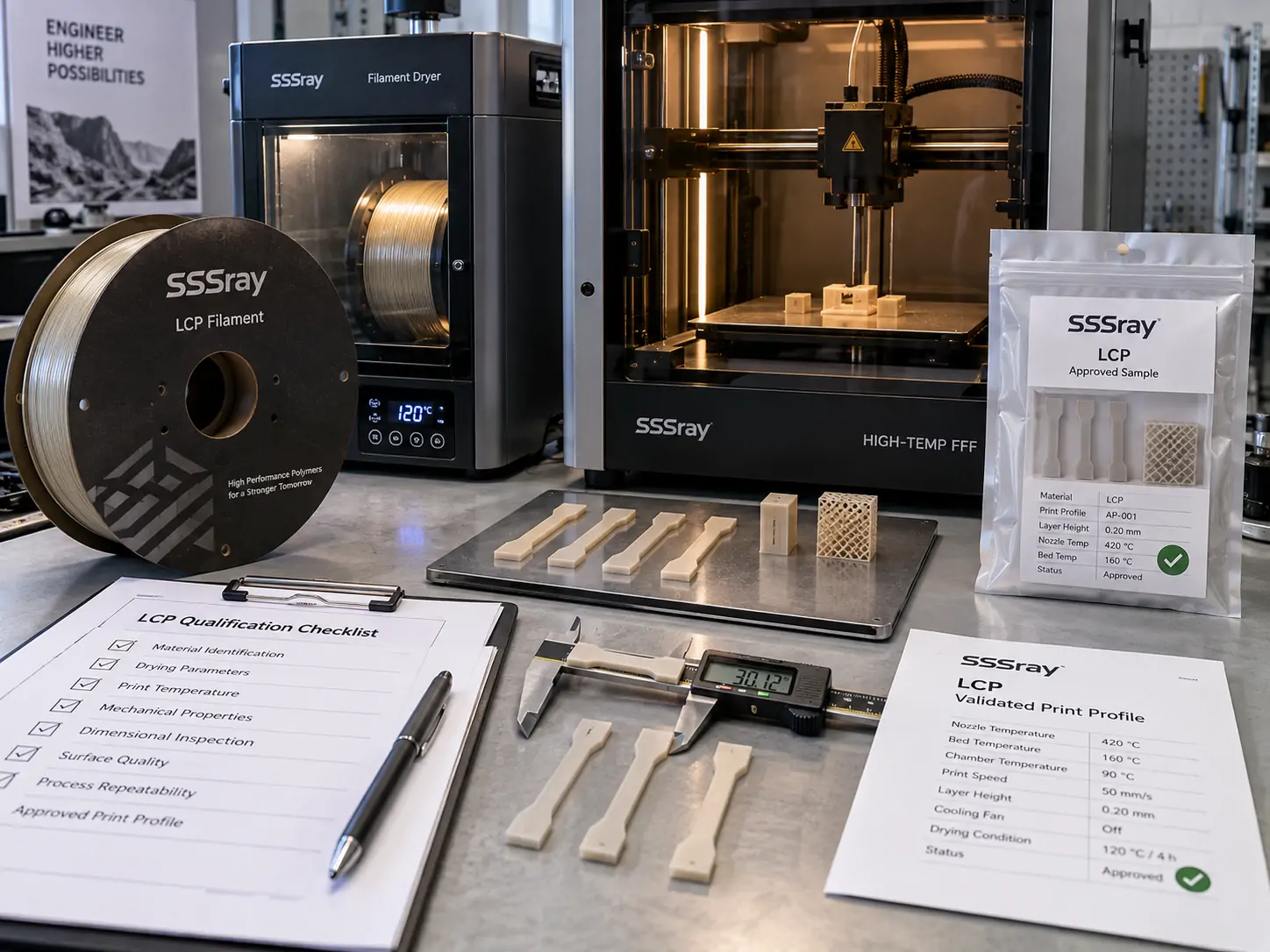
Our recommended qualification sequence is:
- Lock the filament identity. Confirm the exact grade, spool lot, documentation revision and sample identification before changing printer settings.
- Record the starting processing profile. Capture drying, nozzle, bed, chamber, nozzle diameter, speed, cooling and build-surface conditions supplied for the filament route.
- Check spool handling and continuous feeding. Filament geometry, winding and bend behavior must remain stable through the buyer’s real feeder path before mechanical results are trusted.
- Print dimensional and mechanical coupons in the required orientations. The test configuration should reflect the actual load direction of the target component.
- Repeat the approved profile. A successful first coupon proves feasibility; a repeated run begins to prove purchasing consistency.
- Freeze the result into the order specification. The approved grade, profile, packaging, required documents and change-control conditions become the baseline for the next order.
On mobile, swipe horizontally to review the qualification worksheet.
| Field to Lock | SSSray Confirms | Buyer Verifies | Approval Output |
|---|---|---|---|
| Filament identity | Exact additive grade, source route, spool and lot identification | Label, TDS/SDS/CoA scope and sample-to-order consistency | Approved material identity |
| Drying & storage | Starting handling and storage requirements for the selected filament | As-received versus controlled dry-state printing | Approved handling method |
| Thermal profile | Starting nozzle, bed and chamber route where available | Stable extrusion, adhesion, geometry and layer bonding | Machine-specific print profile |
| Flow & speed | Starting flow or speed recommendation for the material route | Bead consistency and dimensional performance at target throughput | Approved production window |
| Mechanical orientation | Available upstream printed data and test-method information | Application-relevant directional coupons | Buyer-defined mechanical acceptance |
| Change control | Agreed material and supply baseline | Repeat-order consistency | Requalification triggers and reorder specification |
5. Seven Gates for Approving an LCP Filament Supply Route
SSSray’s Filament Qualification Program provides the general purchasing structure. For LCP, we tighten that framework around the material-specific variables that can directly change print behavior and component performance.
G1
Application Boundary
We lock: service temperature, chemical exposure, dielectric frequency, mechanical load direction, regulatory environment and part-life requirement.
Approval output: one application requirement sheet tied to the material RFQ.
G2
Grade & Resin Provenance
We lock: exact additive grade, upstream material identity, filament supply route, lot code and document revision.
Approval output: traceability from the sample spool to the approved material route.
G3
Filament Geometry & Feeding
We lock: diameter tolerance, ovality method, inspection record, winding quality and feeder-path behavior.
Approval output: filament QC evidence plus representative feeding performance.
G4
Machine-Specific Process Window
We lock: dryer, hotend, bed, chamber, nozzle, layer, speed and cooling conditions for the target printer family.
Approval output: a controlled print profile linked to the filament lot.
G5
Directional Printed Performance
We lock: test standard, specimen geometry, conditioning, print direction and the buyer’s minimum requirement.
Approval output: a directional coupon result that purchasing and engineering teams can use together.
G6
Application-Specific Technical Evidence
We lock: the required dielectric frequency, heat test, chemical exposure, outgassing, ionic contamination, RoHS/REACH or flame-document scope for the actual application.
Approval output: the applicable technical file attached to the approved SKU.
G7
Commercial Reorder Control
We lock: MOQ, lead time, packaging, labeling, retained-sample requirements, lot documents and engineering-change rules.
Approval output: a repeat-order baseline that protects the result achieved during qualification.
6. LCP vs PEEK, PEI, PPS and PA-CF: Match the Material to the Failure Mode
No engineering filament wins every application. SSSray selects the material around the operating temperature, dimensional requirement, dielectric environment, chemical exposure, machine capability and acceptable manufacturing cost. For a broader high-temperature comparison, see our high-temperature 3D printing materials guide.
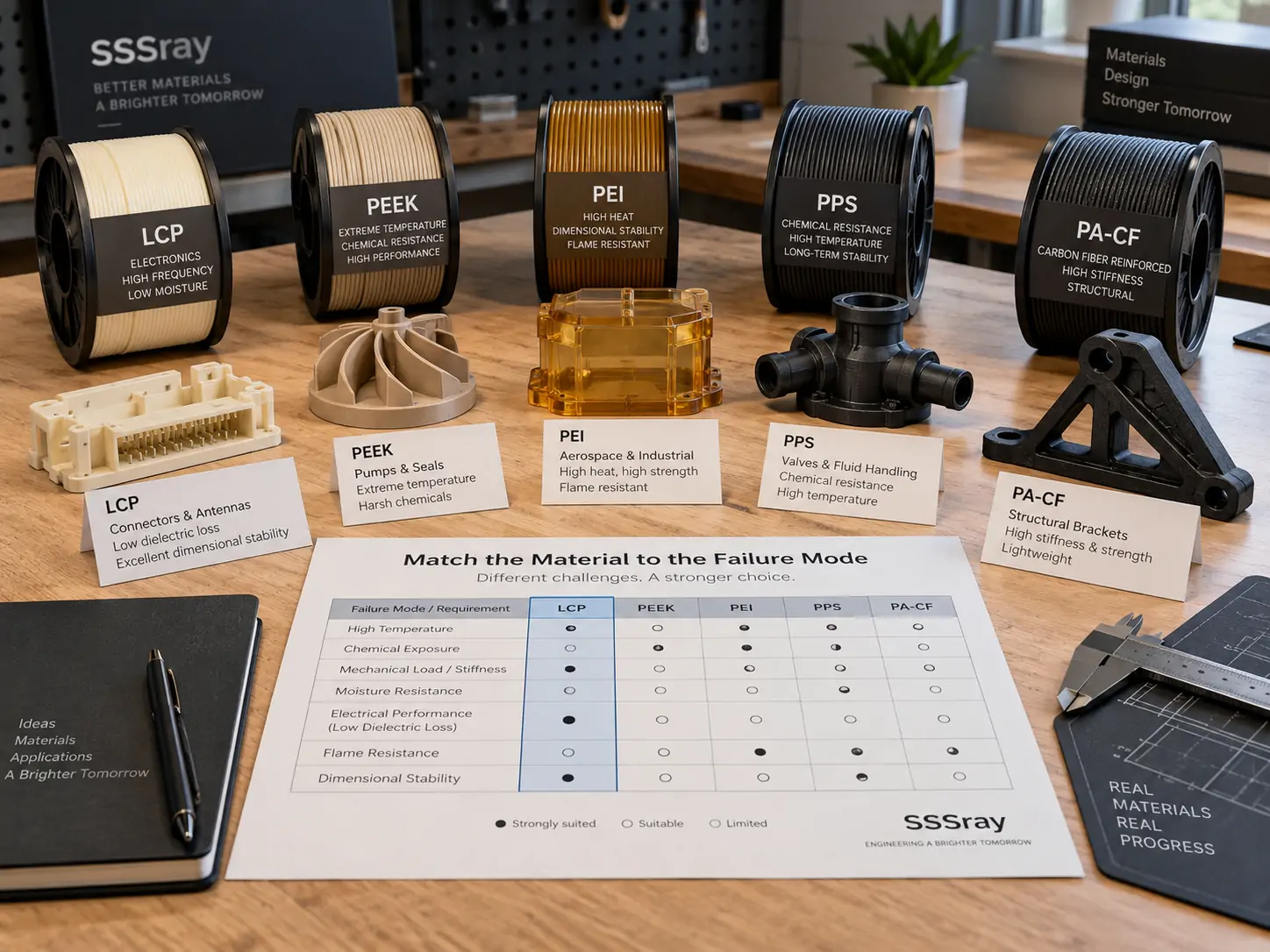
On mobile, swipe horizontally to review every column.
| Material Route | Why Buyers Use It | Main Qualification Challenge | Evidence SSSray Recommends | Where LCP Becomes Strong |
|---|---|---|---|---|
| LCP | Heat resistance, dimensional stability, low dielectric loss, orientation-enabled strength and emerging industrial FFF capability | Grade-specific processing, directional performance and new additive-grade qualification | Exact grade, printer profile, directional coupons and frequency-specific electrical data | Applications combining heat, low expansion, lightweight design and dielectric performance |
| PEEK / PEKK | Established high-temperature structural and chemical-performance routes | Thermal control, crystallization, warpage and demanding printer requirements | Printed mechanical data, thermal history, crystallinity control and application documentation | When a buyer wants a different balance of orientation, dielectric and dimensional behavior |
| PEI | High Tg, dimensional stability and established FST pathways for selected grades | Grade-specific certification and moisture/process control | Exact grade, printed data and application-specific FST documentation | When lower dielectric loss or LCP-specific thermal expansion behavior is valuable |
| PPS / PPS-CF | Chemical resistance, high service temperature and dimensional stability | Brittleness, crystallization and composite-grade variability | Printed impact/tensile data, filler fraction, thermal and chemical tests | When dielectric performance, surface quality or specialized LCP properties provide additional value |
| PA-CF | Strong cost-to-performance ratio for jigs, fixtures and production tooling | Moisture-driven dimensional and mechanical changes plus abrasive fiber handling | Moisture control, fiber fraction, batch diameter and printed mechanical data | When heat, dielectric or dimensional requirements exceed the practical PA-CF operating envelope |
7. What SSSray Requires Behind High-Performance LCP Claims
High-performance materials sell on numbers, but industrial buyers approve them on traceable evidence. When SSSray prepares an LCP sample or quotation, broad marketing claims are converted into specific documents, methods or qualification tests.
On mobile, swipe horizontally to review every column.
| Performance Claim | What Must Be Defined | Evidence to Request | SSSray Approval Logic |
|---|---|---|---|
| “Replaces aluminum” | Alloy, geometry, orientation, temperature, load case and test conditions | Printed directional coupon data plus the exact comparison method | Approve against the defined component requirement, not the headline alone |
| “Low Dk / low loss for RF” | Frequency, specimen preparation, conditioning and test method | Dk/Df data at the buyer’s operating frequency for the relevant grade or part | Use published GHz data for screening, then qualify the actual RF frequency |
| “Cleanroom suitable” | Outgassing, ionic or contamination requirement and acceptance limit | Application-relevant laboratory report and conditioning method | Match the technical file to the customer’s process requirement |
| “UL94 V-0” | Exact grade, specimen thickness and applicable certification record | Grade-specific UL or manufacturer evidence where applicable | Keep resin-grade certification and printed-part approval clearly linked |
| “Tight diameter control” | Maximum tolerance, ovality, sampling or inline inspection method | Lot-level diameter and ovality record | Lock the accepted specification into the repeat order |
| “Stable printing” | Printer family, thermal conditions, flow and run duration | Repeat print and feeding data on representative hardware | Approve the machine-specific route rather than a generic compatibility claim |
8. How SSSray Builds the LCP Qualification Route for Different Buyers
Distributor & Private-Label Brand
A distributor needs more than a technical sample. We align the LCP grade, target customer, packaging, technical file, product claims and repeat-order conditions so the approved material can become a commercially repeatable SKU rather than a one-off engineering spool.
3D Printer OEM
For printer brands, the target is a controlled compatibility result. We build the qualification around feeder behavior, hotend and chamber capability, repeat print performance and profile version control so the supported-material claim is tied to a reproducible configuration.
Print Farm & Production User
For production printing, the real purchasing metric is accepted-part output. We focus on drying, feeding, profile stability, repeated cycles, interruption risk and the relationship between material cost and machine downtime.
Engineering Buyer
Engineering projects start from the component requirement. We connect service temperature, chemical environment, dielectric frequency, critical print direction and test method to the exact filament grade and qualification file before the specification is frozen.
9. SSSray LCP RFQ and Qualification Dataset: What We Lock Before Bulk Release
An industrial LCP order becomes much easier to repeat when the technical and commercial variables are written down before the first bulk release. The matrix below is the evidence map SSSray uses to connect upstream material data, filament production, printer qualification and the buyer’s final application.
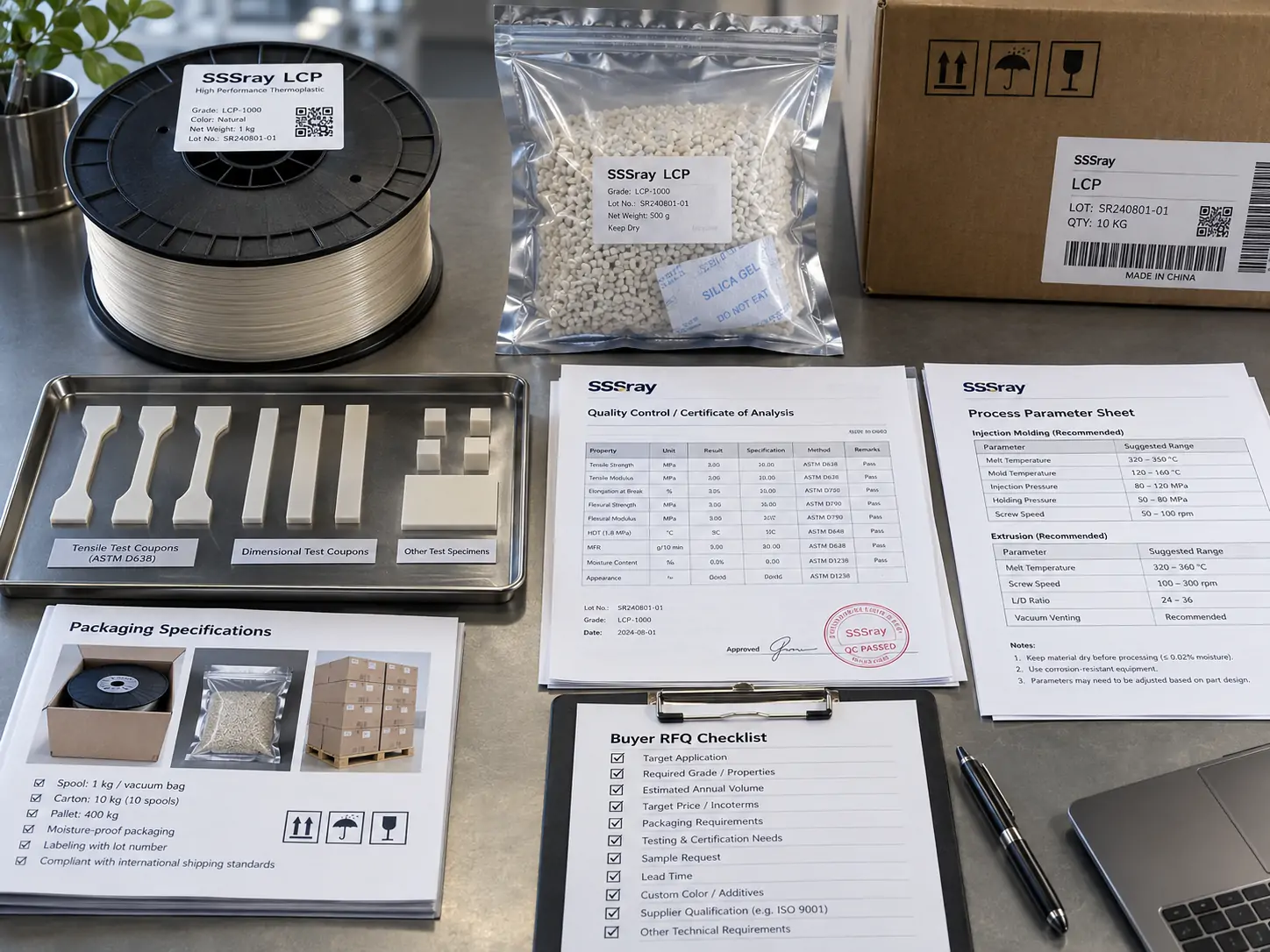
On mobile, swipe horizontally to review the dataset.
| Qualification Variable | Evidence Owner | Evidence to Lock | Release Stage | Commercial Value |
|---|---|---|---|---|
| Additive-grade identity | Upstream supplier / filament supplier | Exact grade, source route, lot and document revision | Before sample approval | Protects the buyer from material substitution |
| Filament diameter & ovality | Filament manufacturer | Agreed tolerance, method and batch record | Before bulk PO | Supports stable flow and feeder performance |
| Drying & storage | SSSray / buyer | Approved handling and storage workflow | Before printer qualification | Separates material behavior from handling-related defects |
| Printer process window | SSSray / printer OEM / buyer | Nozzle, bed, chamber, speed, nozzle geometry and cooling profile | Machine-specific approval | Creates a reproducible production recipe |
| Directional mechanical data | Supplier / buyer / test laboratory | Printed specimens, orientation, conditioning and test method | Application approval | Connects LCP orientation to the real part load |
| Thermal performance | Manufacturer / test laboratory | Exact grade, specimen, load and test method | Application approval | Defines the usable thermal design window |
| Dielectric performance | Manufacturer / test laboratory | Dk/Df at the operating frequency and stated specimen condition | RF application approval | Supports connector, communications and RF design decisions |
| Outgassing / ionic contamination | Buyer / test laboratory | Application-specific method and report | Where required | Supports semiconductor or controlled-environment qualification |
| Sample, MOQ & lead time | SSSray | Written LCP sample and quotation terms | Commercial release | Turns technical approval into an executable supply plan |
| Change control | SSSray / buyer | Approved baseline and requalification triggers | Repeat orders | Protects the qualified printer profile and SKU |
SSSray LCP supply route: we can currently quote and arrange LCP filament samples for customer qualification. The exact grade, sample configuration, project MOQ, lead time, technical documents and packaging route are confirmed in the written quotation. For established SSSray qualification-program products, the published program MOQ starts from 50 spools; an LCP project quotation controls where the selected grade or supply route requires different commercial terms.
10. Frequently Asked Questions
What did Sumitomo Chemical announce about LCP filament in September 2026?
Sumitomo Chemical and Gutenberg announced that they had jointly developed an LCP filament and molding technology for FFF 3D printers. Sumitomo says the process supports stable molding while controlling LCP molecular orientation and achieved strength comparable with aluminum alloys under specified ISO-compliant evaluation conditions. The company also stated that it planned to begin providing filament samples in 2026.
Can SSSray currently quote and provide LCP filament samples?
Yes. SSSray can currently arrange LCP filament samples and project quotations for B2B qualification. The exact grade, sample configuration, MOQ, lead time, documentation and packaging are confirmed against the customer’s application and supply route before order release.
Can SUMIKASUPER injection-molding data be used as the final specification for 3D-printed LCP?
No. SUMIKASUPER resin data are valuable engineering references, but the exact grade, filler system, specimen preparation and process matter. SSSray uses resin-level data for material screening and then connects the selected filament to machine-specific print conditions and printed-part verification.
Does the aluminum comparison mean LCP can replace 6061 aluminum in every component?
No. Sumitomo states that the strength comparison was made under specified conditions using an ISO-compliant test method. For a replacement project, SSSray matches the filament to the actual geometry, temperature, load direction, print orientation and component requirement before the route is approved.
What nozzle and chamber temperatures should be used for LCP filament?
The process window should come from the exact additive-grade filament and target printer combination. During qualification, SSSray records the starting nozzle, bed, chamber, drying, speed, nozzle and cooling conditions and then freezes the successful machine-specific profile into the project specification.
Is LCP automatically cleanroom, aerospace or eVTOL certified?
No material-family name automatically certifies a printed component. Semiconductor, aerospace and eVTOL projects can require different outgassing, ionic contamination, flame, mechanical or regulatory evidence. SSSray defines those requirements at RFQ stage and connects the applicable documents or tests to the exact grade and application.
What should a B2B buyer include in an LCP filament RFQ?
Include the target application, printer make and model, service temperature, chemical exposure, dielectric frequency if relevant, required diameter, expected order volume, destination, packaging needs and required technical documents. SSSray can then prepare the appropriate sample, quotation and qualification route.
11. Request an LCP Sample, Quote and Qualification Plan from SSSray
LCP is becoming a serious FFF material because the combination of heat resistance, dimensional stability, dielectric performance and molecular orientation opens applications that conventional desktop polymers cannot address. The value of the material, however, is realized only when the selected grade, spool, machine profile and finished-part requirement are connected into one controlled supply specification.
SSSray can arrange LCP samples and quotations now. Send us your printer model, target component, operating temperature, chemical environment, dielectric frequency if relevant, expected annual volume and required documentation. We will confirm the suitable material route, sample configuration and commercial terms before the project moves into bulk supply.
For structured evaluation, you can also use our 3D printer filament test protocol, batch QC framework and supplier comparison tool.
For faster quotation, include printer model, target part, operating temperature, chemical exposure, dielectric frequency if applicable, quantity, destination and required technical documents.
Request a quote or free samples
Tell us the material, color, spool size and monthly volume. An engineer replies within 24 hours on business days.
12. Technical References
- Sumitomo Chemical — LCP Filament and Molding Technology for FFF 3D Printers, September 1, 2026
- Sumitomo Chemical Engineering Plastics — SUMIKASUPER LCP Overview
- Sumitomo Chemical — SUMIKASUPER E4205R Grade Data
- Sumitomo Chemical — SUMIKASUPER E6205L Technical Data Sheet, Revised May 30, 2025
- Sumitomo Chemical — SUMIKASUPER SR1205L Technical Data Sheet
- Sumitomo Chemical — SUMIKASUPER LCP Technical Note
- ISO 527-2 — Plastics: Determination of Tensile Properties, Part 2
- ISO 75-1 — Plastics: Determination of Temperature of Deflection Under Load
- ASTM E595 — Outgassing in a Vacuum Environment
- SSSray Filament Qualification Program
- SSSray 3D Printer Filament Test Protocol
- SSSray Batch QC Data & COA Framework
