Online time
Monday to Friday: 9AM - 8PM
Weekend: 10AM - 5PM


PETG-CF Composite Series | Wholesale Supply | OEM / ODM Support
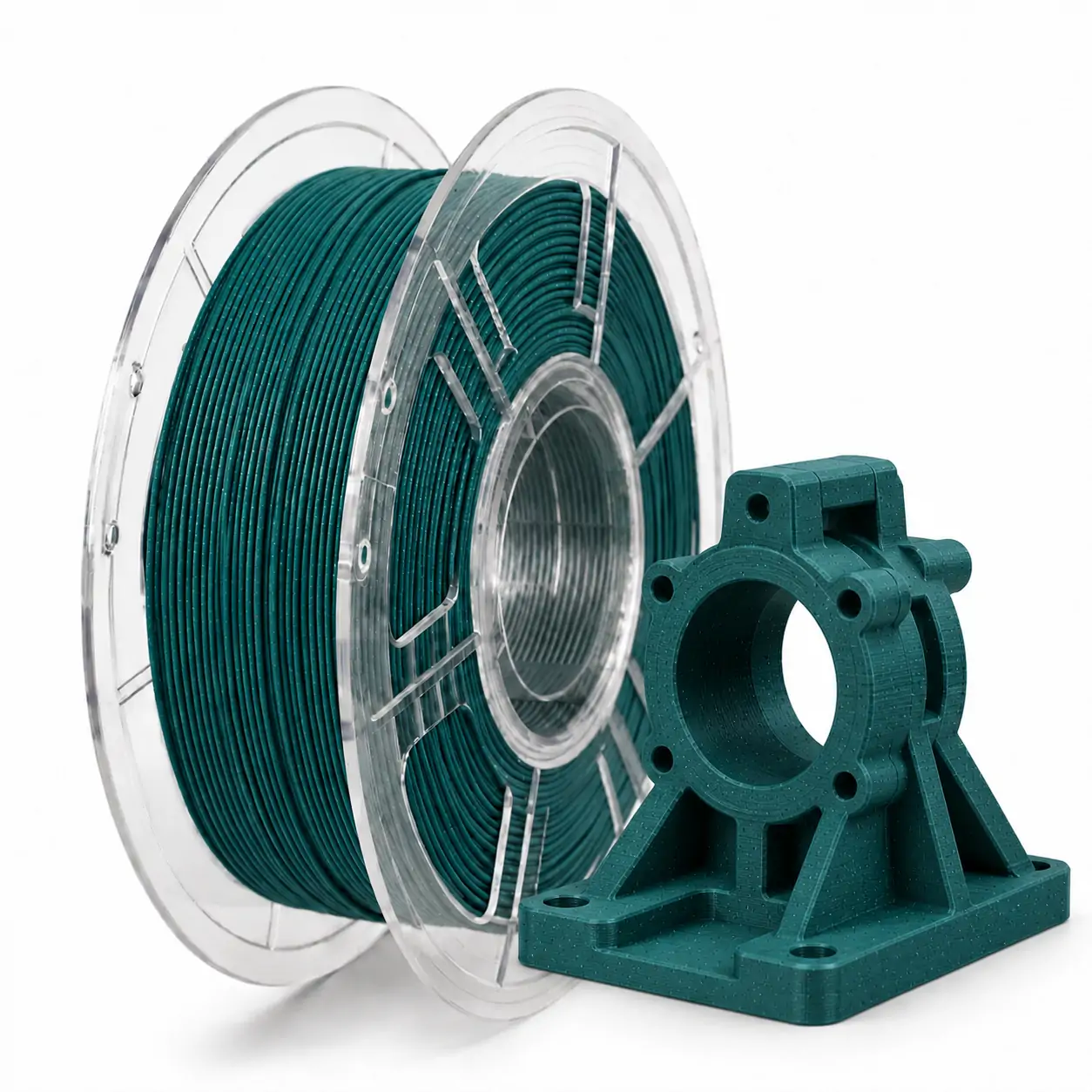
SSSray PETG-CF 3D Printer Filament – Carbon Fiber Filled PETG in Deep Spruce Green, zelený PETG filament s uhlíkovými vlákny for Functional Brackets & Fixtures
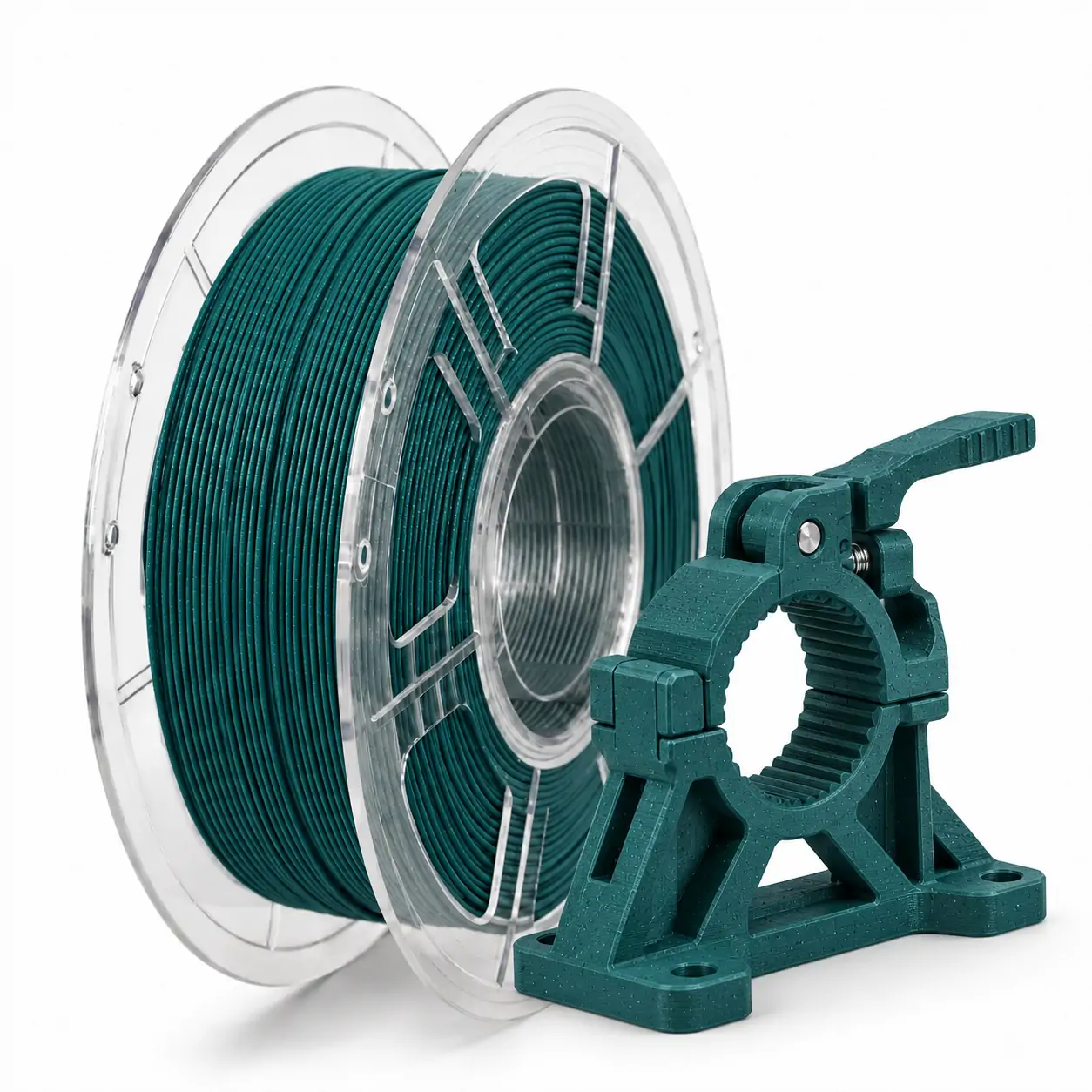
Carbon fiber filled PETG for functional brackets, workshop fixtures and durable printed components where stiffness, dimensional control and a refined dark-green composite finish matter.
Deep Spruce Green combines a dark teal blue-green base with a low-sheen matte-satin surface and fine visible fiber flecks. For B2B programs, the SKU pairs a distinctive engineering color with ±0.03 mm diameter control, vacuum-sealed packaging, hardened-nozzle printing guidance and private-label support.
MaterialPETG-CF
SeriesPETG-CF Composite
Color EffectDeep Spruce Green
Diameter1.75mm
Tolerance±0.03mm
Net Weight1kg
Gross Weight1.3kg
Nozzle Temp235–255°C
Bed Temp70–85°C
Print Speed40–250 mm/s
PackagingVacuum + Desiccant
Spool TypePlastic Spool
MOQ: Neutral packaging from 50 rolls; OEM packaging typically 500–1,000 rolls.
Lead Time: Standard 7–15 days; customized orders typically 15–25 days.
Product Overview
SSSray PETG-CF in Deep Spruce Green is a carbon fiber filled PETG filament developed for functional FDM/FFF parts that need more rigidity and a more technical surface than standard PETG. The color is a dark teal blue-green rather than a bright green: under normal light it reads as a restrained industrial shade, while fine light-colored fiber flecks remain visible across the filament and printed layers. The low-sheen matte-satin finish helps reduce the glossy appearance associated with standard PETG and gives brackets, housings, fixtures and workshop components a cleaner composite look.
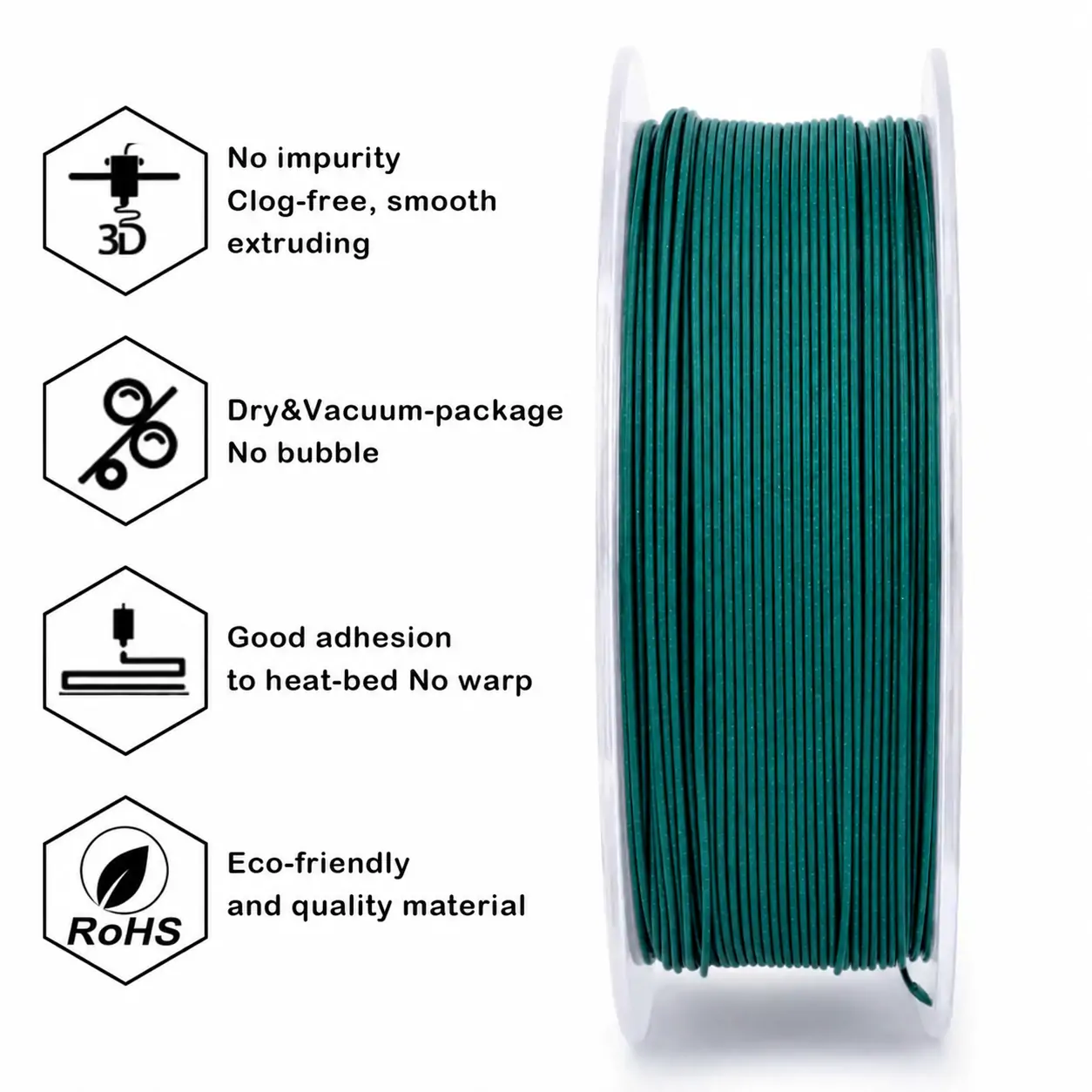
For distributors, print farms and private-label buyers, this SKU is built around repeatable supply rather than cosmetic color alone. Standard 1.75 mm filament is controlled to ±0.03 mm, packed as 1 kg net on a plastic spool and vacuum sealed with desiccant. A hardened wear-resistant nozzle is required for carbon-filled material; a 0.6 mm hardened nozzle is preferred when the application allows it. Wholesale, sample qualification and OEM/ODM programs are supported for export projects.
Why This Product Stands Out
Deep Spruce Green gives an engineering PETG-CF line a color that remains professional without defaulting to black or gray. The carbon-filled surface visually softens layer lines, while the PETG base keeps the material practical for functional parts that need dimensional stability and everyday durability. For B2B buyers, that combination creates a differentiated SKU for brackets, jigs, fixtures, housings and workshop accessories without forcing the end user into the higher moisture sensitivity and process demands associated with many nylon-carbon-fiber materials.
Key Selling Points
Published PETG-CF Reference Data
Mechanical and thermal reference values for the standard PETG-CF formulation are listed once in Technical Specifications below together with the applicable ISO / ASTM test methods and document-status note.
Deep Spruce Green Finish
Dark teal blue-green with a low-sheen matte-satin surface and visible fine fiber flecks.
Stable Diameter Control
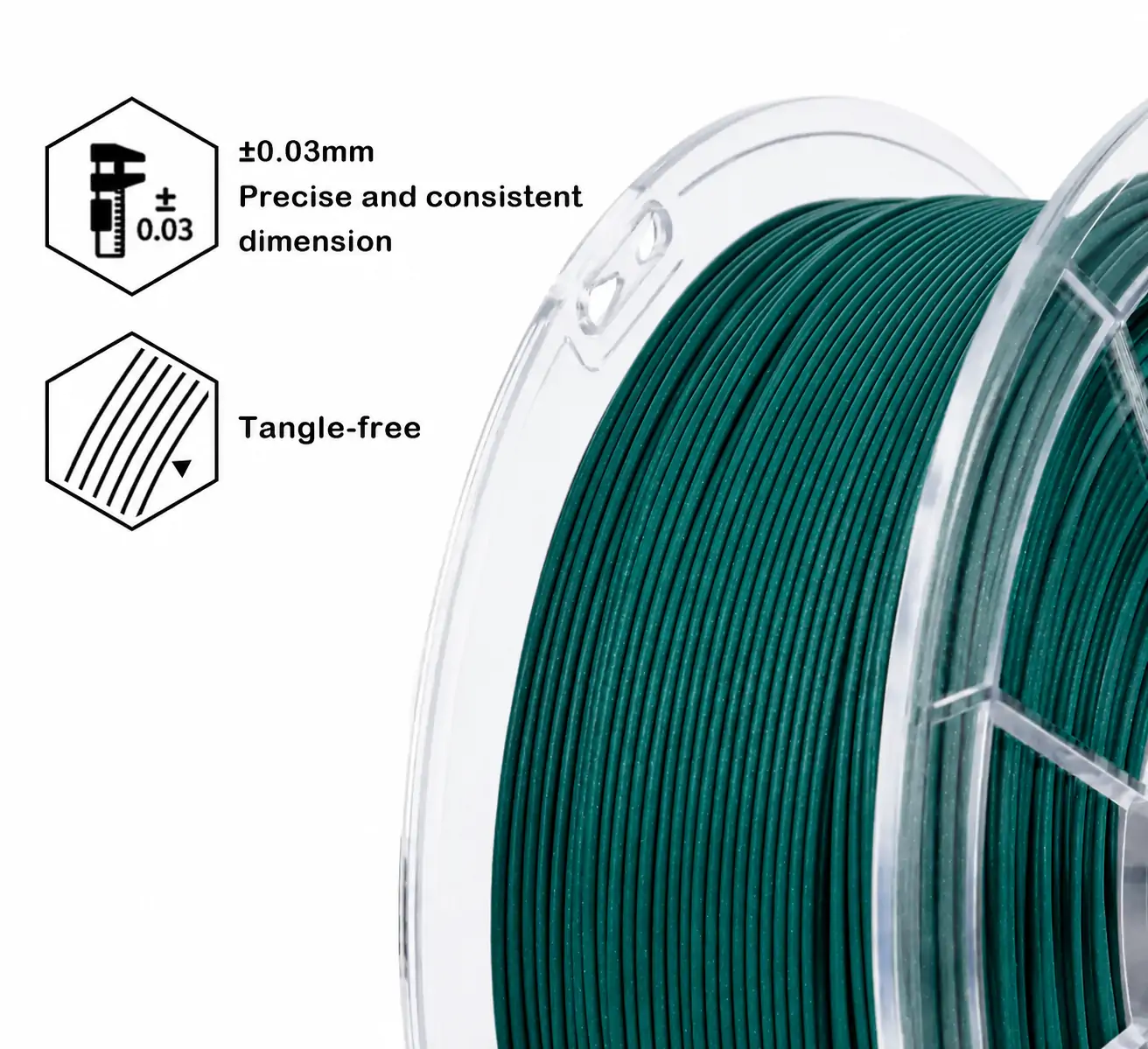
±0.03 mm diameter tolerance supports consistent feeding across repeat production runs.
Carbon-Fiber Reinforced Grade
The standard PETG-CF formulation is carbon-fiber reinforced for higher stiffness; fiber loading can also be adjusted for qualified OEM projects with matched technical documentation.
Export-Oriented Supply
1 kg standard spool format, vacuum sealing and B2B terms suited to wholesale and import programs.
OEM / Private Label
Custom labels, cartons, color matching and project-based packaging options for qualified buyers.
Key Features
| Feature | Practical Buyer Benefit |
|---|---|
| Functional PETG-CF Matrix | Carbon-fiber-reinforced PETG for brackets, fixtures, housings and tooling where a stiffer PETG-based material is preferred. |
| Deep Spruce Green Composite Color | Adds a differentiated dark teal engineering color without metallic, silk, glitter or gradient effects. |
| Wear-Resistant Hardware Requirement | Uses hardened or equivalent abrasion-resistant nozzle hardware for reliable production with carbon-filled material. |
| ±0.03 mm Diameter Tolerance | Supports repeatable feeding and more consistent extrusion in B2B production use. |
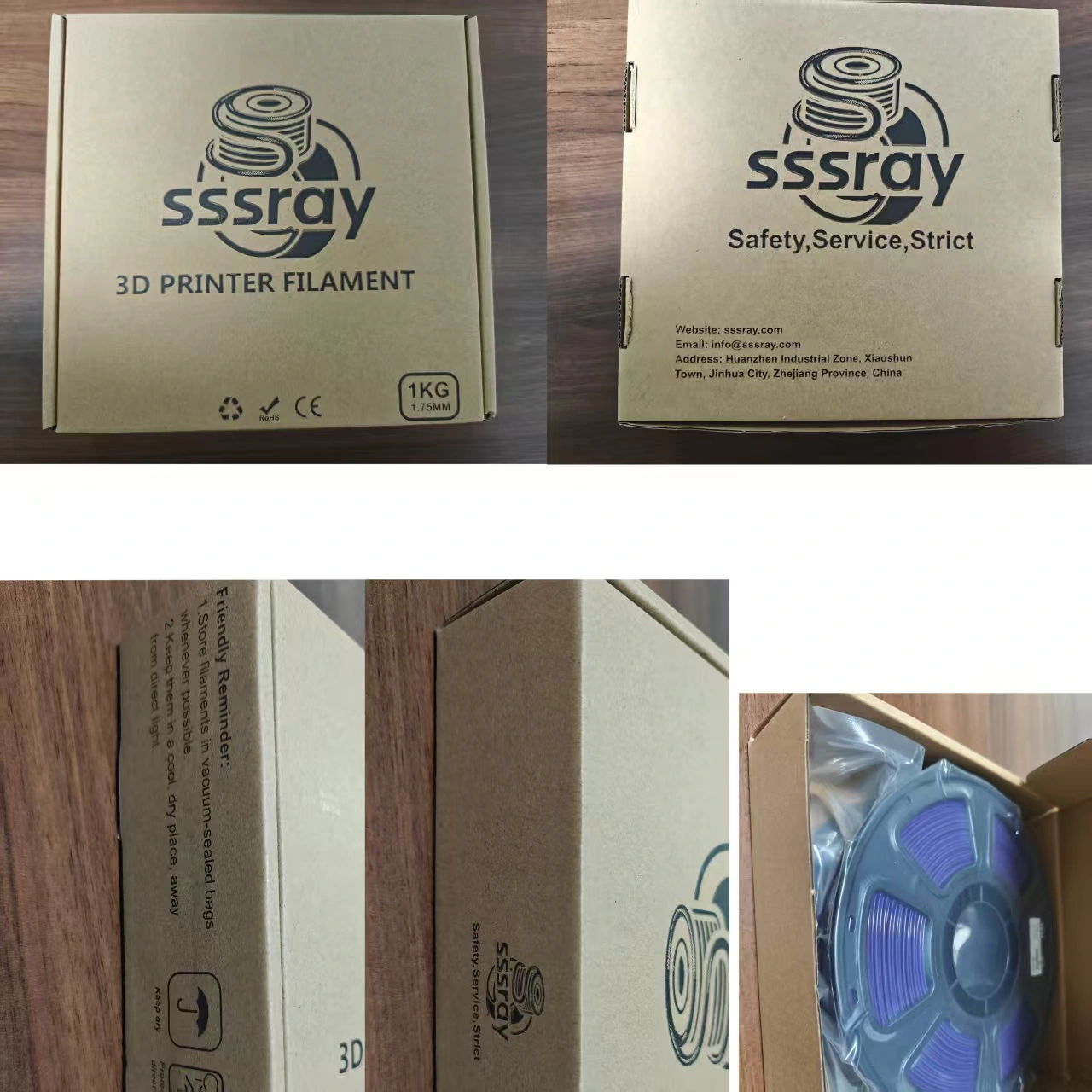
| Vacuum Sealed with Desiccant | Helps control moisture exposure during storage and international transport. |
| OEM / ODM Supply Support | Supports private labels, branded boxes, color programs and distributor-specific packaging projects. |
Commercial Value for B2B Programs
For distributors and private-label buyers, Deep Spruce Green adds a differentiated engineering color to a PETG-CF range without changing the basic material class or hardened-nozzle requirement. The standard 1 kg spool, 50-roll neutral-packaging MOQ and 500–1,000-roll OEM packaging range allow buyers to qualify the SKU first and then scale it into regular channel supply. For repeat orders, the main purchasing controls remain consistent extrusion, dry packaging, color consistency and the approved technical document set for the ordered formulation.
How We Work
1
Application & Load Review
2
Printer & Nozzle Check
3
PETG-CF Sample Test
4
Deep Spruce Green Approval
5
Batch & Packaging Setup
6
QC Release & Shipment
Material Comparison Guide
| Material | Material Difference | Typical Printing Condition | Moisture / Hardware Note | Typical Use |
|---|---|---|---|---|
| PETG-CF | Carbon fiber filled PETG; stiffer feel and more textured surface than standard PETG | Heated bed; moderate cooling; PETG-CF temperature profile | Dry before printing; hardened nozzle required | Functional brackets, fixtures, housings, workshop parts |
| Standard PETG | Unfilled PETG with higher surface gloss and more ductile behavior | Heated bed; moderate cooling | Dry storage recommended; standard nozzle normally sufficient | General functional parts, containers, guards, mounts |
| PLA-CF | Carbon filled PLA; crisp matte appearance with lower heat resistance than PETG-class materials | Lower nozzle and bed temperatures than PETG-CF | Hardened nozzle required | Display parts, rigid prototypes, visual carbon-fiber finish |
| PA-CF | Carbon filled nylon; engineering composite with higher moisture sensitivity and more demanding conditioning | Higher-temperature hotend; enclosure often preferred | Aggressive drying and dry-box printing commonly required | Higher-demand jigs, fixtures and engineering components |
Technical Specifications
| Product Name | SSSray PETG-CF 3D Printer Filament – Carbon Fiber Filled PETG in Deep Spruce Green, zelený PETG filament s uhlíkovými vlákny for Functional Brackets & Fixtures |
|---|---|
| Material | PETG-CF — carbon fiber filled polyethylene terephthalate glycol |
| Carbon Fiber Content | Published standard formulation target ≥10% by weight; confirm the current ordered grade against the applicable TDS / batch document |
| Tensile Strength (XY) | 60±3 MPa — ISO 527-2 / ASTM D638 reference method |
| Tensile Modulus (XY) | 4,500–4,800 MPa — ISO 527-2 / ASTM D638 reference method |
| HDT @ 0.455 MPa | 71°C — ISO 75-2 / ASTM D648 reference method |
| Vicat Softening Temperature | 78°C — ISO 306 / ASTM D1525 reference method |
| Data Status | Mechanical and thermal values above are published standard PETG-CF formulation references used across the SSSray PETG-CF line. They are not presented as a Deep Spruce Green batch COA; request the current applicable PETG-CF TDS and the batch QC / COA matched to the ordered SKU for procurement qualification. |
| Series | SSSray PETG-CF Composite Series – Functional Parts, Brackets & Workshop Fixtures |
| Color / Effect | Deep Spruce Green; dark teal blue-green; low-sheen matte-satin; fine light-colored fiber flecks |
| Filament Diameter | 1.75mm standard; 2.85mm available on request |
| Tolerance | ±0.03mm |
| Net Weight | 1kg standard; 3kg and 5kg options available on request |
| Gross Weight | 1.3kg for the standard 1kg spool configuration |
| Spool Type | Plastic spool |
| Packaging | Vacuum sealed with desiccant |
| Nozzle Hardware | Wear-resistant hardened nozzle required; 0.6mm preferred, 0.4mm supported |
| Printer Compatibility | Most 1.75mm open-material FDM/FFF printers that can run PETG-CF temperatures and a hardened nozzle |
| Typical Applications | Functional brackets, workshop fixtures, jigs, housings, clamps, machine and robotics prototypes |
| OEM / ODM | Supported for qualified B2B projects |
Recommended Print Settings
| Parameter | Recommended Guidance |
|---|---|
| Recommended Nozzle Temperature | 235–255°C |
| Usable Nozzle Range | 230–270°C |
| Recommended Bed Temperature | 70–85°C |
| Usable Bed Range | 60–90°C depending on build surface and part footprint |
| Recommended Print Speed | 60–150 mm/s for routine functional production |
| Usable Speed Range | 40–250 mm/s when hotend flow, nozzle size, temperature and part geometry support the required throughput |
| Nozzle Diameter / Material | 0.6mm hardened steel preferred; 0.4mm hardened steel supported |
| Layer Height | 0.12–0.28mm; 0.20mm is a practical production starting point |
| Cooling Fan | 50–100% after the first 2 layers; reduce cooling where stronger interlayer bonding is the priority |
| Retraction — Direct Drive | 0.8–1.5mm at 25–45 mm/s starting range |
| Retraction — Bowden | 3–5mm at 25–45 mm/s starting range |
| Wall Count | 3–5 perimeters for functional parts |
| Infill | 20–30% for general functional parts; 40–60% where higher internal support is required |
| First Layer Speed | 15–25 mm/s |
| Bed Adhesion | Textured or satin PEI recommended; use a suitable release layer on surfaces prone to excessive PETG adhesion |
| Drying Before Printing | 70°C for 4–6 hours before printing; extend drying when the spool has absorbed significant moisture |
Print Optimization Guide
| Item | Guidance |
|---|---|
| Nozzle Wear | Use a hardened steel, tungsten-carbide or equivalent wear-resistant nozzle; carbon fiber is abrasive. |
| Nozzle Size | Choose 0.6mm where throughput and clog margin matter; 0.4mm is suitable for finer geometry when the filament is dry and feed path is tuned. |
| Drying & Storage | Dry before qualification prints and reseal immediately after use with fresh desiccant. |
| Layer Bonding | Avoid excessive cooling on functional walls; raise fan only when overhang or bridge quality requires it. |
| Surface Finish | For a smoother low-sheen surface, keep outer-wall speed moderate and avoid unnecessary temperature swings. |
| Large Functional Parts | An enclosure can improve thermal consistency and layer bonding on large or thick parts, but does not replace filament drying. |
| Build Surface | Use clean textured/satin PEI or another PETG-compatible plate; apply a release layer where PETG adhesion is too aggressive. |
| Dimensional Qualification | For jigs, bearing housings and fit-critical fixtures, qualify flow ratio, hole compensation and shrinkage on the target printer before batch production. |
Printer Brand Starting Settings
| Printer / Hardware | Nozzle | Bed | Speed | Starting Note |
|---|---|---|---|---|
| Bambu Lab with hardened-steel hotend | 245–260°C | 70–80°C | 80–180 mm/s | Use a hardened 0.4mm or 0.6mm nozzle; 0.6mm is preferred when production throughput and clog margin matter. |
| Prusa with ObXidian / hardened nozzle | 250–265°C | 80–90°C | 50–120 mm/s | Use a textured or satin sheet and tune cooling to balance surface quality with interlayer strength. |
| Creality K1C / CF-capable hardened nozzle | 240–255°C | 70–85°C | 80–160 mm/s | Use a dry spool and keep outer-wall speed lower when a cleaner matte surface is the priority. |
| Flashforge PETG-CF reference | 230–250°C | 60–80°C | 40–60 mm/s | Current Flashforge PETG-CF material guidance uses a 0.6mm or 0.8mm hardened-steel nozzle; use this row as a conservative material starting point and tune on the selected printer. |
For production setup, treat these as starting ranges rather than manufacturer-certified printer profiles unless a manufacturer reference is explicitly stated. The Flashforge row follows current Flashforge PETG-CF material guidance; fine-tune flow, cooling and speed for the selected nozzle, build plate and part geometry.
Performance Characteristics
| Characteristic | Material Behavior | Production Reference |
|---|---|---|
| Rigidity | Carbon-fiber reinforcement reduces flex compared with unfilled PETG and is intended for functional parts where a stiffer response is useful. | Qualify wall thickness, load direction and fit on the target part before batch production. |
| Dimensional Stability | Carbon-fiber reinforcement reduces shrink-driven distortion and supports stable functional geometry. | Useful for jigs, bearing housings and fit-sensitive workshop parts after normal printer calibration. |
| Surface Character | Low-sheen matte-satin composite appearance with visible fine fiber flecks. | Deep Spruce Green keeps the engineering look while differentiating the SKU from standard black and gray PETG-CF. |
| Abrasion | Carbon fiber is abrasive to brass and other low-wear nozzle materials. | Use hardened steel, tungsten-carbide, ruby or equivalent wear-resistant hardware for regular production. |
| Thermal Performance | Use the HDT and Vicat values in Technical Specifications as formulation-level reference data, not as automatic part service-temperature limits. | Validate the printed part under its actual load, geometry and operating temperature before end-use approval. |
| Moisture Control | Dry filament supports cleaner extrusion, steadier flow and a more consistent matte surface. | Dry at 70°C for 4–6 hours when needed and keep opened spools sealed with desiccant. |
| OEM Fiber Loading | Fiber loading can be adjusted for qualified OEM programs where a different stiffness, finish or processing target is required. | Any formulation change should be qualified against the matched technical document set before production release. |
Applications
| Application Focus | Practical Notes |
|---|---|
| Functional Brackets & Mounts | Good fit for rigid mounting parts, sensor brackets and non-safety-critical equipment accessories. |
| Workshop Jigs & Fixtures | Useful where repeatable geometry and a technical surface are more important than high ductility. |
| Bearing Housings & Machine Prototypes | Suitable for fit and assembly prototypes after hole, clearance and load qualification on the target printer. |
| Clamps & Utility Hardware | Works well for non-pressure clamps, holders and workshop accessories where PETG-class durability is appropriate. |
| Robotics & Electronics Housings | Deep Spruce Green gives enclosures and prototype frames a restrained industrial appearance. |
| Print-Farm & 3D-Printer Accessories | Suitable for mounts, organizers, brackets and service parts that benefit from a stiffer PETG-based material. |
| Private-Label Engineering Filament Lines | Distinct dark-teal composite color adds differentiation beyond standard black and gray PETG-CF SKUs. |
Storage Guide
- Keep unopened spools vacuum sealed until qualification or production use.
- After opening, store the spool in a sealed dry box or moisture-barrier bag with active desiccant.
- Dry at 70°C for 4–6 hours before critical prints; extend drying when the spool has absorbed significant moisture.
- During long prints, use dry-box feeding where ambient humidity is high or surface quality is critical.
- Keep away from direct sunlight, heat sources and uncontrolled hot-air drying that can deform the spool.
OEM / ODM Services
SSSray supports OEM / ODM programs for distributors, wholesalers, private-label brands and industrial sourcing teams. Available project options include neutral packaging, custom spool labels, branded retail boxes, barcode and market-language labeling, carton marks, color matching, product-line assortment planning, customer-approved packaging artwork and carbon-fiber loading adjustment for qualified engineering programs.
Neutral packaging starts from 50 rolls. OEM packaging typically starts from 500–1,000 rolls depending on artwork, box structure, label scope and color program. For qualification, approved B2B buyers can request up to 3 complimentary sample spools before moving into a production order.
Quality Control
- Diameter and ovality checks against the ±0.03mm production tolerance
- Winding appearance and cross-over inspection before packing
- Color and surface comparison against the approved Deep Spruce Green reference
- Vacuum-seal, desiccant and bag-integrity inspection
- Batch identification and order-level consistency checks before release
- Final packaging, carton marking and shipment preparation inspection
Technical & Compliance Documentation
- For mechanical and thermal qualification, request the current applicable PETG-CF TDS together with the SKU-specific batch QC / COA; formulation-level reference values on this page do not replace a batch-specific release record.
- Request the current SDS/MSDS package for Deep Spruce Green PETG-CF with your technical inquiry.
- RoHS, REACH and available third-party reports can be matched to the ordered formulation and color where covered by the current document scope.
- Send destination-market or customer document requirements with your RFQ; our team will prepare the applicable file set for the order.
- For customized carbon-fiber loading or other formula changes, the technical and compliance document set is matched to the approved production grade.
Frequently Asked Questions
What is the MOQ for Deep Spruce Green PETG-CF?
Neutral packaging starts from 50 rolls. OEM or private-label packaging typically starts from 500–1,000 rolls depending on label, box, color and artwork requirements.
How does PETG-CF differ from standard PETG?
The carbon-fiber-filled formulation is positioned for higher rigidity, improved dimensional stability and a more technical low-sheen surface than standard glossy PETG. It is also abrasive, so wear-resistant nozzle hardware is required.
Do I need a hardened nozzle?
Yes. Use a wear-resistant hardened nozzle for this carbon-filled filament. A 0.6mm hardened nozzle is preferred for production reliability, while a 0.4mm hardened nozzle can be used for finer details.
What drying condition should I start with?
Start with 70°C for 4–6 hours, then keep the spool sealed with desiccant or feed from a dry box. Extend drying when the spool has absorbed significant moisture.
Which printers can use this filament?
It is suitable for most 1.75mm open-material FDM/FFF printers that can reach PETG-CF temperatures and accept a hardened nozzle. Bambu Lab, Prusa, Creality and Flashforge systems can be used when configured with suitable wear-resistant hardware.
What does Deep Spruce Green look like after printing?
It is a dark teal blue-green with a low-sheen matte-satin finish. Fine light-colored fiber flecks remain visible across printed layers; the effect is not metallic, silk, glitter or gradient.
Can I request samples and private-label packaging?
Yes. Qualified B2B buyers can request up to 3 complimentary sample spools. We also support custom labels, branded boxes, carton marks, color programs and other OEM/ODM packaging work.
What documents and lead time should I plan for?
Standard production lead time is 7–15 days and customized orders are typically 15–25 days. Request the current SKU-specific TDS/SDS and any required compliance documents with your RFQ, and we will prepare the applicable document set for your order.
Need a PETG-CF Supplier for Functional Parts Programs?
Send us your target printer, annual volume, packaging format and destination market. We can prepare a bulk quotation, PETG-CF sample plan and OEM/ODM supply route for Deep Spruce Green.


Related products
-

Carbon Fiber PLA 3D Printer Filament 1.75mm by SSSray, PLA-CF Slate Gray – filamento PLA com fibra de carbono cinza – for Topology-Optimized Brackets & Vented Enclosures
-
Industrial Shock-Absorbing TPU Filament 1.75mm 1KG | High-Resilience Lattice-Grade Flexible Material for Protective Pads, Vibration Dampers & Robotics Grippers | OEM/ODM Bulk Supply
-
SSSray PLA-CF in Dusty Rose: 1.75mm Carbon Fiber PLA 3D Printer Filament – filament PLA fibre de carbone rose – for Motor Mounts & Finned Housings
-
SSSray Graphite Black Carbon Fiber PLA-CF 3D Printer Filament 1.75mm – filament PLA z włóknem węglowym for Mechanical Brackets & Functional Prototypes