Online time
Monday to Friday: 9AM - 8PM
Weekend: 10AM - 5PM




SSSray Silk PLA Series | Emerald Spectrum Collection | Wholesale & OEM / ODM
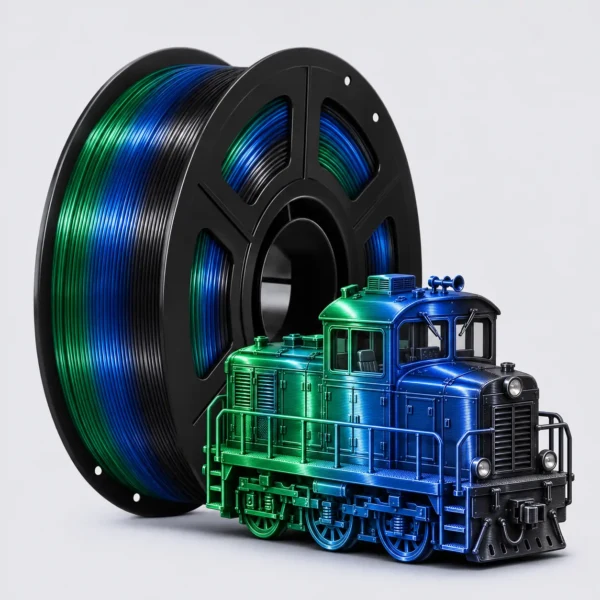
SSSray Emerald Green, Sapphire Blue & Obsidian Black Tri-Color Silk PLA 3D Printer Filament for Detailed Display and Architectural Models – filamento PLA de seda tricolor
Lengthwise-gradient Silk PLA for architectural display models, locomotive builds and premium decorative prints.
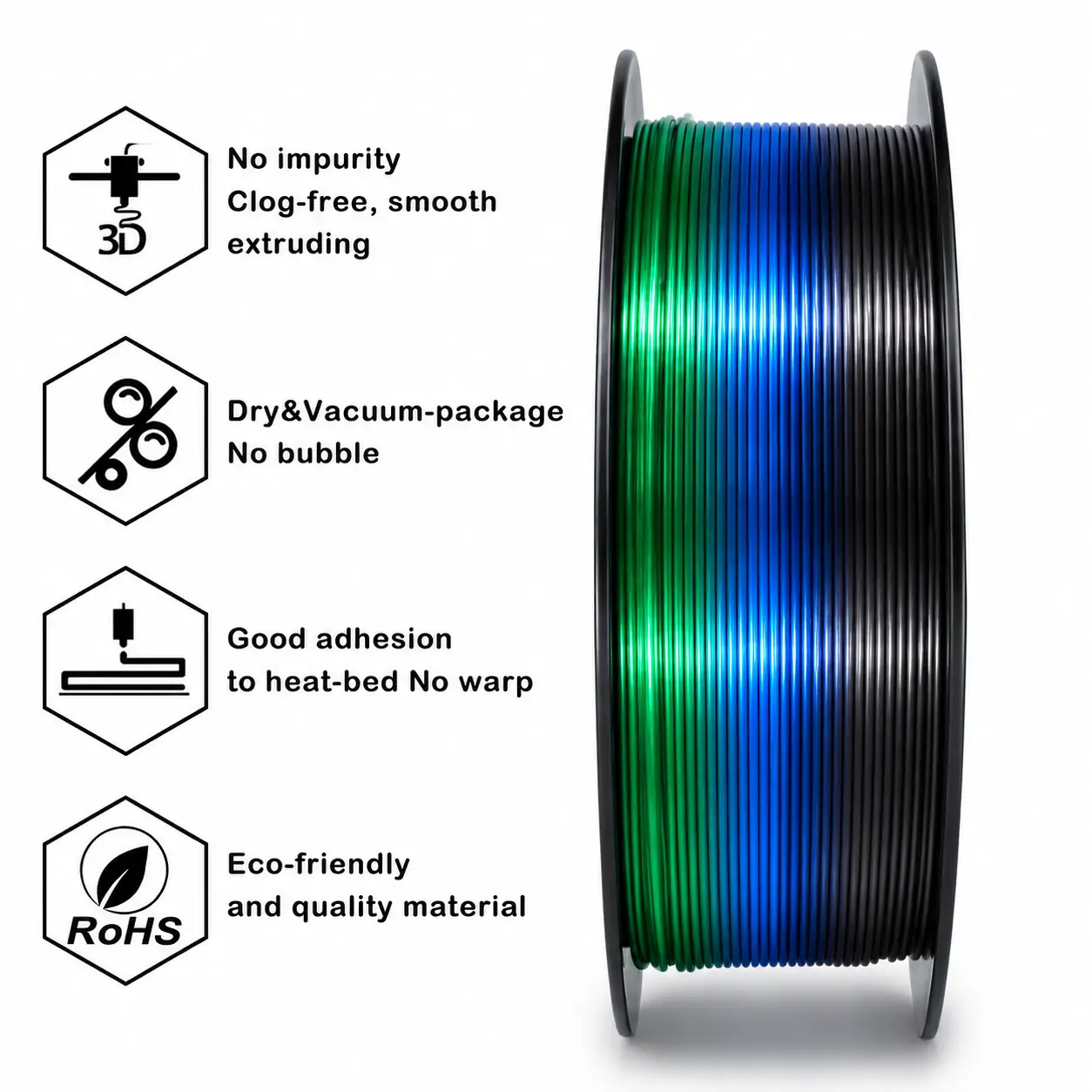
Emerald Green transitions through Sapphire Blue to Obsidian Black along the filament length. As the spool feeds through a standard single-nozzle printer, successive sections of the model develop a smooth three-color progression—without manual filament swaps or a multi-material unit. SSSray supplies this 1.75mm, ±0.03mm grade in 1kg spools for wholesale and private-label programs.
MaterialSilk PLA
SeriesEmerald Spectrum
Color EffectLengthwise Gradient
Diameter1.75mm
Tolerance±0.03mm
Net Weight1kg
Gross Weight1.3kg
Nozzle Temp.210–230°C
Bed Temp.45–60°C
Print Speed60–150mm/s · up to 250mm/s
PackagingVacuum + Desiccant
Spool TypePlastic Spool
MOQ: Neutral packaging from 50 rolls; OEM packaging typically 500–1,000 rolls.
Lead Time: Standard orders 7–15 days; customized orders 15–25 days.
Product Overview
SSSray Emerald Green, Sapphire Blue & Obsidian Black Tri-Color Silk PLA is a lengthwise-gradient FDM/FFF filament created for display models that benefit from a defined color progression and a reflective silk surface. The filament transitions from emerald green through sapphire blue to obsidian black along its length. As the spool feeds through a standard single-nozzle printer, successive sections of the model pick up the changing tones without manual filament swaps or an AMS / multi-material unit. This color direction gives architectural facades, scale locomotives, spiral staircases and exhibition models a darker jewel-tone identity than bright rainbow or warm multi-color palettes.
The grade combines a familiar PLA-based printing workflow with a high-gloss finish. SSSray supplies the standard 1.75mm format with ±0.03mm diameter tolerance, 1kg net weight, plastic spool and vacuum-sealed packaging with desiccant. At our Jinhua, Zhejiang factory, we coordinate extrusion, diameter monitoring, winding, color inspection and packaging for export-oriented supply. Neutral packaging starts at 50 rolls; OEM packaging programs typically start at 500–1,000 rolls.
Product Highlights
A controlled emerald-to-sapphire-to-obsidian progression runs along the filament length, so the color change is built into the spool—not created by a multi-material printer or post-processing. The dark jewel-tone palette is made for large architectural surfaces, locomotive shells, spiral staircases and display pieces where successive color transitions add visual depth as each layer is printed. A reflective Silk PLA surface completes the presentation, while the standard 1.75mm / 1kg format keeps the product familiar for retail and wholesale channels.
Key Selling Points
Lengthwise Three-Color Progression
Emerald green moves through sapphire blue to obsidian black as the filament feeds, creating a color sequence through the print rather than simultaneous side-by-side color faces.
Dark Jewel-Tone Palette
Deep green, saturated sapphire blue and obsidian black create a coordinated color story for architecture, transport models and premium display collections.
Reflective Silk-Gloss Finish
Silk highlights define curved walls, rooflines, raised edges and sculpted details under display lighting.
Single-Nozzle Color Workflow
The color progression is built into the filament, so compatible single-nozzle FDM printers can produce the effect without an AMS or manual spool changes.
High-Speed Profile Window
60–150mm/s is the standard production window, with high-speed tuning up to 250mm/s on capable systems after flow and cooling calibration.
Factory-Direct OEM Supply
SSSray supplies neutral-packaging orders from 50 rolls and OEM packaging programs typically from 500–1,000 rolls for brand and distributor plans.
Key Features
| Feature | Practical Buyer Benefit |
|---|---|
| Emerald Green → Sapphire Blue → Obsidian Black | Creates a recognizable dark jewel-tone gradient for architectural and transport display collections. |
| Lengthwise Color Transition | Color progression is built into the spool and prints through a standard single-nozzle workflow. |
| 1.75mm Filament Diameter | Fits the standard filament format used by most open-material 1.75mm FDM / FFF printers. |
| ±0.03mm Diameter Tolerance | Defines the dimensional target for consistent feeder setup and incoming inspection. |
| 60–150mm/s Standard Speed Window | Supports productive decorative printing; capable high-speed systems can be tuned toward 250mm/s. |
| 1kg Net Spool / 1.3kg Gross Pack | Provides a familiar retail unit and a clear packaged-weight reference for order planning. |
| Vacuum Bag + Desiccant | Helps protect the filament from moisture exposure during storage and handling. |
| Neutral MOQ 50 Rolls / OEM 500–1,000 Rolls | Supports both initial assortment orders and branded volume programs. |
Commercial Value for B2B Buyers
This Emerald Spectrum colorway gives distributors a darker, more architectural option within the Silk PLA range. Its emerald-to-sapphire-to-obsidian progression is distinct from the brighter copper-orange / leaf-green / azure-blue palette of our SSSray Tropic Tricolor Silk PLA and from rainbow products built around a wider color sequence. This SKU is positioned for building models, locomotive displays, spiral staircases and premium decorative pieces where the gradual color shift can be shown clearly in product photography and finished samples.
SSSray manufactures filament at our Jinhua, Zhejiang factory, with 50+ extrusion lines and production capacity of up to 1,000 tons per month. Our production workflow brings together extrusion, in-line diameter monitoring, winding, color inspection and packaging. Neutral packaging starts at 50 rolls; OEM packaging typically starts at 500–1,000 rolls, giving importers and private-label brands a practical route from sample evaluation to repeat wholesale orders.
Our B2B Cooperation Process
1
Inquiry & Requirement Review2
SKU, Color & Specification Confirmation3
Sample Evaluation & Print Feedback4
Packaging, Label & Carton Approval5
Production Scheduling & QC6
Final Packing & Shipment3D Printing Material Comparison
| Material / Filament Type | Surface & Material Behavior | Typical Applications | Typical Print Conditions |
|---|---|---|---|
| Emerald Spectrum Lengthwise Tri-Color Silk PLA | Continuous emerald-to-sapphire-to-obsidian color progression along the filament length, with a reflective Silk PLA surface. | Architectural display models, locomotives, spiral staircases and dark-tone decorative pieces. | 210–230°C nozzle; 45–60°C bed; 60–150mm/s standard speed; slower outer walls for silk gloss. |
| Co-Extruded Tri-Color Silk PLA | Multiple color zones run side-by-side within one strand; printed color visibility is influenced by strand orientation and model geometry. | Twisted vases, curved shells, sculptural décor and models designed to show simultaneous color faces. | Silk PLA temperature range; 45–60°C bed; moderate outer-wall speed for surface finish. |
| Single-Color Silk PLA | One consistent color along the spool with a reflective silk finish. | Trophies, figurines, awards, decorative vessels and display accessories. | Typically 190–230°C nozzle; 45–60°C bed; 40–100mm/s depending on grade. |
| Standard PLA / PLA+ | General-purpose PLA workflow; surface appearance and toughness vary by grade and modifier package. | Prototypes, teaching aids, general models and everyday decorative parts. | Typically 190–230°C nozzle; unheated to 60°C bed; grade-specific profiles apply. |
| PETG | Typically more ductile than PLA and selected for functional parts requiring greater impact tolerance; stringing control is important. | Brackets, containers, fixtures and general-purpose functional components. | Typically 230–250°C nozzle; 70–90°C bed; tune cooling and retraction by grade. |
| ABS / ASA | Higher-temperature engineering thermoplastics; enclosure and shrinkage control are important. ASA adds outdoor weathering resistance. | Functional housings, automotive-style parts and outdoor components. | Typically 230–260°C nozzle; 90–110°C bed; enclosed printing is commonly used. |
Choose the material by the finished part’s appearance, service temperature and mechanical requirements; print windows vary by grade and printer.
Technical Specifications
| Product Name | SSSray Emerald Green, Sapphire Blue & Obsidian Black Tri-Color Silk PLA 3D Printer Filament for Detailed Display and Architectural Models – filamento PLA de seda tricolor |
|---|---|
| Material | Silk PLA (Polylactic Acid), FDM / FFF 3D printing filament |
| Product Series | SSSray Silk PLA Series – Emerald Spectrum Collection |
| Color Effect | Lengthwise tri-color gradient |
| Color Composition | Emerald Green, Sapphire Blue and Obsidian Black |
| Color Sequence | Emerald Green → Sapphire Blue → Obsidian Black along the filament length |
| Color Structure | Lengthwise gradient; colors appear sequentially as the filament is extruded |
| Surface Finish | Reflective Silk-gloss finish; non-metallic appearance |
| Standard Diameter | 1.75mm |
| Diameter Tolerance | ±0.03mm |
| Net Weight | 1kg standard; 3kg / 5kg formats subject to order confirmation |
| Gross Weight | 1.3kg per standard packaged unit |
| Spool Type | Plastic spool |
| Packaging | Vacuum-sealed bag with desiccant |
| Printer Compatibility | Most open-material 1.75mm FDM / FFF printers, subject to spool clearance, hotend capability and slicer setup; the gradient is integrated into the filament and does not require a multi-material unit |
| Printer Examples | Bambu Lab, Prusa, Creality, Flashforge, Anycubic and Elegoo 1.75mm FDM systems |
| Typical Applications | Architectural display models, locomotives, spiral staircases, figurines, exhibition pieces and decorative models |
| OEM / ODM | Supported; options subject to MOQ and specification approval |
| Standard MOQ | Neutral packaging: 50 rolls; OEM packaging: typically 500–1,000 rolls |
| Lead Time | Standard: 7–15 days; customized: 15–25 days |
| Trade Terms | FOB Ningbo / EXW |
Recommended Print Settings
| Parameter | Recommended Starting Value | Usable / Tuning Range |
|---|---|---|
| Nozzle Temperature | 220°C | 210–230°C |
| Bed Temperature | 50–55°C on PEI | 45–60°C; compatible Bambu build plates may use 35–45°C |
| Standard Print Speed | 60–150mm/s | 60–150mm/s, tuned to hotend flow and model geometry |
| High-Speed Printing | 120–200mm/s on capable systems | Up to 250mm/s after flow, cooling and extrusion calibration |
| Outer Wall Speed | 30–60mm/s | 30–60mm/s; reduce toward the lower end when silk gloss is the priority |
| Inner Wall / Infill Speed | 80–150mm/s | 80–150mm/s standard; increase toward 250mm/s only when hotend flow remains stable |
| Layer Height | 0.16–0.20mm | 0.12–0.24mm with a 0.4mm nozzle |
| Cooling Fan | 80–100% after the first 2–3 layers | Use full cooling for bridges and overhangs; tune small-layer cooling to the model |
| Retraction – Direct Drive | 0.5–1.2mm at 25–40mm/s | 0.5–1.5mm; tune to the extruder and hotend |
| Retraction – Bowden | 3–5mm at 25–40mm/s | 3–5mm; tune to the Bowden path and hotend |
| Wall Count | 2–3 walls | 3 walls for larger display shells and architectural models |
| Infill | 15–20% for decorative models | 40–60% for heavier display pieces; infill percentage alone does not establish a structural rating |
| First Layer Speed | 20–30mm/s | 20–30mm/s, based on first-layer adhesion |
| Bed Adhesion | Clean smooth PEI or textured PEI | Glass with a compatible adhesive where required; follow the build-plate maker’s release guidance |
| Nozzle Diameter | 0.4mm standard | 0.2–0.6mm after line-width and flow calibration |
For productive printing, raise inner-wall and infill speeds before increasing visible outer walls. Keep the outer surface stable to retain the Silk PLA sheen and run a short color-transition sample before a long display print.
Print Optimization Guide
| Optimization Target | Practical Guidance |
|---|---|
| Show the Lengthwise Color Progression | Choose taller or larger models with enough extrusion length for the emerald-to-sapphire-to-obsidian transition to appear across successive layers and model sections. |
| Plan Model Orientation | Review the slicer preview and start position on the spool; the visible color placement follows the filament feed and the model toolpath. |
| Preserve Silk Gloss | Keep visible outer walls around 30–60mm/s and avoid abrupt speed changes across prominent surfaces. |
| Increase Production Throughput | Run inner walls and infill at 80–150mm/s first; tune toward 250mm/s only after checking maximum volumetric flow, cooling and extrusion consistency. |
| Refine Architectural Detail | Use a 0.4mm nozzle and 0.12–0.16mm layer height for fine façade lines, stair edges and small decorative features. |
| Control Stringing | Calibrate retraction in small increments; adjust nozzle temperature within 210–230°C while checking extrusion continuity. |
| Secure the First Layer | Clean and level the build plate, then use 20–30mm/s first-layer speed on PEI or the selected plate surface. |
| Manage Moisture | Keep the spool sealed with desiccant between jobs. If moisture-related popping or surface defects appear, dry under the storage guidance for this material and spool. |
Printer Brand Starting Settings
| Printer Ecosystem | Nozzle | Bed | Outer Wall | Inner Wall / Infill |
|---|---|---|---|---|
| Bambu Lab (A / P / X series, 1.75mm open-material setup) | 210–230°C | 35–45°C on compatible plates; follow plate profile | 30–60mm/s | 80–150mm/s; tune toward 250mm/s only after flow calibration |
| Prusa (MK / MINI / CORE families) | 210–230°C | 50–60°C | 30–60mm/s | 60–120mm/s |
| Creality (Ender / K series) | 210–230°C | 50–60°C | 30–60mm/s | 60–150mm/s; high-speed K models can be tuned further after flow checks |
| Flashforge (1.75mm FFF models) | 210–230°C | 45–60°C | 30–60mm/s | 80–150mm/s |
| Anycubic / Elegoo (1.75mm FDM models) | 210–230°C | 45–60°C | 30–60mm/s | 60–120mm/s |
These SSSray starting ranges cover common 1.75mm printer families. Match the bed temperature to the build plate, and confirm hotend flow, spool clearance and slicer settings before increasing speed.
Performance Characteristics
| Characteristic | SSSray Product / Series Reference | Practical Interpretation |
|---|---|---|
| Color Structure | Lengthwise gradient: Emerald Green → Sapphire Blue → Obsidian Black | Colors progress as the filament feeds, producing changing color sections through successive extrusion paths. |
| Color Workflow | Single-nozzle FDM / FFF | The color sequence is integrated into the spool; no AMS or manual filament change is required. |
| Surface Appearance | Reflective Silk-gloss finish | Specular highlights emphasize curved surfaces, architectural edges and display contours. |
| Filament Diameter | 1.75mm | Standard filament format for compatible open-material FDM / FFF printers. |
| Diameter Tolerance | ±0.03mm | Defined dimensional target for feeding setup and incoming quality checks. |
| Standard Print Speed | 60–150mm/s | Suitable for regular decorative production when matched to hotend flow and model geometry. |
| High-Speed Tuning Window | 120–250mm/s on capable systems | Use higher speeds for inner walls and infill after flow, cooling and extrusion calibration. |
| Moisture Protection | Vacuum-sealed bag + desiccant | Helps protect the spool before opening; reseal or store in a dry box between print jobs. |
PLA Silk Series Typical Reference Properties
| Property | Typical Value | Test Method / Condition |
|---|---|---|
| Melt Flow Rate (MFR) | 6–9g/10min | ISO 1133; 190°C / 2.16kg |
| Tensile Strength (XY) | 45 ± 2MPa | ISO 527-2 / ASTM D638 |
| Tensile Modulus (XY) | 2,448MPa | ISO 527-2 / ASTM D638 |
| Elongation at Break (XY) | 10–15% | ISO 527-2 / ASTM D638 |
| Flexural Strength (XY) | 75MPa | ISO 178 / ASTM D790 |
| Flexural Modulus (XY) | 2,580MPa | ISO 178 / ASTM D790 |
| Notched Izod Impact Strength | 5–6kJ/m² | ISO 180 / ASTM D256 |
| Notched Charpy Impact Strength | 5–7kJ/m² | ISO 179-1 |
| Shore Hardness | 84 Shore D | ISO 868 / ASTM D2240 |
| Glass Transition Temperature (Tg) | 56.8°C | ISO 11357-2 / ASTM D3418 |
| Heat Deflection Temperature (HDT) | 57°C @ 0.455MPa / 52°C @ 1.82MPa | ISO 75-2 / ASTM D648 |
| Vicat Softening Temperature | 63°C | ISO 306 / ASTM D1525 |
| Melting Temperature | 150–165°C | ISO 11357-2 / ASTM D3418 |
| Water Absorption (24h) | 0.3–0.4% | ISO 62 |
These are typical reference values for the SSSray PLA Silk Series. Request the current controlled TDS when your project requires grade-specific acceptance limits or documented test conditions.
Applications
| Application Focus | Practical Notes |
|---|---|
| Architectural Display Models | Use the emerald-to-sapphire-to-obsidian progression to create changing bands across facades, rooflines, floors and structural contours. |
| Scale Locomotives & Railway Models | The dark jewel-tone palette suits locomotive shells, carriage details, display bases and transport-themed collections. |
| Spiral Staircases & Curved Architecture | Successive color transitions add visual movement along stair flights, curved walls and vertical model features. |
| Exhibition & Museum Displays | Silk reflections help define large presentation surfaces and model details under controlled display lighting. |
| Figurines & Decorative Sculptures | Plan model height and filament consumption to show more of the lengthwise color progression across the finished piece. |
| Design Studios & Visual Prototypes | Useful for concept models and presentation prototypes where color development and surface appearance support visual communication. |
Storage Guide
- Keep unopened spools in the original vacuum-sealed bag with the supplied desiccant until use.
- After opening, return the spool to a sealed bag or dry box and refresh the desiccant when required.
- Store in a cool, dry location away from direct sunlight, heaters and prolonged high-humidity exposure.
- If moisture-related popping, bubbling or surface defects appear, dry at 50–55°C for 4–6 hours in a controlled filament dryer; use a dryer-safe spool or confirm the plastic spool’s heat rating before drying.
- Keep the filament sealed between production runs to maintain consistent extrusion and surface finish.
OEM / ODM Services
SSSray manufactures filament at our Jinhua, Zhejiang factory and supports distributors, importers, wholesalers and private-label brands with factory-direct supply. Our production capability includes 50+ extrusion lines and capacity of up to 1,000 tons per month, supported by extrusion, winding, in-line diameter monitoring, color inspection and packaging operations.
For the Emerald Spectrum Collection, buyers can develop branded labels, retail boxes, carton marks, packaging language and coordinated product-line presentation. We can also review custom color directions, alternate spool weights and selected diameter options against the production specification and order quantity. Neutral packaging starts from 50 rolls; OEM packaging typically starts from 500–1,000 rolls.
Explore SSSray OEM / ODM manufacturing · Private-label filament programs · B2B filament qualification
Quality Control
At SSSray, our production and packing controls cover material identity, filament dimensions, color progression, winding and finished-unit presentation. Each approved order passes through six coordinated control points:
- Raw Material & Batch Traceability: Track incoming resin grade, batch identity, material preparation and production-lot records for the approved PLA Silk specification.
- Inline Diameter Monitoring: Use laser measurement during extrusion to control the 1.75mm filament against the stated ±0.03mm tolerance, with diameter readings recorded under the applicable QC plan.
- Moisture & Melt-Flow Control: Monitor material condition through moisture analysis and melt-flow testing to support consistent extrusion behavior and repeatable filament formation.
- Color & Surface Inspection: Check the Emerald Green → Sapphire Blue → Obsidian Black progression against the approved color reference, including transition zones and visible surface condition.
- Winding, Weight & Packaging: Inspect spool condition, winding alignment, 1kg net weight, vacuum sealing and desiccant inclusion; the standard packaged-unit gross-weight reference is 1.3kg.
- Print Validation & Pre-Shipment Review: Review extrusion continuity and final color appearance, then check carton marks and shipment preparation. Each shipment includes a batch COA documenting measured lot values; additional inspection records follow the agreed QC plan.
Technical Documents & Compliance Support
SSSray supports buyer qualification and export documentation for our PLA Silk range. Tell us the destination market and required standards, and our team will identify the applicable document revision and test scope for your order.
| Document / Standard | SSSray Buyer Support |
|---|---|
| PLA Silk Series TDS | Current controlled technical data sheet with series reference properties and recommended print guidance for material qualification. |
| SDS / MSDS | Applicable safety data sheet for the selected PLA Silk formulation and supply scope. |
| ISO 9001 | SSSray factory quality-management certification supports supplier qualification; certificate scope and current revision are available on request. |
| RoHS / REACH | Applicable declarations or test reports can be provided for the confirmed material and destination-market requirements. |
| Batch COA / QC Records | Each shipment includes a batch COA documenting measured lot values; additional inspection records follow the agreed QC plan. |
| Third-Party Testing | Independent laboratory testing, including SGS testing, can be arranged against the buyer’s specified method and scope. |
For product qualification, request the TDS and SDS. For market compliance, specify the destination country and the standards required by your customer or importer.
Frequently Asked Questions
How does the Emerald Spectrum color gradient work?
The filament transitions along its length from Emerald Green through Sapphire Blue to Obsidian Black. As the printer feeds the spool, the extruded material follows that color progression. The visible pattern in a finished model depends on filament consumption, model size, print height, wall count and toolpath.
Does this filament require an AMS or multi-material printer?
No. The color progression is built into the filament itself. A compatible single-nozzle 1.75mm FDM / FFF printer can produce the gradient without an AMS or manual spool changes.
Which 3D printers can use this 1.75mm filament?
It is designed for most open-material 1.75mm FDM / FFF printers, including compatible Bambu Lab, Prusa, Creality, Flashforge, Anycubic and Elegoo systems. Check spool clearance, feeder path and hotend capability for the specific printer.
What print settings should I use first?
Start at 220°C nozzle temperature, 50–55°C bed temperature and 60–150mm/s standard print speed. Use 30–60mm/s for visible outer walls. Capable high-speed systems can be tuned toward 250mm/s after flow, cooling and extrusion calibration.
How can I show more of the three-color transition?
Choose a taller or larger model with enough extrusion length to display the emerald-to-sapphire-to-obsidian progression. Preview the slicer toolpath and consider the filament’s starting position when planning the visible color layout.
Which applications suit this dark three-color palette?
The Emerald Spectrum palette is designed for architectural display models, scale locomotives, spiral staircases, exhibition pieces, figurines and decorative sculptures where color progression and a reflective silk surface add presentation value.
Can qualified B2B buyers request samples?
Yes. Qualified B2B buyers can request up to 3 complimentary sample rolls after project review to evaluate the color sequence, surface finish and printer profile before a bulk order.
What are the MOQ, lead time and payment terms?
Neutral packaging starts from 50 rolls, while OEM packaging typically starts from 500–1,000 rolls. Standard orders are scheduled for 7–15 days and customized orders for 15–25 days. T/T is available for all orders with 30% deposit and 70% balance before shipment; PayPal is available for small trial orders, and L/C is considered for evaluated large-volume customers.
Bring Emerald Spectrum into Your Display Filament Range
Source SSSray Emerald Green, Sapphire Blue & Obsidian Black Lengthwise-Gradient Silk PLA directly from our Jinhua factory. Send your target quantity, destination market and private-label requirements for a focused bulk quotation or sample evaluation.


Related products
-

SSSray Candy Pink PLA+ 3D Printer Filament – Pembe PLA+ Filament for Functional Parts & Threaded Prints
-
Premium Matte PLA Tricolor 1.75mm – Brown/Gold Gradient Effect Spool 1kg for Detailed Miniatures | OEM/ODM Bulk Supply
-
Dual Color Gradient Crystal PLA Filament 1.75mm 1kg – Translucent Two-Tone Finish for FDM 3D Printing, Ideal for Artistic Decor & Jewelry Prototypes
-
Pure White PLA+ Filament by SSSray – Filament PLA+ Biały for Detailed Architectural & Display Models, Low-Sheen 3D Printer Filament