Online time
Monday to Friday: 9AM - 8PM
Weekend: 10AM - 5PM

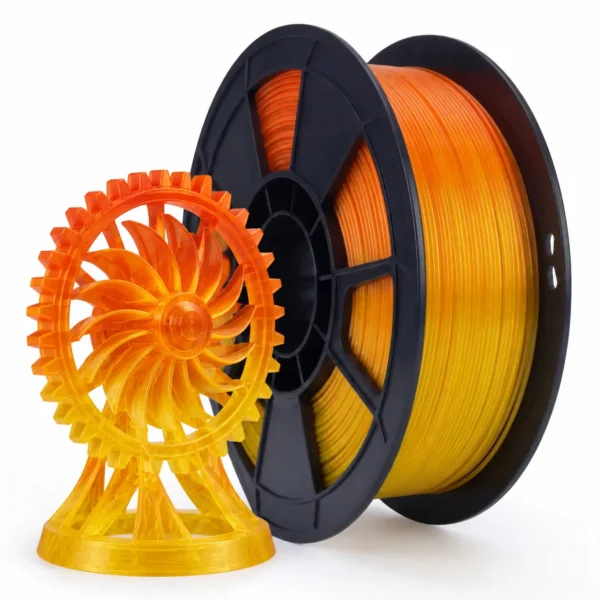



PETG Translucent Series | Orange → Yellow Gradient | OEM / ODM Support
SSSray Orange-to-Yellow Gradient Translucent PETG Filament 1.75mm – Yarı Saydam PETG Filament for Decorative Models
Translucent gradient PETG for distributors, 3D printing stores, private-label brands, creative product lines, and OEM/ODM buyers.
Built around an orange-to-golden-yellow color transition, this PETG is intended for decorative models that benefit from visible light transmission, layered color depth, and a smooth semi-gloss finish while retaining practical PETG printability for repeat B2B supply.
MaterialPETG
SeriesPETG Translucent
Color EffectOrange → Golden Yellow
Diameter1.75mm
Tolerance±0.03mm
Net Weight1kg
Gross Weight1.3kg
Nozzle Temp235–250°C
Bed Temp70–80°C
Print Speed50–150 mm/s
PackagingVacuum + Desiccant
Spool TypePlastic Spool
MOQ: Neutral packaging from 50 spools; OEM packaging typically 500–1,000 spools.
Lead Time: Standard 7–15 days; customized orders typically 15–25 days.
Product Overview
SSSray Orange-to-Yellow Gradient Translucent PETG Filament 1.75mm is made for decorative FDM/FFF prints where color transition and light transmission need to remain visible in the finished model. The filament shifts from saturated orange into golden yellow across the spool, producing layered warm-tone gradients in larger or taller prints. Its translucent body and smooth semi-gloss surface are especially effective on shells, vases, nautilus forms, kinetic display pieces, lampshade-style prototypes, ornaments, and retail demonstration models. Wall thickness, infill, layer height, and cooling directly influence how much light passes through the print, so buyers can position the same material for brighter translucent shells or deeper, more saturated decorative surfaces.
For distributors and private-label buyers, the value is not simply “another PETG color.” The SKU combines a recognizable orange-to-yellow visual identity with ±0.03mm diameter tolerance, vacuum sealing with desiccant, standard 1kg retail format, 50-spool neutral-packaging MOQ, and OEM packaging support for repeat wholesale programs. Sample qualification can be used to confirm the gradient sequence, printing profile, packaging, and finished-model appearance before volume purchasing.
Why This Product Stands Out
We supply this grade as a controlled warm-gradient option between single-color translucent PETG and random rainbow-style multicolor filament. The orange-to-golden-yellow transition gives your product line a controlled warm two-tone story, while the PETG base supports low-warp printing, dependable layer bonding, and glossy-to-semi-gloss surfaces when temperature, cooling, and moisture are managed correctly. It gives distributors a specialty SKU with a clearly visible effect without moving into silk PLA or opaque multicolor products.
Key Selling Points
Stable Diameter Control
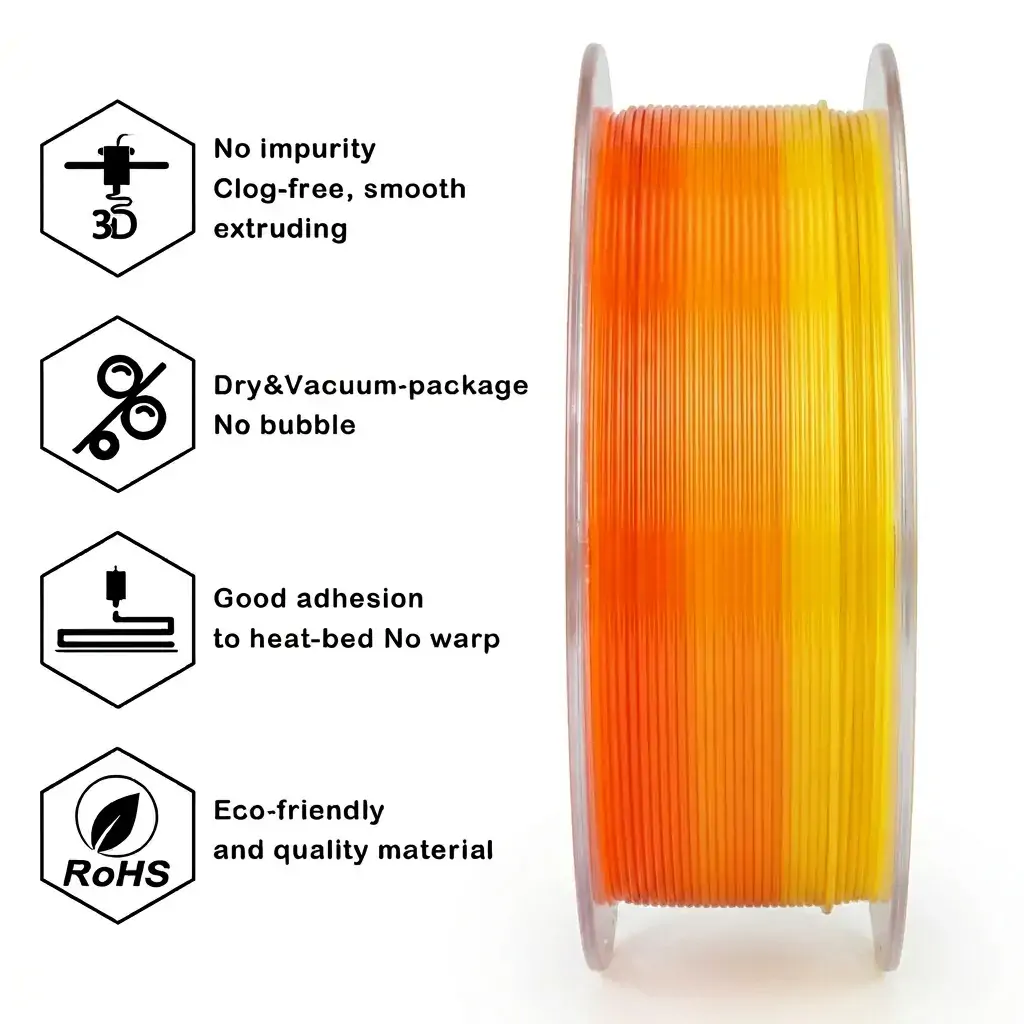
±0.03mm tolerance supports consistent feeding across standard 1.75mm FDM/FFF production runs.
Smooth Extrusion
For routine production, start at 235–250°C and tune flow from there for decorative models and repeatable surface quality.
Warm Gradient Translucency
Orange-to-golden-yellow color change remains visible while the printed walls transmit light.
Retail-Friendly SKU
Standard 1kg format fits mainstream retail, distributor, and private-label filament programs.
Export-Oriented Supply
Suitable for distributors, importers, wholesalers, and private-label buyers.
OEM / ODM Ready
Supports custom labels, packaging, and private-label development.
Key Features
| Feature | Practical Buyer Benefit |
|---|---|
| Orange → Golden Yellow Gradient | Creates a controlled warm-tone transition instead of a random rainbow sequence |
| 1.75mm Standard Diameter | Fits mainstream open-material FDM/FFF printer ecosystems |
| ±0.03mm Tolerance | Supports stable feeding and repeatable extrusion in routine printing |
| Translucent Semi-Gloss PETG | Allows printed walls to transmit light while retaining visible layer-defined color depth |
| Vacuum Sealed with Desiccant | Reduces moisture exposure during storage and international transport |
| OEM / ODM Support | Supports private-label boxes, labels, spool options, and market-specific packaging programs |
Balanced Quality and Cost Efficiency
For distributors, gradient translucent PETG gives end customers a more visible reason to choose the SKU than another single solid color. You can merchandise it around decorative light transmission, warm two-tone transitions, display models, and specialty retail projects while keeping a familiar PETG printing workflow. Start with a 50-spool neutral order, validate demand with samples, then move to custom labels or branded boxes when the program scales.
Why Choose This Product
- PETG printing behavior suited to mainstream open-material FDM/FFF systems
- Smooth semi-gloss surface that supports visible light transmission
- Low warping tendency when bed temperature and first-layer conditions are correctly set
- Orange-to-yellow gradient designed for decorative, display, lighting-style, and general models
- 1kg standard spool format for wholesale and retail programs
- 50-spool neutral MOQ supports distributor testing and smaller B2B launches
- Private-label packaging, custom labels, and OEM program support available
How We Work
1
Requirement Review
2
Specification Confirmation
3
Sample Evaluation
4
Packaging Discussion
5
Production Arrangement
6
Inspection & Shipment
Material Comparison Guide
| Material / Series | Optical Behavior | Color Behavior | Typical Printing Condition | Typical Use |
|---|---|---|---|---|
| Gradient Translucent PETG | Light-transmitting, semi-gloss | Orange → golden yellow transition | Heated bed; moderate cooling; moisture control | Decorative models, illuminated shells, display parts |
| Single-Color Translucent PETG | Light-transmitting | One consistent translucent color | Heated bed; moderate cooling | Lighting covers, colored prototypes, decorative parts |
| Clear / Crystal PETG | Highest clarity potential within PETG-style visual applications | Clear or lightly tinted | Slower outer walls and controlled cooling improve clarity | Vases, covers, display prototypes |
| Opaque PETG | Low light transmission | Solid single color | Standard PETG profile | Functional parts, housings, general-purpose prints |
| Silk / Rainbow PLA | Reflective surface rather than PETG translucency | Silk sheen or multicolor transition | Lower nozzle and bed temperatures than PETG | Figurines, ornaments, visual display models |
Technical Specifications
| Product Name | SSSray Orange-to-Yellow Gradient Translucent PETG Filament 1.75mm – Yarı Saydam PETG Filament for Decorative Models |
|---|---|
| Material | PETG (Glycol-Modified Polyethylene Terephthalate) – FDM/FFF filament |
| Series | SSSray PETG Translucent Series – Color-Gradient Decorative Printing |
| Color / Effect | Translucent Orange → Golden Yellow gradient with smooth semi-gloss appearance |
| Filament Diameter | 1.75mm standard; 2.85mm available on request |
| Tolerance | ±0.03mm |
| Net Weight | 1kg; 3kg and 5kg formats available on request |
| Gross Weight | 1.3kg for standard 1kg retail unit |
| Spool Type | Plastic spool |
| Packaging | Vacuum sealed with desiccant |
| Printer Compatibility | Most 1.75mm open-material FDM/FFF printers, including Bambu Lab, Prusa, Creality, Anycubic, Elegoo, and Flashforge platforms |
| Typical Applications | Decorative models, translucent shells, kinetic display parts, vases, ornaments, lighting-style prototypes, educational display models |
| Trade Terms | FOB Ningbo / EXW |
| Lead Time | Standard 7–15 days; custom programs 15–25 days |
| MOQ | Neutral packaging from 50 spools; OEM packaging typically 500–1,000 spools |
| OEM / ODM | Custom labels, branded boxes, color programs, and project-based spool/packaging options |
Recommended Print Settings
| Parameter | Recommended Guidance |
|---|---|
| Recommended Nozzle Temperature | 235–250°C |
| Usable Nozzle Range | 220–260°C |
| Recommended Bed Temperature | 70–80°C |
| Usable Bed Range | 60–90°C depending on build surface and part size |
| Recommended Print Speed | 50–150 mm/s for routine printing and decorative translucent models |
| Usable Speed Range | 40–250 mm/s after flow, temperature, and extrusion-volume calibration |
| Retraction | Direct Drive 0.8–1.5mm / Bowden 3–5mm as starting ranges |
| Layer Height | 0.12–0.28mm; 0.20–0.28mm emphasizes light transmission and color depth |
| Cooling Fan | 20–50% after the first layers; increase for bridges and small details as needed |
| Wall Count | 2–4 perimeters; 2–3 walls for many decorative translucent shells |
| Infill | 0–15% light-transmitting decorative shells / 15–25% general / 35–50% higher-demand prototypes |
| First Layer Speed | 15–25 mm/s |
| Bed Adhesion | Textured or satin PEI preferred; use a release layer on smooth PEI or glass when adhesion is excessive |
| Drying Guidance | 60–65°C for 8 hours when moisture symptoms appear; reseal with desiccant after use |
Print Optimization Guide
| Item | Guidance |
|---|---|
| Gradient Visibility | Use larger or taller models when you want more of the orange-to-yellow transition to appear in one finished part. |
| Translucency Focus | Use clean dry filament, consistent extrusion, moderate outer-wall speed, and fewer internal structures where light transmission matters. |
| Surface Quality Focus | Run outer walls around 40–70 mm/s and keep cooling moderate to maintain a smooth semi-gloss PETG surface. |
| Stringing Control | Dry the filament first, then tune retraction and reduce nozzle temperature in small steps if fine strings remain. |
| Bed Release | PETG can bond aggressively to smooth surfaces; use a suitable release layer and allow the plate to cool before removal. |
| Color Consistency | For repeat B2B programs, confirm the target gradient sequence and retained sample before bulk production. |
| Lighting-Style Models | Thin shells and controlled wall counts transmit more light; thicker walls produce deeper orange/yellow saturation. |
0.4mm Nozzle Starting Profiles by Printer Brand
| Printer Brand | Nozzle | Bed | Starting Print Speed | Notes |
|---|---|---|---|---|
| Bambu Lab | 240–250°C | 65–75°C | 60–150 mm/s | Use 40–70 mm/s outer walls when surface clarity and gradient presentation are the priority. |
| Prusa | 240–250°C | 75–85°C | 50–120 mm/s | Satin or textured PEI is a practical starting surface; keep outer walls slower for a smoother translucent finish. |
| Creality | 235–250°C | 70–80°C | 50–150 mm/s | Direct-drive machines can start near 1mm retraction; increase throughput after flow and temperature calibration. |
| Flashforge | 240–250°C | 70–80°C | 60–150 mm/s | Keep cooling moderate and tune flow before pushing higher speed to preserve translucent surface continuity. |
| Anycubic / Elegoo | 235–250°C | 70–80°C | 50–150 mm/s | Calibrate first layer and flow first, then raise speed while keeping outer-wall quality under review. |
These are SSSray 0.4mm-nozzle starting profiles for this translucent gradient PETG. Use 50–150 mm/s for routine setup, keep outer walls around 40–70 mm/s when optical finish is the priority, and qualify higher throughput after flow calibration.
Performance Characteristics
| Characteristic | Production Reference | Practical Note |
|---|---|---|
| Diameter Control | ±0.03mm | Supports consistent feeding across standard 1.75mm FDM/FFF systems. |
| Optical Appearance | Translucent, smooth semi-gloss | Printed walls transmit light; clarity changes with wall thickness, layer structure, and infill. |
| Color Transition | Orange → golden yellow | Larger models reveal more of the gradient sequence than small single-color sections. |
| Warping Behavior | Low tendency under a stable heated-bed setup | Use 70–80°C as the normal starting bed range and control first-layer adhesion. |
| Moisture Sensitivity | PETG requires dry storage | Moisture can increase stringing, popping, bubbles, and rough surface texture. |
| Retail Supply Format | 1kg plastic spool, vacuum + desiccant | Suitable for wholesale, e-commerce, and private-label product lines. |
Applications
| Application Focus | Practical Notes |
|---|---|
| Decorative Models & Sculptural Prints | Warm gradient color becomes a visible design feature on curved, organic, and tall geometries. |
| Translucent Vases & Shells | Use controlled wall thickness and limited infill to preserve light transmission. |
| Kinetic & Display Models | Gear, spinner, and showcase parts benefit from glossy edges and changing orange/yellow color zones. |
| Lighting-Style Prototypes | Suitable for decorative covers, shades, and visual mock-ups where warm gradient color and light diffusion are the design focus. |
| Retail Demonstration Prints | Useful for sample walls, swatches, display pieces, and finished models that show the gradient clearly to end buyers. |
| Educational & Creative Projects | PETG durability and visible translucency make it useful for demonstration models and design exercises. |
Storage Guide
- Store sealed in a cool, dry place away from heat sources
- Reseal the spool with fresh desiccant immediately after use
- Keep the filament away from direct sunlight during storage
- Use a dry box or sealed container for long print jobs in humid conditions
- If stringing, popping, bubbles, or a rough surface appear, dry at 60–65°C for 8 hours before retuning print settings
OEM / ODM Services
We support OEM / ODM programs for distributors, 3D printing stores, private-label brands, importers, and sourcing teams. Available options include neutral packaging, custom labels, branded boxes, custom color matching, selected spool formats, barcode/market labeling, and project-based product-line development. Buyers can qualify the grade through our Filament Qualification Program, sample program, and bulk-order test protocol before scaling volume.
MOQ Reference: Neutral packaging from 50 spools; OEM packaging typically 500–1,000 spools.
Quality Control
- Inline laser monitoring controls the finished filament to our standard ±0.03mm diameter specification, with PETG/PCTG ovality controlled to ≤0.020mm.
- Post-drying PETG/PCTG moisture is checked by Karl Fischer testing against a ≤0.025 wt% batch release limit before moisture-protection packing.
- Spectrophotometer color checks compare production lots against the approved master color, with PETG/PCTG color control targeted at ΔE < 1.0.
- Sampled spools are print-verified for feeding, extrusion stability, surface appearance, and the orange-to-yellow gradient presentation before bulk release.
- Batch identification, spool traceability, and COA/QC records support repeat-order review and purchasing approval.
- Vacuum seal, desiccant, winding condition, label, net weight, carton marks, and OEM packing details are checked before shipment release.
Review our Batch QC Data and Test Protocol to see the controls we use for buyer qualification and repeat-order consistency.
Technical & Compliance Documentation
- Send us your destination market and required document list with the RFQ; our sales team will match the available technical and safety files to the confirmed PETG order.
- TDS / SDS and available material-compliance files can be coordinated with the confirmed grade and production lot.
- RoHS, REACH, SGS, or other third-party test reports can be matched or arranged for bulk and OEM projects according to the required scope.
- Batch ID, COA, packaging, and shipment records support purchasing approval, incoming QC, and repeat-order traceability.
Tell us the destination market and document list at quotation stage so we can prepare the required file set together with the order.
Frequently Asked Questions
What is the MOQ for this gradient translucent PETG?
Neutral packaging starts from 50 spools. OEM or private-label packaging is typically 500–1,000 spools depending on the box, label, color, and spool customization scope.
How does the orange-to-yellow gradient appear in a finished print?
The filament transitions from orange into golden yellow along the spool. Larger or taller models normally reveal more of the transition, while small parts can show only one section of the gradient.
Is this the same as clear or crystal PETG?
No. This SKU is intentionally translucent and color-gradient rather than water-clear. It is designed to transmit light while keeping visible orange and yellow color depth.
What settings should I start with?
Start around 235–250°C nozzle, 70–80°C bed, 50–150 mm/s print speed, and moderate cooling. For stronger translucency, keep outer walls around 40–70 mm/s and reduce internal structures that interrupt light transmission.
How should I control PETG stringing?
Dry the filament first, then tune retraction and nozzle temperature. Moist PETG can string, pop, bubble, and leave a rough surface even when the slicer profile is otherwise correct.
Can SSSray supply OEM or private-label packaging?
Yes. We support custom labels, branded boxes, barcode and market labeling, selected spool options, and project-based OEM/ODM programs for qualified B2B buyers.
Can I request samples before a bulk order?
Yes. Qualified B2B buyers can request up to 3 free full-size 1kg sample spools. Standard sample preparation is typically 3–5 working days, giving your team time to check color, gradient behavior, packaging, feeding, and print performance before volume purchasing.
What documents can be supplied with the order?
We match the documentation package to the confirmed PETG grade and destination requirement. TDS/SDS and material-compliance reports are supplied when matching documents are available for the selected SKU; third-party testing can also be arranged for bulk or OEM projects.
Build a Distinctive Translucent PETG Line with SSSray
Tell us your target market, monthly volume, packaging plan, and color requirements. Qualified B2B projects can request up to 3 free full-size 1kg sample spools before moving into 50-spool neutral orders or OEM/private-label programs for this orange-to-yellow translucent PETG series.


Related products
-

SSSray Smoke Gray Transparent PETG 1.75mm 3D Printer Filament – 반투명 회색 PETG 필라멘트 for Functional Prototypes & Design Parts
-
SSSray Gold Sparkle PETG Filament 1.75mm – altın simli PETG filament for Detailed Decorative 3D Printing
-
SSSray Amethyst Purple Transparent PETG Filament 1.75mm – transparant paars PETG-filament for Detailed & Decorative 3D Printing
-
SSSray Coral–Peach–Aqua Multicolor PETG 1.75mm Gradient 3D Printer Filament – Filamento PETG Degradê for Decorative Display Models