Online time
Monday to Friday: 9AM - 8PM
Weekend: 10AM - 5PM



SSSray PPS-GF Engineering Composite Series | Wholesale & OEM / ODM
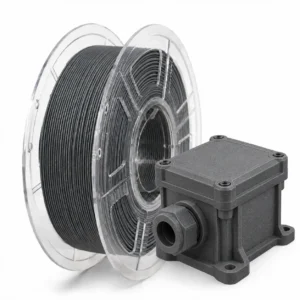
PPS-GF Light Stone Gray 3D Printing Filament by SSSray – filamento PPS reforzado con fibra de vidrio for Equipment Housings & Angle Brackets
High-temperature glass-fiber-reinforced PPS filament for industrial housings, gusseted brackets, mounting bases, electrical enclosures, and qualified end-use parts.
Built for industrial buyers who need the heat resistance, chemical resistance, rigidity, dimensional stability, and electrical insulation advantages of PPS-GF in a distinctive Light Stone Gray finish. The controlled 1.75mm format, vacuum-sealed supply, industrial packaging options, and OEM / ODM support make this SKU ready for distributor and engineering-material programs.
MaterialPPS-GF
SeriesSSSray PPS-GF Engineering Composite Series
Color EffectLight Stone Gray Matte
Diameter1.75mm
Tolerance±0.03mm
Net Weight1kg
Gross Weight1.3kg
Nozzle Temp310–350°C
Bed Temp80–90°C
Print Speed60–150 mm/s
PackagingVacuum + Desiccant
Spool TypePlastic Spool
MOQ: Neutral packaging from 50 rolls; OEM packaging typically 500–1,000 rolls.
Lead Time: Standard 7–15 working days; customized orders typically 15–25 working days.
Product Overview
PPS-GF Light Stone Gray 3D Printing Filament is a glass-fiber-reinforced polyphenylene sulfide engineering composite developed for demanding FDM / FFF applications where heat resistance, chemical resistance, rigidity, dimensional stability, and electrical insulation are part of the material selection. The Light Stone Gray tone is deliberately pale and cool-neutral—closer to concrete or natural stone than metallic silver. On the spool it presents a soft matte surface without reflective sheen bands; printed parts retain a fine fiber-flecked texture that makes ribs, threaded ports, bolt bosses, and gusset geometry visually clean and easy to inspect.
This SKU is built around equipment housings, electrical enclosures, cable-gland bodies, machine mounting bases, fixtures, and gusseted brackets rather than general decorative printing. SSSray supplies the material in a standard 1.75mm format with ±0.03mm diameter specification, 1kg net weight, vacuum-sealed packaging with desiccant, and B2B support for bulk orders, qualification samples, private labels, and OEM / ODM programs.
Key Selling Points
Controlled 1.75mm Feed
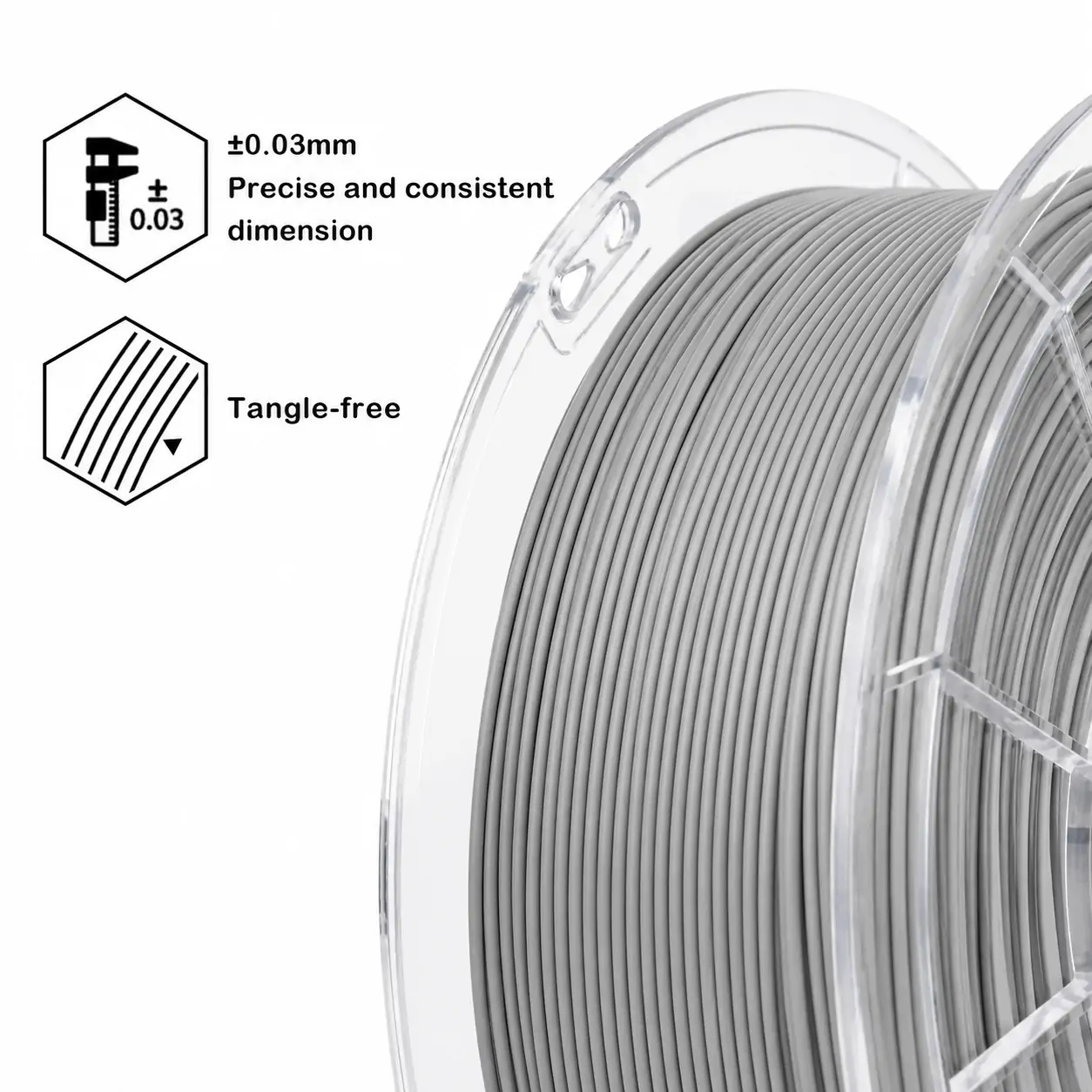
±0.03mm diameter specification supports consistent material feeding and repeatable high-temperature profile tuning.
High-Temperature PPS Platform
Designed for 310–350°C extrusion systems used to produce heat- and chemical-resistant engineering components.
Light Stone Gray Inspection Contrast
Pale matte gray makes ribs, bosses, threaded ports, fastener seats, and bracket geometry easy to inspect.
Electrical Insulation
Non-conductive glass-fiber reinforcement makes PPS-GF attractive for housings and components where CF conductivity is undesirable.
Housing & Bracket Focus
Well matched to equipment enclosures, cable-gland housings, mounting bases, jigs, fixtures, and gusseted brackets.
B2B & OEM Supply
Supports bulk purchasing, private labels, industrial packaging, custom project development, and qualification samples.
Key Features
| Feature | Practical Buyer Benefit |
|---|---|
| Glass-Fiber-Reinforced PPS Matrix | Provides a rigid engineering-material platform for dimensionally demanding housings, mounts, and brackets |
| High-Temperature Material Platform | Extends material selection beyond common PLA, PETG, ABS, and standard nylon programs |
| Electrical Insulation-Oriented GF Reinforcement | Useful for electrical housings and components where conductive carbon-fiber reinforcement is not preferred |
| Light Stone Gray Matte Appearance | Creates a differentiated industrial SKU with clear visual definition around ribs, threads, bosses, and assembly details |
| 1.75mm / ±0.03mm Specification | Provides a standardized feed format for qualified high-temperature FDM / FFF equipment |
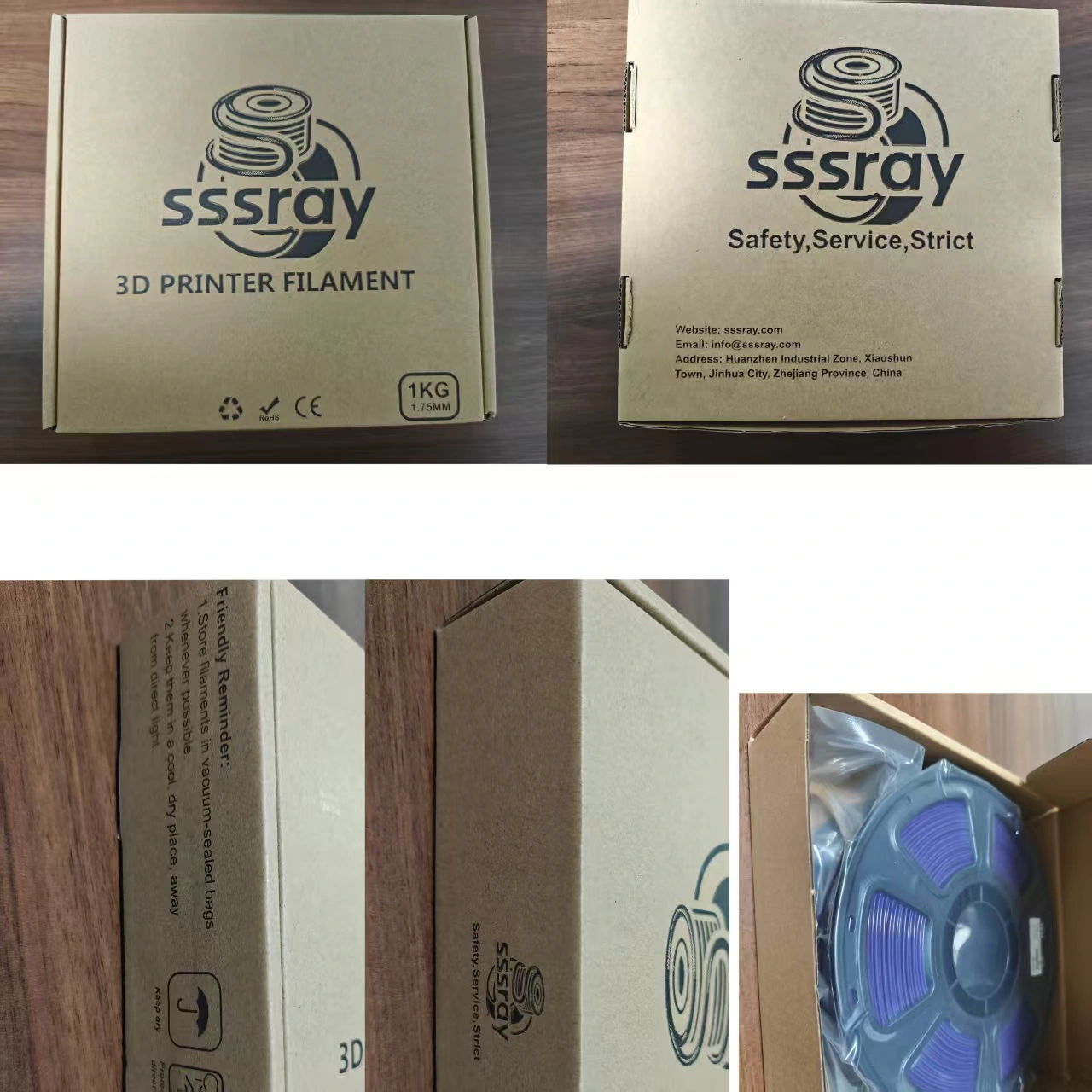
| Vacuum Sealed with Desiccant | Protects the filament during export, warehousing, and pre-production storage |
| OEM / ODM Support | Supports private-label engineering-filament programs with custom labels, cartons, and project-specific presentation |
B2B Supply Value for Distributors & OEM Programs
For distributors, industrial importers, and private-label programs, SSSray positions Light Stone Gray PPS-GF as a distinct engineering-composite SKU alongside PPS-CF, PA-CF, and PC-GF. We support qualification samples, neutral or OEM packaging, repeat-order batch identification, and project-specific labeling so buyers can move from material evaluation to stable bulk supply within one sourcing program.
How We Work
1
Application & Part Review
2
Material / Printer Confirmation
3
Sample Qualification
4
OEM / Packaging Confirmation
5
Batch Production
6
QC Record & Shipment
Material Comparison Guide
| Material | Reinforcement / Electrical Behavior | Moisture Behavior | Typical Print Conditions | Typical Use |
|---|---|---|---|---|
| PPS-GF | Non-conductive glass-fiber reinforcement; suited to insulation-oriented applications where CF conductivity is undesirable | Low moisture sensitivity compared with many nylon composites; dry handling supports cleaner high-temperature extrusion | 310–350°C-class hotend, wear-resistant nozzle, heated bed, cooling fan normally off | Equipment housings, electrical enclosures, brackets, fixtures, mounting bases |
| PPS-CF | Carbon-fiber reinforcement with a darker technical appearance and different electrical behavior | Low moisture sensitivity compared with many PA-based composites | High-temperature hotend, wear-resistant nozzle, controlled filament path | Rigid structural parts, tooling, heat- and chemical-exposed components |
| PA-CF | Carbon-fiber-reinforced nylon | More moisture-sensitive; controlled drying and dry feeding are important | High-temperature nozzle, wear-resistant nozzle; bed and chamber depend on PA grade | Functional brackets, fixtures, lightweight structural components |
| PC-GF | Glass-fiber-reinforced polycarbonate | Drying and moisture control required before demanding prints | High nozzle / bed temperature with enclosed printing environment | Rigid housings, jigs, fixtures, mechanical components |
For broader sourcing programs, explore our wholesale glass fiber reinforced filament, custom engineering 3D printing filament, and batch QC data.
Technical Specifications
| Product Name | PPS-GF Light Stone Gray 3D Printing Filament by SSSray – filamento PPS reforzado con fibra de vidrio for Equipment Housings & Angle Brackets |
|---|---|
| Material | Polyphenylene Sulfide (PPS) reinforced with glass fiber |
| Series | SSSray PPS-GF Engineering Composite Series |
| Color / Effect | Light Stone Gray; pale cool-neutral concrete / stone tone, soft matte, non-metallic, with fine glass-fiber flecks |
| Filament Diameter | 1.75mm standard; 2.85mm available on request |
| Tolerance | ±0.03mm |
| Net Weight | 1kg; larger 3kg / 5kg formats available for project orders |
| Gross Weight | 1.3kg |
| Spool Type | Plastic spool |
| Packaging | Vacuum sealed with desiccant |
| Printer Compatibility | Qualified 1.75mm high-temperature FDM / FFF systems with 310°C+ hotend capability and wear-resistant nozzle; suitable platforms include Bambu Lab H2D, Creality K2 Plus, QIDI Plus5, and Prusa CORE One L+ with HT Hotend |
| Typical Applications | Equipment housings, electrical enclosures, threaded cable-gland ports, gusseted angle brackets, machine mounting bases, jigs, fixtures, and industrial functional components |
| OEM / ODM | Private label, branded cartons, custom labels, Light Stone Gray programs, high-temperature custom color feasibility review, spool presentation, and project-specific packaging |
| Technical Documents | PPS-GF TDS and SDS / MSDS available; additional compliance and project documents supplied according to the ordered SKU and customer requirement |
Recommended Print Settings
| Parameter | Recommended Guidance |
|---|---|
| Recommended Nozzle Temperature | 320–340°C |
| Usable Nozzle Range | 310–350°C |
| Recommended Bed Temperature | 85–90°C |
| Usable Bed Range | 80–100°C depending on build surface, part footprint, and first-layer setup |
| Recommended Print Speed | 60–150 mm/s |
| High-Speed Capability | Up to 250 mm/s on qualified high-flow systems after extrusion-flow and layer-bonding validation |
| Layer Height | 0.15–0.30mm; 0.20mm is a practical production starting point |
| Cooling Fan | 0% for normal printing; limited bridge cooling only when required by geometry |
| Retraction | Direct Drive: 1–3mm at 20–40 mm/s. For Bowden systems, keep retraction as short as stable extrusion allows and tune around the printer’s high-temperature composite profile |
| Wall Count | 3–5 perimeters for functional housings, bosses, and brackets |
| Infill | 20–30% for housings / 40–60% for more highly loaded bracket and fixture geometries |
| First Layer Speed | 15–25 mm/s |
| Bed Adhesion | Clean PEI or suitable high-temperature build surface; use a compatible adhesive / release layer where required |
| Nozzle | Wear-resistant hardened steel or equivalent nozzle. 0.6mm is preferred for higher process margin; 0.4mm+ can be used with controlled fiber-filled profiles |
| Drying | 100°C for 10 hours after extended moisture exposure or when moisture-related print defects appear; keep opened material dry between production runs |
Print Optimization Guide
| Item | Guidance |
|---|---|
| Filament Path | Keep the path smooth with wide-radius bends. Fiber-filled PPS is stiff, and reducing sharp tube bends improves feeding reliability during long jobs. |
| Nozzle Selection | Use a wear-resistant nozzle. A 0.6mm nozzle gives additional flow margin for repeated PPS-GF production, while 0.4mm+ setups remain workable with a correctly tuned profile. |
| Moisture Control | Keep opened material sealed or dry-fed during qualification and production. Dry filament gives cleaner extrusion and more consistent surface quality at PPS processing temperatures. |
| Chamber Strategy | An enclosed machine is preferred for large housings and long bracket geometries. Active chamber heating can further stabilize the thermal environment on suitable printers. |
| First-Layer Control | Use a slow first layer, a clean build surface, and a brim where required for wide mounting bases or long gusseted geometry. |
| Post-Print Heat Treatment | Annealing can further develop PPS crystallinity, dimensional stability, and thermal performance. For production programs, request the annealing schedule matched to the supplied material before locking the final process. |
Printer Brand Starting Settings
| Printer / Configuration | Nozzle | Bed | Speed | Production Starting Point |
|---|---|---|---|---|
| Bambu Lab H2D | 320–340°C | 85–90°C | 70–150 mm/s | 350°C all-metal hotend, hardened-steel extrusion hardware, 120°C bed and active chamber heating provide a suitable PPS-GF qualification platform |
| Prusa CORE One L+ + HT Hotend | 320–340°C | 85–90°C | 60–130 mm/s | Use the 400°C HT Hotend and the high-temperature-material idler configuration specified for PPS-GF |
| Creality K2 Plus | 320–340°C | 85–90°C | 60–130 mm/s | 350°C all-metal hotend, steel-tipped nozzle, 120°C bed and heated chamber provide suitable hardware for PPS-GF process qualification |
| QIDI Plus5 | 320–340°C | 85–90°C | 70–150 mm/s | 370°C hotend, 120°C bed, 65°C active chamber and support for glass-fiber-reinforced polymers make it a strong PPS-GF starting platform |
Start with these values, then lock the production profile after checking extrusion flow, first-layer adhesion, dimensional accuracy, and layer bonding on the actual machine and part geometry.
Performance Characteristics
| Characteristic | Material Behavior | Production Value |
|---|---|---|
| Glass-Fiber Reinforcement | Raises rigidity and improves dimensional control compared with unfilled PPS | Useful for housings, brackets, mounting bases, fixtures, and ribbed structural geometry where part stiffness matters |
| High-Temperature PPS Matrix | Semi-crystalline PPS retains mechanical capability far beyond common commodity filaments | Targets hot equipment housings, under-hood-style components, tooling, machine parts, and other elevated-temperature environments |
| Chemical Resistance | PPS material systems are widely used for resistance to fuels, oils, solvents, acids, bases, and industrial chemicals | Suitable for industrial fixtures, machine components, fluid-adjacent housings, and chemically exposed functional parts after application qualification |
| Electrical Insulation | PPS combined with non-conductive glass-fiber reinforcement retains an insulation-oriented material profile without introducing conductive carbon fiber | Strong fit for electrical housings, sensor enclosures, equipment covers, and components where CF conductivity is undesirable |
| Moisture Behavior | Lower moisture sensitivity than many PA-based engineering composites | Simplifies storage and production handling while dry filament still delivers the cleanest high-temperature extrusion |
| Light Stone Gray Surface | Fine fiber-flecked matte texture with no metallic sheen | Provides clean visual definition around bosses, ribs, threaded ports, fastener interfaces, and gusset edges |
Applications
| Application Focus | Practical Notes |
|---|---|
| Equipment Housings & Enclosures | Well suited to rigid shells, stiffening ribs, bolt bosses, cable-gland ports, covers, and high-temperature equipment enclosures |
| Gusseted Angle Brackets | Glass-fiber reinforcement supports rigid bracket geometry, mounting interfaces, and load-bearing gussets where dimensional control matters |
| Machine Mounting Bases | Suitable for equipment mounts, fixture bases, sensor brackets, and machine-interface components after load qualification |
| Electrical & Electronics Housings | Non-conductive glass-fiber reinforcement makes PPS-GF attractive for insulation-oriented housings where carbon-fiber conductivity is undesirable |
| Jigs, Fixtures & Industrial Tooling | Useful for production aids exposed to elevated temperatures, oils, cleaners, chemicals, and demanding factory environments |
Storage Guide
- Keep unopened spools vacuum sealed with desiccant until qualification or production use
- After opening, store in a dry box or sealed container to maintain stable high-temperature extrusion
- Dry at 100°C for 10 hours after extended moisture exposure or when moisture-related surface defects appear
- Avoid tight guide-tube bends and sharp filament-path turns because fiber-filled PPS is relatively stiff
- Keep the filament away from dust, oil, moisture, and direct heat contamination before printing
OEM / ODM Services
SSSray supplies PPS-GF programs for engineering-material distributors, industrial importers, technical resellers, private-label brands, and OEM sourcing teams. Available services include neutral packaging, custom labels, branded cartons, barcode / SKU systems, spool presentation, and coordinated engineering-material product lines.
Light Stone Gray is positioned as a controlled industrial shade rather than a generic decorative color. Custom high-temperature color matching is available for qualified OEM projects after pigment compatibility, thermal stability, order volume, and target-color requirements are reviewed.
MOQ Reference: Neutral packaging from 50 rolls; OEM packaging typically 500–1,000 rolls.
Quality Control
- Incoming material and production-lot identification for traceable PPS-GF batches
- Diameter sampling against the confirmed 1.75mm ±0.03mm specification
- Winding tension, spool condition, and filament-path inspection
- High-temperature extrusion and sample-print verification within the production process window
- Vacuum seal, desiccant, label, carton, and shipping-package inspection
- Batch number and QC record retention for qualified B2B orders and repeat-order comparison
Compliance & Technical Documentation
SSSray maintains PPS-GF technical documentation for B2B qualification and purchasing. TDS and SDS / MSDS are available for the PPS-GF material line, and batch QC records can be coordinated for qualified orders.
For projects requiring RoHS, REACH, SGS, or other third-party documentation, send the required document list with the inquiry. Our sales team will match the applicable documents to the ordered SKU and project before production.
Frequently Asked Questions
What is the MOQ for PPS-GF Light Stone Gray?
Neutral packaging starts from 50 rolls. OEM / private-label packaging is typically 500–1,000 rolls depending on label, carton, spool, and customization requirements.
What printer hardware is required for this PPS-GF filament?
Use a 1.75mm high-temperature FDM / FFF printer with at least 310°C hotend capability and a wear-resistant nozzle. Suitable platforms include Bambu Lab H2D, Creality K2 Plus, QIDI Plus5, and Prusa CORE One L+ equipped with the HT Hotend.
How fast can PPS-GF Light Stone Gray be printed?
For production-oriented starting profiles, use 60–150 mm/s. Qualified high-flow printers can extend toward 250 mm/s after extrusion flow, dimensional accuracy, and layer bonding have been checked on the actual part.
What nozzle should I use?
Use a wear-resistant hardened-steel or equivalent nozzle because glass-fiber reinforcement is abrasive. A 0.6mm nozzle gives additional process margin for repeated production, while 0.4mm+ setups can also be used with a properly tuned profile.
Does PPS-GF need drying before printing?
Keep opened filament dry during storage and production. After extended moisture exposure or when moisture-related extrusion defects appear, 100°C for 10 hours is a practical drying cycle using suitable drying equipment.
Why use PPS-GF instead of PPS-CF for electrical housings?
Glass fiber provides reinforcement without introducing conductive carbon fiber. This makes PPS-GF attractive for electrical housings, equipment covers, sensor enclosures, and insulation-oriented components where CF conductivity is undesirable.
Can SSSray produce custom colors or private-label PPS-GF?
Yes. Light Stone Gray is a standard industrial shade for this program. High-temperature custom color matching, private labels, branded cartons, barcode systems, and custom packaging can be developed for qualified OEM orders.
What technical documents are available?
PPS-GF TDS and SDS / MSDS are available through our technical document center. For projects requiring additional compliance documentation or batch QC records, send the required document list with the inquiry so we can prepare the appropriate project package.
Source PPS-GF for Industrial Housings, Brackets & Electrical Parts
Send us your printer model, part application, service temperature, chemical environment, annual volume, target packaging, and OEM requirements. We can arrange PPS-GF sample qualification, profile guidance, bulk quotation, and private-label production around your project.


Related products
-

SSSray Dark Slate Gray PPS-GF Glass Fiber Composite Filament – filament PPS z włóknem szklanym for Electrical Junction Boxes & Motor Mounts
-
Engineering Grade PA6/66 Carbon Fiber Reinforced 3D Printing Filament 1.75mm 1kg – High Stiffness Wear Resistant Low Warpage for Metal Replacement Parts
-
PPA-CF Carbon Fiber Filament 1.75mm 1kg – Ultra-High Performance Polyphthalamide with Superior Rigidity & Heat Deflection for Functional Prototypes
-
Industrial Shock-Absorbing TPU Filament 1.75mm 1KG | High-Resilience Lattice-Grade Flexible Material for Protective Pads, Vibration Dampers & Robotics Grippers | OEM/ODM Bulk Supply