Online time
Monday to Friday: 9AM - 8PM
Weekend: 10AM - 5PM


TL;DR: Keep Opened PVA at 15% RH or Lower and Count Exposure Hours
PVA filament storage rarely fails because of one humid afternoon. It fails because opened spools quietly collect exposure hours that nobody logs. Published numeric PVA storage limits in the manufacturer guidance reviewed here range from below 15% RH to below 50% RH, so the safe number is the one written for your exact grade.
Best optionA gasketed dry box held at 15% RH or lower, with regenerable desiccant and a hygrometer, feeding the printer directly.
When not to use itFor ABS or ASA, qualify the exact support grade rather than assuming PVA is the default; HIPS may be the simpler route. On open feeders, use PVA only when the exact hardware guidance supports dry PVA and your dry-chain control can hold.
Key specificationLot moisture content with a named test method, the grade’s storage RH limit and its maximum drying temperature.
Verify the supplierAsk for pouch barrier data, desiccant quantity and a humidity indicator card, not just “vacuum sealed.”
Procurement warningAt 20% scrap, $50/kg PVA really costs $62.50 per usable kilogram, before failed prints are counted.
Abstract
Water-soluble support is often the most expensive filament on a multi-material job, and usually the first one to fail. PVA (polyvinyl alcohol) and BVOH (butenediol vinyl alcohol copolymer) are designed to dissolve in water. That is exactly why they pull moisture out of the air.
For distributors, OEM brands and print farms supplying multi-material workflows, PVA is often treated as a regular support SKU rather than an occasional specialty material. That makes storage control part of the product specification, from packing through the printer feeder.
Four assumptions deserve to be challenged during qualification: that “vacuum sealed” means dry, that one humidity number fits every PVA, that wet support is only a printing problem, and that the lowest price per kilogram wins. The manufacturer data compared below shows why each assumption needs a measurable check.
Take a widely shared claim: 30% relative humidity ruins $50/kg PVA in 72 hours. Checked against manufacturer data, it does not hold as a universal rule. UltiMaker measured its PVA rising from 1% to 3% water over four weeks at 55% RH. BCN3D, by contrast, estimated about 12 hours at 60% RH for its grade to reach a print-failure threshold. In other words, exposure tolerance is grade-specific. It has to be verified, not assumed.
The B2B decision logic follows from that. Support filament only creates value if it reaches the nozzle dry. So the purchase specification, the packaging, the warehouse and the printer feeder must work as one dry chain. A cheap spool that arrives wet, or a good spool stored badly, costs more per usable kilogram than a premium spool handled well.
This guide uses five tools to make that decision: a cross-check of storage and drying data published for seven support grades; the chemistry behind moisture uptake, softening, steam and nozzle carbonization; a tiered storage comparison from sealed bags to industrial dry cabinets; a cost-per-usable-kilogram and payback model; and the PVA Dry-Chain Framework, a seven-checkpoint scorecard for qualifying suppliers and reorders.
Key Takeaways
- No universal safe humidity exists. Published numeric PVA storage ceilings in the manufacturer guidance reviewed here run from below 15% RH (Raise3D) to below 50% RH (UltiMaker). Approve against your grade’s own number.
- Design mixed stock for the strictest numeric PVA limit. Holding 15% RH or lower in a sealed container covers the strictest numeric PVA limits identified in the reviewed manufacturer guidance, with 20% RH as the alarm point; open shelves and 25–40% RH lab cabinets do not.
- Time matters as much as humidity. One grade took four weeks at 55% RH to go from 1% to 3% water; another was estimated to fail after about 12 hours at 60% RH.
- Weight is a practical field test. A 1 kg spool at 3% moisture carries about 30 g of water.
- Wet PVA can fail through three mechanisms: softened filament can jam the feed path, water can flash to steam in the hot end, and prolonged idle heat can cook or carbonize residue.
- Drying temperature is grade-specific. UltiMaker specifies about 50 °C, while Bambu Lab specifies 80 °C. Polymaker’s current PolyDissolve S1 product page contains conflicting drying values (55 °C / 6 h in Technical Specifications and 80 °C / 12 h in Printing Tips), so confirm the current product revision before drying.
- BVOH is not automatically easier to store. It dissolves faster, but suppliers contradict each other on its moisture tolerance.
- “Vacuum sealed” is not a barrier specification. Ask for barrier data, desiccant quantity and a humidity indicator card.
- Dry boxes are the practical sweet spot. In our illustrative 10 kg/month model, resealed bags pay back in about a week and dry boxes in about a month while cutting losses further; industrial cabinets need high volume to justify themselves.
- Price per usable kilogram is the real price. At 20% moisture scrap, $50/kg PVA effectively costs $62.50/kg.
1. Is 30% Humidity Really Too Much for PVA Filament Storage?
Direct answer: not on its own. 30% RH sits inside the published storage window for some PVA grades and above the limit for others. What ruins a spool is cumulative moisture beyond its grade’s printability threshold, meaning humidity multiplied by time and temperature, not one universal line.
Build an SOP on the wrong number and you either over-spend on a tolerant grade or quietly lose a sensitive one.
What PVA and BVOH manufacturers actually publish
Table 1 lines up what seven suppliers publish for their own grades. Read it as a range of evidence, not interchangeable settings.
On mobile, swipe horizontally to review every column.
| Grade | Chemistry | Published storage humidity | Published drying | Published moisture data |
|---|---|---|---|---|
| UltiMaker PVA | PVA | Room below 50% RH; 10–30 °C in Factor 4 guidance; S5/S7 Material Station below 40% RH; Factor 4 Material Station below 15% RH | 50 °C for 16 h; do not exceed 55 °C | 1% → 3% water in 4 weeks at 20 °C / 55% RH; above 4% unusable |
| Bambu Lab PVA | PVA | Below 20% RH, sealed with desiccant | 80 °C for 8–12 h | Saturated water absorption 6.25% at 25 °C / 55% RH |
| Polymaker PolyDissolve S1 | PVA | Dry box required; the current public product guidance reviewed does not state a numeric RH ceiling | Current product page conflicts: 55 °C for 6 h in Technical Specifications; 80 °C for 12 h in Printing Tips | “Very hygroscopic”; no uptake curve found in the current public product guidance reviewed |
| Raise3D PVA+ | PVA | Below 15% RH in the dry box before loading | 80 °C for 8–12 h | Wet filament turns soft and sticky |
| BASF Ultrafuse BVOH | BVOH | Original sealed package at 15–25 °C | 60 °C for 4–16 h | Not stated |
| BCN3D BVOH | BVOH | Airtight container with desiccant | 60 °C for 4–16 h | “Highly hygroscopic” |
| Verbatim BVOH | BVOH | Ships vacuum-sealed with desiccant | Not stated | Claims high durability against moisture |
The manufacturer guidance spans roughly 50–60 °C to 80 °C, but Polymaker’s current product page contains conflicting drying values. Storage and drying settings therefore need to be tied to the exact product revision, not copied across brands.
Published humidity ceilings for water-soluble support (lower = stricter)
The published numeric PVA ceilings reviewed here differ by more than threefold. For mixed-brand inventory, SSSray recommends designing opened-spool storage around the strictest numeric limit in the group: 15% RH or lower inside a closed container.
Why the same spool behaves differently in two warehouses
- Temperature changes what “30% RH” means. At 30 °C, 30% RH carries roughly 1.8 times the water vapor of 30% RH at 20 °C.
- The outer wraps get wet first. Moisture diffuses inward like water into a rolled towel, so a job can start well and fail halfway through.
- Formulations differ. UltiMaker says its PVA is formulated to be less moisture-sensitive than other PVA filaments.
Procurement implicationWrite the grade’s storage RH limit and maximum drying temperature into the purchase spec.
Mistake to avoidCopying a forum number (10%, 30% or 50%) into an SOP that covers several brands.
How to verifyTake the storage line from the current TDS, then run one exposure test on your own printer.
2. Why Water-Soluble Support Is Hygroscopic: Moisture Uptake and Weight Gain
Direct answer: PVA and BVOH carry a hydroxyl (–OH) group on most repeat units. The chemistry that lets them dissolve in a water bath also lets them pull vapor from the air. Absorbed water then acts as a plasticizer, so wet PVA turns soft, bendy and tacky rather than simply “damp.”
In dry PVA, hydroxyl groups hydrogen-bond to each other and give the filament its stiffness. Water molecules compete for those bonds, pry the chains apart and lower the glass transition temperature. Researchers describe this as a humidity-driven glass transition: at constant temperature, enough water switches PVA from glassy to rubbery.
Think of a cracker left open on the counter. It doesn’t fall apart; it loses its snap. Likewise, wet PVA still looks like filament, but it no longer pushes like one.
PVA filament degradation timeline: what the data shows
- UltiMaker PVA, 20 °C / 55% RH: 1% → 3% water in four weeks. UltiMaker rates below 1% as best, above 2% as harmful and above 4% as unusable.
- BCN3D PVA, 60% RH: about 12 hours to reach a 0.47% uptake, where test prints failed.
- BCN3D PVA, 70% RH for four days: 1.22% weight gain, the highest of the three materials tested.
- Bambu Lab PVA, 25 °C / 55% RH: 6.25% saturated water absorption.
So is the timeline hours or weeks? Both, depending on grade, starting dryness and the failure definition, so ask for your own grade’s curve.
How much does PVA weight increase with moisture?
Enough to measure. On a 1 kg net spool, 3% moisture is about 30 g of water, and Bambu Lab’s 6.25% saturation figure equals about 62 g. A 0.1 g bench scale sees that change long before a print does.
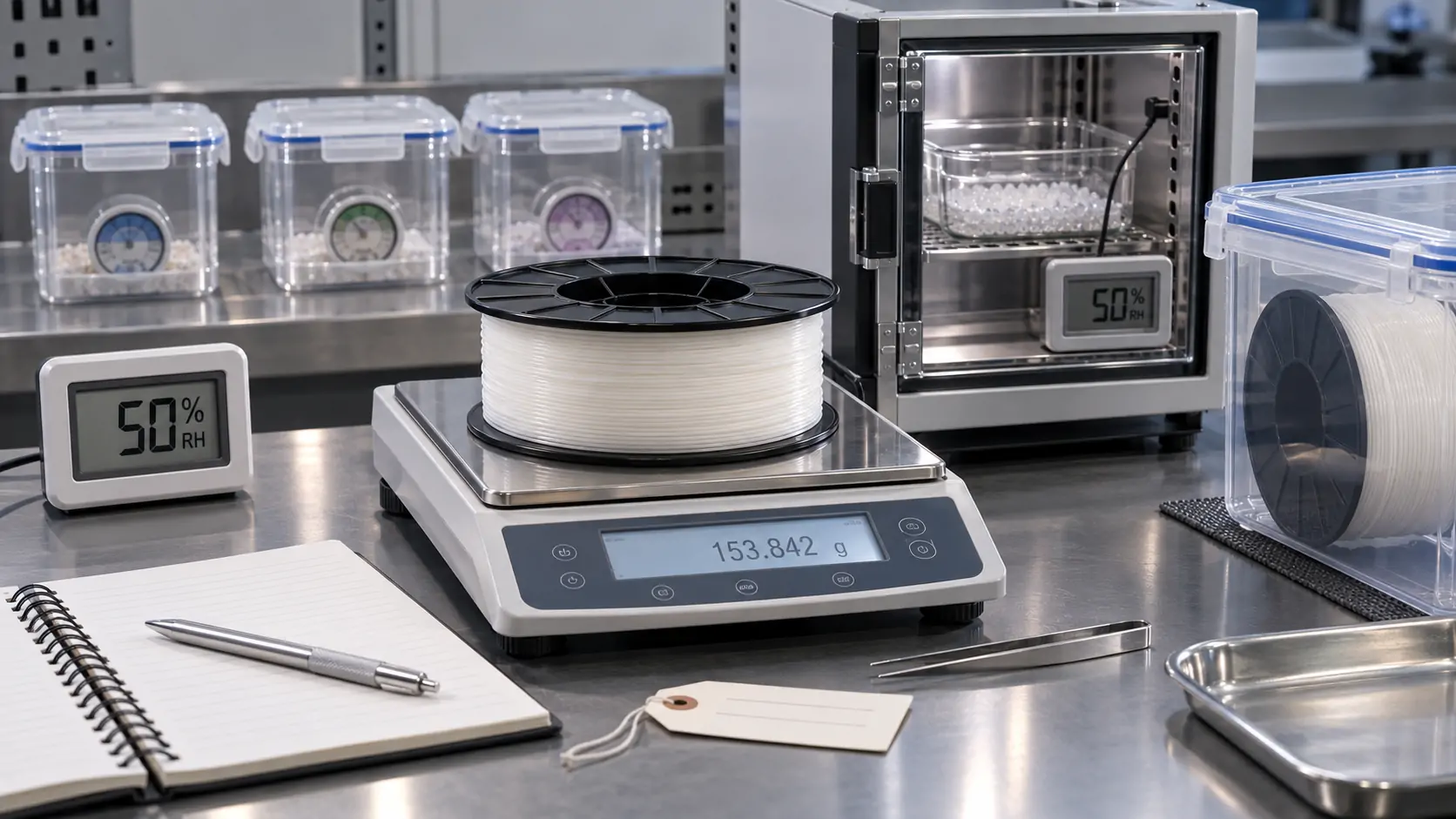
- Weigh each sealed spool on arrival and record the gross weight with its lot number.
- After drying to the supplier’s settings, weigh again. This is the dry reference.
- Before each critical job, compare with the dry reference minus filament used (your slicer reports grams).
- Do not use one cross-brand weight-gain cutoff. Use the exact grade’s validated dry-reference range; if weight rises unexpectedly, confirm with the locked print test or a water-content method.
Procurement implicationAsk for moisture content at packing, with method and lot number; ISO 15512 defines water-content methods for plastics.
Mistake to avoidJudging dryness by feel or by the color of a desiccant packet.
How to verifyRun the weigh log on sample spools and confirm with a moisture analyzer or lot test report.
3. Why Wet PVA Clogs Extruders in Multi-Material Printing
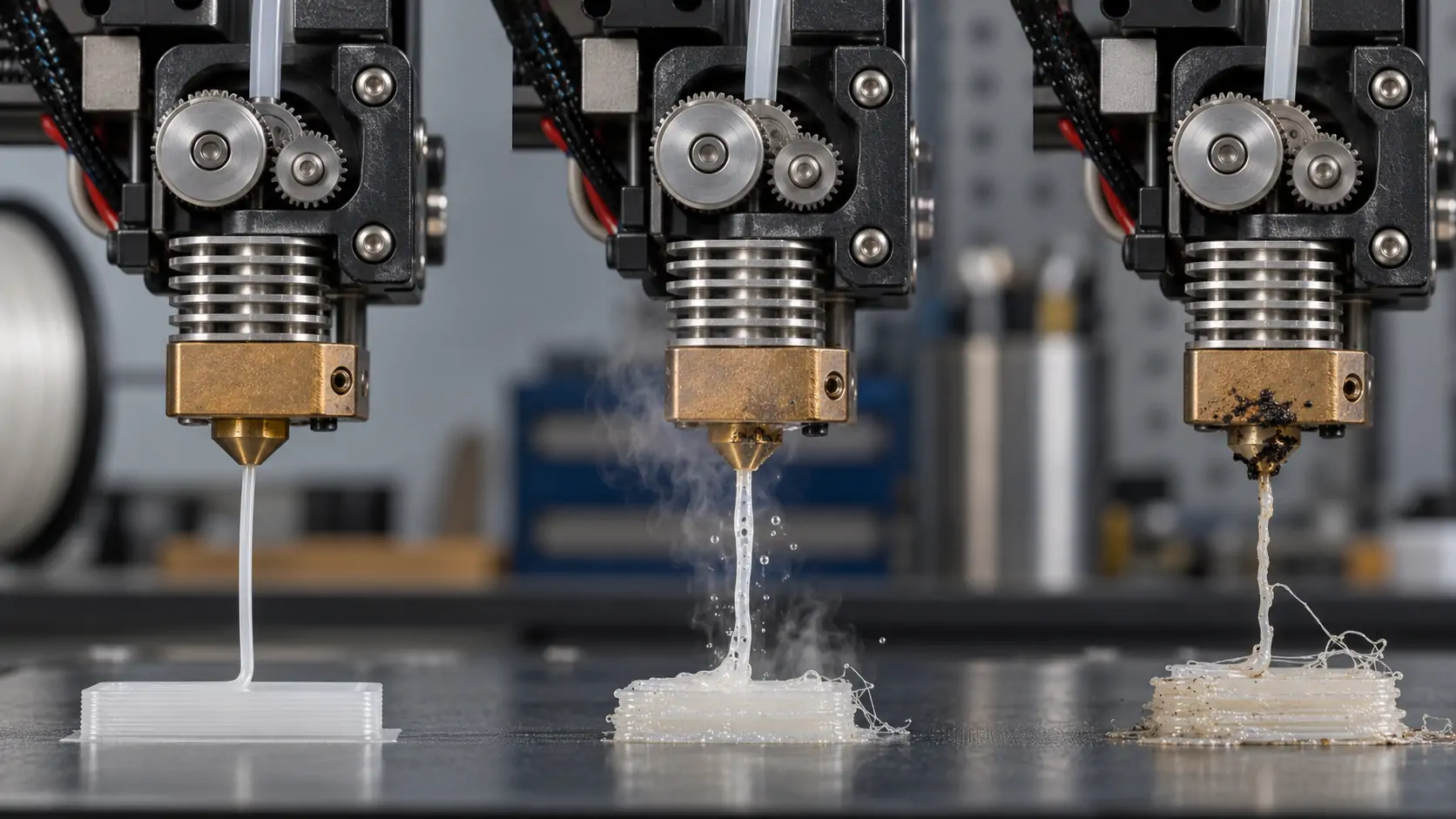
Direct answer: wet PVA can fail in the feed path and at the hot end. Softened filament can deform under drive-gear pressure and buckle in feed tubes. Moisture reaching the hot end can flash to steam, while multi-material jobs add long idle periods at temperature that increase the risk of cooked or carbonized residue.
Three failure mechanisms we check during qualification
- Feed-path failure. Bambu Lab warns that PVA softened by moisture causes feeding failures and nozzle clogs. A soft strand flattens under gear pressure, then jams in tight tube bends.
- Steam in the melt. Water boils far below PVA printing temperatures of roughly 215–250 °C. The result is popping, foamy extrudate, stringing and weak support interfaces.
- Carbonization. PVA prints close to the range where it starts to dehydrate and darken. Print guides warn that PVA is prone to cooking and carbonizing in the nozzle, especially when it sits hot without flow, and wet filament leaves more residue through oozing.
A typical case: a 14-hour PLA job with PVA interfaces every few layers, so the PVA nozzle mostly idles hot. If the spool was also wet, the first visible failure may be a clog at hour nine, and the hot end gets the blame.
Multi-material printing support issues that look like moisture
- AMS Lite documentation: Bambu Lab’s current PVA product guidance and AMS lite specifications list dry PVA as supported, while some A1/AMS lite quick-start guides still warn against absorbent PVA. For qualification, keep PVA dry and follow the documentation for the exact printer and feeder revision in use.
- Heat near the support nozzle: Bambu Lab’s H2D notes warn against pairing PVA with PETG on that toolhead, because PVA has a low heat deflection temperature and PETG wants a bed near 70 °C.
- Wrong pairing: support compatibility is grade- and system-specific. Some PVA grades are optimized for PLA-class materials, while others also list PETG or PA pairings; HIPS remains a common ABS/ASA support option where d-limonene removal fits the process.
- Standby temperature: high idle heat with no flow carbonizes even perfectly dry PVA.
Procurement implicationQualify PVA on the exact multi-material system your customers use, including feeder and job length.
Mistake to avoidReplacing nozzles before ruling out moisture with a simple A/B print.
How to verifyPrint one support test twice on a locked profile: freshly dried, then as received. Compare feed, sound and interface.
4. BVOH vs PVA Moisture Sensitivity: Which Support Material Should You Stock?
Direct answer: treat BVOH as moisture-critical until a lot-level test proves otherwise. Its documented advantages are faster dissolution and wider compatibility. A storage advantage is claimed by some suppliers and contradicted by others.
BVOH is a vinyl alcohol copolymer with butenediol units in the chain. Those units disturb how regularly the chains pack, which is generally linked to faster dissolution; BCN3D reports its BVOH dissolving about twice as fast as PVA. BASF, meanwhile, lists Ultrafuse BVOH for PLA, ABS, PA and PAHT CF15, among others.
On moisture, however, the documents disagree. Verbatim claims high durability against moisture, while BigRep and BCN3D call their BVOH highly hygroscopic. Each may be true for its own formulation, so none replaces a test.
BVOH printability after moisture exposure
Wet BVOH bubbles and strings during extrusion, according to BigRep. Recovery follows the PVA logic with its own numbers. Verbatim lists a glass transition near 68 °C, so the common 60 °C drying setting leaves little margin for a dryer that overshoots.
When HIPS or breakaway support is the smarter stock choice
- ABS and ASA jobs: HIPS, removed with d-limonene, is a common support option and is far less hygroscopic than water-soluble PVA.
- Humid regions with weak storage discipline: breakaway support avoids the dry chain, at the cost of interface finish.
- Slow sellers: if a reseller moves a few PVA spools per quarter, stock risk grows every month.
Procurement implicationQuote BVOH and PVA separately, each with its own drying temperature, RH limit and compatibility list.
Mistake to avoidSwitching to BVOH to “solve” storage, then storing it exactly as before.
How to verifyRun the same exposure and print test on both materials from the same supplier.
5. Tiered PVA Storage: From Desiccant Dry Box to Humidity-Controlled Cabinet
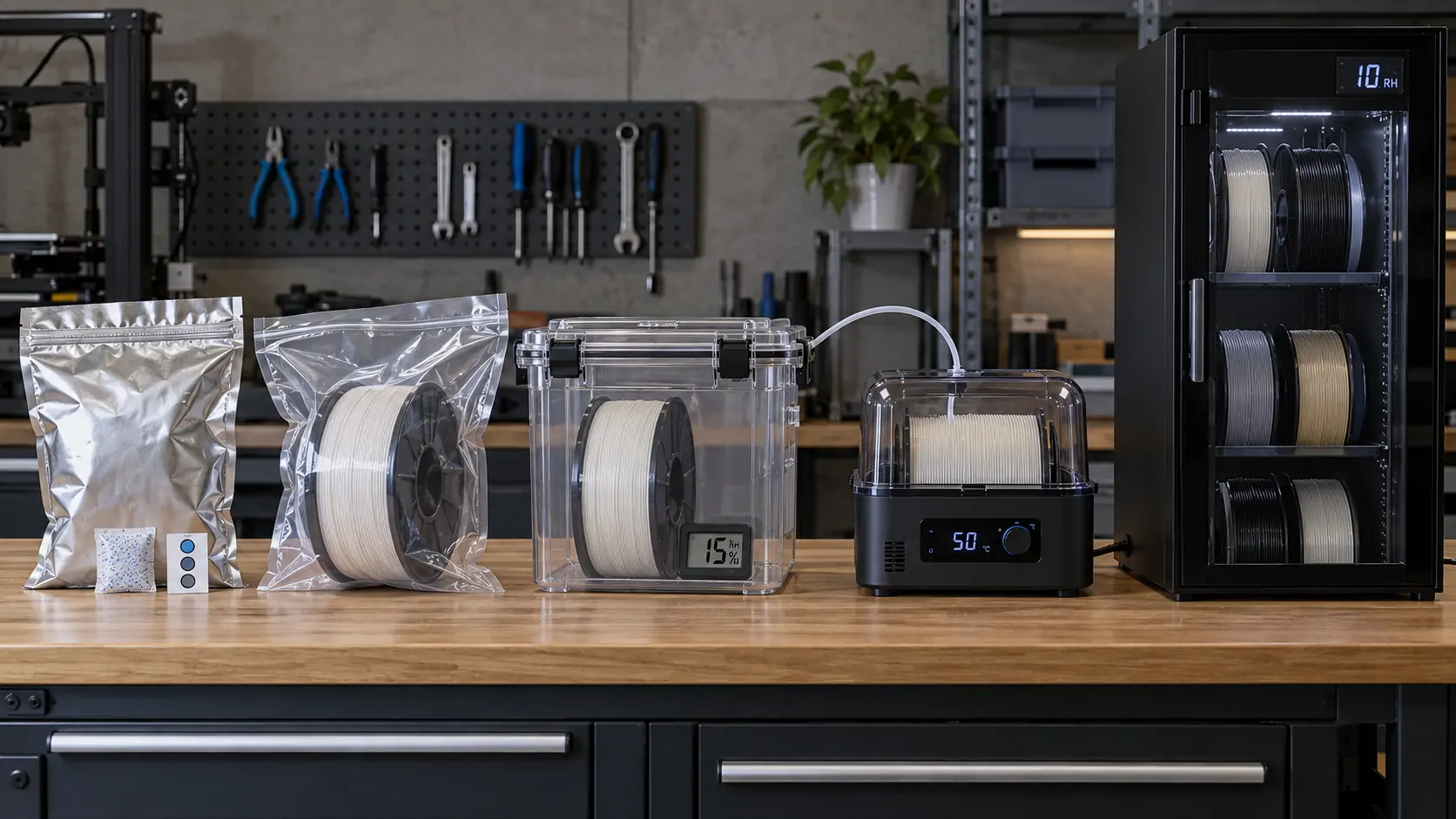
Direct answer: pick the tier by how many hours each spool spends outside a sealed, dry state. For most distributors and print farms, a gasketed dry box held at 15% RH or lower, plus printing straight from a dryer, gives the best return. Industrial cabinets at 10% RH or lower pay off at high volume, or when PVA shares space with nylon, PC and TPU.
Borrow the “floor-life clock” from electronics
Electronics dry-pack practice provides a useful process-control analogy. IPC/JEDEC J-STD-033 applies to moisture- and reflow-sensitive electronic devices, not filament, but its floor-life concept shows why cumulative exposure time matters. SSSray borrows that tracking logic here rather than treating the electronics standard as a PVA compliance requirement.
Treat PVA the same way. Label every opened spool with its lot number, dry-reference weight and cumulative hours outside dry storage. Once the hours pass your validated limit, the spool goes back to the dryer before the next critical job.
On mobile, swipe horizontally to review every column.
| Option | Best use case | Key spec | Advantage | Risk | How to verify | When to reject | SSSray sourcing note |
|---|---|---|---|---|---|---|---|
| Factory pouch, unopened | Warehouse stock, goods in transit | Barrier pouch, sized desiccant, humidity indicator card (HIC) | No added cost | Pinholes, weak seals, saturated desiccant | Read the HIC; weigh a sample spool | HIC past the agreed spot, or sticky filament | Specify pouch, desiccant and HIC in the PO |
| Resealed vacuum bag + indicating silica gel | Opened spools, low-volume users | Reseal immediately after use; fresh desiccant each time | Cheap, portable | Zip seals leak; desiccant saturates unnoticed | Hygrometer card checked after 7 days | Cannot hold below 20% RH for a week | Ask for a resealable bag on distributor SKUs |
| Gasketed dry box + hygrometer | Daily printing, print-through feeding | 15% RH or lower with normal opening | Feeds the printer; RH visible | Skipped regeneration; open feed port | 7-day RH log after fresh desiccant | Above 20% RH within 48 h of regeneration | Good starting tier for sample trials |
| Heated dryer as feeder | Long jobs, humid climates, reviving spools | Accurate at the grade’s maximum drying temperature | Removes moisture during the job | Overshoot can embrittle 50 °C-class grades | Independent temperature probe | Overshoots the grade’s drying limit | Drying limits differ by grade; confirm yours |
| Printer-integrated closed storage | Active jobs on supported printers | Closed chamber; UltiMaker S5/S7 Material Station below 40% RH; Factor 4 Material Station below 15% RH | No handling to the nozzle | The S5/S7 <40% RH environment may still be above stricter PVA targets | Hygrometer inside during a long job | Open or unsealed feeder used for PVA | Confirm spool dimensions and feeder fit |
| Electronic dry cabinet (10% or 5% RH class) | Farms and labs with mixed hygroscopic stock | RH under load and recovery time after opening | Scales; also protects nylon, PC, TPU | Some lab cabinets only reach 25–40% RH | Loaded RH log and recovery data | Cannot hold 15% RH or lower under your use | Worth it beside PA nylon or PC stock |
Note that “humidity-controlled storage cabinet” is not a specification. Bel-Art’s Dry-Keeper horizontal auto-desiccator, a lab cabinet, is rated for 30–40% RH. Electronics dry cabinets, by contrast, target 10% or 5% RH, and one industrial model states it recovers to that level within 30 minutes of the door closing. Always ask for achievable RH under your own loading pattern.
SSSray sourcing note: SSSray supplies PVA support filament in 1 kg, 3 kg and 5 kg spools. For PVA, we usually steer print farms toward the size they can finish within their validated floor life, not the cheapest format per kilogram. A 5 kg spool only saves money if it stays dry to the last meter.
Desiccant dry box sizing and the silica gel regeneration cycle
Desiccant capacity depends on the humidity you want to hold. The MIL-D-3464E desiccant unit adsorbs at least 3.0 g of water at 20% RH but 6.0 g at 40% RH (both at 25 °C). In plain terms, a standard desiccant unit only has to hold half as much water at the dryness PVA needs, so size the box for the 20% RH figure.
Molecular sieve holds about 20% of its weight almost regardless of humidity, so it is stronger below 10% RH. It is harder to regenerate, though: in one patent’s thermogravimetric test, silica gel released most of its water by 120 °C, while 3A sieve released only about 40% by 125 °C.
- Trigger regeneration by hygrometer reading (for example, at 20% RH), not by color change alone.
- Keep two desiccant sets per box and rotate them, so the box never sits open.
- Follow the maker’s instructions; about 120 °C for roughly 3 hours is a common starting point for silica gel.
- Log every regeneration. If the interval keeps shrinking, suspect the box seal.
Vacuum-sealed filament packaging: what the seal does and doesn’t do
Vacuum sealing removes air and makes leaks visible, because a leaking bag goes slack. It does not stop water vapor, however. Over months, the film’s water vapor transmission rate (WVTR) and the desiccant quantity decide how dry the spool stays.
Electronics dry-pack practice under J-STD-033 provides a useful procurement analogy: specify the moisture-barrier bag, relate desiccant loading to bag area and WVTR, and use a humidity indicator card to make moisture ingress visible. PVA buyers can apply the same purchasing logic for ocean freight, while setting the actual storage target from the PVA grade’s own technical guidance.
Procurement implicationPut pouch barrier data, desiccant quantity and HIC into the PO for every PVA SKU.
Mistake to avoidBuying a “humidity controlled” cabinet without its achievable RH and recovery time.
How to verifyRun a 7-day hygrometer log in each tier before rolling it out.
6. Support Material Shelf Life: Revive Moisture-Damaged PVA or Scrap It?
Direct answer: sealed and stored as specified, UltiMaker gives moisture-sensitive materials such as PVA a recommended shelf life of about one year. Once opened, life is counted in exposure hours. Spools that are simply wet can usually be revived at the grade’s own drying temperature; brittle, carbonized or fused spools should be scrapped.
How long can PVA filament last in open air?
Hours to a few weeks, depending on grade and climate. BCN3D estimated about 12 hours at 60% RH for its PVA, while UltiMaker’s grade took four weeks at 55% RH to go from 1% to 3% water. Do not turn those two curves into one universal floor-life rule. Minimize open-air exposure, return PVA to sealed dry storage immediately after use, and validate allowable floor life for the exact grade and environment.
A drying protocol that doesn’t destroy the spool
- Read the grade’s maximum drying temperature in its current TDS. UltiMaker is about 50 °C and warns against exceeding 55 °C; Bambu Lab and Raise3D PVA+ use about 80 °C. Polymaker’s current PolyDissolve S1 page shows both 55 °C / 6 h and 80 °C / 12 h in different sections, so confirm the current product revision before drying.
- Check the spool as well; UltiMaker notes its polypropylene-copolymer spools soften around 80 °C.
- Preheat the dryer and confirm temperature with an independent thermometer.
- Dry roughly 8–16 hours for a full spool so the inner wraps dry too.
- Cool it sealed, then weigh it and record a new dry reference.
When to scrap instead of drying again
- It snaps cleanly when bent after drying, a sign of over-drying or heat crystallization.
- Dark specks or a burnt smell appear with a clean nozzle. Bambu Lab notes its PVA may darken after repeated drying without losing performance, so judge by a print test, not color alone.
- Wraps have fused, or the spool has warped enough to snag.
- It still fails a print test after a full drying cycle at the correct temperature.
Procurement implicationAsk for sealed shelf life with storage conditions, and a manufacture date on every label.
Mistake to avoidDrying every PVA at 80 °C because one brand recommends it.
How to verifyAfter drying, run a print test and check weight against the dry reference.
7. Cost per Print: The Real ROI of PVA Filament Storage
Direct answer: wet PVA costs more than the filament you throw away. Calculate the effective cost per usable kilogram, then add every failed multi-material job. Seen that way, dry boxes and dryers are an easy decision, while industrial cabinets are a volume decision.
Why $50/kg is the floor, not the average
In 2026, branded PVA lists well above $50/kg at retail. Polymaker lists PolyDissolve S1 at $49.99 per 750 g (about $67/kg), and a large EU retailer lists Bambu Lab PVA at roughly $80/kg excluding VAT. These are market reference prices checked at the time of writing, not SSSray quotations. Bulk B2B prices are lower, so this guide uses $50/kg as a conservative landed-price model; SSSray provides project-specific B2B pricing by quantity, destination and packaging requirement.
The formula is simple: effective cost per usable kg = purchase price ÷ (1 − share scrapped by moisture). A failed job then adds PVA, build material, machine hours and operator time.
Effective cost per usable kilogram vs. moisture scrap rate
$50/kg purchase price (B2B reference)$80/kg purchase price (2026 retail reference)
The curve bends upward. At $50/kg, 10% scrap adds about $5.56 to every usable kilogram, while 30% scrap adds $21.43. At $80/kg, the same 30% adds $34.29.
Worked ROI example: a print farm using 10 kg of PVA per month
Table 3 is an illustrative model, not measured data; replace its scrap rates and failure counts with 30 days of your own logs. Inputs: $50/kg landed PVA, 10 kg per month, and $35 per failed job (0.25 kg of PLA at $20/kg, six machine-hours at $3/h, and 30 minutes of operator time at $24/h).
On mobile, swipe horizontally to review every column.
| Storage tier | Setup cost | Assumed moisture scrap | Assumed wet-support failures / month | Monthly loss | Monthly saving vs. no control | Payback |
|---|---|---|---|---|---|---|
| No control (open shelf or printer) | $0 | 25% | 4 | $265 | — | — |
| Tier 1: resealed vacuum bags + silica gel | ~$25 | 12% | 2 | $130 | $135 | ~6 days |
| Tier 2–3: gasketed dry boxes + hygrometers + print-from-dryer | ~$200 | 5% | 1 | $60 | $205 | ~1 month |
| Tier 4: 5% RH-class industrial cabinet | $6,195 (one listed model) | 2% | 0.5 | $27.50 | $237.50 | ~26 months |
At 50 kg per month, the picture shifts. Uncontrolled loss reaches $1,325 a month, Tier 2–3 pays back in about a week, and the cabinet in about five months. Still, the cabinet’s extra saving over well-run dry boxes is only about $162.50 a month, so it wins mainly when it also protects nylon, PC and TPU, or saves desiccant labor.
Procurement implicationCompare suppliers on landed cost per usable kilogram, including arrival condition.
Mistake to avoidChoosing the cheapest PVA in weak packaging, then paying for it in scrap.
How to verifyLog scrap and failed jobs for 30 days before and after any storage change.
8. The PVA Dry-Chain Framework for B2B Buyers
Cold-chain logistics taught food and pharma that a product is only as safe as its weakest temperature link. Water-soluble support works the same way with moisture.
The PVA Dry-Chain Framework tracks seven checkpoints, from the supplier’s extrusion line to your nozzle. One fail can cancel the other six.
On mobile, swipe horizontally to review every column.
| Checkpoint | Why it matters | What to ask | Pass / fail signal | Hidden risk |
|---|---|---|---|---|
| Application requirement | Pairing, feeder and job length must suit the grade | Which build materials and printers is it validated with? Longest job tested? | Pass: named pairings. Fail: “compatible with everything.” | Long jobs can exceed open-air tolerance even with perfect storage |
| Material performance | Uptake and dissolution speed set the storage tier | Storage RH limit, moisture at packing, dissolution conditions? | Pass: numbers with method. Fail: adjectives only. | Thresholds from different methods are not comparable |
| Printability | The as-received condition is what customers get | Locked profile and maximum drying temperature? Does a sample print as received? | Pass: as-received and dried spools both print. Fail: undisclosed drying need. | Dryer overshoot can embrittle a 50 °C-class grade |
| Compliance | Resellers face document and wastewater questions | Lot COA, TDS, SDS, RoHS or REACH files? Disposal guidance for dissolved support? | Pass: current files for the exact grade. Fail: generic PVA SDS. | Verbatim’s BVOH datasheet sets disposal dilution and daily limits; volume users need equivalent guidance |
| Supplier reliability | Most “arrived wet” cases start between extruder and sealer | Time from extrusion to sealing? Packing-area RH? HIC in every pouch? | Pass: documented packing controls. Fail: “we vacuum pack everything.” | Shortcuts during peak season |
| Landed cost | Transit climate adds risk that price per kg ignores | Sea-freight pouch and carton spec? Wet-on-arrival claim process? | Pass: cost per usable kg. Fail: FOB price only. | Returning wet stock can cost more than the spool |
| Reorder stability | New resin, additive or pouch film can change moisture behavior | Will you notify us before changing them? | Pass: written change control, retained samples. Fail: silent substitution. | Problems surface on reorders, after approval |
Score each checkpoint pass, conditional or fail. Approve a supplier only when nothing fails and every “conditional” has a written action and an owner.
9. PVA Supplier Claims vs Reality
Support-filament marketing leans on adjectives, because moisture behavior is hard to photograph. Use Table 5 to turn each claim into a document request.
On mobile, swipe horizontally to review every column.
| Vague marketing claim | What it might hide | Document, sample or test to request | What a reliable supplier provides |
|---|---|---|---|
| “Low moisture absorption” | No reference grade, condition or method | Uptake curve at stated temperature and RH | Uptake at two or more RH levels, plus a print-failure threshold |
| “Vacuum sealed with desiccant” | Permeable film; undersized or saturated desiccant | Pouch film spec, desiccant quantity, HIC type | Barrier spec, desiccant per pouch, HIC in each pouch |
| “Dried before packing” | Unmonitored drying or a long wait before sealing | Drying record and lot moisture result | Lot-linked moisture result by ISO 15512 or a calibrated analyzer |
| “AMS / multi-material compatible” | One printer, one short job | Printer list, feeder type, job length | Named printers, locked profile, long-job record |
| “Shelf life: 2 years” | Unopened pouch in ideal conditions only | Storage conditions and manufacture date on label | Sealed shelf life with conditions, plus opened-spool guidance |
| “Dissolves fast” | Warm water, agitation or thin parts undisclosed | Water temperature, agitation, part geometry | Dissolution data under conditions close to yours |
10. SSSray PVA Dry-Chain Qualification Protocol
SSSray uses this dry-chain qualification protocol to define locked conditions for moisture control, printability and dissolution during B2B PVA qualification. The protocol below defines the sampling plan, test conditions and acceptance criteria used to generate lot-level QC records.
Protocol ID: SSSRAY-PVA-DRYCHAIN-2026-10-R01 · Material: 1.75 mm PVA support filament · Sampling plan: n=9 spools, with three samples taken from the start, middle and end of the production lot.
- Conditioning: 23 ± 2 °C at 30%, 50% and 70% RH; time points at 0, 24, 72 and 168 hours.
- Mass tracking: calibrated balance with 0.01 g resolution; each spool is tied to its lot and sample ID.
- Water-content method: ISO 15512:2019 Method B1/B2 tube-oven vaporization followed by Karl Fischer titration or coulometric determination.
- Reference print setup: 0.4 mm nozzle, 220 °C nozzle, 40 °C bed, 40 mm/s, PLA build material, locked support-tower and overhang coupon profile.
- Print checks: feed stability, popping, stringing, nozzle clogging and PLA/PVA interface quality are recorded at each exposure point.
- Dissolution check: fixed coupon geometry in 25 ± 2 °C water with the same agitation condition for every sample; time to full support removal is recorded.
On mobile, swipe horizontally to review every column.
| Control point | SSSray test condition | Acceptance / record requirement | Why it is controlled |
|---|---|---|---|
| Initial moisture | 0 h, conditioned sample before exposure | Target ≤1.0 wt% water; record actual lot value by ISO 15512 method | UltiMaker identifies <1% as its best-print-quality range; SSSray uses the same conservative starting target for qualification |
| 30% RH exposure | 23 ± 2 °C; 24, 72 and 168 h | Record mass gain and water content; 72 h print must show no feed failure, persistent popping or nozzle clogging | Represents a controlled but imperfect dry-room / feeder environment |
| 50% RH exposure | 23 ± 2 °C; 24, 72 and 168 h | Characterization point: record water content, print result and change from the dry reference | Separates tolerant formulations from grades that require much stricter handling |
| 70% RH exposure | 23 ± 2 °C; 24, 72 and 168 h | Stress-test point: record water uptake and failure mode; not a recommended storage condition | Accelerates moisture exposure so feed, extrusion and dissolution changes are visible |
| Dry-box operating target | Opened spool in sealed feed/storage box | ≤15% RH target; 20% RH alarm point for mixed-brand PVA stock | Matches the strictest numeric PVA guidance identified in the manufacturer sources reviewed for this article |
| Re-drying verification | Use the approved temperature for the exact grade; verify dryer temperature independently | Return to the lot’s dry-reference weight range and pass the locked print coupon | Prevents an 80 °C setting from being copied onto a lower-temperature PVA formulation |
Lot traceability: for each production lot tested under this protocol, the resulting QC record carries the production batch number, sample IDs, actual water-content readings, exposure log and print result. The protocol target is fixed; measured lot values stay linked to the applicable batch QC record.
11. B2B Scenarios: Who Loses Money on Wet PVA, and How to Prevent It
Distributor
Situation: adds PVA to a PLA-heavy catalog, warehoused in a humid climate.
Bad choice: cheapest PVA in thin bags, cartons by the loading dock.
Consequence: “arrived soft” returns, refunds and bad reviews.
Better choice: barrier pouch with HIC, resealable retail bag, drying instructions on the label, stock sized to sell within shelf life.
Verification: HIC check and weigh-in on every inbound lot.
Next step with SSSray: request a PVA sample with its packaging spec.
OEM Brand
Situation: bundles a PVA starter spool with a multi-material printer.
Bad choice: approves a fresh sample but never tests the shipped, stored condition.
Consequence: first-print failures blamed on the printer; support tickets spike.
Better choice: qualify the spool after simulated shipping and storage.
Verification: as-received print test on the shipped hardware after aging.
Next step with SSSray: discuss starter-spool packaging under OEM/ODM.
Print Farm
Situation: runs PVA on ten or more machines, often overnight.
Bad choice: leaves spools in printers and buys a big cabinet first.
Consequence: clogs, scrapped jobs, and a cabinet that doesn’t fix the floor-life habit.
Better choice: dry boxes at 15% RH or lower, print-from-dryer for long jobs, floor-life labels; cabinet once volume justifies it.
Verification: 30-day log of scrap, failed jobs and box RH.
Next step with SSSray: plan a production-lot trial.
Engineering Buyer
Situation: needs internal channels or lattices in PLA or nylon parts.
Bad choice: picks PVA by brand reputation without checking pairing or drying limits.
Consequence: weak interfaces or incomplete dissolution; the schedule slips.
Better choice: compare PVA and BVOH on the real geometry and build material.
Verification: dissolution and interface test on the critical feature.
Next step with SSSray: send the drawing for an engineering review.
12. PVA and BVOH Print and Sourcing Specs at a Glance
Print settings: published starting points
On mobile, swipe horizontally to review every column.
| Parameter | PVA | BVOH |
|---|---|---|
| Nozzle temperature | 215–225 °C (Polymaker); 220–250 °C (Bambu Lab) | 190–220 °C (Fiberlogy); 200–220 °C (Verbatim) |
| Bed temperature | Follow the build material; 35–45 °C (Bambu Lab), 25–60 °C (Polymaker) | About 60 °C (Fiberlogy) |
| Enclosure | Not required; avoid hot chambers near the PVA nozzle | Not required (Fiberlogy) |
| Drying | About 50 °C / 16 h (UltiMaker); 80 °C / 8–12 h (Bambu Lab); Polymaker’s current page conflicts between 55 °C / 6 h and 80 °C / 12 h | 60 °C / 4–16 h (BASF, BCN3D) |
| Nozzle material | Standard brass for unfilled grades; 0.4 mm or larger for production | Standard brass |
| Speed range | 30–40 mm/s on Polymaker’s current product page; its current Wiki TDS table lists 50–150 mm/s, so use the current profile for the exact product revision; below 200 mm/s (Bambu Lab) | 20 mm/s (BCN3D BVOH starting point) |
| Common failure | Soft-filament feed failure, steam popping, carbonized nozzle | Bubbling and stringing when wet |
| Fix | Dry per TDS, print from a sealed dryer, lower standby temperature, cold pulls | Dry at 60 °C, store sealed, print from a dry box |
Sourcing specs: what to put in the RFQ
On mobile, swipe horizontally to review every column.
| Item | What to specify | SSSray reference |
|---|---|---|
| MOQ | Qualification vs. production quantity | From 50 spools (PVA and HIPS) |
| Lead time | Production, packing and transit, in writing | Confirmed per order in the quotation |
| Sample approval | Sample ID, lot, as-received and dried print results | B2B qualification samples tied to sample ID |
| Tolerance | Diameter and ovality, with method and raw data | Agreed per grade from measured data |
| Documentation | Lot COA, TDS, SDS; RoHS or REACH by destination | COA, TDS, SDS; RoHS or REACH per SKU and market |
| Packaging | Barrier pouch, desiccant quantity, HIC, sea-freight carton | Vacuum packing with desiccant; barrier and HIC confirmed per order |
| Private label | Storage and drying text, barcode, box | OEM and private-label labels, boxes, cartons, barcodes |
| Reorder control | Change notice for resin, additives, pouch film, desiccant | Reorder spec linked to the approved sample |
13. PVA Filament Storage FAQ for B2B Buyers
How long can PVA filament last in open air?
Anywhere from hours to a few weeks, depending on grade, temperature and humidity. BCN3D estimated about 12 hours at 60% RH before its PVA absorbed enough moisture to fail prints. UltiMaker, by contrast, measured its more tolerant grade rising from 1% to 3% water over four weeks at 55% RH. Do not use either curve as a universal floor-life limit. Minimize open-air exposure, return PVA to sealed dry storage immediately after use, and validate allowable floor life for the exact grade and environment.
What humidity level is safe for PVA and BVOH storage?
For mixed-brand PVA stock, hold opened spools at 15% RH or lower in a sealed container. That covers the strictest numeric PVA limit identified in the manufacturer guidance reviewed here: Raise3D specifies below 15% RH before loading, while Bambu Lab specifies below 20% RH with desiccant. Polymaker requires a dry box but its current public product guidance reviewed here does not state a numeric RH ceiling. Some grades tolerate more; UltiMaker allows a storage room below 50% RH for its own formulation. Treat BVOH as moisture-critical and use the grade’s own storage guidance.
Can I revive moisture-damaged PVA filament?
Usually yes, if the spool is only wet. Use the exact grade’s current drying guidance: UltiMaker is about 50 °C and warns against exceeding 55 °C, while Bambu Lab specifies about 80 °C. Polymaker’s current PolyDissolve S1 page shows conflicting 55 °C / 6 h and 80 °C / 12 h values, so confirm the current product revision before drying. Cool the spool sealed before loading, and scrap it if it snaps after drying, shows fused wraps, or still fails a print test after a full cycle.
What should a PVA purchase specification include?
At minimum: grade name, diameter tolerance, moisture content at packing with its test method, storage RH limit, maximum drying temperature, pouch barrier spec, desiccant quantity, humidity indicator card and labeling. Add a COA per lot, current TDS and SDS, and RoHS or REACH files where your market needs them. Finally, require written notice before any change to resin, additives, pouch film or desiccant, so a reorder cannot quietly behave differently from the approved sample.
How should a distributor stock PVA to reduce returns and refunds?
Stock only what you can sell within the sealed shelf life, keep cartons away from exterior walls and loading docks, and check humidity indicator cards on every inbound lot. Choose a retail pack with a resealable bag and clear drying instructions, because some apparent “defective PVA” complaints can be caused by storage conditions at the customer’s site. Rotate stock by manufacture date. If demand is slow or seasonal, order smaller quantities more often rather than holding PVA for many months.
Is vacuum-sealed packaging enough for ocean freight?
Not by itself. Vacuum sealing removes air and reveals leaks, but the film’s water vapor transmission rate and the desiccant quantity decide how dry the spool stays over weeks at sea, through the temperature swings of a container crossing climate zones. Ask for barrier film data, desiccant amount per pouch and a humidity indicator card, and protect cartons so seals stay intact. This mirrors how electronics makers dry-pack moisture-sensitive parts under J-STD-033.
What MOQ and documents does SSSray offer for PVA?
SSSray’s PVA and HIPS support filament starts at an MOQ of 50 spools for supplier qualification, with 1 kg, 3 kg and 5 kg spools and OEM or private-label packaging. We provide COA, TDS and SDS for applicable materials, plus RoHS or REACH documentation by SKU and destination market. Lead time, packaging barrier details and pricing are confirmed per order in a written quotation, so include destination, quantity and storage conditions in your RFQ.
14. Conclusion: Treat PVA Filament Storage as Part of the Purchase Spec
PVA filament storage is not a housekeeping detail. It decides whether a $50/kg support material delivers $50 of value, or quietly becomes more than $70 per usable kilogram at 30% scrap, before failed jobs are counted.
The decision logic is short. First, get the grade’s own numbers: storage RH limit, moisture at packing and maximum drying temperature. Next, match the storage tier to exposure hours; resealed bags and dry boxes pay back within weeks, while cabinets earn their place at volume. Finally, run the Dry-Chain Framework so packaging, documents and reorders stay under control.
Your next step is a controlled comparison: one as-received spool, one dried spool, one locked profile and a 30-day log. That test will tell you more than any datasheet adjective.
Prefer to start with paperwork? Request the TDS, COA and SDS, compare materials across our 3D printer filament supplier range, ask about OEM packaging, or request a bulk quote with your destination and monthly volume.
Request a quote or free samples
Tell us the material, color, spool size and monthly volume. An engineer replies within 24 hours on business days.
15. References
- UltiMaker Support: How to dry UltiMaker PVA: moisture thresholds, uptake, drying limits.
- UltiMaker: How to store PVA material, filament storage tips, and Factor 4 user manual: storage RH, shelf life and device-specific Material Station humidity targets.
- Bambu Lab PVA Technical Data Sheet and Bambu Lab PVA product guidance: water absorption, drying, storage humidity and dry-state AMS/AMS lite guidance.
- Polymaker: PolyDissolve S1 product page and current Wiki TDS: dry-box guidance and the current print-speed and drying-setting documentation differences.
- Raise3D Support: How to set up PVA+ filament: wet-filament symptoms and drying.
- BCN3D Smart Cabinet technical study: PVA humidity-limit and shelf-life testing under controlled exposure.
- BASF Ultrafuse BVOH TDS and BCN3D BVOH product data: BVOH storage, drying, dissolution.
- Verbatim BVOH datasheet: thermal data and disposal guidance.
- ISO 15512:2019 Plastics: Determination of water content.
- IPC status: IPC/JEDEC J-STD-033E revision project: electronics dry-pack and floor-life practice used here only as a process-control analogy.
- AGM Container Controls: Selecting desiccant: silica gel, molecular sieve, MIL-D-3464E unit.
- Journal of Applied Polymer Science: Combined effect of relative humidity and temperature on dynamic viscoelastic properties and glass transition of poly(vinyl alcohol).

He Jiang
Senior Researcher · SSSray · 3D Printing Filament Manufacturing · Jinhua, Zhejiang
He Jiang is a senior researcher at SSSray, a 3D printing filament manufacturer in Jinhua, Zhejiang, China. This guide focuses on filament qualification, moisture control, batch QC and sourcing specifications for B2B distributors, print farms and OEM partners, using current manufacturer technical data together with SSSray’s dry-chain qualification procedure.