Online time
Monday to Friday: 9AM - 8PM
Weekend: 10AM - 5PM

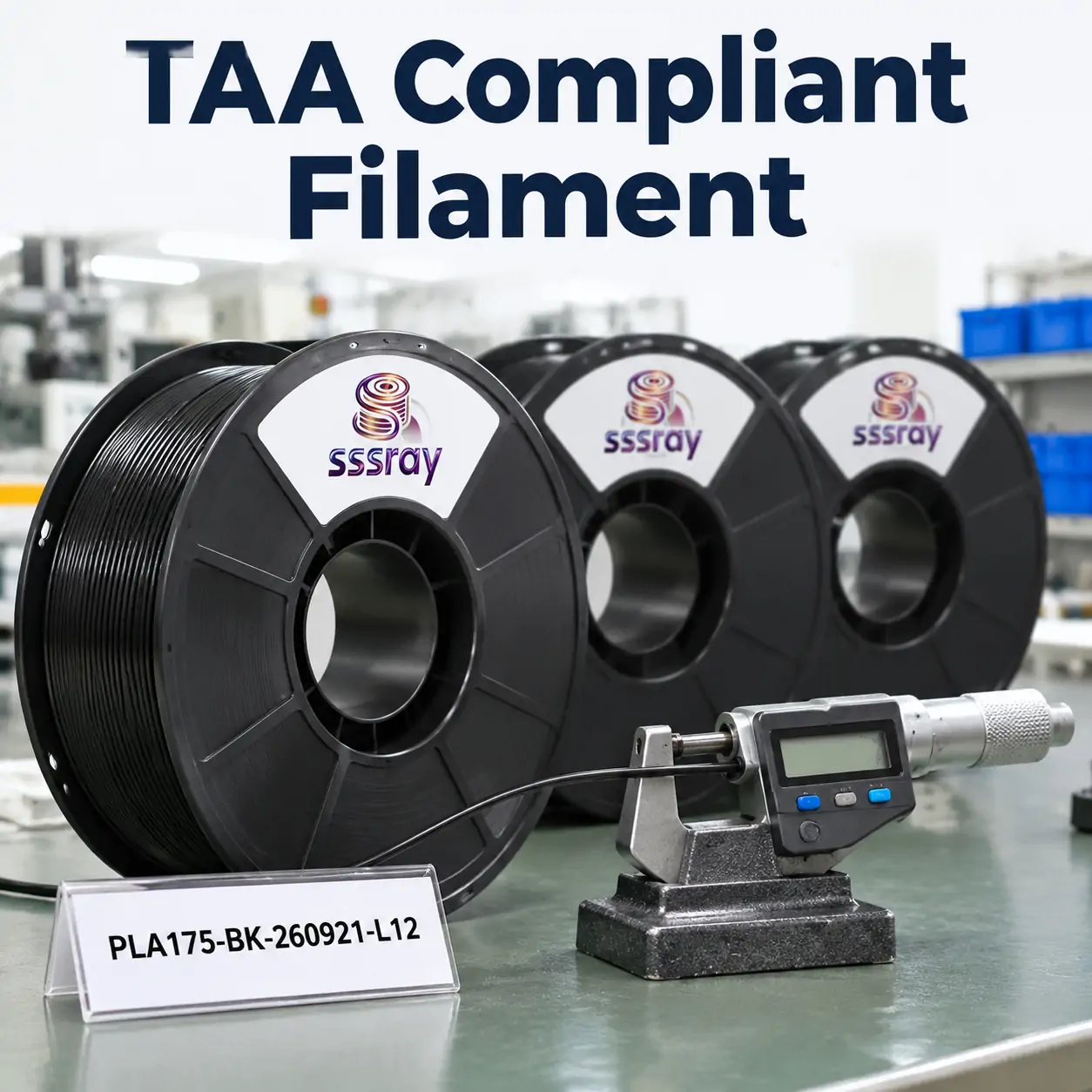
TAA Eligibility Starts With the Purchase Route
For a standard GSA Multiple Award Schedule (MAS) offering, filament must qualify as a U.S.-made or designated-country end product. Finished filament made in mainland China does not qualify for that standard Schedule offering. For school, state, local and other federal purchases outside MAS, check the actual funding, contract and solicitation terms before deciding whether the same spool can be supplied.
GSA MASConfirm that the exact awarded SKU has an eligible, documented country of origin. A low-value order does not remove the Schedule’s TAA requirement.
Schools and commercial buyersIdentify the funding source, purchasing vehicle and any domestic-preference or origin clause before requesting a quote.
Finished-product originRecord the legal manufacturer, manufacturing site and operations that establish the origin of the finished filament.
Lot quality recordsMatch the spool or carton lot to its COA. A COA reports quality results; it does not establish TAA origin.
Before We Quote a U.S. Order
Send us the purchasing route and the exact item requirements so we can check the right records before quoting.
- Buyer and funding: Identify the end buyer, funding source and whether the order is commercial, state/local, under a Federal award or placed through GSA MAS.
- Controlling terms: Provide the solicitation, contract clause, grant condition or written origin requirement that applies to the line item.
- Exact product: Confirm the manufacturer’s part number, material grade, color, diameter, spool format and quantity.
- Origin and lot records: Match the manufacturing-site declaration to the SKU, then match the lot COA to the spool or carton. These records answer different questions.
Which Buyers Need TAA Compliant Filament?
Standard GSA Schedule offerings require an eligible end product, while commercial buyers, schools and other government buyers should check the contract and funding route that governs their order.
Start with the contract number and funding source
A privately funded school can generally consider China-origin filament where its rules and sourcing terms allow it. A school district buying under its own solicitation may have a local preference. Under 2 CFR 200.322, the recipient or subrecipient should, to the greatest extent practicable and consistent with law, provide a preference for the purchase, acquisition, or use of goods, products, or materials produced in the United States. The requirements of this section must be included in all subawards, contracts, and purchase orders under Federal awards. This is a domestic preference under the Uniform Guidance, not the same country-of-origin test as TAA and not a rule that automatically governs every privately funded school purchase. Start with the actual purchase order, award terms or draft solicitation, especially if a dealer or cooperative is involved. For GSA state and local purchasing, check the buyer, program and product category. GSA Cooperative Purchasing covers eligible IT, law-enforcement and security offerings.
Use the comparison below to decide whether to quote the SKU, ask for a written clarification or find an eligible alternative. The result applies to the specific line item and purchase route shown.
Scroll horizontally to see all columns.
| Option | Best use case | Key requirement | Advantage | Risk | How to verify | When to reject | Factory sourcing note |
|---|---|---|---|---|---|---|---|
| Commercial / privately funded education | Distributor stock, ordinary commercial orders, school lab supplies | Buyer’s written terms | Can compare materials and suppliers where origin is unrestricted | A secondary contract or grant adds a restriction | Ask whether any origin rule applies to the PO | A mandatory origin term conflicts with the SKU | China-origin material may be quoted where permitted |
| State / local / public schools | District or university tender, cooperative contract or local agency PO | Solicitation, contract vehicle and funding terms | Eligibility can be resolved at the purchasing office before sampling | Different funding accounts carry different conditions | Ask purchasing which policy, award or passed-through clause controls | Mandatory terms exclude the SKU, or required approval is missing | Quote after the buyer confirms the route in writing |
| Federal AbilityOne / GSA Global Supply | A required-source item or an equivalent matches the requisition | Procurement List, exact National Stock Number (NSN) and applicable source priority | Government stock-number ordering where applicable | A similar-looking commercial spool is substituted without authority | Check the NSN, material, color, diameter and required source with the ordering office | Required source applies and there is no applicable purchase exception | Route the buyer to its designated source |
| Federal GSA Schedule | Order against a Multiple Award Schedule (MAS) contract | Eligible end-product origin and awarded exact item | Schedule terms guide SKU screening up front | Vendor’s Schedule status is mistaken for item approval | Match listing, contract, part number and declared origin | China-origin SKU offered as a standard on-Schedule item | Use an eligible and documented alternate for the Schedule line |
| Other federal solicitations | Agency issues a separate RFQ or tender | Actual FAR clause, agency deviation and bid terms | Can check the clause against the proposed product early | A trade agreement threshold is assumed to determine eligibility by itself | Get the solicitation, amendments and line-item representation | The proposed item fails the applicable clause | Provide factual origin evidence and wait for the contracting decision if unclear |
| Defense / prime contractor | DoD purchase or a purchase order under a defense prime contract | Applicable FAR/DFARS clauses and flow-downs | Machine and consumable line items can be reviewed individually | Bundled equipment and a spool bought separately are treated alike | Ask for the clause matrix and identify each deliverable | The controlling restriction bars the origin or item | Hold any origin-restricted or unresolved item until the prime or buyer confirms |
When an educator selects the filament but another office issues the PO, contact that purchasing office first. Ask which contract will carry the exact product and whether an origin preference or exclusion applies to it.
TAA Compliant Filament on GSA Schedule and Other Federal Orders
Apply GSA’s Schedule rules to awarded Schedule items and read the actual solicitation clauses for other federal purchases.
Why a small GSA Schedule order still needs an eligible spool
GSA’s Multiple Award Schedule guidance states that MAS contract offerings are subject to the TAA: contractors must provide only U.S.-made or designated-country end products and services. A listing on GSA Advantage is an item-level starting point. Verify that the quoted manufacturer’s part number matches the awarded item and that the product shipped still has the listed origin. An invoice from a Schedule holder by itself gives you the vendor’s identity.
FAR 25.402 lists $174,000 as the current WTO Government Procurement Agreement (WTO GPA) threshold for covered federal supply contracts. This is one agreement-specific coverage threshold, not a universal TAA threshold or a general exemption for lower-value federal purchases. The agreement, agency, product scope, exceptions and solicitation clause still determine whether a non-MAS acquisition is covered. The MAS requirement described above remains in force when an individual order is below $174,000; the order value does not make a mainland-China-origin SKU eligible for that Schedule. For a purchase outside MAS, read the actual solicitation and applicable clause rather than relying on the WTO GPA figure alone.
Is the spool on the AbilityOne Procurement List?
GSA Global Supply lists filament NSNs offered through AbilityOne. The GSA product brochure lists SKILCRAFT black PLA, 1.75 mm on a 1 kg spool, as NSN 7045-01-685-8922. Under FAR Subpart 8.7 and 41 CFR 51-5.3, check whether the item or an essentially-the-same product is subject to mandatory-source rules, its availability, and whether an applicable exception or priority changes the route.
If the requisition specifies that NSN, verify the exact item and source with the ordering office before evaluating alternatives. Global Supply requisitioning and ordering against a GSA Schedule are separate routes under FAR 8.402. A commercial spool with a matching diameter, color and weight still needs the buyer’s authority for the applicable route.
What “Buy American” changes for filament
For federal supplies, FAR Subpart 25.1 generally looks to U.S. manufacture plus a domestic component-cost test for manufactured end products. Under the published FAR baseline, the general non-iron/steel percentage is 65% for items delivered from 2024 through 2028 and 75% starting in 2029. The FAR waives the component-cost test for most commercially available off-the-shelf (COTS) items, with special treatment for products predominantly of iron or steel. U.S. manufacture remains relevant. Applicable exceptions, alternates and agency deviations can change the outcome.
For covered trade-agreement acquisitions, eligible products may receive equal consideration with domestic offers. For a defense trade-agreement clause, for example DFARS 252.225-7021, read that clause’s definitions and delivery rules, including qualifying-country treatment. For a lower-value federal tender, screen the actual Buy American or other clause, including any buyer-documented exception. Ask the contracting officer to resolve an unclear origin provision before making a representation.
Purchase check: Send the contract number and the exact clause text with the request. A reseller can then verify whether the SKU is awarded and whether the manufacturer can substantiate its declared origin.
TAA Compliant Filament, Designated Countries and Substantial Transformation
For a country-of-origin claim under the Trade Agreements Act, substantiate the manufacture of the finished filament, including any material steps performed in more than one country.
TAA eligibility is not a product certification
TAA eligibility is not a standalone product certification or quality mark. It is determined for a particular procurement by applying the governing trade-agreement clause and country-of-origin rules to the finished product. Our lot COA reports agreed quality measurements; it does not establish the filament’s country of origin or prove substantial transformation. For that review, identify the legal manufacturer, manufacturing site and the operations performed on the material.
Use the list that applies to the clause
The current FAR 25.003 designated-country definition groups eligible entries under the WTO GPA, Free Trade Agreements, least-developed-country and Caribbean Basin categories. It includes Canada, Japan and Taiwan (known in the WTO as the Separate Customs Territory of Taiwan, Penghu, Kinmen and Matsu (Chinese Taipei)); mainland China, India, Vietnam, Thailand and Malaysia are not listed as designated countries. An alternate distributor or shipping route does not establish a different manufacturing origin. Review the applicable clause, such as FAR 52.225-5, and the GSA lookup before quoting and again if the country representation changes on a reorder.
What physically changes between a pellet and a retail spool?
At our Jinhua factory, we melt the polymer feedstock, extrude it through a die, cool the strand and control its diameter so it feeds into a fused-filament printer. For a quote on our Jinhua-made filament, we identify the manufacturing site, the relevant operations and the production lot that goes with the SKU. The buyer can check those facts against the clause for the finished spool.
Now consider a shipment entering the U.S. as finished printable filament and leaving a U.S. warehouse on a different spool. The country where it was wound, the brand on its box and the place where a sample passed a print test can all be captured on the file. Simple re-spooling and labeling leave the material and use essentially intact. On those facts, a claim that the filament changed origin has a weak basis.
For a genuine multi-country manufacturing process, collect the input descriptions, factory addresses, process flow, manufacturing records and the origin basis for the exact SKU. Have U.S. government-contracts or customs counsel review the facts before certifying a disputed origin. An eligible party can request a U.S. Customs and Border Protection (CBP) final determination under 19 CFR Part 177, Subpart B for the relevant government procurement case.
Defense Procurement: NDAA Additive Manufacturing Restrictions and the Berry Amendment
Review a DoD machine line under the applicable equipment rules and a stand-alone filament line under its own sourcing clauses and flow-downs.
What Section 849 covers
Section 849 of the enacted FY 2026 National Defense Authorization Act (NDAA) bars the Secretary of Defense from entering into a contract for a covered additive manufacturing machine beginning one year after enactment, on December 18, 2026. A covered machine is one manufactured by a covered additive manufacturing company; the statutory definition also includes related services or equipment provided or manufactured, respectively, by that company. The exception states that the prohibition does not apply to procurement of additive manufacturing systems or machines for the purposes of intelligence, electronic warfare, or information warfare operations, testing, analysis, or training. The covered-company definition applies to entities that produce or provide additive manufacturing machines and are identified on specified U.S. government lists, are domiciled in a covered nation, or are subject to unmitigated foreign ownership, control or influence by a covered nation. 10 U.S.C. 4872, which Section 849 uses to define covered nations, includes China.
For a defense lab that orders a printer and PLA together, have the buyer identify what is bundled, who manufactures or provides it, and which rule applies to each deliverable. For a stand-alone filament line, check the applicable FAR and DFARS clauses, prime-contract flow-downs and program requirements. Have the contracting officer resolve any scope question about material supplied with a machine.
The Berry Amendment restrictions implemented in DFARS 225.7002-1 target listed classes such as food, clothing, certain textiles and fibers, qualifying individual equipment, and hand or measuring tools. Ordinary PLA or PETG feedstock falls outside those listed classes as such. If a bid uses a clause name as shorthand, request the actual text and required evidence from the prime or contracting officer.
Dates that affect an open RFQ
- December 18, 2025: Public Law 119-60 was enacted, starting the statutory clock for Section 849.
- March 13, 2026: Effective date shown on the FAR 2026-01 pages referenced here. Use the active text and any agency deviation for your solicitation.
- December 18, 2026: Section 849’s machine-contract prohibition is scheduled to begin under the enacted text. Confirm current instructions for a procurement crossing that date.
- January 1, 2029: The published general FAR domestic component threshold rises to 75% for applicable deliveries, subject to the governing clause and exceptions.
For a quote that spans a change date, record the expected contract date, the delivery schedule and the buyer’s interpretation for the affected line items.
Compliance Checklist for Quoting and Reordering Filament
We qualify a U.S. spool order by checking the route, the exact item, the origin evidence and the production lot before we commit to delivery.
Our route-to-lot check for the RFQ and PO
Hold the quote when the buyer cannot identify the purchasing vehicle or asks for a sourcing representation that the spool file cannot support. Once the route is clear, use the same item and lot identifiers at sample approval, receipt and reorder.
- Buyer and route: Identify the end buyer, purchase vehicle and grant or award number. For a federal requisition, ask whether there is a required-source NSN.
- Controlling text: Attach the solicitation clause or written sourcing requirement and any amendment or flow-down.
- Exact item: Record manufacturer’s part number, finished-filament grade, color, diameter, spool format and quoted quantity.
- Origin evidence: Request the legal manufacturer, manufacturing site, relevant operations and a SKU-specific country-of-origin declaration. Obtain documented approval where the bid requires it.
- Performance acceptance: Lock the sample, printer and slicer profile. Agree on feed reliability, filament geometry and the criteria for accepted prints.
- Cost and delivery: Compare freight, stock commitments, qualification and traceability costs for eligible options. Confirm the ship date and the cost of holding a different SKU for a restricted route.
- Lot handoff: Match the spool or carton lot, packing list and COA. Have the factory confirm the manufacturing site and explain any discrepancy before releasing incoming inventory.
- Reorder: Require written change notice for the manufacturing site, process, material grade or SKU. Hold an affected line until purchasing reviews it.
Supplier Claims vs Reality
When we quote, we match the SKU, the production site and the batch documents. Use the same checks when comparing quotes.
Swipe the table to see all columns.
| Claim | What it might hide | What to request | What a supplier can substantiate |
|---|---|---|---|
| “Ships from the USA” | Warehouse location in place of manufacturing location | Exact SKU, manufacturing site and origin declaration | Manufacturing and fulfillment locations identified separately |
| “TAA compliant brand” | Origin varies by diameter, spool format or factory | Written basis for the exact item and the applicable clause | Current SKU-level origin and named manufacturing operations |
| “GSA vendor” | Vendor holds a contract but the SKU’s award status is unknown | Schedule contract and awarded item identifier | A matching listing, quote and item record |
| “COA available” | The report can cover test values while leaving the production site unverified | Lot COA plus separate origin evidence | A matching lot ID and an origin declaration tied to the SKU |
A distributor can use these fields to keep a reorder for a restricted customer from being filled with otherwise identical commercial stock.
Buying for a route that permits China-origin filament? Send us the buyer type, exact SKU and any origin clause. We typically respond to a complete inquiry within one business day with the quote path and the records we can supply.
How this looks on an actual buying desk

Distributor. A municipal reseller asks for the same black PLA that independent schools already buy. A common inventory code risks pulling stock with an ineligible origin. Get the municipal clause, keep its approved SKU visible on the pick list and request separate commercial and restricted SKU records. If China-origin is permitted, compare our black 1.75 mm PLA against the buyer’s approved spec.
OEM brand. A brand puts its own label on finished imported PLA for its retail channel and receives a request to use the same artwork on a Schedule line. The artwork can hide a picking error. Assign the eligible alternate its own part number, review the origin file and ask us to quote OEM labels and cartons for the commercial route. Lock the origin wording and SKU on the packaging proof.
Print farm. A farm has qualified a filament on its printers and wins work for a supplier to a public agency. Check whether the customer is buying printed parts, filament, or both, and which clauses reach the inputs. Confirm the scope with the buyer, then request a representative sample and preserve the approved slicer profile. Set acceptance on the feeder and part that drove the purchase.
Engineering buyer. A defense lab needs a printer, spare equipment and consumables. A bundled line can leave the scope of the machine rule unresolved. Ask the buyer to identify the controlling clauses and confirm how each item will be evaluated. For a line you can source from us, request the grade-specific data sheet and a sample review through our filament qualification program.
SSSray Batch Data — What a PLA Lot Record Establishes
Our published lot record lets a buyer match sampled print-material properties to a specific production batch and request the corresponding documentation on a live quote.
Use the batch number to verify the physical spool
We document this standard black PLA batch, nominally 1.75 mm and 1 kg net, in our print farm procurement record. We publish release data for the properties a buyer can check on a spool, and we keep the sourcing file behind that lot ready to match against the buyer’s purchase terms. The record ID is SSS-PLA-HTSQTY-LV-2026-0923-R1 and the batch ID is PLA175-BK-260921-L12. We produced it on 21 September 2026 and measured it on 22–23 September 2026. The sample was 20 of 600 spools, every 30th off the winder, so the sampled spools run from the start of the production run to its end. Within each sampled spool, we measure at 0, 2, 4, 6 and 8 m from the outer end of the wound strand where printing begins. The first-to-fifth measurement span is 8 m per spool; these are five point measurements, not a continuous measurement of every metre. The lot-level claim rests on 20 spools drawn across the 600-spool run, not on inspecting every metre of a single spool.
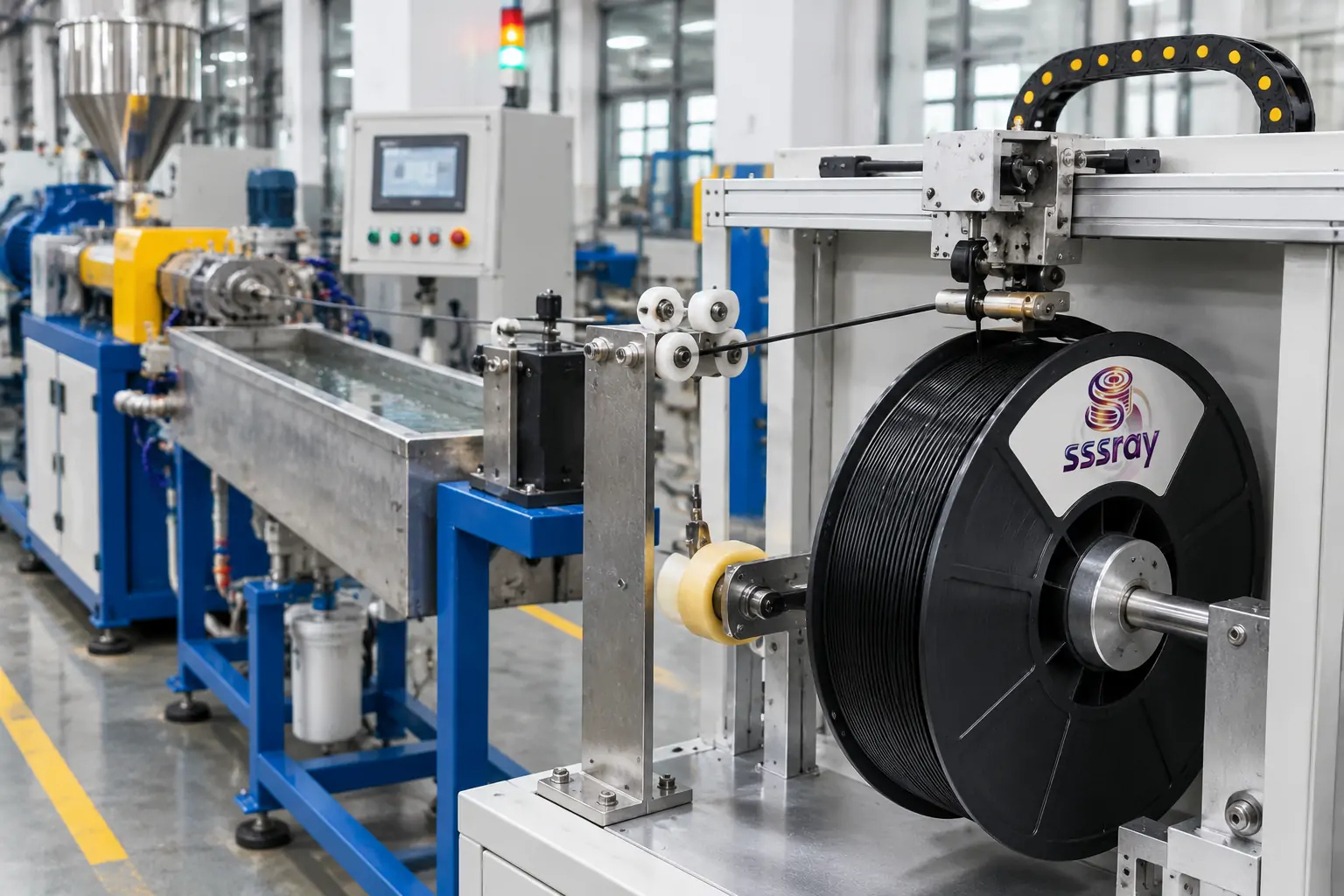
The table pairs each recorded result with its release limit. The margin column is calculated from the published measurements. Our batch QC process describes how we link production records to orders. For a live qualification, ask us to record any ambient temperature or relative humidity constraints in your inspection plan.
Swipe the table to see all columns.
| Parameter | Equipment and method | Coverage and result | Published release limit | Margin to limit |
|---|---|---|---|---|
| Filament diameter | Bench digital micrometer, 0.001 mm readability. Five positions per spool at 0, 2, 4, 6 and 8 m from the outer end of the wound strand; two perpendicular readings at each position (8 m from first to fifth position). Bench method. | 200 readings, mean 1.750 mm, range 1.729–1.768 mm | 1.75 ± 0.03 mm | 0.009 mm at the closest limit |
| Ovality | Difference between the perpendicular diameter readings at each bench position | 100 positions, mean 0.007 mm, maximum 0.014 mm | ≤ 0.020 mm | 0.006 mm below the limit |
| Net filament weight | Bench scale, 0.1 g readability, checked against a 1 kg reference weight, spool tare removed | 20 spools, mean 1,004.3 g, range 1,001.7–1,007.9 g | ≥ 1,000 g | 1.7 g above the minimum |

What the signed record carries beyond this summary
A page like this one is a summary, not a release certificate. If your inspection plan depends on the items below, ask for the signed COA for the lot on the quote and match its identifiers to the spool or carton before you release incoming stock.
Swipe the table to see all columns.
| Field | What the buyer checks on the signed record | What this page publishes |
|---|---|---|
| Record and lot identity | Release record number, lot number and the line or lot sequence behind the suffix | SSS-PLA-HTSQTY-LV-2026-0923-R1 and PLA175-BK-260921-L12 |
| Production and test window | Production date, conditioning time and the date of each test | Produced 21 September 2026; measured 22–23 September 2026 |
| Sampling basis | Lot size, sampling interval, spools sampled and the measuring positions on each spool | 600 spools, every 30th off the winder, 20 sampled from the start of the run to its end, 5 positions per spool at 0, 2, 4, 6 and 8 m from the outer end of the strand (8 m first-to-fifth span), 2 perpendicular readings at each |
| Apparatus and calibration | Instrument make and model, asset number, calibration certificate number and its due date | Method and readability for each parameter; the calibration certificates travel with the signed COA on request |
| Results and limits | Per-parameter values, the release limit and the pass or hold decision | Diameter, ovality and net weight, each with the calculated margin to its limit |
| Release authority | Name, role and signature date of the person who released the lot | Not reproduced here; the signed copy travels with the shipment |
| Revision | Revision number and any value it supersedes | R1 |
Two of these fields sink more incoming inspections than the measurements do. A calibration certificate that expired before the test date breaks traceability, and a release signature dated after the goods left the plant means the lot shipped before anyone released it. Both are worth checking at sample approval, not at receipt.
How the Same 200 Readings Perform Against Two Acceptance Limits
At the recorded factory limit of 1.75 ± 0.03 mm, all 200 diameter readings fell inside the release window. For a buyer specifying ±0.02 mm at every measured point, 199 of 200 readings are within that tighter band, or 99.5% of the readings. That single outlying reading would trigger a hold under an all-points rule. We measured 20 of 600 spools, or 3.33% of this lot, so use these figures to set the inspection plan for your next order.
For this sample, our 1.729 mm minimum is 0.009 mm above the 1.720 mm release limit. The upper margin is 1.780 minus 1.768 mm, or 0.012 mm. These are calculations from measured values. For a tight-tolerance RFQ, specify the instrument, axes, sample positions and pass rule before we produce the lot.
On a new order, match the current lot COA to the spool or carton and compare against your approved sample. For a tender, request the origin declaration and manufacturing-site evidence separately. A buyer considering our commercial stock can use the filament test protocol to set print acceptance before sampling.
Production data: credited to SSSray. Contact SSSray for permission to redistribute the published QC records.
Heat-Performance Qualification: An Illustrative PLA Example
Illustrative values, not a production-lot release record. This example shows why a heat-performance result must be checked alongside dimensional stability. The figures below are from a worked example for one unfilled high-heat PLA grade; they do not represent a released SSSray batch.
| Measurement | As-printed mean | Annealed mean | Sample size per state |
|---|---|---|---|
| HDT, 0.45 MPa (Method B) | 56.6 °C | 82.7 °C | 5 |
| HDT, 1.80 MPa (Method A) | 50.8 °C | 68.2 °C | 5 |
| Vicat B50 | 62.4 °C | 89.5 °C | 5 |
| Calculated crystallinity (Xc) | 10.3% | 36.6% | 3 |
| Cantilever residual tip deflection after cooling | 1.31 mm | 0.11 mm | 5 |
| Dimensional change — X / Y / Z | −0.00% / 0.00% / 0.00% | −1.32% / −1.18% / +1.55% | 5 |
For the example purchase order, all annealed HDT-B readings must be at least 80 °C, all HDT-A readings at least 65 °C, and residual deflection no more than 0.20 mm. The annealed specimens meet those three criteria. However, every measured coupon on all three axes falls outside the ±1.00% dimensional band: X changes by −1.32% on average, Y by −1.18%, and Z by +1.55%. The buyer holds the sample for dimensional requalification rather than approving it on heat performance alone.
View the full test plan, specimen readings and method references
Lock the test plan before quoting a heat-performance requirement
We ask a buyer to give us the applied load, allowable part movement and dimensional tolerance before selecting a qualification method. The example below runs that sequence on one unfilled high-heat PLA grade to show what the records would contain.
Scroll horizontally to see all columns.
| Method | Equipment and setup | Cohorts or endpoints |
|---|---|---|
| Build and cohorts | FFF printer with a 0.4 mm nozzle. Unfilled high-heat PLA grade. Printed flat, length along X; 0.20 mm layers, 100% rectilinear infill at ±45°, 205 °C nozzle and 60 °C bed. Each method has its own coupons. Use the test code plus P or A and the position number, such as HDT-B-A01. In each row, results follow that specimen order. | As-printed P and annealed A; n = 5 per state per HDT stress, Vicat, dimension and cantilever test; n = 3 per state for DSC. |
| Annealing and conditioning | Convection oven with a calibrated reference thermocouple. A: 85 ± 2 °C for 60 min after the tray returns to setpoint, followed by cooling in the closed oven to below 40 °C. P: hold at ambient. Condition both cohorts for 48 h before measurement. | Conditioning at 23 ± 2 °C and 50 ± 10% RH. Dimensions use fixed points before and after the assigned treatment. |
| HDT, ISO 75-1/75-2 | HDT apparatus, three-point bending in a stirred bath. Flatwise 80 × 10 × 4 mm bars, 64 mm nominal span, 120 ± 10 °C/h. The deflection endpoint is about 0.34 mm for a nominal 4 mm bar and 0.2% flexural strain increase. | Method B at 0.45 MPa; Method A at 1.80 MPa. Use independent bars for each stress and calculate force from the actual cross-section. |
| Vicat, ISO 306:2022 | Vicat apparatus with a nominal 1 mm² indenter. Printed 10 × 10 × 4 mm coupon. B50: 50 N, 50 °C/h; record temperature at 1 mm penetration. | Five coupons per state; test the face parallel to the build plane. |
| First-heating DSC | DSC; 5–8 mg from the center of a separately printed coupon; nitrogen 50 mL/min; 25 to 200 °C at 10 °C/min. ISO 11357-2/-3 terminology. First heating retains the prior build and anneal history. | Xc = 100 × (ΔHm − ΔHcc) / 93.7 J/g. This example assumes an unfilled PLA mass basis; calculate Xc separately for each specimen. |
| Dimensional change | Digital micrometer, 0.01 mm resolution. Five 60 × 20 × 4 mm coupons per state. Measure the same marked positions before and after treatment, after conditioning at room temperature. | X = length, Y = width, Z = thickness. Per coupon change = 100 × (after − before) / before. |
| Cantilever | Heated chamber, cantilever fixture and displacement gauge. 80 × 10 × 4 mm flat bars, 50 mm free length, 1.00 N at the tip, 60 ± 1 °C for 30 min after stabilization. Unload and record residual displacement after 30 min at 23 ± 2 °C. | Custom fixture comparison. Direct tip load setup gives about 1.88 MPa nominal outer-fiber stress at the clamp. |
Read the thermal and fit results together
Individual readings follow the specimen numbering in the methods table. Means and ranges are calculated from the individual values before rounding.
Scroll horizontally to see all columns.
| Measurement | State | n | Individual readings | Mean (range) | Unit |
|---|---|---|---|---|---|
| HDT, 0.45 MPa | As printed | 5 | 55.8, 56.4, 57.0, 57.3, 56.5 | 56.6 (55.8 to 57.3) | °C |
| HDT, 0.45 MPa | Annealed | 5 | 80.9, 82.0, 82.8, 83.6, 84.2 | 82.7 (80.9 to 84.2) | °C |
| HDT, 1.80 MPa | As printed | 5 | 49.8, 50.2, 50.8, 51.4, 51.8 | 50.8 (49.8 to 51.8) | °C |
| HDT, 1.80 MPa | Annealed | 5 | 66.8, 67.6, 68.2, 68.9, 69.5 | 68.2 (66.8 to 69.5) | °C |
| Vicat B50 | As printed | 5 | 61.6, 62.1, 62.5, 62.8, 63.0 | 62.4 (61.6 to 63.0) | °C |
| Vicat B50 | Annealed | 5 | 88.3, 88.9, 89.6, 90.1, 90.6 | 89.5 (88.3 to 90.6) | °C |
| Tg midpoint | As printed | 3 | 57.8, 58.1, 58.4 | 58.1 (57.8 to 58.4) | °C |
| Tg midpoint | Annealed | 3 | 58.8, 59.1, 59.0 | 59.0 (58.8 to 59.1) | °C |
| Cold crystallization peak | As printed | 3 | 108.3, 107.7, 108.0 | 108.0 (107.7 to 108.3) | °C |
| Cold crystallization peak | Annealed | 3 | 113.6, 114.1, 114.5 | 114.1 (113.6 to 114.5) | °C |
| Melting peak | As printed | 3 | 164.1, 164.6, 164.4 | 164.4 (164.1 to 164.6) | °C |
| Melting peak | Annealed | 3 | 164.9, 165.1, 165.4 | 165.1 (164.9 to 165.4) | °C |
| Melting enthalpy ΔHm | As printed | 3 | 33.4, 34.1, 34.6 | 34.0 (33.4 to 34.6) | J/g |
| Melting enthalpy ΔHm | Annealed | 3 | 38.8, 39.4, 40.1 | 39.4 (38.8 to 40.1) | J/g |
| Cold crystallization enthalpy ΔHcc | As printed | 3 | 24.1, 24.3, 24.7 | 24.4 (24.1 to 24.7) | J/g |
| Cold crystallization enthalpy ΔHcc | Annealed | 3 | 4.9, 5.2, 5.4 | 5.2 (4.9 to 5.4) | J/g |
| Calculated crystallinity Xc | As printed | 3 | 9.9, 10.5, 10.6 | 10.3 (9.9 to 10.6) | % |
| Calculated crystallinity Xc | Annealed | 3 | 36.2, 36.5, 37.0 | 36.6 (36.2 to 37.0) | % |
Scroll horizontally to see all columns.
| Axis | State | n | Before (mm) | After (mm) | Individual change (%) | Mean (range), % |
|---|---|---|---|---|---|---|
| X | As printed | 5 | 60.02, 59.98, 60.05, 60.00, 60.03 | 60.02, 59.97, 60.05, 60.01, 60.03 | 0.00, -0.02, 0.00, 0.02, 0.00 | -0.00 (-0.02 to 0.02) |
| Y | As printed | 5 | 20.01, 20.03, 19.99, 20.02, 20.00 | 20.00, 20.03, 20.00, 20.02, 20.00 | -0.05, 0.00, 0.05, 0.00, 0.00 | 0.00 (-0.05 to 0.05) |
| Z | As printed | 5 | 4.00, 4.02, 3.99, 4.01, 4.00 | 4.00, 4.02, 3.99, 4.01, 4.00 | 0.00, 0.00, 0.00, 0.00, 0.00 | 0.00 (0.00 to 0.00) |
| X | Annealed | 5 | 60.02, 60.05, 59.98, 60.00, 60.04 | 59.20, 59.27, 59.22, 59.23, 59.20 | -1.37, -1.30, -1.27, -1.28, -1.40 | -1.32 (-1.40 to -1.27) |
| Y | Annealed | 5 | 20.01, 20.03, 19.99, 20.02, 20.00 | 19.77, 19.81, 19.75, 19.77, 19.77 | -1.20, -1.10, -1.20, -1.25, -1.15 | -1.18 (-1.25 to -1.10) |
| Z | Annealed | 5 | 4.00, 4.02, 3.99, 4.01, 4.00 | 4.06, 4.08, 4.05, 4.08, 4.06 | 1.50, 1.49, 1.50, 1.75, 1.50 | 1.55 (1.49 to 1.75) |
Scroll horizontally to see all columns.
| Measurement | State | n | Individual readings | Mean (range) | Unit |
|---|---|---|---|---|---|
| Loaded tip deflection at 30 min | As printed | 5 | 3.65, 3.80, 3.92, 4.02, 4.11 | 3.90 (3.65 to 4.11) | mm |
| Loaded tip deflection at 30 min | Annealed | 5 | 0.90, 0.97, 1.04, 1.08, 1.16 | 1.03 (0.90 to 1.16) | mm |
| Residual tip deflection after cooling | As printed | 5 | 1.18, 1.24, 1.32, 1.40, 1.43 | 1.31 (1.18 to 1.43) | mm |
| Residual tip deflection after cooling | Annealed | 5 | 0.08, 0.09, 0.12, 0.13, 0.15 | 0.11 (0.08 to 0.15) | mm |
How the example decision is reached
For this example purchase order, all sampled HDT-B readings must be at least 80 °C, all HDT-A readings must be at least 65 °C, and residual deflection must stay at or below 0.20 mm. The annealed cohort passes those three heat and deflection checks. Its mean dimensional changes are -1.32% in X, -1.18% in Y and +1.55% in Z; every coupon on all three axes falls outside the ±1.00% dimensional band. The engineering buyer therefore holds the sample for dimensional requalification and asks the supplier for a revised annealing or compensation plan.
Method references: ISO 75-1, ISO 75-2, ISO 306, ISO 11357-2, ISO 11357-3 and the PLA crystallinity calculation reference.
Worked-example terms: illustrative values used to demonstrate the method. For republication or redistribution, contact SSSray.
TAA Compliant Filament FAQ for Schools and Government Buyers
The answer depends on the exact item, the purchase route and the origin it can substantiate.
Can schools buy Chinese 3D printer filament?
Yes, where the specific purchasing route and its terms permit it. A privately funded purchase under a private school’s ordinary policy differs from a public district order using a cooperative contract or a federal award. Under 2 CFR 200.322, the recipient or subrecipient should, to the greatest extent practicable and consistent with law, provide a preference for the purchase, acquisition, or use of goods, products, or materials produced in the United States. The requirements of this section must be included in all subawards, contracts, and purchase orders under Federal awards. This is a domestic preference under the Uniform Guidance, not the same country-of-origin test as TAA and not a rule that automatically governs every privately funded school purchase. Ask the purchasing office to identify the funding source, the ordering vehicle and any exact origin language. Keep its answer with your quote and PO.
Is Chinese filament TAA compliant if a U.S. brand re-spools or relabels it?
Generally no for a standard Schedule offering if the imported product is already finished filament and U.S. work is limited to winding, labeling or packing. The strand already has its composition, controlled diameter and printing use before it reaches the U.S. For a different fact pattern, such as feedstock actually processed into filament at another site, collect the operations and input records. Have the origin basis reviewed before a supplier makes a claim for the finished SKU.
When does a federal buyer have to check AbilityOne for filament?
Check the Procurement List when a federal requisition names an NSN or a similar listed item may meet the requirement. For example, GSA lists SKILCRAFT black PLA in 1.75 mm and 1 kg under NSN 7045-01-685-8922. Ask the ordering office to confirm the required source, current availability, any essentially-the-same restriction and whether an applicable exception exists. Keep the agency’s determination with the requisition before evaluating a commercial substitute, even if its published size and polymer match the listed spool.
How do you sell 3D printer filament on GSA Schedule?
Offer the exact awarded SKU through an applicable Schedule contract and substantiate that it meets the governing origin terms. GSA states that MAS contract offerings are subject to TAA and that contractors must provide only U.S.-made or designated-country end products and services. The $174,000 WTO GPA supply threshold is an agreement-specific coverage threshold; it does not create a low-value exception for a product offered on a MAS contract. A manufacturer working with a Schedule reseller should give the reseller the part number, manufacturing site, origin basis and a way to check the shipping lot. The reseller should confirm that the item is included in its awarded catalog and keep the product representation current. A change in the manufacturing site or processes calls for a review before the next offer.
Do state governments always require TAA compliant filament?
No. Check the relevant state or local policy, solicitation language, funding conditions and contract vehicle. A public university may buy one order from a state contract and another under the conditions of a federal award. For GSA purchasing, verify that the buyer, program and product category are eligible. A prime contract can also pass specific sourcing terms down to a supplier. Ask the procurement officer which exact terms reach the spool, whether the requirement is a preference or an exclusion, and what proof must be submitted.
Can the military buy 3D printers from a Chinese manufacturer?
Section 849 of the FY 2026 NDAA bars the Secretary of Defense from entering into a contract for a covered additive manufacturing machine beginning December 18, 2026. A machine is covered when it is manufactured by a covered additive manufacturing company; the definition also includes related services or equipment provided or manufactured, respectively, by that company. The statutory exception says the prohibition does not apply to procurement of additive manufacturing systems or machines for the purposes of intelligence, electronic warfare, or information warfare operations, testing, analysis, or training. China is a covered nation, but the buyer must check the manufacturer’s status against the full statutory definition and review the solicitation. A stand-alone filament order is not itself an additive manufacturing machine and needs its own clause and flow-down review. Ask the contracting officer or prime to identify the treatment of each deliverable before quoting a bundle.
Does a certificate of analysis prove TAA compliance?
No. A COA reports lot-specific quality measurements against the agreed specification; it does not establish the finished product’s country of origin or prove substantial transformation. Request a separate SKU-level origin declaration identifying the legal manufacturer, manufacturing site and relevant operations, then compare that evidence with the clause governing the purchase.
What evidence should a procurement team request before the first reorder?
Request the current SKU-level origin declaration and a lot-matched COA. The declaration should identify the legal manufacturer and the site and process supporting the origin claim. The COA should reference the lot on the carton or spool and report the tests you agreed at sample approval. Check whether any manufacturer, site or material change has taken place since the last order. Require the supplier to flag changes before shipping, especially when the SKU serves both public and commercial buyers.
Conclusion — Buy TAA Compliant Filament Against the Exact Clause
Approve the purchasing route and the exact origin first, then qualify the grade, sample and lot for the printer and application.
For a private school or a distributor, the practical starting point is a written answer on which buyer terms permit China-origin material. For GSA Schedule or another origin-restricted bid, start with an eligible SKU whose manufacturing origin the seller can substantiate. A domestic warehouse or an approved test spool tells you only one part of the story. Ask purchasing for the governing clause and ask the supplier to tie its documents to the actual item.
For commercial or education orders that permit China-origin filament, send the buyer type, delivery location, applicable clause, material, diameter, color, spool size, volume and target date. We typically reply to complete inquiries within one business day. For an eligible inquiry, we confirm the manufacturing origin, the bulk or OEM quote path, and availability of sample spools, grade-specific TDS/SDS and the lot COA. For an origin-restricted line, confirm the authorized route with your purchasing office first.
Request a quote or free samples
Tell us the material, color, spool size and monthly volume. An engineer replies within 24 hours on business days.
References
Use these sources to confirm the terms that govern your line item. We checked the regulatory sources on November 18, 2026. For product safety and material-specific U.S. requirements, see our U.S. filament safety and compliance guide.
- FAR 25.003 — Designated-country definitions · GSA — Designated-country lookup
- FAR 25.402 — Trade agreement thresholds · FAR 52.225-5 — Trade Agreements clause
- FAR Subpart 25.1 — Buy American for supplies
- GSA — Trade Agreements Act compliance on the Multiple Award Schedule · FAR 8.402 — Schedule ordering and GSA Global Supply
- GSA — State and local buyer eligibility · GSA — Cooperative Purchasing scope
- GSA Global Supply — Filament NSNs and AbilityOne ordering · GSA — SKILCRAFT filament NSN brochure
- FAR Subpart 8.7 — AbilityOne purchase priority and exceptions · 41 CFR 51-5.3 — Essentially-the-same commodities
- 2 CFR 200.322 — Domestic preferences for procurements
- 19 CFR Part 177, Subpart B — CBP procurement origin determinations
- GovInfo — Public Law 119-60 and enactment date · GovInfo — FY 2026 NDAA, Section 849
- 10 U.S.C. 4872 — Covered nations
- DFARS 225.7002-1 — Berry Amendment restrictions · DFARS 252.225-7021 — Defense trade agreements
- SSSray — Standard black PLA batch record · SSSray — Bench sampling method and black PLA release limits
- SSSray — Quote request and typical response time

He Jiang
Senior Researcher · SSSray · 3D Printing Filament Manufacturing · Jinhua, Zhejiang
He Jiang is a senior researcher at SSSray, a 3D printing filament manufacturer in Jinhua, Zhejiang, China. He works on matching a buyer’s material spec to the production lot, qualification method and documents our factory supplies.
