Online time
Monday to Friday: 9AM - 8PM
Weekend: 10AM - 5PM


TL;DR: Match the Compliance Route to the Application, Not the Logo
USA filament compliance is not one badge. FDA, UL and ASTM answer three different questions: what may touch food or the body, how a plastic burns, and what may be called compostable. Most general-purpose filament needs none of the three. For US-bound filament shipments, the importer must determine and make the applicable TSCA certification at entry, and California sales bring Proposition 65 into play.
Best optionBuild one baseline pack per SKU (SDS, TDS, lot COA, TSCA statement, Prop 65 review), then add only the route your application triggers.
When not to use itSkip FDA, ISO 10993 and UL files for prototypes, jigs and decorative prints. They add cost and prove nothing for those uses.
Key specificationEvery claim should name the exact grade and color, the regulation or standard, the test thickness or conditions of use, and a date.
Verify the supplierAsk whether the evidence covers the finished filament or only the base resin. Check UL claims in UL’s database and FDA claims against 21 CFR or the FCN inventory.
Procurement warning“FDA approved filament” does not exist, and a molded-bar UL 94 rating does not transfer to a printed part. Ask for documents when you see either.
Abstract
Compliance paperwork is where USA filament deals most often stall. A buyer asks for “FDA approved, UL certified, ASTM tested” filament, a supplier answers “yes” to all three, and neither side has said which product, use or document they mean.
Part of the confusion is structural. The FDA, the Consumer Product Safety Commission (CPSC) and the Environmental Protection Agency (EPA) are federal regulators. UL Solutions, by contrast, is a private company that tests and certifies. ASTM International writes standards and certifies nothing. Three very different roles get compressed into one line on a spec sheet.
Meanwhile, 2026 raised the stakes for USA filament compliance. CPSC’s electronic filing of certificate data became mandatory on July 8, 2026 for imported consumer products subject to CPSC certification requirements. The FDA partially recognized the new ISO 10993-1:2025 on May 25, 2026, and its fiscal-year 2027 device fees took effect on October 1, 2026. Looking ahead, California’s extension for “compostable” labels on synthetic materials expires on June 30, 2027.
Four buyer assumptions waste the most money: that filament can be “FDA approved”; that a UL 94 rating measured on molded bars carries over to a printed part; that PLA may be sold as “biodegradable” everywhere; and that a REACH or RoHS declaration covers the USA.
The B2B logic is simpler than the alphabet soup suggests. Compliance attaches to an application and a claim, not to a polymer name. A PETG spool used for jigs needs a baseline import pack and nothing more. Yet the same spool printed into a food scoop, a toy or a device housing triggers three different routes.
This guide follows that logic in six steps: an application-to-requirement matrix; a route-by-route explanation of food contact, medical, flammability, compostability, toy safety and chemical rules; a cost and lead-time comparison built on published fees; a per-kilogram amortization model; the Compliance-Fit Scorecard, a seven-checkpoint framework for approving suppliers and reorders; and SSSray’s own factory data, covering batch release limits, flame-retardant grade data and a 30-day moisture test on our V-0 nylon.
Key Takeaways
- “FDA approved filament” is not a real status. A filament can only be compliant for a stated use.
- A Food Contact Notification is supplier-specific. It covers only the named manufacturer or supplier and their customers, so a silent resin swap can remove the legal basis.
- A 510(k) clears a device, never a spool. ISO 10993 data on filament supports a device file but does not replace evaluating the finished device.
- UL 94 ratings are thickness-specific and process-specific. UL states that Yellow Card ratings cannot be applied to 3D printed parts.
- ASTM D6400 covers industrial composting, not “biodegradable.” California restricts “biodegradable” labels and ties “compostable” to ASTM D6400.
- BPI certification is not open to every product. Items must be associated with food scraps or yard trimmings, which generally excludes a filament spool.
- ABS has a CPSC shortcut that PLA and PETG lack. 16 CFR 1308.2 exempts ABS, PP, PE and HIPS from third-party phthalate testing.
- REACH paperwork is not USA filament compliance. US entry requires the importer to make the applicable TSCA certification, and California sales need a Proposition 65 review.
- Fixed compliance cost only makes sense per kilogram. A $5,000 annual cost adds $5.00/kg at 1 tonne a year but $0.10/kg at 50 tonnes.
- A flame rating needs a thickness, a color and a dry spool. SSSray publishes PETG-FR and PC-ABS-FR as UL 94 V-0 typical at 1.5 mm in black, and our V-0 nylon took up 0.32% moisture in 24 hours at 50% RH.
1. FDA vs UL vs ASTM: Which USA Compliance Applies to Which Filament?
Direct answer: none of the three applies to filament by default, so USA compliance starts with the application. FDA rules are triggered by food or body contact, UL ratings by fire-safety requirements in an end product, and ASTM D6400 by a compostability claim. The baseline US chemical-compliance checks are the applicable TSCA import certification and, for California sales, a Proposition 65 review.
A driving analogy helps. FDA, CPSC and EPA are the traffic police. UL is closer to a crash-test rating that fleet buyers insist on. ASTM writes the test manual everyone else quotes.
Regulator, certifier or standards body: who can stop a shipment?
- FDA (regulator). Authorizes food contact substances and clears or approves medical devices. It does not approve filament.
- CPSC and EPA (regulators). CPSC requires certificates for children’s products; under TSCA, importers certify chemical compliance at entry.
- UL Solutions (private certifier). It tests and certifies plastics to UL 94, the flammability standard published by its non-profit affiliate UL Standards & Engagement. UL Recognition is a certification with factory follow-up.
- ASTM International (standards developer). It publishes D6400 and F963 but certifies nothing. CPSC makes F963 mandatory for toys.
Which filaments require FDA, UL or ASTM evidence? An application matrix
On mobile, swipe horizontally to review every column.
| Application | Typical filament | Legally required in the USA | Commonly requested by buyers | Who carries the obligation | Usually unnecessary |
|---|---|---|---|---|---|
| Prototypes, jigs, décor, general retail spools | PLA, PETG, ABS, ASA, TPU | Applicable TSCA import certification at entry; Proposition 65 warning where required | SDS, TDS, lot COA, RoHS and REACH declarations | Importer of record; brand owner for labels | FDA, ISO 10993, UL 94, ASTM D6400 |
| Food-contact parts (scoops, molds, containers) | PETG, PLA, PP | Each substance expected to migrate must be authorized (21 CFR listing, FCN, GRAS or exemption) | Declaration for the exact grade and color; migration test on the print | Maker of the finished article | UL 94, ISO 10993 |
| Medical device components | PETG, PC, PA12, TPU, PEEK | Device clearance or approval where required; biological evaluation of the finished device | ISO 10993-5, -10 and -23 reports; change control | Device manufacturer | ASTM D6400; UL 94 unless the device is electrical |
| Electrical enclosures and electronics parts | Flame-retardant ABS, PC, PETG, PA-CF | Nothing for filament itself; the end-product standard sets the flame class | UL 94 report on printed bars; UL Recognized (Blue Card) grade | End-product manufacturer | FDA, ASTM D6400 |
| Toys and children’s products (age 12 and under) | PLA, PETG, ABS, TPU | Children’s Product Certificate for applicable children’s product safety rules; total lead ≤ 100 ppm in accessible component parts; for children’s toys and child care articles, each of eight regulated phthalates ≤ 0.1%; ASTM F963-23 for children’s toys | Component-part test reports for each color | US importer or domestic manufacturer | ISO 10993; UL 94 unless the toy is electrical |
| “Compostable” or “eco” marketing claims | PLA, PHA blends | Substantiation under the FTC Green Guides; California limits “biodegradable” and “compostable” labels | ASTM D6400 report on the formulated filament | Brand making the claim | FDA, UL 94 |
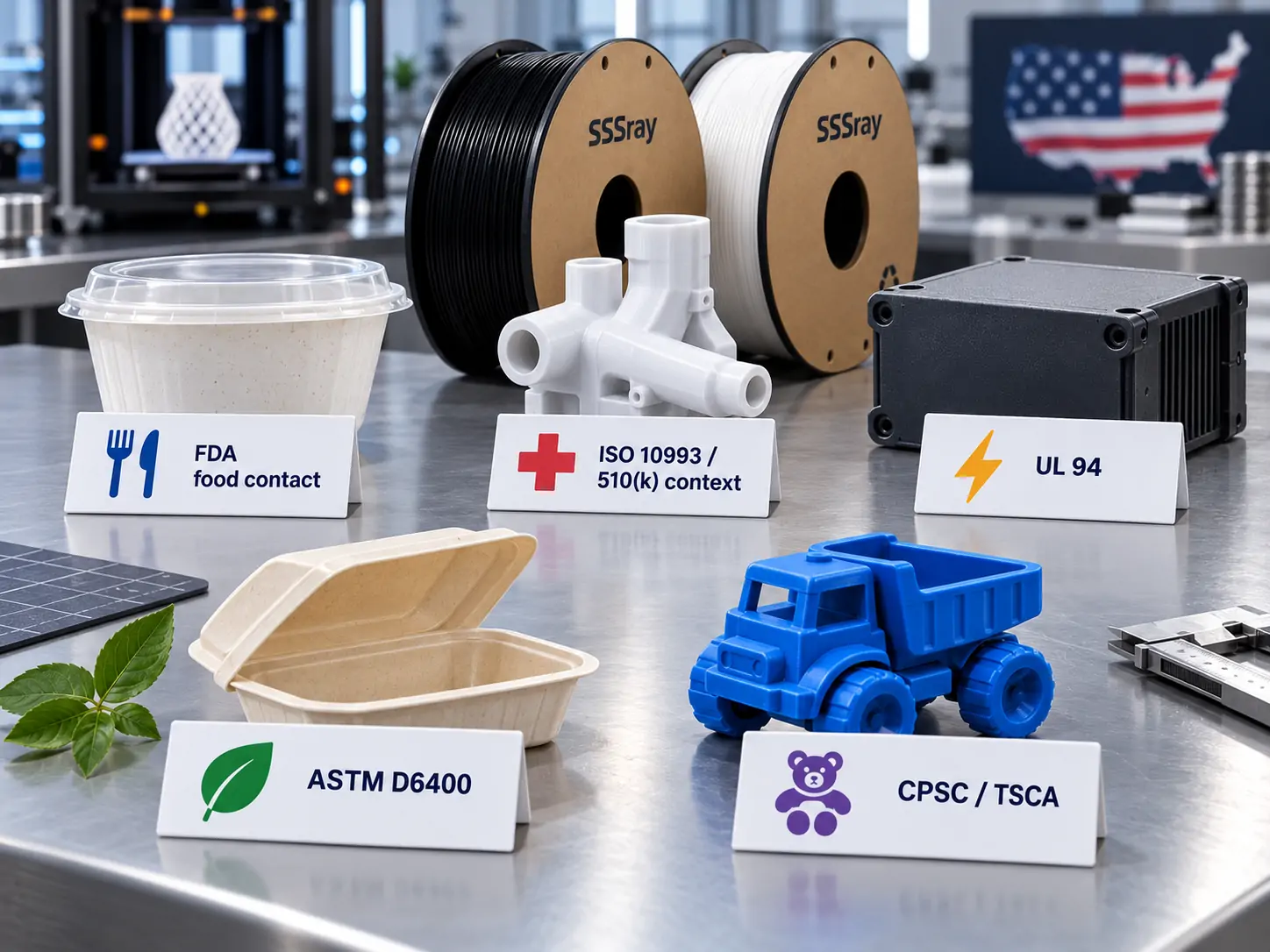
Two patterns stand out. In USA compliance, the obligation almost always sits with whoever makes or imports the finished product, while the filament supplier provides the evidence. And over-certification is real: food-contact and flammability files on a hobby PLA line are documents no customer can use.
Procurement implicationState the end use in the RFQ. Without it, a supplier can only quote a generic pack.
Mistake to avoidAsking for “all certificates” and comparing suppliers by logo count.
How to verifyMap each SKU to one row of Table 1, then list only the documents that row needs.
2. FDA Approved 3D Printing Filament Is a Myth: Food Contact Filament Regulation in Practice
Direct answer: no filament is “FDA approved,” and none needs to be. The law requires that every substance reasonably expected to migrate into food from the finished article is authorized for that use. A filament can be compliant under stated conditions; FDA does not approve the spool itself.
A substance gets that authorization in one of four ways: a food additive regulation in 21 CFR Parts 174–178; an effective Food Contact Notification (FCN), which FDA has 120 days to object to; GRAS status or a prior sanction; or a Threshold of Regulation exemption for very low exposure (21 CFR 170.39).
What is the difference between FDA compliant and FDA approved?
“FDA compliant,” used properly, means the composition conforms to a named regulation or FCN under named conditions of use. “FDA approved,” applied to a filament, has no legal meaning.
The two main mechanisms also differ. A food additive regulation is public, so anyone whose material meets its specifications may rely on it. An FCN, by contrast, is proprietary. FDA’s FCN inventory states that a notification is only effective for the manufacturer or supplier identified in it, although their customers may rely on it for the notified use.
The sourcing consequence is direct: if a filament maker switches to a look-alike resin from another producer, the notification no longer covers the material.
Do I need FDA approval for PETG food containers?
No approval is needed, but compliance is. PETG-type copolyesters are listed in 21 CFR 177.1315, which sets composition, extraction limits and conditions of use. That covers the base polymer only. Three more layers matter:
- Colorants and additives. Pigments need their own clearance, for example under 21 CFR 178.3297. A natural grade is the simplest case.
- Conditions of use. The regulation links each copolymer type to extraction limits and permitted uses. One entry, for instance, excludes carbonated beverages and beer.
- The printing process. Nozzle wear, residue from earlier materials and layer lines that trap food soil are the article maker’s responsibility.
PLA follows a different path. It has no polymer listing of its own in 21 CFR Part 177, so resin producers rely on effective FCNs. For a PLA quote, therefore, check the inventory for the resin maker’s name.
What a usable food-contact declaration contains
- The exact grade name and color, with the regulation section or FCN number relied on.
- Conditions of use: food types, temperature, contact time, single or repeated use.
- A statement covering colorants and additives, and whether testing was done on resin, filament or a printed article.
- Issue date, signatory and a commitment to notify formulation changes.
Established brands word this carefully. colorFabb states that its food-contact compliance holds for the raw materials only, not for the filament or the printed part. That candor is the baseline for comparing suppliers on USA filament compliance.
Procurement implicationBuy food-contact grades by exact color, and write the resin source into the specification.
Mistake to avoidAccepting a resin maker’s certificate as proof for a pigmented, re-extruded filament.
How to verifyMatch the cited section or FCN number against 21 CFR or FDA’s inventory; test migration on the printed part for critical uses.
3. Medical Device Material Compliance: ISO 10993 vs FDA 510(k) for Filament Buyers
Direct answer: they are not alternatives. A 510(k) is a premarket submission for a medical device. ISO 10993 is the family of standards used to evaluate that device’s biological safety. Filament is a raw material in both, so it is never “510(k) cleared” or “ISO 10993 certified” on its own.
FDA evaluates biocompatibility on the device in its final finished form, because printing, post-processing, cleaning and sterilization can all change the surface that touches a patient.
Material-level data still has value as an early screen. The usual starting set is the “big three”: cytotoxicity (ISO 10993-5), sensitization (ISO 10993-10) and irritation (ISO 10993-23). A 2024 review in Frontiers in Toxicology describes these three as standard for nearly all medical devices.
What changed for medical device material compliance in 2026
- ISO 10993-1:2025. The sixth edition, published in November 2025, places biological evaluation inside a life-cycle risk-management process.
- FDA partial recognition. On May 25, 2026, FDA recognized that edition in part. Clause 6.9 on biological risk estimation is not recognized.
- Transition window. Manufacturers can keep following the 2018 edition until July 1, 2029, so material reports citing either edition remain usable during the changeover.
- FY2027 user fees. From October 1, 2026, a 510(k) costs $28,653, or $7,163 for a qualified small business. Annual establishment registration is $13,785.
In USA compliance terms, these fees belong to the device manufacturer, not the filament supplier.
Can I sell medical filament without ISO 10993?
You can sell the filament. What you cannot do is imply that the spool makes a device compliant. No rule obliges a spool to carry an ISO 10993 report, yet a device maker can do little with a material that lacks one. Device manufacturers typically ask for:
- ISO 10993-5, -10 and -23 reports on printed specimens of the exact grade and color, and USP Class VI results where specified.
- Formulation disclosure under a confidentiality agreement.
- Lot-level COA with traceability to the resin lot.
- Written notice before any change to resin, pigment or additive.
Procurement implicationLock the formulation in a supply agreement. A new pigment can trigger new testing on your device.
Mistake to avoidPlanning a submission around a one-page “biocompatible” certificate with no lab, method or date.
How to verifyCheck that each report names the exact grade, laboratory, standard edition and specimen preparation.
4. UL Certification for Filament: UL94 Flammability Rating, Yellow Card and Blue Card
Direct answer: no federal law requires filament to be UL certified, so this part of USA compliance arrives indirectly. The safety standard for an end product sets a flame class for its plastic enclosure, and the certifier or buyer then asks for material evidence.
So which filaments require UL certification in the USA? In practice, flame-retardant ABS, PC, PETG and PA grades printed into enclosures and internal parts of electrical products. Standard PLA, PETG and TPU for general use do not.
UL94 flammability rating in plain terms
UL 94 holds a small flame to a plastic bar, about 125 mm × 13 mm at a stated thickness, and records how long it keeps burning and whether it drips flaming particles.
- HB. Slow burning on a horizontal bar; the lowest class.
- V-2. A vertical bar stops burning within 30 seconds of each flame application. Flaming drips are allowed.
- V-1. The same 30-second limit, but drips must not ignite the cotton placed below.
- V-0. Burning stops within 10 seconds of each application, with at most 50 seconds in total across five bars and no cotton ignition.
Two details tend to vanish from sales sheets. A rating is valid at a stated thickness, so V-0 at 3.0 mm says nothing about a 1.5 mm wall. It also applies only to the colors tested.
Why a molded-bar rating does not transfer to a printed part
A printed bar contains air gaps between extrusion lines, and those gaps expose more surface to the flame. A formulation that self-extinguishes as a molded bar may therefore burn longer as a printed one.
UL states that none of the ratings from a Yellow Card can be applied when that material is used to print a 3D part. The Blue Card, by contrast, is issued when a material intended for 3D printing receives the UL Recognized Component Mark.
As a result, flammability evidence comes in three strengths:
- A “V-0” line on a datasheet. The weakest form; ask what was tested and how.
- A UL 94 test report on printed bars. Useful for internal approval, provided thickness, orientation and print settings match yours.
- A UL Recognized grade with a Blue Card. The usual requirement when your end product is itself UL certified, and checkable in UL’s database.
How long does UL testing take for a new filament?
The burn is short, but conditioning is not. One set of bars is conditioned for 48 hours at 23 °C and 50% RH, and a second set for 7 days at 70 °C. One US fire-test laboratory advertises an average turnaround of about two weeks.
UL Recognition is a longer, quote-based project that adds a formulation review and factory follow-up inspections. We recommend requesting a written timeline first.
One chemical check belongs here too. EPA restricts decaBDE and PIP (3:1) under TSCA Section 6(h), so ask for a written statement that the flame-retardant package contains neither.
Our own grades follow the same rule. SSSray PETG-FR and PC-ABS-FR are published as UL 94 V-0 typical at 1.5 mm in black, and Section 10 lists the data behind them.
Procurement implicationSpecify the flame class, minimum wall thickness and color together.
Mistake to avoidQuoting a resin’s Yellow Card rating to a customer for a printed enclosure.
How to verifyLook the grade up in UL’s database by file number, or send bars printed at your wall thickness to an accredited lab.
5. ASTM D6400 Compostability Standard: What PLA Filament Can Legally Claim
Direct answer: ASTM D6400 is a specification for plastics designed to be composted in municipal or industrial facilities. It is not a general “biodegradable” standard, and passing it says nothing about a landfill, the ocean or a backyard heap.
It asks three things of a material under controlled composting:
- Disintegration. After 12 weeks, no more than 10% of the material remains on a 2 mm sieve.
- Biodegradation. At least 90% of the organic carbon converts to carbon dioxide within 180 days.
- Compost safety. Regulated metals stay under set limits, and the compost does not harm plant growth.
Why does PLA pass in a facility yet sit unchanged on a shelf? Its ester bonds break by reaction with water, and that reaction is fast only around PLA’s glass transition near 60 °C. Industrial compost holds that heat and moisture for weeks. A garden pile does not.
What a PLA filament brand can and cannot say in the USA
- Federal level. Under the FTC Green Guides, an unqualified “degradable” claim is deceptive unless the item breaks down completely within about a year of disposal.
- California. State law restricts “biodegradable,” “degradable” and “decomposable” on products, and allows “compostable” only when ASTM D6400 and further conditions are met.
- The 2027 date. California also requires compostable products to qualify as organic agricultural inputs; CalRecycle’s extension for synthetic materials expires on June 30, 2027.
In USA filament compliance terms, “made from plant-based PLA” can be supported, “industrially compostable per ASTM D6400” needs a test report on the formulated filament, and “biodegradable” is the word to remove.
Cost of getting ASTM D6400 certification for PLA
The North American certifier is the Biodegradable Products Institute (BPI). Its published fees are a $1,500 application for commercial-only certification, a $3,500 base annual license covering up to five certificates, and $1,000 per certificate for recertification every three years. A combined commercial-and-home application is $3,000, and a formulation change to a certified item is filed as a modification with a $500 application fee. Laboratory testing is billed separately. Time is the larger cost: disintegration testing takes at least three months, biodegradation at least six, and the whole process up to twelve months or more.
There is also an eligibility gate. BPI requires that an item be associated with food scraps or yard trimmings collected for composting. A general-purpose spool generally falls outside that scope, although resins can be certified. A realistic route for a filament brand therefore has three steps:
- Source PLA resin that already holds a compostability certificate.
- Commission ASTM D6400 testing on your own formulation, because masterbatch, impact modifiers and silk or matte additives can change the result.
- Make a qualified claim that cites the test report.
Procurement implicationTreat each formulation as a separate product. A certificate for natural PLA does not cover PLA+ or silk PLA.
Mistake to avoidPrinting “biodegradable” on boxes that will be sold into California.
How to verifyAsk which ASTM D6400 edition and lab were used, and whether the sample was resin or finished filament.
6. CPSC Toy Safety Requirements, TSCA Inventory Listing and REACH vs USA Chemical Compliance
Direct answer: three chemical-safety layers sit underneath every other part of USA filament compliance. CPSC rules apply when the product is for children. TSCA applies to every import. Proposition 65 applies when you sell into California. A European REACH or RoHS file answers none of them.
CPSC toy safety requirements for printed products
- Scope. A children’s product is one designed or intended primarily for children aged 12 or younger.
- Certificate. The importer or domestic manufacturer issues a Children’s Product Certificate based on testing at a CPSC-accepted laboratory.
- Limits. Total lead of no more than 100 ppm in accessible parts, eight phthalates at no more than 0.1% each in toys and child-care articles, and ASTM F963-23 for toys.
- eFiling. Since July 8, 2026, certificate data must be filed electronically at entry. Goods entered from a foreign-trade zone follow on January 8, 2027.
A general-use spool is not a children’s product, whereas 3D-pen refills marketed to children are. Under CPSC’s component-part testing rule (16 CFR Part 1109), a toy maker may rely on a supplier’s test reports, provided an accepted lab did the testing and the lot is traceable.
In addition, 16 CFR 1308.2 lists plastics that do not need third-party phthalate testing when made with specified additives: polypropylene, polyethylene, the polystyrene family including HIPS, and ABS. PLA, PETG and TPU are not on that list. For a toy brand, that is a testing-cost difference between ABS and PLA that no datasheet mentions.
TSCA inventory listing for filament
Every chemical substance in an imported filament must be on the TSCA Inventory or covered by an exemption, such as the polymer exemption. The importer signs the certification; the supplier provides the facts.
Under 19 CFR 12.121, chemical substances and mixtures need a certification at entry, while those that are part of an “article” need one only if a specific rule says so. EPA guidance adds that an item is not an article if its shape at import serves no function in its end use. Filament is melted and reshaped, so importers commonly file a positive certification; confirm with your customs broker.
A useful supplier statement covers three points:
- The polymer, pigments and additives are listed or exempt.
- Flame-retardant grades contain no decaBDE or PIP (3:1).
- Whether any PFAS, such as a PTFE lubricant, is intentionally added. The window for EPA’s one-time PFAS report opens no later than January 31, 2027.
REACH vs USA chemical compliance
REACH works through EU registration, plus communication duties when a Candidate List substance exceeds 0.1% by weight. TSCA works through Inventory status, a certification at the border and use-specific restrictions in 40 CFR Part 751. Proposition 65 adds a warning duty when a product exposes Californians to a listed chemical, and its list differs from the EU one.
Proposition 65 deserves a color-by-color look. UltiMaker’s compliance overview, for example, flags its ABS for styrene and its black and white colors for carbon black and titanium dioxide. Short-form warnings on products manufactured from January 1, 2028 must also name at least one listed chemical.
Procurement implicationCollect certificate data before the goods ship. With eFiling, a missing report surfaces at entry.
Mistake to avoidFiling a European REACH report as if it answered TSCA or Proposition 65.
How to verifyConfirm the lab on CPSC’s accepted list, and check that report sample IDs match the batch you received.
7. Third-Party Certification Cost, Lead Time and Value per Kilogram
Direct answer: in USA filament compliance, published fees are the small part. BPI’s application and license fees total $5,000 in the first year, and FDA’s fiscal-2027 510(k) fee is $28,653, paid by the device maker. Laboratory work, which is quote-based, usually dominates. The clock is the tighter constraint: about two weeks for a UL 94 screening test, but twelve months or more for a full compostability certification.
Third-party certification cost and timeline by route
Table 2 separates what is published from what must be quoted.
On mobile, swipe horizontally to review every column.
| Route | Published fee | Quote-based cost | Published clock time | Who normally pays |
|---|---|---|---|---|
| FDA food contact via an existing 21 CFR listing | None for relying on a listing | Migration or extraction testing | No agency review | Article maker, with supplier support |
| FDA Food Contact Notification (new substance) | No FDA fee | Chemistry, toxicology and dossier work | 120-day FDA review | Resin or additive manufacturer |
| FDA 510(k) for a device | $28,653 standard or $7,163 small business (FY2027); $13,785 annual registration | Biocompatibility and performance testing | 90 FDA-day review goal | Device manufacturer |
| UL 94 test report (independent lab) | No public price list | Lab testing per thickness and color | 7-day conditioning; about 2 weeks at one US lab | Filament supplier or buyer |
| UL Recognition (Blue Card) | No public price list | Testing, listing and follow-up service | Project timeline quoted by UL | Filament manufacturer |
| ASTM D6400 with BPI certification | $1,500 application; $3,500 annual license; $1,000 recertification every 3 years | Lab testing at a BPI-approved lab | At least 6 months; up to 12 or more overall | Brand or resin maker |
| CPSC Children’s Product Certificate | No CPSC fee; the certificate is self-issued | Accepted-lab testing per color and material | Set by the laboratory’s test schedule | US importer or domestic manufacturer |
Figure 1 puts the clock times on one scale.
Published clock time before a compliance claim can be supported (weeks)
A flammability report fits inside a normal sampling cycle. A compostability claim has to be planned a year ahead.
Which certifications add most value to filament pricing?
A certificate earns its cost in one of two ways: it lets a customer buy at all, or it supports a higher price. The first is worth far more.
- Access evidence. A UL Recognized flame-retardant grade for an enclosure maker, or per-color CPSC reports for a toy brand. Without it, there is no order.
- Premium evidence. A compostability claim or a food-contact declaration. It adds value only if the channel pays for it.
- Decorative logos. Anything on general-purpose filament that no customer’s process requires.
Volume then decides whether the numbers work: compliance cost per kilogram = annual fixed compliance cost ÷ annual kilograms sold of that certified grade.
Compliance cost per kilogram vs. annual volume of the certified grade
$5,000 a year (BPI first-year published fees, lab tests excluded)$25,000 a year (illustrative quote-based program)
On mobile, swipe horizontally to review every column.
| Annual fixed cost | 1 t | 2 t | 5 t | 10 t | 20 t | 50 t |
|---|---|---|---|---|---|---|
| $5,000 | $5.00/kg | $2.50/kg | $1.00/kg | $0.50/kg | $0.25/kg | $0.10/kg |
| $25,000 | $25.00/kg | $12.50/kg | $5.00/kg | $2.50/kg | $1.25/kg | $0.50/kg |
The curve is steep at the left. A brand selling 2 tonnes a year of a certified grade carries $2.50/kg from a $5,000 annual cost; at 20 tonnes, the same cost is $0.25/kg. Scope matters as much. Because food-contact, toy and flammability evidence is color-specific, every added color multiplies the test bill, so a recommended starting range is two or three colors.
Fee and cost note: Tables 2 and 3 use fees published by FDA and BPI as of October 2026 and a per-kilogram model. They are third-party and modelled compliance costs, not SSSray prices. For the filament itself, SSSray quotes highly competitive factory-direct pricing by grade, color and annual volume.
Procurement implicationAsk for quotes by color and volume tier, with compliance cost shown separately.
Mistake to avoidSpreading one certification budget across a full range of low-volume colors.
How to verifyRun the formula with last year’s sales of the grade before approving any test program.
8. The Compliance-Fit Scorecard: A Buyer Framework for USA Filament Sourcing
A building inspector does not ask whether a house “has permits.” They ask which permit covers which work, who signed it and when it expires. The Compliance-Fit Scorecard applies the same habit to USA filament sourcing, through seven checkpoints from application to reorder.
On mobile, swipe horizontally to review every column.
| Checkpoint | Why it matters | What to ask | Pass / fail signal | Hidden risk |
|---|---|---|---|---|
| Application requirement | Compliance attaches to the end use, not to the polymer name | Which row of Table 1 applies, and who is the certifying party? | Pass: one named route with an owner. Fail: “we need all certificates.” | The use drifts after launch: a jig material ends up in a kitchen product |
| Material performance | A compliant grade that fails mechanically is still a failed purchase | Are values measured on printed specimens? At what thickness is the flame class valid? | Pass: properties and ratings at your wall thickness. Fail: resin datasheet values only. | Flame retardants and mineral fillers can lower impact strength |
| Printability | Evidence holds only for parts printed like the test specimens | What nozzle, temperature, orientation and drying were used for test bars? | Pass: a documented profile you can reproduce. Fail: unknown specimen preparation. | A different infill or layer height moves the part away from the report |
| Compliance | A claim has to be specific enough to check | Which clause, edition, lab and date? Finished filament or only resin? | Pass: the document names the exact grade and color. Fail: one certificate for the whole range. | Standards move: ISO 10993-1:2025 now, California labeling in 2027 |
| Supplier reliability | A certificate describes one formulation at one moment | Is there lot traceability and written change notification? | Pass: a batch ID links spool, COA and resin lot. Fail: no change-control commitment. | A silent resin or pigment swap can void an FCN basis or a UL file |
| Landed cost | Fixed compliance cost must be carried by real volume | What is the compliance cost per kilogram at my volume, by color? | Pass: cost shown per color and tier. Fail: one blended price. | Low-volume colors quietly carry most of the cost |
| Reorder stability | Third-party files need upkeep to stay valid | When do licenses and reports expire, and what triggers re-testing? | Pass: a shared renewal calendar. Fail: “the certificate is valid forever.” | A lapsed license discovered at customs or in a retailer audit |
Score each checkpoint pass, conditional or fail. Approve only when nothing fails and every “conditional” has a written action and an owner.
9. Filament Supplier Compliance Claims vs Reality
Filament compliance marketing in the USA leans on short phrases, because the real answer is a paragraph. Use Table 5 to turn each phrase into a document request.
On mobile, swipe horizontally to review every column.
| Vague marketing claim | What it might hide | Document, sample or test to request | What a reliable supplier provides |
|---|---|---|---|
| “FDA approved” or “food safe” | A status that does not exist; often a resin maker’s letter | Regulation section or FCN number for the exact grade and color; colorant statement | A dated declaration with citation, conditions of use and scope |
| “UL certified” or “UL 94 V-0” | A molded-bar rating, a thicker specimen than your wall, or a test report presented as certification | Test report with thickness, color and specimen preparation; UL file number | A report on printed bars, or a Blue Card you can look up |
| “Medical grade” or “biocompatible” | Resin-level data, undated, with no laboratory named | ISO 10993 part numbers, lab, edition and specimen description | Reports for the exact grade and color, plus change-control terms |
| “Biodegradable” or “eco-friendly” PLA | Industrial-compost-only behavior; untested additives | ASTM D6400 report on the formulated filament | Qualified wording backed by the report, with no “biodegradable” for California |
| “Toy safe” or “CPSIA compliant” | In-house testing, or European toy testing only | Reports from a CPSC-accepted lab for each color | Accepted-lab reports traceable to the production lot |
| “REACH and RoHS compliant, so fine for the USA” | No TSCA or Proposition 65 review | TSCA statement and a Proposition 65 assessment by color | Both US documents alongside the EU files |
10. SSSray Factory Data and the USA Filament Compliance Document Pack
We make filament in Jinhua, Zhejiang, on more than 50 extrusion lines, and ship it to importers who carry the USA compliance obligations described above. Our part is to keep each claim narrow enough to be checked. This section therefore publishes the factory-side numbers behind our documents: the release limits every lot must pass, the flammability data for our flame-retardant grades with thickness and color stated, a 30-day moisture test on our V-0 nylon, and the papers that travel with a US-bound order.
SSSray data record SSS-USA-CDP-2026-10. Production-lot QC is anchored to public batch SSR-PA6-66-260918-L07-B01; the section also uses SSSray batch QC benchmarks (August 2026 revision), TDS reference data for black PETG-FR and black PC-ABS-FR (August 2026), and our separate 30-day PA-CF controlled-humidity test record from Q1 2026. The production batch can be checked against the published lot record and its matching COA route; the PA-CF moisture series remains a separate test record.
Two working rules shape everything that follows.
- We separate QC limits from regulatory evidence. Table 6 lists the release limits published on our batch QC data page. They control diameter, roundness, moisture and color on every lot. Food-contact, medical and flammability evidence is issued separately, by grade and color.
- We do not describe any filament as “FDA approved.” Food-contact, medical, compostability and toy-safety evidence is scoped per project, with grade, color, standard and laboratory agreed before sampling. Our PETG-FR product page, for instance, states that the grade is not positioned for food-contact, drinking-water or medical use.
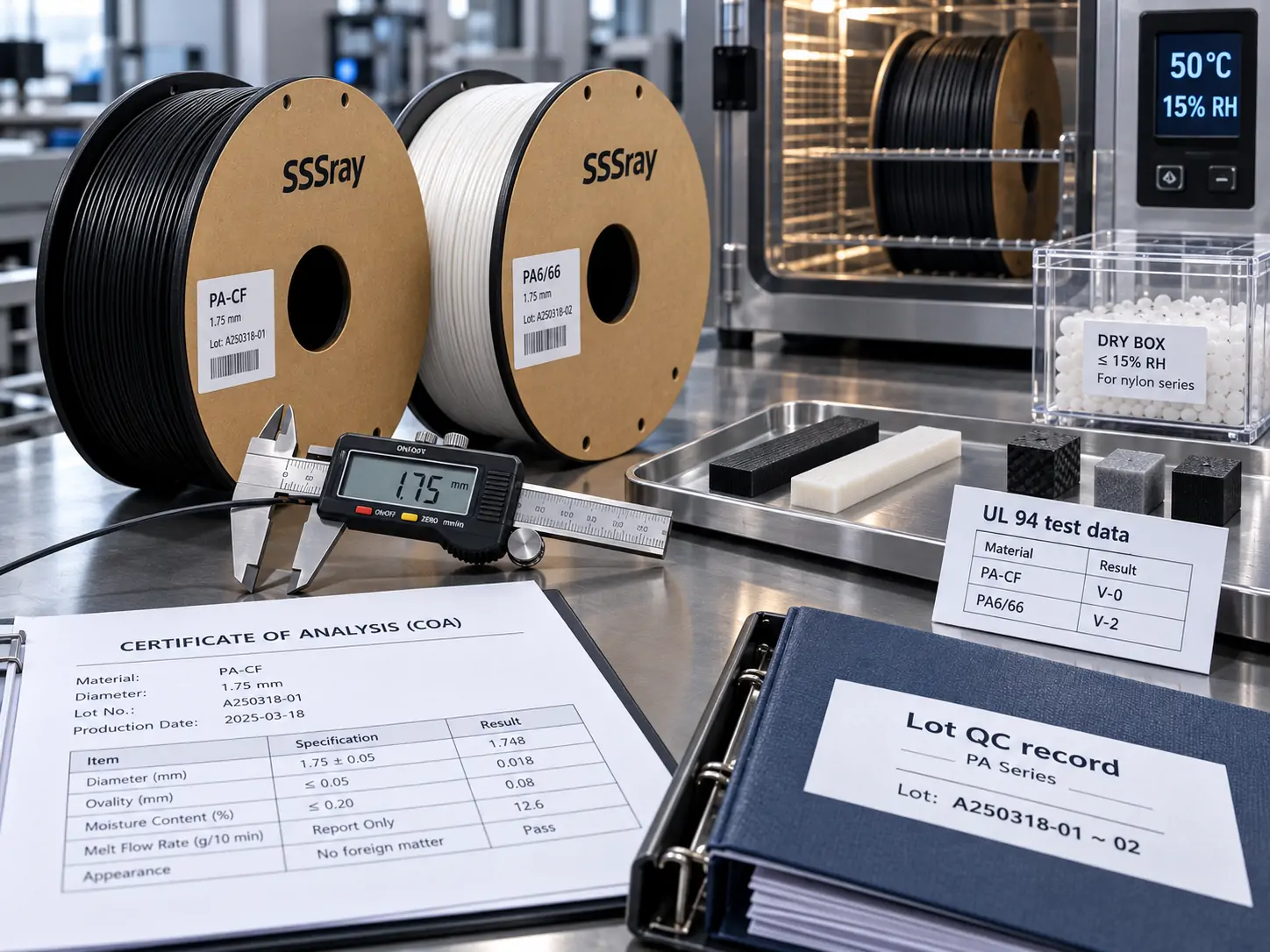
Published production-lot record: PA6/66 engineering nylon
Public Batch ID SSR-PA6-66-260918-L07-B01. SSSray PA6/66 Engineering Nylon Filament, 1.75 mm; produced and tested September 18, 2026 on Extrusion Line 07. The lot passed diameter, ovality and pre-seal moisture release gates and was released for shipment.
- Diameter audit. Continuous inline laser micrometer monitoring, with a COA audit sample of 10 spools × 3 archived laser checkpoints per spool = 30 measurement sets.
- Measured diameter. Mean 1.751 mm; observed range 1.731–1.772 mm against the 1.75 ±0.03 mm release requirement.
- Maximum ovality. 0.018 mm against a ≤0.020 mm release limit.
- Pre-seal conditioning. 80 °C × 8 h before final moisture release.
- Moisture test. Karl Fischer titration, n = 3; mean pre-seal moisture 0.017 wt% (170 ppm) against a <0.020 wt% (200 ppm) release requirement.
- Final result. All mandatory production QC gates passed — RELEASED.
Batch release record: equipment, sampling and limits
- Diameter and ovality. Inline dual-axis laser micrometers on every extrusion line scan the strand 500 times per second. Any segment outside ±0.03 mm for more than 3 seconds is cut automatically and diverted to a purge bin, so the check covers the full extruded length rather than a sample.
- Moisture. Karl Fischer titration on each production lot, after dehumidifying drying and before vacuum sealing.
- Color. Spectrophotometer ΔE against the master Pantone or RAL reference for each lot.
- Print check. Sampled spools run continuous 24-hour prints on Bambu Lab, Creality and Voron machines at speeds up to 500 mm/s.
- Result. More than 90% of our output measures within ±0.01 to ±0.02 mm. We publish ±0.03 mm because that is the limit we hold on every lot.
On mobile, swipe horizontally to review every column.
| Material family | Diameter tolerance | Maximum ovality | Maximum moisture before sealing | Color difference limit |
|---|---|---|---|---|
| PLA, PLA+ and high-speed PLA | ±0.03 mm | ≤ 0.020 mm | ≤ 0.02% | ΔE < 0.8 |
| PETG and PCTG copolyester | ±0.03 mm | ≤ 0.020 mm | ≤ 0.025% | ΔE < 1.0 |
| ABS and ASA | ±0.03 mm | ≤ 0.020 mm | ≤ 0.03% | ΔE < 1.0 |
| PA-CF and PETG-CF composites | ±0.03 mm | ≤ 0.025 mm | ≤ 0.015% (after 12 h drying) | Matte carbon reference |
| TPU (85A and 95A) | ±0.03 mm | ≤ 0.025 mm | ≤ 0.02% | ΔE < 1.2 |
These are pass/fail limits for release. The measured diameter, ovality and moisture values for your lot are printed on its COA, which you match to the batch ID on the master carton and spool label.
Flame-retardant grades: UL 94 data with thickness and color stated
Section 4 asks suppliers for three things on any flame claim: the class, the thickness and the color. Table 7 applies that test to our own flame-retardant grades.
On mobile, swipe horizontally to review every column.
| Property | Black PETG-FR | Black PC-ABS-FR |
|---|---|---|
| Flame class and test thickness | UL 94 V-0 typical at 1.5 mm | UL 94 V-0 typical at 1.5 mm, standard specimens |
| Limiting oxygen index | 32% | 30% |
| Density | 1.29 g/cm³ | 1.20 g/cm³ |
| Tensile strength (XY) | 48 ± 3 MPa | 45 ± 3 MPa |
| Notched Izod impact strength | 3.5–5.5 kJ/m² | 7–9 kJ/m² |
| HDT at 0.455 MPa | 73 °C | 103 °C |
| Nozzle and bed window | 230–260 °C nozzle; 70–90 °C bed | 250–280 °C nozzle; 90–110 °C bed |
| Drying before printing | 65 °C for 4–6 h | 80 °C for 6–8 h |
| Diameter tolerance and roundness | ±0.03 mm; ≤ 0.02 mm | ±0.03 mm; ≤ 0.02 mm |
| MOQ and lead time | From 50 rolls; 7–15 working days | From 50 rolls; 7–15 working days |
| Standard documents | RoHS, SDS and TDS; SGS report on request | RoHS, SDS and TDS; third-party verification on request |
Three details make these lines checkable. The color is named. The thickness is stated. And “typical” marks a TDS reference value measured on standard 125 mm × 13 mm specimens, which is exactly the kind of datasheet line Section 4 tells you to question.
So we answer the question in advance. For a wall thinner than 1.5 mm, a color other than black, or an end product that is itself UL certified, we scope a test on bars printed at your wall thickness at a named third-party laboratory (SGS or equivalent) before the order. The report states thickness, color, specimen preparation and conditioning.
The trade-off between the two grades is on the TDS too. PETG-FR prints in an ordinary PETG window, whereas PC-ABS-FR offers higher impact strength and a 103 °C HDT but needs an enclosed printer, a 90–110 °C bed and a hardened steel nozzle.
Why test bars start with a dry spool: 30-day moisture data on our V-0 nylon
UL 94 conditions one set of bars for 48 hours at 23 °C and 50% RH. We held our carbon-fiber nylons, including the flame-retardant PA-CF V0 grade, in that same climate for 30 days.
- Batches. Four Q1 2026 production batches, one per grade: PA-CF V0 (PA66 base, phosphorus-based flame retardant), PA12-CF, PA6-CF and PPA-CF, each with 15% chopped carbon fiber.
- Specimens. FFF-printed tensile bars 0.5 mm thick, three per grade (n = 3), starting below 0.10% moisture.
- Conditions. ISO 62 controlled-humidity exposure at 23 °C and 50% RH, held with a saturated magnesium nitrate solution; bars stored open on a rack.
- Measurement. Calibrated moisture balance, read at 0, 6, 24, 72, 168, 336 and 720 hours. Table 8 reports the mean of the three bars.
SSSray PA-CF filament: moisture uptake at 23 °C and 50% RH (% by mass)
PA-CF V0 (flame-retardant)PA6-CFPA12-CFPPA-CF
On mobile, swipe horizontally to review every column.
| Time at 50% RH | PA-CF V0 (PA66 base) | PA12-CF | PA6-CF | PPA-CF |
|---|---|---|---|---|
| 0 h (as sealed) | < 0.10% | < 0.10% | < 0.10% | < 0.10% |
| 6 h | 0.12% | 0.10% | 0.18% | 0.06% |
| 24 h | 0.32% | 0.20% | 0.55% | 0.12% |
| 72 h | 0.60% | 0.38% | 1.05% | 0.22% |
| 168 h (1 week) | 0.90% | 0.55% | 1.55% | 0.32% |
| 336 h (2 weeks) | 1.20% | 0.72% | 2.00% | 0.42% |
| 720 h (30 days) | 1.45% | 0.85% | 2.40% | 0.50% |
| Open time to reach 0.3% | About 1.5 days | About 3 days | About 0.5 day | About 5 days |
Read the PA-CF V0 column against the UL 94 conditioning step. At 24 hours the bars held 0.32% moisture and at 72 hours 0.60%, so the 48-hour point falls between the two. A standard UL 94 bar is thicker than 0.5 mm and absorbs more slowly, but the direction is the same: the bar that meets the flame is not a dry bar.
Moisture matters earlier, too. Wet nylon prints with voids, and voids are the air gaps that make a printed bar burn longer than a molded one. Our V-0 grade crosses 0.3% after about 1.5 days in open air. The working rule is therefore simple: print test bars from filament dried at 80 °C for 6–8 hours and used the same day, and have the laboratory record specimen conditioning in the report.
Procurement implicationFor nylon-based flame-retardant grades, put the drying step and the specimen conditioning into the test request.
Mistake to avoidComparing two V-0 reports without checking thickness, color and how the bars were dried.
How to verifyAsk for the report page that lists specimen preparation, conditioning and thickness.
What travels with a USA filament order
On mobile, swipe horizontally to review every column.
| Document | What it states | When it is issued | How you verify it |
|---|---|---|---|
| Lot COA | Measured diameter, ovality and moisture for the shipped lot, against the Table 6 limits | With every wholesale and OEM order from 50 spools, at no charge | The batch ID on the carton and spool label matches the COA |
| TDS | Grade properties and print window; for flame-retardant grades, the flame class with its test thickness | By grade; current availability confirmed in the document center or at order confirmation | Compare the TDS with the product page for the same grade |
| SDS (GHS format) | Hazard classification and handling for the SKU | By SKU, confirmed at order confirmation | Check the SKU name and revision date |
| RoHS and REACH declarations | EU restricted-substance and Candidate List status | By SKU, confirmed at order confirmation | The declaration names the SKU and date |
| TSCA composition statement | Polymer, pigments and additives are Inventory-listed or exempt; decaBDE and PIP (3:1) status for flame-retardant grades; whether any PFAS is intentionally added | By SKU for US-bound orders, on request | Your customs broker uses it to support the importer’s TSCA certification |
| Proposition 65 formulation review | Listed chemicals relevant to each color, for example carbon black in black or titanium dioxide in white | By color for private-label programs, on request | The review names the grade and color on your artwork |
| UL 94 test report | Flame class with thickness, color, specimen preparation and conditioning, from a named laboratory | On request for flame-retardant grades; third-party testing through SGS or an equivalent laboratory | Report number and laboratory name |
| Application evidence | Food-contact declaration, ISO 10993 screening, ASTM D6400 report or CPSC-accepted laboratory reports | Scoped per project; grade, color, standard and laboratory agreed before sampling | Each report names the exact grade and color |
Traceability: each shipment carries a batch ID on the master carton and on every spool label. Send that ID to your sales manager to receive the matching digital COA before customs clearance.
11. B2B Scenarios: Four Buyers, Four Different USA Compliance Routes
The same spool can sit on four different USA filament compliance routes. Each card below pairs a common mistake with the better choice.
Distributor
Situation: a US reseller lists PLA and PETG on marketplaces, including sales into California.
Bad choice: copies “FDA approved, biodegradable, UL certified” from a supplier sheet into every listing.
Consequence: listing takedowns, claim challenges and Proposition 65 notices.
Better choice: a baseline pack per SKU, qualified wording and a Proposition 65 review by color.
Verification: audit each claim against a document on file.
Next step with SSSray: request the TDS, SDS and COA pack for your range.
OEM Brand
Situation: a private-label brand launches 3D-pen refills and craft kits for children.
Bad choice: assumes its European REACH and RoHS reports are enough.
Consequence: no certificate data to eFile, so the shipment risks delay at entry.
Better choice: test each color at a CPSC-accepted lab and keep the palette short.
Verification: lab on CPSC’s accepted list; sample IDs match the batch.
Next step with SSSray: plan colors and test scope under OEM/ODM.
Print Farm
Situation: a farm prints enclosures for an electronics customer who specifies V-0.
Bad choice: buys the cheapest spool with “V-0” on the label and prints 1.2 mm walls.
Consequence: parts fail the customer’s test, and the job is reprinted at the farm’s cost.
Better choice: a printed-bar report at the real wall thickness, or a UL Recognized grade if the product is UL certified.
Verification: test report details and a UL database lookup.
Next step with SSSray: set up a flame-retardant grade trial.
Engineering Buyer
Situation: a device startup prototypes a skin-contact wearable housing.
Bad choice: orders “medical grade” filament on the strength of a one-page certificate.
Consequence: testing is repeated on the device, and a later pigment change resets the work.
Better choice: a natural grade with material-level ISO 10993 data and a formulation locked in writing.
Verification: reports name the grade, laboratory, edition and date.
Next step with SSSray: send the application brief for an engineering review.
12. Sourcing Specs: What to Write Into a Compliance-Ready Filament RFQ
Table 10 turns USA filament compliance into purchasing terms; print settings belong to each grade’s TDS.
On mobile, swipe horizontally to review every column.
| Item | What to specify | SSSray reference |
|---|---|---|
| MOQ | Qualification and production quantity for each certified color | From 50 spools for qualification orders; flame-retardant grades from 50 rolls in neutral packaging, with OEM packaging typically from 500–1,000 rolls |
| Lead time | Production time plus any external laboratory time, in writing | Samples in 3–5 working days; standard bulk production in 10–15 days; flame-retardant grades in 7–15 working days, or 15–25 when customized; lab time extra |
| Sample approval | Sample ID tied to a lot; printed bars or coupons wherever a rating is claimed | B2B qualification samples |
| Tolerance | Diameter and ovality limits with the measurement method | ±0.03 mm diameter; ovality limits by family in Table 6 |
| Documentation | Baseline pack plus application evidence, each naming grade and color | COA, TDS and SDS; RoHS and REACH by SKU; TSCA composition statement and Proposition 65 review on request; UL 94 reports for flame-retardant grades |
| Packaging | Barrier bag and desiccant; label claims reviewed; country-of-origin marking | Vacuum packing with desiccant; aluminum-foil barrier bags for moisture-sensitive families |
| Private label | Claim wording, Proposition 65 text and barcodes approved before printing | OEM boxes, spool stickers and barcode printing |
| Reorder control | Written notice before any resin, pigment or additive change; re-test triggers | Batch ID on carton and spool; change-notification terms agreed in the PO |
13. USA Filament Compliance FAQ for B2B Buyers
What is the difference between FDA compliant and FDA approved?
“FDA compliant” means a material’s composition conforms to a named FDA regulation or effective notification under stated conditions of use; “FDA approved” has no legal meaning for filament. FDA authorizes food contact substances and clears or approves medical devices, not spools. The purchasing test is whether the supplier can cite a regulation section or FCN number for the exact grade and color, state the conditions of use, and say whether the evidence covers resin, filament or a printed part.
Do I need FDA approval for PETG food containers?
No. You need compliance, not approval. PETG-type copolyesters are listed in 21 CFR 177.1315, so the base polymer has a route, but pigments and additives need their own clearance, and the regulation’s conditions of use must fit your food and temperature. The printed container is your responsibility as the article maker. When ordering, specify a named grade and color, ask for a signed declaration citing the regulation, and consider migration testing on the printed part for repeated-use applications.
How long does UL testing take for a new filament?
A UL 94 test at an independent laboratory usually fits within a few weeks, while UL Recognition takes longer and is quote-based. The standard requires one set of bars to be conditioned for 48 hours and another for 7 days at 70 °C, and one US fire-test lab advertises an average turnaround of about two weeks. Recognition adds a formulation review and factory follow-up inspections. Ask for a written schedule before committing to a launch date.
Can I sell medical filament without ISO 10993?
Yes, you can sell the filament, but you should not describe it as making a device compliant. ISO 10993 is applied to the finished device, and FDA clears or approves the device, not its raw material. Even so, device manufacturers can rarely qualify a filament without material-level cytotoxicity, sensitization and irritation data, lot traceability and written change control. If you buy for a device project, request those reports for the exact grade and color, and fix the formulation in the supply agreement.
What documentation do I need to import certified filament?
At minimum: a commercial invoice, packing list and transport document, with the tariff classification agreed with your broker; the applicable TSCA certification made by the importer; and the SDS, TDS and lot COA for the grades shipped. Then add what your application triggers: a food-contact declaration, a UL 94 report or UL file number, an ASTM D6400 report, or CPSC-accepted lab reports. If the finished imported product is subject to CPSC certification requirements, the importer must eFile its certificate data at entry; this requirement took effect on July 8, 2026.
What is the cost of getting ASTM D6400 certification for PLA?
BPI’s published fees are $1,500 to apply for commercial-only certification, $3,500 a year for the base license and $1,000 per certificate at each three-year recertification; laboratory testing is quoted separately. Biodegradation testing alone takes at least six months. Before budgeting, check eligibility: BPI certifies items associated with food scraps or yard trimmings, so a general-purpose spool may not qualify. A practical alternative is to buy certified resin and commission ASTM D6400 testing on your own formulation.
Which filaments require UL certification in the USA?
No federal law requires any filament to be UL certified. The requirement comes from the end product: when an electrical product’s safety standard sets a flame class for its plastic parts, the manufacturer asks for material evidence at a stated thickness. In practice that means flame-retardant PETG, PC-ABS, ABS, PC and PA grades printed into enclosures and internal parts, while standard PLA, PETG and TPU for prototypes, jigs and décor do not need it. Ask for the flame class, the test thickness and the color together. SSSray PETG-FR and PC-ABS-FR, for example, are published as UL 94 V-0 typical at 1.5 mm in black.
Does REACH or RoHS compliance cover filament sold in the USA?
No. REACH and RoHS are European rules, and a declaration under either one answers no US requirement. US entry requires the importer to make the applicable TSCA certification, California sales need a Proposition 65 review by color, and children’s products need a Children’s Product Certificate based on testing at a CPSC-accepted laboratory. Keep the EU files, because many US buyers still request them, and add the US documents before the first shipment.
What USA compliance documents does SSSray provide with filament orders?
Every wholesale and OEM order from 50 spools ships with a lot COA and a TDS, and each carton and spool carries a batch ID that matches the COA. SDS, RoHS and REACH documents are confirmed by SKU at order confirmation. For US-bound orders we add a TSCA composition statement and a Proposition 65 formulation review on request, and UL 94 test reports for flame-retardant grades. Food-contact, medical, compostability and toy-safety evidence is scoped per project, with grade, color, standard and laboratory agreed before sampling.
14. Conclusion: Pay Only for the USA Compliance Your Filament Application Triggers
FDA, UL and ASTM are not three versions of the same stamp. FDA governs what may touch food and what may be sold as a medical device. UL 94 describes how a plastic burns at a given thickness. ASTM D6400 defines what can be called compostable. Around them sit TSCA at the border, CPSC for children’s products and Proposition 65 in California.
The decision logic for USA filament compliance is short. First, name the application and find its row in Table 1. Next, ask for evidence that names the exact grade and color, the clause or standard, and the conditions under which it holds. Then put the fixed cost over real volume, and certify only the colors that can carry it. Finally, write change control into the order, because a certificate describes one formulation at one moment.
As a next step, pick one SKU, list the claims on its box and product page, and match each claim to a document. Whatever has no document should be reworded or removed before the next shipment.
Prefer to start elsewhere? Compare materials across our range, ask about OEM packaging and label wording, or browse the flame-retardant filament range. When you request a quote, include your application, destination and annual volume.
SSSray document matching: The regulatory references and published fee schedules in this guide are current to October 6, 2026. For each US order, we match the exact grade, color, destination and intended end use, then confirm the document set for that SKU before sampling or order confirmation.
Request a quote or free samples
Tell us the material, color, spool size and monthly volume. An engineer replies within 24 hours on business days.
15. References
- U.S. FDA: Inventory of Effective Food Contact Substance (FCS) Notifications, and 21 CFR 170.104: who an FCN is effective for and the 120-day review.
- 21 CFR 177.1315: Ethylene-1,4-cyclohexylene dimethylene terephthalate copolymers: the food-contact listing relevant to PETG-type copolyesters.
- U.S. FDA: Medical Device User Fee Amendments (MDUFA) fees: FY2026 and FY2027 510(k) and registration fees.
- NAMSA: The FDA’s recognition of ISO 10993-1:2025: partial recognition dated May 25, 2026; and MD+DI: FDA’s take on the ISO 10993-1 update: 2018 edition usable until July 1, 2029.
- Kanďárová and Pôbiš (2024), Frontiers in Toxicology: The “Big Three” in biocompatibility testing of medical devices.
- UL Solutions: Blue Card, plastics for additive manufacturing: Blue Card versus Yellow Card.
- RTP Company: UL94 V-0, V-1 and V-2 flammability standard, and VTEC Laboratories: UL 94 test lab: specimens, conditioning and stated turnaround.
- Biodegradable Products Institute: Fees and timeline, BPI eligibility criteria, and BPI modification applications.
- CalRecycle: Truth-in-labeling laws: “biodegradable” and “compostable” rules and the June 30, 2027 extension; and 16 CFR 260.8: FTC Green Guides on degradable claims.
- U.S. CPSC: eFiling frequently asked questions, and 16 CFR 1308.2: phthalate testing determinations for specified plastics.
- 19 CFR 12.121: TSCA import certification; EPA final rule on decaBDE and PIP (3:1), 89 FR 91486; and UL Solutions: TSCA PFAS reporting start date.
- Foley & Lardner: Proposition 65 short-form warning changes, and UltiMaker filament compliance overview (distributor knowledge base): an example of color-level Proposition 65 disclosure.
- colorFabb: Food-safe filaments: an example of raw-material-level food-contact wording.
- SSSray primary data: batch QC benchmarks; technical data for black PETG-FR and PC-ABS-FR; and the PA-CF 30-day moisture test.

He Jiang
Senior Researcher
SSSray · 3D Printing Filament Manufacturing · Jinhua, Zhejiang
He Jiang is a senior researcher at SSSray, a 3D printing filament manufacturer in Jinhua, Zhejiang, China. For this guide, his work focuses on filament batch QC, technical-document traceability and the application of public US regulatory requirements to B2B filament sourcing. The article combines Code of Federal Regulations, FDA, CPSC, EPA, UL, BPI and CalRecycle sources with SSSray production-lot QC and controlled-humidity test records for B2B brand owners, distributors and OEM partners.
Guide scope: this USA filament compliance guide covers food-contact, medical-device, flammability, compostability, toy-safety and chemical rules for 3D printing filament, drawing on the Code of Federal Regulations, FDA, CPSC, EPA, UL Solutions, BPI and CalRecycle publications and on SSSray batch QC and test data.
