Online time
Monday to Friday: 9AM - 8PM
Weekend: 10AM - 5PM
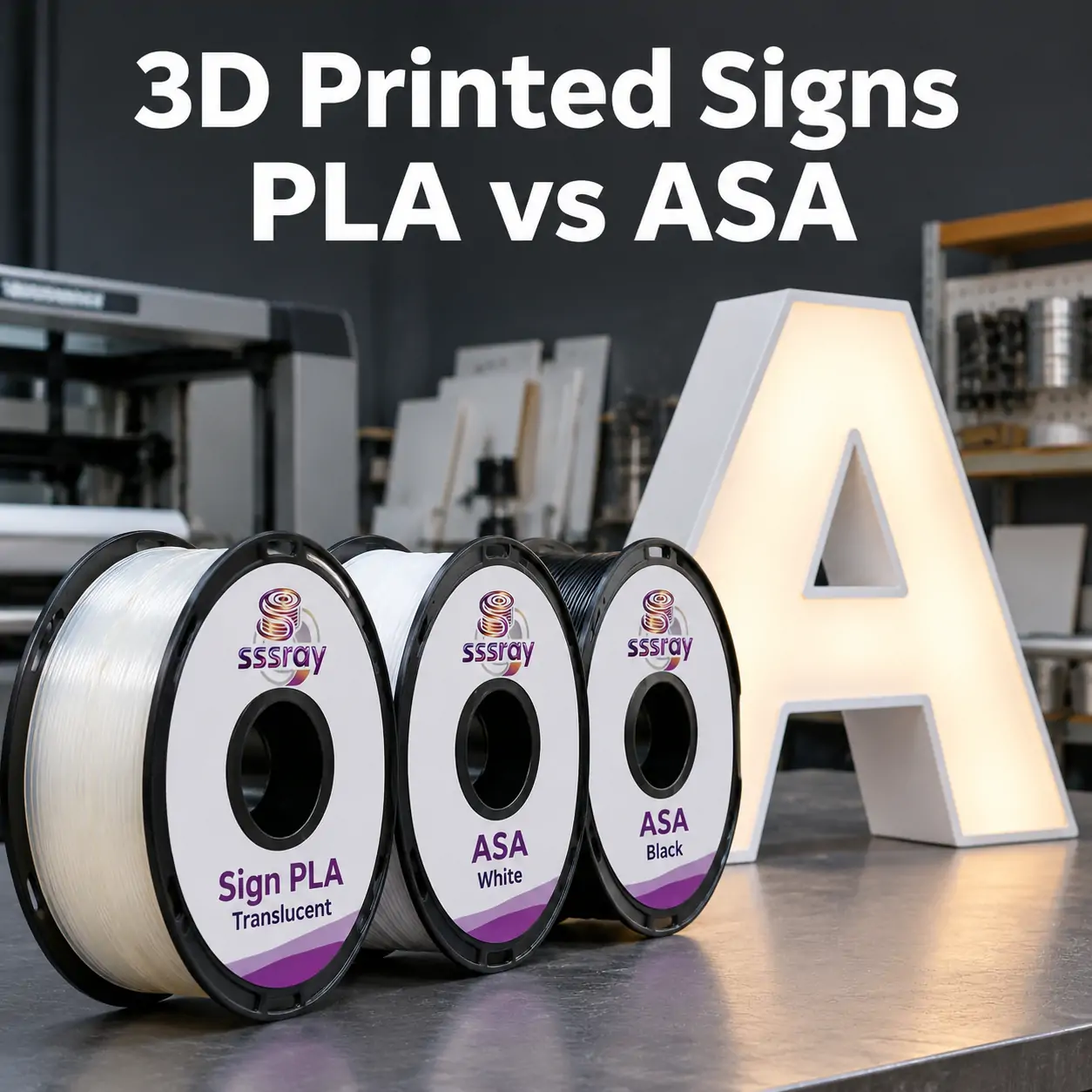
TL;DR: 3D Printed Signs Need ASA Shells Outdoors and Sign-Grade PLA Faces Indoors
For 3D printed signs and channel letters, the right filament depends on where each part of the letter lives. Sunlit returns and backs need ASA; indoor light-transmitting faces are where translucent sign-grade PLA earns its place; outdoor faces usually stay acrylic or polycarbonate sheet.
SSSray batch data, cutoff 30 Oct 2026: after 100 h at 55 °C and about 100% RH, sign-grade PLA kept 79.7% of its tensile strength and white ASA kept 98.1%; a 1.6 mm ASA-LW wall at 0.78 g/cm³ weighs 1.25 kg/m², 55% less than .040-inch aluminum.
Best optionZone split: ASA or ASA-LW returns and backs outdoors, translucent sign-grade PLA faces indoors, sheet acrylic or PC faces outdoors.
When not to use itPLA on any letter that sees direct sun or a hot shop window; ASA without an enclosed printer; a printed shell used as the electrical enclosure of a US listed sign.
Key specificationHeat deflection at a stated load (PLA 56.4 °C vs ASA about 100 °C at 0.45 MPa) and light transmission at a stated wall (35–50% at 2 mm, 660 nm).
Verify the supplierAsk for batch-level transmission, HDT load, hot-wet retention and Blue Card or base-resin UL data, not just “UV resistant.”
Procurement warningThe UL 879 revision dated 3 Sep 2025 is scheduled to take effect on 3 Sep 2027. It adds requirements for non-enclosure-rated sign bodies and polymeric enclosure materials; a filament label alone never makes a letter listable.
Abstract
Channel letters have been built the same way for decades: aluminum coil bent into returns, a routed back, a 3/16-inch acrylic face and a plastic trim cap. 3D printing changes that sequence. The return and back come off the printer as one shell, a sample letter can reach the client the same day, and the finished can is lighter than its metal equivalent.
Chinese equipment makers began shipping dedicated channel-letter printers around 2019–20,[7] and European fabricators such as Modulex now sell ASA-bodied printed letters.[9] So the question has moved from “can it be done?” to “which material goes where?”
That is where most buying mistakes happen. Four assumptions cause the costly ones: that one filament can serve the whole letter, that “UV-stabilized PLA” means outdoor-ready, that a filament can be “UL approved,” and that a shallower printed letter is always cheaper. Each fails for a measurable reason: heat deflection, hot-wet strength loss, the UL 879 material ratings, or the extra LEDs a shallow can needs.
This guide uses one framework, the Zone-Split Letter Method. It treats a letter as four zones (face, return, back and mounting) and asks four questions of each: will it stay stiff at the temperatures it will see, will it keep its strength after heat plus moisture, will it pass or block light as intended, and does the US listing path allow it?
Every answer is tied to a published number: material datasheets, peer-reviewed weathering studies from 2023 and 2026, an LED module spacing chart, and the Intertek update notices for UL 48 and UL 879. Where a figure is our own, it carries a public batch ID, the instrument, the sample count and the result, all collected in Section 8.
Key Takeaways
- One filament rarely fits the whole letter. Split by zone: ASA for sun-exposed returns and backs, translucent sign-grade PLA for indoor faces, sheet acrylic or polycarbonate for outdoor faces.
- PLA loses the heat argument outdoors. Our sign-grade PLA has an HDT of 56.4 °C at 0.45 MPa under ISO 75-2 and a Vicat A50 value of 62.3 °C; a reference ASA datasheet lists 100 °C and 106 °C, about 44 °C more margin, and our white ASA batch measured 98.6 °C.
- Heat plus moisture is the real test. After 100 h at 55 °C and 100% RH, two of three PLA brands in a 2023 study lost 23–28% of their tensile strength; all three ASA brands kept 96–100%. Our own batches repeat the pattern: sign PLA 79.7%, ASA 98.1–98.5%.
- Printed shells are lighter by a calculable amount. A solid 1.6 mm ASA wall weighs about 1.68 kg/m², against 2.77 kg/m² for .040-inch aluminum: roughly 39% less. Foamed ASA-LW at 0.78 g/cm³ cuts that to 1.25 kg/m², about 55% less.
- Shallow letters cost LEDs. Printing lets returns drop from 60 mm to 30 mm, but the current US LED Point XL2 chart specifies 12-inch single-row spacing at 5 inches deep and 6-inch spacing at 2 inches. In our light box, a 30 mm can needed 1.7 times the modules per metre to stay even.
- Translucency needs a stated method. Our translucent sign PLA transmits 35–50% at 660 nm through a 2 mm wall (current batches 43.6% and 45.1%); sign-white 7328 acrylic is quoted at 28% and 2447 at 47%. These are bookends, not like-for-like figures.
- US listing sets the material floor. The UL 879 revision dated 3 Sep 2025 is scheduled to take effect on 3 Sep 2027; its revised sections address non-enclosure-rated sign bodies and polymeric sign-body enclosure materials. The UL 48 revision dated 14 May 2025 is scheduled to take effect on 14 May 2027.
- Savings are real but conditional. One German fabricator reports printed letters up to 30% cheaper depending on shape. Filament is a small share of the bill; labor, LED count and listing decide the final price.
1. Can You 3D Print Channel Letters? Where Printed Shells Replace Aluminum
Direct answer: yes. A printed shell can replace the bent-aluminum return and the back of most small and mid-size letters, while the face often stays acrylic. The gain comes from collapsing several fabrication steps into one print, not from cheaper plastic.
What the traditional build involves
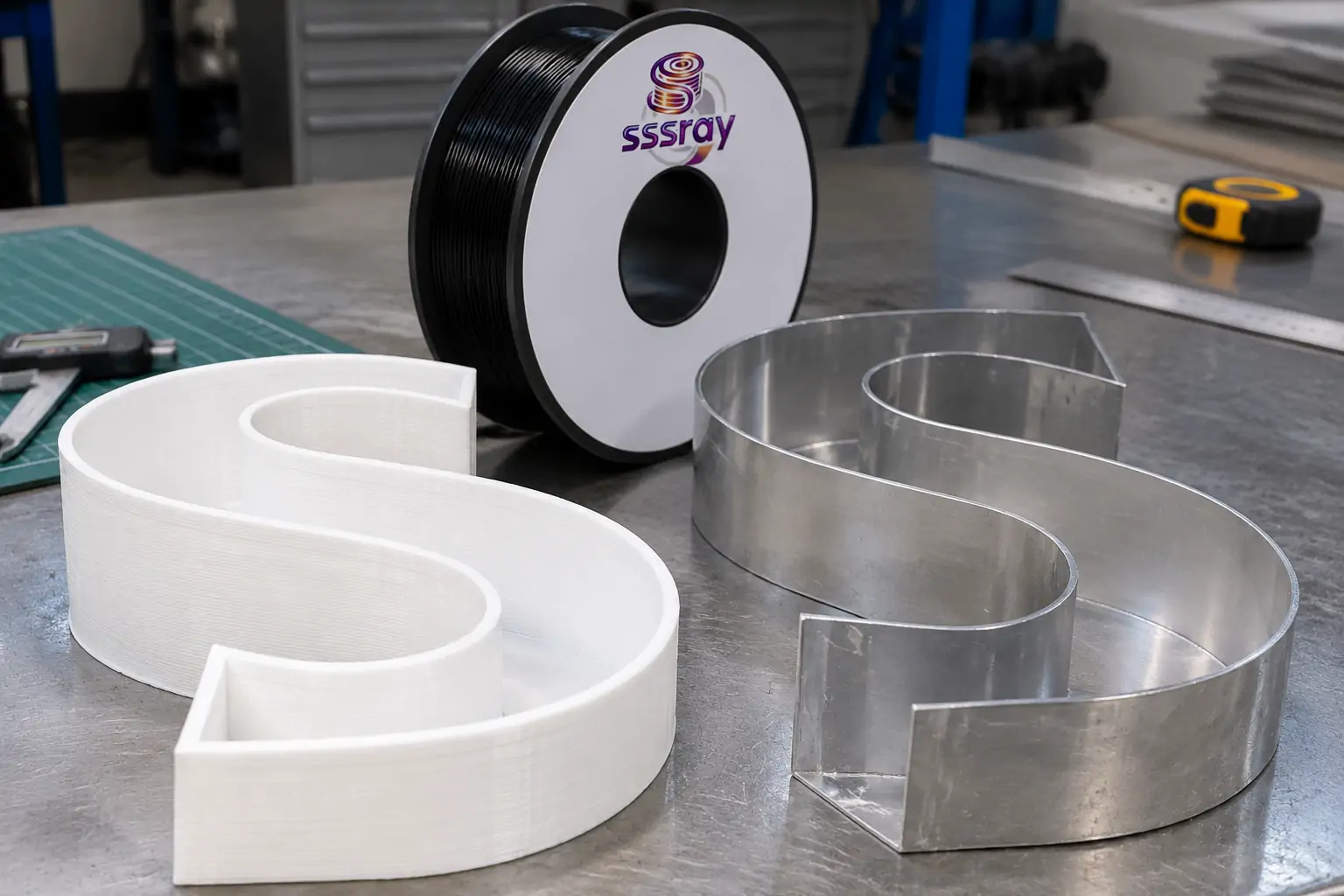
A standard US wholesale letter combines 3- or 5-inch channel letter returns bent from .040-inch aluminum coil, a 3/16-inch acrylic face and a 3/4- or 1-inch trim cap. In one wholesaler’s standard front-lit build, the back is .040-inch aluminum as well.[11]
Each of those parts is cut, bent, notched, riveted or glued by hand. Think of it as tailoring a suit seam by seam; printing is closer to knitting the garment to size in one pass.
Four reasons sign shops switch
- Replacement: in a 2021 case study sponsored by printer maker Tractus3D, German fabricator Styles Werbetechnik reports that its conventional letters started at 60 mm deep, while printed ones go down to 30 mm and still light up without molded opal glass.[8]
- One-piece processing: returns and face edges print in one pass, shaped exactly to the face, so they bond to acrylic without clamps or extra fasteners.[7]
- Same-day samples: in the Styles trial, letters printed after the first few hours of testing were already accurate enough to install.[8]
- Weight: a 2025 Sign Media Canada article puts PETG-based letters at 40–60% lighter than equivalent aluminum and acrylic builds.[7]
The weight math, per square metre of wall
Weight claims are easy to check, because shell mass is simply wall thickness times density. Figure 1 compares a .040-inch aluminum return with printed walls of the same area, including the foamed ASA-LW profile we approve for production.
Return-wall mass per square metre (lower = lighter)
A 1.6 mm ASA return is about 39% lighter than .040-inch aluminum, while a 2.0 mm PLA wall saves only about 10%. Foamed ASA-LW goes further: at our approved 260 °C profile, a 1.6 mm wall weighs 1.25 kg/m², about 55% less than aluminum and the same as a 1.2 mm solid ASA wall. That saving holds only for the foaming profile locked at sample approval.
Mass is not stiffness, though. Aluminum’s modulus (about 69 GPa for 3003) is roughly 35 times that of printed ASA, which is why printed returns run 1.6–2.0 mm walls and rely on depth, corners and the bonded face for rigidity. Foaming helps here: our ASA-LW coupons measured a 1,150 MPa flexural modulus against 1,960 MPa for solid ASA, so the 1.6 mm foamed wall carries about 1.4 times the bending stiffness of a 1.2 mm solid wall of the same mass (E·t³: 1,150 × 1.6³ vs 1,960 × 1.2³).
Are 3D printed signs cheaper? Channel letter cost vs aluminum
Material is rarely the deciding cost. The same 2025 article estimates about Cdn$3 of PETG for a letter 2 inches deep and 14 inches tall, and puts a printer capable of signage-grade work at Cdn$1,000–15,000.[7] Styles reports custom letters up to 30% cheaper depending on shape, mainly because its printers run unattended and waste little.[8]
Two costs can erase that saving: extra LED modules in shallow letters (Section 4) and listing work for US illuminated signs (Section 5). So price a finished letter, not a kilogram of filament.
Procurement implicationQuote printed letters per finished letter (shell, LEDs, face, listing), never per kilogram of filament.
Mistake to avoidComparing filament cost with aluminum coil cost and calling the gap “savings.”
How to verifyPrint one representative letter, weigh it, log machine hours and LED count, then price it beside the aluminum quote.
2. What Filament Is Best for 3D Printed Signs? Assign Materials by Zone
Direct answer: no single filament is best for 3D printed signs. The best result comes from matching each zone of the letter to the stress it actually sees: light, heat, sun or load.
The four zones of a printed letter
Treat a channel letter like a small building. The face is the window, the return is the wall, the back is the foundation slab, and the mounting is the anchor bolts. Each needs a different material for the same reason a house does.
- Face: passes and diffuses light. Indoors, translucent sign-grade PLA works well; outdoors, sheet acrylic or polycarbonate remains the safer choice. Modulex’s Luma letters, for example, pair ASA sides and back with a 3 mm cast acrylic face.[9]
- Return (sidewall): carries the letter shape, blocks side glow and takes the sun. Outdoors, this is where ASA filament for signs earns its price, solid or as lightweight ASA-LW; indoors, opaque PLA is enough.
- Back: holds LEDs and wiring and faces the wall, where heat collects. Use ASA outdoors.
- Mounting: studs and brackets. Keep these metal where possible, because UL 48 adds a Mounting Test when polymeric parts carry the sign’s weight.[3]
Main comparison: signage filament options
Table 1 is the buyer’s view of the same split: which signage or channel letter filament fits each job, how to check it, and when to walk away.
On mobile, swipe horizontally to review every column.
| Option | Best use case | Key spec | Advantage | Risk | How to verify | When to reject | SSSray sourcing note |
|---|---|---|---|---|---|---|---|
| Translucent sign-grade PLA | Indoor lit faces, edge-lit and side-glow letters, trade-show signs | 35–50% transmission at 660 nm, 2 mm wall; HDT 56.4 °C (0.45 MPa, ISO 75-2) | Crisp edges on open printers at 190–220 °C | Softens in sun, hot windows and sealed lit cans | Light-box test at real depth; 55 °C warp check | Letter faces the sun or a south-facing window | 1 kg spools; from 50 rolls; batch-level transmission data available on the COA for the tested translucent sign-grade PLA batches |
| Opaque sign-grade PLA | Indoor returns and backs, non-lit lobby letters, client mockups | Vicat 62 °C; diameter 1.75 ± 0.03 mm | Lowest cost per part, fastest print | Thin white walls glow when lit | Backlight bleed check on a lit sample | Any exterior or sealed lit use | Same series in solid white and colors |
| ASA (solid) | Outdoor returns and backs, halo-lit letters | HDT about 100 °C, Vicat about 106 °C (reference TDS) | Keeps strength and color under UV and moisture | Warping, fumes; needs an enclosure | Blue Card or base-resin UL 94 and RTI; warp test on longest stroke | No enclosed printer, or no UL material data for US listings | 1/3/5 kg spools; from 50 spools |
| ASA-LW (foaming) | Large outdoor returns where weight or freight matters | Foaming window 240–280 °C; 0.78 g/cm³ at our 260 °C profile | Lowest shell mass of the exterior options | Lower stiffness and HDT; voids if over-foamed | Weigh coupons; check wall stiffness and water ingress | Parts that carry mounting loads | Profile locked at sample approval |
| PETG | Indoor or temporary letters, sheltered displays | Tough and clear; common in dedicated sign printers | Easy printing, good impact strength | Falls short of aluminum in permanent outdoor installs | Accelerated UV exposure on the grade sold | Permanent full-sun installations | Available through wholesale PETG supply |
| Acrylic or PC sheet face | Outdoor lit faces on printed ASA bodies | 7328 white 28%, 2447 white 47% transmission (supplier data) | Proven in listed signs; uniform diffusion | Separate cutting and bonding step | Face material and adhesive inside the listing | When the listing file does not cover it | Not a filament; pair with printed ASA shells |
Notice that PETG appears as the incumbent rather than the answer. Sign Media’s 2025 review says printed returns typically use PETG, and also that desktop-printed PETG letters still fall short of aluminum in permanent outdoor installations.[7]
3. Is PLA OK for Outdoor Signs? Heat, Moisture and UV Data
Direct answer: not for sun-exposed returns, backs or faces. PLA softens near 56–62 °C and loses strength under heat plus moisture, while ASA keeps about 44 °C more heat margin and holds its strength in the same tests.
Heat: the softening ceiling
PLA is a glassy polymer with a glass transition near 58 °C. Below it, the molecular chains are locked like cold honey; above it, they start to slide, and a long thin return slowly bows under its own weight. A sealed letter in summer sun, with LEDs running inside, can climb toward that range. That single property settles most of the ASA vs PLA for signage debate before UV even enters it.
Table 2 lines up the published heat limits. The test load matters, so it is stated for every value.
On mobile, swipe horizontally to review every column.
| Material and source | Glass transition (DSC) | HDT at 0.45 MPa | HDT at 1.8 MPa | Vicat softening |
|---|---|---|---|---|
| Sign-grade PLA | 58.2 °C (DSC, ISO 11357-2, SSSray batch test) | 56.4 °C (ISO 75-2, 0.45 MPa, SSSray batch test) | Not published | 62.3 °C (Vicat A50, SSSray batch test) |
| ASA, solid (Bambu Lab ASA TDS V3.0) | Not reported | 100 °C | 92 °C | 106 °C |
| ASA, self-foaming (Bambu Lab ASA Aero TDS V1.0) | Not reported | 85 °C | 78 °C | 80 °C |
The foamed row matters for ASA-LW buyers. The self-foaming grade sits about 15 °C below solid ASA in that maker’s data, even though its test bars were printed at 225 °C, below its 240–280 °C nozzle range.[12] Our own fully foamed coupons (0.78 g/cm³) measured 83.1 °C, still about 27 °C above sign PLA.
UL’s component standard builds in the same caution. For polymeric enclosures in signs subject to sun exposure, UL 879 requires the material’s thermal index to sit at least 15 °C above the highest temperature measured.[1]
Heat plus moisture: what one hot, wet week does
PLA is a polyester, and hot water slowly cuts its ester bonds. That hydrolysis is why condensation inside a warm letter can hurt PLA more than dry heat alone. A 2023 study in Materials tested three brands each of PLA and ASA after 100 hours in a condensation chamber.[5]
Tensile strength kept after 100 h at 55 °C and 100% RH (share of as-printed value)
The spread between PLA brands is the procurement lesson: one PLA held up and two did not, so a datasheet strength value alone tells you little about a hot, wet letter. All three ASA brands stayed within 5% of their starting strength.
We ran our own batches through the same exposure and the same specimen (record SGN-HW-03, Figure 5). Sign-grade PLA batch SSR-PLASG-260902-L03-B01 kept 79.7% (52.6 → 41.9 MPa), both ASA batches kept 98.1% and 98.5%, and the foamed ASA-LW batch kept 96.4%. We publish the PLA result because it is the reason we position sign PLA for indoor and sheltered display, not for exterior letters.
UV: the surface goes first, then strength
In the same study, PLA surfaces turned sticky after just 20 hours under a 125 W mercury lamp, while ASA showed no visible change at 20 hours and only slight color change at 100 hours.[5] A 2026 accelerated UV-condensation study in Manufacturing Technology found that ASA kept its ductility and even gained strength, whereas PLA stiffened the most and shifted its glass transition upward.[6]
The chemistry explains it. ASA replaces the butadiene rubber in ABS, whose carbon–carbon double bonds UV light attacks, with an acrylate rubber that lacks them. Our ABS vs ASA UV resistance guide covers that mechanism in depth.
How long do 3D printed signs last outside?
We found no published multi-year field data on 3D printed outdoor sign letters, so treat any fixed “years outdoors” claim as unverified. The studies above are short: 98 days of covered winter exposure, and accelerated cycles.
Our own 1,000-hour ISO 4892-3 run (record SGN-UV-04) points the same way. White ASA changed by ΔE*ab 1.4 and kept 97.2% of its tensile strength, black ASA 1.9 and 96.6%, and ASA-LW 2.2 and 94.1%. The sign PLA control reached ΔE*ab 6.7, kept 61.8% and chalked from 500 hours.
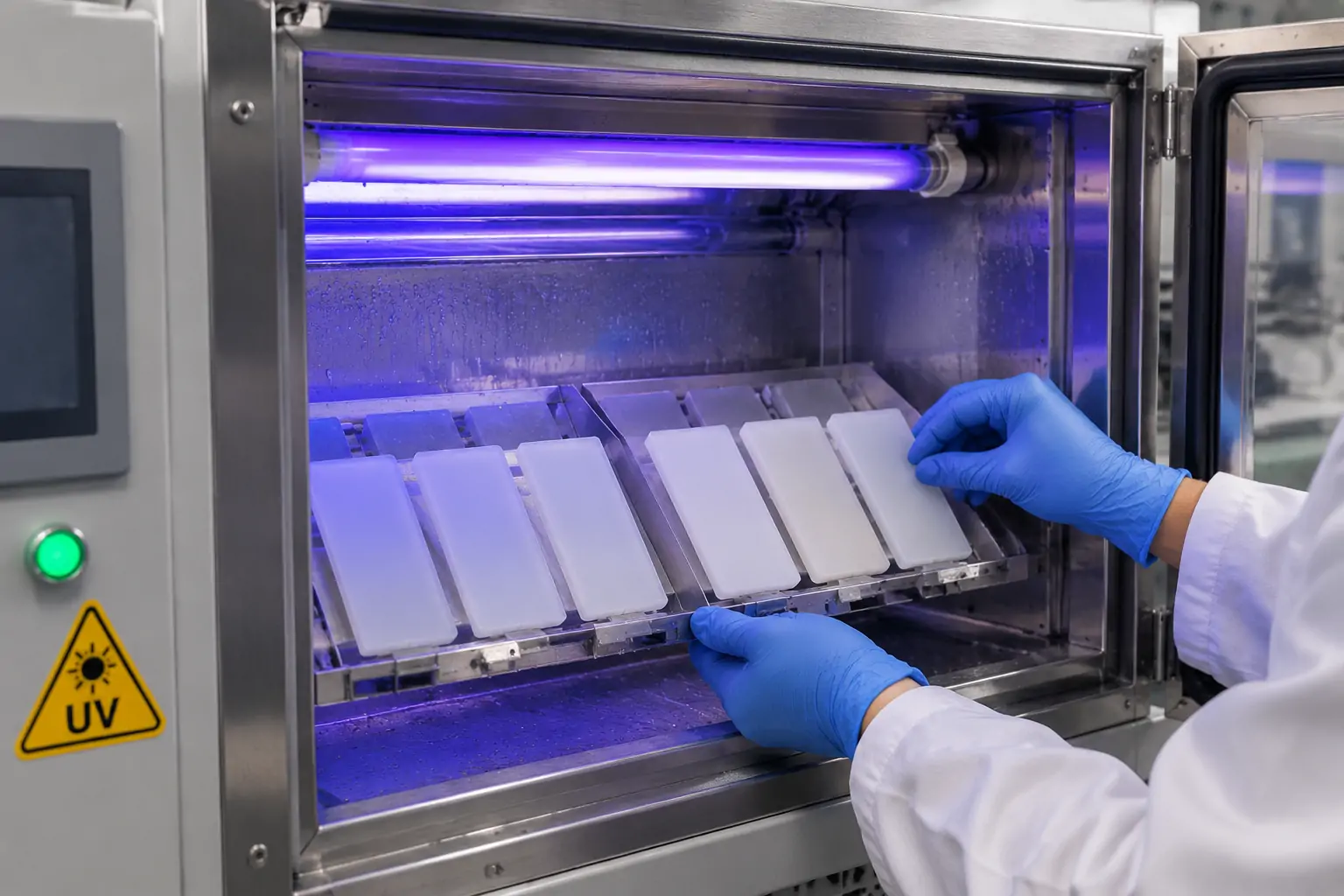
What the data supports is a ranking, not a lifespan: ASA has a credible path to long outdoor service, while PLA does not. Accelerated hours do not convert to a fixed number of years, and real life depends on wall thickness, color, sealing, LED heat and climate. So validate with an accelerated exposure to ISO 4892-3 plus a pilot installation.
Procurement implicationWrite “no PLA in sun-exposed or sealed exterior zones” into the spec, and require HDT at a stated load for every exterior material.
Mistake to avoidAccepting “UV-stabilized PLA” as outdoor material. Stabilizers slow fading; they do not raise a 56.4 °C heat ceiling.
How to verifyRun a hot-wet coupon test (55 °C, about 100% RH, 100 h) and compare tensile retention before approving any exterior filament.
4. Translucent PLA Filament and LED Light Diffusion for 3D Printed Signs
Direct answer: an even glow comes from three settings working together: the face’s light transmission at its real thickness, the print structure that scatters that light, and LED spacing matched to letter depth.
How much light should a printed face pass?
A good face behaves like frosted bathroom glass: it lets light through but hides the bulb. So a translucent PLA filament for faces must work as a light diffusing filament, not a clear one. Too clear and every LED shows as a dot; too dense and the letter looks gray at night. Table 3 gives reference points.
On mobile, swipe horizontally to review every column.
| Face material | Quoted light transmission | Thickness | Measurement basis |
|---|---|---|---|
| Translucent sign-grade PLA (our TDS) | 35–50% | 2 mm printed wall | Single wavelength, 660 nm |
| Translucent sign-grade PLA, batch SSR-PLASG-260826-L03-B01 | 43.6% (660 nm); 38.9% luminous, haze 99.1% | 2.0 mm printed plaque | Integrating sphere at 660 nm; ASTM D1003 haze meter |
| Optix-LD 7328 white acrylic | 28% | Not stated | Distributor light-transmission figure |
| Optix-LD 2447 white acrylic | 47% | Not stated | Distributor light-transmission figure |
| Optix-LD Max 2406 white acrylic | 64% | Not stated | Distributor light-transmission figure |
A single-wavelength reading and a broadband figure are not the same measurement, so use these numbers as bookends.[11] That is why we also report ASTM D1003 luminous transmittance: on that broadband basis our 2.0 mm face reads 38.9%, between the 7328 and 2447 quotes, with sheet thickness still unstated. The only fair comparison is both faces in the same light box, lit by the project LED.
Why print structure changes the glow
Every boundary between printed lines bends and scatters light. Air gaps between perimeters and infill show up as dark lines, and a thick outer wall can trace a bright outline around the letter.
- Use 100% infill on translucent faces to reduce internal voids; it does not guarantee a void-free part. Calibrate extrusion and check wall-to-infill bonding.
- Keep 2–3 wall perimeters; more walls tend to outline the stroke.
- Try 0.28 mm layers for smoother diffusion, then sand and apply a matte clear coat if the face still shows lines.
Letter depth vs LED spacing
Printing makes shallow LED channel letters easy, but light needs distance to mix. Figure 3 uses US LED’s current Point XL2 spacing chart. Point XL2 has a 175° beam angle; spacing still depends on letter depth, face material and interior reflectivity.
Maximum LED spacing vs channel-letter depth (US LED Point XL2 chart)
Single-row spacingModule-to-module spacing
At 2 inches deep, the Point XL2 chart specifies 6-inch single-row and multiple-row spacing; at 3 inches it specifies 9 inches, and from 4 to 12 inches it specifies 12 inches. Module-to-module spacing is 6 inches at 2 inches and 8 inches from 3 to 12 inches. Use both spacing dimensions to lay out multi-row letters; closer pitches can offset some of the filament savings from a shallow shell.
Light-box results for 3D printed signs at 51 mm and 30 mm
We checked the chart against our own faces (record SGN-LED-05). Three 2.0 mm faces from translucent batch SSR-PLASG-260826-L03-B01 were lit by 160° Class 2 modules in a single row along a 100 mm × 400 mm stroke, and luminance was read at nine points from 1 m. Figure 4 shows the uniformity ratio, minimum luminance divided by average.
Face uniformity, Lmin ÷ Lavg (higher = more even; our target ≥ 0.70)
Dropping from 51 mm to 30 mm at unchanged spacing cut uniformity from 0.81 to 0.52. Tightening the pitch to 60 mm restored 0.76, but that is 16.7 modules per metre of stroke instead of 9.8, or 1.7 times the LEDs and about 12.0 W/m instead of 7.1 W/m. Budget that before promising a slimmer letter.
Stop light bleeding through the returns
Thin white walls act like a lampshade: lit from inside, the whole return glows and the letter edges blur. For face-lit letters, print returns in an opaque or dark color, add a dark inner skin on multi-material printers, or paint the interior reflective white and the exterior opaque.
Our measurements put numbers on the lampshade (record SGN-BLD-06, return luminance as a share of face luminance, target below 5%). Solid white sign PLA bled 14.6%, 9.3% and 6.2% at 1.2, 1.6 and 2.0 mm walls; white ASA bled 10.8%, 6.9% and 4.4%. Black ASA stayed at or below 0.3%, and a 1.2 mm white ASA wall with a 0.4 mm black inner skin read 0.5%.
Procurement implicationSpecify transmission with wavelength or method, wall thickness and infill; approve faces in the actual LED box, not under a desk lamp.
Mistake to avoidMaking letters shallower to save filament without adding LED modules. Hot spots appear on the face.
How to verifyPrint a test stroke at the target depth, light it at the planned spacing, and photograph it at 1 m and 3 m.
Planning shallow letters? Send your letter depth, narrowest stroke and LED module. We print a 2.0 mm face from the current translucent batch, light it at your spacing in our box, and return the Lmin ÷ Lavg reading with photos within 5 working days.
5. UL 48 and 3D Printed Channel Letters: What US Buyers Must Verify
Direct answer: in the US, an illuminated letter must be part of a listed sign, so the printed body has to fit inside the sign maker’s UL 48 investigation. A spool is never “UL approved” for signs: at most, a grade can be UL Recognized as a material, and only the finished sign is listed.
NEC 600.3 requires electric signs and section signs to be listed and installed per that listing (quoted from the 2014 edition by IAEI).[4] UL 48 covers the finished sign, while UL 879 covers sign components and materials. In September 2025, a Sign Media Canada author reported that UL and CSA certifications were not yet available for 3D printed signs and expected UL-certified filament within a couple of years,[7] so confirm the current position with your listing engineer before quoting.
UL 48 and UL 879: effective dates and changes
Intertek’s notices identify separate revision timelines. The UL 48 revision dated 14 May 2025 is scheduled to take effect on 14 May 2027; the UL 879 revision dated 3 September 2025 is scheduled to take effect on 3 September 2027. Earlier UL 48 and UL 879 revisions have their own effective dates and must not be conflated. Table 4 separates the requirements by revision.[1][2][3] Table 4 pulls out the clauses that touch a printed letter.
On mobile, swipe horizontally to review every column.
| Requirement | Standard and clause | Effective | Rating or test | What it means for a printed letter |
|---|---|---|---|---|
| Non-enclosure-rated sign body material | UL 879 Ed. 9, rev. 3 Sep 2025, Section 4.11 | 3 Sep 2027 | New evaluation pathway for non-enclosure-rated sign body materials, including conditioning and impact requirements under the revised clauses | Confirm the exact material category and test path with the sign listing engineer; do not treat a general filament data sheet as evidence of compliance |
| Polymeric sign-body enclosure material | UL 879 Ed. 9, rev. 3 Sep 2025, Section 4.12 | 3 Sep 2027 | New section for sign-body polymeric enclosure materials; consult the standard for the applicable construction and evaluation requirements | Do not assume an enclosure rating from the base resin or a filament-level claim; confirm the complete construction with the listing engineer |
| Polymeric insulating barrier | UL 879 Ed. 9, rev. 3 Sep 2025, 2.2.2 | 3 Sep 2027 | Requirements include a flammability rating of at least HB (or the specified HB test procedure), temperature rating at or above maximum component operating temperature, and additional material criteria | Evaluate the actual material role and component operating conditions; do not generalize this clause to all printed sign-body parts |
| Sign mounting hardware loading | UL 48 Ed. 15, rev. 14 May 2025, 4.1.6.1A.3 and 5.24 | 14 May 2027 | Signs mounted using permanent magnets require mechanical securing and a loading test of the magnetic mounting means | This applies to the specified magnetic mounting configuration; it is not a blanket test requirement for every polymeric mounting component |
| Thermal design for signs | UL 48 Ed. 15, rev. 14 May 2025, Section 4.5 | 14 May 2027 | Signs must meet the specified thermal design criteria or the applicable temperature testing; signs containing only Class 2 circuits are treated as meeting the temperature test under the stated clause | Apply the clause to the complete sign design and its power architecture; confirm the applicable conditions in the standard |
| Environmental location marking | UL 48 Ed. 15, rev. 14 May 2025, 7.2.12–7.2.13 | 14 May 2027 | Environmental suitability markings for dry, damp or wet locations, with specific provisions for multi-housing signs | Ensure the finished sign marking matches the evaluated environmental location; this is a sign-level marking requirement |
The practical reading: decide whether the printed shell is a sign body, an enclosure, or another component before selecting the applicable UL 879 requirements. Keep line-voltage components within the evaluated/listed enclosure arrangement and confirm the complete sign design with the listing engineer.
A design path that keeps the printed shell out of the enclosure role
- Power LEDs from a Class 2 source. Under NEC 600.21, power supplies must be self-contained or sit in a listed sign body or listed separate enclosure.[4]
- Treat the printed return and back according to the exact UL 879 material category and evaluation applicable to the finished sign; do not assume a universal HB/RTI threshold for every printed body.
- Carry the sign’s weight through metal studs or a metal backer, so polymeric parts do not need the Mounting Test.
- For outdoor sign-body materials evaluated under the UL 879 revision effective 3 September 2027, confirm the required conditioning and impact sequence with the listing engineer.
What to ask your filament supplier
UL handles 3D printing materials through its Blue Card program, which certifies a material as printed and records the printer and build parameters behind each rating. UL also states that ratings from a molded resin’s Yellow Card cannot be applied to a 3D printed part.[13] So ask whether the grade holds a Blue Card. If it does not, the base resin’s UL iQ record (UL 94 class at your wall thickness, RTI) is background for your listing engineer, not proof, and you need written notice before any pigment, masterbatch or formulation change.
Our engineering view: a PLA with an HDT of 56.4 °C at 0.45 MPa has limited heat margin for sun-exposed or internally heated sign structures. Keep the material application-specific and have the listing engineer confirm the applicable component requirements.
Procurement implicationMake “listing path confirmed by the listing engineer” a gate before scaling printed production for US illuminated signs.
Mistake to avoidAsking a filament supplier for a “UL certificate” for the spool.
How to verifyCollect the Blue Card or base-resin UL iQ data and the sign maker’s UL file number, and confirm the printed body sits inside that file.
6. Sign-Making 3D Printer Setup: Print Settings for PLA, ASA and ASA-LW
Direct answer: sign-grade PLA runs on open-frame printers at 190–220 °C; ASA and ASA-LW need an enclosed, warm build space and low cooling, and ASA-LW also needs flow calibration because it foams.
What printer do sign shops use for channel letters?
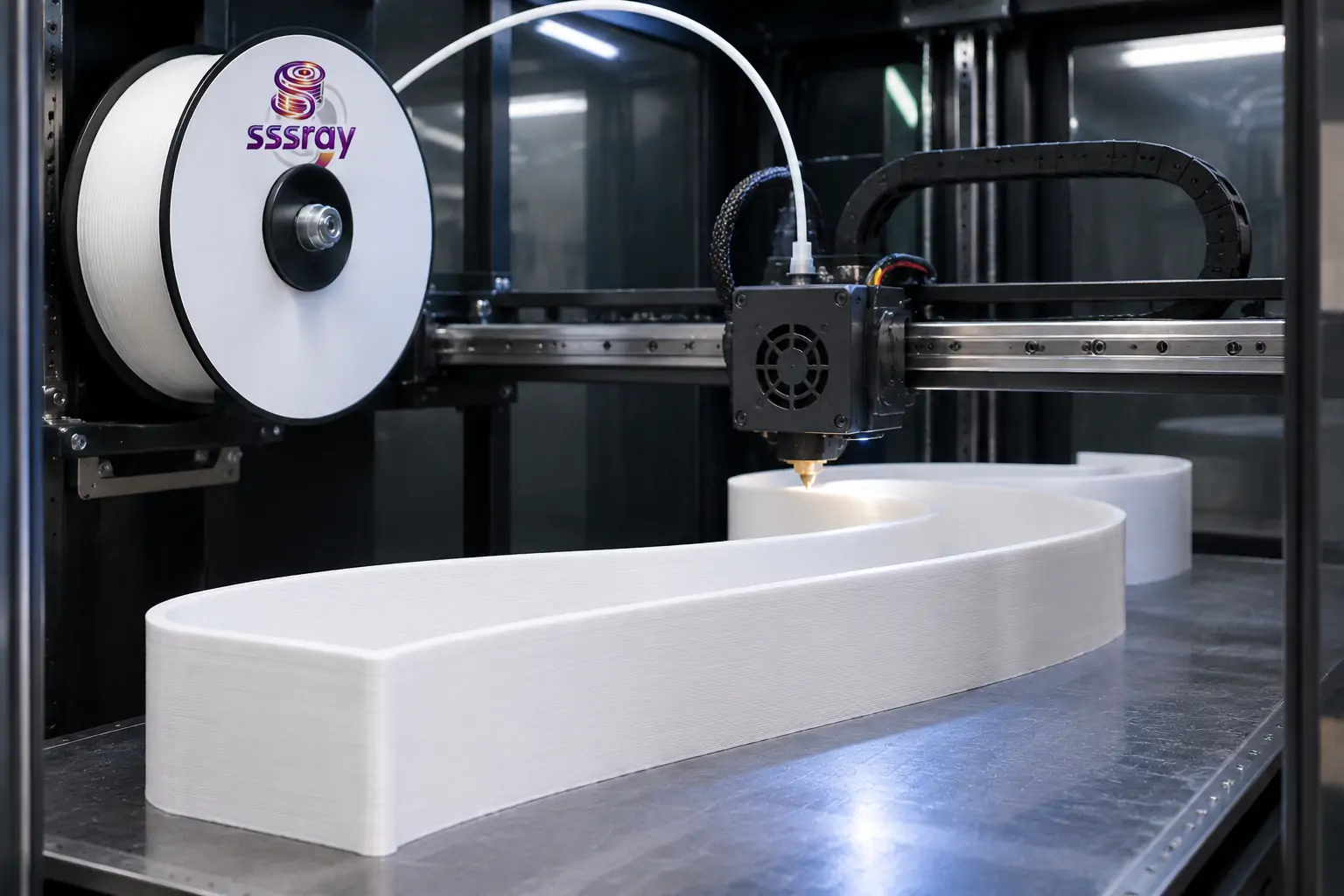
Three classes dominate. Dedicated sign printers from Chinese makers, sold since about 2019–20, come with software that turns vector files into letter shells.[7] Large-format machines handle big letters: Styles began on a Tractus3D T1250 (35 cm diameter, 60 cm high) and moved to a T3000 with a 1 m bed.[8] Enclosed desktop printers cover smaller letters.
Match the bed to your most common letter height, and budget an enclosure for every machine that will run ASA.
Starting print settings for 3D printed signs, by material
Table 5 gives starting points from current product data. Lock final values on your own printer during sample approval.
On mobile, swipe horizontally to review every column.
| Parameter | Sign-grade PLA | ASA | ASA-LW |
|---|---|---|---|
| Nozzle temperature | 190–220 °C (start at 215 °C) | 250–260 °C (usable 240–270 °C) | 240–260 °C; foaming window 240–280 °C |
| Bed temperature | 25–60 °C (start at 55 °C) | 90–105 °C (usable 80–110 °C) | 90–100 °C (usable 80–110 °C) |
| Enclosure | Not required; avoid drafts | Recommended; one ASA TDS lists a 45–60 °C chamber | Enclosed printer for large parts |
| Drying | 50 °C for 4–6 h if stringing or popping | Bambu Lab TDS: blast drying oven at 80 °C for 8 h, or X1 heatbed at 90–100 °C for 12 h (pre-print drying, not annealing) | ASA Aero TDS: blast drying oven at 80 °C for 8 h, or X1 heatbed at 90–100 °C for 12 h; store sealed below 20% RH |
| Nozzle material | Brass (unfilled grade) | Brass for unfilled grades | Brass, 0.4 mm or larger |
| Speed range | 40–200 mm/s (usable 40–250 mm/s) | 50–100 mm/s; 100–180 mm/s on tuned enclosed systems | 30–90 mm/s (30–60 mm/s for tight foaming) |
| Cooling fan | 50–100% after layer 2 | 0–20% | 0–20% |
| Common failure | Large flat letters lift; perimeter lines show on lit faces | Corner lift and layer splits from drafts | Unstable foaming, stringing, rough surface |
| Fix | 5–8 mm brim, 55–60 °C bed; 100% infill, 2–3 walls on faces | Preheat the enclosure, add a brim, keep the fan low; raise nozzle temperature before speed | Change temperature and flow one at a time; retraction 0–1.4 mm or off |
The ASA-LW column is the one that most often surprises buyers: the same spool prints at different densities depending on nozzle temperature, so the profile is part of the specification. On our white ASA-LW batch, 240, 260 and 280 °C gave 0.94, 0.78 and 0.66 g/cm³ at flow ratios of 0.90, 0.74 and 0.63.
Enclosure is not optional on long strokes either. In record SGN-WRP-08, a 600 mm white ASA return printed in a 50 °C chamber lifted at most 0.18 mm at the corners; the same file on an open-frame printer in a 24 °C room lifted up to 1.9 mm, and one of three prints split between layers.
7. Signage Filament Claims vs Reality
Direct answer: most signage-filament claims are adjectives. Turn each one into a number with a test condition before you approve the supplier.
Table 6 converts the common claims into document requests.
On mobile, swipe horizontally to review every column.
| Vague marketing claim | What it might hide | Document, sample or test to request | What a reliable supplier provides |
|---|---|---|---|
| “UV-resistant PLA for outdoor signs” | Stabilizer slows fading but leaves the 56–62 °C softening range unchanged | HDT at stated load; hot-wet retention; UV exposure report | HDT and Vicat with load and method, plus zone limits in writing |
| “LED diffusion filament” | Transmission quoted at an unstated thickness or wavelength | Transmission with wavelength or method, wall thickness and infill | A batch value on the COA, such as 43.6% at 660 nm through 2 mm |
| “UL-approved filament” | UL lists signs, not spools; a molded resin’s Yellow Card rating does not carry over to printed parts | Blue Card file number for the printed grade, or base-resin UL iQ data plus colorant change policy | Blue Card data where it exists, otherwise resin data and written notice before any formulation change |
| “Outdoor-grade ASA” | No exposure hours, color change or retained-strength data | ISO 4892-3 exposure report with hours, ΔE and retained tensile | Exposure data on the grade sold, not a generic ASA reference |
| “Lightweight ASA” | Density depends on nozzle temperature; HDT and stiffness drop | Density vs nozzle-temperature curve; HDT of foamed coupons | A locked profile with target density and wall at sample approval |
| “Consistent color across batches” | Lot drift shows when letters from two lots hang side by side | ΔE limit against a retained master; lot labels | Retained master sample, ΔE on the COA, lot number on every spool |
| “Channel-letter filament” (proprietary trade names without a clearly disclosed polymer family) | A proprietary blend whose base polymer, heat limit and outdoor data may not be disclosed | Base polymer family, HDT at stated load, transmission method, hot-wet retention | The polymer family on the TDS and the same test set as Table 8 |
If a supplier cannot answer the third column within a week, that silence is itself the answer.
8. SSSray Batch Data: PLA vs ASA for 3D Printed Signs
Direct answer: across six public production batches tested between 28 August and 30 October 2026, ASA and ASA-LW passed every exterior gate we set, while sign-grade PLA passed every indoor gate and failed the exterior ones, which is exactly where the zone split puts it.
Data record: SSS-SGN-ZSL-2026-10 · Protocol: SSR-SGN-PROT-2608, Rev. A, issued 17 August 2026 · Test window: 28 August to 30 October 2026 · Lab: SSSray QC lab, Jinhua, under our ISO 9001 quality system · Batch ID format: SSR-[grade]-[YYMMDD]-L[line]-B[batch], printed on every spool label, master carton and COA.
Table 7 lists the six batches behind this guide and how each passed release. The limits are the ones on our batch QC data page: diameter ±0.03 mm, ovality ≤ 0.020 mm, moisture ≤ 0.02% for PLA and ≤ 0.03% for ASA before sealing, and ΔE*ab below 0.8 for PLA and 1.0 for ASA against the retained master.
On mobile, swipe horizontally to review every column.
| Public batch ID | Grade and color | Line, produced | Batch size | Diameter, mean (range), mm | Max ovality, mm | Moisture before sealing (Karl Fischer, n = 3) | ΔE*ab vs master | Release |
|---|---|---|---|---|---|---|---|---|
| SSR-PLASG-260826-L03-B01 | PLA Signage Grade, translucent white | L03, 26 Aug 2026 | 620 kg | 1.751 (1.733–1.768) | 0.016 | 0.014% | 0.42 | Released |
| SSR-PLASG-260902-L03-B01 | PLA Signage Grade, solid white | L03, 2 Sep 2026 | 540 kg | 1.750 (1.731–1.767) | 0.015 | 0.013% | 0.36 | Released |
| SSR-PLASG-261009-L03-B01 | PLA Signage Grade, translucent white | L03, 9 Oct 2026 | 600 kg | 1.752 (1.735–1.770) | 0.017 | 0.015% | 0.58 | Released |
| SSR-ASA-260828-L05-B01 | ASA, white | L05, 28 Aug 2026 | 480 kg | 1.749 (1.729–1.766) | 0.017 | 0.022% | 0.51 | Released |
| SSR-ASA-260904-L05-B01 | ASA, black | L05, 4 Sep 2026 | 520 kg | 1.751 (1.732–1.769) | 0.018 | 0.024% | 0.47 | Released |
| SSR-ASALW-260911-L06-B01 | ASA-LW, white | L06, 11 Sep 2026 | 300 kg | 1.750 (1.730–1.768) | 0.019 | 0.026% | 0.66 | Released |
Signage tests on those batches: equipment, samples and results
Table 8 records the nine signage-specific tests in protocol SSR-SGN-PROT-2608. Each row names the instrument, method, specimen count and test conditions. SSSray’s reported batch results can be traced to the listed production batch and underlying QC record; third-party figures are identified separately in the references.
On mobile, swipe horizontally to review every column.
| Record | Batch | Equipment | Method | Samples | Conditions | Result | Verdict |
|---|---|---|---|---|---|---|---|
| SGN-LT-01 | SSR-PLASG-260826-L03-B01; SSR-PLASG-261009-L03-B01 | Shimadzu UV-2600i with ISR-2600Plus integrating sphere; BYK haze-gard i | Total transmittance at 660 nm; ASTM D1003 luminous transmittance and haze | 5 plaques per batch, 60 × 60 × 2.0 mm | Printed flat at 215 °C, 0.25 mm layers, 100% infill; 40 h at 23 °C and 50% RH | 43.6% (42.1–44.8) and 45.1% (43.9–46.0) at 660 nm; luminous 38.9% and 40.2%; haze 99.1% and 99.0% | Pass (spec 35–50%) |
| SGN-TH-02 | SSR-PLASG-260902-L03-B01; SSR-ASA-260828-L05-B01; SSR-ASALW-260911-L06-B01 | Instron CEAST HV3 HDT/Vicat tester; TA Instruments DSC 25 | ISO 75-2 at 0.45 and 1.80 MPa; ISO 306 A50; ISO 11357-2, 10 K/min, second heat | 3 bars per test per batch | Printed flat, 100% infill; ASA-LW printed at 260 °C (0.78 g/cm³) | PLA: HDT 56.4 °C, Vicat 62.3 °C, Tg 58.2 °C. ASA: HDT 98.6 / 90.4 °C, Vicat 105.1 °C. ASA-LW: HDT 83.1 / 76.2 °C, Vicat 79.4 °C | Pass (PLA within 0.5 °C of TDS; ASA values on COA) |
| SGN-HW-03 | SSR-PLASG-260902-L03-B01; SSR-ASA-260828-L05-B01; SSR-ASA-260904-L05-B01; SSR-ASALW-260911-L06-B01 | Condensation chamber per ISO 6270-2; Instron 5966 with 10 kN load cell | EN ISO 527-2 type 1BA at 5 mm/min; mass gain by balance | 7 exposed and 7 control bars per batch | Printed flat, 0.15 mm layers, 100% infill; 100 h at 55 °C and about 100% RH, 15–19 Sep 2026 | Tensile kept: PLA 79.7% (52.6 → 41.9 MPa, +2.4% mass); ASA white 98.1% (46.9 → 46.0 MPa, +0.8%); ASA black 98.5% (47.3 → 46.6 MPa, +0.9%); ASA-LW 96.4% (24.8 → 23.9 MPa, +1.1%) | ASA, ASA-LW pass (≥ 90%); PLA exterior fail, indoor and sheltered use only |
| SGN-UV-04 | Same four batches as SGN-HW-03 | Q-Lab QUV/se with UVA-340 lamps; X-Rite Ci7800 spectrophotometer (D65/10°, SCI); Instron 5966 | ISO 4892-3 method A, cycle 1: 0.76 W/(m²·nm) at 340 nm, 8 h UV at 60 °C BPT, 4 h condensation at 50 °C BPT | 5 color plaques per checkpoint and 5 tensile bars at 1,000 h, per batch | Started 14 Sep 2026; checkpoints at 250, 500 and 1,000 h; 1,000 h reached 25 Oct 2026 | ΔE*ab at 250 / 500 / 1,000 h and tensile kept: ASA white 0.5 / 0.9 / 1.4, 97.2%; ASA black 0.7 / 1.2 / 1.9, 96.6%; ASA-LW 0.8 / 1.4 / 2.2, 94.1%; PLA control 1.9 / 3.8 / 6.7, 61.8%, chalking from 500 h | ASA, ASA-LW pass (ΔE*ab ≤ 3.0, ≥ 85%); PLA control fail |
| SGN-LED-05 | SSR-PLASG-260826-L03-B01 | SSSray 600 × 300 mm light box, matte white interior; Konica Minolta LS-160 luminance meter | 9-point face luminance; uniformity = Lmin ÷ Lavg | 3 faces per variant | 2.0 mm faces on a 100 × 400 mm stroke; 160° 12 V Class 2 modules, 0.72 W, single row; read from 1 m | 51 mm deep, 102 mm pitch: 0.81 (1,180 cd/m²); 30 mm, 102 mm: 0.52; 30 mm, 60 mm: 0.76 (1,710 cd/m²) | Pass, fail, pass (target ≥ 0.70) |
| SGN-BLD-06 | SSR-PLASG-260902-L03-B01; SSR-ASA-260828-L05-B01; SSR-ASA-260904-L05-B01 | Same light box and luminance meter | Return luminance ÷ face luminance in a dark room | 3 walls per thickness per material | Walls 1.2, 1.6 and 2.0 mm on a 51 mm deep letter; viewed at 1 m | White PLA 14.6 / 9.3 / 6.2%; white ASA 10.8 / 6.9 / 4.4%; black ASA ≤ 0.3%; 1.2 mm white ASA with 0.4 mm black inner skin 0.5% | Pass for white ASA at 2.0 mm, black ASA and the dual-skin wall; fail for white PLA (target < 5%) |
| SGN-DEN-07 | SSR-ASALW-260911-L06-B01 (solid reference SSR-ASA-260828-L05-B01) | Mettler Toledo MS204TS balance with density kit; Instron 5966 three-point bend fixture | ISO 1183-1 method A; ISO 178 flexural modulus | 3 coupons per nozzle temperature | Nozzle 240, 260 and 280 °C at flow ratios 0.90, 0.74 and 0.63 | 0.94 / 0.78 / 0.66 g/cm³; flexural modulus at 260 °C 1,150 MPa vs 1,960 MPa for solid ASA | Profile locked at 260 °C, 0.78 ± 0.03 g/cm³ |
| SGN-WRP-08 | SSR-ASA-260828-L05-B01 | Large-format enclosed printer and open-frame printer; height gauge on a granite surface plate | First-article corner lift on the longest stroke | 3 prints per setup | 600 mm L-shaped return, 51 mm high, 1.6 mm wall; 50 °C chamber vs 24 °C room | Enclosed: max 0.18 mm (mean 0.14 mm). Open frame: max 1.9 mm (mean 1.6 mm), 1 of 3 prints split | Enclosed pass; open frame fail (limit ≤ 0.30 mm) |
| SGN-CAN-09 | SSR-PLASG-260826-L03-B01; SSR-ASA-260828-L05-B01; SSR-ASALW-260911-L06-B01 | Instron 5966 with a cantilever deflection fixture; calibrated height gauge | In-house comparative cantilever deflection, 80 mm free span, 500 g end load, 60 s dwell | 5 strips per batch | Printed strips 100 × 10 × 3 mm, flat, 100% infill, 0.20 mm layers; 23 ± 2 °C, 50 ± 10% RH; deflection read at the free end | Mean free-end deflection: translucent sign PLA 18.3 mm; white ASA 9.5 mm; ASA-LW at 0.78 g/cm³ 13.9 mm | Ranking pass (stiffness ASA > ASA-LW > PLA; comparative method only) |
SSSray batches: tensile strength kept after 100 h at 55 °C and about 100% RH
How to read this data: Table 7 values are release checks run on every batch; Table 8 values are signage qualification tests run on the batches named. Your shipment’s COA carries the same batch ID as the spool label and master carton, and the raw readings behind any figure here are available on request through our batch QC records, because pigment load and wall thickness move transmission and hot-wet retention from batch to batch. Pass limits marked as targets are our own qualification rules, not industry standards.
Procurement implicationWrite batch-level gates into the PO: 35–50% transmission at 660 nm for faces; at least 90% hot-wet retention and ΔE*ab ≤ 3.0 after 1,000 h for exterior shells.
Mistake to avoidApproving a signage filament from a datasheet value with no batch ID, instrument or sample count behind it.
How to verifyMatch the batch ID on your spool label to its COA, then ask for the raw readings behind any Table 8 figure you rely on.
9. B2B Scenarios: Who Buys Which Signage Filament
Direct answer: the right SKU mix depends on who prints the letter and where it will hang. Four typical buyers show the pattern.
Distributor
Situation: adding a signage shelf for local sign shops.
Bad choice: stocking only translucent PLA and selling it as outdoor-capable.
Consequence: soft, bowed returns after the first summer, then refunds.
Better choice: translucent sign PLA for indoor faces, white and black ASA for exterior shells, each labeled by zone.
Verification: hot-wet coupon and light-box photo for every SKU.
Next step: request a zone-split sample set.
OEM Brand
Situation: bundling filament with a channel-letter printer.
Bad choice: tuning default profiles on one PLA lot only.
Consequence: the next lot glows differently and customers blame the printer.
Better choice: lock transmission range and color ΔE to a retained master, with change notice in the contract.
Verification: compare each batch’s COA transmission and ΔE with the master.
Next step: discuss an OEM/ODM signage line.
Print Farm
Situation: printing letter shells for several sign shops.
Bad choice: running ASA on open-frame machines to free capacity.
Consequence: corner lift, split layers and reprints on long strokes.
Better choice: ASA on enclosed machines, PLA faces on open frames, jobs batched by material.
Verification: first-article warp check on the longest stroke.
Next step: plan ASA supply for your farm.
Engineering Buyer
Situation: rolling out illuminated letters to US stores.
Bad choice: approving the printed letter before confirming the UL path.
Consequence: the inspector rejects unlisted letters and the rollout stalls.
Better choice: Class 2 LEDs, printed body reviewed as non-enclosure material, metal mounting.
Verification: UL file covers the printed body; Blue Card or base-resin data on file.
Next step: review the resin path with our engineers.
10. Zone-Split Sample Request: What to Send Before You Ask for a Quote
Direct answer: send the letter’s size, depth, exposure and lighting with your sample request. Those facts decide which signage filament we recommend and how many rolls you need to test.
Table 9 is the request format. The more rows you fill, the fewer emails before a usable sample set ships.
On mobile, swipe horizontally to review every column.
| RFQ item | What to tell us | Why it changes the recommendation |
|---|---|---|
| Letter size | Tallest letter and narrowest stroke | Sets printer bed, wall count and whether faces are printed or cut |
| Return depth | Planned depth in mm | Drives LED spacing and wall height |
| Exposure | Indoor, covered exterior or full sun; climate | Decides PLA vs ASA or ASA-LW |
| Lighting | Face-lit, halo-lit or non-lit; LED module and beam angle | Sets the transmission target and return opacity |
| Face material | Printed PLA, acrylic or PC sheet | Decides whether a translucent grade is needed |
| Listing path | US UL 48 file, other market, or non-electrical | Decides which resin data you need from us |
| Color and finish | RAL or Pantone; matte or gloss | Color matching and lot-to-lot ΔE control |
| Volume and packaging | Monthly kilograms; neutral or private label | MOQ tier, spool size and lead time |
A typical first set is three rolls: one translucent sign-grade PLA, one white or black ASA, and one ASA-LW.
Supply terms: neutral packaging from 50 rolls; OEM or private-label packaging typically 500–1,000 rolls; standard lead time 7–15 working days, customized 15–25 working days; FOB Ningbo or EXW; up to 3 sample rolls for qualified buyers after project review.
Reply within one working day: a zone-split recommendation, the batch COAs in the Table 7 format, and a sample plan sized to your test.
11. 3D Printed Signs FAQ for B2B Buyers
What filament is best for 3D printed signs?
There is no single best filament for 3D printed signs; choose by zone. For indoor illuminated faces, translucent sign-grade PLA gives crisp edges and even diffusion on open printers. For outdoor returns and backs, ASA is the stronger choice: one reference datasheet lists a 100 °C heat deflection temperature at 0.45 MPa, against 56.4 °C for our sign PLA, and ASA kept 96–100% of its tensile strength in a hot-wet test that cost two PLA brands 23–28%. Our own batches repeated the result, with sign PLA keeping 79.7% and white ASA 98.1%. The Bambu Lab ASA and ASA Aero reference values are manufacturer TDS data; both TDS documents state that their test specimens were annealed and dried at 80 °C for 12 h before testing. That specimen-conditioning step is separate from the pre-print filament-drying settings in Table 5. Outdoor faces normally stay acrylic or polycarbonate sheet.
Is PLA OK for outdoor signs?
Only in shade, and only for short-term, non-critical pieces. PLA’s glass transition sits near 58 °C and our sign-grade PLA has an in-house ISO 75-2 HDT of 56.4 °C at 0.45 MPa, so a sunlit return or a sealed letter with LEDs inside can soften and creep. Moisture makes it worse: in a 2023 study, 100 hours at 55 °C and 100% humidity cut one PLA’s tensile strength from 59.1 to 42.6 MPa. UV-stabilized PLA slows fading but does not lift that heat ceiling. Use ASA outdoors.
How long do 3D printed signs last outside?
We found no published multi-year field data on printed channel letters, so treat any fixed “years outdoors” claim as unverified. The data does show a clear ranking: ASA kept its ductility and strength in a 2026 accelerated UV-condensation study, while PLA stiffened and shifted its glass transition. In our own 1,000-hour ISO 4892-3 run, white ASA changed by only ΔE 1.4 and kept 97.2% of its tensile strength, while the sign PLA control kept 61.8%. Real lifetime then depends on wall thickness, color, sealing, LED heat and climate. Ask for an ISO 4892-3 exposure report with hours, color change and retained strength, and run a pilot installation before a rollout.
How do you make illuminated 3D printed letters?
Print the return and back as one ASA or PLA shell, fit LED modules to the back, and close it with a light-diffusing face. For printed faces, use translucent sign-grade PLA at 100% infill to reduce internal voids; this does not guarantee a void-free part. Calibrate extrusion and verify wall-to-infill bonding. Two or three walls and 0.28 mm layers are starting points to validate in the actual light box. Match LED spacing to depth: the current US LED Point XL2 chart specifies 6-inch single-row and multiple-row spacing at 2-inch depth, 9 inches at 3-inch depth, and 12 inches from 4 to 12 inches. Module-to-module spacing is 6 inches at 2-inch depth and 8 inches from 3 to 12 inches. In the US, power the LEDs from a Class 2 source and keep the build inside a listed design.
What light transmission should a translucent PLA sign face have?
For an even face-lit glow, assess transmittance at 660 nm through a 2 mm printed face and state the method and thickness. Our current translucent batches read 43.6% and 45.1%, or 38.9% and 40.2% as ASTM D1003 luminous transmittance with about 99% haze. There is no universal pass band that guarantees an even sign: confirm the face in a light box at the actual depth and LED layout. Our test face scored 0.81 uniformity at 51 mm deep but 0.52 at 30 mm with unchanged LED spacing.
Are 3D printed channel letters cheaper than aluminum?
Often, but not because filament is cheap. One German fabricator reported printed letters up to 30% cheaper depending on shape, mainly from unattended printing and low waste, and a 2025 trade article estimated about Cdn$3 of PETG for a 2-inch-deep, 14-inch-tall letter. Labor, LED count, face material and listing costs decide the real price. The current US LED Point XL2 chart specifies 6-inch single-row and multiple-row spacing at 2-inch depth, 9 inches at 3 inches, and 12 inches from 4 to 12 inches; module-to-module spacing is 6 inches at 2 inches and 8 inches from 3 to 12 inches. Include the resulting LED count, labor, face material and listing costs when comparing a finished letter with aluminum. Price one finished sample letter against your aluminum quote.
Can a 3D printed channel letter be UL listed?
Possibly, through the sign maker’s UL 48 investigation, but never through the filament alone. In September 2025 an industry author reported that UL and CSA certifications were not yet available for 3D printed signs. The UL 879 revision dated 3 September 2025 is scheduled to take effect on 3 September 2027. It adds requirements for non-enclosure-rated sign bodies and polymeric sign-body enclosure materials; the applicable evaluation depends on the component category and construction. The separate UL 48 revision dated 14 May 2025 is scheduled to take effect on 14 May 2027. UL’s Blue Card program can certify a 3D printing material as printed, but that is a material rating, not a sign listing. Ask your listing engineer whether the printed body can sit inside your file, and collect Blue Card or base-resin UL data from the supplier.
Does SSSray publish batch test data for its signage filament?
Yes. Every SSSray figure in this guide carries a public batch ID, the instrument, the method, the sample count and the result. For example, translucent sign PLA batch SSR-PLASG-260826-L03-B01 measured 43.6% transmission at 660 nm through 2.0 mm (5 plaques), and white ASA batch SSR-ASA-260828-L05-B01 kept 98.1% of its tensile strength after 100 hours at 55 °C and about 100% RH (7 bars). The COA for your shipment carries the same batch ID as the spool label and master carton.
What MOQ, lead time and samples does SSSray offer for signage filament?
Our sign-grade PLA and ASA lines start at 50 rolls in neutral packaging, with OEM or private-label packaging typically from 500–1,000 rolls. Standard lead time is 7–15 working days and customized orders typically 15–25 working days, shipped FOB Ningbo or EXW. Qualified buyers can receive up to three sample rolls after project review, enough for a zone-split set of translucent PLA, ASA and ASA-LW. RoHS, SDS/MSDS and TDS are available for both lines, with COA and REACH support on ASA.
12. Conclusion: Specify 3D Printed Signs Zone by Zone
3D printed signs work when each part of the letter gets the material its job demands. Indoors, translucent sign-grade PLA gives sharp, evenly lit faces on simple printers. Outdoors, ASA or ASA-LW carries the returns and backs because it keeps its stiffness and strength where PLA softens, while sheet acrylic or polycarbonate stays on the face.
In the US, the listing path has the last word: confirm that the printed body fits a UL 48 file before you scale. Then run one decisive test. Print a representative letter in the zone split, light it at the planned depth, put a coupon through a hot-wet cycle, and price the finished letter beside your aluminum quote. Three sample rolls are enough to do it.
What you get: up to three sample rolls (translucent sign PLA, white or black ASA, ASA-LW) with the COA for each batch. What to send: the eight items in Table 9. Reply: within one working day.
Prefer paperwork first? Ask SSSray for the TDS, COA and MSDS, compare suppliers with our supplier comparison tool, see our reseller and distributor program, ask about OEM packaging, or request a bulk quote with letter sizes, exposure and monthly volume.
Request a quote or free samples
Tell us the material, color, spool size and monthly volume. An engineer replies within 24 hours on business days.
13. References
- Intertek Standards Update Notice: UL 879 Ed. 9 rev. 18 Dec 2023, effective 18 Dec 2025: earlier revision notice; consult the applicable clauses and the later 2025 revision separately.
- Intertek Standards Update Notice: UL 879 rev. 3 Sep 2025, effective 3 Sep 2027: UV and low-temperature conditioning for outdoor sign body materials.
- Intertek Standards Update Notice: UL 48 Ed. 15 rev. 14 May 2025, effective 14 May 2027: magnetic mounting loading test, thermal design, Class 2 supply connections and environmental marking provisions.
- IAEI Magazine: Welcome Guide for the Proper Electrical Inspection of LED Signage: NEC 600.3 listing and 600.21 power supply text.
- Sedlak et al., “Analysis of the Mechanical Properties of 3D-Printed Plastic Samples Subjected to Selected Degradation Effects,” Materials 16(8):3268, 2023.
- Kohutiar et al., “Effect of Accelerated Aging on the Mechanical Properties of FFF-Manufactured Polymers,” Manufacturing Technology 26(1):43–52, 2026.
- Sign Media Canada: Signmakers, level up with 3D printing (G. Carro, 26 Sep 2025): printed returns, weight, cost, printer timeline and certification status.
- 3DPrint.com (sponsored by Tractus3D): How the Tractus3D printers shook up the channel letter industry: Styles Werbetechnik depth and cost data.
- Modulex: Luma 3D printed channel letters: ASA sides and back with 3 mm cast acrylic face.
- US LED Point XL2 White Modules official specification: 175° beam angle and spacing chart by sign depth.
- Harbor Sales: Selecting the best white acrylic for your project and B2Sign standard channel letter specification: face transmission and aluminum build.
- Bambu Lab ASA Technical Data Sheet V3.0 and Bambu Lab ASA Aero Technical Data Sheet V1.0: density, HDT, Vicat, specimen and drying data.
- UL Solutions: Blue Card Plastics for Additive Manufacturing: certification of 3D printing materials as printed, and the Yellow Card note for printed parts.

He Jiang
Senior Researcher · SSSray · 3D Printing Filament Manufacturing · Jinhua, Zhejiang
He Jiang is a senior researcher at SSSray, a 3D printing filament manufacturer in Jinhua, Zhejiang, China, and leads the signage filament qualification work behind protocol SSR-SGN-PROT-2608. This guide on 3D printed signs and channel letters combines current standards notices, peer-reviewed weathering data and SSSray batch data from six public production batches; lab data cutoff 30 October 2026.