Online time
Monday to Friday: 9AM - 8PM
Weekend: 10AM - 5PM


TL;DR: PETG-ESD for Room-Temperature Fixtures, PA612-ESD Where Heat or Load Decides
ESD-safe filament is not approved by the spool. It is approved by the printed part, measured in your own process. For semiconductor handling, PETG-ESD is the practical default for trays, nests and jigs that stay near room temperature. PA612-ESD earns its extra process cost only when the part must stay stiff under load or survive heat that would soften PETG.
Best optionPETG-ESD for most back-end trays and test jigs; PA612-ESD for hot, loaded or wear-prone fixtures.
When not to use itWafer-contact parts in front-end fabs, bake trays at 125 °C in PETG-ESD, or any pin carrier where a dissipative body would leak current between contacts.
Key specificationSurface resistance of the printed part, typically 106 to below 109 Ω, with test method, voltage and humidity stated.
Verify the supplierAsk for readings on printed plaques by IEC 61340-2-3 or ANSI/ESD STM11.11, with nozzle temperature and orientation recorded.
Procurement warningIn published data, a 20 °C nozzle change moved one PETG-ESD grade by about 34 times in resistance. Lock the print profile with the lot.
Abstract
The chip cycle has turned sharply upward. WSTS reported that the global semiconductor market reached USD 702 billion in the first half of 2026, more than double the same period a year earlier. More devices are moving through assembly, test and packaging lines, and each new package outline needs trays, nests and jigs that can be made fast.
That is where ESD-safe 3D printing filament comes in. A printed tray can be on the line in a day, not weeks. However, the same speed makes it easy to approve the wrong thing.
Three buyer assumptions cause most of the trouble: that “ESD-safe” on a label is a specification, that a filament can be “IEC 61340-5-1 compliant,” and that nylon is always the safer engineering choice. Each assumption can lead to the wrong qualification decision.
In practice, a carbon nanotube ESD filament does not have one resistance value. Polymaker’s own data sheets show Fiberon PA612-ESD reading from 7.74 × 10⁷ Ω down to below 103 Ω across the nozzle temperatures and print orientations tested. In other words, the same spool can print a dissipative part or a conductive one.
So the B2B decision logic runs in a different order than most guides suggest. Start with the application: device sensitivity, temperature, load and cleanliness. Then pick the polymer. Then lock the print profile. Only then does a resistance number on a certificate mean anything.
This guide compares PA612-ESD and PETG-ESD on published mechanical, thermal and electrical data. It explains static dissipative versus conductive behavior in plain terms, shows how to measure surface resistance on printed parts and report surface resistivity when required, and separates what IEC 61340-5-1 actually covers from what suppliers imply. It also covers clean room limits, real cost per kilogram, and the Printed-Part ESD Approval Framework, a seven-checkpoint scorecard for suppliers and reorders.
Prices and documents were checked on 10 October 2026. For contractual ESD limits, SSSray recommends stating the exact standard edition, surface-resistance window, test method, conditioning environment and printed-part acceptance criteria in the RFQ or purchase specification.
Key Takeaways
- Approve the part, not the spool. Resistance depends on filament, nozzle temperature, orientation and grounding path together.
- Dissipative and conductive are different classes. ANSI/ESD S541 puts dissipative at 104 to below 1011 Ω and conductive below 104 Ω. Many ESD programs narrow device-contact surfaces to 106–109 Ω.
- PA612-ESD wins on heat and in-plane strength, not everywhere. HDT is 157.0 °C against 76 °C, and XY tensile strength is 84.3 MPa against 36.1 MPa. Z-axis strength is almost the same: 21.5 versus 20.7 MPa.
- PETG-ESD wins on moisture and process simplicity. Its published equilibrium water absorption is 0.41%, with no annealing step and a 65 °C drying setting.
- Nozzle temperature is an electrical setting. Fiberon PETG-ESD is published at 1.6 × 10⁷ Ω at 250 °C, 4.7 × 10⁵ Ω at 270 °C and below 104 Ω at 290 °C.
- No filament is “certified” to IEC 61340-5-1. That standard covers an organization’s ESD control program. Materials are qualified by test report.
- “Clean room compatible” needs numbers. Neither Fiberon data sheet we reviewed lists outgassing or ionic contamination data, so request it or test for it.
- Spool size moves price more than polymer choice. On 10 October 2026, PA612-ESD cost $129.98/kg in a 0.5 kg spool and $46.66/kg in a 3 kg spool.
1. Why ESD-Safe 3D Printing Filament Demand Is Rising With the 2026 Chip Cycle
Direct answer: more chips are being handled, in more package shapes, with less tolerance for static. Printed ESD tooling fills the gap between a new package outline and the molded tray that arrives weeks later.
The volume side is clear. WSTS projected the 2026 semiconductor market at USD 1.51 trillion in its Spring forecast, then recalculated the year at about USD 1,655 billion after second-quarter actuals. Memory drives most of that growth, and it leans heavily on advanced packaging. For tooling buyers, that means more fixtures, more often.
Why static margins are shrinking at the same time
Meanwhile, devices are getting easier to damage. The Industry Council on ESD Target Levels recommends 250 V as the charged device model (CDM) target for most integrated circuits, and 125 V for very high-speed interfaces. The ESD Association’s technology roadmap describes CDM targets for die-to-die interfaces in advanced packages as below 100 V.
The control standard has moved too. IEC 61340-5-1:2024 covers handling of parts with withstand voltages of 100 V human body model and 200 V CDM or higher, and notes that more sensitive devices can require additional controls.
Put simply, a fixture that was good enough for a 500 V part may not suit a chiplet interface. So ask the end user for the lowest CDM level on the line, and put a resistance class, not just the word “ESD,” in the purchase order.
2. Static Dissipative vs Conductive: Reading the Surface Resistance 106–109 Ohm Window
Direct answer: conductive materials move charge fast, dissipative materials move it slowly, and insulators do not move it at all. For parts that touch devices, slow and controlled is what you want.
Think of static charge as water in a tank. A conductor pulls the plug, and the tank empties in a rush. A dissipative material opens a small drain. An insulator has no drain at all.
That rush matters. If a charged chip touches a very conductive surface, the discharge is fast and the peak current is high. This is the CDM event that damages modern devices. Desco’s guidance makes the same point: below about 106 Ω, a worksurface can discharge a charged device too quickly.
On mobile, swipe horizontally to review every column.
| Class | Surface resistance | How charge leaves | Typical filament example | Use next to devices |
|---|---|---|---|---|
| Conductive | Below 1 × 10⁴ Ω | Very fast; high peak current possible | Carbon-loaded “conductive” filament for circuits and sensors | Shielding and grounding paths; avoid direct contact with bare devices |
| Static dissipative | 1 × 10⁴ to below 1 × 10¹¹ Ω | Controlled bleed to ground | PETG-ESD, PA612-ESD, ABS-ESD | Preferred class for intimate contact |
| Common working window | 1 × 10⁶ to below 1 × 10⁹ Ω | Slow enough to limit CDM risk, fast enough to ground reliably | Well-controlled ESD prints | Typical target for trays, nests and worksurfaces |
| Insulative | 1 × 10¹¹ Ω and above | Does not leave; cannot be grounded | Standard PLA, PETG, ABS, nylon | Keep away from unprotected devices or neutralize with ionization |
ANSI/ESD S20.20 sets the worksurface limit at below 1 × 10⁹ Ω, which is why 109 is the usual ceiling. The 106 floor is an engineering choice to slow the discharge, not a universal limit.
What is the difference between ESD and conductive filament?
Many ESD-safe filaments used for electronics handling are designed to print within the static-dissipative range. Conductive filament targets lower resistance, often for printed circuits, sensors, grounding paths or shielding. Both are usually black and carbon-filled, which is why they get confused. “Anti-static filament” is a looser label still: it can also mean a surface additive that relies on air humidity. Carbon nanotube grades do not.
Ω or Ω/sq: the unit trap in supplier data
Surface resistance is the direct measurement reported in ohms (Ω). Surface resistivity is a geometry-normalized value reported in ohms per square (Ω/sq). Under ANSI/ESD STM11.11 concentric-ring geometry, surface resistivity is commonly calculated at about ten times the measured surface resistance; that conversion does not apply to a two-point probe. ESD material limits are commonly specified in resistance, while some filament data sheets use resistivity terminology, so the RFQ should state the unit and test fixture explicitly.
Procurement implicationWrite the class, the window, the unit and the test method into the spec. “ESD-safe” alone is not a requirement.
Mistake to avoidAssuming lower resistance is always safer. Below 104 Ω the part is conductive, not dissipative.
How to verifyAsk whether the quoted figure is Ω or Ω/sq, and which fixture and voltage produced it.
3. PA612-ESD vs PETG-ESD: Mechanical Properties, Heat and Moisture Compared
Direct answer: PA612-ESD is roughly twice as stiff and strong in the print plane and holds shape about 80 °C higher. PETG-ESD absorbs far less water, stretches more before breaking and needs a much simpler process. Between layers, they are nearly equal.
Table 2 lines up Polymaker’s two Fiberon grades, which are tested by the same methods and so compare cleanly. For market reference, eSUN publishes its PETG-ESD at 109 Ω with a 68 °C HDT, and 3DXTech targets 104–109 Ω for its nanotube-based ESD-PETG.

On mobile, swipe horizontally to review every column.
| Property | Fiberon PA612-ESD (TDS V1.0) | Fiberon PETG-ESD (TDS V1.1) |
|---|---|---|
| Conductive system | Carbon nanotubes + 10% carbon fiber | Carbon nanotubes |
| Published surface resistance | Headline 104–107 Ω/sq; TDS table 7.74 × 10⁷ to below 103 Ω | (1.6 ± 0.3) × 107 Ω at 250 °C to below 104 Ω at 290 °C (ANSI/ESD STM11.11) |
| HDT at 0.45 MPa / 1.8 MPa | 157.0 °C / 125.4 °C | 76 °C / 72 °C |
| Young’s modulus, XY | 4,293.7 MPa dry; 3,730.8 MPa wet | 1,983.0 MPa |
| Tensile strength, XY | 84.3 MPa dry; 73.6 MPa wet | 36.1 MPa |
| Tensile strength, Z | 21.5 MPa dry; 19.2 MPa wet | 20.7 MPa |
| Elongation at break, XY | 3.0% | 7.3% |
| Charpy impact, notched XY | 5.9 kJ/m² | 5.7 kJ/m² |
| Moisture data | Wet specimens held 4.64% moisture; store below 20% RH | Equilibrium water absorption 0.41% at 23 °C / 70% RH |
| Flame rating | UL 94 HB at 1.5 mm | UL 94 HB at 1.5 mm |
| Nozzle temperature | 280–300 °C | 250–290 °C |
Note that the PA612-ESD specimens were annealed at 100 °C for 16 hours, so its dry values are best-case numbers. “Wet” means a further 48 hours in 60 °C water.
Three things the numbers say that marketing pages do not
- The nylon advantage is directional. In XY, PA612-ESD is about 2.3 times stronger and 2.2 times stiffer. In Z, it is 21.5 MPa against 20.7 MPa. A clamp printed upright gains almost nothing.
- Moisture cuts the nylon lead, but does not erase it. Wet stiffness falls about 13%, still well above PETG-ESD. The larger concern is dimensional drift in tight nests.
- PETG-ESD is more forgiving. It stretches 7.3% before breaking, against 3.0%. For snap-fit lids and clips, that matters more than peak strength.
Which ESD filament works best for semiconductor tooling?
- Choose PETG-ESD for room-temperature trays, kitting inserts, PCB nests, covers and most hand-loaded jigs.
- Choose PA612-ESD for fixtures near hot test heads, parts under clamp load, thin tools that must stay flat, and wear surfaces.
- Do not approve by polymer name alone if the part sees a 125 °C bake under load, touches wafers, or must carry a flame rating above HB. PETG-ESD is ruled out for a 125 °C bake; PA612-ESD should be validated on the actual tray geometry and stack load because its published HDT is 125.4 °C under the 1.8 MPa test condition. Polymaker states that PA612-ESD is not UL 94 V-0.
Procurement implicationState service temperature, load direction and tolerance in the RFQ. They decide the polymer before price does.
Mistake to avoidBuying nylon “to be safe” and then printing load paths across the layers.
How to verifyPrint the real fixture in both materials and check flatness after one thermal cycle at service temperature.
4. Carbon Nanotube ESD Filament: Why Print Temperature and Orientation Change the Reading
Direct answer: a carbon nanotube ESD filament conducts through a network of touching tubes. Anything that changes how well printed lines fuse together changes that network. Therefore nozzle temperature and raster direction are electrical settings, not just quality settings.
Picture a crowd passing buckets hand to hand. If people stand close, the bucket moves quickly. If there are gaps between rows, it slows or stops. Each printed line is a row, and hotter printing closes the gaps.
Polymaker explains it the same way: resistance depends on the material’s conductivity and on shell-to-shell and layer-to-layer bonding.
Published surface resistance vs nozzle temperature (log scale)
Fiberon PETG-ESD, 0° specimenFiberon PA612-ESD, 0° specimenFiberon PA612-ESD, 90° specimen
Three patterns stand out. First, PETG-ESD drops about 34 times between 250 °C and 270 °C. Second, at 280 °C, PA612-ESD reads about 100 times lower on a 90° specimen than on a 0° specimen. Third, PETG-ESD crosses into the conductive class at 290 °C, the top of its own recommended window.
PA612-ESD stays dissipative through 300 °C. At 320 °C, above its recommended range, the 45° and 90° specimens fall below 103 Ω, and Polymaker warns that the material may then behave more like a conductor. Also note that the 280 °C, 0° value of 7.74 × 10⁷ Ω sits above the 104–107 headline range. Headline ranges are summaries, not limits.
Why this matters more in a print farm than in a lab
A lab prints on one calibrated machine, while a farm prints on thirty. If hot ends differ by 10 °C, parts from the same spool land in different places on the curve. A fixture approved on printer 4 is not automatically approved on printer 19.
Carbon nanotubes, carbon black and wear
Carbon nanotubes are long and thin, so they form a network at low loading. Roughly round carbon black particles usually need much more, which tends to make parts more brittle and more likely to leave black rub-off.
Durability still needs checking. Polymaker’s FAQ says ESD properties typically hold for one to two years under controlled conditions and recommends regular testing. So re-measure on a schedule.
Workplace note: NIOSH recommends an exposure limit of 1 µg/m³ for airborne carbon nanotubes, as an 8-hour average. Nanotubes bound in plastic are not loose powder, but extract fumes when printing at volume and avoid dry sanding.
Procurement implicationApprove a filament lot together with a printer model, nozzle temperature and orientation rule.
Mistake to avoidRaising nozzle temperature to fix layer adhesion on an approved ESD part without re-measuring it.
How to verifyPrint plaques at the low, middle and high end of your window and plot your own three-point curve.
5. How to Measure Surface Resistance and Report Surface Resistivity of 3D Printed Parts
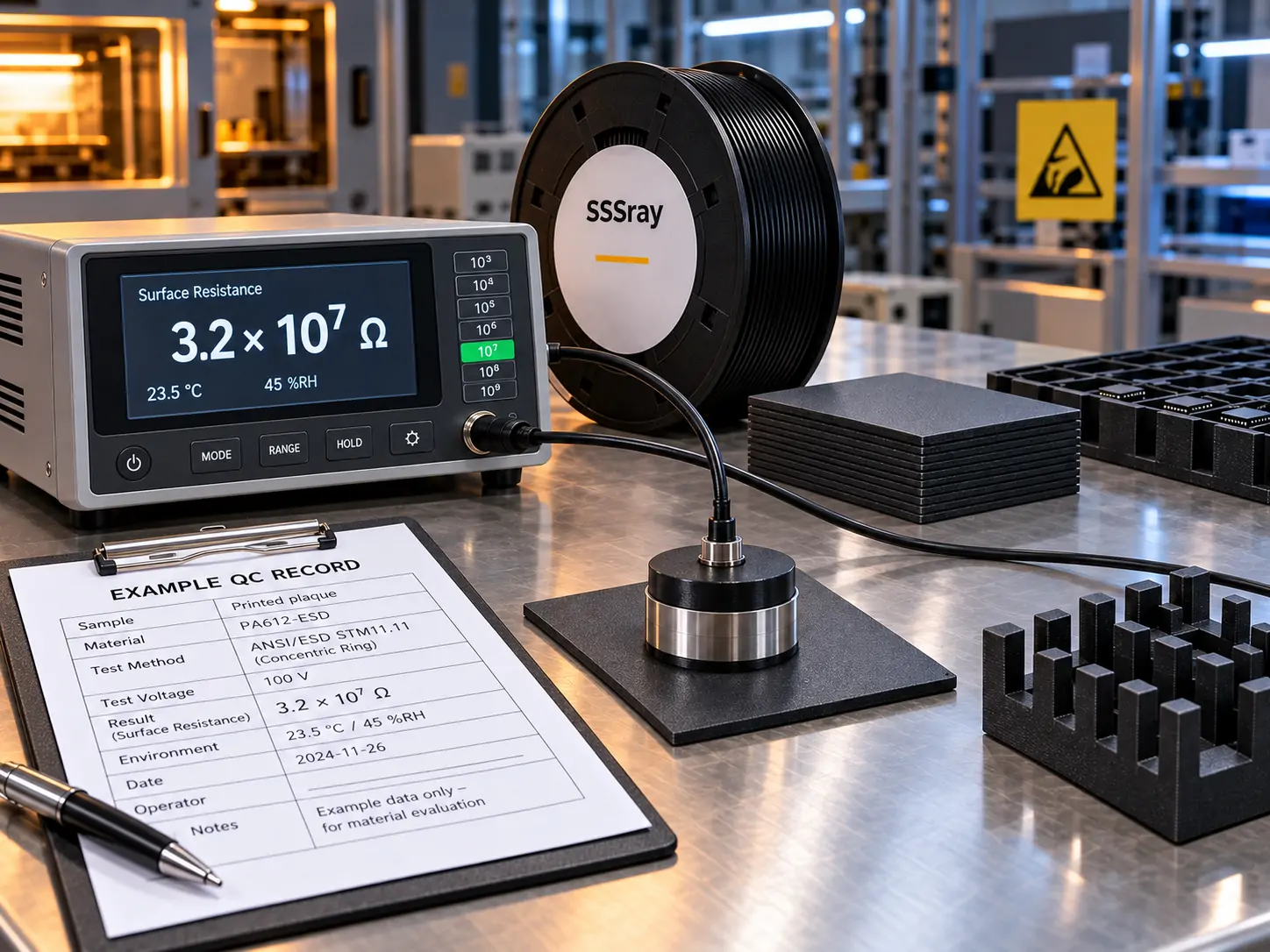
Direct answer: use a resistance meter built for ESD work, with a concentric ring or two-point probe, at 10 V or 100 V, after conditioning the part at a known humidity. A handheld multimeter cannot do this job.
A multimeter tests with a few volts and usually stops reading in the tens of megohms. ESD meters apply a defined voltage and read up to 1011 Ω or more. On a dissipative print, a multimeter often just shows “open circuit.”
A practical measurement routine
- Print flat plaques with the production profile. A common ring fixture is about 100 mm across, so the plaque must be larger. Record nozzle temperature and raster direction.
- Condition before testing. Product qualification under ANSI/ESD S20.20 is commonly run at 12% ± 3% RH and 23 °C, because dry air is the usual worst case.
- Pick the test voltage by range. Standard practice is 10 V below 106 Ω and 100 V at or above.
- Measure both faces. The bed side and the top skin often read differently.
- Measure the real part. Use a two-point probe on small or curved features. IEC 61340-5-3:2022 refers to the two-point probe in IEC 61340-2-3 for this.
- Check the path to ground. Measure from the part’s surface to the ground point in its working position. A dissipative tray on an insulating shelf is still isolated.
- Log the spread. Record lot, printer, sample count, minimum and maximum.
What resistance does not tell you
Resistance shows whether charge can leave, not how much charge a surface creates when a device slides across it. For very sensitive parts, add a charge-generation check; IEC 61340-5-3:2022 added low-charging guidance for this reason. Also reject any reading taken on the raw filament strand, because devices never touch the strand.
6. Clean Room Compatible Filament: Outgassing, Particles and Standard Materials
Direct answer: no filament is clean room compatible by itself. Clean rooms are classified by airborne particles, and equipment is assessed as built. A printed part has to be judged on three things: the particles it sheds, the vapors it releases and the static it holds.
ISO 14644-14, reissued in February 2026, gives a method for assessing equipment by the particles it emits. Notably, its scope excludes electrostatic properties. Clean and ESD-safe are two separate approvals.
Low outgassing materials for semiconductor use: what to ask for
Outgassing is vapor leaving a solid, like the “new car smell” from fresh plastic. Inside a tool or sealed carrier, those vapors can condense on optics or bond pads.
ASTM E595 is the best-known screening test. A sample is held at 125 °C in vacuum for 24 hours, and total mass loss (TML) and collected volatile condensable material (CVCM) are reported. The historical screening levels are 1.00% TML and 0.10% CVCM.
Those levels come from spacecraft work, and ASTM leaves acceptance criteria to the user. The buying rule is the same either way: ask for a number and a method.
- Neither Fiberon data sheet we reviewed lists outgassing or ionic contamination data. Treat such claims as unproven until a report is supplied.
- Nylon carries water. A humid PA612 part releases it under vacuum or heat, which counts toward mass loss. Dry or anneal the part first.
- PETG softens first. With a glass transition of 77 °C, PETG-ESD distorts well below 125 °C.
Particles: the fiber question
Do not infer front-end cleanroom suitability from ESD data alone. FDM parts have ridged surfaces that can trap and release debris, and fiber-filled grades require particle and cleaning checks where sliding contact is involved. Wafer-contact applications require the fab’s own particle, chemical-contamination, outgassing and cleaning qualification.
Can I use standard filament in clean room environments?
Standard PLA, PETG, ABS and nylon should not be treated as ESD-safe by default near exposed devices because they are insulating materials that can retain charge. ANSI/ESD S20.20-2021 allows process-essential insulators when the ESD control requirements are met; for an essential insulator within 25 mm of an unprotected ESDS item, the surface voltage must remain below 125 V when measured as specified.
Standard filament can still serve for covers, brackets or process-essential insulating features when the site ESD plan controls their location and generated voltage.
Procurement implicationQuote cleanliness separately from ESD: particle test, outgassing method and cleaning process each need a line.
Mistake to avoidCoating a printed part to seal it, then assuming resistance is unchanged. Most coatings insulate.
How to verifyRe-measure resistance after cleaning, coating or baking, and run a wipe test for rub-off on white cloth.
7. Chip Trays, Test Jigs and Electronics Packaging: 3D Printing the Right ESD Material
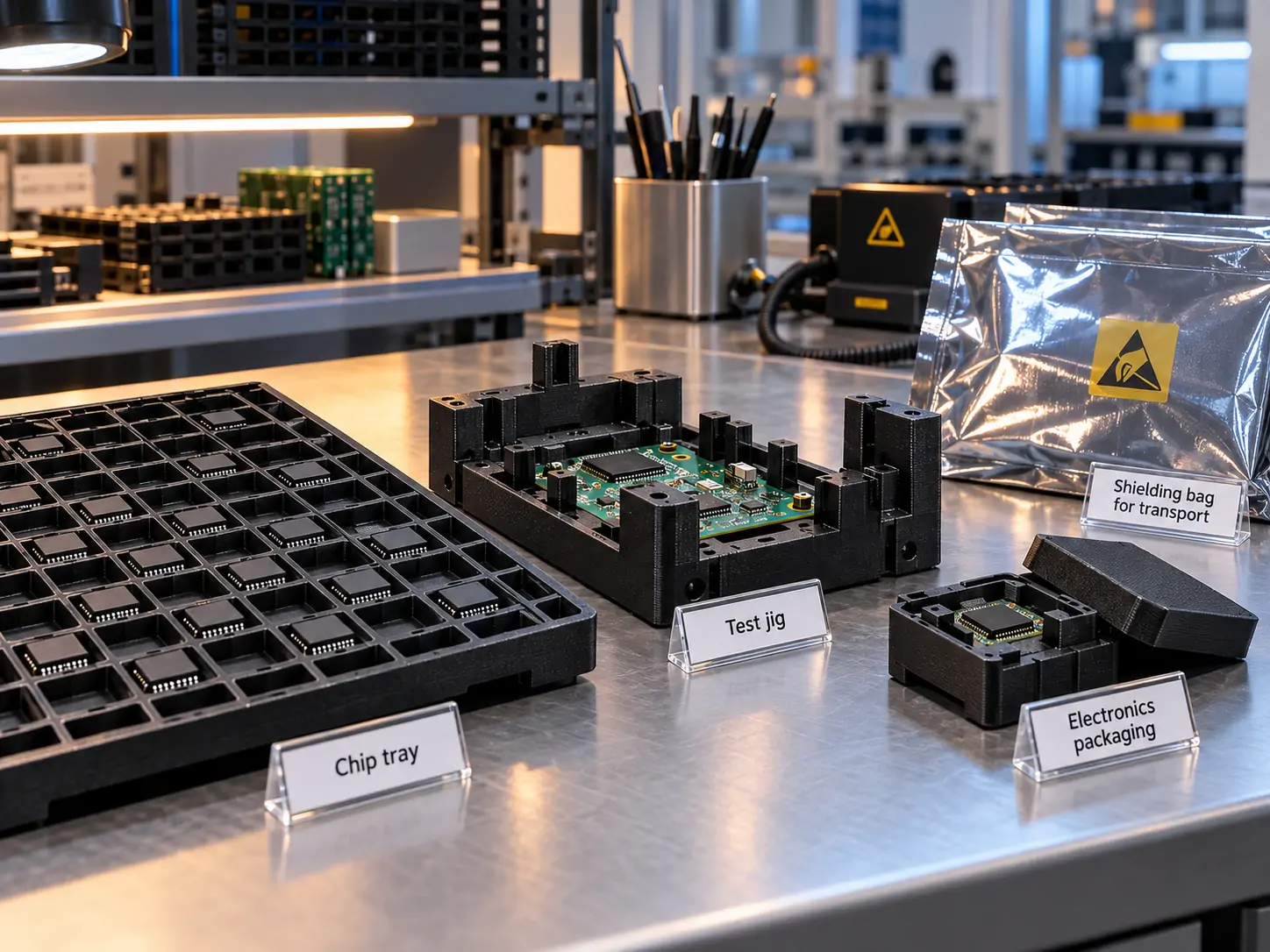
Direct answer: match the material to the hottest moment and the tightest tolerance in the part’s life. Most custom 3D printed chip trays and jigs are room-temperature parts, and PETG-ESD handles them. Heat, clamp force and wear move the choice to PA612-ESD.
Custom 3D printed chip trays: two limits to check first
- Size. The standard JEDEC matrix tray outline is 322.6 × 135.9 mm. That will not fit a 256 mm print bed in any orientation, so full-outline trays need a 330–350 mm class printer.
- Bake. Moisture-sensitive devices are often baked in their trays at 125 °C. PETG-ESD is ruled out. PA612-ESD publishes 157.0 °C HDT at 0.45 MPa and 125.4 °C at the 1.8 MPa test condition, so a 125 °C bake application should be qualified on the actual tray geometry, stack load and dimensional tolerance rather than approved from HDT alone.
Consequently, printed trays make the most sense for work-in-process transport, kitting, odd outlines and low volumes at room temperature. Molded high-temperature trays remain the normal route for bake-rated volume use.
Test jig ESD protection: where dissipative is the wrong answer
A test jig has two jobs that pull in opposite directions. The nest should bleed charge, but the plate that holds the test pins must keep them electrically apart.
Here is the arithmetic. If a dissipative pin plate presents 106 Ω between two adjacent pins, and one sits at 3.3 V, about 3.3 µA flows between them. For a low-leakage measurement, that is a false failure waiting to happen.
Therefore, split the design. Print the nest and handling surfaces in ESD material, and make the pin carrier from an insulating, low-charging material.
Electronics packaging: inside and outside the protected area
Under ANSI/ESD S541, packaging inside an ESD protected area needs low charging and a dissipative or conductive contact surface. Outside it, the package also needs discharge shielding, which a printed dissipative box does not provide. IEC 61340-5-3:2022 tightened that requirement from 50 nJ to 20 nJ, so a printed tray leaving the protected area should travel inside a shielding bag.
On mobile, swipe horizontally to review every column.
| Option | Best use case | Key spec | Advantage | Risk | How to verify | When to reject | SSSray sourcing note |
|---|---|---|---|---|---|---|---|
| PETG-ESD | Room-temperature trays, PCB nests, kitting inserts | Part resistance window; HDT about 68–76 °C | Low moisture uptake; no annealing | Softens near hot equipment; resistance shifts with nozzle temperature | Plaques at three nozzle temperatures; flatness after warm soak | Service above about 60 °C; readings below 104 Ω at your profile | Send window, method and printer model with the inquiry |
| PA612-ESD | Hot test fixtures, clamped tools, wear surfaces | HDT 157.0 °C at 0.45 MPa; conditioned dimensions | About 2× in-plane stiffness and strength | Moisture drift; orientation sensitivity; nozzle wear | Dimensions and resistance after annealing and conditioning | No dryer or hardened nozzle; Z-loaded design | Confirm dry packing and storage limit per lot |
| ABS-ESD | Enclosures and fixtures on enclosed printers | Part resistance window; enclosed chamber | Familiar processing; easy machining | Warping on large flat trays; fumes | Flatness on the largest part; plaque resistance | Open-frame printers; large thin trays | SSSray lists an ESD-safe ABS at 106–109 Ω/sq |
SSSray sourcing note: SSSray lists an ESD-safe ABS filament in its specialty engineering range and handles other compounds through its ODM program. For a PETG or PA612 based ESD grade, send the resistance window, test method, print temperature range and spool size as the starting specification.
Procurement implicationBuy by part family. Trays, hot fixtures and pin carriers may need three different materials.
Mistake to avoidPrinting a whole test jig, pin plate included, from one ESD spool.
How to verifyRun pin-to-pin leakage on the assembled jig and a bake trial on any tray that will see heat.
8. IEC 61340-5-1 Compliance: What Certifications Prove ESD Filament Meets Standards?
Direct answer: IEC 61340-5-1 and ANSI/ESD S20.20 are ESD control-program standards; they do not by themselves certify an individual filament spool. An organization can implement or be audited against these program requirements, while a filament supplier supports printed-part qualification with material documentation and test evidence tied to the specimen, print profile and lot.
The current edition, IEC 61340-5-1:2024, updated product qualification requirements and added a reference to IEC TS 61340-5-4 for compliance verification testing. The current IEC TS 61340-5-4:2026 covers compliance verification of technical items in an ESD control program and explicitly excludes product qualification from its scope.
Two terms from these standards are worth learning, because auditors use them:
- Product qualification is the evidence gathered before an item enters the program, normally under controlled, dry conditions.
- Compliance verification is the periodic check that the item still meets limits in service.
A filament data sheet supports the first. Only your own measurements deliver the second. So replace “IEC 61340-5-1 compliant” in your spec with a resistance window and a named test method.
The document set a reliable supplier should offer
- A technical data sheet stating resistance with unit, method, voltage and specimen print settings.
- A certificate of analysis per lot, with resistance measured on printed specimens.
- A safety data sheet for hazard and handling information, plus a TDS, technical declaration or COA that identifies the conductive system where that formulation detail can be disclosed.
- RoHS and REACH declarations for the destination market.
- On request, a third-party laboratory report by IEC 61340-2-3 or ANSI/ESD STM11.11.
9. Cost per kg: ESD-Safe Filament vs Standard Engineering Grade, and Bulk Procurement
Direct answer: at list prices on 10 October 2026, branded ESD filament cost roughly $46–130 per kilogram, against about $19/kg for the same brand’s standard PETG. However, spool size and reject rate change the real figure more than the polymer does.
List price per kilogram by grade and spool size (USD, 10 October 2026)
Market price snapshot — 10 October 2026: these figures are a dated reference compiled from public manufacturer and distributor list prices, not an SSSray quotation. SSSray provides competitive project pricing based on material grade, resistance specification, order volume, testing requirements and packaging.
Two readings are useful. First, the ESD premium on PETG is about 3.2 times at the 1 kg size. Second, PA612-ESD in a 3 kg spool costs slightly less per kilogram than PETG-ESD in a 3 kg spool, while the 0.5 kg nylon spool costs about 2.8 times as much per kilogram as the 3 kg one.
For reference, eSUN’s store showed prices as low as $34.99 for its 1 kg PETG-ESD spool, while US-made 3DXTech ESD-PETG listed at roughly $95–105 per 750 g at one US reseller.
Real purchasing cost: price per accepted kilogram
The formula is simple: cost per accepted kg = price ÷ (1 − reject share). Reject share includes failed prints and parts that measure outside the resistance window.
As an illustration only, assume 8% rejects on PETG-ESD and 15% on PA612-ESD, which is harder to dry and print. PETG-ESD at $59.99/kg becomes about $65.21, and PA612-ESD at $46.66/kg becomes about $54.89. Replace both rates with 30 days of your own logs.
Then add the process costs that nylon carries and PETG does not: drying at 100 °C for 10 hours, annealing at 100 °C for 16 hours, a hot end that holds 280–300 °C, and a hardened nozzle. Polymaker puts brass nozzle life at about 9 hours on PA612-ESD.
Bulk procurement of ESD filament for electronics manufacturing
- Buy by lot. Ask that one order ships from one compound lot, with the lot number on every spool.
- Size spools to consumption. A 3 kg nylon spool saves money only if it stays dry to the last meter, and Polymaker notes that its 3 kg spools do not fit popular multi-material units.
- Hold a retained sample. Keep one sealed spool and five measured plaques from each approved lot.
Procurement implicationCompare quotes on cost per accepted kilogram, at the spool size you will really use.
Mistake to avoidChoosing nylon on the 3 kg price while running machines that only take 1 kg spools.
How to verifyLog rejects by cause for 30 days: print failure, dimension, or resistance out of window.
10. The Printed-Part ESD Approval Framework for B2B Buyers
A dissipative tray without a defined path to ground cannot reliably drain accumulated charge. A supply chain works the same way: one unverified link cancels the rest. The Printed-Part ESD Approval Framework follows seven checkpoints, from the device on your line back to the supplier’s compounding lot.
On mobile, swipe horizontally to review every column.
| Checkpoint | Why it matters | What to ask | Pass / fail signal | Hidden risk |
|---|---|---|---|---|
| Application requirement | Device sensitivity, heat and contact type set the class | Lowest CDM level on the line? Peak temperature? Device contact or not? | Pass: written window and temperature. Fail: “needs to be ESD.” | Pin carriers need insulation, not dissipation |
| Material performance | Polymer decides heat, stiffness and moisture behavior | HDT at two loads, XY and Z strength, wet values, moisture uptake? | Pass: numbers with methods. Fail: one headline value. | Dry, annealed data hides in-service drift |
| Printability | Resistance moves with temperature and orientation | Resistance at low, middle and high nozzle temperature? By orientation? | Pass: curve on printed specimens. Fail: strand or pellet data. | Printer-to-printer temperature offsets |
| Compliance | Auditors accept test evidence, not labels | Method, voltage, humidity? Lot COA? SDS plus TDS or technical declaration for the conductive system? RoHS and REACH? | Pass: report naming the method. Fail: “certified to IEC 61340-5-1” with no printed-part evidence. | Ω and Ω/sq mixed between documents |
| Supplier reliability | Additive dispersion varies between compounding runs | How is each lot tested? How many specimens? Retained samples? | Pass: lot-linked readings. Fail: one “typical” value for all lots. | Silent change of additive supplier |
| Landed cost | Rejects and process steps outweigh list price | Price by spool size? Dry-pack spec? Claim terms for out-of-window lots? | Pass: cost per accepted kg. Fail: FOB price only. | Nylon moisture pickup in ocean transit |
| Reorder stability | The approved profile only fits the approved compound | Will you notify before changing resin, additive or loading? | Pass: written change control. Fail: “same or equivalent.” | Problems appear on reorders, after approval |
Score each checkpoint pass, conditional or fail. Approve a supplier only when nothing fails and every “conditional” has a written action and an owner.
11. ESD Filament Supplier Claims vs Reality
ESD performance is invisible, so marketing fills the gap with adjectives. Use Table 5 to turn each claim into a document request.
On mobile, swipe horizontally to review every column.
| Vague marketing claim | What it might hide | Document, sample or test to request | What a reliable supplier provides |
|---|---|---|---|
| “ESD-safe” | No class, window or unit | Resistance window in Ω with method | Dissipative window on printed specimens, with voltage and humidity |
| “106–109 Ω” | Measured on pellets, strand or one ideal print; Ω/sq quoted as Ω | Specimen type, print settings and unit | Readings at several nozzle temperatures and orientations |
| “IEC 61340-5-1 compliant” | A program standard applied to a material | The test report behind the statement | Report by IEC 61340-2-3 or ANSI/ESD STM11.11 |
| “Clean room compatible” | No particle or outgassing data | Outgassing result with method; particle or wipe test | Named test, sample condition and result |
| “Permanent anti-static” | Surface wear, coating or contamination effects ignored | Resistance before and after abrasion and cleaning | Durability data plus a re-test interval |
| “Low moisture absorption” | Compared with PA6, not with PETG | Uptake value with temperature and RH | Wet and dry mechanical data side by side |
12. SSSray ESD Printed-Part Qualification Protocol
SSSray uses this controlled protocol for B2B qualification and production-lot release of ESD-safe filament. Planar specimens are 120 × 120 × 3 mm plaques at 100% infill. Surface resistance is measured with an ESD resistance meter and concentric-ring electrode using ANSI/ESD STM11.11 methodology for planar specimens, with IEC 61340-2-3 used when the customer specification calls for the IEC method. Test voltage is 10 V for readings below 106 Ω and 100 V at or above 106 Ω. Routine production-lot QC uses n=9 plaques at the approved profile; initial electrical-profile qualification uses n=18 plaques across three nozzle temperatures, two raster orientations and three replicates per condition.
Protocol ID: SSSRAY-ESD-PARTQUAL-2026-10-R01 · Controlled qualification record: SSSRAY-ESD-QR-2026-10-R01 · Material: 1.75 mm ESD-safe filament · Routine lot QC: n=9 plaques, three each from start-, middle- and end-of-lot spools at the approved production profile · Initial profile qualification: n=18 plaques, three temperatures × two raster orientations × three replicates.
On mobile, swipe horizontally to review every column.
| Control point | SSSray test condition | Acceptance / record requirement | Why it is controlled |
|---|---|---|---|
| Routine lot QC | n=9 at the approved production profile: three plaques from start-, middle- and end-of-lot spools; top and bed surfaces measured | Every reading inside the customer’s window; default 1 × 10⁶ to below 1 × 10⁹ Ω | Verifies repeat supply against the approved lot profile |
| Initial profile qualification | n=18: low, middle and high nozzle temperatures × 0° and 90° raster × three replicates; for published Fiberon reference points use 250/270/290 °C for PETG-ESD and 280/290/300 °C for PA612-ESD | Record every reading and the full spread; flag any result below 1 × 10⁴ Ω or outside the customer’s specified window | Separates temperature and raster effects before a production profile is released |
| Dry-air condition | 23 ± 3 °C and 12 ± 3% RH for at least 48 h before qualification measurement | Conditioning start/end time, temperature and RH are recorded with each result set; no reading may exceed the approved window | Controls the humidity effect and represents the dry qualification condition commonly used for ESD material testing |
| Orientation | 0° and 90° raster are controlled inside the n=18 initial qualification matrix | Report both orientations and their ratio at each qualification temperature | Published nanotube-grade data shows large orientation effects |
| IPA wipe durability | SSSray internal work instruction: 70 ± 2% v/v IPA, low-lint polyester wipe, 10 double strokes over the marked test area under 10 ± 2 N normal load; air-dry 10 min, then return the plaque to the controlled conditioning environment before re-measurement | Record pre-wipe and post-wipe resistance on the same face and location; result remains inside the approved customer window; visible rub-off, whitening or surface damage is recorded | Checks whether routine IPA cleaning shifts electrical performance or damages the printed surface |
Test-record traceability: SSSRAY-ESD-QR-2026-10-R01 is the controlled qualification record linked to this protocol. Each completed production record carries the production batch number, spool and plaque IDs, printer model, nozzle type and diameter, nozzle and bed temperatures, print speed, conditioning start/end time, temperature and RH, resistance-meter model and serial number, electrode type, test voltage, pre-wipe and post-wipe readings where applicable, and all actual resistance results. Routine lot records contain nine plaque results; initial profile qualification records contain eighteen. Published supplier-TDS values remain external benchmarks and are not substituted for SSSray production-lot measurements.
13. B2B Scenarios: Who Loses Money on the Wrong ESD Filament, and How to Prevent It
Distributor
Situation: adds an ESD line for electronics repair shops and contract manufacturers.
Bad choice: lists one “ESD PETG” with a single headline value copied from the supplier.
Consequence: customers measure a different number, then return stock as “not ESD.”
Better choice: publish the window with unit, method and print temperature, and stock two spool sizes.
Verification: buyer-side incoming spot check on five plaques per inbound lot, separate from the SSSray n=9 production-lot QC record.
Next step with SSSray: request an ESD sample spool with its TDS.
OEM Brand
Situation: wants a private-label ESD filament matched to its own printers.
Bad choice: approves a sample without fixing the slicer profile it ships.
Consequence: a firmware temperature change moves parts out of the window months later.
Better choice: approve compound, profile and printer model as one package, with change control.
Verification: three-temperature plaque curve on the shipped hardware.
Next step with SSSray: discuss an OEM/ODM ESD grade.
Print Farm
Situation: prints trays for an electronics assembler across many machines.
Bad choice: buys PA612-ESD on the 3 kg price and runs it without drying or annealing.
Consequence: warped trays, worn nozzles and readings that differ by machine.
Better choice: PETG-ESD for room-temperature trays; nylon only on dedicated, calibrated machines.
Verification: one plaque per machine per lot, logged for 30 days.
Next step with SSSray: plan a production-lot trial.
Engineering Buyer
Situation: needs a test fixture near a heated socket.
Bad choice: prints the entire fixture, pin plate included, in one ESD material.
Consequence: leakage between pins causes false test failures.
Better choice: PA612-ESD for the hot nest; an insulating, low-charging plate for the pins.
Verification: pin-to-pin leakage and nest resistance to ground on the built fixture.
Next step with SSSray: send the drawing for an engineering review.
14. PA612-ESD and PETG-ESD Print and Sourcing Specs at a Glance
Print settings: published starting points
On mobile, swipe horizontally to review every column.
| Parameter | PA612-ESD | PETG-ESD |
|---|---|---|
| Nozzle temperature | 280–300 °C; resistance falls as temperature rises | 250–290 °C; at 290 °C published readings fall below 104 Ω |
| Bed temperature | 40–50 °C; do not exceed 50 °C | 70–80 °C |
| Enclosure | Heated chamber not required; keep chamber air below 50 °C | Not needed; keep the door open on enclosed printers |
| Drying and annealing | Dry at 100 °C for 10 h; store below 20% RH; anneal at 100 °C for 16 h per the TDS | Dry at 65 °C for 3 h per the TDS if moisture was absorbed; no annealing specified |
| Nozzle material | Hardened steel or ruby; brass lasts about 9 h | Hardened nozzle required |
| Speed range | Up to 300 mm/s when dry on suitable hardware | Fiberon PETG-ESD TDS V1.1 states up to 500 mm/s, while the current Polymaker shop technical box lists 50 mm/s maximum; lock the qualified speed to the approved printer profile |
| Common failure and fix | Popping from moisture, warping from a hot bed, nozzle wear; dry longer, hold the bed at 50 °C or below, fit a hardened nozzle | Weak layer bonding when cooled hard; reduce fan and speed, then re-measure resistance |
These are recommended starting references. For PETG-ESD, the current Polymaker shop page contains both a 50 mm/s maximum in its technical box and an “up to 500 mm/s” statement in the print-settings content, while TDS V1.1 also states up to 500 mm/s. Treat speed as part of the approved qualification profile: record the printer, nozzle temperature, speed and resistance result, then keep that profile with the sample approval and purchase specification.
Sourcing specs: what to put in the RFQ
On mobile, swipe horizontally to review every column.
| Item | What to specify | SSSray reference |
|---|---|---|
| MOQ | Qualification versus production quantity | ESD-safe ABS from 50 rolls in neutral packaging; OEM packaging typically 500–1,000 rolls |
| Lead time | Compounding, extrusion, testing and transit, in writing | Standard orders 7–15 working days; customized orders typically 15–25 working days |
| Sample approval | Sample ID, lot, plaque readings and print profile | B2B qualification samples tied to sample ID |
| Tolerance | Diameter and ovality with method and raw data | ±0.03 mm stated maximum diameter tolerance |
| Documentation | Lot COA with resistance, TDS, SDS, RoHS and REACH | TDS, SDS, RoHS and applicable compliance files; printed-part resistance evidence and third-party testing can be matched to the project requirement |
| Packaging | Vacuum pouch, desiccant, lot label; dry-pack detail for nylon | Vacuum packing with desiccant; details confirmed per order |
| Private label | Resistance window, unit and method on the label; ESD marking | OEM and private-label labels, boxes, cartons and barcodes |
| Reorder control | Change notice for resin, additive type and loading | Reorder spec linked to the approved sample |
15. ESD-Safe Filament FAQ for B2B Buyers
What is the difference between ESD and conductive filament?
Many ESD-safe filaments for electronics handling are designed for the static-dissipative range, while conductive filament is built for lower resistance. Under ANSI/ESD S541, dissipative materials measure from 104 to below 1011 Ω and conductive materials measure below 104 Ω. A dissipative surface transfers charge more slowly to ground or another conductive object, while a conductive surface transfers charge faster. For device-contact tooling, specify the required resistance window, unit, test method, conditioning environment and print profile rather than relying on the label alone.
Which ESD filament works best for semiconductor tooling?
PETG-ESD suits most room-temperature tooling, and PA612-ESD suits hot or loaded tooling. Published data puts PETG-ESD heat deflection at 76 °C and PA612-ESD at 157.0 °C under light load. PA612-ESD is also about twice as stiff and strong in the print plane. However, PETG-ESD absorbs far less water and needs no annealing, so it holds tolerance with less effort. Choose by peak temperature, load direction and tolerance, then confirm with a printed trial part.
How do I measure surface resistance and surface resistivity of 3D printed parts?
Use an ESD resistance meter with a concentric ring or two-point probe, not a multimeter. Print flat plaques with your production profile, condition them at a known humidity, and test at 10 V below 106 Ω or 100 V above. Measure the top and bed surfaces, and then the real part. Report the direct measurement as surface resistance in Ω. With ANSI/ESD STM11.11 concentric-ring geometry, surface resistivity in Ω/sq is commonly calculated at about ten times that resistance value; do not apply that conversion to a two-point probe. Finally, measure resistance from the part to ground in its working position.
What certifications prove ESD filament meets standards?
IEC 61340-5-1 and ANSI/ESD S20.20 are ESD control-program standards and do not by themselves certify an individual filament spool. For purchasing, ask for product evidence instead: a lot certificate with resistance measured on printed specimens, the test method such as IEC 61340-2-3 or ANSI/ESD STM11.11, the voltage and humidity used, and the print settings. Add the SDS, RoHS and REACH declarations, plus any applicable third-party product test report. The printed item is then qualified within the buyer’s ESD control program.
What does ESD filament cost per kg compared with standard engineering grade?
Expect roughly three times the price of the standard grade from the same brand, and more in small spools. On 10 October 2026, Polymaker listed standard PETG at $18.99/kg and Fiberon PETG-ESD at $59.99/kg in a 1 kg spool. Fiberon PA612-ESD ranged from $129.98/kg in a 0.5 kg spool to $46.66/kg in a 3 kg spool. For budgeting, divide price by one minus your reject share to get cost per accepted kilogram.
What should a bulk procurement spec for ESD filament include?
It should state a resistance window, a unit and a test method before anything else. Then add the specimen print settings, conditioning humidity, sample count per lot and the action if a lot measures out of window. Include diameter tolerance, moisture at packing, spool size, dry-pack details for nylon and the document set. Finally, require written notice before any change to resin, additive type or loading, because an approved print profile only fits the compound it was approved with.
16. Conclusion: Buy ESD-Safe Filament by the Printed Part, Not the Label
ESD-safe filament is a starting material, not a finished guarantee. The published data is clear on that point: the same carbon nanotube spool can print a dissipative tray or a conductive one, depending on nozzle temperature and orientation.
So the decision logic is short. First, define the application: device sensitivity, peak temperature, load direction and cleanliness. Next, choose the polymer. PETG-ESD covers most room-temperature trays and jigs, while PA612-ESD is for heat, clamp load and wear. Then lock the print profile and measure printed plaques by a named method. Finally, run the Printed-Part ESD Approval Framework so documents, cost and reorders stay under control.
Your next step is a controlled qualification: run the n=18 electrical-profile matrix across three nozzle temperatures and two raster orientations, lock the approved profile, then use the n=9 production-lot QC plan for repeat supply and confirm one real fixture at service conditions. Keep the qualification plaques and lot records as the reference for every reorder. That evidence tells you more than any “ESD-safe” label.
Prefer to start with paperwork? Request the TDS, COA and SDS, compare materials across our 3D printer filament supplier range, ask about OEM packaging, or request a bulk quote with your resistance window and monthly volume.
Request a quote or free samples
Tell us the material, color, spool size and monthly volume. An engineer replies within 24 hours on business days.
17. References
- IEC 61340-5-1:2024, Electrostatics – Protection of electronic devices from electrostatic phenomena – General requirements: scope, edition 3 changes.
- IEC 61340-5-3:2022, Properties and requirements classification for packaging: shielding limit, two-point probe, low-charging guidance.
- IEC TS 61340-5-4:2026, Compliance verification: compliance-verification procedures for technical items in ESD control programs; product qualification is outside its scope.
- ANSI/ESD S541-2026, Packaging Materials and Desco Industries ESD Q&A: packaging requirements, resistance classes and worksurface guidance.
- ANSI/ESD STM11.11-2022, Surface Resistance Measurement of Planar Materials: planar-material surface-resistance method, specimen conditioning and reproducible measurement requirements.
- In Compliance Magazine: What’s New in ESD Control Standards? and ESDA forum on process-essential insulators: ANSI/ESD S20.20-2021.
- In Compliance Magazine: Updated Trends in Charge Device Model (CDM) and The ESD Association Technology Roadmap: CDM target levels.
- WSTS Spring 2026 semiconductor market forecast and WSTS Q2 2026 release: market size and growth.
- Polymaker Fiberon PA612-ESD TDS V1.0 and product wiki: mechanical, thermal and resistance data.
- Polymaker Fiberon PETG-ESD TDS V1.1, product wiki and ESD materials explainer.
- eSUN PETG-ESD Technical Data Sheet V1.0 and 3DXTech ESD-safe filament overview: market reference grades.
- ISO 14644-14:2026, Assessment of suitability for use of equipment by airborne particle concentration.
- NASA Goddard Outgassing Database user guide: ASTM E595 method and screening levels.
- NIOSH Current Intelligence Bulletin 65: Occupational Exposure to Carbon Nanotubes and Nanofibers; and Potter, Al-Abed, Lay and Lomnicki, VOC Emissions and Formation Mechanisms from Carbon Nanotube Composites during 3D Printing, Environmental Science & Technology, 2019.

He Jiang
Senior Researcher · SSSray · 3D Printing Filament Manufacturing · Jinhua, Zhejiang
He Jiang is a senior researcher at SSSray, a 3D printing filament manufacturer in Jinhua, Zhejiang, China. His work focuses on engineering-filament qualification, printed-part resistance verification, lot-level QC records and sourcing specifications for B2B distributors, OEM brands, print farms and electronics manufacturers. For ESD-safe materials, he evaluates polymer choice, print-profile sensitivity, conditioning, resistance measurement and repeat-lot controls together so buyers can qualify the printed part rather than rely on a spool label alone.
