Online time
Monday to Friday: 9AM - 8PM
Weekend: 10AM - 5PM


TL;DR: Use hBN-PLA to Decide Before Tooling, Not to Replace It
Use hBN-PLA as a candidate for controlled bench prototypes when the trial needs to compare heat spreading, geometry or electrical-insulation behavior. Define the experiment and temperature boundary before choosing the composite. Published coupon results do not qualify a production battery enclosure, and a filler loading by itself does not establish the thermal, fire or electrical performance of the printed part.
Avoid whenParts sit above about 50 °C, carry crash loads, ride in a vehicle or face thermal runaway. PLA softens near 55–60 °C and is not V-0 by default.
Key specThermal conductivity with direction and method: about 0.25–0.35 W/m·K at 10 wt% hBN, against about 0.13 W/m·K for neat PLA.
VerifyA batch COA with hBN loading by TGA, diameter records and third-party laser-flash data measured on printed coupons.
Warning“V-0” or “battery-safe” without a report at your wall thickness is marketing. In our worked example, printing stays cheaper up to about 830–1,110 parts.

He Jiang
Senior Researcher · SSSray · 3D Printing Filament Manufacturing · Jinhua, Zhejiang
He Jiang is a senior researcher at SSSray, a 3D printing filament manufacturer in Jinhua, Zhejiang, China. His work for SSSray focuses on engineering-filament qualification, thermal-management composites, electrical-insulation requirements, printed-coupon testing and lot-level QC evidence for FFF applications. He writes for B2B brand owners, distributors and OEM engineering teams, connecting published materials research with practical supplier qualification, test planning and sourcing decisions.
Abstract
The market pressure behind this topic is real. IDTechEx expects the market for lithium-ion batteries in EVs to grow from US$170 billion in 2026 to US$320 billion in 2036. Around 80% of today’s pack enclosures are aluminum, with steel making up most of the rest. China’s GB 38031-2025 has been in force since July 1, 2026 and raises the safety bar for traction-battery thermal events and mechanical protection. Engineering teams must test more pack concepts, faster, against a harder safety bar. Every week saved before tooling freeze is now worth more, and every wrong material choice costs more to undo.
That is where thermally conductive filament enters the conversation. Hexagonal boron nitride (hBN), often called “white graphite”, moves heat well along its platelets but does not conduct electricity. Mixed into PLA, it gives a cheap, printable material that spreads heat better than plain plastic.
Buyers tend to make four mistakes with it. They treat a thermal filament as an enclosure material. They compare conductivity numbers without asking the measurement direction. They accept flame-rating claims never tested at their wall thickness. And they judge lightweighting by density alone, ignoring what the part replaces.
The B2B decision logic we recommend is simple: price the decision, not the spool. Ask which engineering question the printed part will answer, what evidence proves the material behaved as claimed, and at what quantity tooling becomes cheaper.
This guide uses four tools to answer that. An evidence ladder ranks peer-reviewed data above standards, standards above supplier documents, and documents above marketing copy. An original seven-gate framework, Cell-to-Spool, structures supplier qualification. A break-even cost model shows every assumption. Four buyer scenarios show the same material being right for one buyer and wrong for another. SSSray separates our own lot-level factory QC evidence from published hBN performance benchmarks, so buyers can trace which values come from our production records and which come from peer-reviewed material studies.
Key Takeaways
- hBN-PLA’s proven job is prototype heat spreading. In the December 2025 Applied Sciences study, a 10 wt% hBN-PLA holder cut the hottest-to-coldest cell gap from 4.65 °C to 3.75 °C and peak cell temperature by 2.7 °C.
- It is not a production housing material. PLA’s heat deflection point sits near 55 °C, and cells in that same bench test already reached 45–48 °C at a 2C discharge.
- Always ask “in which direction?” One printed BN composite measured 1.97 W/m·K along the print path and 0.69 W/m·K across it.
- Expect modest numbers at printable loadings. About 0.25–0.35 W/m·K at 10 wt%; values above 1 W/m·K need heavy loadings or special print strategies, and parts become brittle.
- Choose hBN over graphene near high voltage. A common conductive graphene PLA is rated at 0.6 Ω·cm and limited to 12 V; BN composites measure around 1012 Ω·cm.
- Plain hBN filler alone should not be treated as a UL 94 V-0 flame-retardant system. Published V-0 PLA formulas rely on phosphorus and nitrogen chemistry; we found no data showing plain hBN-PLA reaching V-0.
- Printed parts only save weight when they replace heavier hardware. The study’s holder added about 21% to module mass.
- Tooling is the real competitor. 2026 production steel molds run US$8,000 to over US$150,000 with 4–14 week lead times, and every post-tooling change costs about US$2,000–8,000.
- Qualify it like an engineering material. Loading by TGA, laser-flash data on printed coupons with direction, diameter records, moisture control, retained samples and a written acceptance standard.
1. EV Battery 3D Printing in 2026: Where hBN-PLA Actually Fits
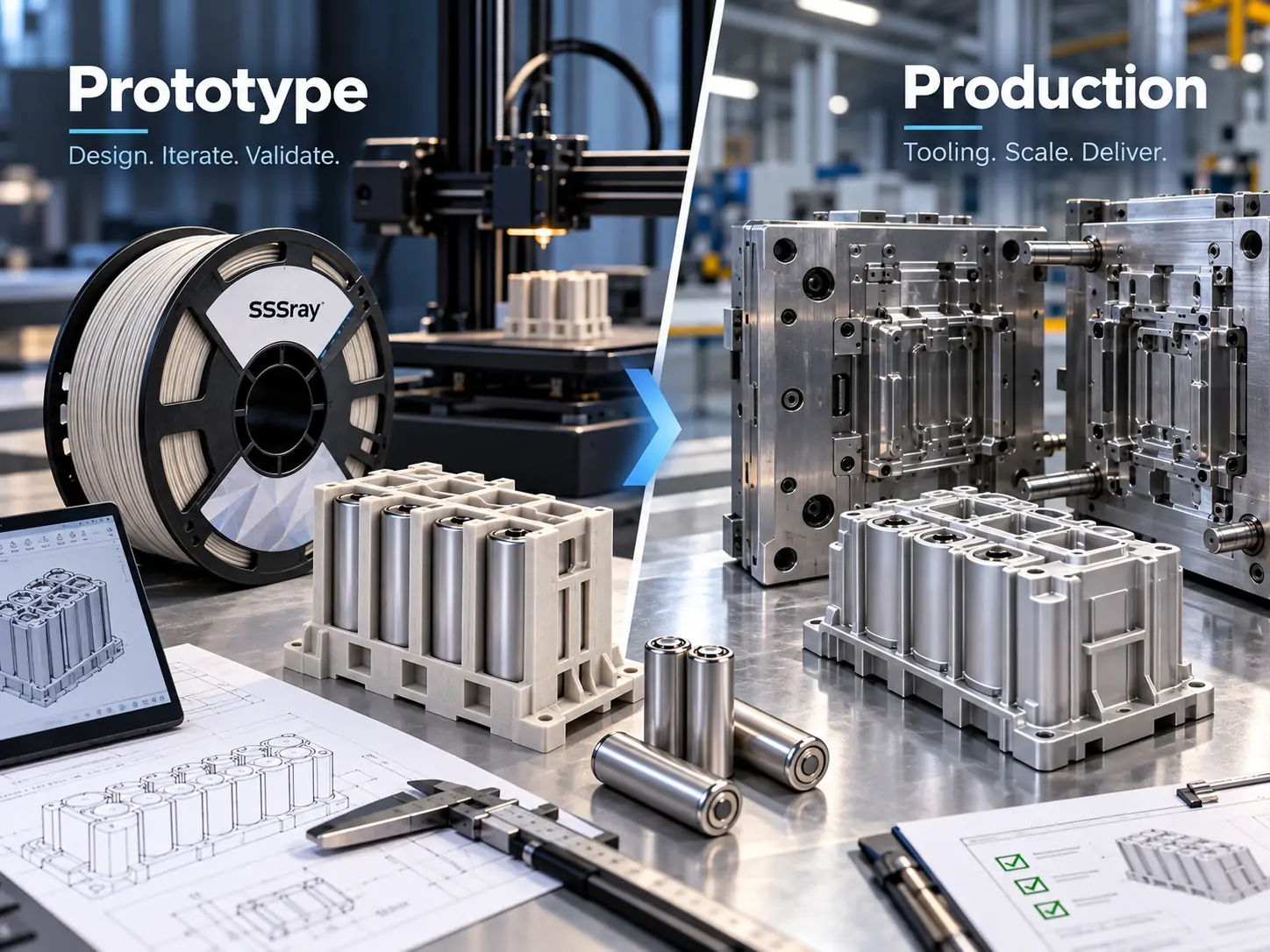
Short answer: hBN-PLA has its strongest economic and engineering fit between the first CAD model and the day you cut steel. In that window you can print an insulating, better-than-PLA heat spreader in days and change it for the price of filament. After design freeze, molded or metal production routes take over where vehicle-level certification, crash performance, fire behavior and long-term durability become mandatory.
What the December 2025 hBN-PLA Battery Case Study Measured
The study everyone quotes is Yakaryilmaz and colleagues at Çukurova University and the University of Zagreb, published in Applied Sciences on December 11, 2025. The team compounded 10 wt% hBN (30–40 µm, ≥99% purity) into PLA on a twin-screw line, then drew filament at ±0.03 mm.
They printed a holder for a 3S2P module of 18650 cells on an Ender-3 S1. Under a 2C discharge at 25 °C, peak cell temperature fell from 48.54 °C to 45.84 °C. The spread between hottest and coldest cell fell from 4.65 °C to 3.75 °C, roughly 20% better uniformity.
Three details rarely make it into the headlines:
- The baseline was a module with no case at all, taken from the team’s earlier study. So the comparison is “holder vs no holder”, not “hBN-PLA vs a molded part”.
- The composite’s thermal conductivity was not measured directly. The authors cite literature values of 0.25–0.35 W/m·K for 10 wt% hBN.
- The authors themselves flag brittleness and list mechanical, fatigue and thermal-aging tests as future work.
Put simply, the study proves that a better baking tray cooks more evenly. It does not prove the tray survives an oven fire.
Why PLA Stops at the Prototype Line
PLA’s glass transition sits around 55–60 °C, and its heat deflection temperature is roughly 55 °C. In the study above, cells already reached 45–48 °C on a lab bench at 25 °C room temperature. Add a hot climate, fast charging or a thermal event, and a PLA-based part is operating inside its softening range.
Pack architecture is also moving away from the parts people want to print. IDTechEx notes that cell-to-pack designs eliminate module housings entirely. Tomorrow’s production parts are fewer, larger and certified, which is the territory of aluminum, SMC and flame-retardant engineering compounds.
How Automotive OEMs Use Additive Manufacturing During Vehicle Development
Public evidence from 2025–2026 shows heavy use of printing, but not of PLA battery housings:
- General Motors develops additive parts at its Additive Industrialization Center, and the Cadillac CELESTIQ carries more than 130 additively made parts.
- BMW Group reports that its Additive Manufacturing Campus has produced more than 1.6 million parts since 2020, with series WAAM metal parts planned from 2027.
- Ford has printed more than 1,000 parts, including battery cold plates and cooling plates, for its 2026 Formula 1 return, according to 3D Printing Industry.
The pattern is consistent. OEMs print to learn fast, then certify with production materials.
Procurement implication: buy hBN-PLA as a development consumable with a named job, such as a thermal mock-up, a bench cell holder or a fixture, and budget it per design loop.
Mistake to avoid: writing “battery housing material” on the purchase order. It invites the wrong acceptance criteria and the wrong liability.
How to verify: ask which published formulation the supplier’s compound resembles (loading, particle size, matrix) and request printed-coupon data, not resin data.
Go deeper: our 3D printer filament qualification program shows how we stage trials before bulk.
2. Thermal Management Filament Science: How hBN Carries Heat Through PLA
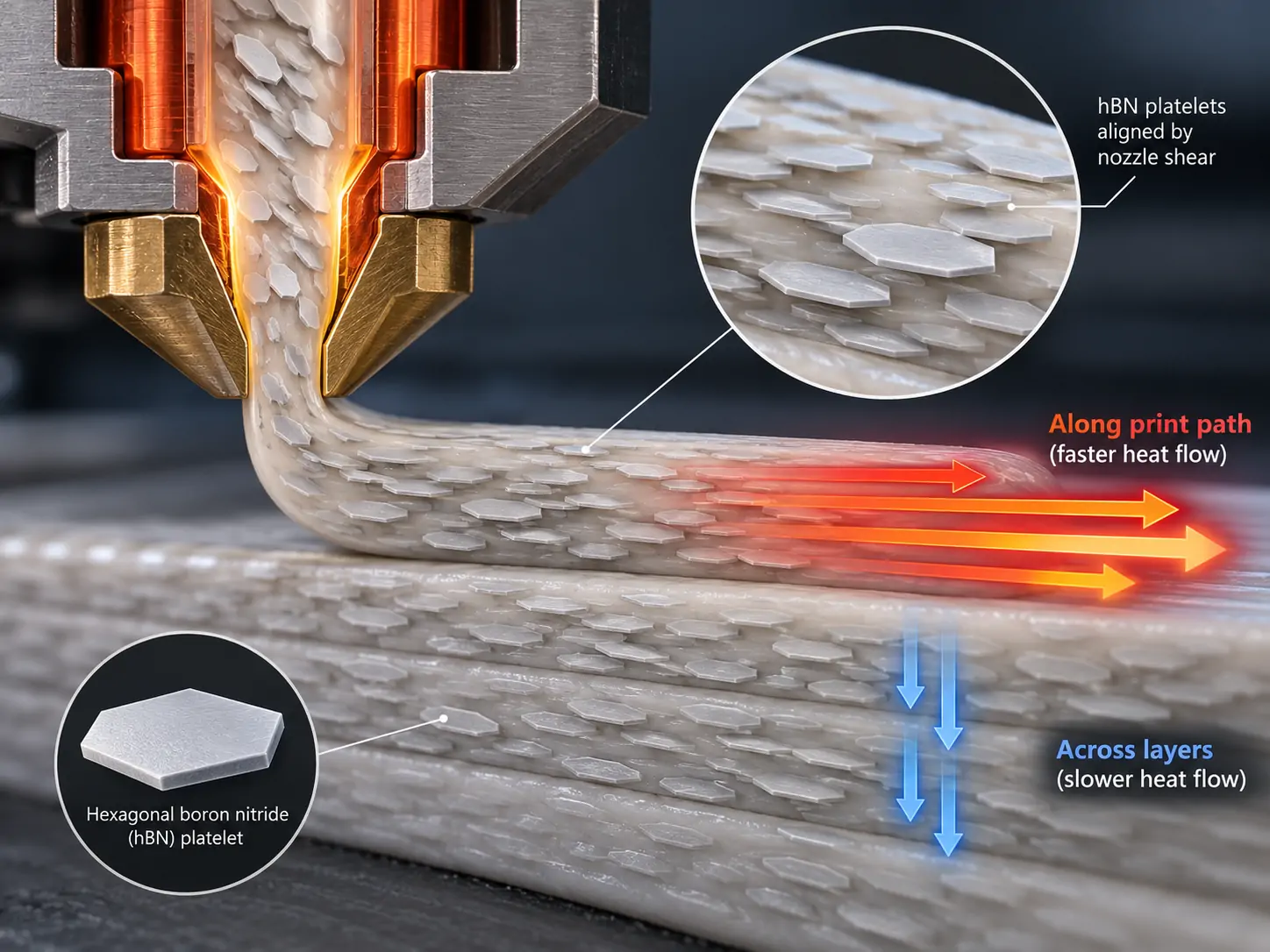
Short answer: hBN platelets conduct heat very well along their flat faces and poorly through their thickness, and they do not conduct electricity. In PLA they only help when enough platelets sit close enough to form paths. FFF printing then lines them up along the nozzle path, so the same part conducts heat differently in X, Y and Z.
Platelets, Percolation and the Stepping-Stone Problem
Picture crossing a stream on stepping stones. The stones (hBN platelets) are excellent conductors; one widely cited value is about 400 W/m·K along the plate and about 30 W/m·K across it. The water between them (PLA, about 0.13 W/m·K) is the bottleneck.
Too few stones and you cannot cross at all. The 2025 study reports that below about 5 wt% hBN the platelets fail to connect. Too many stones and the extruder chokes: the same paper reports nozzle clogging, unstable extrusion and weaker layer bonding above about 15 wt% on standard setups.
Every contact between platelet and polymer also adds thermal resistance. That is why filler grade, particle size and surface treatment matter as much as the headline loading.
Why Print Direction Changes the Datasheet Number
Shear inside the nozzle lays platelets flat along the extrusion path. In a 2024 Polymers study, a printed polyamide with 32 wt% BN measured 1.97 W/m·K along the print direction but only 0.69 W/m·K across it, a 2.8× gap in one part.
A 2025 Polymer Composites paper went the other way. By building walls so platelets stood vertically, Li and co-workers reached 3.04 W/m·K through-plane in hBN/PLA, about 420% above the same material printed with platelets lying flat.
The practical rule for buyers: a single conductivity number on a filament datasheet is incomplete. ASTM E1461-13(2022) is a flash-method standard written primarily for homogeneous, isotropic solids; printed composites can still be compared with careful experimental design, but substantial anisotropy can distort absolute results. For hBN-filled FFF parts, report build orientation, heat-flow direction, specimen geometry, density and specific heat together with the laser-flash result.
hBN-PLA Thermal Conductivity vs Standard PLA: The Numbers
The chart below compares published values. Materials differ in matrix, loading and process, so read it as a map of what is achievable, not as a ranking of products.
Thermal conductivity of PLA and BN composites (W/m·K)
On mobile, swipe horizontally to review every column.
| Material | Process | Direction | k (W/m·K) | Source |
|---|---|---|---|---|
| Neat PLA | FFF reference | Isotropic (reported) | 0.13 | Bagatella et al., 2024 |
| PLA + 10 wt% hBN | Compounded, FFF | Not stated | 0.25–0.35 | Literature range cited by Yakaryilmaz et al., 2025 |
| PA + 32 wt% BN | FFF | Through-plane | 0.69 ± 0.01 | Bagatella et al., 2024 |
| BN-ABS | Injection molded | Not stated | 1.45 | Quill et al., 2018 (via Yakaryilmaz et al.) |
| PA + 32 wt% BN | FFF | In-plane | 1.97 ± 0.11 | Bagatella et al., 2024 |
| hBN/PLA | FFF, vertical alignment | Through-plane | 3.04 | Li et al., 2025 |
| Aluminum 6061-T6 | Wrought | Isotropic | 167 | Protolabs 2026 data sheet |
Two lessons stand out. Molding usually packs filler better than printing: the ABS study above found molded specimens conducted best, while printed parts still reached about five times neat ABS. A 2023 comparison in TPU likewise reached 2.1 W/m·K only in a molded specimen at 65 wt% hBN.
The second lesson is scale. Even the best printed composite is a heat spreader, not an aluminum heat sink. Some compounders also note that beyond roughly 10 W/m·K, geometry and convection limit further temperature drops, so fin and airflow design matter as much as the filament.
Procurement implication: specify conductivity as “in-plane and through-plane, ASTM E1461, printed coupons, build orientation stated”. Anything less cannot be compared across suppliers.
Mistake to avoid: accepting a resin or molded-plaque value for a printed application. Printed parts usually measure lower.
How to verify: request the lab report, not a datasheet line. Check specimen size (for example 12.7 mm square, about 2 mm thick), density and specific heat inputs.
Go deeper: see how coupons are defined in our 3D printer filament test protocol for bulk and OEM orders.
3. hBN Composite PLA vs Graphene PLA Filament Near Battery Electrics
When electrical insulation is a hard requirement near cells, busbars or high-voltage wiring, hBN is the material family to evaluate before conductive graphene-filled PLA. hBN is electrically insulating, while commercial graphene PLA grades are commonly engineered to conduct electricity.
The Insulation Gap Is About Twelve Orders of Magnitude
The product specification for Graphene 3D Lab’s conductive graphene PLA lists a volume resistivity of 0.6 Ω·cm. It also warns that the material softens around 50 °C and should stay below 12 V and 100 mA.
By contrast, the printed BN-filled polyamide in the 2024 Polymers study measured about 1012 Ω·cm. EV traction packs run at several hundred volts, so this is not a subtle difference. It is the difference between a spacer and a potential short path.
Graphene can push conductivity higher. One lab PLA/graphene composite reached 3.22 W/m·K at 9.08 vol%. But heat and electricity travel together in that material, which is the wrong trade near live parts.
Where Graphene PLA Filament Still Earns Its Place
Graphene PLA is a sensible buy for low-voltage sensing traces, capacitive touch parts and static-dissipative handling aids kept well away from high-voltage zones. For a distributor, that makes the two materials complementary SKUs with different buyers, not substitutes.
For battery-adjacent material, put a minimum volume resistivity in the purchase specification, for example ≥1012 Ω·cm measured on printed specimens. Do not assume “graphene-enhanced” means electrically insulating; many graphene-filled PLA grades are intentionally conductive. Verify volume resistivity for the exact grade. For qualification, ask for resistivity per IEC 62631-3-1 or ASTM D257 on printed parts, plus dielectric strength if the part separates conductors.
Go deeper: compare supplier answers side by side with our 3D printer filament supplier comparison tool.
4. Flame Retardant EV Filament: Can a 3D Printed Battery Housing Pass UL94 V-0?
Short answer: a printed part can be made from a UL 94 V-0 rated material, but neat PLA and plain hBN-PLA are not V-0 materials, and a V-0 rating alone never qualifies an EV battery enclosure.
What UL 94 V-0 Does and Does Not Prove
UL 94 is a small-flame screening test. For a V-0 result, a vertical bar receives two 10-second flame applications and must stop burning within 10 seconds each time, without flaming drips igniting cotton below.
Labs test five specimens per set in two conditioning sets: 48 hours at 23 °C and 50% RH, and 168 hours at 70 °C. That second set runs well above PLA’s softening point, so ask your lab how specimen distortion was handled.
Ratings are also tied to thickness. A V-0 result at 3 mm says nothing about a 1.6 mm printed rib, and printed layer seams can behave differently from a molded bar.
Neat PLA is flammable and drips, with limiting oxygen index values around 20.5–22.5% in published work. PLA does reach V-0 in the literature, but through phosphorus and nitrogen flame-retardant systems. One recent formulation used BN nanosheets as part of a hybrid retardant with phytic acid and an iron framework to reach V-0 at 6 wt%. We found no published data showing plain hBN-PLA reaching V-0 on its own.
For budgeting, one ISO 17025 lab, Measurlabs, lists the UL 94 vertical burn test at €1,250.
Enclosure-Level Tests: UL 2596 and GB 38031-2025
Battery enclosures face much harsher screening. UL 2596’s Torch and Grit test hits material plaques with a flame of about 1,200 °C for 10 seconds, then 5 seconds of flame plus grit blast, repeated until the plaque breaches.
China’s GB 38031-2025 was published March 28, 2025 and has been in force since July 1, 2026. The revised standard strengthens thermal-event and mechanical-protection requirements, including bottom-impact evaluation. For procurement work, use the current SAMR/SAC text and MIIT interpretation rather than a secondary summary when translating those requirements into a vehicle test plan.
A PLA-based material does not belong in that conversation. Treat it as a bench material.
Is hBN-PLA Safe for Lithium-Ion Battery Proximity?
For supervised bench thermal prototypes, hBN-PLA can be appropriate when temperature limits, electrical separation and fire controls are defined. It provides electrical insulation, but the PLA matrix still burns, softens near 55 °C and can take up moisture over time.
We recommend three bench rules: set a test abort temperature at least 10 °C below the measured heat deflection temperature of your batch, run cell tests inside a fire-rated enclosure, and never leave printed holders in a vehicle or charger after the test program ends.
Procurement implication: if your prototype must represent production fire behavior, buy a flame-retardant engineering filament and demand the test report at your wall thickness.
Mistake to avoid: copying a resin supplier’s V-0 claim into your own documents for a printed part.
How to verify: check the UL Product iQ listing (yellow card) or an accredited report naming thickness, color and conditioning.
Go deeper: for heat-resistant prototype work, review our wholesale PC filament supplier options.
5. Battery Housing Lightweight Claims: How Much Weight Can hBN Filament Save?
By density, an hBN-PLA part weighs about half as much as an aluminum part of the same volume. But equal volume is not equal function, and in the only published hBN-PLA battery case study, the printed holder added about 21% to module mass.
The Density Math, Done Honestly
On mobile, swipe horizontally to review every column.
| Material | Density (g/cm³) | Mass of same volume vs aluminum | Thermal conductivity (W/m·K) | Source |
|---|---|---|---|---|
| PLA | 1.24 | ≈ 46% | ≈ 0.13 | Yakaryilmaz et al., 2025 |
| PLA + 5–15 wt% hBN | 1.27–1.30 | ≈ 47–48% | 0.25–0.35 (10 wt%) | Yakaryilmaz et al., 2025 |
| hBN powder | 2.1–2.3 | ≈ 78–85% | ≈ 400–600 along plate | Bagatella et al., 2024; supplier data |
| Molded thermally conductive compound | ≈ 1.5 (average) | ≈ 56% | Up to ≈ 30 | LATI LATICONTHER range |
| Aluminum 6061-T6 | 2.70 | 100% (baseline) | 167 | Protolabs 2026 |
| Steel | ≈ 7.8 | ≈ 289% | Not compared here | Industry reference |
The catch is in the last two columns. Aluminum conducts heat roughly 500 times better than 10 wt% hBN-PLA and is far stiffer, so a metal wall can be much thinner. A like-for-like redesign in printed polymer would need thicker walls, ribs or fins, which eats into the density advantage.
Electric vehicle lightweighting in production follows a different path. Metallic battery boxes make up about 10–20% of pack mass, and empty metal enclosures add roughly 110–160 kg to a vehicle. Composite enclosure suppliers claim 30–50% savings against aluminum depending on application, but those are glass- or carbon-reinforced production composites such as SMC, not PLA.
What the Published hBN-PLA Module Actually Weighed
In the 2025 study, the printed case weighed 56.51 g against roughly 267 g of cells. That is about 21% more mass, lowering cell-level gravimetric energy density from about 230 to about 190 Wh/kg.
Scaled to a 60 kWh pack of about 1,000 such sub-modules, the authors estimate around 56 kg of hBN-PLA, or roughly 2.8% of a 1,900–2,100 kg vehicle. They argue the structure could replace existing hardware rather than add to it. That is the right test for any weight claim: compare against the parts you remove, including pads, brackets and fasteners.
For lightweighting claims, ask for a mass budget of the assembly before and after, not a density sheet. Avoid quoting “50% lighter than aluminum” as a general part-level claim because it only applies to identical volumes. Verify the real assembly by weighing printed parts from the actual profile and infill; the published study used 70% grid infill, so mass and conductivity change together.
Go deeper: for stiff, light prototype brackets, see our wholesale carbon fiber filament range.
6. Cost Comparison: 3D Printed vs Injection Molded Battery Case
Short answer: for prototypes and pre-series quantities, printing wins because there is no tooling bill and design changes cost filament, not steel. In our worked example below, the break-even sits near 830 parts and moves to about 1,110 parts if two post-tooling changes are needed.
2026 Tooling Benchmarks
A 2026 US injection molding pricing report from Jaycon gives these ranges:
- Prototype aluminum tooling (SPI Class 105): about US$1,500–8,000, ready in 2–4 weeks.
- Production steel tooling (Class 104 to 101): about US$8,000 to over US$150,000, ready in 4–14 weeks.
- Mid-volume multi-cavity steel (Class 103): about US$25,000–60,000.
- Molded piece prices for many parts: about US$0.35–6.00.
Design changes are the hidden accelerator. One mold maker’s 2026 price list puts engineering changes after a production mold is cut at US$2,000–8,000 each.
The Break-Even Formula and a Worked Example
The math fits on one line: break-even quantity = (tooling + expected change costs) ÷ (printed cost per part − molded cost per part). Our worked example uses these stated assumptions, so replace them with your own quotes:
- Tooling US$30,000, inside the Class 103 band above.
- Molded piece price US$4.00, inside the reported range.
- Printed hBN-PLA part US$40 all-in, an SSSray planning assumption for a part of roughly 150 g including compound, about six machine hours and handling.
- Scenario B adds two post-tooling changes at US$5,000 each.
Cumulative cost vs quantity (worked example, US$)
On mobile, swipe horizontally to review the full chart.
On mobile, swipe horizontally to review every column.
| Quantity | Printed hBN-PLA | Molded, no changes | Molded, two changes | Cheaper route |
|---|---|---|---|---|
| 100 | 4,000 | 30,400 | 40,400 | Printing |
| 500 | 20,000 | 32,000 | 42,000 | Printing |
| 833 | 33,320 | 33,332 | 43,332 | Break-even (no changes) |
| 1,111 | 44,440 | 34,444 | 44,444 | Break-even (two changes) |
| 1,500 | 60,000 | 36,000 | 46,000 | Molding |
Read the chart as a shape, not a verdict. Printing is a straight line with no head start; molding starts high and stays flat. Every uncertain design change pushes the molded lines up and the crossover to the right, which is exactly why teams print while the design is still moving.
Cost Lines Buyers Forget
- Compound development: a custom high-filler filament usually needs a trial extrusion, and trial scope and fees should be agreed before any spool is made.
- Testing: laser flash, resistivity and any flame test on printed coupons. Budget them per material change, not once.
- Scrap: brittle composites crack at clips and screw bosses, so plan reprints.
- Drying and storage: dryer time, sealed bins and desiccant add real cost at farm scale.
- Time: 4–14 weeks of tooling lead time has a price, even if it never appears on an invoice.
Procurement implication: compare total cost per validated design loop, not price per kilogram.
Mistake to avoid: cutting steel while thermal questions are still open. A US$2,000–8,000 change fee repeats with every open question.
How to verify: ask your molder for SPI class, cavities, lead time and change pricing in writing, then run the break-even formula with your real numbers.
Go deeper: for bulk baseline materials, see our wholesale 3D printer filament supplier page.
7. Rapid Prototyping Battery Design: A Validation Workflow That Survives Tooling
Use hBN-PLA to compare designs under controlled conditions, then confirm the winner in a production-intent material before tooling. The printed part answers “which design?”, not “is it certifiable?”
- Write the thermal question. For example: “Does holder design B cut the cell temperature spread by at least 0.5 °C versus design A at 2C?”
- Freeze the trial material. Record loading, hBN particle size, matrix and color. White BN parts radiate less than black ones; one study notes a little carbon black can raise emissivity from about 0.7 to 0.9.
- Test coupons before parts. Laser flash in both directions, plus tensile bars (five specimens is the usual minimum per ASTM D638).
- Lock the slicer profile. Same printer model, nozzle, infill, orientation and batch for every design variant.
- Instrument like the published study. Thermocouples on the center of each cell surface, ±0.5 °C accuracy, controlled ambient around 25 ± 0.5 °C and minimal airflow.
- Repeat. At least three runs per design so a 0.5 °C difference is not noise.
- Translate. Re-run the winning geometry in a production-intent material, such as a flame-retardant PC, a glass-filled polyamide or a molded conductive compound.
- Archive for the RFQ. Batch numbers, profiles and data become the evidence pack you hand to the tooling supplier.
For controlled design comparisons, plan the prototype filament and production-intent filament in the same sourcing round, and ask the supplier to reserve enough of one batch for the full A/B comparison with a retained sample. Mixing batches between design A and design B can turn a geometry comparison into a batch comparison.
Go deeper: glass-filled parts for step 7 are covered on our wholesale glass fiber reinforced filament page.
8. The Cell-to-Spool Buyer Decision Framework
We built this framework for thermal filaments used around batteries. It runs from the cell, meaning what the part must do, to the spool, meaning whether the supplier can repeat it. A material must pass every gate; one failed gate is a stop, not a trade-off.
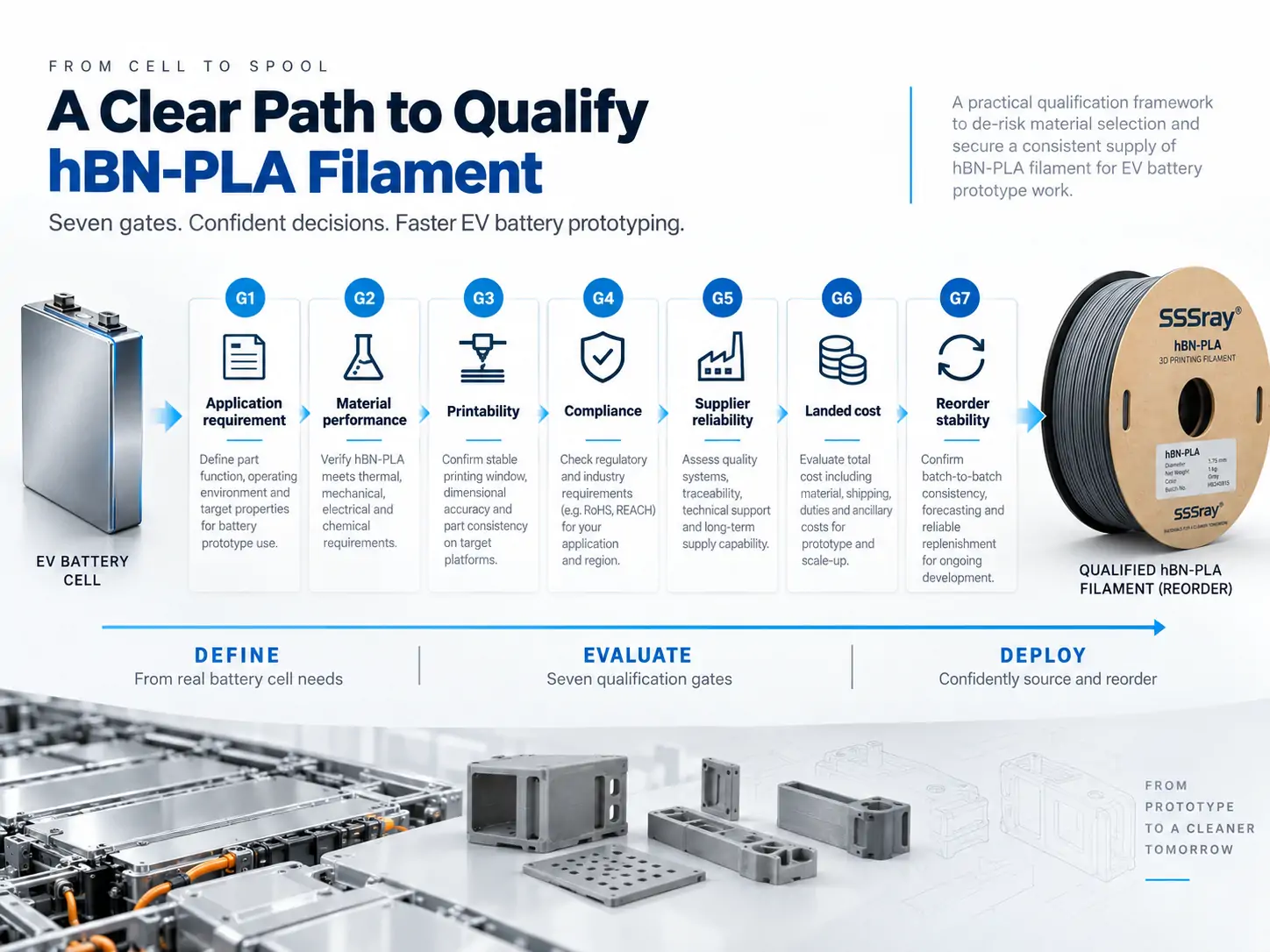
G1
Application requirement
Why it matters: it decides whether PLA is allowed at all. What to ask: maximum part temperature, nearby voltage, load and service life.
Pass: bench use below about 45 °C. Fail: in-vehicle use or parts above about 50 °C. Hidden risk: a prototype quietly becomes a field part.
G2
Material performance
Why it matters: it proves the thermal effect is real. What to ask: in-plane and through-plane conductivity, test method and specimen orientation.
Pass: a laser-flash report on printed coupons. Fail: one number with no method. Hidden risk: molded plaque data presented as printed data.
G3
Printability
Why it matters: high filler loads clog nozzles and weaken layers. What to ask: loading, particle size, nozzle size and a reference profile.
Pass: a full 1 kg spool printed without a clog. Fail: “just use a bigger nozzle” as the only answer. Hidden risk: unlisted hard co-fillers wearing nozzles.
G4
Compliance
Why it matters: documents decide what you may legally claim. What to ask: SDS, RoHS, REACH and any flame report at your thickness.
Pass: documents linked to the batch. Fail: generic certificates. Hidden risk: a V-0 rating copied from a different material.
G5
Supplier reliability
Why it matters: custom compounds depend on process control. What to ask: factory or trader, extrusion lines, QC records and third-party lab.
Pass: batch QC data shared openly. Fail: no factory evidence. Hidden risk: the formula changes between trial and bulk.
G6
Landed cost
Why it matters: price per kilogram hides testing and scrap. What to ask: trial fee, test fees, MOQ, freight and drying needs.
Pass: cost per validated design loop is known. Fail: only a kilogram price. Hidden risk: reprints from brittle parts.
G7
Reorder stability
Why it matters: design comparisons need identical batches. What to ask: formula card, retained samples and batch reservation.
Pass: a retained sample for every batch. Fail: a “same as before” promise. Stop if the compounder substitutes the hBN grade without notice.
Why the gates are separate: a good thermal result, a reliable supplier and a stable reorder are three different decisions. Passing one gate is not evidence for the next.
9. Main Comparison Table: hBN-PLA and the Alternatives
Procurement managers can use this table directly. It covers the realistic options for battery housing development work, from the cheapest fit check to the production route.
On mobile, swipe horizontally to review every column.
| Option | Best use case | Key spec | Advantage | Risk | How to verify | When to reject | SSSray sourcing note |
|---|---|---|---|---|---|---|---|
| Standard PLA | Fit and packaging checks | k ≈ 0.13 W/m·K; HDT ≈ 55 °C | Cheapest, easiest to print | No thermal benefit | Dimensional check only | Any thermal question | Stock bulk PLA |
| hBN-PLA (≈ 10 wt%) | Thermal mock-ups, bench cell holders | k ≈ 0.25–0.35 W/m·K; insulating | Prints on standard FFF, spreads heat | Brittle, softens near 55 °C | TGA loading, LFA on printed coupons | Any in-vehicle or fire-rated use | Custom compound; trial first |
| High-load BN in PA or TPU (≥ 30 wt%) | Printed heat spreaders, fixtures | k up to ≈ 2 W/m·K in-plane | Higher heat transfer and heat resistance than PLA | Anisotropy, low elongation, drying | Both directions measured | No direction stated on data | Engineering route review needed |
| Graphene PLA | Low-voltage sensors, static control | ≈ 0.6 Ω·cm (conductive) | Electrically functional | Short-circuit path near HV | Resistivity on printed parts | Any HV-adjacent part | Not recommended for packs |
| Flame-retardant PC or PC blend filament | Prototypes needing fire behavior | UL 94 class at stated thickness | Closer to production plastics | Needs high temperatures and enclosure | Yellow card or accredited report | Rating at other thickness only | Engineering PC route |
| Molded thermally conductive compound | Production modules and covers | k up to ≈ 30 W/m·K; FR grades V-0 | Certifiable, repeatable | Tooling cost and lead time | Datasheet, UL listing, IMDS/PPAP | Design not yet frozen | Use printed stage first |
| Aluminum or SMC enclosure | Series pack housing | Crash, fire, sealing to OEM spec | Proven at vehicle level | Heavy (Al) or tooling-heavy (SMC) | UL 2596 material screening where specified; GB 38031-2025 and OEM vehicle/battery tests where applicable | Early concept phase | Outside filament scope |
Notice how the “When to reject” column moves: early options fail on certification, late options fail on timing. That is the whole case for staging.
10. Supplier Claims vs Reality for Thermal Management Filament
Thermal and “battery” filaments attract vague marketing. This table translates common claims into document requests.
On mobile, swipe horizontally to review every column.
| Vague claim | What it might hide | What to request | What a reliable supplier provides |
|---|---|---|---|
| “High thermal conductivity” | In-plane only, or molded data | LFA report per ASTM E1461 on printed coupons | Both directions, specimen orientation, lab name |
| “UL94 V-0 filament” | Rating of another grade or thickness | Yellow card or accredited report | Thickness, color and conditioning sets stated |
| “Safe for battery use” | No defined test at all | Resistivity, HDT and flame data on printed parts | Limits of use written into the TDS |
| “Graphene-enhanced” | Tiny loading, or electrically conductive | Loading and volume resistivity | Resistivity value and voltage limits |
| “Automotive grade” | No automotive documentation | IMDS entry, PPAP readiness | Honest scope: prototype grade unless stated |
| “Lighter than aluminum” | Equal-volume density math | Assembly mass before and after | Part-specific mass estimate |
| “Same as your sample” | Filler grade changed between batches | Retained sample and formula card | Batch-linked COA with loading by TGA |
SSSray evidence rule: every adjective in a filament spec sheet should map to a number, a test method and a document. If it cannot, we leave it out of the TDS.
11. Buyer-Specific Scenarios for hBN-PLA Battery Prototypes
Distributor
Situation: customers ask for “battery filament” after reading about the 2025 study.
Bad choice: listing a graphene PLA as a thermal battery material.
Consequence: a conductive part near a pack, returns and liability questions.
Better choice: stock hBN-PLA as a labeled prototype-grade thermal filament with use limits on the label.
Verification method: resistivity and LFA reports for the exact batch you stock.
Next step with SSSray: ask about private label packaging that prints use limits on the box.
OEM Brand
Situation: a printer brand wants a “thermal” SKU for its engineering line.
Bad choice: launching with a single in-plane conductivity number on the box.
Consequence: engineers test through-plane, get a third of the value and lose trust.
Better choice: publish both directions and a tested reference profile for your printer.
Verification method: a pilot batch printed on the brand’s own machines before artwork is final.
Next step with SSSray: start with our OEM/ODM filament program.
Print Farm
Situation: a farm wins a job for 300 cell holders for a bench test program.
Bad choice: running high-load compound through brass 0.4 mm nozzles across the fleet.
Consequence: clogs, stops and inconsistent parts between printers.
Better choice: 10 wt% compound, dedicated printers, one batch and a locked profile.
Verification method: first-article dimensions and mass per printer, plus retained parts.
Next step with SSSray: request a free sample spool of our baseline materials to set up the fleet profile.
Engineering Buyer
Situation: a pack team must choose between two module concepts before tooling.
Bad choice: cutting a Class 103 tool to “learn from real parts”.
Consequence: US$25,000–60,000 committed, then change fees for each lesson.
Better choice: print both concepts in hBN-PLA, compare, then confirm in production-intent material.
Verification method: the eight-step workflow in section 7, with three runs per design.
Next step with SSSray: send your target spec through our custom engineering 3D printing filament route.
12. hBN-PLA Print Settings and Sourcing Specs
hBN-PLA is a custom compound, not a commodity SKU. At SSSray we handle it through our custom engineering filament route: high-filler formulations are reviewed before trial extrusion, and trial scope, testing fees and acceptance points are agreed before any sample spool is made. The settings below are starting references drawn from the published studies, to be confirmed on your printers.
On mobile, swipe horizontally to review every column.
| Setting | hBN-PLA, ≈ 10 wt% | High-load BN composites (≥ 30 wt%) | Common failure | Fix |
|---|---|---|---|---|
| Nozzle temperature | 215 °C starting point (test 205–225 °C) | Matrix dependent; 250 °C for BN-filled PA in one study | Under-extrusion from high melt viscosity | Raise in 5 °C steps, lower flow rate |
| Bed temperature | 60 °C | Up to 90 °C for PA-based grades | Corner lift on long holders | Brim, clean PEI, slower first layer |
| Enclosure | Not required; avoid drafts | Closed chamber recommended | Layer splitting on tall parts | Enclose; reduce part cooling on PA grades |
| Drying | About 50 °C for 4–6 h | Up to 90 °C for 24 h for BN-filled PA in one study | Bubbles, rough walls, weak layers | Dry before every job; store sealed with desiccant |
| Nozzle material and size | 0.4 mm worked in the 2025 study | 0.6 mm used for 32 wt% BN without clogging | Clogs above about 15 wt% on 0.4 mm | Larger nozzle; hardened nozzle if hard co-fillers are present |
| Speed range | 35 mm/s at 2.5 mm³/s in the study; test 30–50 mm/s | 45 mm/s with 0.3 mm layers in one study | Gaps and weak infill at high flow | Cap volumetric flow, then raise gradually |
| Cooling and infill | Fan 100%; 70% grid infill in the study | 100% infill for thermal parts | Lower conductivity from voids | Higher infill along the heat path |
hBN itself is soft, around Mohs 2, so it wears nozzles far less than glass fiber. Ask whether the compound contains harder co-fillers such as alumina or magnesium oxide, because those change the nozzle decision.
On mobile, swipe horizontally to review every column.
| Spec | What to write in the PO | SSSray practice | Red flag |
|---|---|---|---|
| MOQ | Trial quantity, then bulk quantity | Engineering materials from 150 spools, confirmed by resin, additives and testing complexity | Bulk MOQ before any trial |
| Lead time | Trial date and bulk date separately | Confirmed after formula route, sample scope, packaging and documents are clear | Fixed date before the formula is agreed |
| Sample approval | Measurable acceptance points | Acceptance points agreed before trial extrusion | “Approve if it prints well” |
| Tolerance | Diameter and ovality limits | Laser diameter monitoring on every line, ±0.03 mm | No diameter records offered |
| Documentation | COA, TDS, SDS, RoHS, REACH, test reports | COA/TDS/MSDS with RoHS/REACH support; third-party tests via SGS or equivalent | Generic certificates without a batch link |
| Packaging | Vacuum sealing, desiccant, humidity indicator | Drying, vacuum packing and desiccant confirmed before bulk | Open cartons for a hygroscopic compound |
| Private label | Label content including use limits | Private label and OEM packaging available | No room for use-limit wording |
| Reorder control | Formula card, retained sample, batch reservation | Batch notes, formula card and packing method fixed at bulk | Filler grade changes without notice |
13. SSSray hBN-PLA Qualification Record and Factory QC Evidence
SSSray qualifies hBN-PLA in two evidence layers: production-lot control on the extrusion line, then hBN-specific validation on printed coupons. The factory measurements below come from SSSray public production-lot record SSR-PA6-66-260918-L07-B01 and document the lot-traceability, diameter, ovality and moisture-control system already used for engineering filament. hBN-specific thermal and electrical targets are listed separately against peer-reviewed benchmark data so the source of every number remains auditable.
On mobile, swipe horizontally to review every column.
| Check | Method / record | Sample plan | Release gate | Verified result or benchmark |
|---|---|---|---|---|
| Factory QC reference lot | Public SSSray Batch ID SSR-PA6-66-260918-L07-B01; Production / test date September 18, 2026; Extrusion Line 07 | Commercial engineering-filament production lot | Unique lot-to-line traceability | RELEASED |
| Diameter | Continuous inline laser micrometer monitoring with archived COA checkpoints | 10 spools × 3 archived checkpoints = 30 measurement sets | 1.75 ±0.03 mm | Mean 1.751 mm; observed range 1.731–1.772 mm; PASS |
| Maximum ovality | Inline orthogonal diameter control linked to the same production lot | Same 30 archived measurement sets | ≤0.020 mm | 0.018 mm; PASS |
| Pre-seal moisture | 80 °C × 8 h conditioning followed by Karl Fischer titration | n=3 | <0.020 wt% before vacuum sealing | Mean 0.017 wt% (170 ppm); PASS |
| hBN formulation target | TGA residue on the actual pilot compound before bulk release | n=3 per hBN-PLA pilot lot | 10 wt% target, project acceptance band agreed before trial | 10 wt% is the published formulation benchmark used for this qualification route; the lot COA must report the actual TGA result |
| Reference print profile | Creality Ender-3 S1; 0.4 mm nozzle; 215 °C nozzle; 60 °C bed; 0.20 mm layer; 35 mm/s; 2.5 mm³/s; 70% grid infill; 100% fan | Published 10 wt% hBN-PLA battery-case study | Use as a controlled starting profile, then lock the SSSray pilot-lot profile before buyer approval | Peer-reviewed profile verified in Yakaryilmaz et al. (2025) |
| Thermal conductivity | ASTM E1461-13(2022)-based laser-flash measurement on printed coupons, with build orientation, heat-flow direction, density and specific heat reported | 3 coupons per direction for a buyer qualification lot | Project-specific minimum in-plane and through-plane values | Published 10 wt% hBN-PLA benchmark: approximately 0.25–0.35 W/m·K; this range is literature data, not an SSSray instrument reading |
| Electrical insulation | IEC 62631-3-1 or ASTM D257 on printed specimens | n=3 per qualification condition | Buyer-defined minimum volume resistivity | Published BN-filled PA reference: 1.7 × 10¹² Ω·cm; use only as a benchmark until the hBN-PLA lot result is attached |
| Battery thermal benchmark | 3S2P 18650 module, 2C discharge, 25 °C environment | Published comparison under matched conditions | Use to set the buyer’s own thermal acceptance target | Peak cell temperature 48.54 °C → 45.84 °C; cell spread 4.65 °C → 3.75 °C with the 10 wt% hBN-PLA case |
| Flammability | UL 94 vertical test on printed bars at the buyer’s required thickness when specified | Accredited-lab specimen set | Classification reported only at the tested thickness and condition | No V-0 claim is made for plain hBN-PLA without a matching test report |
SSSray release rule: the trial formula, production-lot ID, diameter record, moisture result and any buyer-required thermal, electrical or flammability report are tied to the shipment record before bulk approval. For custom hBN-PLA, the 150-spool engineering-material MOQ remains subject to the agreed resin, filler, test scope and packaging specification.
14. EV Battery 3D Printing and hBN Composite PLA: Procurement FAQ
What is hBN-PLA thermal conductivity vs standard PLA?
At about 10 wt% hBN, expect roughly 0.25–0.35 W/m·K, compared with about 0.13 W/m·K for neat PLA, so around two to three times higher. Higher values exist in research: one vertically aligned hBN/PLA print reached 3.04 W/m·K through-plane, and a printed polyamide with 32 wt% BN reached 1.97 W/m·K along the print path. Those numbers depend on heavy loadings and on direction. Always ask which direction was measured, on what specimen, and by which method. A single figure without those details cannot be compared with another supplier’s figure.
Can a 3D printed battery housing pass UL94 V-0?
A printed part can pass UL 94 V-0 if the filament is a flame-retardant grade and the test is run at your wall thickness, but neat PLA and plain hBN-PLA are not V-0 materials. Published V-0 PLA formulas depend on phosphorus and nitrogen retardants, not on hBN alone. Also remember that V-0 is only a small-flame screening test. A production EV battery-enclosure program may also use material screening such as UL 2596 Torch and Grit; in China, the vehicle battery system must meet the applicable GB 38031-2025 requirements. Treat a V-0 printed prototype as a better prototype, not a qualified housing.
Is hBN-PLA safe for lithium-ion battery proximity?
It is reasonable for supervised bench prototypes, because hBN keeps the composite electrically insulating. It is not suitable for in-vehicle use. The material still burns, softens near 55 °C and absorbs moisture slowly over time. In the December 2025 study, cells already reached about 46 °C at a 2C discharge in a 25 °C lab. Set an abort temperature at least 10 °C below your batch’s measured heat deflection temperature, run tests inside a fire-rated enclosure, and retire printed holders once the test program ends.
How much weight can hBN filament save in EV design?
It saves weight only when a printed part replaces heavier hardware. By density, hBN-PLA at about 1.27–1.30 g/cm³ weighs roughly half as much as aluminum at 2.70 g/cm³ for the same volume. But aluminum conducts heat about 500 times better and is far stiffer, so printed walls must be thicker. In the only published hBN-PLA battery case study, the printed holder added about 21% to module mass because it was added, not substituted. Calculate the assembly mass before and after, including pads, brackets and fasteners.
Where can I buy thermal conductive filament for battery prototypes?
Buy it from a manufacturer that can compound to a written specification and share batch data, not from a listing that only states “high thermal conductivity”. hBN-PLA is usually a custom compound, so expect a trial extrusion with agreed acceptance points before bulk supply. Ask for loading by TGA, laser-flash results in both directions on printed coupons, volume resistivity and diameter records. At SSSray, requests like this go through our custom engineering filament route, where high-filler formulas are reviewed before any trial spool is made.
How should I plan bulk procurement of hBN composite filament for automotive work?
Split the purchase into a trial phase and a bulk phase, each with its own acceptance points. Reserve one batch for any design comparison so results are not skewed by batch variation, and require a retained sample plus a formula card. Put diameter, moisture, loading and conductivity limits into the purchase order. Remember that production automotive parts usually require IMDS data as part of PPAP, which prototype filament rarely has. Keep the order scoped as development material unless the supplier can document otherwise.
What documents should I request before approving an hBN-PLA sample?
Request a batch-linked COA, TDS, SDS and RoHS or REACH declarations, plus test reports on printed specimens. The test reports should cover thermal conductivity in both directions by ASTM E1461, volume resistivity, tensile results and, only if you need it, UL 94 at your thickness. Check that each report names the batch number, specimen orientation and lab. If a supplier sends one generic certificate for all batches, ask again. Approval should reference measurable values, never “prints well” or “same as sample”.
When does printing stop being cheaper than an injection molded battery case?
Printing usually stops being cheaper somewhere in the high hundreds to low thousands of parts, depending on tooling and change costs. Use break-even quantity = (tooling + expected changes) ÷ (printed cost − molded cost). With US$30,000 tooling, a US$4 molded part and a US$40 printed part, the crossover is about 833 parts, or about 1,111 with two US$5,000 design changes. Quantity is not the only trigger, though. Once you need certification, crash performance or fire ratings, production tooling is required anyway.
Use hBN-PLA to Decide Faster, Not to Replace the Tool
Begin with a non-vehicle bench test whose thermal and electrical conditions are defined by the engineering team. Keep the published research, SSSray qualification record and your final component evidence distinct. Record orientation, wall construction, measurement direction and the exact formulation. If the prototype requires a different temperature capability, use our high-temperature material screening guide before requesting the next material trial.
The same evidence draws a hard line. PLA softens near 55 °C and plain hBN-PLA is not a V-0 material. Production enclosure programs move into material screening, OEM validation and applicable vehicle/battery standards such as GB 38031-2025, where aluminum, SMC and certified flame-retardant engineering compounds are the relevant material classes.
The decision logic is short. Name the question the printed part answers. Demand direction-specific conductivity data and batch-linked documents. Run the break-even with real quotes. Then confirm the winning design in production-intent material before cutting steel.
Next step: send us your target part, operating temperature, voltage near the part and expected quantity. We will propose a trial scope with the tests and documents listed above, so your first spool arrives with evidence attached.
When you contact SSSray, state the application, operating temperature, nearby voltage and required documents. Thermal, electrical, flammability and commercial requirements must be confirmed for the specific compound and order. For baseline comparisons, see our custom PLA filament page.
Request a quote or free samples
Tell us the material, color, spool size and monthly volume. An engineer replies within 24 hours on business days.
15. Technical References
- Yakaryilmaz et al. (2025), 3D-Printed hBN-PLA Composite Battery Case for Enhanced Passive Thermal Management in Li-Ion Module, Applied Sciences 15(24):13067 — the source of the cell-temperature, loading, print-setting and module-mass figures.
- Bagatella et al. (2024), Thermally Conductive and Electrically Insulating Polymer-Based Composites Heat Sinks Fabricated by FDM, Polymers 16(3):432 — in-plane and through-plane conductivity, resistivity and print settings for BN-filled polyamide.
- Li et al. (2025), 3D printing of boron nitride platelets/polylactic acid composites, Polymer Composites 46(5):4605–4613 — vertically aligned hBN/PLA reaching 3.04 W/m·K through-plane.
- Do et al. (2023), Polymer Composites with Hexagonal Boron Nitride: Injection Moulding, Powder Bed Fusion and Casting, Polymers 15(6):1552 — how processing route changes conductivity.
- Gorur et al. (2023), 3D printing of hBN nanosheets/PLA nanocomposites for thermal management, Composites Part B 265:110955 — printed hBN-PLA heat sinks for electronics.
- UL Solutions: UL 2596 Torch and Grit (TaG) Test — screening method for EV battery enclosure materials.
- UL Solutions: Combustion (Fire) Tests and UL 94 — definitions of V-0, V-1, V-2, HB and 5V classifications.
- SAMR / SAC: GB 38031-2025, Electric Vehicles Traction Battery Safety Requirements — official publication date, implementation date and standard status; see also the MIIT official interpretation.
- IDTechEx (2026): Li-ion Batteries and Battery Management Systems for EVs 2026–2036 — market context for EV battery demand.
- Jaycon (August 2026): Injection Molding Cost in 2026 — tooling class, lead-time and piece-price ranges used in the cost model.
- e-Mobility Engineering (November 2025): Lightweight EV Battery Enclosures — share of aluminum and steel in current pack enclosures.
- Graphene 3D Lab Conductive Graphene PLA specification (listing) — volume resistivity and voltage limits of a commercial graphene PLA.
- SSSray: 3D Printer Filament Batch QC Data & Factory COA — public factory QC system for lot traceability, inline diameter control and moisture release records.
- SSSray: PA6 Price 2026 — SSSray PA6/66 Production-Lot QC Record — public batch SSR-PA6-66-260918-L07-B01 with line, diameter, ovality and Karl Fischer moisture results.