Online time
Monday to Friday: 9AM - 8PM
Weekend: 10AM - 5PM

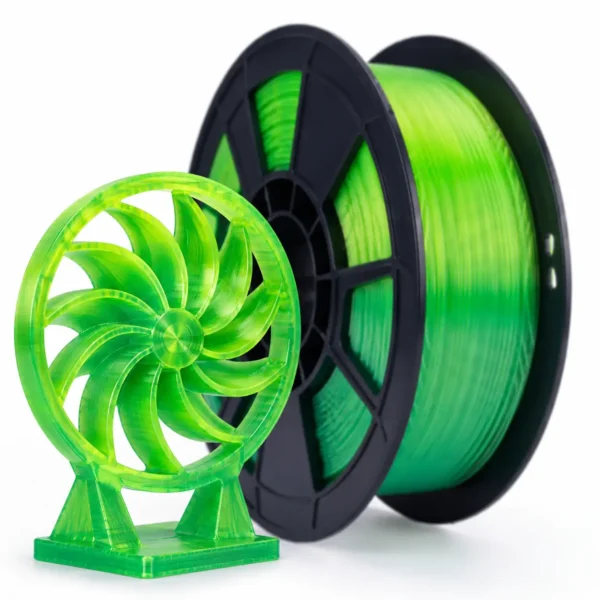
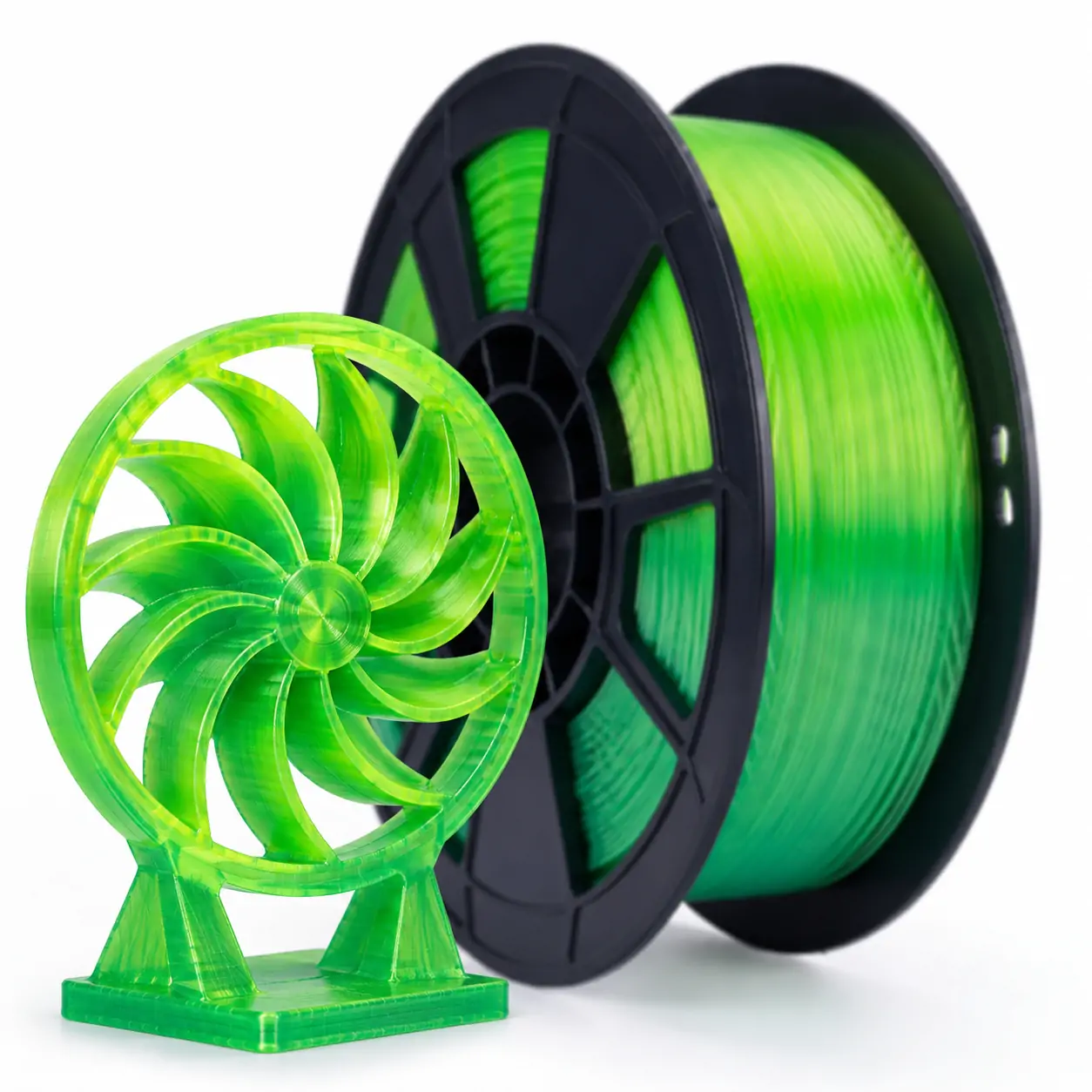
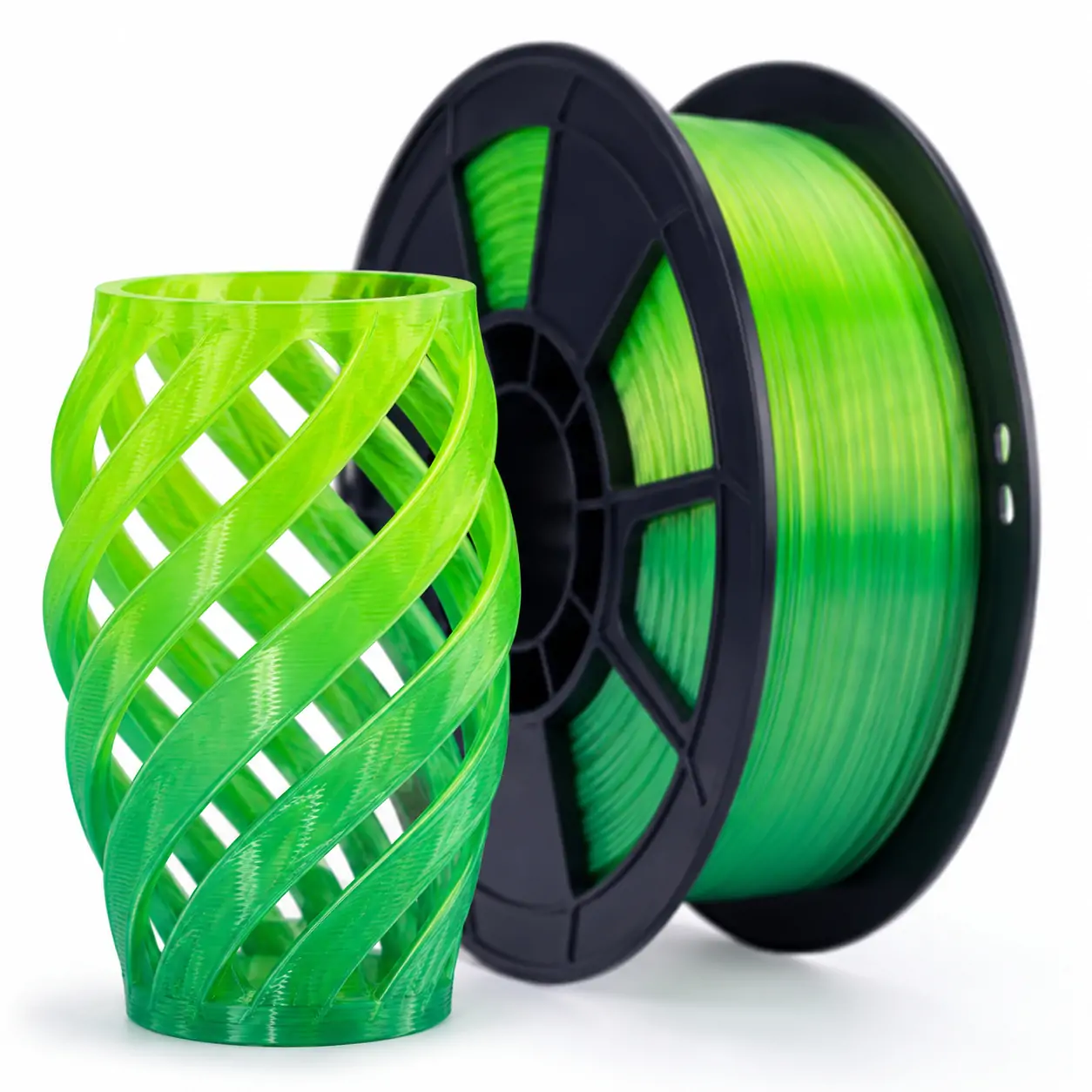
PETG Translucent Gradient Series | Wholesale Supply | OEM / ODM
SSSray Lime-to-Emerald Green Translucent PETG 1.75mm 3D Printer Filament – خيط PETG شبه شفاف أخضر for Spiral Vases & Decorative Models
Factory-supplied translucent gradient PETG for spiral vases, light-catching decorative models, retail filament programs, and private-label B2B projects.
The lime-to-emerald transition gives tall shells and continuous-wall prints a vivid green depth while PETG provides practical toughness, smooth semi-gloss surfaces, and dependable layer bonding when printed dry and within the recommended temperature range.
MaterialPETG
SeriesTranslucent Gradient
Color EffectLime → Emerald
Diameter1.75mm
Tolerance±0.03mm
Net Weight1kg
Gross Weight1.3kg
Nozzle Temp240–255°C
Bed Temp70–80°C
Print Speed60–150 mm/s
PackagingVacuum + Desiccant
Spool TypePlastic Spool
MOQ: Neutral packaging from 50 rolls; OEM packaging typically 500–1,000 rolls.
Lead Time: Standard 7–15 days; customized orders typically 15–25 days.
Product Overview
SSSray Lime-to-Emerald Green Translucent PETG is made for buyers who want a PETG SKU with a clearly recognizable visual identity, not another generic solid green. The filament moves from bright lime green toward a deeper emerald tone while retaining a translucent, light-transmitting appearance and smooth semi-gloss surface. On tall spiral vases, twisted shells, decorative containers, turbine-style models, and other continuous-wall prints, the tonal shift becomes more visible as the geometry catches and passes light through the printed walls. The 1.75mm format, ±0.03mm diameter tolerance, plastic spool, and vacuum-sealed packaging with desiccant fit standard distributor and private-label programs.
For bulk and OEM buyers, we support neutral-pack orders from 50 rolls, custom packaging programs, standard and custom color discussions, batch traceability, and sample qualification. PETG also gives this decorative series a practical balance of layer bonding, lower warping tendency than ABS/ASA, and more toughness than typical decorative PLA. For wholesale PETG programs, see our Wholesale PETG Filament and Custom PETG Filament supply pages.
Why This Product Stands Out
We developed this lime-to-emerald grade for decorative PETG lines where the printed model itself needs to sell the color. The translucent gradient gives spiral and continuous-wall geometry more visual depth than a flat solid green, while the PETG base keeps the SKU practical for everyday FDM users. For distributors and private-label brands, it adds a visually distinctive PETG option that is easy to position alongside standard translucent and solid-color grades. The strongest visual effect appears on taller models, curved surfaces, and thin-wall designs where light can travel through the material and reveal the green transition.
Key Selling Points
Lime-to-Emerald Gradient
A bright-to-deep green transition that gives tall decorative prints a more distinctive shelf and display presence.
Translucent Light Play
Semi-transparent walls transmit and diffuse light, making curves, twists, and layered contours more visible.
Spiral-Vase Friendly
Continuous-wall printing highlights the gradient without infill interrupting the light-transmitting appearance.
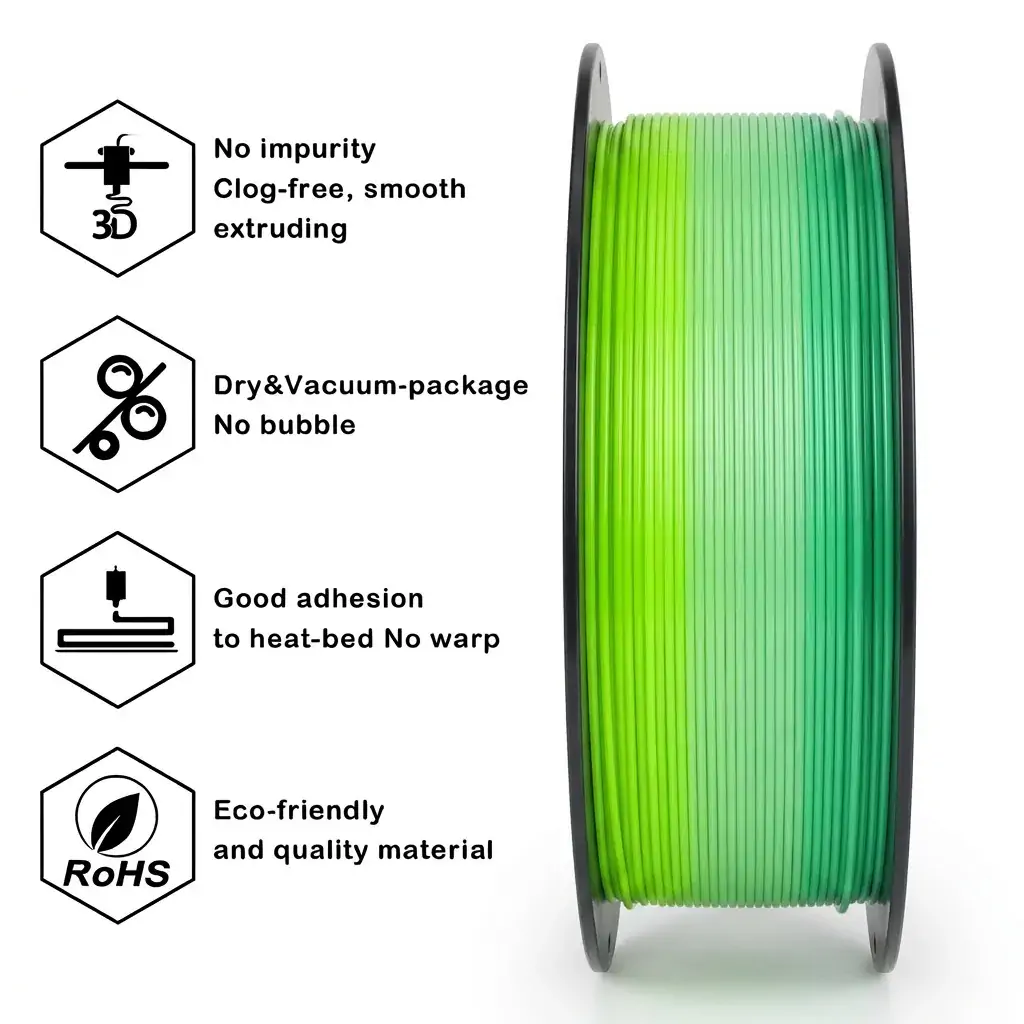
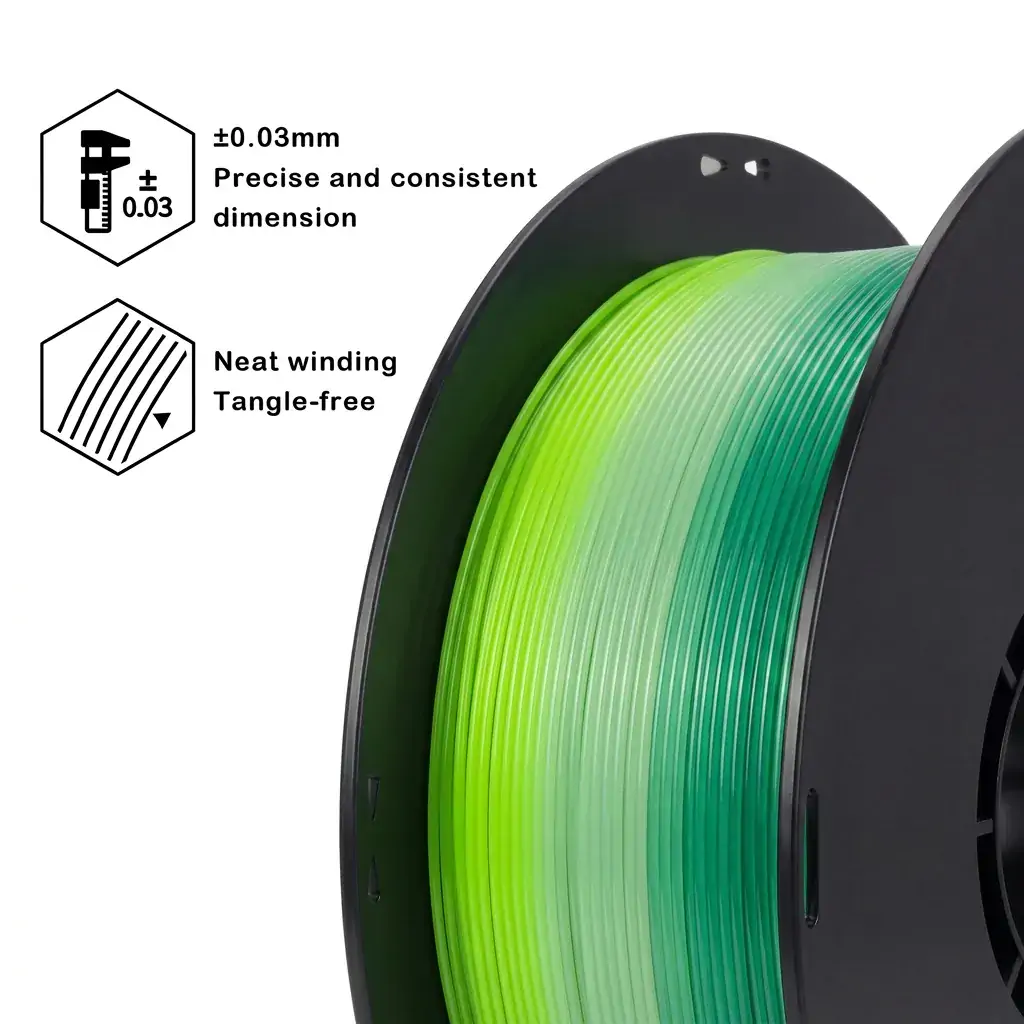
±0.03mm Diameter Control
Controlled filament diameter supports steadier feeding and repeatable extrusion across wholesale and private-label batches.
Export-Ready Supply
Vacuum-sealed units, desiccant, export cartons, batch identification, and FOB Ningbo / EXW support B2B fulfillment.
Private-Label Ready
Custom labels, branded boxes, color programs, and packaging development are available for qualified OEM / ODM projects.
Key Features
| Feature | Practical Buyer Benefit |
|---|---|
| Lime Green → Emerald Green Translucent Gradient | Creates a recognizable green decorative SKU that is visually different from single-color translucent PETG |
| Light-Transmitting Semi-Gloss Surface | Works especially well on curved shells, spiral vases, decorative containers, and display models |
| 1.75mm Standard Diameter | Fits the mainstream 1.75mm open-material FDM / FFF printer ecosystem |
| ±0.03mm Tolerance | Supports stable feeding and more consistent extrusion across routine production lots |
| Vacuum Sealed + Desiccant | Helps limit moisture exposure during storage and international transport |
| OEM / ODM Supply Program | Supports neutral packing, private labels, branded boxes, and project-based color development |
Commercial Value for PETG Distributors
This grade gives distributors a stronger visual story without forcing end users into a difficult specialty material. PETG is already familiar in the FDM market, so the lime-to-emerald translucent effect can be added as a higher-interest decorative SKU while keeping the printing workflow close to standard PETG. The 1kg retail format, 50-roll neutral-pack MOQ, OEM options, and sample qualification route also make it practical to test demand before expanding a private-label range. For buyers building a broader PETG assortment, this grade complements clear, solid-color, high-speed, matte, and other specialty PETG lines with a distinct green gradient and decorative focus.
Why Choose This Product
- Distinct lime-to-emerald green transition for decorative and display-focused product lines
- Translucent PETG appearance that becomes more expressive on tall, curved, and thin-wall geometry
- ±0.03mm diameter tolerance with batch-oriented QC and lot traceability support
- Recommended 60–150 mm/s production range with a slower clarity-focused wall strategy when needed
- Vacuum-sealed 1kg units with desiccant and export-carton preparation
- Neutral packaging from 50 rolls for channel testing and wholesale replenishment
- OEM / ODM support for labels, branded boxes, spool presentation, and private-label programs
How We Work
1
Requirement & Market Review2
Grade & Color Confirmation3
Sample Qualification4
OEM Packaging Approval5
Batch Production & QC6
Export Packing & ShipmentMaterial Comparison Guide
| Material / Effect | Visual Behavior | Typical Printing Condition | Typical Use | Typical B2B Use |
|---|---|---|---|---|
| Lime-to-Emerald Translucent PETG | Green tonal transition with light-transmitting semi-gloss walls | Heated bed; dry filament; moderate cooling; PETG temperature range | Spiral vases, decorative shells, display models | Specialty PETG SKU with color-transition identity |
| Clear / Single-Color Translucent PETG | Uniform clear or tinted translucent appearance | Similar PETG thermal range; settings strongly affect clarity | Light covers, prototypes, decorative parts | Transparency-focused or single-color translucent line |
| Solid-Color PETG | Opaque or near-opaque color with smooth PETG finish | Standard PETG profile with heated bed | Functional parts, brackets, containers | General-purpose PETG assortment |
| Silk PLA | High visual sheen; usually opaque | Lower nozzle and bed temperatures than PETG | Figurines, trophies, decorative models | Appearance-first PLA line |
| ASA | Opaque surface; lower light transmission | Higher thermal control; enclosure commonly preferred | Outdoor housings and functional parts | Weather-oriented engineering line |
Technical Specifications
| Product Name | SSSray Lime-to-Emerald Green Translucent PETG 1.75mm 3D Printer Filament – خيط PETG شبه شفاف أخضر for Spiral Vases & Decorative Models |
|---|---|
| Material | PETG (Glycol-Modified Polyethylene Terephthalate) – FDM / FFF 3D Printing Filament |
| Series | SSSray PETG Translucent Gradient Series – Light-Transmitting Decorative Prints |
| Color / Effect | Lime Green → Emerald Green translucent gradient with a smooth semi-gloss appearance |
| Filament Diameter | 1.75mm standard; 2.85mm available on request |
| Tolerance | ±0.03mm |
| Net Weight | 1kg (3kg / 5kg options by project) |
| Gross Weight | 1.3kg |
| Spool Type | Plastic spool |
| Packaging | Vacuum sealed with desiccant |
| Recommended Nozzle | 0.4mm standard; larger nozzles may be used for thicker translucent walls |
| Printer Compatibility | Most 1.75mm open-material FDM / FFF printers, including Bambu Lab, Prusa, Creality, Anycubic, Elegoo, and Flashforge platforms |
| Typical Applications | Spiral vases, twisted shells, decorative containers, turbine-style models, display objects, light-diffusing decorative parts |
| OEM / ODM | Supported: labels, branded boxes, private-label packaging, spool presentation, and project-based color development |
| Trade Terms | FOB Ningbo / EXW |
| Technical Documentation | TDS / SDS support; destination-market compliance files matched to the confirmed production grade |
Recommended Print Settings
| Parameter | Recommended Guidance |
|---|---|
| Recommended Nozzle Temperature | 240–255°C |
| Usable Nozzle Range | 230–260°C |
| Recommended Bed Temperature | 70–80°C |
| Usable Bed Range | 65–90°C, depending on build surface and first-layer adhesion |
| Recommended Print Speed | 60–150 mm/s for general printing |
| Usable Speed Range | 40–220 mm/s after flow and cooling calibration |
| Clarity-Focused Outer Wall | 30–60 mm/s for smoother, more light-transmitting continuous walls |
| Layer Height | 0.16–0.28mm; 0.20–0.28mm is a practical starting range for spiral vases |
| Cooling Fan | 30–60% after first layers; reduce toward 0–30% for clearer continuous walls and increase for bridges / overhangs |
| Retraction | Direct drive 0.8–1.2mm / Bowden 3–5mm as starting ranges |
| Retraction Speed | 25–40 mm/s starting range |
| Wall Count | 1 wall in spiral / vase mode; 2–4 walls for standard parts |
| Infill | 0% in vase mode; 10–20% decorative; 30–50% for higher-demand non-optical parts |
| First Layer Speed | 20–35 mm/s |
| Bed Adhesion | Textured / satin PEI preferred; smooth PEI or glass with a thin release layer if adhesion is too aggressive |
| Drying | 65°C for about 8 hours before printing when moisture exposure is suspected or maximum surface quality is required |
| Print-Storage Humidity | Keep sealed with desiccant; low-humidity feeding is recommended for long jobs |
Print Optimization Guide
| Item | Guidance |
|---|---|
| Show the Gradient More Clearly | Choose taller models or long continuous toolpaths; short prints may show only part of the lime-to-emerald transition |
| Maximize Light Transmission | Use fewer walls, minimal infill, slower outer walls, stable extrusion, and moderate-to-low cooling on continuous surfaces |
| Spiral Vase Setup | Use continuous single-wall mode with 0% infill and a stable 0.20–0.28mm layer height as a practical starting point |
| Reduce Stringing | Print dry filament, avoid excessive nozzle temperature, and calibrate retraction before increasing travel speed |
| Protect Build Surface | PETG can bond strongly to smooth PEI or glass; use a suitable release layer when needed |
| Large Decorative Parts | Keep the bed clean, avoid drafts, and maintain stable bed temperature to reduce corner lift on wide footprints |
| Color Consistency | For multi-piece sets, print parts from the same production lot and plan toolpath length when matching gradient placement matters |
Printer Brand Starting Settings
| Printer Brand | Nozzle | Bed | Speed | Starting Guidance |
|---|---|---|---|---|
| Bambu Lab | 245–255°C | 70–75°C | 80–150 mm/s | Slow outer walls to 40–70 mm/s when light transmission and surface smoothness matter more than throughput |
| Prusa | 240–250°C | 80–90°C | 50–100 mm/s | Satin or textured PEI is a practical PETG starting surface; tune cooling for layer bonding and surface clarity |
| Creality | 240–250°C | 70–80°C | 50–100 mm/s | Start with moderate cooling and calibrate retraction to control PETG stringing |
| Anycubic | 240–250°C | 70–80°C | 50–100 mm/s | Confirm first-layer spacing and bed adhesion before increasing speed |
| Elegoo | 240–250°C | 70–80°C | 50–110 mm/s | Use dry filament and reduce outer-wall speed for clearer decorative shells |
| Flashforge | 240–250°C | 70–80°C | 50–120 mm/s | Use a PETG starting profile and fine-tune flow, cooling, and retraction for the specific hotend |
Start from the range above, then tune flow, cooling, retraction, and wall speed for the printer, nozzle, build surface, and target level of translucency.
Performance Characteristics
| Characteristic | Material Behavior | Production / Buyer Reference |
|---|---|---|
| Light Transmission | Translucent rather than optically clear | Wall thickness, infill, nozzle temperature, speed, and layer interfaces directly affect the visible result |
| Surface Appearance | Smooth semi-gloss PETG finish | Curved and twisted surfaces show the lime-to-emerald color depth more clearly under side lighting |
| Warping Behavior | Lower shrinkage tendency than ABS / ASA | Wide flat parts still benefit from stable bed temperature, clean surface, and draft control |
| Moisture Response | PETG is moisture-sensitive during printing | Drying and sealed storage help reduce bubbles, surface roughness, and stringing |
| Gradient Visibility | Depends on filament path length consumed by the model | Tall spiral vases and long continuous toolpaths reveal more of the transition than small parts |
| Layer Bonding | Strong interlayer bonding is typical when PETG is printed hot enough and not over-cooled | Cooling should be balanced against bridge quality and the desired translucent appearance |
Applications
| Application Focus | Practical Notes |
|---|---|
| Spiral Vases & Twisted Vessels | Continuous walls maximize the visual impact of the lime-to-emerald transition and reduce infill-related clouding |
| Decorative Containers | Useful for display bowls, organizers, sleeves, and non-food-contact decorative vessels where light transmission adds depth |
| Architectural & Display Models | Translucent green surfaces highlight ribs, curves, fins, and layered geometry under directional lighting |
| Turbine / Organic Demonstration Models | Suitable for visually complex shapes where semi-gloss PETG surfaces make contour changes easy to see |
| Retail Demonstration Prints | Strong choice for sample models that help distributors show the difference between solid PETG and translucent gradient PETG |
| Creative General-Purpose PETG Parts | Can be used beyond decorative prints when the geometry and load requirements are appropriate for standard PETG |
Storage Guide
- Keep unopened spools in the original vacuum-sealed bag with desiccant until needed
- After opening, store the spool in a sealed dry box or moisture-barrier bag with fresh desiccant
- If bubbling, popping, rough extrusion, or increased stringing appears, dry at about 65°C for 8 hours before recalibration
- For long prints, low-humidity filament feeding helps keep surface quality and extrusion more consistent
- Protect stored spools from direct sunlight, heat sources, and repeated high-humidity exposure
OEM / ODM Services
We support distributors, importers, e-commerce sellers, and private-label brands with neutral packing, custom labels, branded retail boxes, barcode / SKU labeling, spool presentation options, color-line planning, and project-based packaging development. Neutral packaging starts from 50 rolls, while customized OEM packaging normally starts from 500–1,000 rolls depending on the scope.
For buyers building a branded filament line, our 3D Printer Filament OEM / ODM and Private Label Filament pages outline the cooperation route. Qualified buyers can also use our Filament Qualification Program before moving into volume production.
Quality Control
- Inline laser diameter monitoring controls standard PETG production to the confirmed 1.75mm / ±0.03mm specification
- PETG / PCTG ovality is controlled to ≤0.020mm to support stable feeding and extrusion consistency
- Karl Fischer moisture checks use a PETG / PCTG release limit of ≤0.025 wt% before moisture-barrier packing
- Spectrophotometer color control targets ΔE < 1.0 against the approved master color for stronger reorder consistency
- Lot identification, spool traceability, winding inspection, and batch records support B2B follow-up and repeat-order matching
- Final release checks cover vacuum sealing, desiccant, labels, cartons, quantity, and confirmed OEM packaging requirements
For qualification workflows, review our 3D Printer Filament Test Protocol and Batch QC Data pages.
Technical & Compliance Documentation
- TDS: Current technical data for the production grade is available for wholesale and OEM orders
- SDS / MSDS: Safety data documentation for the supplied PETG grade is available for shipment and buyer review
- Destination-Market Documents: Share the destination country and required document list at quotation stage so our team can prepare the applicable file set for the order
- Batch Records: Batch ID and related QC records can be linked to the production lot for B2B follow-up and repeat orders
- Third-Party Testing: Third-party testing can be arranged for bulk and OEM projects when required by the buyer or destination market
Frequently Asked Questions
What is the MOQ for Lime-to-Emerald Translucent PETG?
Neutral packaging starts from 50 rolls. OEM or private-label packaging normally starts from 500–1,000 rolls depending on label, box, spool, and color customization requirements.
Will every printed model show the full lime-to-emerald gradient?
The visible transition depends on how much filament the model consumes and the toolpath length. Tall spiral vases and long continuous-wall models usually reveal more of the color progression than small parts.
What settings work well for spiral vases?
A practical starting point is 240–255°C nozzle, 70–80°C bed, 0.20–0.28mm layer height, one continuous wall, 0% infill, and a slower 30–60 mm/s outer-wall speed when light transmission and surface smoothness are the priority.
Is this PETG transparent or translucent?
This product is translucent rather than optically clear. Wall thickness, print speed, nozzle temperature, cooling, infill, and layer structure all influence how much light passes through the finished part.
Does the filament need drying?
Dry filament gives more consistent PETG surfaces. If the spool has absorbed moisture or you need the cleanest translucent finish, dry at about 65°C for 8 hours and keep it sealed with desiccant during storage.
Which printers can use this filament?
It is designed for most 1.75mm open-material FDM / FFF printers, including common Bambu Lab, Prusa, Creality, Anycubic, Elegoo, and Flashforge platforms. Start from a PETG profile and tune flow, cooling, and retraction for the machine.
Can SSSray provide private-label packaging or custom colors?
Yes. We support custom labels, branded boxes, spool presentation options, standard and project-based color programs, and other OEM / ODM requirements for qualified B2B projects.
Can I request samples before a bulk order?
Yes. Qualified buyers can apply for up to 3 free sample rolls after project review. Standard production lead time is 7–15 days, while customized orders are typically 15–25 days.
Build a More Distinctive Translucent PETG Line
Talk with SSSray about bulk pricing, lime-to-emerald sample qualification, neutral packaging from 50 rolls, and private-label PETG programs for your market.


Related products
-

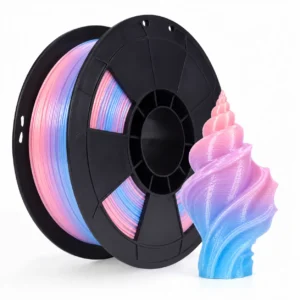
SSSray Pink–Lavender–Sky Blue Gradient PETG Filament 1.75mm – Filament PETG Gradientowy for Decorative & Detailed 3D Printing
-
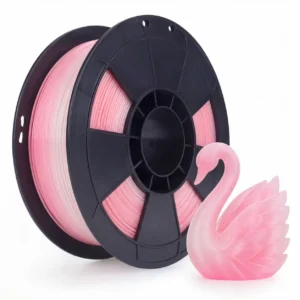
SSSray Blush Pink-to-Frost White Translucent PETG 3D Printer Filament 1.75mm – 半透明PETGフィラメント for Decorative Display Models
-
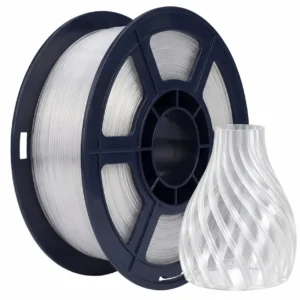
SSSray Clear Transparent PETG 1.75mm 3D Printer Filament – 透明PETGフィラメント for Functional Enclosures & Display Models
-
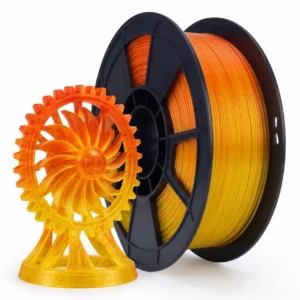
SSSray Orange-to-Yellow Gradient Translucent PETG Filament 1.75mm – Yarı Saydam PETG Filament for Decorative Models