Online time
Monday to Friday: 9AM - 8PM
Weekend: 10AM - 5PM

TL;DR: Treat UL94 V-0 as the Entry Ticket, Not the Rail or Aviation Approval
A UL94 V-0 result is a useful small-flame screen, not a rail or aviation approval. Rail work may require oxygen index, smoke and toxicity under EN 45545-2; aircraft interiors use the test route applicable to the component under 14 CFR 25.853 Appendix F, which can include vertical, horizontal, 45° or 60° tests plus heat-release and smoke requirements for specified large interior components. Qualify the material, printed configuration and production process together—not the spool label alone.
Best optionFor rail parts that actually map to R22, shortlist PC-FR or PA-FR grades with thickness-specific R22 evidence. For installed aircraft parts, shortlist certified-grade PEI 9085 or PEKK only when the applicable Appendix F/FST evidence and process traceability match the component.
When not to use itDo not treat a commodity V-0 PETG-FR or PC-FR datasheet as evidence for an installed cabin panel, partition, stowage component or other regulated aircraft interior part.
Key specificationFor R22, verify printed-specimen evidence at the relevant thickness: oxygen index ≥28% (HL1–HL2) or ≥32% (HL3), plus the applicable smoke and toxicity limits.
Verify the supplierLab report number, specimen thickness and color, printed or molded bars, Cl/Br content and PTFE disclosure.
Procurement warningAn R22 test set lists at about €4,300 per variant: €433 per kg if you only buy 10 kg.
Abstract
Rail operators, aerospace manufacturers and MROs now use additive manufacturing for production and replacement parts. Deutsche Bahn reports more than 200,000 printed components in service. Stratasys says Airbus prints over 25,000 flight parts a year in ULTEM 9085 CG. And in June 2026, Stratasys released a glass-filled PA6/66 flame-retardant filament classified to EN 45545-2 R22/R23 at HL2.
In other words, flame-retardant filament has moved from the prototype shelf into the spare-parts store. Buying habits, however, have not caught up. Many RFQs still ask for “UL94 V-0 filament for trains,” as if one label settled fire safety.
It doesn’t. UL94 is a small-flame screening test from the electrical world, and passing it says little about the other two rule sets. EN 45545-2 adds oxygen index, smoke density and smoke toxicity, while 14 CFR 25.853 uses a hotter, longer flame and, for large cabin surfaces, heat release and smoke limits.
Four assumptions cause the costliest mistakes: that a molded-bar V-0 rating transfers to printed parts; that a material classification covers any part printed from it; that “halogen-free” means PFAS-free; and that price per kilogram is the main cost. Each looks harmless in an RFQ and becomes expensive after a failed test.
The B2B logic is straightforward: compliance evidence belongs to a defined material and part configuration, not to a generic spool name. We therefore lock material identity, print profile, specimen thickness and evidence into one qualification record so distributors, OEM brands, print farms and engineering buyers are all working from the same traceable baseline.
This guide moves from application to standard to material to purchase. It compares the rule sets side by side, explains smoke, dripping and halogen chemistry, compares five FR material families, prices a printed-sample test plan from public laboratory list prices, and ends with the Transit Fire-Fit Framework, a seven-checkpoint scorecard for suppliers and reorders. SSSray data is separated into TDS-typical values, published first-hand moisture data, a public production-lot QC record and the FR qualification protocol used for future lot-specific testing.
Key Takeaways
- UL94 V-0 is a screen, not an approval. Read the rating with its tested thickness, material/color scope and specimen/process conditions.
- V-0 and V-1 differ in burn time, not dripping. Both fail if a flaming drip ignites the cotton; only V-2 allows that.
- Many small non-listed interior rail parts can map to R22. The 0.2 m² threshold matters only after the product category is confirmed; listed products may follow another requirement set.
- Aircraft interior testing is component-specific. Appendix F uses a minimum 1550 °F (843 °C) flame for the 60 s and 12 s vertical routes, but other categories use horizontal, 45° or 60° procedures.
- Rail toxicity scoring punishes halogens. HCl counts about 18 times more than CO, gram for gram, in the CIT formula.
- “Halogen-free” does not automatically mean PFAS-free. IEC 61249-2-21 limits chlorine and bromine but not fluorine, so a PTFE anti-drip additive can still be present.
- Print settings change fire results. In a 2024 study, 30% infill burned longer than 50% or 70% infill.
- Testing dominates cost at low volume. An R22 set spread over 100 kg adds €43/kg.
- Retail FR premiums vary widely: the October 2026 public-price snapshot is about +38% for Bambu PC FR over PC and +83% for Prusament PETG V0 over PETG; PEI 9085 is roughly four to five times a $54.99/kg PC-FR reference.
1. Railway and Aviation Fire Standards: Where UL94 V-0 Fits and Where It Stops
For procurement: UL94 V-0 is a useful first filter for flame-retardant filament, but UL94 alone does not establish rail or aviation compliance. EN 45545-2 adds requirement-set-specific fire, smoke and toxicity criteria; 14 CFR 25.853 Appendix F maps different aircraft interior components to different test procedures.
Think of UL94 as the parking test at driving school; rail and aviation standards are the motorway exam.
Key rule sets and test routes side by side
Table 1 lines up the requirements a printed interior part is most likely to face.
On mobile, swipe horizontally to review every column.
| Rule set | Typical printed parts | Test and specimen | Key pass limits | What it means for buyers |
|---|---|---|---|---|
| UL 94 vertical (Ed. 7-2023, revised 2026) | Electrical housings and material screening | 50 W flame, two 10 s applications; 125 × 13 mm bars | V-0: each afterflame ≤10 s; ≤50 s total for 5 bars; no cotton ignition | Useful screen; not rail or aviation approval by itself |
| EN 45545-2 R22 | Non-listed interior items ≤0.2 m² where the product classification maps to R22 | OI (EN ISO 4589-2); smoke (EN ISO 5659-2, 25 kW/m²); toxicity by the contract edition | HL1 / HL2 / HL3: OI ≥28 / 28 / 32%; Ds max ≤600 / 300 / 150; CIT ≤1.2 / 0.9 / 0.75 | Common route for qualifying eligible small interior parts |
| EN 45545-2 R23 | Non-listed exterior items ≤0.2 m² where the product classification maps to R23 | OI; smoke at 25 kW/m²; toxicity by the contract edition | HL1 / HL2 / HL3: OI ≥28 / 28 / 32%; Ds max — / 600 / 300; CIT — / 1.8 / 1.5 | Do not reuse the stricter R22 smoke/toxicity numbers as the R23 table |
| EN 45545-2 R1 | Interior surfaces and applicable non-listed items >0.2 m² | ISO 5658-2 flame spread; ISO 5660-1 cone; EN ISO 5659-2 at 50 kW/m² | CFE ≥20; MARHE — / ≤90 / ≤60 kW/m²; Ds(4) ≤600 / 300 / 150; VOF4 ≤1200 / 600 / 300; CIT ≤1.2 / 0.9 / 0.75 | Broader fire package than R22/R23 |
| 14 CFR 25.853, Appendix F Part I | Listed cabin materials: some use 60 s or 12 s vertical tests; other categories use horizontal, 45° or 60° procedures | For vertical tests, Bunsen/Tirrill flame ≥1550 °F (843 °C); minimum 3 specimens; specimen no thicker than the minimum thickness to be qualified | 60 s route: burn ≤6 in, after-flame ≤15 s, drips ≤3 s. 12 s route: ≤8 in, ≤15 s, ≤5 s | Map the component to the exact Appendix F paragraph before testing |
| 14 CFR 25.853(d), Parts IV and V | Specified large interior components on airplanes with 20 or more passenger seats | Heat release and smoke testing | 2-min total heat release ≤65 kW·min/m²; peak ≤65 kW/m²; smoke Ds ≤200 at 4 min | Material choice must be tied to the tested configuration and approval route |
| 49 CFR 238, Appendix B (US rail) | Panels and other passenger-equipment materials; certain small miscellaneous parts <100 cm² may be treated separately | ASTM E162 flame spread; ASTM E662 smoke; Appendix B notes and fire-hazard analysis where applicable | Panels: Is ≤35; Ds(1.5) ≤100; Ds(4.0) ≤200 | Small-part relief is conditional, not an automatic size exemption |

Contract edition matters. The published standard is EN 45545-2:2020+A1:2023, while applicable TSI and project references can still identify EN 45545-2:2020 depending on the assessment framework. ERA has recommended updating TSI references to the 2020+A1:2023 edition, so we lock the exact edition into the RFQ, purchase order and laboratory quotation before testing.
What we put in the RFQWrite the standard, R-set or paragraph, hazard level and thinnest wall into every RFQ.
Common RFQ gapAsking for “rail-grade” or “aerospace-grade” filament without naming a rule set.
What we verifyMap each part number to one requirement set before requesting quotes.
2. What a UL94 V-0 Rating Means for 3D Printed Parts
What V-0 tells us: five bars of one thickness stopped burning within 10 seconds after each of two flame applications, and no flaming drip ignited the cotton below. It says nothing about thinner walls, other colors, smoke, toxicity or a part printed at 40% infill.
V-0 vs V-1 vs V-2: the dripping behavior test, explained
- V-0: each afterflame ≤10 s; total ≤50 s for five bars; afterflame plus afterglow ≤30 s; no cotton ignition.
- V-1: ≤30 s, ≤250 s and ≤60 s; still no cotton ignition.
- V-2: V-1 times, but flaming drips may ignite the cotton.
So the real gap between V-0 and V-1 is burn time; dripping separates V-1 from V-2. Also note that one set is conditioned 48 h at 23 °C and 50% RH, and a second set is aged 7 days at 70 °C.
Datasheet line, lab report or UL Blue Card
Buyers looking for UL94 V-0 certified filament will meet three levels of evidence:
- “V-0 typical” on a datasheet: a claim, often from molded bars.
- A lab report on printed bars: names the lab, thickness, color and orientation.
- A UL Blue Card: a UL rating for printing, tied to printer and build parameters.
UL states that molded Yellow Card ratings cannot simply be applied to 3D-printed parts. A Blue Card is intentionally process-specific, so check the current card for the exact material, printer, build parameters and scope instead of copying a molded-resin rating into a printed-part claim.
Why printed bars burn differently
FFF specimens are anisotropic and can contain inter-road and inter-layer voids, so a printed bar is not equivalent to a molded plaque. UL research has shown that the printed-versus-molded effect is material-dependent: some FR systems lose performance after printing while others track the molded result more closely.
How to audit a supplier’s UL94 test video
A video supports a claim but never replaces the report. A credible one shows a caliper thickness reading, specimen IDs, two timed applications per bar, cotton below, and all five bars of a set.
What we specifySpecify the UL94 class at your thinnest wall and color, on printed specimens.
Where ratings get misreadAccepting a 3 mm V-0 result for a 1.5 mm part.
What we ask the lab forRequest the report: lab, date, thickness, color, infill and orientation.
3. EN 45545-2 Railway Standard Compliance for Railway Interior 3D Printing
For rail RFQs: the requirement depends on the vehicle hazard level and the product requirement set. Many small, non-listed interior printed parts at or below 0.2 m² can map to R22, but only after confirming that the part is not already covered by a listed EN 45545-2 product category.
Step 1: find the hazard level
On mobile, swipe horizontally to review every column.
| Operation category | N: standard | A: automatic | D: double-deck | S: sleeping car |
|---|---|---|---|---|
| OC1: above-ground | HL1 | HL1 | HL1 | HL2 |
| OC2: tunnels under 5 km | HL2 | HL2 | HL2 | HL2 |
| OC3: tunnels over 5 km | HL2 | HL2 | HL2 | HL3 |
| OC4: no lateral evacuation | HL3 | HL3 | HL3 | HL3 |
Operation and design categories determine the hazard level; familiar examples such as above-ground trams, tunnel service and sleeping vehicles are useful orientation only. For a purchase specification, use the project/operator classification rather than assigning HL1, HL2 or HL3 from a vehicle nickname.
Step 2: the 0.2 m² line
EN 45545-2 lists many products, including seats and wall panels, with their own requirement sets. For non-listed products, the 0.2 m² threshold helps determine whether R1 or the small-item R22/R23 route applies. For additive parts this can reduce the test package, but only after the product classification has been confirmed for the actual installation.
Step 3: check R22 with margin
Oxygen index is the oxygen share needed to keep a sample burning; air holds about 21%. A result sitting exactly on the threshold leaves no room for lot variation, so look for a few points of margin.
What changed in 2026
- Stratasys launched FDM PA6/66-GF30-FR on 17 June 2026, meeting R22/R23 at HL2 and FMVSS 302, with Alstom and Siemens Mobility quoted.
- Stratasys’s current ULTEM 9085 railway material sheet now publishes R1, R2, R3, R6, R7, R17, R22 and R23 results with thickness-specific hazard levels. That is the level of scope a buyer should request; “HL3” without the R-set, thickness and print conditions is still incomplete.
- Omni3D notes that non-compliant adhesive or paint can undo a compliant filament’s result.
Printed-specimen evidence is becoming the safer procurement baseline because build parameters can change fire behavior. In the US rail rule, certain miscellaneous discontinuous small parts under 100 cm² may be exempted only when they are not expected to contribute materially to fire growth and the required fire-hazard analysis supports that treatment.
What we lock before quotingPut the hazard level, R-set, largest part area and thinnest wall in the RFQ.
Where rail claims go wrongAccepting “EN 45545 HL3” with no R-set; R22 on a clip says nothing about R1 panels.
What we check in the reportRead the classification report: R-set, HL, thickness, lab accreditation, date and edition.
4. FAA Flame Test Requirements for Aviation Cabin Components Material
For aircraft interiors: Appendix F does not send every cabin material through the same vertical test. Listed ceiling/wall panels, partitions, galley structures and large stowage-compartment materials use the 60-second vertical route; many molded/thermoformed parts, trays and air-duct items use the 12-second vertical route; other categories use horizontal, 45° or 60° procedures. Specified large interior components on airplanes with 20 or more passenger seats also face heat-release and smoke requirements.
A Bunsen burner is not a UL94 flame
UL94 uses a 50 W flame for 10 seconds, twice. Appendix F uses a Bunsen flame of at least 1550 °F (843 °C) for up to 60 seconds. Moreover, the regulation requires specimens no thicker than the minimum thickness to be qualified. Consequently, a V-0 rating at 3 mm says little about a 1.2 mm printed duct wall.
Smoke and toxicity data cabin buyers expect
Airframers add their own toxicity tests. The Antero 840CN03 datasheet reports Boeing BSS 7238/7239 and Airbus AITM 2.0007/3.0005 results, extinguishing in under one second in the 60 s test, and peak heat release near 56 kW/m². Stratasys reports ULTEM 9085 at UL94 V-0 (1.5 and 3 mm), with an OSU two-minute total of 16 kW·min/m² and an oxygen index of 49%.
Which aerospace OEMs accept 3D printed FR components?
- Airbus: per Stratasys (December 2025), 25,000+ printed parts a year in ULTEM 9085 CG across the A320, A350 and A400M.
- Etihad Engineering: EASA design and production approval; filament printing since 2017, powder-bed PA 2241 FR since 2019.
- Process standards: SAE published AMS7100 (FFF process) and AMS7101 (FFF material) in 2019 at airlines’ request.
Can standard FR filament be used for aviation applications?
For tooling, fixtures and non-installed ground equipment, a commercial FR filament may be appropriate after the normal engineering risk review. For an installed cabin part, the material and printed configuration must satisfy the applicable Appendix F route at the qualified thickness and sit inside an approved design/installation path, such as the type-certificate holder, an STC route or an equivalent approved design organization where applicable.
What we request for cabin partsRequest Appendix F results at your thickness and orientations; add Parts IV and V for large surfaces.
Where aircraft claims go wrongReading “14 CFR 25.853 compliant” as complete; a 12 s pass does not cover a 60 s panel.
What we verifyCheck the paragraph tested, thickness, orientation, lot number and certified-grade traceability.
5. Smoke Density Rating and Halogen-Free FR Filament: The Chemistry Buyers Miss
For FR chemistry: flame-retardant chemistry affects smoke, dripping and combustion gases, but EN 45545-2 judges measured performance rather than a “halogen-free” label. Low-smoke, low-toxicity formulations are often a useful starting point where R22/R23 margin matters, provided the actual oxygen-index, smoke and toxicity data support the claim.
How flame retardants work, in plain terms
- Gas phase (halogens, some phosphorus): traps the radicals that keep a flame alive, like cutting a fire’s fuel line; the price is acid gas and often more smoke.
- Condensed phase (many phosphorus systems): turns the surface into char, a heat shield the part grows on itself.
- Anti-drip agents: some thermoplastic FR systems use small PTFE additions to form fibrils that help control melt dripping; the exact loading is formulation-specific.
Reading a smoke density rating for 3D materials
Smoke is reported as Ds, the specific optical density; higher means darker smoke. Rail uses ISO 5659-2 at 25 or 50 kW/m², while aviation and US rail use the ASTM E662/F814 chamber, so the numbers are not interchangeable. A “low smoke” claim without method and heat flux is marketing, not data.
Why toxicity scoring punishes halogens
EN 45545-2 divides each gas’s measured yield by a reference concentration and adds the results into a CIT value. The reference values are HF 25, NOx 38, HCN 55, HCl 75, HBr 99, SO₂ 262, CO 1,380 and CO₂ 72,000 mg/m³. Gram for gram, therefore, HCl counts about 18 times more than CO, and HBr about 14 times more.
“Halogen-free” has a narrow definition
IEC 61249-2-21 sets chlorine and bromine each below 900 ppm and their total below 1,500 ppm. It ignores fluorine. As a result, a grade can satisfy that chlorine/bromine definition while still containing PTFE. If a formulation uses 0.5 wt% PTFE, that corresponds to roughly 3,800 ppm fluorine; the actual loading must come from the supplier or formulation record.
PTFE is a fluoropolymer within the broad PFAS scope used in the EU restriction proposal. In March 2026, ECHA’s RAC adopted its opinion and SEAC agreed its draft opinion; the proposal is still moving through the REACH restriction process and is not yet a final EU-wide restriction. Buyers should therefore treat PTFE disclosure as change-control information, not as proof that a current grade is already prohibited. A 2026 review by Sai and co-authors surveys PFAS-free routes to V-0 polycarbonate; removing an anti-drip component can change fire behavior, so reformulated grades need requalification.
What we request from the compounderAsk for Cl and Br in ppm, PTFE yes or no, and the FR chemistry family.
Where chemistry claims go wrongTreating “halogen-free” as “PFAS-free” in an EU tender.
What we documentHalogen test result, SDS, signed PTFE declaration and a retest plan for reformulation.
6. PC-FR vs PA-FR vs PEI 9085: Choosing a Flame Retardant 3D Printing Filament
For material selection: choose the rule set and part requirement first, then shortlist material families. PC-FR/PC-ABS-FR can fit enclosures and selected rail parts when the required R-set evidence exists; reinforced PA-FR is a strong candidate for stiffness-critical brackets; certified-grade PEI 9085 or PEKK is often considered for aircraft interiors when its FST data and qualified process match the component. PETG-FR remains a practical option for enclosures, screening and development work where its thermal envelope is sufficient.
PC-FR vs PA-FR comparison
- Moisture: our PA-CF V0 reached 0.32% after 24 h at 50% RH, versus 0.20% for PA12-CF.
- Dripping: fiber reinforcement can reduce melt flow and dripping in some PA-FR systems, while some PC-FR formulations use anti-drip additives; verify the exact formulation rather than assuming the behavior from the polymer family.
- Heat and stiffness: PC-FR grades list HDT around 100–113 °C; glass-filled PA-FR wins on stiffness, as Stratasys’s 2026 PA6/66-GF30 rail grade shows.
- Printing: PC-FR/PC-ABS-FR generally benefits from an enclosed thermal environment, while reinforced PA-FR needs disciplined drying and a wear-resistant nozzle; follow the exact grade TDS for active-chamber requirements.
Main comparison table for procurement
Each row ends with a rejection trigger: knowing when to walk away saves more than knowing what to buy.
On mobile, swipe horizontally to review every column.
| Option | Best use case | Key spec | Advantage | Risk | How to verify | When to reject | SSSray sourcing note |
|---|---|---|---|---|---|---|---|
| PETG-FR (V-0 grade) | Electrical enclosures, development parts | V-0 at stated thickness; HDT about 73 °C | Accessible processing, no active heated chamber required for the SSSray grade | Lower heat margin; no rail smoke/toxicity classification | Printed UL94 plus the application-specific fire package | Service temperature approaches the validated thermal limit, or installed cabin use lacks the required FST evidence | From 50 rolls; run the required R-set before rail use |
| PC-FR / PC-ABS-FR | Small rail parts, housings near 100 °C | V-0 at 1.5 mm; OI about 30% | Heat and impact resistance | Warping; PTFE anti-drip; may miss HL3 | R22 set; Cl/Br and PTFE disclosure | Anti-drip undisclosed | PC-ABS-FR needs a 70–90 °C chamber |
| PA-FR, glass or carbon filled | Load-bearing brackets, clips | R22/R23 data; moisture at packing | Stiffness, less dripping, HL2 precedent | Fast moisture uptake; abrasive | Lot Karl Fischer moisture plus R22 | No moisture data, or bubbling on arrival | PA-CF V0 for trial lots |
| PEI 9085 (ULTEM 9085-type) | Qualified cabin parts, ducts and rail parts where its published scope fits | Appendix F/FST and EN 45545 data are grade/process-specific; OI about 49% for published Stratasys data | Long FST record; certified-grade Airbus use | 350–380 °C nozzle; about $220–287/kg in the 14 October 2026 retail snapshot | Applicable FST report at the printed thickness and qualified process | Generic “PEI” with no grade/process-specific FST evidence | On request; use certified-grade sources for installed cabin programs |
| PEKK (Antero-type) | Cabin parts needing ESD | Appendix F, BSS 7239 and AITM data | Low heat release; even burn across directions | Price; limited supply | Same evidence set as PEI 9085 | No FST data for the exact grade | Not an SSSray stock grade |
| PC, PA12 or ABS without FR | Jigs, fixtures, mock-ups | No flame rating claimed | Lowest cost | Unsuitable for installed parts | Confirm the part is not installed | Any installed passenger-area part | Standard ABS and PC ranges |
SSSray sourcing note: our flame-retardant line covers PETG-FR and PC-ABS-FR, both UL94 V-0 typical at 1.5 mm, plus ABS-FR and PA-CF V0 for trials. None holds an EN 45545-2 or FAR 25.853 classification today, so we supply them with a printed-specimen test plan rather than a rail approval claim.

How we shortlistShortlist two materials per part and test both on the same printed profile.
Where over-specification wastes moneySpecifying PEI 9085 for every part “to be safe.”
How we qualifyRun R22 or Appendix F on specimens printed with the production profile.
7. How to Test Flame Retardancy of 3D Printed Samples Before You Buy
Our qualification rule: test printed specimens, not pellets or molded plaques, at the thinnest wall and with the exact production profile. Start with a low-cost screen, then run the full requirement set only on the candidate that passes.
What research says about print settings
A 2024 Polymers study burned printed ULTEM 9085 CG and Antero 800NA in the 60-second vertical test. Burn length fell as thickness rose, and 30% infill burned longer than 50% or 70%. All specimens passed, yet the lesson stands: infill, thickness and orientation belong in the approved specification.
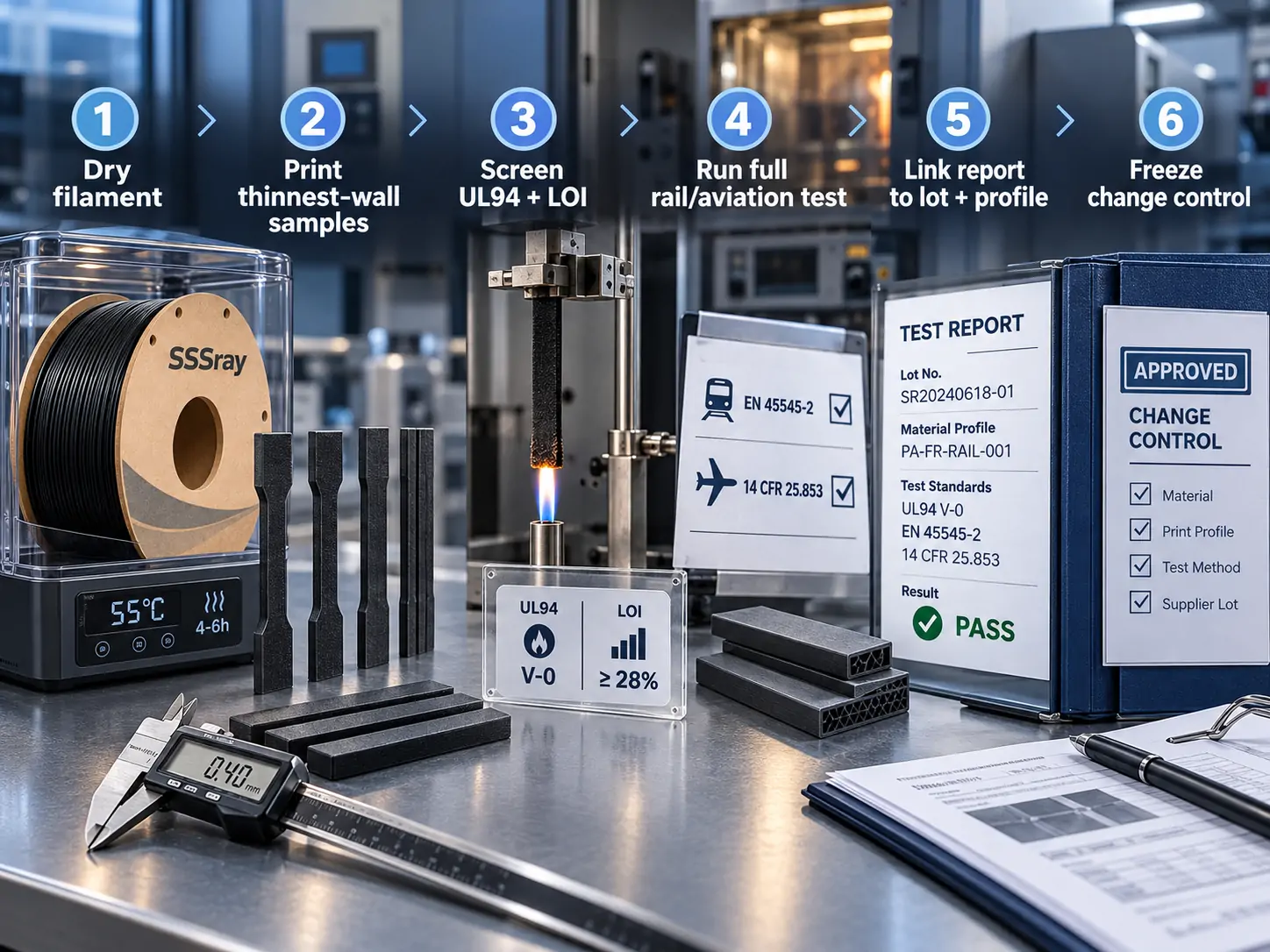
A six-step printed-sample test plan
- Map each part to its rule set and thinnest wall.
- Lock the profile: printer, nozzle, walls, infill, orientation, chamber.
- Dry the filament to its TDS and record Karl Fischer moisture.
- Screen with UL94 vertical (both conditioning sets) and oxygen index.
- Run the full set, including any paint, adhesive or insert.
- Freeze it: link the report to lot, profile and change control.
On mobile, swipe horizontally to review every column.
| Test | Standard | Specimens requested | List price | Used for |
|---|---|---|---|---|
| Vertical burn, 50 W | UL 94 / IEC 60695-11-10 | 20 bars, 125 × 13 mm | €1,250 | UL94 V class |
| Oxygen index | EN ISO 4589-2 | 20 bars, 80–150 × 10 × 4 mm | €562 | R22/R23 |
| Smoke density | ISO 5659-2 | 6 pieces, 75 × 75 mm | €1,836 | R22 Ds max; R1 |
| Smoke toxicity | NF X 70-100 (basis of EN 17084) | 100 g or 75 × 75 mm piece | €1,836 | R22/R23 CIT |
| Cone calorimeter | ISO 5660-1 | 6 pieces, 100 × 100 mm | €928 | R1 MARHE |
| Vertical Bunsen burner | CS / 14 CFR 25.853, App. F | 4 specimens, 75 × 305 mm | Price on tender | Cabin materials |
Add a €97 service fee per order; the public UL94 and oxygen-index listings show typical turnaround of about four weeks. These are planning figures, not a compliance quotation. Before issuing a PO, confirm the exact standard edition, conditioning, specimen preparation, report accreditation and toxicity route required by your contract. Measurlabs’ current public UL94 page still names UL 94 sixth edition, so an edition check is mandatory when your specification cites the current seventh edition.
How we budget the test planBudget tests per variant and have specimens printed on the agreed profile.
Where approvals breakApproving a 1.5 mm printed part with a 4 mm molded plaque.
What stays in the test recordThe report must state printer, profile, infill and orientation.
9. The Transit Fire-Fit Framework for Bulk Procurement of UL94 V-0 Filament
A fire approval works like a laboratory chain of custody: the result counts only if every link is traceable. This framework turns that chain into seven checkpoints.
On mobile, swipe horizontally to review every column.
| Checkpoint | Why it matters | What to ask | Pass / fail signal | Hidden risk |
|---|---|---|---|---|
| Application requirement | It decides every later test | Which standard, R-set or paragraph, HL and thinnest wall? | Pass: one rule set per part. Fail: “rail grade.” | Paint, adhesive or inserts change the tested build |
| Material performance | Chemistry sets smoke and dripping | OI, Ds and CIT or FST data at which thickness? Cl/Br? PTFE? | Pass: numbers with method. Fail: adjectives. | A result on the threshold leaves no lot margin |
| Printability | Results hold for one profile | Which printer, infill and orientation made the specimens? | Pass: profile file linked to report. Fail: molded plaques only. | Lower infill can lengthen burn length |
| Compliance | Approvals need reports | Report number, lab accreditation, edition, date | Pass: ISO/IEC 17025 report per variant. Fail: “certificate on request.” | Edition changes, such as EN 17084 toxicity |
| Supplier reliability | FR dosing drift moves results | How is FR content controlled? Moisture at packing? Retained samples? | Pass: lot COA with moisture. Fail: no lot records. | Peak-season shortcuts in drying |
| Landed cost | Testing outweighs price | Cost per approved part, including tests and scrap? | Pass: per-part model. Fail: FOB price only. | Retesting after reformulation |
| Reorder stability | Approval covers one formulation | Will you notify resin, FR, anti-drip or pigment changes? | Pass: written notice, retained samples. Fail: silent substitution. | Potential PFAS-related reformulation or customer PTFE restrictions |
Score each checkpoint pass, conditional or fail. Approve a supplier only when nothing fails and every “conditional” has a written action and an owner.
10. Flame-Retardant Filament Supplier Claims vs Reality
Fire performance is invisible on a spool, so marketing fills the gap with labels. Table 6 turns them into document requests.
On mobile, swipe horizontally to review every column.
| Vague marketing claim | What it might hide | Document, sample or test to request | What a reliable supplier provides |
|---|---|---|---|
| “UL94 V-0 certified” | Molded bars, one thickness, no UL file | Blue Card or printed-bar lab report | Report number, thickness, color, profile |
| “Meets EN 45545” | No R-set or HL | Classification report | R-set, HL, thickness, accredited lab |
| “14 CFR 25.853 compliant” | Only the 12 s test | Report naming the Appendix F paragraph | Part I at printed thickness; Parts IV and V where needed |
| “Halogen-free” | No ppm data; PTFE undisclosed | Cl/Br in ppm, SDS, PTFE declaration | IEC 61249-2-21 values and a signed PTFE statement |
| “Low smoke” | No method or heat flux | ISO 5659-2 or ASTM E662 results | Ds values with heat flux and thickness |
| “Aerospace grade” | No lot traceability | Certificate of conformance per lot | Lot-traceable grade with change notice |
11. SSSray First-Hand FR Data, Public Lot QC and Qualification Controls
We separate four evidence layers so a buyer can see exactly what has been measured, what is only a TDS-typical value, and what still needs an application-specific fire report. The public production-lot record below is a nylon QC example from the same SSSray lot-control system; it is not presented as an EN 45545 or aircraft fire qualification.
Dataset use: the SSSray first-party datasets published in this section are free to read. SSSray retains rights to the data; contact SSSray before reuse or redistribution. Site terms apply.
Published SSSray FR grade data: useful for screening, not rail or aviation approval
On mobile, swipe horizontally to review every column.
| Grade | Published flame data | Other published values | Current transit status | Next qualification step |
|---|---|---|---|---|
| PETG-FR, black | UL94 V-0 typical at 1.5 mm; OI 32% | 1.29 g/cm³; tensile 48 ± 3 MPa; HDT 73 °C | No EN 45545 or 14 CFR 25.853 classification claimed | Printed UL94 screen, then the required R-set if used for rail |
| PC-ABS-FR | UL94 V-0 typical at 1.5 mm; OI 30% | 1.20 g/cm³; HDT 103 °C; Tg 109.7 °C | No EN 45545 or 14 CFR 25.853 classification claimed | Run the project R-set at the qualified thickness |
| PA-CF V0 (PA66 base, phosphorus-FR) | V-0 positioning; verify the exact report supplied with the quoted grade | Published Q1 2026 moisture-exposure data below | No rail/aviation classification claimed here | Lot moisture + printed fire screening + required rail/aviation test route |
| ABS-FR | Grade-dependent V-0 target; confirm report scope before listing | Published family data varies by SKU | No rail/aviation classification claimed here | Printed UL94 screen first, then application-specific testing |
Oxygen index shows why margin matters. A typical OI of 30% for PC-ABS-FR is above the R22 HL1/HL2 oxygen-index floor but below the 32% HL3 floor; PETG-FR at 32% sits on the HL3 oxygen-index threshold. Neither statement is an R22 classification because smoke and toxicity evidence are still required.
First-hand SSSray FR handling data: PA-CF V0 moisture exposure

SSSray first-hand test record — Q1 2026 PA-CF V0 moisture exposure: four SSSray production batches · 0.5 mm printed tensile bars · mean of n = 3 samples per grade · 23 °C and 50% RH · saturated magnesium-nitrate humidity control · calibrated moisture balance · seven time points from 0 to 720 h. The published source is the SSSray 30-day PA-CF moisture study.
On mobile, swipe horizontally to review every column.
| Exposure | PA-CF V0 moisture | PA12-CF reference |
|---|---|---|
| 0 h | <0.10% | <0.10% |
| 6 h | 0.12% | 0.10% |
| 24 h | 0.32% | 0.20% |
| 72 h | 0.60% | 0.38% |
| 168 h | 0.90% | 0.55% |
| 336 h | 1.20% | 0.72% |
| 720 h | 1.45% | 0.85% |
These values support handling and drying decisions for the tested material set. The original Q1 moisture article did not publish the individual batch IDs, so we do not use that dataset as lot-specific fire-qualification evidence.
Public SSSray production-lot QC record: what traceability looks like before fire testing
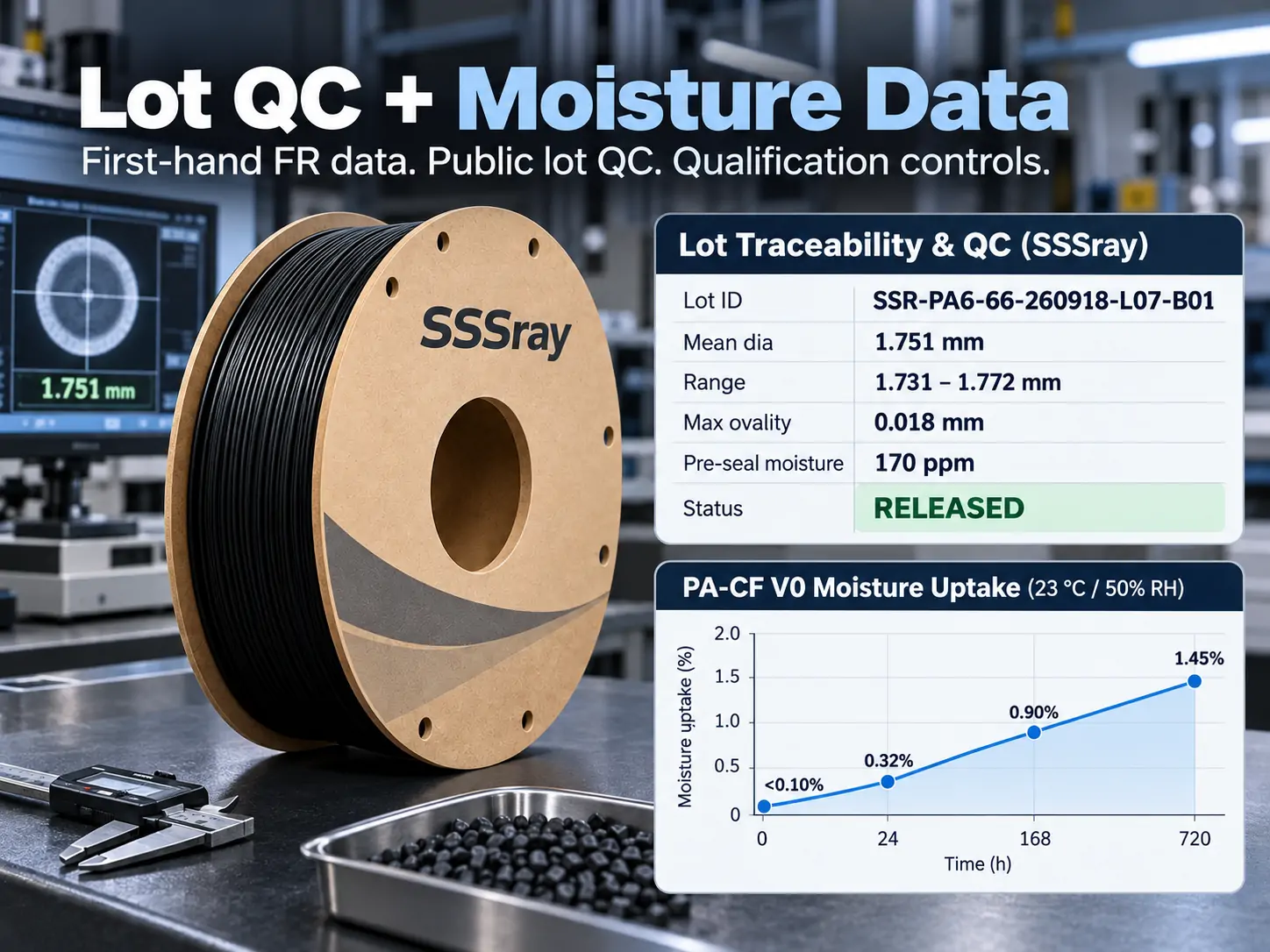
The following record is already public on SSSray.com and provides the batch, equipment type, sample count, conditions and measured results that procurement teams should expect from a lot-controlled program. It is a PA6/66 engineering-nylon QC record, not an FR fire-test result.
On mobile, swipe horizontally to review every column.
| QC item | Public record | Release requirement | Result |
|---|---|---|---|
| Public Batch ID | SSR-PA6-66-260918-L07-B01 | Unique production-lot traceability | PASS |
| Production / test date | 18 September 2026 | Lot-matched QC before packing | PASS |
| Extrusion line | Line 07 | Production-line traceability | PASS |
| Diameter equipment / method | Continuous inline laser micrometer monitoring | 1.75 ±0.03 mm | PASS |
| COA diameter audit sample | 10 spools × 3 archived checkpoints = 30 measurement sets | Representative checkpoints inside release tolerance | PASS |
| Mean / observed diameter | Mean 1.751 mm; observed 1.731–1.772 mm | 1.72–1.78 mm | PASS |
| Maximum ovality | 0.018 mm | ≤0.020 mm | PASS |
| Pre-seal conditioning | 80 °C × 8 h | Controlled drying before final moisture release | PASS |
| Moisture equipment / sample | Karl Fischer titration, n = 3 | <0.020 wt% before vacuum sealing | PASS |
| Mean pre-seal moisture | 0.017 wt% (170 ppm) | <0.020 wt% (200 ppm) | PASS |
| Final lot release | Diameter, ovality and moisture gates passed | All mandatory production QC gates passed | RELEASED |
How we use this lot record for FR orders: the released batch shows the lot-to-line traceability, diameter, ovality, drying and moisture controls we use before project qualification. FR fire evidence is then attached to the actual FR grade, production lot, printed specimen and qualified build so the production record and fire report stay traceable to the same project baseline.
How SSSray Applies Lot-Linked FR Qualification Controls
SSSray qualification control set: 1.75 mm PETG-FR, PC-ABS-FR and PA-CF V0 · Public factory-QC baseline: batch SSR-PA6-66-260918-L07-B01 uses 10 spools × 3 archived diameter checkpoints and Karl Fischer n = 3 for pre-seal moisture · FR project record: specimen count follows the applicable standard and laboratory plan, with the actual FR batch ID, printer, profile, orientation and thickness recorded.
On mobile, swipe horizontally to review every column.
| Control point | SSSray test condition | Acceptance / record requirement | Why it is controlled |
|---|---|---|---|
| Lot identity | Batch ID, production line and date before specimen printing | All test specimens trace to the production lot | Prevents report-to-lot mismatch |
| Lot moisture | Karl Fischer before sealing; the public reference lot uses n = 3 | Material-specific release limit plus actual measured result and sample count on the lot COA | Wet filament can change printed structure and repeatability |
| Specimen printing | Production printer/profile or the laboratory specimen-build plan defined for the project | Printer ID, nozzle, layer height, walls/infill, profile file, orientation and specimen thickness recorded | Fire behavior is process- and geometry-sensitive |
| UL94 screen | Accredited laboratory where required; test the stated rating thickness and the project’s thinnest relevant wall when practical | Report the achieved class exactly; do not upgrade V-1 to V-0 | Thickness and conditioning affect classification |
| Rail test route | R-set and hazard level defined before quotation; exact EN 45545 edition in PO | OI, smoke, toxicity and any additional tests match the selected R-set | Prevents a generic “EN 45545” claim |
| Aviation test route | Appendix F paragraph mapped to the actual component before specimens are ordered | Test method, thickness and process match the qualified configuration | Prevents a 12 s result being sold as a 60 s or full-cabin approval |
| Change control | Any change to resin, FR package, anti-drip, pigment or print process | Written notice and documented retest decision before shipment | Keeps reorders inside the approved baseline |
SSSray release standard: each flame-performance claim is stated at the level supported by the actual grade and report—for example, “TDS typical UL94 V-0 at 1.5 mm.” Rail and aviation project claims are released against the corresponding lot-linked R-set or Appendix F evidence, with specimen thickness and print process recorded in the project file.
12. B2B Scenarios: Who Loses Money on Flame-Retardant Filament
Distributor
Situation: rail maintenance customers ask for “EN 45545 filament.”
Bad choice: relabels a V-0 PETG-FR as “rail approved.”
Consequence: a customer’s part fails R22; claims follow.
Better choice: list it as “UL94 V-0 at 1.5 mm; EN 45545 not tested,” with a data pack.
Verification: check report thickness and scope before listing.
Next step with SSSray: request the TDS, COA and SDS.
OEM Brand
Situation: launches a private-label FR line for the EU.
Bad choice: prints “halogen-free” with no ppm data and ignores PTFE.
Consequence: the claim can be challenged, and a future PFAS restriction or customer PTFE policy may trigger reformulation and requalification.
Better choice: document Cl/Br, disclose anti-drip chemistry, agree change control.
Verification: halogen result and signed PTFE statement per SKU.
Next step with SSSray: discuss the FR line under OEM/ODM.
Print Farm
Situation: prints rail spares for a maintenance depot.
Bad choice: drops infill from 100% to 40% to save machine hours.
Consequence: parts no longer match the tested build.
Better choice: treat the profile as part of the approval.
Verification: a print record per part: lot, profile, printer.
Next step with SSSray: plan a production-lot trial.
Engineering Buyer
Situation: needs a replacement cabin trim part.
Bad choice: chooses PC-FR because the datasheet says V-0.
Consequence: the part may fail the applicable cabin test or arrive at design review without the required evidence, delaying the program.
Better choice: shortlist certified-grade PEI 9085 or PEKK when their FST scope matches the part; keep commodity PC-FR for tooling or non-installed uses unless the required aircraft evidence is generated.
Verification: Appendix F results at printed thickness, lot traceability.
Next step with SSSray: send the drawing for engineering review.
13. FR Filament Print and Sourcing Specs at a Glance
Print settings: published starting points
On mobile, swipe horizontally to review every column.
| Parameter | PETG-FR | PC-FR / PC-ABS-FR | PEI 9085 |
|---|---|---|---|
| Nozzle temperature | 230–260 °C (SSSray) | 250–280 °C (SSSray); 260–280 °C (Bambu) | 350–380 °C (Fiberlogy) |
| Bed temperature | 70–90 °C | 90–110 °C | 160 °C |
| Enclosure / chamber | No active heated chamber required for SSSray PETG-FR | SSSray PC-ABS-FR: 70–90 °C chamber; other PC-FR grades: follow the exact TDS | Heated enclosed chamber; Fiberlogy recommends above 80 °C |
| Drying | 65 °C, 4–6 h | 80 °C, 6–8 h | 120 °C, 6 h |
| Nozzle / hot end | 0.4 mm+; use wear-resistant hardware for abrasive formulations or long production runs | All-metal hot end; nozzle material follows filler/additive abrasiveness | High-temperature all-metal hot end |
| Speed range | 40–150 mm/s | 40–300 mm/s | Not published; tune per printer |
| Common failure | Popping when wet; soft near 70 °C | Warping, layer splits | Warping, cracking on large flats |
| Fix | Dry per TDS; keep below HDT | Heated chamber, brim, dry feed | Hot bed and chamber, slow cooling |
Sourcing specs: what to put in the RFQ
On mobile, swipe horizontally to review every column.
| Item | What to specify | SSSray reference |
|---|---|---|
| MOQ | Qualification lot vs. production quantity | From 50 rolls neutral; OEM typically 500–1,000 rolls |
| Lead time | Production, testing and transit | 7–15 working days standard; 15–25 custom |
| Sample approval | Sample ID, lot, printed-specimen results | Sample support for qualified buyers; quantity confirmed per project |
| Tolerance | Diameter and ovality with method | ±0.03 mm; roundness ≤0.02 mm |
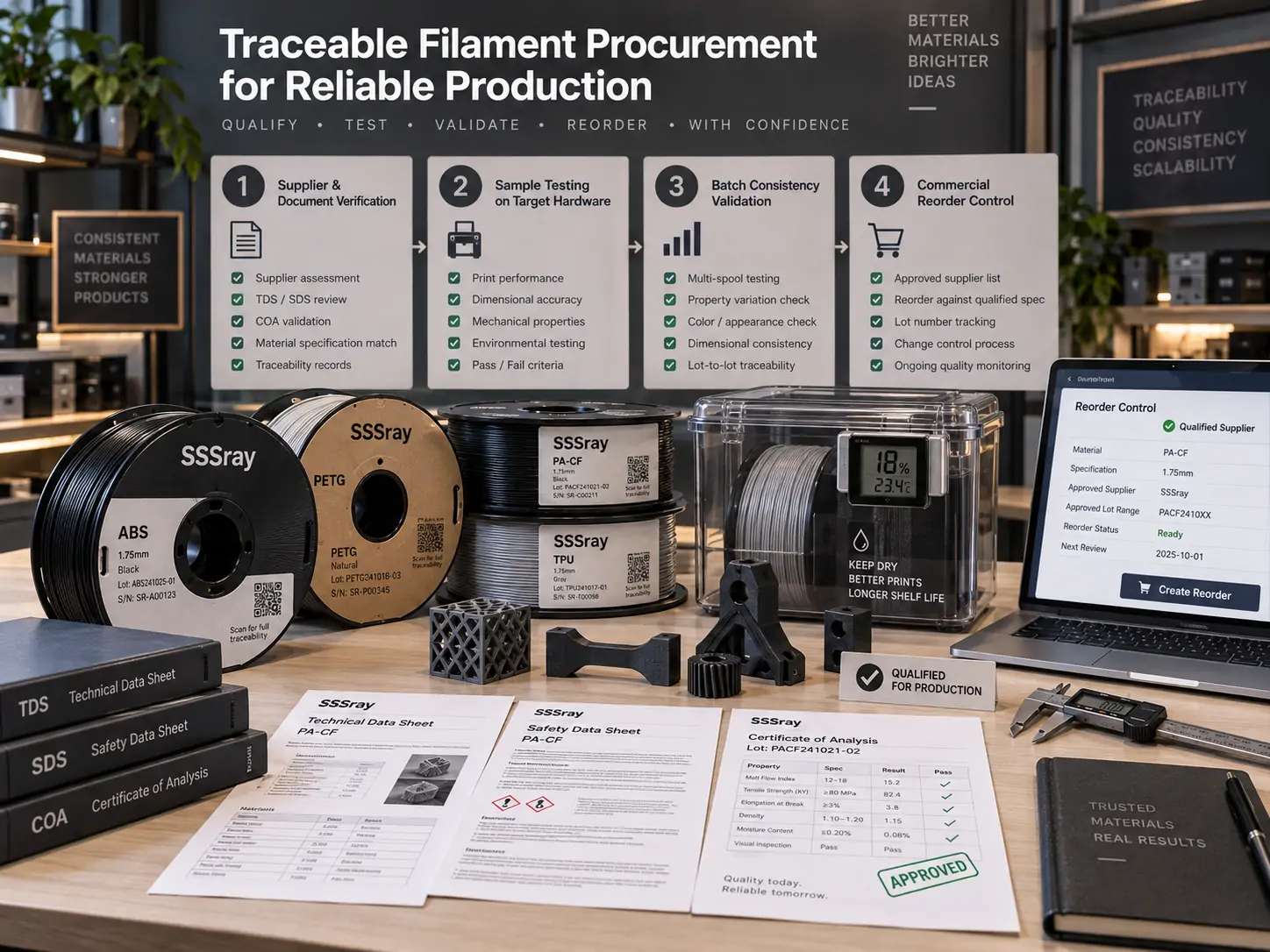
| Documentation | TDS, SDS, lot COA, flame report, Cl/Br and PTFE statement | TDS, SDS/MSDS, RoHS; third-party verification on request |
| Packaging | Barrier pouch with desiccant; sea-freight carton | Vacuum-sealed foil pouch with desiccant |
| Private label | Flame claim wording with thickness | Private-label labels, boxes, cartons |
| Reorder control | Change notice for resin, FR, anti-drip, pigment | Reorders linked to the approved lot report |
14. Flame Retardant 3D Printing Filament FAQ for Rail and Aviation Buyers
What does a UL94 V-0 rating mean for 3D printed parts?
It means test bars of one stated thickness stopped burning within 10 seconds after each of two 10-second, 50 W flame applications, with no flaming drips igniting cotton. Three caveats apply to printed parts: the rating must be read with its tested thickness, applicable color/material scope and specimen conditions; UL states that molded Yellow Card ratings cannot be applied to printed parts; and infill and orientation can change results. Treat V-0 as a screen and ask for printed-bar reports or a UL Blue Card.
Which filament meets railway fire safety standards?
No filament “meets EN 45545-2” in the abstract; a grade is tested against a defined requirement set, hazard level, thickness and process. For eligible small non-listed interior parts, R22 uses OI ≥28% for HL1–HL2 or ≥32% for HL3 plus smoke and toxicity limits. Stratasys PA6/66-GF30-FR is published for R22/R23 at HL2, while the current ULTEM 9085 railway sheet publishes multiple R-sets with thickness-specific hazard levels. Ask for the classification/test report that matches your part instead of accepting a generic HL claim.
Can I use standard FR filament for aviation applications?
For tooling, fixtures, mock-ups and non-installed ground equipment, often yes after normal engineering review. Installed cabin parts are different: map the component to the applicable 14 CFR 25.853 Appendix F route, qualify the real thickness and printed process, and use the approved aircraft design/installation path. Some categories use 60 s or 12 s vertical tests; others use horizontal, 45° or 60° procedures. Specified large interior components on airplanes with 20 or more passenger seats also face heat-release and smoke criteria.
How do I test flame retardancy of 3D printed samples before a bulk order?
Print specimens at your thinnest wall using the production profile, after drying the filament and recording its moisture. Screen first with UL94 vertical and oxygen index, listed at about €1,250 and €562 per variant by one accredited lab. Then run the full set, such as R22 or Appendix F Part I. Finally, link the report to the lot number and profile file, and write a change-control clause into the bulk contract. Expect about four weeks per screening round.
How much more does flame-retardant filament cost than standard engineering filament?
In the 14 October 2026 public retail snapshot, Bambu Lab PC FR at $54.99/kg was about 38% above Bambu PC at $39.99/kg, and Prusament PETG V0 at $54.99/kg was about 83% above standard Prusament PETG at $29.99/kg. PEI 9085 examples were about $220–287/kg. These are retail observations, not market averages or SSSray B2B quotes. SSSray provides competitive project pricing after grade, volume, testing and packaging are confirmed. At low volume, laboratory qualification can still dominate the economics.
Which aerospace OEMs accept 3D printed FR components?
Airbus is the clearest public example: Stratasys reports more than 25,000 printed parts a year in ULTEM 9085 CG across the A320, A350 and A400M. Etihad Engineering holds EASA design and production approval for printed cabin parts, and SAE’s AMS7100 and AMS7101 specifications for FFF were written at airlines’ request. In every case, acceptance rests on a controlled material, process and approval route, never on a spool label. Ask your airframer or design organization which material specifications it already holds.
Do FR filaments lose properties after long storage?
Storage life depends on the exact grade, barrier packaging and current TDS, so use the supplier's current shelf-life statement rather than a generic FR-filament number. Once opened, FR nylon absorbs moisture quickly: our PA-CF V0 reached 0.32% after 24 hours and 1.45% after 30 days at 23 °C and 50% RH. Printing wet filament creates voids and hydrolysis. Therefore, reseal with desiccant, dry to the TDS before printing, and include aged specimens in qualification. Unopened spools should stay cool and dry in their original pouch.
What should a bulk RFQ for UL94 V-0 filament for transportation include?
Name the rule set, hazard level, thinnest wall and required tests. Then ask for flame data on printed specimens with lab, thickness and color; Cl/Br content in ppm and a PTFE declaration; a lot COA with moisture; the packaging specification; and written change control. Also state the qualification lot size, because spreading test costs over a larger approved lot lowers the real cost per kilogram. Finally, request sample spools from the production lot you intend to order.
15. Conclusion: Buy Flame Retardant 3D Printing Filament Against the Part, Not the Label
UL94 V-0 earns a flame retardant 3D printing filament a place on the shortlist, not on a train or aircraft. Those decisions rest on EN 45545-2, 14 CFR 25.853 and 49 CFR 238, judged on parts printed the way you will produce them.
The decision logic is short. First, map each part to its exact rule set, hazard level or Appendix F paragraph and thinnest qualified wall. Next, shortlist material families whose published evidence fits that route instead of selecting from a generic “rail grade” or “aerospace grade” label. Then budget testing per variant and use the Transit Fire-Fit Framework to keep reorders inside the approved baseline. Finally, file every report with its batch ID, printer/profile, orientation and specimen thickness so the next order can be checked against the same evidence.
Your next step is a controlled trial: one grade, one locked profile, printed specimens at the thinnest wall, and a screening report first.
Prefer to start with paperwork? Request the TDS, COA and MSDS, compare materials across our 3D printer filament supplier range, ask about OEM packaging, or request a bulk quote with your rule set, thinnest wall and annual volume.
Request a quote or free samples
Tell us the material, color, spool size and monthly volume. An engineer replies within 24 hours on business days.
16. References
- eCFR: 14 CFR 25.853 and Appendix F to Part 25.
- 49 CFR Part 238, Appendix B; EUR-Lex rolling-stock TSI reference list citing EN 45545-2:2020; ERA opinion recommending EN 45545-2:2020+A1:2023 in updated TSI references.
- UL 94 Ed. 7-2023 (revised 2026) and UL Solutions: Blue Card.
- Measurlabs EN 45545-2 guide; prices for UL 94, ISO 4589-2, ISO 5659-2, NF X 70-100 and ISO 5660-1; RISE vertical test.
- ABB R22/R23 requirement table, an R1 classification report, the Wacker hazard-level matrix and Stratasys ULTEM 9085 railway fire test matrix.
- Stratasys: PA6/66-GF30-FR rail material (June 2026), Stratasys railway materials and the Airbus production release (December 2025).
- ULTEM 9085 datasheet and Antero 840CN03 datasheet.
- Glaskova-Kuzmina et al., Polymers 16(3):336, 2024 (FFF-printed PEI and PEKK).
- UL study on printed-part variability (2020).
- Sai et al., UL94 V0-rated flame-retardant polycarbonate and PFAS-free routes (2026); pinfa on PTFE anti-drip alternatives; ECHA universal PFAS restriction status (2026).
- Deutsche Bahn: 200,000+ 3D-printed parts; Etihad Engineering EASA-approved AM facility; SAE AMS7100/7101 summary.
- Retail price snapshot (14 October 2026): Prusament PETG and Prusament PETG V0; Bambu Lab PC and Bambu Lab PC FR; 3DXTECH ThermaX PEI 9085; Fiberlogy PEI 9085; print settings from Fiberlogy.
- SSSray first-hand evidence: Q1 2026 PA-CF moisture study, public PA6/66 lot record SSR-PA6-66-260918-L07-B01, and SSSray batch QC controls.

He Jiang
Senior Researcher
SSSray · 3D Printing Filament Manufacturing · Jinhua, Zhejiang
He Jiang is a Senior Researcher at SSSray, a 3D printing filament manufacturer in Jinhua, Zhejiang, China. He focuses on filament qualification, batch QC, printer-process testing and B2B sourcing requirements. For this guide, he reviewed flame-retardant material evidence, printed-specimen qualification routes and SSSray lot-control records for rail and aviation buyers.
