Online time
Monday to Friday: 9AM - 8PM
Weekend: 10AM - 5PM

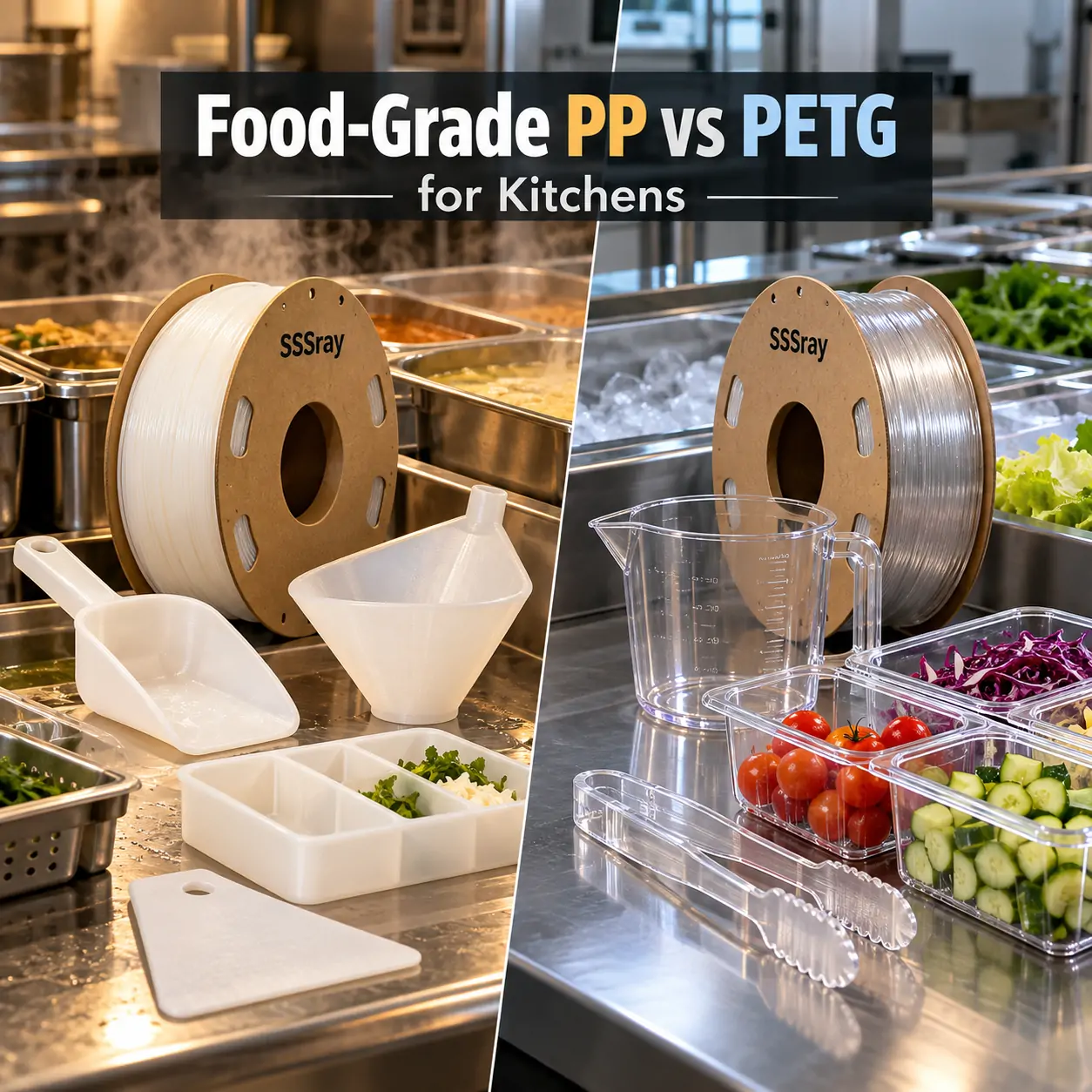
TL;DR: Use Documented Natural PP for Hot Wash and Hot Holding, Keep Documented PETG for Cold Duty
Documented PETG can fit cold-contact duty when the exact grade, color and intended-use conditions are covered. However, the public US listing for PETG-type copolyester stops at an 82 °C hot fill and 49 °C storage, and PETG softens below a commercial dishwasher’s final rinse. Food-grade PP filament covers that gap, provided the supplier names the exact line of 21 CFR 177.1520 and the part is designed for a softer plastic.
Best optionNatural, unfilled PP filament with a declaration that cites a 21 CFR 177.1520 item number, printed on dedicated hardware.
When not to use itStiff, tight-tolerance or clear parts, and anything that carries load while hot. Printable PP deflects at 54–75 °C under 0.45 MPa.
Key specificationDSC melting peak, HDT and Vicat on printed bars, n-hexane extractables and the stated conditions of use.
Verify the supplierAsk whether the declaration covers the finished filament or only the base resin, and whether cooking use is included.
Procurement warning“PP” on a spool often means a copolymer that melts near 130 °C, not the 160 °C homopolymer in a molded food pan.
Abstract
Print farms and OEM brands now sell portion scoops, funnels, dough cutters and container lids to restaurants, bakeries and central kitchens. Most are printed in PETG, because it prints easily and is widely sold as “food safe.”
A commercial kitchen, however, is not a home kitchen. Under the FDA Food Code, hot food is held at 57 °C or above. A hot-water dish machine has to bring the utensil surface to 71 °C, with a final rinse of 82–90 °C, and its detergent can run at pH 11 to 12.5. Those conditions test both the regulation behind a food-contact claim and the polymer itself.
Four buyer assumptions cause most of the trouble: that a “food safe” label covers hot use, that PP is automatically more heat resistant than PETG, that “BPA-free” means compliant, and that some filament is “FDA approved.”
The data cuts both ways. PETG’s base listing limits hot fill and storage temperature, and its glass transition (71–80 °C) sits below the final rinse. Yet printable PP is not the PP of a molded food pan: datasheets put its heat deflection temperature at 54–75 °C and its melting point near 130 °C. PP’s real advantages are that 177.1520 item 1.1 does not state PETG’s explicit hot-fill and storage limits, item 3.2a specifically covers packing or holding food during cooking, and the polymer offers useful resistance to alkaline detergent.
The B2B logic follows from that. Compliance attaches to a grade, a color and a use. Performance attaches to a printed part in the buyer’s own wash cycle. A sound purchase needs both.
This guide works through that decision with six tools: a line-by-line reading of 21 CFR 177.1520 and 177.1315; thermal data from seven published sources; the Food Code 2026 warewashing rules and the EU repeat-use rules for articles placed on the market from 16 September 2026; a cost-per-part model; the Wash-Cycle Fit Framework, a seven-checkpoint scorecard; and the SSSray PP qualification reference data with a kitchen-cycle qualification protocol.
Key Takeaways
- PETG’s base US listing states explicit hot-fill and storage limits; PP item 1.1 does not state those same limits. 21 CFR 177.1315 item 1 covers hot fill up to 82.2 °C and storage up to 48.9 °C. 21 CFR 177.1520 item 1.1 instead sets resin specifications, while copolymer item 3.2a specifically covers articles used for packing or holding food during cooking.
- “PP filament” is often a copolymer. UltiMaker and BASF publish melting points of about 131 °C, outside the 160–180 °C window of item 1.1a. Ask which item the declaration cites.
- Under load, printable PP is not more heat resistant than PETG. Published HDT at 0.45 MPa is 54–75 °C for PP filament and 68–76 °C for PETG. PP’s advantage here is chemical resistance and the applicable food-contact regulatory route; hot-load dimensional stability still has to be verified on the printed geometry.
- Commercial dish machines run hotter than PETG’s glass transition. The final rinse is 82–90 °C against a 71–80 °C glass transition, and a 2025 study measured a 24.4% loss of layer adhesion in printed PETG at only 70 °C.
- “BPA-free” says nothing about compliance. Neither PP nor PETG is made from bisphenol A in the first place.
- Layer lines are a cleanability issue for every polymer. The Food Code requires multiuse food-contact surfaces to be smooth and free of crevices.
- Density changes the cost comparison. PP at 0.90 g/cm³ gives 41% more part volume per kilogram than PETG at 1.27 g/cm³, so PP at $50/kg costs the same per part as PETG at $35.43/kg.
- Color is part of the compliance scope. FormFutura, for example, marks only the natural variant of its PP as food contact compliant.
1. Why PETG Isn’t Enough for Commercial Kitchen 3D Printed Tools
SSSray recommendation: Documented PETG can fit cold and ambient food-contact duty when the exact grade, color and intended-use conditions are covered. It runs short in three commercial conditions: hot holding, hot-water machine washing and alkaline detergent. Its non-oriented 21 CFR 177.1315 item 1 conditions and its glass transition both need to be checked against those hotter service conditions.
What a commercial kitchen actually does to a tool
The FDA Food Code, the model that US states and local health departments adopt, describes the service environment better than any filament datasheet:
- Hot holding: food is held at 57 °C (135 °F) or above (§ 3-501.16).
- Machine wash solution: at least 66–74 °C, depending on machine type (§ 4-501.110).
- Hot-water final rinse: at least 82 °C for most machines (74 °C for stationary-rack, single-temperature units) and at most 90 °C at the manifold (§ 4-501.112).
- Sanitizing result: the utensil surface must reach 71 °C (160 °F) (§ 4-703.11).
- Detergent: one commercial warewash detergent data sheet lists a use-solution pH of 11.0–12.5 at a 150–160 °F wash.
FDA released Food Code 2026 on September 17, 2026, and its summary of changes does not list these sections. States adopt their own editions, so the local code governs.
One nuance matters. Low-temperature machines sanitize chemically, with a wash of only 49 °C or more. The heat is gentler there; the detergent is not.
Kitchen process temperatures vs. published material limits (°C)
The final rinse sits above every PETG bar. It also sits above PP’s heat deflection temperature, so the real difference lies elsewhere. Section 3 explains it.
Where PETG runs short
- The listing. The public PETG listing, 21 CFR 177.1315 item 1, allows hot fill up to 82.2 °C and storage up to 48.9 °C, with no thermal treatment in the container. Holding food at 57 °C or above is outside those conditions. A resin maker that holds a Food Contact Notification with wider conditions should cite its number on the declaration.
- The polymer. PETG is amorphous. Past its glass transition it loses stiffness quickly, and stress frozen in during printing is released, so parts warp.
- The chemistry. PETG is a polyester. Its ester links can be attacked by hot, alkaline water, which is exactly what a dish machine supplies.
A 2025 study gives a sense of scale. Kailo and co-authors washed printed PETG cups in a domestic dishwasher at 70 °C over ten days. Tensile strength barely moved (44 to 42 MPa), but layer adhesion fell from 18.19 to 13.76 MPa, a 24.4% drop. The study used three specimens per test. For comparison, the Food Code hot-water sanitizing rinse enters the manifold at 82 °C for most machines and may not exceed 90 °C, while the utensil surface target is 71 °C.
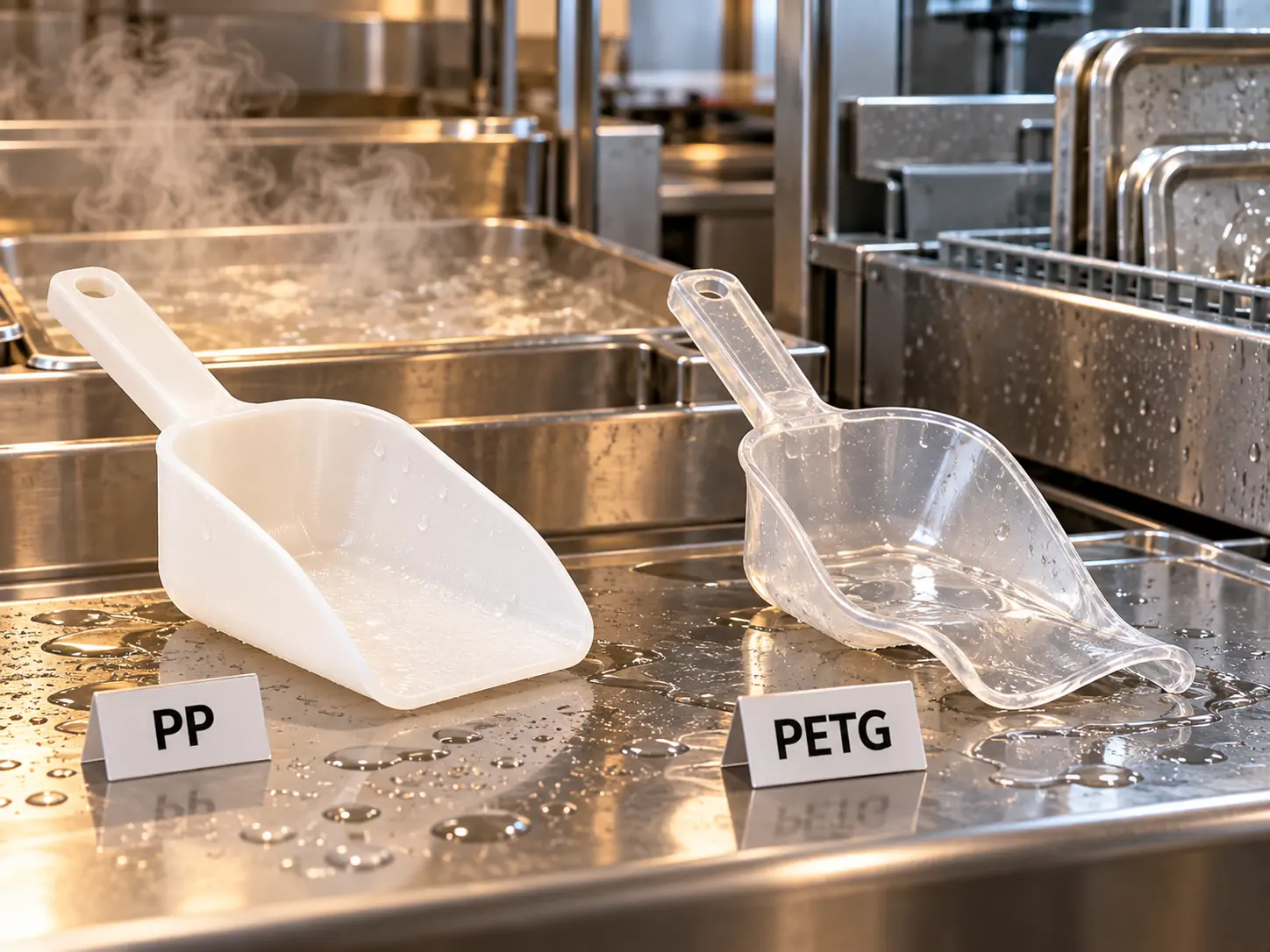
Procurement implicationWrite the customer’s machine type, rinse temperature and hot-holding use into the RFQ before choosing a polymer.
Mistake to avoidApproving PETG tools on a home dishwasher test, then selling them to restaurants.
How to verifyAsk for the declaration’s conditions of use and compare them with the hottest step in the customer’s process.
2. FDA 21 CFR 177.1520 Compliance: Which Line Covers Your Food Contact PP Filament?
Direct answer: 21 CFR 177.1520 lists olefin polymers by item number, and each item has its own limits. Homopolymer PP falls under item 1.1, many printable grades under item 3, and item 3.2a specifically covers articles used for packing or holding food during cooking. A declaration that cites the section without the item leaves a key part of the use scope unspecified.
Table 1 puts the PP items next to the PETG listing, using the public text of 21 CFR 177.1520 and 177.1315.
On mobile, swipe horizontally to review every column.
| Listing | Polymer covered | Key specification | Conditions of use in the listing | What it means in a kitchen |
|---|---|---|---|---|
| 177.1520 item 1.1a | Polypropylene (homopolymer) | Density 0.880–0.913; melting point 160–180 °C; n-hexane extractables ≤ 6.4% at reflux; xylene solubles ≤ 9.8% at 25 °C | No hot-fill or storage temperature ceiling in the item | The food-pan polymer; printable grades often fall outside its melting window |
| 177.1520 item 3.1a | Olefin copolymers | Density 0.85–1.00; n-hexane extractables ≤ 5.5% at 50 °C; xylene solubles ≤ 30% at 25 °C | Food-contact articles, excluding those for packing or holding food during cooking | Fits scoops, lids and funnels; does not fit cook-in use |
| 177.1520 item 3.2a | Olefin copolymers | Density 0.85–1.00; n-hexane extractables ≤ 2.6% at 50 °C | Articles used for packing or holding food during cooking | The copolymer item to verify when the article packs or holds food during cooking |
| 177.1315 item 1 | PETG-type copolyester, non-oriented (1–34 mol% CHDM) | Inherent viscosity ≥ 0.669; extraction limits such as 0.23 µg/cm² in water | Hot fill ≤ 82.2 °C; storage ≤ 48.9 °C; no thermal treatment in the container; foods up to 25% alcohol, excluding carbonated beverages and beer | Fits cold and ambient contact when the exact grade, color and intended-use conditions are covered; does not fit hot holding under item 1 |
Why the item number matters for FDA food contact PP filament
Printable PP grades tend to melt lower than the homopolymer used for molded food pans. UltiMaker’s PP data sheet gives 130.6 °C and BASF’s Ultrafuse PP data sheet gives 131 °C, which is typical of propylene copolymers.
Such a grade cannot meet item 1.1a, which requires 160–180 °C, so it has to rely on a copolymer item. And items 3.1a and 3.2a differ on exactly the point a kitchen cares about: cooking. The resin producer assigns the item, so have your supplier write the item number on the declaration.
Do I need FDA approval or just FDA-compliant material?
Compliant material. FDA does not approve filament or printed tools. Its guidance places the responsibility on the manufacturer, and notes that customers can request a letter of guaranty.
Compliance also covers more than the base resin. Pigments need their own clearance, for example under 21 CFR 178.3297, so a natural grade is the simplest case. FormFutura, for instance, marks the natural variant of its Centaur PP as the food contact compliant one.
BPA-free 3D printing material: true, but not the question
PP is built from propylene, and PETG from terephthalic acid, ethylene glycol and cyclohexanedimethanol. Neither uses bisphenol A, so “BPA-free” on either spool is chemistry, not evidence of food-contact compliance. Under Regulation (EU) 2024/3190 as corrected in 2026, the general first-placement transition for repeat-use BPA-containing final food-contact articles ended on 20 July 2026, while qualifying repeat-use professional food production equipment has a derogation until 20 January 2028.
Procurement implicationBuy food-contact PP by exact grade and color, with the 177.1520 item number written on the declaration.
Mistake to avoidAccepting a resin maker’s certificate as proof for a pigmented, re-extruded filament.
How to verifyCompare the declared item with the grade’s DSC melting peak and its n-hexane extractables result.
3. Heat Resistance and Food Contact Temperature: PETG vs PP Food Grade in Numbers
Direct answer: it depends on which number you read. Under load, both materials lose stiffness between about 55 and 75 °C. PETG then loses stiffness rapidly around its 71–80 °C glass-transition range, while semi-crystalline PP can retain unloaded shape above that range even though typical printable PP still has an HDT of only 54–75 °C; its melting point is about 130 °C.
So what temperature can food-grade filament withstand? Table 2 collects the published values.
On mobile, swipe horizontally to review every column.
| Grade | Polymer type | HDT at 0.45 MPa | Vicat softening | Glass transition or melting point |
|---|---|---|---|---|
| Polymaker PETG | Amorphous copolyester | 69 °C | 75 °C | Glass transition 71 °C |
| UltiMaker PETG | Amorphous copolyester | 76.2 °C | 82.9 °C | Glass transition 77.4 °C |
| SSSray Engineering PP | Semi-crystalline PP | 75 °C | 96 °C | Not listed on the product data sheet |
| UltiMaker PP | Semi-crystalline PP | 64.1 °C | 99.0 °C | Melting point 130.6 °C |
| BASF Ultrafuse PP | Semi-crystalline PP | 54 °C | Not listed | Melting point 131 °C |
| Molded PP homopolymer labware (reference) | Semi-crystalline PP homopolymer | 107 °C | Not listed | Autoclave cycle at 121 °C; brief use to 130 °C |
Prusament lists 68 °C at 0.45 MPa for its PETG. The last row is molded labware from Thermo Fisher, shown as a reference for homopolymer PP.
Four temperatures, four different questions
- Glass transition: where an amorphous plastic turns rubbery. It is PETG’s real ceiling.
- Heat deflection temperature (HDT): where a loaded bar bends. It rewards stiff materials, so soft PP scores low.
- Vicat softening: where a needle sinks 1 mm into the surface.
- Melting point: where the crystals of a semi-crystalline plastic let go. PETG has none.
A kitchen analogy helps. PETG behaves like hard candy: rigid, then suddenly soft. PP behaves like a firm rubber spatula: never very rigid, but it keeps its shape in hot water.
The reason is structure. PP’s own glass transition is below freezing (BASF lists −5 °C for a PP grade), so its crystals do the holding until the melting point. PETG has no crystals to fall back on.
Which filament survives industrial dishwasher cycles?
None by default, which is why “dishwasher safe filament material” is a claim to test, not to trust. PP has the better odds in a hot-water machine, for three reasons: the rinse stays roughly 40–50 °C below the melting point of printable PP, PP does not hydrolyze, and Thermo Fisher rates PP’s resistance to bases as excellent. Formlabs’ food-safety guide likewise lists several PP filaments as dishwasher safe and PETG brands as not.
Even so, PP is soft when hot, and printed PP can warp as residual stress relaxes. Use thicker walls and ribs, and keep parts unloaded in the rack.
PETG, for its part, has thermal margin only in low-temperature, chemical-sanitizing machines.
Repeated steam sterilization filament: is printed PP autoclavable?
Molded homopolymer PP is: Thermo Fisher recommends 121 °C at 15 psi for 20 minutes for its empty PP containers. Printed PP is a different case. A melting point near 131 °C leaves about 10 °C of margin, so treat it as not validated until your own parts survive repeated cycles. PETG is not a candidate; in our PETG surgical-guide review, autoclaved PETG guides in a 2025 study were too deformed to scan.
Procurement implicationAsk for HDT and Vicat measured on printed bars, plus the DSC melting peak, not one “heat resistant to” figure.
Mistake to avoidQuoting molded-PP food-pan temperatures for a printed copolymer part.
How to verifyRun 50 cycles in the customer’s machine and measure flatness, critical dimensions and weight before and after.
4. Layer Adhesion, Cleanability and Post-Processing of Food-Grade Parts
Direct answer: a compliant polymer does not make a printed part cleanable. Layer lines are grooves roughly 0.1–0.3 mm apart, and bacteria are about a thousandth of a millimeter long. Inspectors judge the surface, not the spool.
The Food Code definition is specific. A “smooth” food-contact surface is free of pits and inclusions, with a cleanability equal to or better than number 3 (100 grit) stainless steel. Multiuse surfaces must also be free of breaks, open seams, cracks and crevices (§ 4-202.11).
Why layer adhesion is a food safety concern
Weak bonds between layers open into fine gaps that hold moisture and soil, and in containers they become leak paths. Hall and co-authors found that biofilm formation on printed materials depends on surface structure and hydrophobicity, so texture matters as much as chemistry.
The Kailo study adds a useful twist. After ten days, dishwasher-cleaned PETG cups carried fewer microbes than hand-washed ones (1.06 versus 1.52 log CFU per 28 cm²). Yet the dishwasher is also what cut PETG’s layer adhesion by 24.4%. The cleaning method that works best is the one PETG tolerates least.
PP starts from a better position. It fuses well when printed hot with little fan, and FormFutura reports watertight single-wall prints with its PP.
Post-processing food grade parts: what helps and what creates new problems
- Print for density. Lower layer heights, extra walls and 100% infill leave fewer voids.
- Use dedicated hardware. Formlabs advises against brass nozzles, which can contain lead, and recommends a dedicated stainless steel nozzle.
- Design out crevices. Add radii to internal corners, avoid blind holes and split complex shapes so every surface can be reached.
- Treat coatings as a new material. A food-grade coating can seal layer lines, but Formlabs notes that coatings may degrade and do not guarantee safety for prolonged use. The coating also becomes the food-contact layer, and it wets PP poorly because PP’s surface energy is only about 29–31 mN/m.
- Set a service life. Define how many cycles a part may run, and which visible changes mean replacement.
Procurement implicationSpecify layer height, wall count and nozzle material in the print brief, not only the filament.
Mistake to avoidAssuming a food-contact declaration for the spool settles hygiene for the part.
How to verifyFill-and-hold leak test, then a swab or ATP check after the customer’s normal cleaning routine.
5. Printing Food-Grade PP Filament: Warping, Bed Adhesion and Layer Bonding
What we see in production: PP is harder to print than PETG for two physical reasons: low surface energy and crystallization shrinkage. Both are manageable with the right bed surface, a warm chamber and suitable geometry.
- It sticks to almost nothing but itself. PP’s surface energy is about 29–31 mN/m, against 42–46 mN/m for PET-family plastics. A PP build surface is the usual answer.
- It shrinks as it crystallizes. Autodesk’s molding reference puts PP shrinkage at 1.8–2.5%, while forming guides put PETG at about 0.2–0.5%. That difference is what lifts corners.
- On the plus side, it barely absorbs water. Our PP data sheet lists 0.01–0.03% water absorption in 24 hours, so drying is rarely the problem.
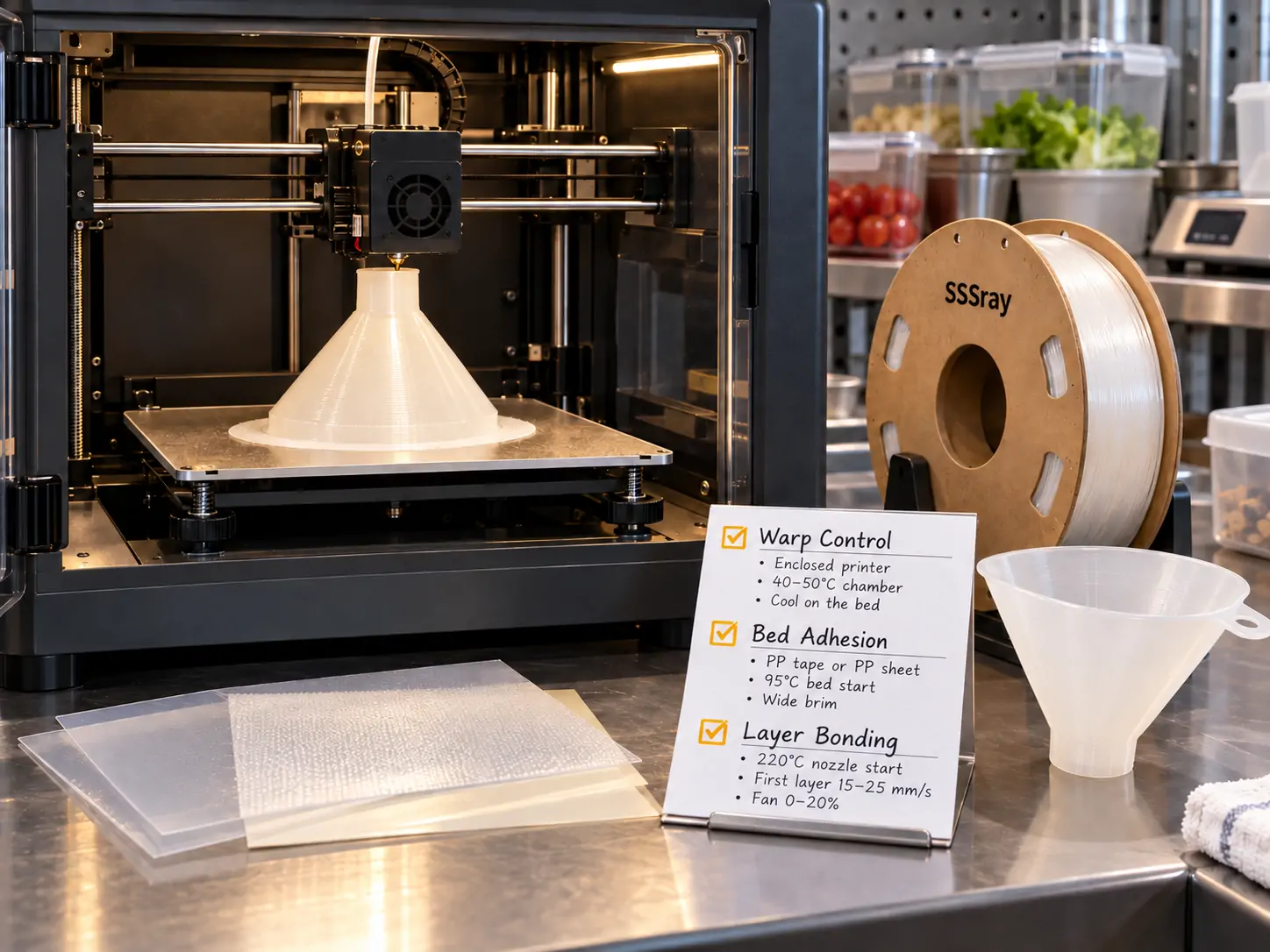
Operating steps we recommend for a first PP run
- Fit a dedicated stainless steel nozzle and purge the hot end fully.
- Prepare a PP build surface: PP tape, a PP sheet or a PP-specific adhesive.
- Start mid-window. For SSSray PP, the recommended starting reference is a 220 °C nozzle and a 95 °C bed.
- Hold the chamber at 40–50 °C and keep the part fan at 0–20%.
- Print the first layer at 15–25 mm/s, with a brim on anything large.
- Let the part cool on the bed inside the enclosure, then check flatness and wall fusion before locking the profile.
Datasheets disagree more for PP than for most materials: BASF recommends a 60–80 °C bed, while our own window is 80–110 °C. A profile should travel with the grade it was validated on.
Procurement implicationAsk for a validated print profile and bed-surface recommendation with the sample spool.
Mistake to avoidJudging a PP grade on a bare PEI sheet with a PETG profile.
How to verifyPrint a flat 150 mm coupon and a closed container, then measure corner lift and leak-test the walls.
6. Migration Testing and Paperwork: How to Prove a 3D Printed Part Is Food Safe
Direct answer: no single certificate proves it. Proof has three layers: composition (a declaration for the exact grade and color), migration (a test on the printed part) and hygiene (a cleanable design plus a cleaning check).

United States: declaration, health code and optional certification
- Composition: a supplier declaration that cites the CFR section and item, the colorant status and the conditions of use.
- Health code: the local version of the Food Code decides whether an inspector accepts the surface as smooth and cleanable.
- Certification: NSF/ANSI 51-2025 sets minimum public health and sanitation requirements for food equipment materials, including cleanability and heat resistance tests.
Certification gained weight this year. According to FDA’s summary of changes, Food Code 2026 extends § 4-205.10 to multiuse utensils and tableware that are certified or classified for sanitation under ANSI standards.
European Union: migration limits and the 2026 repeat-use rules
Under Regulation (EU) No 10/2011, a plastic article needs a declaration of compliance, and its overall migration must stay within 10 mg/dm². The test condition is chosen to match the worst foreseeable use:
- OM2: 10 days at 40 °C, for long storage at room temperature.
- OM3: 2 hours at 70 °C, for hot fill or brief heating.
- OM5: 2 hours at 100 °C or 1 hour at 121 °C, for use up to 121 °C.
Kitchen tools are repeat-use articles, so the migration test is run three times in succession under the applicable test conditions. Regulation (EU) 2025/351 also requires repeat-use articles to be composed and designed so migration does not increase over subsequent intended-use cycles. For articles first placed on the market from 16 September 2026, the amended rules apply; Article 14a also requires instructions that slow deterioration, describe observable deterioration and warn about damage or foreseeable misuse that could increase migration.
Budget time as well as money. One EU laboratory lists repeat-use overall migration in olive-oil simulant at €942 per sample, with a typical turnaround of eight weeks and 25 to 40 sample articles.
Can I sell 3D printed food containers legally?
Yes, provided the finished article meets the applicable material, use-condition, cleanability, documentation and local-market requirements. The FAQ lists the four controls we use when qualifying a program.
SSSray market-control rule: for each food-contact program, we lock the grade, color, food type, contact time, temperature and repeat-use condition before production, then keep the applicable declaration and test report with the lot record.
Procurement implicationPlan the migration test early; eight weeks of laboratory time sits on the critical path of a launch.
Mistake to avoidTesting a molded plaque or the raw filament instead of the printed article.
How to verifyCheck that the report names the grade, color, test condition, simulant and the three successive results.
7. Cost Comparison: Food-Grade vs Standard Filament per Finished Part
For B2B costing: compare cost per part, not cost per kilogram. PP is 29% lighter than PETG, so a kilogram prints 41% more volume. Then add what “food-grade” really costs: documentation and color-specific testing.
Density moves the break-even point
The formula is short: material cost per part = part volume × density × price per kilogram. A solid 100 cm³ part weighs 127 g in PETG and 90 g in PP.
Material cost of a 100 cm³ solid part vs. filament price
PETG (1.27 g/cm³)PP (0.90 g/cm³)
At the same price per kilogram, the PP part is 29% cheaper. Put another way, PP at $50/kg costs the same per part as PETG at $35.43/kg.
Retail prices still favor PETG. In October 2026, Polymaker lists PETG from $18.99 for a 1 kg spool, and a large EU retailer lists Fiberlogy natural PP at about $49.29/kg excluding VAT. That is 2.6 times the price per kilogram, but 1.84 times per part ($4.44 versus $2.41).
Price note: the prices in this section are market reference prices recorded in October 2026, not SSSray quotations. SSSray will provide you with highly competitive factory-direct pricing for your grade, color and annual volume.
What “food-grade” adds to the price
- Documented resin and color discipline. A grade with a food-contact statement and change control, in natural or cleared pigments, with line cleaning between runs.
- Testing. If each simulant is priced like the olive-oil test above, three simulants cost roughly €2,900 per color. Spread over 500 kg, that is about €5.85/kg. Over 5,000 kg, it falls to about €0.58/kg.
Volume and color count therefore decide affordability. One natural grade at steady volume carries the cost easily. Six colors at 100 kg each do not.
Cost per service cycle is the number that matters
For a repeat-use tool, the useful figure is cost per part ÷ wash cycles survived. A part that warps after a few hot cycles is expensive however cheap the spool was.
Procurement implicationAsk for quotes per kilogram and convert them to cost per part with each material’s density.
Mistake to avoidRejecting PP on price per kilogram without correcting for 29% lower density.
How to verifyWeigh the same printed part in both materials and divide each cost by the cycles it survives.
8. PETG vs PP Food Grade Options: A Procurement Comparison
Table 3 turns the sections above into three buying options.
On mobile, swipe horizontally to review every column.
| Option | Best use case | Key spec | Advantage | Risk | How to verify | When to reject | SSSray sourcing note |
|---|---|---|---|---|---|---|---|
| Documented natural PETG | Cold and ambient food contact; low-temperature machines | Declaration citing 177.1315 or an FCN, with conditions of use | Stiffness; clarity for inspection | Item 1 limits: hot fill ≤ 82.2 °C, storage ≤ 48.9 °C | Declaration plus a cold-cycle wash test | Hot holding at 57 °C or above; 82–90 °C rinse | Scoped per project through custom PETG |
| Standard PP filament | Chemical-resistant parts, living hinges, tool prototypes | Density 0.90 g/cm³; HDT 54–75 °C; melting often near 130 °C | Alkali resistance; very low water uptake | No food-contact declaration; warping | TDS plus a flat-coupon print | Any food-contact sale without documents | Stock PP from 50 rolls; not sold as food-contact certified |
| Documented natural PP copolymer | Repeat-use tools washed hot; hot-fill contact | 177.1520 item 3.1a or 3.2a; n-hexane ≤ 5.5% or ≤ 2.6% at 50 °C | The cited CFR item defines the use scope; 3.2a specifically covers packing or holding food during cooking | Soft when hot; pigments outside the scope | Declaration, 50-cycle wash test, migration test | Declaration without an item number, or for resin only | Grade, color, standard and laboratory agreed before sampling |
Standard PETG without a declaration is left out; it stays a good choice for jigs and fixtures that never touch food.
9. The Wash-Cycle Fit Framework for Food-Grade PP Filament Buyers
A dishwasher-safe mark on a molded container reflects a finished article that was tested. A spool has no such history. The Wash-Cycle Fit Framework rebuilds that evidence for a printed part, through seven checkpoints.
On mobile, swipe horizontally to review every column.
| Checkpoint | Why it matters | What to ask | Pass / fail signal | Hidden risk |
|---|---|---|---|---|
| Application requirement | Machine type and hot holding set the real temperature | Hot-water or chemical sanitizing? Rinse temperature? Hot holding? | Pass: a written duty profile. Fail: “for kitchen use.” | The tool drifts from the cold line to the steam table |
| Material performance | One “heat resistant” figure hides four temperatures | HDT and Vicat on printed bars? DSC melting peak? | Pass: values with method and specimen type. Fail: molded-resin values only. | Printable PP can melt 30 °C lower than homopolymer |
| Printability | Warped or poorly fused parts cannot be cleaned | Validated profile and bed surface? Leak-test result? | Pass: flat coupon and watertight container. Fail: no profile supplied. | A bed adhesive becomes an unplanned contact material |
| Compliance | A claim has to be specific enough to check | Which 177.1520 item? Filament or only resin? Which colors? | Pass: a dated declaration naming grade and color. Fail: one certificate for the whole range. | EU repeat-use rules changed from 16 September 2026 |
| Supplier reliability | A declaration describes one formulation | Traceability to the resin lot? Written change notice? | Pass: batch ID links spool, COA and resin lot. Fail: no change-control commitment. | A silent resin or pigment swap removes the legal basis |
| Landed cost | Price per kilogram misleads when densities differ | Cost per part by density? Test cost per color? | Pass: cost per part and per service cycle. Fail: price per kilogram only. | Low-volume colors carry most of the testing cost |
| Reorder stability | Wash performance depends on the formulation | What triggers re-testing? Are retained samples kept? | Pass: re-test triggers in the PO. Fail: “same as last time.” | A reorder passes paperwork but fails the wash cycle |
Score each checkpoint pass, conditional or fail. Approve only when nothing fails and every “conditional” has a written action and an owner.
10. Food Safe 3D Printing Filament Claims vs Reality
Marketing for food safe 3D printing filament relies on short phrases. Use Table 5 to turn each phrase into a document request.
On mobile, swipe horizontally to review every column.
| Vague marketing claim | What it might hide | Document, sample or test to request | What a reliable supplier provides |
|---|---|---|---|
| “Food safe” or “food grade” | A resin-level statement with no conditions of use | Declaration for the exact grade and color, citing the regulation | A dated declaration with scope, conditions and signatory |
| “FDA approved PP” | A status that does not exist for filament | The 177.1520 item number and a letter of guaranty | Item number, extractables data and change-control terms |
| “Dishwasher safe” | A home machine, a molded sample or an unstated cycle count | Machine type, rinse temperature, detergent and number of cycles | A cycle-test record on printed parts |
| “BPA-free” | Nothing; it is true of all PP and PETG | The full food-contact declaration instead | A declaration that covers additives and colorants |
| “Heat resistant to 100 °C” or “autoclave safe” | A Vicat, melting or molded-resin value presented as a service temperature | HDT on printed bars, DSC melting peak, trial on printed parts | Each temperature named with its method |
| “Complies with EU 10/2011” | Monomer listing only, with no migration test | Declaration of compliance and a repeat-use migration report | Three successive results under a stated test condition |
11. SSSray PP Qualification Reference Data and Kitchen-Cycle Qualification Protocol
We extrude PP in Jinhua, Zhejiang, and we hold our own product to the checks in this guide. Our stock Engineering PP is built for chemical-resistant and functional parts and is not sold as a food-contact grade.
Food-contact PP is a scoped program at SSSray. Grade, color, standard and laboratory are fixed in writing before sampling, so every declaration names exactly what was tested. The qualification reference record below is tied to our current Engineering PP product data and lot-QC release controls; customer production lots add the actual batch ID and COA measurements.
SSSray qualification reference data
Reference Record ID: SSSRAY-PP-REF-2026-10-R01 · Material: SSSray Engineering PP, 1.75 mm, natural / white · Record basis: current SSSray PP technical product data and lot-QC release controls · Lot traceability: the customer-lot COA adds the production Batch ID, measured diameter and roundness record, production date and release status.
On mobile, swipe horizontally to review every column.
| Check | Method / record | Published result or release limit | How it is used |
|---|---|---|---|
| Density | Engineering PP technical data | 0.90 g/cm³ | Mass-to-volume and sourcing reference |
| Filament diameter | Inline dual-axis laser control with lot COA record | 1.75 mm; production tolerance ±0.03 mm | Lot release and feeding consistency |
| Roundness | Perpendicular-axis diameter comparison on the extrusion line | ≤ 0.02 mm | Lot release |
| Tensile strength, XY | Engineering PP technical data | 23 ± 2 MPa | Qualification reference for the printed grade |
| HDT | 0.455 MPa reference condition | 75 °C | Load-bearing heat check |
| Vicat softening | Engineering PP technical data | 96 °C | Softening reference, not a continuous-use rating |
| Water absorption | 24 h technical-data reference | 0.01–0.03% | Storage and conditioning reference |
| Print qualification baseline | SSSray PP starting profile | 220 °C nozzle; 95 °C bed; 40–50 °C chamber; 0–20% fan; 15–25 mm/s first layer | Starting point before locking the customer profile |
For kitchen use, we read the thermal values together: the 75 °C HDT is below the 82–90 °C hot-water rinse range, while the 96 °C Vicat result is a penetration-softening reference rather than a continuous-use temperature. We therefore qualify the printed geometry in the customer’s actual wash cycle instead of turning either number into a blanket service-temperature claim.
The kitchen-cycle qualification protocol
Protocol ID: SSSRAY-PP-KITCHEN-2026-10-R01 · Material: 1.75 mm natural PP for a food-contact program · Sampling plan: n = 9 spools, three each from the start, middle and end of the production lot · Coupons per spool: a 150 mm flat bar, a closed 250 ml container and a Z-direction tensile bar, printed with a dedicated stainless steel nozzle on a PP build surface.
On mobile, swipe horizontally to review every column.
| Control point | Test condition | Acceptance / record requirement | Why it is controlled |
|---|---|---|---|
| Lot identity | DSC melting peak; density | Recorded per lot and matched to the declared 177.1520 item | A melting peak near 130 °C and one above 160 °C belong to different items |
| Filament geometry | Inline laser micrometer on the extrusion line, 500 scans per second | 1.75 ± 0.03 mm; roundness ≤ 0.02 mm; out-of-tolerance segments are cut automatically | Soft filament needs consistent feeding to fuse layers fully |
| First-article print | Locked profile on a PP build surface | Flat coupon and watertight container before any wash exposure | Separates print defects from wash damage |
| Wash exposure | 50 cycles in a hot-water commercial machine; rinse temperature and detergent pH logged | Record mass, corner lift and two critical dimensions at 0, 10, 25 and 50 cycles; limits follow the customer drawing | The final rinse sits above the HDT of printable PP |
| Leak integrity | Fill-and-hold check on the closed container | No visible seepage at each checkpoint | Seepage marks an interlayer gap that cleaning cannot reach |
| Layer bond retention | Z-direction tensile test at 0 and 50 cycles | Report the percentage retained with the cycle log | Published PETG data shows a 24.4% loss at only 70 °C |
| Migration evidence | Third-party test on printed articles; three successive runs for repeat use | Report names grade, color, simulant and test condition | Resin-level data does not cover the printed, colored article |
Lot traceability: every program record carries the production batch ID from the carton and spool label, the sample IDs, the wash-cycle log and the laboratory report number, so a buyer can match each result to the spool it came from.
12. B2B Scenarios: Four Buyers Choosing Between PETG and PP Food Grade
Distributor
Situation: lists “food safe” filament for restaurant-supply customers.
Bad choice: copies “FDA approved, dishwasher safe” onto every PETG and PP color.
Consequence: warped-part returns and claims no document can support.
Better choice: one natural PP SKU with a declaration, and plain wording for the rest.
Verification: match every listing claim to a document on file.
Next step with SSSray: request a PP sample with its TDS and SDS.
OEM Brand
Situation: launches a private-label kitchen filament in the EU and the US.
Bad choice: orders six colors on one resin certificate.
Consequence: five colors have no pigment clearance, and no test covers repeat use.
Better choice: start with natural, add colors only when volume carries the testing.
Verification: a declaration per color and a repeat-use migration report.
Next step with SSSray: plan grade, colors and label text under OEM/ODM.
Print Farm
Situation: prints portion scoops and lids for a restaurant group.
Bad choice: prints in PETG on shared machines with brass nozzles.
Consequence: parts warp in the dish machine, and the farm reprints at its own cost.
Better choice: documented natural PP on a dedicated machine, with a locked profile.
Verification: a 50-cycle test in the customer’s own machine before volume.
Next step with SSSray: set up a production-lot trial.
Engineering Buyer
Situation: designs a dosing part for a food-equipment maker.
Bad choice: selects PP for “heat resistance” and keeps PETG wall thicknesses.
Consequence: the part flexes when hot and fails a fit check.
Better choice: redesign for PP’s modulus, or choose a stiffer documented material.
Verification: HDT on printed bars and a hot fit check at 80 °C.
Next step with SSSray: send the drawing for an engineering review.
13. Food-Grade PP Filament Print and Sourcing Specs at a Glance
Print settings: published starting points
On mobile, swipe horizontally to review every column.
| Parameter | PP | PETG |
|---|---|---|
| Nozzle temperature | 200–240 °C (SSSray, starting reference 220 °C); 220–240 °C (BASF) | 240–260 °C (Polymaker); 250 ± 10 °C (Prusament) |
| Bed temperature | 80–110 °C (SSSray); 60–80 °C (BASF) | 60–70 °C (Polymaker); 80 ± 10 °C (Prusament) |
| Enclosure | Recommended; 40–50 °C chamber (SSSray) | Not required for most parts |
| Drying | 60 °C for 2–4 h if needed (SSSray); 60 °C for 4–16 h (BASF) | 60 °C for 6 h if moisture is absorbed (Polymaker) |
| Nozzle material | Dedicated stainless steel; 0.4 mm or larger | Dedicated stainless steel |
| Speed range | First layer 15–25 mm/s; 20–50 mm/s (BASF); from 40 mm/s once validated (SSSray) | Up to 200 mm/s (Prusament); up to 300 mm/s (Polymaker) |
| Common failure | Corner lift, bed release, under-fused walls | Stringing; warping after a hot wash |
| Fix | PP build surface, brim, warm chamber, fan at 0–20% | Dry the spool, tune retraction; avoid hot-water machines |
Sourcing specs: what to put in the RFQ
On mobile, swipe horizontally to review every column.
| Item | What to specify | SSSray reference |
|---|---|---|
| MOQ | Qualification and production quantity for each color | From 50 rolls neutral; OEM packaging typically 500–1,000 rolls |
| Lead time | Production time plus external laboratory time, in writing | Standard 7–15 working days; customized 15–25; laboratory time extra |
| Sample approval | Sample ID tied to a lot; printed coupons and wash-cycle record | B2B qualification samples tied to sample ID |
| Tolerance | Diameter and roundness with the measurement method | 1.75 ± 0.03 mm; roundness ≤ 0.02 mm |
| Documentation | Declaration by grade and color; lot COA, TDS, SDS | TDS, SDS and RoHS as standard; food-contact evidence scoped per project |
| Packaging | Sealed bag; lot and production date marked | Vacuum sealed with desiccant; lot and date marked |
| Private label | Claim wording and care instructions approved before printing | OEM labels, boxes and barcodes |
| Reorder control | Written notice before any formulation change; re-test triggers | Batch ID on carton and spool; change terms agreed in the PO |
14. Food-Grade PP Filament FAQ for B2B Buyers
Why is PP better than PETG for food contact?
For hot, repeated food-contact programs, appropriately documented PP often has a better fit than PETG, but the exact CFR item and intended use still matter. 21 CFR 177.1315 item 1 gives non-oriented PETG-type copolyester explicit hot-fill and storage limits of 82.2 °C and 48.9 °C. 21 CFR 177.1520 item 1.1 instead sets polypropylene resin specifications, while copolymer item 3.2a specifically covers articles used for packing or holding food during cooking. Printable PP is still relatively soft under load, so the printed part must be qualified for its actual wash and service cycle.
Do I need FDA approval or just FDA-compliant material?
You need compliant material, because FDA does not approve filament or printed tools. Compliance means every substance that may migrate is authorized for the intended use, under a regulation such as 21 CFR 177.1520 or an effective notification. When buying, ask the supplier for a dated declaration that names the exact grade and color, the regulation section and item, and the conditions of use. Ask too whether the evidence covers the finished filament or only the base resin.
Which filament survives industrial dishwasher cycles?
No filament survives by default, but documented PP has the best odds in hot-water machines. The Food Code final rinse is 82–90 °C, above PETG’s glass transition, and one 2025 study measured a 24.4% loss of layer adhesion in PETG at only 70 °C. PP does not hydrolyze and resists alkaline detergent, yet it softens, so parts must not carry load in the rack. Before a volume order, run 50 cycles in the customer’s machine and measure flatness, dimensions and leak integrity.
Can I sell 3D printed food containers legally?
Yes, provided the finished article meets the applicable material, use-condition, cleanability, documentation and local-market requirements. Every component that may migrate, pigments included, must be authorized for the intended use; the real food type, temperature, contact time and repeat-use condition must match the supporting evidence; the finished surface must meet the applicable cleanability rules; and the seller should keep the declaration, test reports and lot records with the product file. EU repeat-use articles also need the instructions and deterioration information required by the current plastics rules.
How do I prove a 3D printed part is food safe?
Build a file with three kinds of evidence. First, a declaration for the exact grade and color that cites the regulation and conditions of use. Second, a migration test on the printed article, run three times in succession for repeat-use parts. Third, hygiene evidence: a design without crevices, a dedicated stainless steel nozzle and a cleaning check after the customer’s normal routine. Add lot traceability so each part links to a spool and a resin lot.
How should I plan bulk food-grade PP filament procurement for manufacturing?
Start with one natural grade and fix the specification before the first production order. The RFQ should state the 177.1520 item or EU basis, diameter tolerance, the validated print profile, documents per lot and written change control for resin and additives. Qualify on a production lot, not a hand-made sample, and keep retained samples. At SSSray, PP starts from 50 rolls in neutral packaging, with standard lead times of 7–15 working days; food-contact evidence is scoped per project before sampling.
How much more does food-grade filament cost than standard filament?
Expect a premium that shrinks with volume. The extra cost comes from documented resin, color discipline and testing rather than from the polymer itself. Using one EU laboratory’s list price as a guide, repeat-use migration testing across three simulants is roughly €2,900 per color, which adds about €5.85/kg over 500 kg but about €0.58/kg over 5,000 kg. Compare per part as well: PP’s lower density means PP at $50/kg matches PETG at $35.43/kg.
15. Conclusion: Buy Food-Grade PP Filament by Line Item, Then Test the Wash Cycle
Documented PETG can be a good cold-duty food-contact material when the exact grade, color and intended-use conditions are covered. The problem is when it is sold into a hot-duty job. Its base listing stops at an 82.2 °C hot fill and 48.9 °C storage, and its glass transition sits below a commercial final rinse.
Food-grade PP filament closes that gap, with conditions. The decision logic is short. First, write down the duty: machine type, rinse temperature and any hot holding. Next, ask for a declaration that names the 21 CFR 177.1520 item, the color and the conditions of use. Then design for a soft plastic and print on dedicated hardware. Finally, run 50 cycles in the real machine before volume, and compare cost per part and per service cycle.
As a next step, pick one tool your customers wash hot. List the claims on its product page and match each one to a document or a test record. Whatever has neither should be reworded or tested before the next shipment.
Prefer to start with paperwork? Request the TDS, COA and MSDS, compare materials across our 3D printer filament supplier range, ask about OEM packaging, or request a bulk quote with your application, destination and annual volume.
Request a quote or free samples
Tell us the material, color, spool size and monthly volume. An engineer replies within 24 hours on business days.
16. References
- 21 CFR 177.1520: Olefin polymers.
- 21 CFR 177.1315: Ethylene-1,4-cyclohexylene dimethylene terephthalate copolymers.
- U.S. FDA: Food Code 2026 and Summary of Changes in the 2026 FDA Food Code.
- U.S. FDA: Determining the regulatory status of components of a food contact material.
- Regulation (EU) No 10/2011, consolidated text and Regulation (EU) 2025/351.
- Regulation (EU) 2024/3190 on BPA and other bisphenols, consolidated after the 2026 correction.
- Kailo, Gáspár, Krisztina, Kiskó and Koris (2025), Progress in Agricultural Engineering Sciences 21(1): Investigating the effect of dishwasher on 3D printed food-contact material.
- Hall, Palmer, Ji, Ehrlich and Król (2021), Frontiers in Microbiology: Bacterial biofilm growth on 3D-printed materials.
- Thermo Fisher Scientific: Polypropylene (PP) labware.
- UltiMaker PP technical data sheet v3.00, BASF Ultrafuse PP technical data sheet and Polymaker PETG product data; UltiMaker PETG and Prusament PETG technical data sheets for the remaining PETG values.
- Formlabs: The essential guide to food safe 3D printing.
- ANSI: NSF/ANSI 51-2025, Food Equipment Materials, and Measurlabs: overall migration testing, simulant D2, repeated use.
- SSSray primary data: Engineering PP filament product data and batch QC benchmarks.

He Jiang
Senior Researcher · SSSray · 3D Printing Filament Manufacturing · Jinhua, Zhejiang
He Jiang is a senior researcher at SSSray, a 3D printing filament manufacturer in Jinhua, Zhejiang, China. For this guide, his work focuses on engineering-filament qualification, lot-level QC documentation, PP and PETG processing behavior, and food-contact sourcing requirements for B2B buyers. The article combines SSSray technical product and lot-QC data with FDA, e-CFR, EUR-Lex, manufacturer technical data and published testing so distributors, OEM brands and production users can qualify the material against a defined use condition.
