Online time
Monday to Friday: 9AM - 8PM
Weekend: 10AM - 5PM

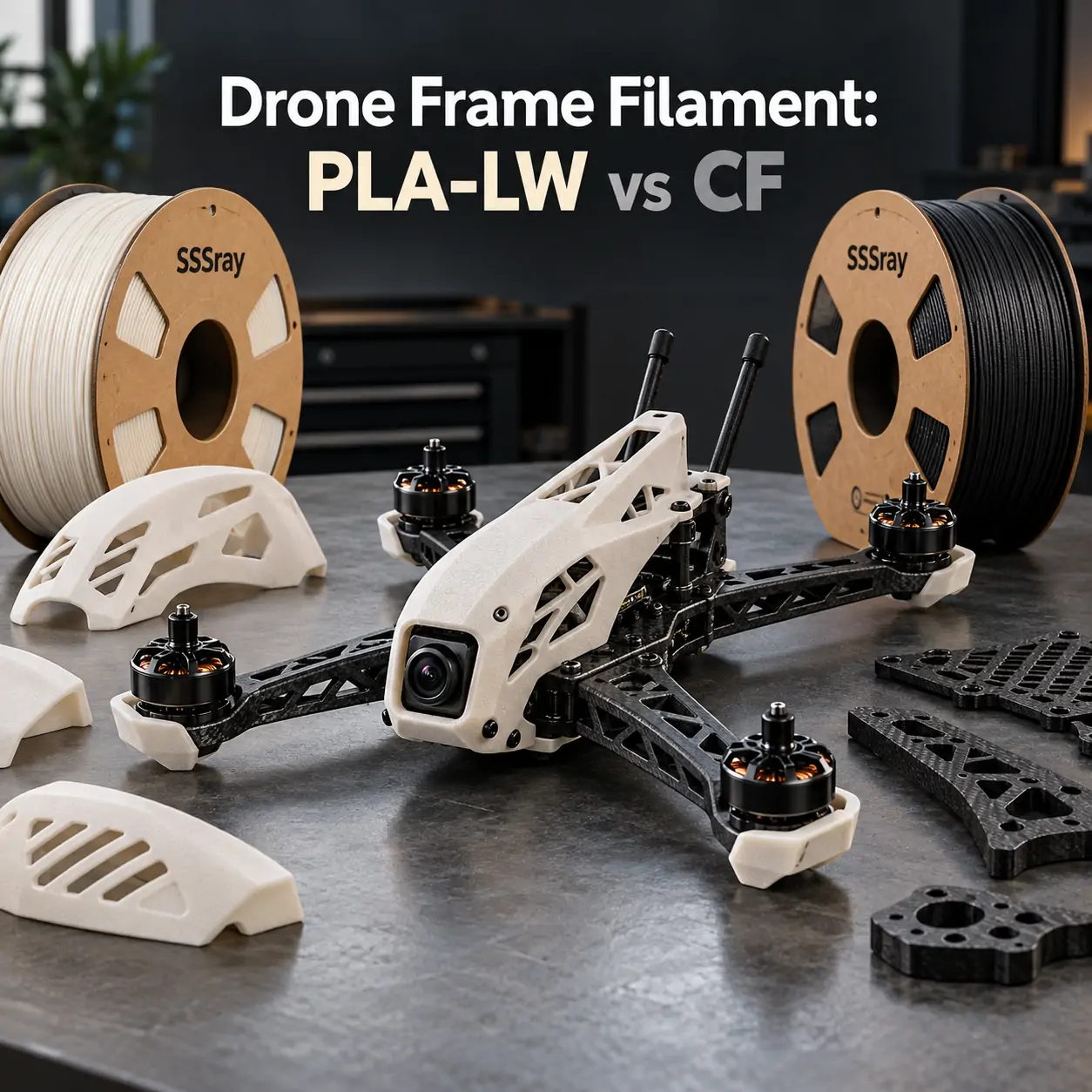
TL;DR: Print the Skin in PLA-LW, Carry the Load in Carbon Fiber
For drone frame 3D printing filament, the real choice is rarely PLA-LW or carbon fiber. For many production UAV programs, a split-material bill of materials is the stronger approach: foamed PLA-LW for shells, fairings and wing skins, and carbon fiber nylon or PET-CF for arms, motor mounts and joints. Published tests and supplier maximums report 14–65% weight reduction for selected PLA-LW grades and settings; for thermal planning, Bambu Lab PLA Aero lists a heat-deflection temperature of 53 °C, which is not a universal PLA-LW limit.
Best optionA split bill of materials: active-foaming PLA-LW for non-structural skins, PA-CF or PET-CF for every part in the load path.
When not to use itKeep PLA-LW out of motor mounts, arms and sun-soaked airframes. For humid service, qualify PA6-CF using conditioned-state mechanical data and the actual part geometry.
Key specificationPrinted density at a locked temperature and flow for PLA-LW; dry and conditioned modulus plus Z-strength for carbon fiber grades.
Verify the supplierAsk for a lot-level foaming curve and fiber-content result, then print the same calibration cube from three spools.
Procurement warningAt the retail reference prices in Table 5, PA6-CF material costs about 2.8–4.5× as much as PLA-LW for the same printed volume; compare the finished-part cost after design and yield are included.
Abstract
For UAV OEMs and print farms, every gram added to the airframe affects endurance, payload and material cost. A lighter frame flies longer on the same battery, carries more payload, or can move a design below a registration threshold in markets where weight changes the applicable rules. That turns drone frame 3D printing filament into a purchasing decision, not only an engineering one. For a print farm or OEM brand planning 2027 volumes, the decision repeats on every spool.
A May 2025 review in the MDPI journal Materials compared carbon-fiber-filled PLA, PETG and nylon for UAV parts. It reported typical tensile strengths of 60–80, 50–70 and 80–110 MPa, and noted that fiber-filled filaments usually cost 60–150% more than unreinforced ones. Meanwhile, foaming PLA suppliers advertise weight cuts of up to 65%. For SSSray buyers, the deciding factor is how these published figures translate into repeatable, qualified printed parts.
Three assumptions cause most bad orders. The first is that “lightweight” and “strong” sit on the same scale. The second is that every LW-PLA behaves the same, although active-foaming and pre-foamed grades need different print processes. The third is that a carbon fiber datasheet measured on dry bars describes a nylon part after a humid month in the field.
The B2B logic is simpler than the marketing. Pay for grams saved only where grams matter, and pay for stiffness only where load travels. A frame is a set of parts with different jobs, so it rarely deserves a single material. Getting that split wrong costs twice: once in material, and again in returns.
This guide uses five tools to make that decision: an endurance model that links airframe mass to hover time; a cross-check of published weight-reduction and mechanical data; a decision tree that splits parts by load path; a cost-per-printed-volume comparison; and the Load-Path Sourcing Framework, a seven-checkpoint scorecard for approving suppliers and reorders. Figures were checked against supplier and journal sources in October 2026, with 2027 production planning in mind.
Key Takeaways
- The weight saving is real but not fixed. Published values run from 14.3% and 20.6% in peer-reviewed tests to 50–65% in supplier maximums.
- The “65%” figure is a flow number. colorFabb states that flow can be cut by up to 65% at peak expansion near 240–250 °C. It is a ceiling, not a typical result.
- Weight pays back faster than linear. Under ideal hover theory, 10% less all-up weight gives about 17% more hover time.
- Foam is efficient in panels, not in beams. Use PLA-LW for skins and shells; use carbon fiber grades for arms and mounts.
- Grade-specific heat limits matter. Bambu Lab lists 53 °C HDT for PLA Aero and 186–194 °C for PA6-CF and PAHT-CF; these are values for those products under their stated test conditions.
- Read nylon data wet and dry. Bambu Lab lists its PA6-CF bending modulus at 5,460 MPa dry and 3,560 MPa wet; its “normal PA6-CF” reference falls from 4,870 to 1,890 MPa.
- Active-foaming and pre-foamed LW-PLA are different products. One needs a calibrated process; the other prints like PLA with a smaller, fixed saving.
- Lot-to-lot foaming consistency is the hidden spec. Same settings on a new lot can give a different part weight, so ask for printed density per lot.
- Compare cost per printed volume. For equal printed volumes at the cited retail references, 100 cm³ of PLA-LW costs about $2.72–4.36 in material, against about $12.26 for PA6-CF.
- Keep carbon fiber away from antennas until tested. The 2025 MDPI review lists PLA and ABS as the usual choices around antenna housings.
1. Drone Frame 3D Printing Filament: What a Lighter Frame Is Worth
Direct answer: more than its share of the scale suggests. For a multirotor with a fixed battery, ideal rotor momentum theory puts hover power in proportion to weight raised to the power 1.5. Endurance therefore improves faster than weight falls.
Think of treading water with a backpack. Each extra kilo does not just add effort; it makes every second afloat more expensive. A hovering drone pays the same kind of penalty in watts.
Endurance vs weight optimization for a UAV: the model
The frame is only part of all-up weight (AUW), next to battery, motors, electronics and payload. So Figure 1 plots two cases: an airframe that is 15% of AUW and one that is 30%.
Modelled hover endurance gain vs. airframe mass reduction
Airframe = 15% of all-up weightAirframe = 30% of all-up weight
The curve bends upward. A 30% lighter airframe adds about 7% hover time when the frame is 15% of AUW, and about 15% when it is 30%. In other words, the same filament is worth twice as much on a frame-heavy design.
In the field, forward flight, wind and battery voltage sag trim the ideal figure, and fixed-wing aircraft follow different math. The ranking holds either way: the heavier the frame’s share, the more a lightweight filament earns.
The 250 g line: when grams become a compliance question
Weight also decides paperwork. In the United States, drones under 250 g can qualify for the FAA registration exemption only when flown exclusively under the Exception for Limited Recreational Operations; drones operated under Part 107 must be registered regardless of weight. EU open-category requirements differ by aircraft class and operation. For OEM programs, we check the target market and operating category before stating a weight-related regulatory benefit on packaging.
Here is a worked example. A 262 g build carries a 55 g printed shell. Cut the shell’s mass by 30% and you save 16.5 g, landing at 245.5 g. For an OEM brand, those grams can decide which shelf the product sits on.
Procurement implicationAsk engineering for the frame’s share of all-up weight before paying a premium for lighter filament.
Mistake to avoidQuoting a filament’s weight-saving percentage as if it were the aircraft’s.
How to verifyWeigh printed parts from the sample lot and re-run the endurance math with real grams.
2. How Much Weight Can PLA-LW Save vs Regular PLA?
Direct answer: between roughly 14% and 65%, and the number depends more on the print process than on the label. Supplier maximums sit at 50–65%. Peer-reviewed tests that kept parts mechanically useful measured 14.3% and 20.6%.
How foaming PLA gets to a 65% weight reduction
Active-foaming PLA-LW lightweight filament carries a blowing agent that stays dormant at normal PLA temperatures. Above an activation point, roughly 210–230 °C depending on the brand, it releases gas and the melt swells as it leaves the nozzle. One study describes the agent in a colorFabb grade as a saturated hydrocarbon at no more than 2.5 wt%, while eSUN describes microsphere foaming.
It works like bread dough in an oven. The flour is the same, the volume is larger, and the crumb depends on temperature and time. Because the bead swells, you turn slicer flow down so walls keep their width. Less plastic per millimeter means a lighter part.
colorFabb, for example, reports no expansion at 200 °C and the most at 240–250 °C, where volume nearly triples and flow can drop by up to 65%. Figure 2 sets that ceiling beside other published figures.
Published weight reduction vs. regular PLA at the same geometry (higher = lighter)
Why the gap? A supplier maximum comes from a single-wall test piece at peak temperature. A real part needs walls that bond to each other. In a 2024 Polymers study of a flying-wing UAV, raising the nozzle from 210 °C to 230 °C cut specimen weight by 20.6%, yet estimated stress and modulus fell about fourfold.
The authors still judged LW-PLA acceptable for the airframe, provided deformation limits were met. That is how we position PLA-LW with our own customers: light enough to matter, and soft enough to need a design that allows for it.
ColorFabb LW-PLA vs eSUN and others: active-foaming or pre-foamed?
Table 1 lines up what five suppliers publish. Use it to compare product families, then lock settings on the grade you buy.
On mobile, swipe horizontally to review every column.
| Grade | Foaming type | Published lightweight figure | Nozzle temperature | Published mechanical / thermal data |
|---|---|---|---|---|
| colorFabb LW-PLA | Active (foams in the nozzle) | Nearly 3× volume; flow reduction up to 65% | Foams from about 230 °C; peak at 240–250 °C | Diameter tolerance ±0.1 mm; maximum activated density 0.403–0.476 g/cm³; glass transition 55 °C |
| eSUN PLA-LW | Active | Foaming ratio up to 220%; density down to 0.54 g/cm³ | 190–270 °C adjustable range (reseller listing); set from the foaming-ratio chart | Not stated on the product page |
| Bambu Lab PLA Aero | Active | Print density 50–80% of normal; flow ratio 0.5–0.8 | 220–260 °C | Tensile 24 ± 2 MPa; bending modulus 1,690 ± 120 MPa; HDT 53 °C. A second Bambu Lab listing gives 26 MPa and 1,960 MPa |
| SUNLU LW-PLA | Fixed low density | 0.84 g/cm³; about 30% lighter | 180–200 °C | Tensile 20 ± 4 MPa; flexural 35 ± 5 MPa; HDT 53 ± 3 °C |
| Polymaker PolyLite LW-PLA | Pre-foamed (stabilized foam) | Fixed density; one reseller listing states 0.6 g/cm³ | Similar to regular PLA | Density and line width described as consistent regardless of temperature |
Two details matter for buyers. First, Bambu Lab’s own listings show two sets of mechanical values, so always tie approval to the current TDS revision. Second, the two families behave differently on the shop floor.
- Active-foaming grades save the most weight. However, density moves with temperature, speed and flow, and retractions can clog a nozzle full of expanding melt.
- Pre-foamed grades generally print more like standard PLA and give a more predictable density at a locked process; normal lot and print variation still applies. The weight saving is usually smaller and is not controlled by nozzle foaming.
The split comes from RC aircraft 3D printing materials, where LW-PLA first took off. Model Aviation notes that designs listing “LW-PLA” usually assume the active-foaming type, printed at about half the normal flow. Ship the wrong type and your customer’s proven design stops working.
Procurement implicationWrite the foaming type and the printed density at a named temperature and flow into the PO, not just “LW-PLA.”
Mistake to avoidPromising customers 65% lighter parts from a figure measured on a single-wall test cube.
How to verifyPrint a 20 mm solid cube at the supplier’s locked profile, weigh it, and divide by measured volume.
3. Is Carbon Fiber Stronger Than Foaming PLA for Drones? Specific Strength Compared
Direct answer: yes, by a wide margin, even after dividing by density. On published datasheets, carbon fiber nylon delivers roughly 3.5–4 times the tensile strength per gram of a low-density PLA. It also holds its shape at temperatures where PLA-LW has already softened.
On mobile, swipe horizontally to review every column.
| Material (published source) | Density (g/cm³) | Tensile strength (MPa) | Bending or Young’s modulus (MPa) | Heat deflection temperature | Specific strength (MPa ÷ g/cm³) |
|---|---|---|---|---|---|
| LW-PLA, fixed low density (SUNLU) | 0.84 | 20 ± 4 | Not stated | 53 ± 3 °C | 23.8 |
| Active-foaming PLA (Bambu Lab PLA Aero) | 1.21 as filament; prints at 50–80% of normal | 24 ± 2 | 1,690 ± 120 | 53 °C | Depends on print density |
| PA12-based carbon fiber nylon (Bambu Lab PAHT-CF) | 1.06 | 92 ± 7 | 4,230 dry; 3,640 wet | 194 °C | 86.8 |
| PA6 carbon fiber nylon (Bambu Lab PA6-CF) | 1.09 | 102 ± 7 | 5,460 dry; 3,560 wet | 186 °C | 93.6 |
| PPA carbon fiber (Bambu Lab PPA-CF) | 1.25 | 168 ± 4 | 9,860 dry; 9,620 wet | 227 °C | 134.4 |
| Carbon fiber PLA (MDPI 2025 review range) | 1.3–1.4 | 60–80 | 4,500–6,000 | Not stated | 43–62 |
| Carbon fiber PETG (MDPI 2025 review range) | 1.3–1.4 | 50–70 | 3,000–4,500 | Not stated | 36–54 |
| Carbon fiber nylon (MDPI 2025 review range) | 1.1–1.2 | 80–110 | 6,500–8,000 | Not stated | 67–100 |
These values come from different labs, specimen prints and test conditions. So use Table 2 to rank families, then confirm the exact grade with your own bars. The last column is our own calculation: tensile strength divided by density.
Why foam still wins in skins and shells
If carbon fiber is so much stronger per gram, why print anything in PLA-LW? Because parts fail in different ways. A motor arm is a beam; its stiffness per gram follows modulus divided by density. A wing skin is a panel; its bending stiffness per gram follows the cube root of modulus divided by density.
Run the numbers on an ideal foam. Halve the density and, by the textbook scaling for cellular solids, stiffness drops to about a quarter. As a beam, that foam is half as efficient. As a panel, it is about 26% more efficient, because the wall can be thicker for the same weight.
Corrugated cardboard makes the point. It is useless as a rope and excellent as a box. Likewise, PLA-LW belongs in fuselage shells, fairings and wing skins, where thickness does the work.
One caution, though. Real prints can fall short of the ideal: the 2024 study above lost about three quarters of its stiffness for only 20.6% less weight. That result is why we qualify printed density and mechanical performance together, with Section 6 treating print settings as part of the specification.
UAV carbon fiber composite: chopped-fiber filament is not laminate
A printed “carbon fiber” arm and a cut carbon plate share a name, not a structure. Filament uses short chopped fibers, commonly 15–30% by weight according to the MDPI review. Fibers line up along the print path, so strength across layers is lower.
- Layer direction: Bambu Lab lists PA6-CF bending strength at 151 MPa flat (XY) but 80 MPa upright (Z), both dry.
- Continuous fiber: the review cites tests where continuous-fiber parts reached at least four times the properties of chopped-fiber FDM or SLS parts.
- Hybrid frames: colorFabb describes a student-built drone with an LW-PLA body and wings over an internal carbon tube skeleton, rated for a 10 kg takeoff weight.
Read nylon data wet and dry
Nylon absorbs water, and water softens it. Bambu Lab’s PA6-CF loses about 35% of its bending modulus from dry to wet. Its “normal PA6-CF” reference loses about 61%. The PA12-based PAHT-CF loses only about 14%, and PPA-CF barely moves.
So the stiffest grade on a dry datasheet may not be the stiffest arm in a coastal warehouse. Design on the conditioned value, or buy the grade that changes least.
We checked this on our own material as well, tracking SSSray PA-CF filaments for 30 days with a moisture meter. The results are in our PA-CF 30-day moisture test.
Procurement implicationRequest dry and conditioned values, plus Z-direction strength, for every nylon-based carbon fiber grade.
Mistake to avoidComparing foamed PLA and carbon fiber nylon on tensile strength alone, and skipping heat and moisture.
How to verifyHave three bars printed flat and three upright from the sample lot, then bend-test both sets.
4. Motor Vibration, Crash Resistance and Heat: Where a Lightweight Frame Fails
Direct answer: PLA-LW is limited by stiffness and heat, not by weight. It suits low-load skins and is a poor choice for motor mounts and arms. Carbon fiber grades have their own limits: brittleness in PLA-CF and moisture in PA6-CF.
Can PLA-LW withstand drone motor vibration?
Not as a motor mount or arm. We do not recommend PLA-LW for either: its reduced stiffness and limited heat resistance work against a warm, vibrating load-bearing part. As one product-specific reference, Bambu Lab PLA Aero lists 53 °C HDT.
A soft arm flexes more and shifts the frame’s resonances down toward the range where motors operate. Motors and speed controllers also run warm. Put together, a foamed PLA mount can creep, loosen its bolts and feed vibration into the flight controller.
The practical rule is simple. PLA-LW parts can ride on the airframe, but they should not carry a motor. If a design forces the issue, run a full-battery test at rated thrust and check bolt preload, cracks and deflection afterwards.
Which lightweight filament has the best crash recovery?
It depends on what “recovery” means. If it means surviving the impact, the MDPI review gives typical impact resistance of 4–6 kJ/m² for carbon fiber PLA, 8–12 for carbon fiber PETG and 10–15 for carbon fiber nylon. One hands-on frame review found a PLA-CF frame light and rigid but far more fragile than real carbon plate.
If it means getting back in the air, economics take over. A cracked PLA-LW fairing reprints in hours for a few dollars. For a fleet, the best crash resistance in a lightweight frame is often a design choice: sacrificial foam skins and TPU bumpers around a carbon fiber nylon core.
Heat: check the PLA-LW grade and printed part
Bambu Lab lists a heat deflection temperature of 53 °C for PLA Aero and 57 °C for basic PLA. A dark airframe in summer sun, or a drone left in a parked vehicle, can pass that. By contrast, PA6-CF and PAHT-CF are listed at 186 °C and 194 °C.
For hot-climate UAV programs, we shortlist higher-temperature lightweight materials or a carbon-fiber composite design, then qualify the finished geometry under its expected load and temperature.
Procurement implicationState service temperature and humidity in the RFQ; they pick the polymer family before weight does.
Mistake to avoidApproving PLA-LW on an indoor bench, then shipping to customers who store drones in cars.
How to verifySoak a printed part at worst-case temperature for an hour under its real load, then measure deflection.
5. The UAV Frame Material Decision Tree: PLA-LW or Carbon Fiber, Part by Part
The sections above reduce to seven questions. Ask them for each part, not for the aircraft. Most frames end up with two or three materials.
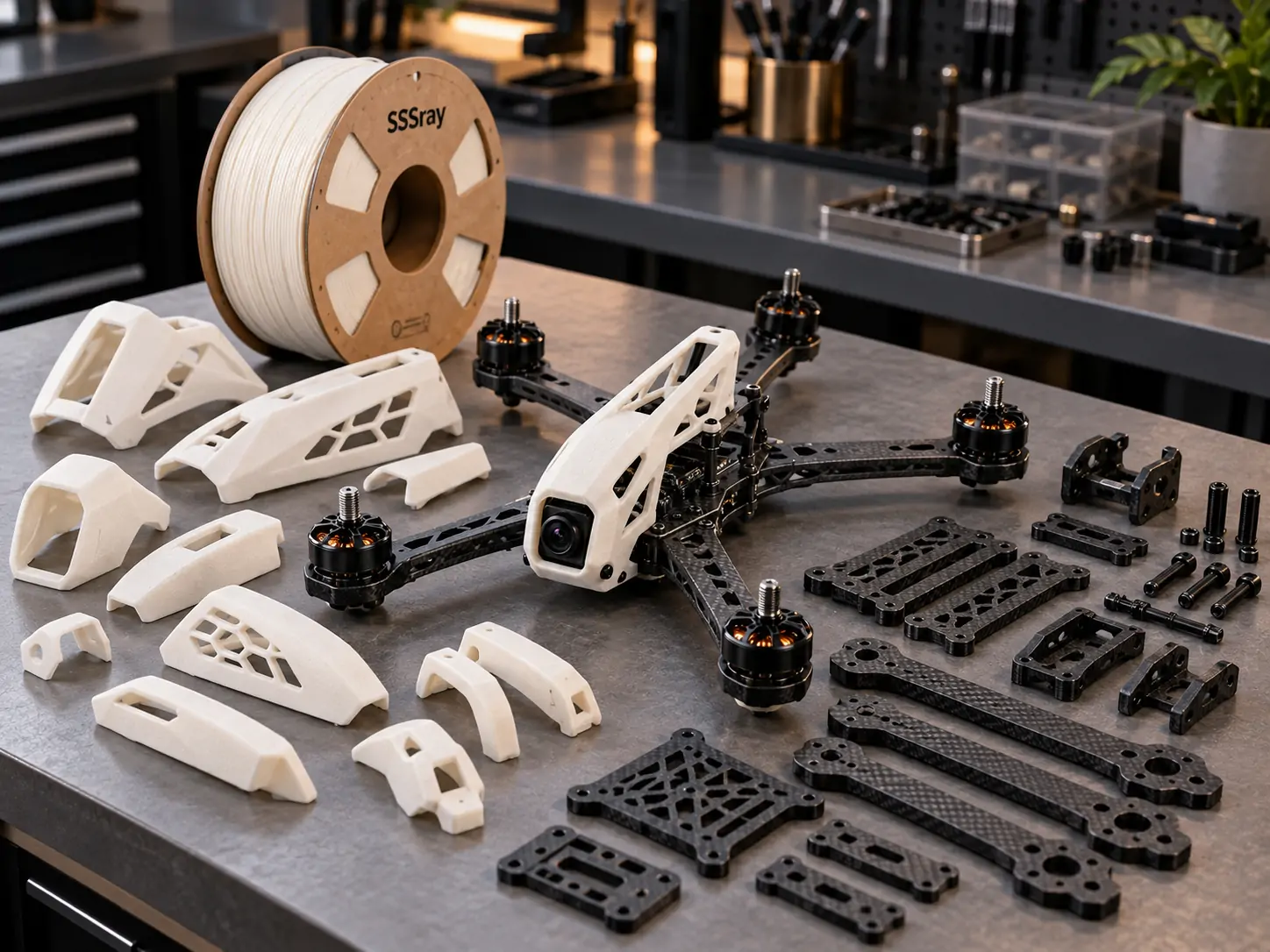
- Is the part in the load path? Arms, motor mounts, spar joints and landing-gear roots are. If yes, choose from the carbon fiber family and go to question 2. If no, go to question 4.
- Will it see more than about 50 °C in service or storage? If yes, use PET-CF, PA-CF or a higher grade. Keep PLA-CF for prototypes and indoor aircraft.
- Will it live in humid air without dry storage? If yes, prefer a PA12-based grade or PET-CF. Use PA6-CF only when parts stay dry, or when the design is sized on wet values.
- Is weight the main driver for this skin, fairing or shell? If yes, PLA-LW is the candidate. If no, standard PLA+ or PETG is cheaper and stiffer.
- Can you lock the print process? One printer model, one profile and trained operators suit active-foaming grades. Multi-site or customer printing suits pre-foamed grades.
- Is the aircraft used in heat or direct sun? If yes, replace PLA-LW with a foamed ASA-type grade or a thin carbon fiber shell.
- Does the part sit near a GPS or telemetry antenna? If yes, keep carbon-fiber-filled material away, or prove radio performance by test.
Table 3 turns the tree into a purchasing sheet. Each row names the check that approves the option and the signal that rejects it.
On mobile, swipe horizontally to review every column.
| Option | Best use case | Key spec | Advantage | Risk | How to verify | When to reject | SSSray sourcing note |
|---|---|---|---|---|---|---|---|
| Active-foaming PLA-LW | Wing skins, fuselage shells, fairings, canopies | Printed density at a locked temperature, flow and speed | Largest weight saving; one spool prints about twice the volume | Density drift between lots; clogging on retraction; grade-dependent heat resistance (Bambu PLA Aero HDT 53 °C) | 20 mm cube weight from three spools of the lot | No foaming curve, or cube weights spread beyond your limit | Request the foaming curve with the sample spool |
| Pre-foamed LW-PLA | Multi-site or customer-printed parts | Filament density with tolerance | Prints like PLA; repeatable weight | Smaller, fixed saving; breaks designs tuned for active foaming | Weigh a metered length of filament | Customer designs assume about half flow | Confirm the foaming type in writing before quoting |
| PLA-CF | Prototype frames, indoor aircraft, stiff brackets | Fiber content; modulus; impact strength | Easy to print; rigid; matte finish | Brittle in crashes; PLA-level heat resistance | Drop test on the real arm geometry | Outdoor or crash-prone use | Entry carbon fiber SKU for resellers |
| PET-CF | Arms and structural parts in humid use | Modulus; HDT; water absorption | Low moisture uptake; low warp; listed HDT of 205 °C for one brand | Lower impact than nylon grades | Flat and upright bend bars | High-impact landing gear | Often the cost-performance route for farms; see our PET-CF cost analysis |
| PA6/66-CF | High-stress arms and motor mounts kept dry | Dry and conditioned modulus; Z-strength | High strength and toughness | Moisture softening; needs drying and an enclosure | Conditioned bend test; moisture at packing | Dry-only data, or no drying instruction | Supplied on 1 kg, 3 kg or 5 kg spools by program |
| PA12-based or PPA-CF | Outdoor, humid or hot-duty structure | Wet-state modulus; HDT | Properties hold when wet; highest heat margin | Highest price; hotter nozzle, up to 310 °C for PPA-CF | Printer temperature capability check | Printers that cannot reach temperature | For accounts with qualified printers |
SSSray sourcing note: SSSray supplies active-foaming PLA-LW through its custom PLA program and a carbon fiber line covering PLA-CF, PET-CF, PA6/66-CF, PPA-CF and PPS-CF. For UAV projects we usually suggest qualifying one skin material and one load-path material on the same sample order, because the parts are approved as an assembly, not one by one.
6. Mass Production: Print Settings for Lightweight Drone Parts
Direct answer: lock temperature, flow and speed as one set. With active-foaming filament, each of the three changes part weight, so a “small tweak” by one operator becomes a weight problem across a batch. Calibrate once per lot, then leave it alone.
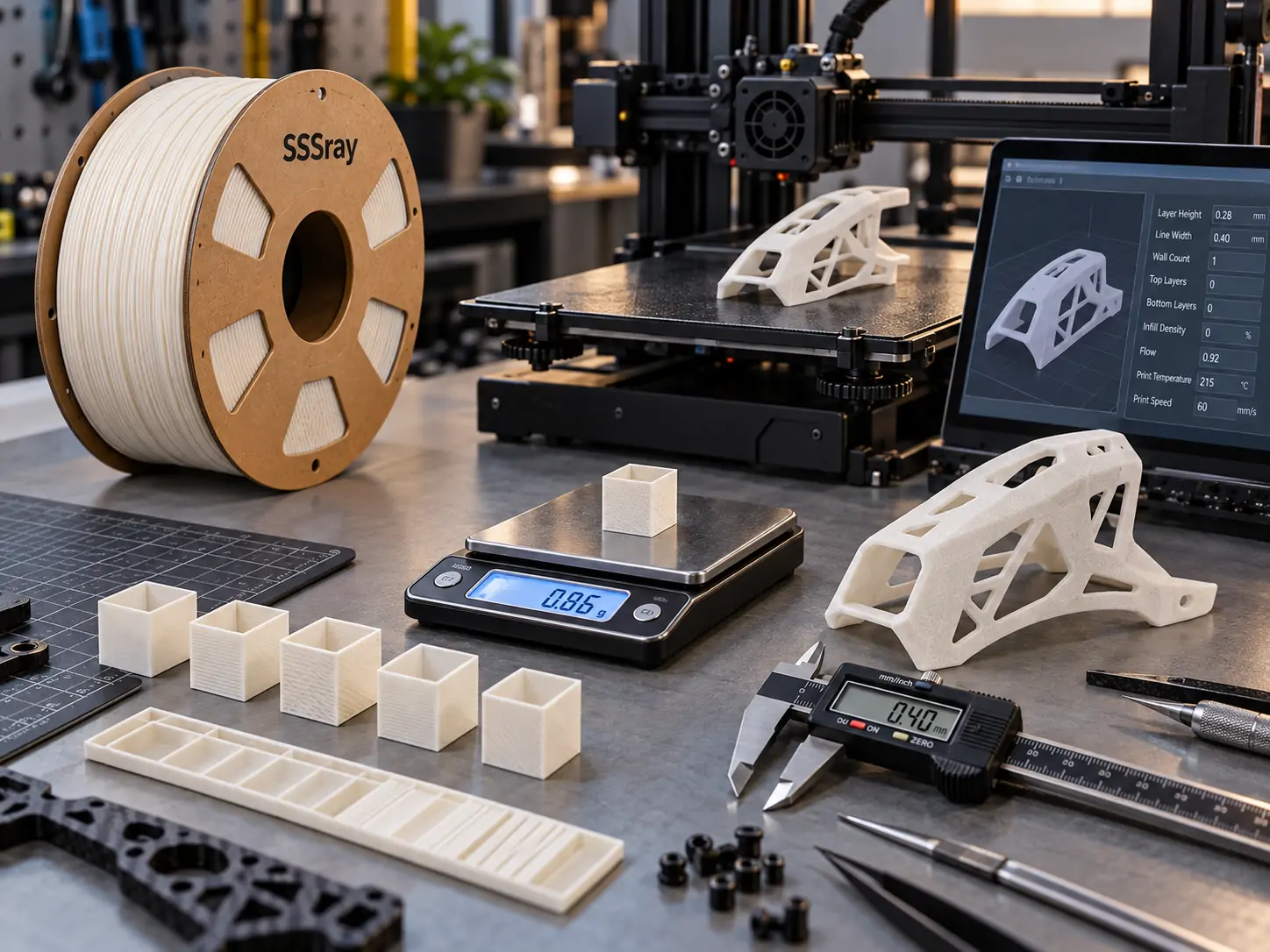
PrusaSlicer lightweight settings: a calibration routine for any slicer
The routine below follows colorFabb’s published method. In PrusaSlicer the key control is the extrusion multiplier; Bambu Studio and OrcaSlicer call it flow ratio.
- Dry the spool. Bambu Lab notes that foaming PLA has high requirements for drying and parameter settings.
- Print single-wall cubes. Use no top or bottom, 0.2 mm layers, extrusion multiplier 1.0 and about 25 mm/s. Step from 200 °C upward in 10 °C increments.
- Measure wall thickness. Pick the temperature that gives the expansion you want. colorFabb saw none at 200 °C and the most at 240–250 °C.
- Reduce flow at that temperature. Step the multiplier down until the wall returns to nominal width. Users report about 0.43 on a Prusa MINI at 240 °C and 0.42–0.50 on Bambu Lab printers.
- Hold speed steady and limit retractions. eSUN warns against rapid speed changes while foaming, and expanding melt can block a nozzle after long retractions.
- Print and weigh a 20 mm solid cube. Record the printed density. That number becomes your lot acceptance check.
One more finding is worth a line in your work instruction. A 2025 peer-reviewed study saw wall-to-infill bonding defects below 230 °C, where foaming was incomplete. Running cool to “play safe” can therefore weaken the part.
On mobile, swipe horizontally to review every column.
| Parameter | Active-foaming PLA-LW | Carbon fiber nylon (PA6-CF / PAHT-CF) |
|---|---|---|
| Nozzle temperature | 220–260 °C (Bambu Lab PLA Aero); foaming from about 230 °C, peak 240–250 °C (colorFabb) | 260–290 °C (Bambu Lab PA6-CF and PAHT-CF) |
| Bed temperature | 35–45 °C with glue (Bambu Lab PLA Aero) | 80–100 °C (PA6-CF, reseller technical listing) |
| Enclosure | Not required; avoid hot chambers that soften PLA | Enclosed printer; 45–60 °C chamber listed for PA6-CF; PAHT-CF is described as unsuitable for open-frame printers |
| Drying | Dry before use; follow the grade’s TDS | 80 °C for 10 h in a blast drying oven (Bambu Lab PA6-CF) |
| Nozzle material | Standard nozzle for unfilled grades; 0.4 mm typical | Hardened steel, ruby or tungsten carbide |
| Speed range | 25 mm/s for calibration; 30–50 mm/s as a typical starting range (colorFabb); keep it constant | Use the supplier’s profile for the exact printer |
| Common failure | Clogs after retraction; weight drift between lots; weak wall bonding below the activation temperature | Moisture bubbles; warping; nozzle wear; weak Z-direction bond |
| Fix | Fewer retractions; locked temperature, flow and speed; a new cube for every lot | Dry and enclose; wear-resistant nozzle; orient the main load in the XY plane |
Embedded electronics filament printing: channels, antennas and heat
Printed frames can carry their own wiring routes. The MDPI review describes internal channels, sensor mounts with TPU damping, and conduits formed with soluble support. It also rates printed conductive traces as limited in conductivity, so treat them as signal paths at most.
- Antennas: the review names PLA and ABS for the areas around antennas because they do not interfere with radio signals. Carbon is conductive, so test any carbon-fiber-filled part near GPS or telemetry.
- Heat sources: speed controllers and video transmitters run warm. Keep them off PLA-LW walls, or add an air gap.
- Internal conduits: soluble support leaves clean channels; see our PVA filament storage guide before adding it to a production line.
Procurement implicationAsk for a starting profile for your exact printer, and treat it as part of the approved sample.
Mistake to avoidLetting each operator tune temperature “by eye.” Every change moves part weight.
How to verifyWeigh the first part of every shift against a control limit set during the pilot run.
7. Cost Comparison: PLA-LW vs PA-CF for UAV Production
Direct answer: at the cited retail prices, PA6-CF costs about 2.5× as much as PLA-LW per kilogram. For the same 100 cm³ of printed material in Table 5, the PA6-CF material cost is about 2.8–4.5× the PLA-LW cost. Finished-part costs depend on geometry, processing and yield.
Price per kilogram hides the real number
In October 2026, one US reseller lists Bambu Lab PLA Aero at $44.99/kg, and MatterHackers lists Bambu Lab PA6-CF at $112.49/kg and PAHT-CF at $119.99/kg. eSUN’s EU store shows PLA-LW at €28.11–36.99. These are market reference prices; SSSray quotes B2B orders factory-direct by quantity, destination and packaging.
The formula is short: material cost per printed cm³ = price per kg × printed density ÷ 1,000. Table 5 applies it to 100 cm³ of printed material, about the plastic in a small airframe shell set.
On mobile, swipe horizontally to review every column.
| Material and condition | Reference price | Printed density | Mass per 100 cm³ | Material cost per 100 cm³ |
|---|---|---|---|---|
| PLA-LW foamed to 50% of normal density | $44.99/kg | 0.605 g/cm³ | 60.5 g | $2.72 |
| PLA-LW foamed to 80% of normal density | $44.99/kg | 0.968 g/cm³ | 96.8 g | $4.36 |
| PA6-CF | $112.49/kg | 1.09 g/cm³ | 109 g | $12.26 |
| PAHT-CF | $119.99/kg | 1.06 g/cm³ | 106 g | $12.72 |
Price note: the figures in Table 5 reflect market price levels recorded at the time of writing in October 2026. SSSray will provide you with highly competitive factory-direct pricing for your quantity, packaging and destination.
Equal printed volume does not guarantee equal structural performance or equal finished-part cost. An engineered carbon-fiber arm may use less material than a lower-stiffness alternative. For low-load fairings, we normally quote PLA-LW first and move to a higher-cost grade when heat or mechanical requirements call for it.
How to calculate real purchasing cost
Material is only the first line. The number that matters is cost per good part = (material + machine time + labor) ÷ first-pass yield. Three adders move it most.
- Yield: a foaming lot that drifts in density creates overweight parts that pass visual checks and fail the scale.
- Process overhead: carbon fiber nylon needs drying, an enclosure and wear-resistant nozzles. The MDPI review puts fiber-filled filament at 60–150% above unreinforced material before those extras.
- Landed cost: freight and duty change the ranking. Our Section 301 guide works through the US duty stack on Chinese filament.
Procurement implicationQuote the skin and load-path materials together, and compare cost per good assembly.
Mistake to avoidRanking suppliers by FOB price per kilogram when one kilogram prints twice the parts.
How to verifyTrack grams used, failed prints and nozzle changes across a 100-part pilot.
8. The Load-Path Sourcing Framework for Drone Frame Filament Buyers
Engineers trace a load path to see where force travels through a structure. Buyers can trace one too: from the aircraft’s requirement, through the material and the print, to the supplier’s lot and your reorder.
The Load-Path Sourcing Framework has seven checkpoints. A fail at any one of them reaches the aircraft sooner or later.
On mobile, swipe horizontally to review every column.
| Checkpoint | Why it matters | What to ask | Pass / fail signal | Hidden risk |
|---|---|---|---|---|
| Application requirement | Load, heat and humidity choose the polymer family | Which parts carry load? Peak service temperature? Target part weight? | Pass: a material per part class. Fail: one filament for the whole frame. | A weight target set on the aircraft but never on the printed part |
| Material performance | Datasheet conditions decide whether numbers transfer | Printed density at stated settings? Dry and conditioned modulus? Z-strength? | Pass: values with method and state. Fail: “up to” figures only. | Two TDS revisions in circulation for the same grade |
| Printability | Foaming and fiber-filled grades both narrow the process window | Profile for our printer? Drying step? Nozzle type? Retraction limits? | Pass: a profile that reproduces the sample. Fail: “same as PLA.” | A profile tuned on one printer brand and shipped to another |
| Compliance | Resellers and OEMs need documents for each market | Lot COA, TDS and SDS? RoHS or REACH files? Handling notes for carbon fiber dust? | Pass: current files for the exact grade. Fail: a generic certificate. | Filament documents do not certify the aircraft; airworthiness is a separate process |
| Supplier reliability | Foaming agent and fiber loading are set at compounding | How is foaming checked per lot? How is fiber content measured? | Pass: lot records with numbers. Fail: “every batch is the same.” | A supplier unable to trace the shipped lot to its extrusion and QC records |
| Landed cost | Volume printed per kilogram differs by more than 2× across these grades | Price per kg, duty, freight, and expected parts per spool? | Pass: cost per good part. Fail: FOB price only. | Nylon spools that arrive wet add a drying step you did not cost |
| Reorder stability | A new lot that foams differently changes aircraft weight | Will you notify us before changing resin, foaming agent or fiber source? | Pass: written change control and retained samples. Fail: silent substitution. | Problems appear on the second order, after the design is frozen |
Score each checkpoint pass, conditional or fail. Approve a supplier only when nothing fails and every “conditional” has a written action and an owner.
9. Supplier Claims vs Reality: Lightweight and Carbon Fiber Filament
Lightweight and carbon fiber filaments sell on big numbers. Use Table 7 to turn each one into a document or a test before it reaches your purchase order.
On mobile, swipe horizontally to review every column.
| Vague marketing claim | What it might hide | Document, sample or test to request | SSSray batch evidence for approval |
|---|---|---|---|
| “65% lighter than PLA” | A single-wall test piece at peak temperature, not a bonded part | Printed density at stated temperature, flow and speed; cube weights | Density at two or three temperatures with the profile, plus a strength result at the same settings |
| “Foaming ratio 220%” | A maximum at one temperature; no lot tolerance | Foaming curve for the lot you are buying | A lot-linked foaming curve and an agreed band |
| “Carbon fiber reinforced” | Low or unstated fiber content | Fiber content with test method; fiber type | Stated loading by weight on the lot COA |
| “High-strength nylon CF” | Dry-only, flat-printed data | Dry and conditioned values, flat and upright, with test standard | Both states and both orientations on one sheet |
| “Low moisture absorption” | No base polymer, method or condition | Base polymer (PA6, PA12, PET); absorption at stated humidity and time | Named polymer, absorption data and drying instructions |
| “Same quality every batch” | No lot data behind the sentence | QC records for the last three lots: diameter, density, foaming | Lot COA, retained samples and written change notice |
10. SSSray Batch QC Data and UAV Frame Filament Qualification Protocol
SSSray runs 50+ extrusion lines in Jinhua, Zhejiang, with capacity of up to 35 tons a day under an ISO 9001:2015 quality system. Two layers of control sit behind every spool discussed in this guide. The first is the batch QC that runs on our extrusion lines in Zhejiang for every production lot. The second is a UAV-specific qualification protocol that we run against the buyer’s locked print profile.
Factory batch QC limits enforced on every lot
Table 8 lists the pass/fail limits we enforce for the two material families used in a split-material frame. The same figures appear on our batch QC data page, and the measured values for each lot are documented on the Certificate of Analysis (COA) shipped with the order.
On mobile, swipe horizontally to review every column.
| QC parameter | PLA family (includes PLA-LW) | PA-CF / PETG-CF carbon composite | Equipment and method | Record |
|---|---|---|---|---|
| Diameter precision | ±0.03 mm | ±0.03 mm | Inline laser micrometers scanning 500 times per second; a segment outside tolerance for more than 3 seconds is cut and purged | Laser diameter log for the lot |
| Maximum ovality | ≤ 0.020 mm | ≤ 0.025 mm | Inline dual-axis laser measurement | Laser diameter log for the lot |
| Maximum moisture before sealing | ≤ 0.02% | ≤ 0.015% after 12 h drying | Karl Fischer titration after dehumidification | Moisture result on the lot COA |
| Color accuracy | ΔE < 0.8 | Matte carbon reference | Spectrophotometer against the master reference | Color ΔE log for the lot |
| Print stress test | Sampled spools, 24 h continuous printing | Sampled spools, 24 h continuous printing | Bambu Lab, Creality and Voron printers, at speeds up to 500 mm/s depending on grade | Print-test record |
| Packaging barrier | −0.09 MPa vacuum with silica desiccant | High-barrier aluminum bag | Vacuum sealing after the moisture check | Packing record |
| Traceability | Batch ID on master carton and spool label | Batch ID on master carton and spool label | Individual spool laser serialization | COA matched to the Batch ID |
The ±0.03 mm figure is our maximum limit, not our typical result: more than 90% of SSSray filament holds ±0.01 mm to ±0.02 mm in production. For comparison, colorFabb lists ±0.1 mm for its LW-PLA.
These limits answer two questions raised earlier. A ±0.03 mm diameter window keeps flow, and therefore part weight, steady along the spool. A moisture ceiling checked by titration before sealing protects foaming behavior in PLA-LW and stiffness in nylon-based carbon fiber grades.
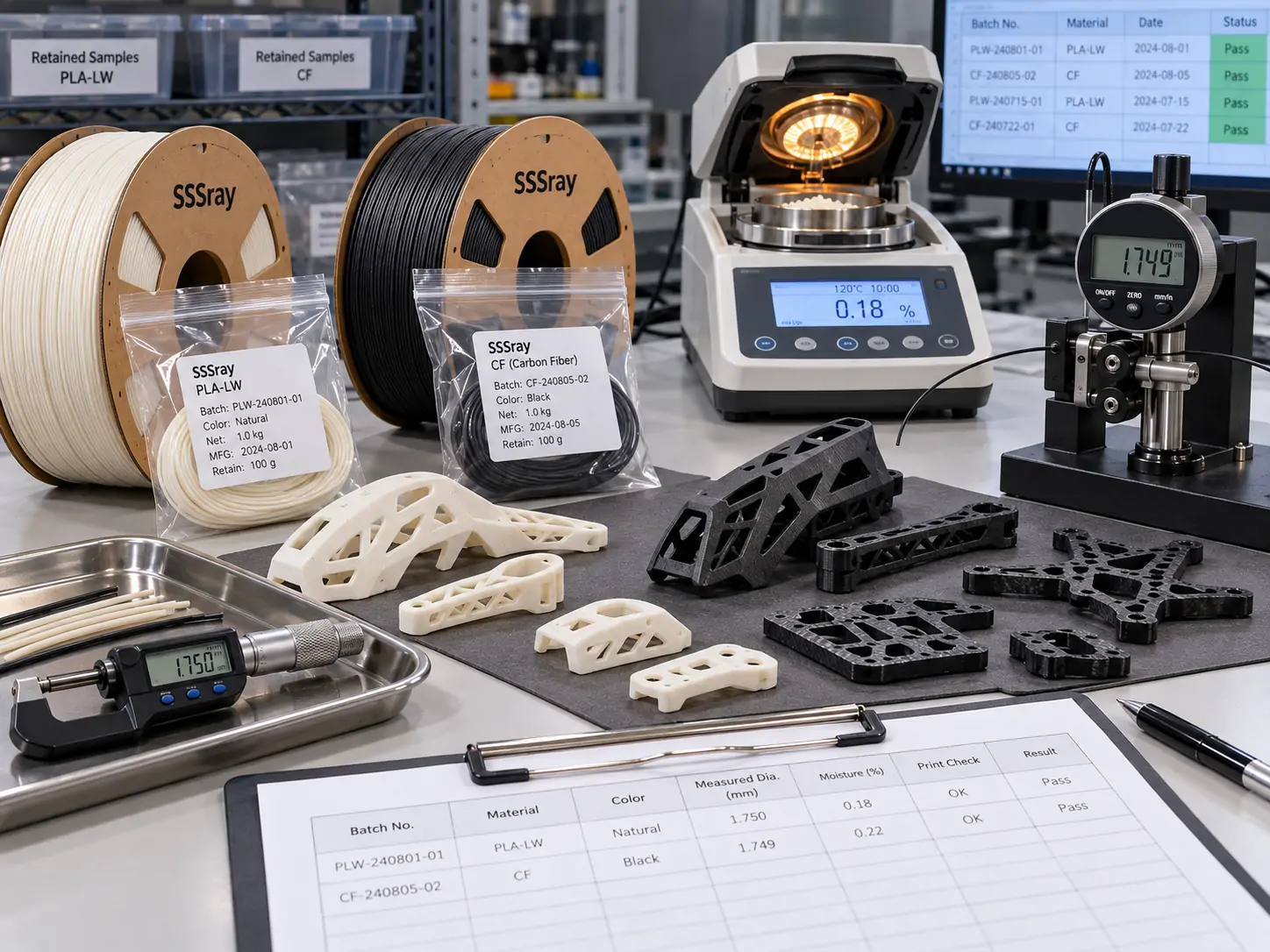
UAV frame qualification protocol
For drone programs we add the protocol below. It defines locked conditions for foaming, printed density and directional strength, together with the sampling plan and record requirements.
Protocol ID: SSSRAY-UAV-LWCF-2026-10-R01 · Materials: 1.75 mm active-foaming PLA-LW and carbon fiber grades · Sampling plan: n=9 spools, with three taken from the start, middle and end of the production lot.
- Diameter and ovality: inline laser micrometer log for the lot, verified on the nine sample spools.
- Conditioning: spools dried to the grade’s instruction; water content by Karl Fischer titration (ISO 15512).
- Foaming curve (PLA-LW): single-wall cube, 0.4 mm nozzle, 0.2 mm layers, 25 mm/s, extrusion multiplier 1.0, from 200 °C to 260 °C in 10 °C steps; wall thickness by micrometer.
- Printed density (PLA-LW): 20 mm solid cube at the locked profile; mass on a 0.01 g balance, dimensions by caliper.
- Directional strength: ISO 527-2 tensile and ISO 178 flexural bars printed flat (XY) and upright (Z), n=5 per orientation.
- Wet-state check (nylon-based CF): bars conditioned to ISO 1110 before testing; dry and conditioned values reported side by side.
- Fiber content (CF grades): thermogravimetric residue following ISO 11358-1, reported against the lot number.
On mobile, swipe horizontally to review every column.
| Control point | SSSray test condition | Acceptance / record requirement | Why it is controlled |
|---|---|---|---|
| Filament diameter | Inline laser micrometers across the lot; nine-spool verification | ±0.03 mm; ovality ≤ 0.020 mm for the PLA family and ≤ 0.025 mm for carbon composite; raw log retained | A flow error changes wall width and part weight |
| Foaming curve | Single-wall cube, 200–260 °C in 10 °C steps | Wall thickness recorded at each step; curve stays inside the band agreed on the approved sample | The same settings must give the same expansion on a reorder |
| Printed density | 20 mm cube at the buyer’s locked profile | g/cm³ recorded per spool; lot mean and spread reported against the approved sample | This number sets aircraft weight |
| XY and Z strength | ISO 527-2 and ISO 178 bars, two orientations | Mean and standard deviation recorded and compared with the approved sample | Layer bonding is the weak direction in a printed arm |
| Dry vs conditioned state | Nylon-based CF bars conditioned to ISO 1110 | Both values reported; the buyer designs on the conditioned one | Parts in the field are not dry |
| Fiber content | Thermogravimetric residue, ISO 11358-1 | Residue by weight recorded against the grade specification | Fiber loading drives stiffness and nozzle wear |
Lot traceability: every shipment carries a unique Batch ID on the master carton and on each spool label. The COA and the protocol record carry that Batch ID together with sample IDs, print profile and measured values, so your team can request the digital COA matching its Batch ID before customs clearance. Methods are described in our filament test protocol.
11. B2B Scenarios: Who Loses Money on the Wrong Drone Frame Filament
Distributor
Situation: adds an RC and drone shelf with LW-PLA and carbon fiber grades.
Bad choice: lists one generic “LW-PLA” with a 65% claim and no profile.
Consequence: returns from customers whose parts came out heavy or clogged the nozzle.
SSSray recommendation: state the foaming type, printed density at a named setting, and a starting profile per printer brand.
Verification: print the calibration cube from every inbound lot.
Next step with SSSray: request sample spools with the print profile.
OEM Brand
Situation: launches a sub-250 g camera drone with a printed shell.
Bad choice: approves shell weight from one golden spool.
Consequence: a reorder lot foams less, and finished aircraft drift over the weight class.
SSSray recommendation: a weight tolerance on the printed part, lot-level density records and change control.
Verification: weigh first articles from each lot against a control limit.
Next step with SSSray: lock the specification under OEM/ODM.
Print Farm
Situation: prints 500 airframe kits a month on 20 machines.
Bad choice: runs PA6-CF for every part, with open spools on the printers.
Consequence: moisture-sensitive nylon processing, worn nozzles and PA6-CF material costs applied to skins that do not need that grade.
SSSray recommendation: PLA-LW for skins, PET-CF or PA12-based CF for arms, dry boxes and hardened nozzles.
Verification: a 100-part pilot with a yield and weight log.
Next step with SSSray: plan a production-lot trial.
Engineering Buyer
Situation: specifies a fixed-wing survey UAV for a hot climate.
Bad choice: copies PLA-LW wing-skin settings from an RC aircraft forum.
Consequence: skins soften in the sun and the wing twists in flight.
SSSray recommendation: a heat-capable lightweight grade or thin carbon fiber shell over a carbon tube spar; PLA-LW for interior fairings only.
Verification: heat soak under load at worst-case temperature.
Next step with SSSray: send the drawing for an engineering review.
12. Sourcing Specs for Bulk Procurement of PLA-LW and Carbon Fiber Filament
Print settings are in Table 4. Table 10 covers the other half of the RFQ: what to specify when you buy in volume.
On mobile, swipe horizontally to review every column.
| Item | What to specify | SSSray reference |
|---|---|---|
| MOQ | Qualification vs. production quantity | 50-spool qualification order for PLA-LW and carbon fiber grades |
| Lead time | Production, packing and transit, in writing | Samples dispatch in 3–5 working days; standard carbon fiber orders commonly 7–15 working days; customized orders 15–25 working days after specification confirmation |
| Sample approval | Sample ID, lot, print profile, printed density and part weights | B2B qualification samples tied to sample ID |
| Tolerance | Diameter and ovality; printed-density band for PLA-LW | ±0.03 mm diameter; ovality ≤ 0.020 mm for the PLA family and ≤ 0.025 mm for carbon composite; printed-density band agreed on the approved sample |
| Documentation | Lot COA, TDS, SDS; RoHS or REACH by destination | Lot COA with every shipment; TDS and SDS/MSDS; RoHS or REACH per SKU and market |
| Packaging | Vacuum bag and desiccant; spool that tolerates nylon drying temperature | PLA family: −0.09 MPa vacuum with silica desiccant; carbon composite: high-barrier aluminum bag; 1 kg, 3 kg and 5 kg formats |
| Private label | Foaming type, drying and abrasive-nozzle warnings on the label; barcode | OEM and private-label labels, boxes, cartons, barcodes and warning copy |
| Reorder control | Change notice for resin, foaming agent, fiber source or loading | Reorder specification linked to the approved sample |
| Trade terms | Incoterm, port and export documents | EXW or FOB Ningbo |
13. Drone Frame 3D Printing Filament FAQ for B2B Buyers
What is the best filament for drone frame weight reduction?
For low-load skins and fairings, active-foaming PLA-LW can deliver major weight savings; published tests and supplier maximums range from about 14% to 65% under different conditions. For temperature exposure, check the exact grade: Bambu Lab PLA Aero lists 53 °C HDT, not a universal PLA-LW threshold. For arms, motor mounts and joints, carbon fiber nylon or PET-CF gives far more stiffness and strength per gram. So the best answer for a whole frame is usually a pair of materials, chosen part by part.
How much weight can PLA-LW save vs regular PLA?
Between roughly 14% and 65%, depending on temperature, flow and how much strength you keep. colorFabb states that flow can be reduced by up to 65% at peak expansion, eSUN publishes a minimum printed density of 0.54 g/cm³, and Bambu Lab lists print density at 50–80% of normal. Peer-reviewed tests that printed for mechanical performance measured 14.3% and 20.6%. For planning, treat 30–50% on skins as a starting assumption, then confirm it by weighing parts from the lot you will actually buy.
Is carbon fiber stronger than foaming PLA for drones?
Yes. Published datasheets put carbon fiber nylon at about 92–102 MPa tensile strength against roughly 20–24 MPa for lightweight PLA, and the gap remains about 3.5–4 times after dividing by density. For the cited Bambu Lab grades, heat-deflection values are 186–194 °C for PA6-CF and PAHT-CF, compared with 53 °C for PLA Aero. Foamed PLA still earns its place in panels and shells, where a thicker, lighter wall is more efficient than a thin, dense one.
Can PLA-LW withstand drone motor vibration?
Not in motor mounts or arms. We do not recommend PLA-LW for either, because its lower stiffness and grade-dependent heat resistance work against a part that holds a warm, vibrating motor. PLA-LW is suitable for skins and fairings that ride on the frame. If a design must load it, run a full-battery test at rated thrust and inspect for creep, cracks and loose fasteners. For the motor mount itself, we supply carbon fiber nylon and PET-CF.
How should we approach bulk procurement of PLA-LW for drone manufacturing?
Buy it against a printed-density specification, not a brand name. Define the foaming type, the locked print profile, the printed density target with a tolerance, and the diameter tolerance. Then ask for a foaming curve and density record for each lot, and keep a retained sample from the approved order. Start with a pilot quantity, weigh first articles from every lot, and require written notice before any change to resin or foaming agent. That sequence prevents most weight-related returns.
How do I compare the cost of PLA-LW vs PA-CF for UAV production?
Compare cost per good printed part instead of price per kilogram. Multiply price per kilogram by printed density and divide by 1,000 to get material cost per cubic centimeter; at October 2026 retail references, that gives about $2.72–4.36 per 100 cm³ for PLA-LW and about $12.26 for PA6-CF. Then add machine time, drying, nozzle wear and scrap, and divide by first-pass yield. Finally, include freight and duty for your destination, because landed cost can reorder the ranking between suppliers.
What documents should I request before approving a carbon fiber filament supplier?
Request a lot-specific COA, the current TDS and SDS, and RoHS or REACH files for your market. For nylon-based grades, ask for mechanical values in both dry and conditioned states and in both flat and upright print orientations, with the test standards named. Add fiber content with its test method, moisture content at packing, drying instructions and nozzle guidance. A supplier who can also show QC records for the last three lots is giving you evidence of consistency, not a promise.
What MOQ and lead time does SSSray offer for drone frame filament?
SSSray’s wholesale carbon fiber filament starts from 50 spools, with 1 kg, 3 kg and 5 kg options for PA and CF programs. Standard carbon fiber orders commonly take 7–15 working days, and customized orders 15–25 working days after the specification is confirmed. The same 50-spool qualification order applies to PLA-LW, and samples dispatch in 3–5 working days. Terms are EXW or FOB Ningbo, and every shipment includes a lot COA matched to its Batch ID. Include printer model, target part weight and destination in your RFQ for a faster answer.
14. Conclusion: Choose Drone Frame 3D Printing Filament by Load Path
The PLA-LW vs carbon fiber question has a clear answer once you stop asking it about the whole aircraft. Skins, shells and fairings want low density, and foamed PLA-LW delivers it at a low cost per printed volume. Arms, mounts and joints want stiffness that survives heat and moisture, and carbon fiber nylon or PET-CF delivers that.
The decision logic is short. First, find the frame’s share of all-up weight, so you know what a gram is worth. Next, split the parts by load path, temperature and humidity. Then buy each material against the number that controls it: printed density at a locked profile for PLA-LW, and conditioned, Z-direction strength for carbon fiber grades.
Your next step is a controlled sample run. Order both materials together, print one calibration cube and one set of bend bars from three spools, weigh everything, and compare the results with the supplier’s lot record. That one afternoon of testing will tell you more than any “up to 65%” on a label.
Prefer to start with paperwork? Request the TDS, COA and MSDS, compare materials across our 3D printer filament supplier range, ask about OEM packaging, or request a bulk quote with your printer model and monthly volume.
Request a quote or free samples
Tell us the material, color, spool size and monthly volume. An engineer replies within 24 hours on business days.
15. References
- Kantaros, A., Drosos, C., Papoutsidakis, M., Pallis, E., Ganetsos, T. Composite Filament Materials for 3D-Printed Drone Parts. Materials 2025, 18, 2465: property ranges, cost premium, embedded electronics, antenna materials.
- Investigating Additive Manufacturing Possibilities for an Unmanned Aerial Vehicle with Polymeric Materials. Polymers 2024, 16, 2600: LW-PLA weight and stiffness change at 230 °C.
- Performance Enhancement of Lightweight PLA Parts Printed by FFF Using Taguchi–GRA Method (2025, PMC12431516): 14.3% mass reduction, bonding defects below 230 °C.
- Characterization of PLA/LW-PLA Composite Materials Manufactured by Dual-Nozzle FDM 3D-Printing Processes. Polymers 2024, 16, 2852: effect of nozzle temperature on foaming and stiffness.
- 3D-Printed Piezoelectret Based on Foamed Polylactic Acid (PMC10674440): blowing-agent description for a commercial LW-PLA.
- colorFabb: How to print with LW-PLA: expansion test method, temperatures and flow reduction.
- eSUN PLA-LW product data: foaming ratio, minimum density, speed guidance and EU store price.
- Bambu Lab PLA Aero product data: print density, flow ratio, mechanical and thermal values.
- Bambu Lab PA6-CF, PAHT-CF and PPA-CF product data: dry and conditioned modulus, Z-direction strength, heat deflection and print conditions for the cited grades.
- SUNLU LW-PLA specifications: density, tensile and flexural strength, heat deflection.
- Model Aviation: Selecting the Correct LW-PLA: active-foaming vs pre-foamed grades.
- FAA DroneZone: official drone registration portal; the 250 g (0.55 lb) registration threshold.
- Leishman, J. G., Principles of Helicopter Aerodynamics, Cambridge University Press: momentum theory for hover power. Gibson, L. J. and Ashby, M. F., Cellular Solids, Cambridge University Press: stiffness scaling of foams.
Dataset use: © 2026 SSSray. Citation and linking with attribution are permitted. Republishing, redistributing or commercially reusing this dataset or substantial portions requires prior written permission from SSSray.

He Jiang
Senior Researcher · SSSray · 3D Printing Filament Manufacturing · Jinhua, Zhejiang
He Jiang is a senior researcher at SSSray in Jinhua, Zhejiang. In this guide, he compares PLA-LW and carbon fiber filament for drone frame parts, including printed weight, strength, heat resistance, print settings and batch consistency. At SSSray, we connect these material choices with factory QC and repeat-order requirements for UAV OEM brands, distributors and print farms.